The Professional Scrum Master certifications from Scrum.org represent a clear and demanding benchmark for anyone serious about understanding Scrum. Unlike many certifications that require little more than a one-time course attendance, the PSM series sets a high bar, asking candidates to prove their grasp of Scrum theory as well as their ability to apply it in messy, real-world contexts. This article lays out the training approaches, exam strategies, and career implications for all three levels of the PSM certification, helping you decide which one to aim for and how to get there efficiently.
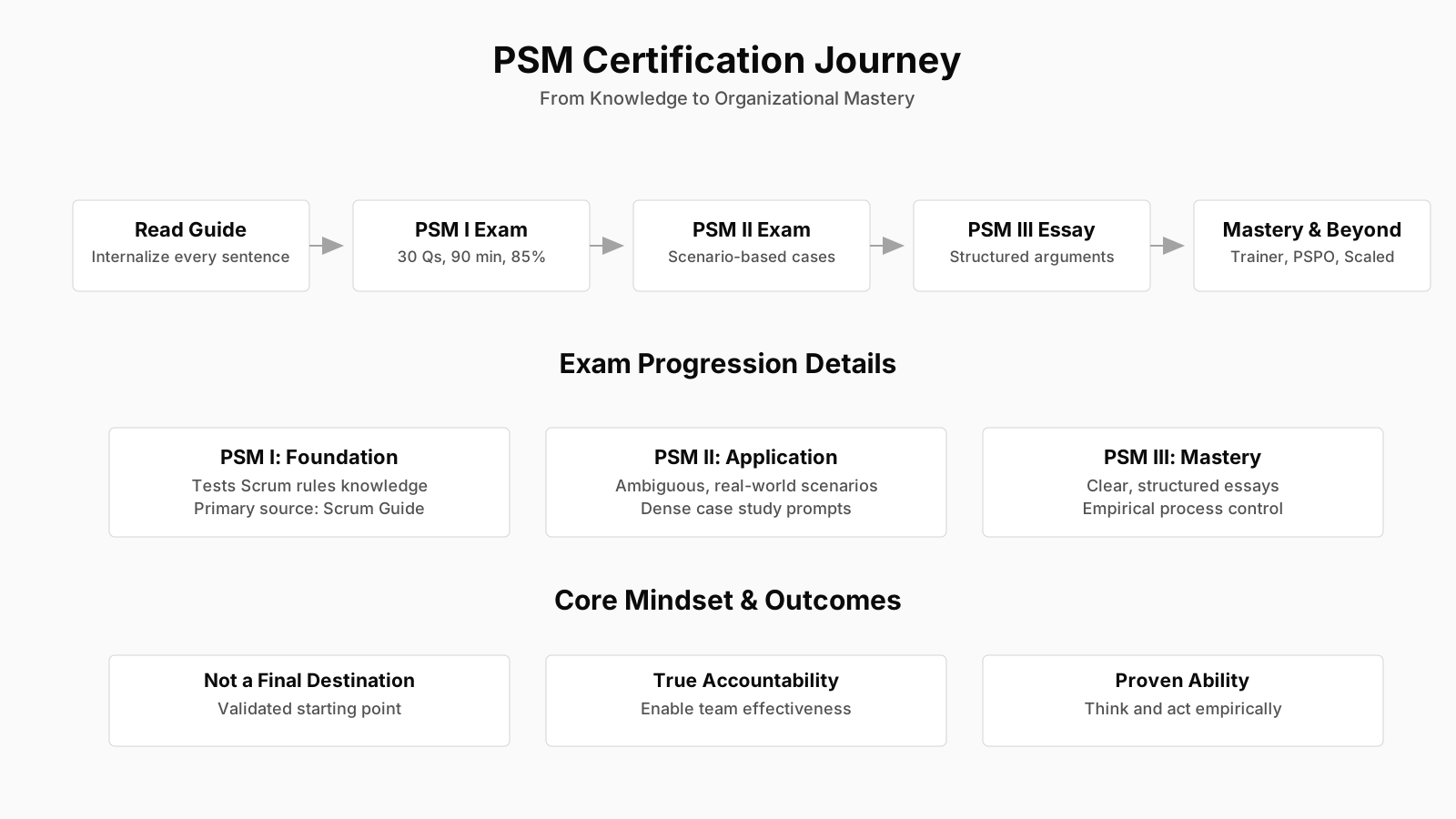
PSM Certifications: Summary of Key Exam & Training Topics
| Key Concept | Summary |
|---|---|
| PSM Certification | Scrum.org's Professional Scrum Master certifications establish a rigorous benchmark, testing both deep theoretical knowledge and the capacity to navigate complex, real-world situations. |
| Three Levels | PSM I validates foundational mastery of the Scrum Guide, PSM II assesses the ability to resolve ambiguous trade-offs in practice, and PSM III challenges candidates to diagnose multifaceted dysfunctions in interactive, multi-player scenarios. |
| PSM I Exam | The 60-minute PSM I exam presents 80 questions with an 85% passing score, demanding precise comprehension and recall of Scrum Guide principles under significant time pressure. |
| PSM II Exam | PSM II comprises 30 scenario-based questions over 90 minutes, requiring candidates to select the most effective response consistent with Scrum values and the Scrum Master’s accountability. |
| PSM III Exam | PSM III presents 30 intricate questions in 120 minutes, testing the ability to prioritize interventions when organizational culture, technical debt, and stakeholder pressures intersect. |
| No Mandatory Training | Since no course attendance is required, the credibility of a PSM pass rests solely on demonstrated competence, distinguishing it from credentials that mandate training. |
| PSM I Preparation | Effective PSM I preparation demands meticulous study of the Scrum Guide, targeted practice tests, and deliberate analysis of incorrect answers to close knowledge gaps. |
| PSM II Preparation | Preparing for PSM II requires hands-on Scrum experience, engagement with case studies, and reflective peer discussions that dissect real-world setbacks, building the judgment necessary for scenario-based questions. |
| PSM III Difficulty | PSM III distinguishes itself as one of the most demanding agile credentials, requiring a synthesis of experience, theory, and systems thinking rather than mere knowledge accumulation. |
| Certification Progression | The progressive certification architecture enables professionals to calibrate their target level against current experience, facilitating focused and efficient preparation for each successive credential. |
The Three Levels of Professional Scrum Master
Scrum.org structures the Professional Scrum Master qualification into three distinct tiers, each building on the previous one in depth and nuance. The PSM I, II, and III certification progression is designed not just to test memorization of the Scrum Guide but to verify that someone can actually make sense of Scrum in situations filled with ambiguity and organizational friction. Many people start by underestimating this difference, thinking that PSM II is simply PSM I with a few extra terms, but the reality is anything but that. The foundational level is about knowing what the rules say; the advanced levels are about knowing what to do when the rules do not quite spell out the answer.
PSM I targets the core understanding of Scrum as defined in the official Scrum Guide. You need to know the accountabilities, events, artifacts, and the theory of empiricism inside out. PSM II presses further, probing your ability to interpret and apply Scrum in environments where trade-offs are not obvious. For example, you might be asked how a Scrum Master should respond when the Product Owner consistently fails to maintain a clear Product Backlog, or what stance to take when an organization wants to add extra reporting layers on top of the Scrum Team. PSM III goes even deeper into complex, multiplayer scenarios where several things are breaking at once and you must diagnose the most impactful intervention.
The thinking behind this layered design is that real mastery cannot be captured by a single exam. A junior Scrum Master might pass PSM I after a few weeks of study. PSM II often takes months of practical experience to really understand the intent behind the questions. And PSM III is widely regarded as among the toughest agile certifications , with a pass rate that reflects the degree of synthesis required. None of these assessments require you to attend a specific course; you can simply register and take the exam online , which makes the credibility of the pass something you earn entirely on your own merit.
PSM I: The Entry Point
This is the certification most people encounter first. The exam consists of 80 questions to be completed in 60 minutes, with a passing score of 85 percent. The questions are a mix of multiple choice, multiple answer, and true/false formats. The content draws directly from the Scrum Guide, and there are no scenario-based questions of the kind that appear at higher levels. What trips people up is the precision required. Many questions ask you to identify exactly what the Scrum Guide says about a particular event or accountability. A single word like "only" or "must" can change the correct answer entirely.
Preparation for PSM I should start with a thorough, close reading of the Scrum Guide. Not skimming. Not highlighting a summary. You need to develop a mental model of how the pieces fit together. Understand why Sprint length cannot exceed one month, but also why it must be consistent. Know the specific moments when the Daily Scrum becomes counterproductive if it turns into a status report. The exam will test whether you can spot the subtle difference between a Sprint Backlog and a Product Backlog, and between responsibilities of the Developers versus those of the Product Owner.
Because there is no mandatory training course, many candidates rely on open book practice tests and reading lists. The Scrum.org website itself offers an open assessment that gives a flavor of PSM I style questions, though the real exam is harder. A useful strategy is to read the Scrum Guide and then attempt to answer every practice question you can find while constantly revisiting the source text to understand why each wrong answer is wrong. Repetition alone does not work; you need to internalize the logic of empiricism, the three pillars of transparency, inspection, and adaptation, and the concept that Scrum Masters are accountable for the team’s effectiveness, not for the team’s output in a command-and-control sense.
PSM II: Advanced Application
The jump from PSM I to PSM II is significant. The exam has 30 questions, 90 minutes, and the same 85 percent passing score. The questions are heavily scenario-based, often presenting a described situation and asking what you, as a Scrum Master, should do next or what the issue really is. Sometimes multiple answers seem right, and you must select the best one or the one that is most aligned with Scrum values and the Scrum Master accountability. Simple recall of the Scrum Guide will not be enough; you need to be able to diagnose problems through the lens of self-management and servant leadership.
Typical questions might describe a team that keeps missing Sprint Goals, a Product Owner who is constantly overruled by a senior stakeholder, or a situation where the Definition of Done is being compromised to meet a deadline. You need to pick the most effective approach that addresses the root cause without undermining the team’s autonomy. The exam rewards those who can distinguish between a solution that would work in a traditional project management context and one that respects Scrum’s empirical process control. For example, adding more checkpoints might seem logical, but the better answer often involves increasing transparency or coaching the Product Owner and stakeholders on the purpose of the Sprint Review.
Experience has a lot to do with preparation here. Reading case studies, discussing real failures with other Scrum Masters, and reflecting on your own mistakes at work is just as important as any course. Many effective candidates study the recommended reading on the Scrum.org website, such as books on servant leadership and agile coaching, and then attempt the practice exams to see if their judgment aligns with Scrum.org’s stance. The interesting part is that the exam does not test your opinion; it tests whether your decision-making is consistent with the official Scrum Guide and the underlying principles. That means you might personally prefer a certain coaching technique, but if it violates the Scrum Master’s stance as a change agent, it will be marked wrong.
PSM III: Mastery at a Different Level
PSM III is not simply an expansion of the previous two levels. The exam length is 30 questions in 120 minutes, still with 85 percent to pass. But the nature of the questions shifts toward complex, layered scenarios where multiple dysfunctions coexist. You might be given a detailed case of a multi-team product environment where organizational culture, technical debt, and stakeholder pressure all collide. The exam asks you to choose the most appropriate response from a set of options that all look reasonable to less experienced practitioners. This is where your ability to prioritize interventions based on empirical evidence gets tested to the extreme.
People often ask what separates a PSM II holder from someone capable of passing PSM III. It is less about knowing more facts and more about having the judgment to see which lever to pull first, and why. For instance, if a team lacks a clear Product Goal, has a weak Definition of Done, and is also facing pressure to report velocity to management, a PSM III-level answer will address the highest-impact action, likely coaching on empiricism and the Product Goal, rather than jumping to the most visible symptom. The exam expects you to recognize that some problems are second-order effects of deeper root causes.
Preparation requires a blend of deep Scrum Guide internalization and actual lived experience in complex organizations. Sitting around and reading theory will not be enough. Many successful candidates have spent years inside Scrum Teams, seeing how things go wrong, experimenting with different coaching strategies, and learning what actually sticks. They often engage in peer study groups where they dissect case studies and argue about the right interventions. The PSM III exam does not ask for textbook definitions; it asks what you would do when two values conflict, or when you have to influence without authority in a politically charged environment.
Key Takeaways from the PSM Certification Levels
- Three-tier progression design
- The Professional Scrum Master pathway progresses from foundational rule mastery in PSM I through scenario-based application in PSM II to advanced diagnostic synthesis in PSM III.
- PSM I entry requirements
- This 80-question, 60-minute exam requires precise recall of the Scrum Guide, with an 85% passing threshold and no scenario-based questions, testing the candidate’s accurate grasp of accountabilities, events, and artifacts.
- PSM II advanced application
- In 90 minutes, the 30 scenario-based questions challenge candidates to diagnose real-world issues such as a Product Owner neglecting the backlog or organizational pressure undermining team self-management.
- PSM III mastery challenge
- Recognized as one of the most demanding agile certifications, this exam presents simultaneous systemic failures and asks candidates to pinpoint the most impactful intervention by synthesizing Scrum principles at an expert level.
- Credibility through self-study
- No mandatory course is required at any tier; candidates can register and test online, earning certification solely through their demonstrated knowledge and practical experience.
Why Choose PSM Over Other Scrum Master Certifications
There are several Scrum Master certifications in the market, but the Professional Scrum Master series holds a distinct reputation. The most frequent comparison people make is between PSM I and the Certified ScrumMaster from another organization. The PSM certification vs CSM difference often comes down to the assessment approach and the overall philosophy. The PSM exams do not require a course, so the credential’s value rests solely on demonstrated knowledge. Someone who achieves PSM I has proven they can pass a rigorous test without a mandatory training gate. The certification itself does not expire, which signals that the knowledge is meant to be built upon rather than renewed through periodic payments.
In practice, many organizations look at PSM certifications as evidence of deep Scrum knowledge because they know the exam is not a formality. This does not mean the alternative certifications are bad; they often provide excellent training and community. But a PSM credential, especially at level II or III, tends to stand out when hiring managers want to know if someone can actually coach teams through dysfunction rather than just recite the Scrum events. The rigorous online assessment model also means that anyone, anywhere in the world, can earn these certifications under equal conditions. There is no requirement to attend a physical classroom or join a membership body.
Another advantage is the direct link to the Scrum Guide. The Scrum.org materials are maintained by Ken Schwaber, a co-creator of Scrum, and the assessments are continuously updated to reflect the latest version of the guide. That alignment gives the PSM certifications a theoretical coherence that some other bodies lack. When the Scrum Guide was updated in 2020 to emphasize the concept of a Product Goal within the Product Backlog, the PSM exams shifted accordingly. This close coupling means that certified individuals are always tested on the most current definition of Scrum, which makes the credential relevant as the framework evolves.
Training Approaches for Each Level
Deciding how to prepare for the PSM exams depends a lot on your learning style and your current depth of experience. Some people learn best in a structured classroom with an expert instructor, while others prefer to sit with the Scrum Guide and a stack of practice questions for weeks. The preparation for PSM I, II, and III should not be treated as one-size-fits-all. PSM I can often be tackled through deliberate self-study, because the knowledge domain is finite and clearly defined. The Scrum Guide is only about 13 pages, and the rest is a matter of making sure you have not misinterpreted any of the key sentences.
A very common mistake is to do a two-day course and assume that alone will get you through PSM I. While the official Professional Scrum Master course from Scrum.org is a solid primer, the exam still requires you to think. The course gives you the conceptual scaffolding, but you need to spend time on your own with the Open Assessment and other question banks to train your pattern recognition. Effective self-study involves reading the Scrum Guide multiple times, each time with a different lens: once for accountabilities, once for events, once for the theory, and once for the Glossary. Then you take practice exams, and for every question you miss, you revisit the exact portion of the Scrum Guide that explains the right answer.
For PSM II, training courses become more valuable because the scenarios are not just from the Scrum Guide. The official Advanced Professional Scrum Master course offered by Scrum.org trainers dives into case studies, facilitation techniques, and coaching stances. However, attending a course is not enough either. You need to pair that with real reflection: how have you handled a situation where a team member dominated the Daily Scrum? What was the outcome? The exam questions often hinge on whether your instinct is to solve a problem for the team or to help the team solve it themselves. Discussing these dilemmas with other Scrum practitioners in communities, whether online or in local meetups, can sharpen your judgment more than any lecture.
PSM III preparation is even less about formal training and more about immersive reflection. There is no specific training course that maps directly to the PSM III exam, though some very advanced coaching workshops can help. Most successful candidates spend months working with a mentor and using resources like the Scrum Master Learning Path on Scrum.org, which includes articles, videos, and case studies. They also tend to design their own practice by taking complex real-world scenarios and writing out their analysis before checking with peers. The goal is not to find the "right answer" but to develop a reasoning process that aligns with empiricism and servant leadership.
Key Takeaways on PSM Exam Preparation
- PSM I self-study foundation
- For PSM I, focused self-study of the Scrum Guide paired with deliberate exam practice is effective because the assessment tests a well-defined and bounded set of framework rules and principles.
- Course plus practice needed
- A two-day course provides a helpful baseline, but on its own it falls short; pairing it with the Open Assessment and targeted question banks trains the pattern recognition needed to diagnose scenario nuances accurately.
- PSM II scenario training
- The Advanced Professional Scrum Master course lays a valuable foundation for PSM II, yet deep preparation requires you to reflect honestly on real-world team dilemmas and engage actively in practitioner discussions to sharpen situational judgment.
- PSM III immersive reflection
- PSM III readiness grows through sustained reflective practice, mentoring others, and constructing your own intricate scenario analyses rather than relying on formal coursework alone.
- Develop reasoning process
- Success at the PSM III level hinges on cultivating a coherent reasoning process anchored in empiricism and servant leadership, enabling you to weigh competing tensions skillfully rather than searching for a single correct answer.
PSM I Exam Strategy: From Preparation to Passing
The PSM I exam can feel like a race against time. With 80 questions in 60 minutes, you have less than a minute per question. That time pressure is deliberate. A solid PSM I exam preparation plan must include not just content mastery but also a pacing strategy. The most effective approach is to go through the entire exam quickly in a first pass, answering all the questions you are confident about, and flagging the tricky ones for review. Because the platform allows you to mark questions and come back, you should not get stuck on a single confusing multiple-answer question for three minutes. Move on and return with fresh eyes.
Content-wise, you should know the Scrum Guide almost by heart. The exam will test you on the exact number of events, the maximum timeboxes, and the specific language around accountabilities. For example, the Scrum Master serves the Product Owner in several ways, including "helping find techniques for effective Product Goal definition and Product Backlog management." A question might list four plausible-sounding activities; three of them might be things a Scrum Master could reasonably do, but only one is precisely described in the Scrum Guide. That kind of precision can only be learned through repetition and careful reading, not general familiarity.
Many candidates find that reading the Scrum Guide aloud and then trying to explain each section to someone else, or even to an empty room, cements the concepts far better than rereading silently. The explanation process forces you to connect ideas. If you cannot articulate why the Sprint Retrospective appears at the end of the Sprint, not the beginning, you probably do not understand inspection and adaptation deeply enough. Similarly, practice tests that explain why wrong answers are wrong are invaluable. You will see the same concepts tested from multiple angles, and that builds your ability to recognize traps.
On exam day, technical setup matters. The exam is online and uses a proctoring tool that requires a stable internet connection, a working webcam, and a quiet room. Make sure your environment meets the requirements before you log in, because troubleshooting mid-exam can cost time you cannot afford. Also, note that the exam is in English, and if English is not your first language, you can request extra time, but you must arrange that in advance by contacting Scrum.org support. Do not underestimate the mental fatigue of 60 minutes of intense focus. Getting enough sleep the night before and having a glass of water handy makes a practical difference to your score.
PSM II Exam Strategy: Demonstrating Deep Understanding
The PSM II exam is less about speed and more about depth. With 30 questions in 90 minutes, you have ample time to read scenarios carefully. The challenge is that PSM II scenario-based exam questions often present answers that all seem plausible within a Scrum context, forcing you to choose the most suitable one according to the Scrum Guide and the Scrum Master stance. You might get a scenario about a Scrum Team that has been working together for several Sprints but never produces a potentially releasable Increment. The answer choices could range from coaching the team on the Definition of Done, to raising the issue in the Sprint Retrospective, to having the Product Owner reject the work. The right answer likely involves addressing the systemic root cause, not just picking the most active remedy.
To prepare, read beyond the Scrum Guide. The Scrum.org suggested reading list includes books on servant leadership, coaching, and agile product management. You need to understand the nuances of facilitation, how to help a Product Owner manage a complex Product Backlog, and what it means to serve the organization as a Scrum Master. The exam will ask you to identify when a Scrum Master should be a coach, a teacher, a mentor, or a change agent. There is often a best stance for a given scenario, and the difference emerges from small details in the question text. For instance, if a Development Team is new and unfamiliar with Scrum events, the teaching stance is appropriate. If the team is mature but struggling with an external department’s demands, the change agent stance applies.
Practice exams for PSM II are harder to find than for PSM I, and many free online resources are either outdated or do not match the complexity. Consider investing in a reputable question bank from a recognized training provider, but verify that it aligns with the latest Scrum Guide. Even better, form a study group with two or three experienced Scrum Masters and dissect real case studies together. Discuss why one option is better than another, back up your reasoning with passages from the Scrum Guide, and listen to alternative interpretations. The act of defending your choice under peer scrutiny mimics the mental process you need during the exam.
During the actual exam, read every question at least twice. The first time, note down what the core dysfunction is. The second time, notice any subtle details that might shift the context, such as a statement that the Scrum Master has already tried a certain approach in a previous Sprint. That detail might cancel out one of the answer options. Also, use the flagging feature liberally. Your first instinct on a tough question may not be right, and coming back after you have settled into the exam rhythm can lead to a clearer perspective. Remember that the exam is not designed to trick you; it is designed to see if you can apply Scrum thinking under pressure.
Key Takeaways on Depth-Focused Exam Strategy
- Choose root causes over quick remedies
- The PSM II exam presents scenarios where multiple responses seem plausible; success hinges on selecting the option that tackles the underlying systemic dysfunction described in the Scrum Guide, rather than the most visible or quickest remedy.
- Master four distinct Scrum Master stances
- Distinguishing between coach, teacher, mentor, and change agent roles relies on subtle scenario details: a new team may require education on Scrum events, while a mature team might need a change agent to navigate external organizational demands.
- Use targeted practice and double-read questions
- Effective preparation includes using question banks aligned with the latest Scrum Guide, debating case studies in study groups, and during the exam, reading each question twice to detect context-altering details, coupled with the flagging feature to manage difficult items.
PSM III Exam Strategy: Navigating the Highest Hurdle
The PSM III exam is a different beast entirely. The questions are dense, often containing multiple paragraphs of backstory about organizational structure, team dynamics, and product complexity. Candidates consistently report that the PSM III exam difficulty stems not from obscure trivia but from the need to weigh competing interests and identify the smallest possible effective intervention. The time limit of 120 minutes for 30 questions gives you on average four minutes per question, which sounds generous until you hit a question that requires you to untangle a Gordian knot of organizational dysfunction before you can even see the possible answers clearly.
A productive strategy is to treat each question like a mini case study. On your first read, do not look at the answer options. Instead, try to diagnose the situation on your own: what is the most pressing problem, and what would you do about it? Only then look at the choices. If your independent analysis matches one of the options, you probably have a good answer. If not, re-read the scenario to see what you might have missed. Sometimes the exam presents options that are technically correct in a pure Scrum sense but are inappropriate given the stage of the team or the organizational constraints described. The ability to spot that nuance is the hallmark of a PSM III pass.
Experience is the best preparation, but structured reflection can accelerate it. Keep a journal of your daily work as a Scrum Master, writing down tricky situations and what you chose to do. Later, ask yourself whether you addressed the root cause or just the symptom. More importantly, ask if your action was consistent with the Scrum Master’s primary accountability of improving the Scrum Team’s effectiveness. PSM III expects you to think in terms of systemic improvement, not quick fixes. This means you should be able to explain why certain actions might make a team feel better in the short term but erode self-management over time.
Timing during the exam can be managed by allocating roughly three to four minutes per question, but with flexibility. Some questions will be quick because the scenario is straightforward and the correct answer jumps out at you. Others may take ten minutes of intense reasoning. Do not force yourself to a rigid schedule. Instead, keep an eye on the clock at the halfway point. If you are behind, shift into a more intuitive mode of answering and flag questions for later review. Unlike PSM I, guessing by elimination is harder because many answers sound correct. So trust your instinct, but verify with logic. The exam’s passing score remains 85 percent, meaning you can miss four or five questions and still pass, so do not let one baffling question derail your confidence.
Common Pitfalls and Misconceptions
Many candidates walk into their first PSM attempt with assumptions that actually hinder their performance. One of the most widespread PSM certification mistakes is treating the exam as a simple vocabulary test. While PSM I requires you to know terms like Sprint Goal and Increment, the phrasing tricks people into selecting answers that sound right but are not based on the Scrum Guide’s exact wording. For example, the Scrum Guide never says the Daily Scrum is a status meeting, yet many practice questions offer that as a distractor. If you rely on your workplace’s loose interpretation of Scrum, you will get tripped up.
Another common error at the PSM II and III levels is assuming that the Scrum Master should always step in and fix problems directly. The exams are designed to test the concept of servant leadership, which often means creating an environment where the team solves its own issues. Candidates frequently pick the most action-oriented option, like immediately coaching the Product Owner or escalating to management, when the better answer might be to facilitate a discussion within the team or to make the lack of a Definition of Done transparent. The exam tests restraint and strategic awareness, not just good intentions.
Misconceptions about the Product Owner accountability also appear. Some people think the Product Owner is the "boss" of the Scrum Team, or that the Product Owner assigns work to the Developers. These misunderstandings will cost points. The Scrum Guide states that the Product Owner is accountable for maximizing the value of the product resulting from the work of the Scrum Team, but the Developers are accountable for creating a plan for the Sprint, the Sprint Backlog. The balance of accountabilities is a recurring theme across all PSM levels, and confusing them leads to wrong answers consistently.
At the PSM III level, a subtle pitfall is overthinking. Candidates with deep experience sometimes read too much into a scenario and invent details that are not there. You must answer based on what is written, not on what you have witnessed in a similar situation at your company. The exam scenario is self-contained; if a key piece of information is missing, the correct answer is usually the one that would first seek to make the situation transparent rather than guess and act prematurely. Disciplined test-taking means trusting the scenario as presented and not projecting your own organizational trauma onto it.
Key Misunderstandings That Hurt PSM Scores
- Exact wording traps in phrasing
- Many candidates mistakenly treat the exam as a vocabulary check; in reality, questions purposefully use phrasing that sounds correct but contradicts the Scrum Guide’s precise terminology, such as describing the Daily Scrum as a status meeting.
- Servant leadership over action
- Points are lost when candidates choose the most immediate intervention, whereas the exam requires the Scrum Master to facilitate team problem-solving, promote self-organization, and make obstacles visible instead of fixing them outright.
- Confusing Product Owner accountabilities
- A frequent misperception is that the Product Owner manages the team or delegates tasks to Developers; the Scrum Guide clearly separates accountability for value optimization from the Developers’ accountability for Sprint planning and execution.
Maintaining and Leveraging Your PSM Certification
Once you earn a PSM credential, there is no renewal fee and no expiration date. This permanent status is both a strength and a subtle responsibility. The PSM certification value over time depends on how you continue to grow. The software industry changes, and although the core Scrum framework is stable, the ways teams implement it evolve. Staying current involves reading the Scrum.org blog, attending webinars, and contributing to the community. Employers see the PSM III badge and instantly recognize that the holder has gone through a demanding process, but they still want to see continuous learning and adaptation to new contexts like remote work or scaled Scrum.
Leveraging the certification in your career means talking about it not as a trophy but as evidence of a problem-solving mindset. On your resume or LinkedIn profile, don’t just list "PSM II certified." Describe what the journey taught you: the ability to diagnose team dysfunctions, facilitate conflict resolution, and guide organizations toward empiricism. Hiring managers are increasingly skeptical of certifications that seem easy to obtain, so when they see PSM II or III, they tend to ask behavioral questions to see if your answers match the depth they expect. Be ready to share specific stories that demonstrate the judgment the exam tested.
In the broader community, holding a PSM certification also connects you to a global network of practitioners who value substance over ceremony. Many local meetups and online groups include PSM holders who share hard-won insights. Engaging with these communities not only keeps your knowledge sharp but can lead to mentorship opportunities and career moves. The certification itself does not guarantee a job, but it opens doors to conversations that otherwise might not happen. In a market where the title "Scrum Master" is sometimes given to people who merely schedule meetings, a PSM credential signals a commitment to the true accountability of enabling effectiveness.
The PSM journey does not end with passing an exam. For those who reach PSM III, the next horizons include contributing to the wider agile body of knowledge through writing, speaking, or teaching. Some even go on to pursue the Professional Scrum Trainer program or delve into related certifications like Professional Scrum Product Owner or Scaled Professional Scrum. The framework thinking you develop through PSM exams becomes a foundation for tackling larger organizational design challenges. In that sense, the certification is less a final destination and more a validated starting point for a career spent making teams genuinely better at what they do.
Advance Your Career with Professional Certification
Earning a Scrum Master credential validates your ability to guide teams through complex project lifecycles and remove impediments effectively. Many professionals pursue a project management training program that aligns with the Scrum Guide to build a deep understanding of empiricism and self-management. The PSM assessment from Scrum.org emphasizes practical scenario-based questions that test your real-world judgment rather than rote memorization. You need consistent practice with open assessments and a thorough review of the Nexus framework for scaled contexts to pass all three levels.
A structured approach to product leadership starts with mastering backlog refinement, stakeholder alignment, and value-driven prioritization. Candidates who complete a product management certification often discover that the exam focuses heavily on hypothesis testing and outcome-based planning. These programs teach you to connect market evidence with incremental delivery, ensuring every sprint produces measurable customer impact. Studying the Evidence-Based Management guide alongside the Scrum framework clarifies how to set meaningful product goals.
HR professionals transitioning to agile environments benefit from certifications that cover modern people operations, feedback systems, and team dynamics. An human resources certification with a focus on agile HR equips you to redesign performance reviews, compensation models, and talent acquisition around iterative principles. The training examines how HR can foster psychological safety and continuous learning without traditional command-and-control structures. You will learn to apply servant leadership techniques to recruiting, onboarding, and employee development.