In the landscape of advanced project management credentials , few certifications command the same respect as the Program Management Professional (PgMP) designation. For experienced program managers seeking to validate their strategic leadership abilities , the PgMP blueprint offers a rigorous and rewarding path to global recognition. Training for program management certification is not a simple box-ticking exercise; it demands a deliberate synthesis of real-world experience, targeted study, and an intimate understanding of how multiple related projects align with organizational strategy . This article provides a comprehensive guide to constructing your own PgMP blueprint, covering every phase from initial eligibility assessment through to maintaining the credential and leveraging it for career transformation .
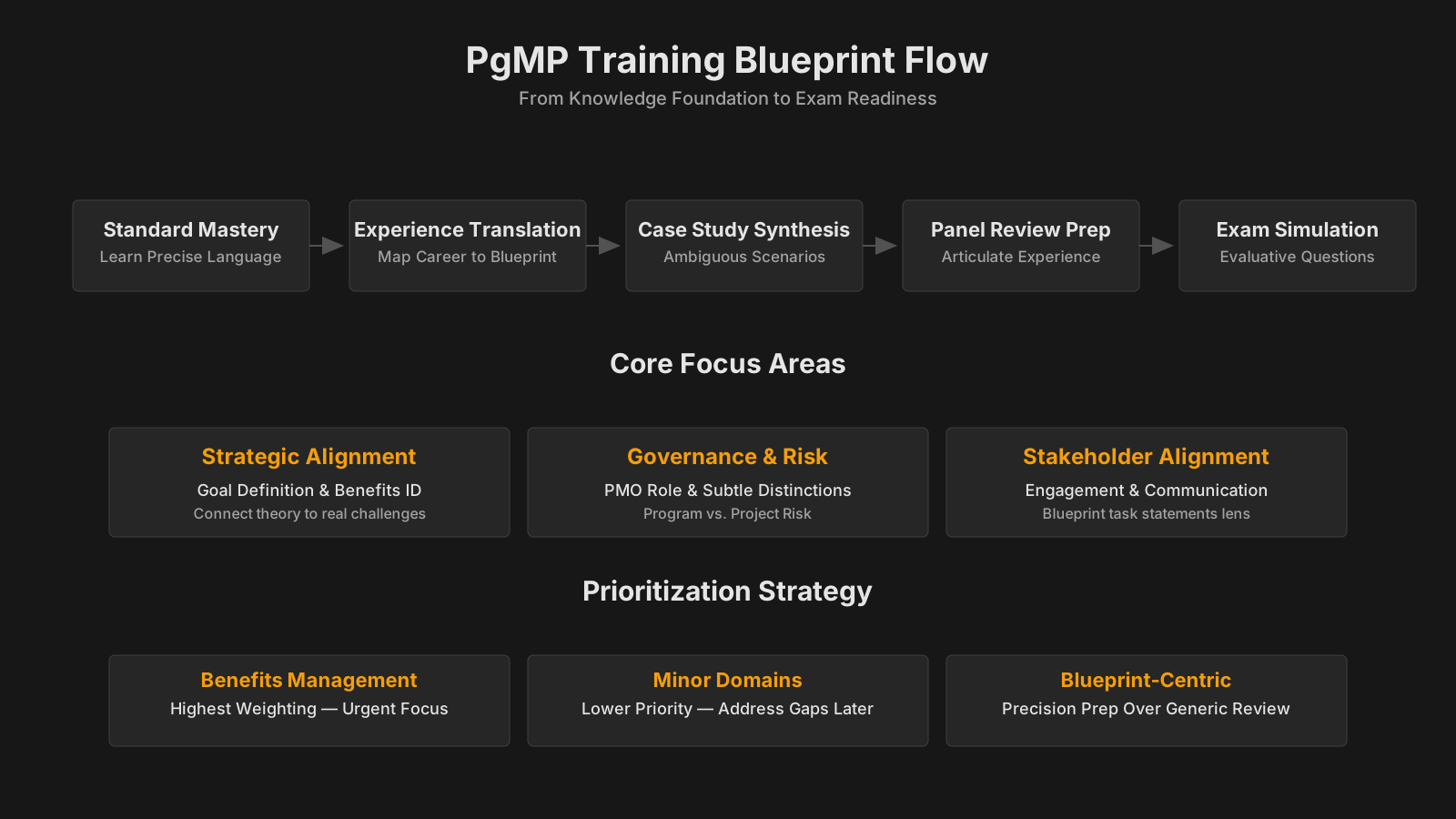
Summary of the PgMP Training Blueprint
| Key Concept | Summary |
|---|---|
| PgMP Distinction | The PgMP validates advanced expertise in coordinating multiple interconnected projects to achieve strategic business value, setting it apart from the PMP which governs the execution of single projects for tactical delivery. |
| Program Focus | Program management elevates focus from discrete project deliverables to sustained organizational outcomes and enterprise wide business value, demanding seamless orchestration of interdependent components and strategic alignment across stakeholder groups. |
| Certification Value | Earning the PgMP signals mastery of complex program leadership, opening doors to senior executive roles, higher compensation, and the ability to guide transformative initiatives that measurably enhance organizational performance. |
| Performance Domains | The PgMP examination blueprint is built upon five interrelated performance domains that comprehensively define program management practice: Program Strategy Alignment, Benefits Management, Stakeholder Engagement, Governance, and Program Life Cycle Management. |
| Strategy Alignment | Program leaders must rigorously and continuously validate program coherence with evolving organizational strategy, using market intelligence and capability assessments to adapt roadmaps and safeguard long term relevance. |
| Benefits Management | This domain governs the entire benefits lifecycle, from initial identification and quantification through sustained monitoring via benefits realization plans and dependency mapping, and mandates decisive corrective action when benefits prove unattainable. |
| Stakeholder Engagement | Effective program stakeholder engagement extends to C-suite sponsors, regulators, and key influencers, requiring sophisticated stakeholder analysis, tailored communication architectures, and proactive negotiation to align divergent expectations toward common program goals. |
| Application Process | Candidates must satisfy rigorous experience and education prerequisites, then submit a comprehensive application and professional experience summary; those selected for audit must successfully navigate a panel review to confirm their readiness for the certification. |
| Exam Structure | The four-hour, 170 multiple-choice exam is weighted across the five performance domains, featuring complex scenario-based items that test the candidate’s applied judgment, strategic decision making, and ability to navigate program level complexities under timed conditions. |
| Career Impact | Maintaining the PgMP through continuing education and professional development reinforces a trajectory toward enterprise wide program leadership, enabling oversight of large scale transformations and establishing the credential holder as a strategic organizational change agent. |
Decoding the PgMP Blueprint: What Program Management Certification Really Entails
The PgMP certification, developed and maintained by the Project Management Institute (PMI), stands as one of the most elite credentials in the portfolio, program, and project management ecosystem. While many professionals are familiar with the Project Management Professional (PMP) certification, the PgMP exists on an entirely different plane. It is not simply an advanced version of the PMP; it certifies that a professional has the demonstrated experience, knowledge, and performance competence to manage multiple, related projects in a coordinated way to achieve strategic benefits that would not be possible if those projects were managed individually. Understanding this distinction is the first critical layer of the PgMP blueprint.
Program management focuses on the delivery of benefits through the orchestration of component projects and other related activities. Where project managers are concerned with outputs, such as a new software application or a constructed bridge, program managers are accountable for outcomes and the realization of broader business value. This might involve integrating a new customer relationship management system across five different departments while simultaneously decommissioning legacy tools, retraining staff, and adjusting business processes. The PgMP blueprint, therefore, tests a candidate’s ability to navigate complexity, ambiguity, and stakeholder alignment at the strategic level. The exam and the application process are designed to filter out those who merely know the terminology from those who have truly lived the experience.
A common misconception is that the PgMP is simply a longer and harder version of the PMP exam. In reality, the two certifications assess fundamentally different domains. The PMP is rooted in the execution and delivery of a single project, governed by its own charter and constrained by a relatively clear scope. The PgMP, by contrast, dives into program governance , benefits realization, stakeholder engagement at the executive level, and the intricate dependencies between components. The PgMP candidate must demonstrate proficiency in closing the gap between strategic intent and tangible business results. This distinction is why the PgMP blueprint requires a training approach that moves far beyond memorizing processes and into the realm of critical analysis and judgment.
The value proposition of the certification is substantial, both for individuals and for organizations. For the individual program manager, the PgMP often leads to enhanced credibility, expanded professional networks, and access to more senior roles that oversee large-scale transformations. Compensation surveys consistently show PgMP holders earning a premium over their non-credentialed peers. For organizations, having PgMP-certified leaders means a greater likelihood that complex strategic initiatives will deliver their intended benefits on time and within budget. The PgMP blueprint serves as a common framework and language for managing programs, reducing miscommunication and aligning efforts across diverse stakeholder groups. When you invest in training for program management certification, you are investing in a career-long capability, not just an exam pass.
The PgMP Blueprint for Strategic Program Management
At its core, the PgMP certification is built around a performance domain framework that reflects the real-world duties of a program manager. The current PgMP Exam Content Outline (ECO) defines five distinct performance domains that form the structural PgMP blueprint. These domains are Program Strategy Alignment, Program Benefits Management, Program Stakeholder Engagement, Program Governance, and Program Life Cycle Management. Each domain carries a specific weighting in the exam, but more importantly, each represents a competency area that must be demonstrated in the professional experience summary and the panel review, if required by PMI’s audit process.
Program Strategy Alignment is the foundational domain that separates program management from project management. A competent program manager does not simply accept a business case at face value; they continually test whether the program remains aligned with the organization’s strategic goals, market conditions, and internal capabilities. The PgMP blueprint expects candidates to be skilled at conducting environmental scans, facilitating strategic alignment sessions, and recommending adjustments to the program roadmap when organizational priorities shift. This domain requires training that focuses on business acumen, not just procedural knowledge. A candidate who cannot articulate how their program supported strategic transformation will struggle in the application and the examination.
Program Benefits Management is perhaps the most emphasized theme in the entire PgMP blueprint. While project managers are often concerned with deliverables, program managers live and breathe benefits. The certification training must prepare you to define, categorize, and quantify benefits, create a benefits realization plan, and then monitor and sustain those benefits long after the program’s components have been closed. In practice, this means understanding how to build a benefits dependency map, identify key performance indicators, and transition ongoing benefit measurement to operational owners. The exam will present scenarios where a previously declared benefit is no longer achievable, and you must decide whether to adjust the program, cancel a component, or escalate to the governance board. This kind of decision-making cannot be crammed; it must be cultivated through case-based study.
Program Stakeholder Engagement at the PgMP level is fundamentally different from the stakeholder management described in project management guides. Here, stakeholders are often C-suite executives, external regulators, community leaders, and representatives from multiple business units with conflicting interests. The PgMP blueprint demands sophisticated communication and negotiation strategies. Training for this domain includes learning how to perform a detailed stakeholder analysis that maps power, influence, and interest across the program’s ecosystem. You must be able to craft a program communication management plan that addresses the information needs of each group while managing expectations about what the program can realistically deliver. The exam often presents complex scenarios involving resistant stakeholders and asks you to select the most effective leadership approach, not just the technically correct process output.
The PgMP Certification Process: A Gatekeeping Journey
Before diving into the content of your training, it is essential to understand the entry barriers and the multi-layered evaluation process. The PgMP certification is not open to everyone; it requires a significant amount of verified professional experience. For candidates with a four-year degree, PMI mandates at least 48 months of unique, non-overlapping program management experience within the last 15 years, plus 48 months of project management experience or a PMP. For those with a high school diploma or associate’s degree, the requirement rises to 84 months of program management experience and the same 48 months of project management experience or PMP. These numbers are not suggestions; they are strict thresholds that must be met with detailed, verifiable descriptions.
The application itself is a formidable component of the PgMP blueprint. Unlike many certifications where the application is a formality, the PgMP application serves as a pre-qualification filter. You must describe your program management experience across the five domains, providing summaries that clearly articulate your role, the strategic context, and the benefits delivered. PMI subjects these applications to a review process, and a significant percentage of applicants are selected for an audit. The audit requires you to provide supporting documentation, such as signed verification from a supervisor or program sponsor. After the application is approved, there is an additional panel review step, which is essentially a qualitative assessment of your experience by a team of volunteer PgMP holders. If you pass the panel review, you are then eligible to take the 170-question multiple-choice exam, which must be completed within a four-hour window.
This multi-stage gateway is critical to the credential’s prestige. It means that training for the PgMP certification must begin long before you open a study guide. You need to assess your own experience honestly and identify any gaps that might cause a panel reviewer to question your suitability. Some candidates discover that what they considered program management was, in reality, managing a very large or complex project. Others realize that their experience is strong in execution but weak in strategic alignment or benefits sustainment. An honest self-assessment against the PgMP blueprint should be your first step. If significant gaps exist, consider seeking assignments that broaden your exposure before applying.
Core Insights on the PgMP Blueprint
- PgMP versus PMP distinction
- The PgMP is a standalone certification that centers on orchestrating multiple interdependent projects to realize strategic gains beyond the reach of any single project.
- Program manager accountability
- Program managers are ultimately accountable for delivering business outcomes and strategic value, not just outputs, requiring them to navigate organizational complexity and secure alignment among senior stakeholders.
- Five performance domains
- The PgMP Exam Content Outline structures the exam around five performance domains: Program Strategy Alignment, Benefits Management, Stakeholder Engagement, Governance, and Life Cycle Management, each carrying a distinct examination weight.
- Program Strategy Alignment focus
- This foundational domain requires program managers to continuously verify that the program remains consistent with strategic objectives, market shifts, and internal capabilities through environmental scanning and iterative roadmap adjustments.
- Benefits Management emphasis
- Benefits Management is the central thread woven through the PgMP blueprint, examining candidates on their capacity to demonstrate how their programs delivered concrete, measurable business results.
Building Your Effective PgMP Training Blueprint
Creating a personalized PgMP training blueprint is essential because no single textbook, course, or boot camp can fully prepare you for the multifaceted assessment. The blueprint must integrate formal study with reflective practice, peer discussion, and simulated application of judgment. You are not learning new theory from scratch; you are contextualizing a standardized framework around years of lived experience. Many capable program managers fail the first attempt because they rely too heavily on their intuition without thoroughly mapping it to the PMI lexicon and performance domains. Others fall into the opposite trap, memorizing the Standard for Program Management without being able to apply it to novel scenarios.
The ideal PgMP training blueprint spans several months of consistent effort. It begins with a thorough reading of PMI’s foundational texts: the Standard for Program Management and the Exam Content Outline. These documents are the constitution of the exam. However, reading alone is insufficient. You must then engage with a reputable training provider that offers a structured program of expert-led sessions. The best instructors are not simply lecturers; they are experienced program managers who can tell stories, illustrate pitfalls, and clarify the differences between PMI’s ideal model and the messy reality you have encountered. Look for a course that provides a balanced mix of domain deep-dives, application writing workshops, and full-length simulated exams.
When evaluating training for program management certification, be wary of providers that promise a guaranteed pass or suggest that you can cram over a weekend. The cognitive load of the PgMP exam is high because the questions rarely ask for simple definitions. They present dense situational analyses, often a paragraph long, and require you to choose the best among several seemingly reasonable alternatives. Your brain needs time to build the neural pathways that distinguish when to escalate to the governance board versus when to handle an issue within the program team. This kind of nuanced decision-making is honed through repeated exposure to practice questions, combined with expert debriefs that explain not just why the correct answer is right, but why the wrong answers are wrong.
Tailoring Your PgMP Training Blueprint to Your Experience Level
Your personal PgMP training blueprint will look different depending on the nature of your career history. If you have spent the last decade managing large-scale IT transformations, your strengths likely lie in the lifecycle management and stakeholder engagement domains, but you may need to deliberately strengthen your skills in benefits quantification and sustainment. Conversely, if your background is in business strategy or operations, you might intuitively understand benefits alignment but need to build deeper confidence in the governance and component integration aspects. An effective blueprint diagnoses these individual patterns. A good starting point is to take a diagnostic assessment early in your preparation. Many training providers offer a PgMP readiness quiz that maps your confidence across the five domains.
For those with deep but narrow experience, it can be helpful to broaden your mental model by studying case studies of programs in industries different from your own. Reading about how a government infrastructure program handled regulatory stakeholder engagement, or how a pharmaceutical company managed the complex benefits chain from research through to patient outcomes, can expand your pattern recognition. The PgMP exam is sector-agnostic, so you must be comfortable applying program management principles to any scenario. A rich PgMP blueprint includes supplementing your core study materials with white papers, webinars, and articles that showcase program management challenges across diverse contexts.
Another dimension of tailoring involves your preferred learning modality. Some candidates thrive in an intensive virtual classroom environment with interactive whiteboards and breakout rooms. Others prefer the self-paced online course that allows them to replay lectures multiple times around a demanding work schedule. Still others need the accountability of a study group or a personal coach. The optimal PgMP training blueprint combines several modalities. For example, you might complete a self-paced course to build foundational vocabulary, then enroll in a weekend boot camp for the interpersonal exchange, and finally join a weekly peer study circle to keep momentum until exam day. The key is to design a sustainable rhythm that you can maintain without burnout.
Essential Resources for the PgMP Training Blueprint
The market for PgMP preparation resources has matured significantly, offering a range of high-quality tools that were not available a decade ago. At the core of any resource collection sits the PMI Standard for Program Management, currently in its fifth edition. This is the primary reference from which the exam draws its terminology and process logic. Candidates often ask whether they should also study the PMBOK Guide. While the PMBOK Guide is not directly tested, a strong familiarity with its concepts is beneficial because program components are often projects. You should also obtain a copy of the PgMP Exam Content Outline directly from PMI’s website; this free document provides the definitive breakdown of domain weights and the specific tasks under each domain.
Beyond the official standards, invest in a dedicated PgMP exam preparation book. Several reputable authors have written thick volumes that systematically cover each domain with chapter-ending quizzes. Look for a book that includes hundreds of practice questions with detailed answer rationales. Question banks are the lifeblood of your training for program management certification, but quality varies dramatically. Some commercial question banks rely on simplistic, knowledge-recall items that bear little resemblance to the real exam’s complex situational style. Seek out banks that have been vetted by the PgMP community, often those developed by ATPs (Authorized Training Partners) or independent experts with a proven track record.
Flashcards and mobile apps can play a supporting role, particularly for memorizing the ITTOs (Inputs, Tools, Techniques, and Outputs) of the various program management processes. However, do not mistake ITTO memorization for genuine understanding. The PgMP exam may ask you to identify the correct input for a process, but it is far more likely to ask you what you should do next after a key input is missing. A comprehensive Pgmp training blueprint also includes audio resources, such as podcasts or recorded lectures, that you can absorb during commutes or exercise. The goal is to immerse your brain in the language of program management so that PMI’s logic becomes second nature.
Mastering the Five Performance Domains Through Deliberate Practice
To pass the PgMP exam and, more importantly, to become a more effective program manager, you must study each performance domain with a depth that goes beyond surface definitions. The deliberate practice method, which involves focused effort on specific areas of weakness with continuous feedback, is perfectly suited to the PgMP blueprint. In this section, we will explore what mastering each domain entails, along with common pitfalls and recommended training techniques. Remember that the domains are interconnected; a benefits management decision often triggers a stakeholder engagement action or requires governance approval. The exam will test these cross-domain linkages relentlessly.
Program Strategy Alignment demands that you think like a chief strategy officer for your program. Training exercises should include writing a program business case from a provided scenario, identifying which organizational strategic themes a program supports, and evaluating whether an environmental change warrants a program adjustment. A valuable practice is to take a real strategic shift from a well-known company, such as a pivot to sustainability, and map how a hypothetical program within that company would document its strategic alignment. This kind of mental rehearsal prepares you not just for the exam, but for the panel review where you may be asked to justify a program’s strategic contribution.
For Program Benefits Management, you must become fluent in the entire benefits lifecycle. Start by practicing the creation of a benefits register and a benefits realization plan. Learn to differentiate between a benefit, an outcome, and an output. For instance, a new data analytics platform is an output; the ability to make faster marketing decisions is an outcome; and a ten percent increase in campaign conversion rate is a benefit. The exam will test your ability to select the appropriate response when benefits begin to erode. Should you conduct a benefit sustainment review, initiate a risk response, or recommend program closure? The correct answer often depends on the strategic importance of the eroding benefit and the availability of alternative ways to achieve the same outcome.
Program Stakeholder Engagement at the PgMP level requires you to operate as a diplomat and a business partner. Your training must cover advanced communication models, conflict resolution techniques, and stakeholder influence mapping. Practice analyzing a provided list of stakeholders and crafting a tailored engagement approach for each. For example, a regulator requires a compliance-based engagement strategy focused on transparency and reporting, while an internal business unit head may require a collaborative engagement strategy focused on co-creating a transition plan. The exam will describe nuanced behaviors, and you must identify the most appropriate stakeholder management tool, which might be a stakeholder engagement assessment matrix, a communications management plan update, or simply an informal one-on-one meeting.
Program Governance is a domain that often feels bureaucratic to some candidates, but in reality it is the decision-making backbone of any successful program. Your PgMP training blueprint should include sessions that explore governance models in depth. You need to understand the roles and responsibilities of the program sponsor, the program governance board, the program manager, and the steering committee. The exam will present scenarios where there is a conflict between the program’s needs and a component project’s objectives, and the governance board must adjudicate. You must know when to escalate an issue, what level of detail to present, and how to prepare for a governance phase-gate review. Becoming comfortable with the governance vocabulary and the escalation thresholds is non-negotiable.
Program Life Cycle Management ties all the other domains together across the phases of program definition, benefits delivery, and closure. The PgMP blueprint places significant emphasis on program integration management, which involves the consistent coordination of all program activities and components. Training exercises should simulate the development of a program roadmap, a program master schedule, and a program resource management plan. You must be adept at identifying when a critical dependency between two component projects is at risk and deciding what to do about it. The life cycle domain also covers program procurement, financial management, and scope management. An effective study technique is to draw a visual map of the life cycle phases and overlay the key processes from each domain at the appropriate stage, building a holistic mental model of how a program unfolds.
Core Takeaways for Domain Mastery
- Program Strategy Alignment Practice
- Develop proficiency by drafting program business cases from scenarios and aligning real-world strategic shifts, such as sustainability pivots, to hypothetical programs to prepare for exam questions and panel reviews.
- Benefits Management Lifecycle
- Master the full benefits lifecycle by developing a benefits register and benefits realization plan, and differentiate between outputs, outcomes, and benefits to confidently choose the correct corrective action when benefit erosion occurs.
- Stakeholder Engagement Nuances
- Practice analyzing stakeholder lists and designing tailored engagement strategies, such as a compliance-focused approach for regulators and a collaborative one for business unit heads, to address nuanced exam scenarios with confidence.
- Governance as Decision Backbone
- Understand governance roles such as the sponsor and steering committee, know precisely when to escalate issues, and prepare thoroughly for phase-gate reviews to reconcile conflicts between program and project objectives effectively.
- Life Cycle Integration Skills
- Simulate constructing a program roadmap and integrated master schedule, and map lifecycle phases visually with essential processes to build a holistic mental model for managing dependencies and integration.
The Application and Panel Review: Your Experience as an Asset
One of the most intimidating parts of the PgMP journey is the application and panel review process. This is where your PgMP training blueprint must extend beyond exam content and into the art of professional storytelling. PMI is not simply looking for a list of projects you have managed; they want compelling evidence that you have directed programs through the full lifecycle. Each experience summary must be written in the first person, using active language, and structured around the domains. A common mistake is to write generic descriptions such as, “I managed a program to upgrade the IT infrastructure.” Instead, a strong summary reads, “I aligned the IT infrastructure modernization program with the organization’s digital transformation strategy by conducting a SWOT analysis, facilitating strategic alignment workshops with the CTO and CFO, and defining a roadmap that prioritized components based on benefit-cost ratios.”
To prepare for the application, allocate several days to draft, review, and refine your summaries. Work with a mentor or a training provider who has successfully guided candidates through this phase. They can help you identify language that triggers a positive evaluation versus language that raises red flags. For instance, if you spend too much time describing project-level activities without linking them to program benefits, your application may be flagged as insufficiently strategic. Your Pgmp training blueprint should include a dedicated application writing workshop where you receive iterative feedback. This investment pays dividends because an audit or a panel review rejection can delay your certification by months.
The panel review, if you are selected, involves a team of assessors evaluating your experience summaries against a scoring rubric. You may be asked to provide additional information or clarification. The best preparation is to ensure that your summaries are thorough from the outset, leaving no ambiguity about your role, the program’s strategic drivers, and the benefits realized. Some candidates worry that they have not used PMI’s exact terminology in their real-world work. This is not a problem, as long as you can demonstrate that your activities are equivalent. For example, you may have called it a “business review meeting” rather than a “governance gate review,” but if you can explain that the meeting involved a go/no-go decision based on benefit achievement against a threshold, the competency is demonstrated.
The PgMP Exam: Strategy and Execution
After your application is approved and any panel review is successfully completed, you will be authorized to schedule the exam. The PgMP exam consists of 170 multiple-choice questions, of which 20 are unscored pretest items. You have four hours to complete the exam, which is administered at Pearson VUE testing centers or through an online proctored solution. The exam is computer-based, and you have the ability to flag questions for review, a functionality you should leverage strategically. The sheer length of the exam means that stamina and time management are as important as knowledge. Your Pgmp training blueprint must include several full-length, timed practice exams under conditions that simulate the real testing environment.
As you progress through the exam, you will encounter a mix of question types. Some are direct knowledge questions, but the majority are lengthy situational analyses. You must read the scenario carefully, paying attention to the role you are playing and the specific question being asked. A common trap is to answer based on what you would do in your organization, rather than what the PMI framework and the role described would require. For instance, the scenario may state that you are the program manager, and the question asks what you should do next after the sponsor unexpectedly departs the company. Your instinct might be to assume the deputy sponsor role, but the correct answer according to the PgMP blueprint would involve engaging with the governance board to address the vacancy and ensure continued sponsorship.
Time management is a critical skill. You should aim to complete the first pass through all 170 questions in about three hours, leaving a full hour for review. When you encounter a difficult question, do not spend more than two minutes on it initially. Make your best selection, flag it, and move on. Your review time is best spent on the flagged items and on questions where you were torn between two answers. Practice exams will help you calibrate your pace. Pay attention to your performance across domains. If you consistently score lower on Program Benefits Management, double down on that area in your final weeks of training. The goal is not to achieve perfection in any single domain but to exceed the overall passing threshold, which is determined by psychometric analysis and is not publicly disclosed as a fixed percentage.
A PgMP Blueprint for Application Success
To turn your training into a passing score, you must integrate several often-overlooked strategies. First, develop a pre-exam routine that optimizes your mental state. The PgMP exam is a cognitive marathon. In the days before the exam, prioritize sleep, hydration, and light review rather than frantic cramming. On exam day, eat a balanced meal, and arrive at the testing center or log in early to resolve any technical issues. If you are taking the exam online, test your computer’s compatibility days in advance, and ensure your workspace meets the proctoring requirements to avoid unnecessary stress.
During the exam, use the tutorial period to write down any memory aids on the provided scratch paper or digital notepad. You might jot down key formulas, the five domains, or the primary governance roles. This externalizes your memory and reduces cognitive load. As you read each question, actively identify the domain and process group it belongs to. This will help you filter out distractor options that belong to a different domain. For example, if the question is clearly about benefits sustainment, but one answer choice describes a risk identification technique, you can eliminate that choice quickly. Your training for program management certification should have drilled this pattern recognition to the point of automaticity.
Finally, trust your preparation. The PgMP exam is designed to be challenging, but it is not a trick. Every question is linked to a task in the Exam Content Outline. If you have followed a disciplined Pgmp blueprint, you will have encountered similar scenarios during your practice. When you feel uncertain, return to the strategic principle: what action brings the program closer to delivering its intended benefits and satisfying the governance framework? Lean on that guiding principle, and you will navigate the ambiguity with confidence.
Core Exam Strategy Takeaways
- Time Management and Pacing
- Plan to complete an initial pass of all 170 questions within three hours, flagging tricky items for later review and capping first-attempt time at two minutes per question.
- Situational Question Approach
- Base your answers on the PMI framework and the scenario's designated role, rather than on your own organizational practices, to skillfully avoid common pitfalls.
- Pre-Exam Mental Preparation
- In the days before the exam, prioritize quality sleep, hydration, and lightweight review; then, during the tutorial period, document key memory aids such as essential formulas and governance roles.
- Guiding Strategic Principle
- Whenever in doubt, select the action that most directly moves the program toward delivering its promised benefits while upholding the governance framework.
Beyond the Exam: Maintaining Your PgMP and Leading with Impact
Earning the PgMP certification is a monumental achievement, but it is not the end of your professional development journey. The credential is valid for three years, during which you must earn 60 professional development units (PDUs) to renew it. Your Pgmp training blueprint should include a plan for ongoing learning that aligns with the PMI Talent Triangle, which emphasizes technical project management, leadership, and strategic and business management skills. This is not merely a maintenance exercise; it is an opportunity to deepen your expertise in areas that were perhaps not your strongest during the initial certification.
Many PgMP holders find that the process of preparing for renewal prompts them to explore emerging trends such as digital transformation, sustainability, and adaptive program governance. The discipline of recording PDUs encourages intentional professional development rather than passive consumption. You might decide to deliver a presentation on program management to your local PMI chapter, serve as a mentor to aspiring PgMP candidates, or publish an article reflecting on lessons learned from a recent program. These activities not only earn PDUs but also strengthen your personal brand and contribute to the program management community.
The true measure of the PgMP blueprint’s success is how it transforms your daily practice. Once you hold the certification, you have a responsibility to lead programs with integrity and to advocate for sound program management principles within your organization. You may find that you are now better equipped to push back on unrealistic expectations, to articulate the need for a formal benefits realization plan, and to facilitate difficult governance conversations. The credential gives you a seat at tables you may not have had access to before. Use that seat to elevate the profession and to deliver the strategic value that your stakeholders deserve. The journey of training for program management certification is ultimately a journey of professional identity formation, one that equips you to navigate complexity with clarity and to turn ambitious strategy into measurable reality.
Advance Your Career with Professional Certification
Earning a professional project management certification validates your competency and opens doors to higher-level leadership roles, directly impacting career growth and earning potential. This formal recognition assures employers that you possess a globally accepted skill set to strategically align complex initiatives with business goals, which is critical for organizational success. Investing in structured project management training not only prepares you for exams like the PgMP but also deepens your mastery of governance, stakeholder management, and benefits realization. Certified professionals consistently deliver better project outcomes, making them invaluable assets in today’s competitive landscape.
Earning a professional product management certification validates your expertise in guiding products from concept to market, demonstrating to employers that you possess a structured, strategic mindset essential for driving business outcomes. As organizations increasingly adopt agile frameworks, a product owner certification signals your ability to prioritize backlogs, collaborate with cross-functional teams, and maximize value delivery, making you a standout candidate in a competitive field. Beyond personal career advancement, certified professionals elevate their teams by implementing best practices that reduce time-to-market and improve stakeholder alignment. Ultimately, this credential not only accelerates your own growth into leadership roles but also fuels organizational success through more disciplined, customer-centric product development.
Earning a professional credential in human resources validates your expertise in modern people management and aligns your skills with evolving industry standards, giving you a competitive edge in the job market. Pursuing an HR management certification demonstrates your commitment to strategic workforce planning, compliance, and employee development, which directly contributes to higher retention rates and operational efficiency. Organizations led by certified HR professionals often experience stronger leadership pipelines and a more agile response to change, making the certification a powerful investment in both personal career acceleration and long-term business success.