The role of Chief Operating Officer has undergone a profound transformation over the past decade. No longer confined to overseeing day-to-day operations, today's COO must orchestrate a fundamental reimagining of how an organization delivers value. A COO Digital Operations Modernization Leadership Program equips senior operations executives with the mindset, skills, and strategic frameworks to lead this shift. Such a program is not merely about technology adoption; it addresses the integration of people, processes, and digital tools to drive sustainable competitive advantage. As organizations face pressure from digital-native competitors, supply chain disruptions, and evolving customer expectations, the COO's ability to modernize operations becomes a critical determinant of organizational resilience and growth.
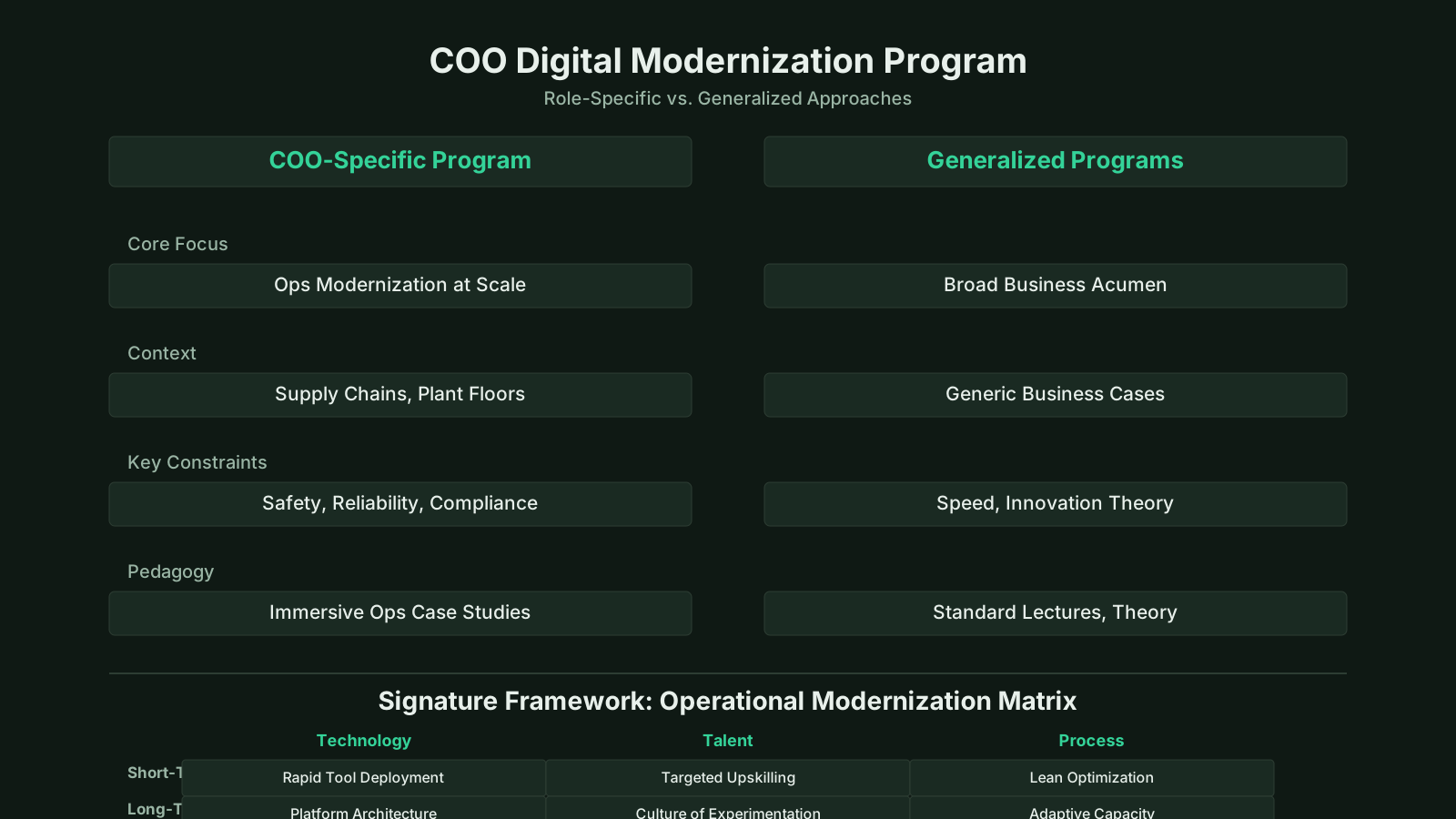
COO Digital Operations Modernization Leadership Program: Key Topics Summary
| Key Concept | Summary |
|---|---|
| COO Evolution | The COO role has shifted from managing daily operations to architecting a strategic reinvention of how the enterprise creates and delivers value in a digital-first environment. |
| Program Purpose | This leadership program equips COOs with the mindset, capabilities, and frameworks to fuse people, processes, and digital tools into a unified engine for enduring competitive advantage. |
| Digital Mandate | Modern COOs must harmonize operational excellence with innovation, transforming the operations function from a cost center into a strategic enabler through scaled adoption of AI, cloud, and intelligent automation. |
| Enterprise Orchestration | COOs learn to orchestrate cross-functional initiatives across IT, marketing, and HR, applying systems thinking to realign value streams, break down silos, and overcome deep-seated organizational inertia. |
| Strategic Roadmapping | Effective COOs articulate a compelling digital vision and construct a dual-track roadmap that captures early, credibility-building wins while securing sustained investment for rearchitecting legacy systems. |
| Core Competencies | Digital operations leadership demands a fusion of technical fluency, data acumen, financial stewardship, adaptive change leadership, and high emotional intelligence. |
| Data Literacy | COOs must interpret complex operational data, separate meaningful signals from noise, and embed an evidence-based decision culture that unlocks the full value of operational data streams. |
| Financial Acumen | They build rigorous business cases for digital investment, modeling scenarios that capture tangible savings and intangible benefits such as agility, while proactively surfacing and mitigating hidden implementation costs. |
| Change Leadership | The program develops advanced change leadership skills, applying structured frameworks like Kotter's 8-step process to dismantle resistance and embed large-scale operational transformation. |
| Organizational Impact | Firms with digitally mature operations consistently achieve stronger margins, greater agility, and deeper customer loyalty, with the COO uniquely placed to accelerate and sustain this maturity. |
The Evolving Role of the COO in the Digital Age
The traditional COO was often responsible for internal efficiency, cost management, and process reliability. While these remain foundational, the digital age demands a far more expansive mandate. Operations leaders must now navigate a landscape defined by data ubiquity, intelligent automation , and real-time connectivity. A COO Digital Operations Modernization Leadership Program begins by reexamining this expanded remit. Participants learn to balance operational excellence with innovation, transforming the operations function from a cost center into a strategic enabler.
Digital operations modernization encompasses the redesign of core business processes through technologies like cloud computing, artificial intelligence, the Internet of Things, and robotic process automation. However, technology alone does not deliver results. The modern COO must act as an integrator, aligning digital initiatives with corporate strategy, customer experience goals , and workforce capabilities . This requires fluency in digital technologies, but also deep expertise in change management , organizational design , and data-driven decision-making.
Research and industry observation consistently show that companies with digitally mature operations achieve higher margins, greater agility, and stronger customer loyalty. The COO is uniquely positioned to drive this maturity because operations represent the connective tissue of the organization. By modernizing supply chains, production workflows, service delivery, and internal support functions, the COO can unlock value that directly impacts the bottom line. A leadership program for COOs therefore focuses on building the capacity to envision a digital future, build the business case, and marshal the resources required to turn vision into reality.
From Functional Leadership to Enterprise Orchestration
Many COOs ascend to the role after careers in supply chain management, manufacturing, or finance. Their deep functional expertise is valuable, but digital modernization demands an enterprise-wide perspective. A COO Digital Operations Modernization Leadership Program helps participants move beyond siloed thinking. They learn to orchestrate cross-functional initiatives that span IT, marketing, R&D, and human resources. This orchestration capability is vital because digital transformation never remains contained within a single department. A new customer-facing platform, for instance, will inevitably require changes to back-end order fulfillment, inventory management, and customer support processes.
The program emphasizes systems thinking and stakeholder alignment. COOs practice mapping value streams across the entire organization and identifying digital leverage points. They also develop skills in influencing without direct authority, a frequent necessity when collaborating with chief information officers, chief digital officers, and business unit leaders. By framing modernization as an enterprise outcome rather than a technology project, COOs can mobilize broader support and overcome the organizational inertia that often derails ambitious initiatives.
Strategic Vision and Digital Roadmapping
An effective COO must be able to articulate a compelling digital operations vision and translate it into an actionable roadmap. This involves setting clear priorities, sequencing investments, and defining measurable milestones. Within a leadership program, participants work through real-world scenario planning. They learn to assess their organization’s digital maturity honestly, identifying gaps in technology infrastructure, data capabilities, and talent. They also analyze external trends, such as shifts in customer behavior or regulatory changes, to ensure the roadmap remains forward-looking.
The roadmap must balance short-term gains with long-term transformation. Quick wins, such as automating a manual reporting process, build credibility and fund further investment. Longer-term moves, like rearchitecting legacy IT systems or embedding predictive analytics into operations, require sustained commitment. A COO Digital Operations Modernization Leadership Program teaches frameworks for portfolio management that evaluate initiatives on strategic alignment, feasibility, and expected return. This disciplined approach prevents the common pitfall of spreading resources too thinly across too many digital projects.
Core Takeaways on the Modern COO
- Expanded Mandate Beyond Efficiency
- Today’s COO must fuse operational discipline with innovation leadership, elevating the function from a cost center to a strategic enabler that directly shapes competitive advantage.
- Integrator of Technology and Strategy
- Modern COOs weave digital initiatives tightly into corporate strategy, customer experience, and talent development, requiring mastery of both technology architecture and organizational change.
- From Silos to Enterprise Orchestration
- The role has moved from functional leadership to orchestrating boundaryless initiatives across IT, marketing, R&D, and HR, reflecting how digital transformation permeates every part of the organization.
- Articulating a Digital Operations Vision
- Effective COOs build a compelling vision and practical roadmap grounded in honest digital maturity assessment, sequenced deliberately with near-term wins that fund long-term transformation.
- Disciplined Portfolio Management
- They apply structured frameworks to evaluate projects on strategic fit and value potential, preventing the common trap of spreading resources too thin across an undisciplined collection of digital initiatives.
Core Competencies for Digital Operations Leadership
Modernizing operations at scale demands a blend of hard and soft skills rarely found in a single individual. A COO Digital Operations Modernization Leadership Program therefore targets a specific set of competencies. These span technical literacy, data acumen, financial stewardship, change leadership, and emotional intelligence. While no COO needs to code or configure cloud infrastructure, a solid grasp of underlying technologies enables better decision-making and more productive conversations with technical teams.
Data literacy is arguably the most critical competency. Operations generate vast amounts of information, from machine sensor readings to customer interaction logs. COOs must be able to interpret analytics, distinguish signal from noise, and foster a culture where decisions are grounded in evidence rather than intuition. This does not mean abandoning experience-based judgment, but rather augmenting it with rigorous analysis. The program often includes hands-on exercises with data visualization and statistical reasoning to build confidence.
Financial acumen goes beyond budgeting and cost control. Digital modernization requires significant investment, and COOs must build robust business cases that account for both tangible benefits, such as labor savings, and intangible ones, like improved customer satisfaction or strategic flexibility. They learn to model different scenarios and communicate the financial narrative to boards and investors. Equally important is the ability to identify and mitigate the hidden costs of digital initiatives, such as integration complexity, cybersecurity risks, and the productivity dip that often accompanies new tool rollouts.
Change Leadership and Communication Mastery
Digital implementation frequently fails not due to technology shortcomings but because of organizational resistance. COOs enrolled in a COO Digital Operations Modernization Leadership Program develop advanced change leadership capabilities. They study established models like Kotter’s eight-step process and the ADKAR framework, adapting them to the specific challenges of operational transformation. The program highlights the importance of creating a sense of urgency, building a guiding coalition, and generating short-term wins to sustain momentum.
Communication mastery is integral. A COO must be able to explain complex digital concepts in simple terms to diverse audiences, from frontline workers to board members. Storytelling becomes a tool for conveying the purpose behind modernization, connecting daily tasks to larger strategic goals. Effective communicators address fears transparently, acknowledging that automation may shift roles but also create opportunities for more meaningful work. Leadership programs often incorporate communication coaching, including practice with town hall presentations, executive briefings, and media interactions.
Agile Mindset and Adaptive Problem-Solving
Traditional operations management prized predictability and adherence to plan. Digital environments are too dynamic for rigid, long-range planning. A COO Digital Operations Modernization Leadership Program instills an agile mindset, emphasizing iterative progress, rapid experimentation, and continuous feedback. COOs learn to apply agile principles not just to software development but to process redesign, product launches, and even strategic planning itself.
Adaptive problem-solving means embracing ambiguity and reframing challenges as learning opportunities. The program uses case studies and simulations where participants must pivot in response to unexpected market shifts or technology failures. This trains COOs to lead with resilience and make high-stakes decisions under uncertainty. They also discover how to foster psychological safety within their teams, encouraging the candid reporting of issues and the free exchange of ideas that drive innovation.
Designing a COO Digital Operations Modernization Program
A well-designed COO Digital Operations Modernization Leadership Program balances theory, application, and peer learning. The most effective formats are modular, spanning several months with a mix of in-person residencies, virtual sessions, and workplace projects. This blended approach allows participants to immediately test new concepts within their organizations and return with real-world insights. Program design begins with a thorough needs assessment, mapping the organization’s digital maturity, the COO’s current skill profile, and the strategic priorities for the coming years.
Curriculum architects draw from multiple disciplines: industrial engineering, information systems, behavioral psychology, and strategic management. Rather than presenting these as silos, a cohesive program weaves them into integrated modules. For example, a session on process mining might incorporate data analytics techniques, change management implications, and financial modeling. The goal is to mirror the interconnected nature of real operations challenges.
Action learning projects form the backbone of many programs. Participants select a pressing digital modernization initiative within their own company, such as automating a distribution center or implementing predictive maintenance. Over the program duration, they apply frameworks, consult with faculty and peers, and track progress. This not only delivers immediate business value but also cements learning through practice. The program concludes with a capstone where participants present their outcomes to a panel, sharpening both analytical and communication skills.
Curriculum Structure and Key Modules
A typical COO Digital Operations Modernization Leadership Program curriculum might open with a module on digital strategy and environmental scanning. COOs learn to analyze industry disruption patterns, assess competitive threats, and spot opportunities for operational innovation. They explore frameworks like Porter’s five forces adapted for digital ecosystems and the concept of the boundaryless organization. This strategic grounding ensures that subsequent tactical modules remain anchored to business outcomes.
The next module often dives into technology foundations and architecture decision-making. Without delving into code, COOs grasp the principles of cloud platforms, APIs, microservices, and data lakes. They analyze trade-offs between build versus buy, best-of-breed versus integrated suites, and on-premise versus cloud deployment. A critical component is cybersecurity and risk management, since digital operations expose organizations to new vulnerabilities. COOs learn to ask the right questions about data governance, regulatory compliance, and incident response.
Process excellence remains a core thread. The program revisits Lean and Six Sigma but through a digital lens, introducing techniques like process mining, digital twin simulation, and intelligent workflow automation. Participants discover how to identify processes ripe for automation and how to measure the impact beyond simple efficiency metrics. A module on supply chain digitalization might cover real-time visibility platforms, autonomous logistics, and circular economy models, reflecting the broadening scope of operations leadership.
Experiential Learning and Peer Networks
Lectures and reading alone cannot build the muscle of leadership. A COO Digital Operations Modernization Leadership Program incorporates immersive experiences such as digital factory visits, crisis simulations, and design sprints. Seeing advanced automation in action makes abstract concepts tangible and sparks ideas for participants’ own contexts. Simulations that collapse timelines, such as a week-long exercise where teams must digitally transform a simulated business under competitive pressure, build rapid decision-making and teamwork skills.
Equally powerful is the peer network that forms during the program. COOs often report that the candid conversations with fellow participants from different industries are among the most valuable takeaways. They share challenges, workshop solutions, and provide accountability long after the formal program ends. These networks become an enduring resource for benchmarking, talent sourcing, and staying abreast of emerging practices.
Core Takeaways on Program Design
- Blended modular format
- An optimal blended modular design interweaves in-person residencies, live virtual sessions, and extended workplace projects, creating a continuous cycle of learning and immediate application that deepens retention.
- Integrated multidisciplinary curriculum
- The curriculum fuses industrial engineering, information systems, behavioral psychology, and strategic management into seamlessly integrated modules, mirroring the cross-functional tensions that define real-world operations leadership.
- Action learning projects
- Action learning projects require participants to address a live digital challenge from their own organization, applying frameworks and iterating with faculty and peer feedback while tracking measurable progress to embed learning through direct application.
- Technology foundations and risk management
- COOs build a working command of cloud platforms, APIs, microservices, and data lakes, complemented by a structured approach to evaluating trade-offs and mitigating risks in cybersecurity, data governance, and regulatory compliance.
- Experiential learning and peer networks
- Immersive activities such as digital factory tours, crisis simulations, and design sprints transform abstract frameworks into tangible skills, and the candid peer dialogue that follows creates a lasting professional network for benchmarking, problem solving, and discovering emerging practices.
Key Frameworks and Methodologies for Operational Modernization
A COO Digital Operations Modernization Leadership Program equips leaders with a toolkit of frameworks that guide analysis and action. No single framework fits every situation, so the emphasis is on contextual application. One widely referenced model is the digital maturity matrix, which plots organizations along dimensions such as strategy, culture, technology, and data. COOs learn to diagnose their current state and chart a progression from digital beginner to digital native. This prevents the common error of attempting advanced initiatives without the foundational building blocks in place.
Lean management principles continue to underpin operational excellence, but they are augmented by digital capabilities. The concept of lean digital combines waste elimination with data-driven insight. For instance, value stream mapping, a classic lean tool, can now be enhanced with real-time process data from enterprise systems. This dynamic value stream mapping allows COOs to spot bottlenecks that traditional periodic observation might miss. The program emphasizes that lean and digital are complementary, not competing, philosophies.
Agile frameworks, originally designed for software development, have been adapted for broader operational contexts. The Scaled Agile Framework (SAFe) and Large-Scale Scrum (LeSS) provide structures for coordinating agile teams across large enterprises. COOs explore how to implement these frameworks within manufacturing, logistics, and service operations. They also consider the cultural prerequisites, such as empowered teams, servant leadership, and a tolerance for experimentation. The program cautions against a one-size-fits-all approach, advocating for hybrid models that blend agile, waterfall, and lean depending on the nature of the work.
Process Mining and Digital Twin Technology
Process mining has emerged as a transformative tool for operations leaders. By extracting event logs from enterprise systems, process mining software reconstructs how processes actually run, revealing deviations, inefficiencies, and compliance gaps. A COO Digital Operations Modernization Leadership Program provides hands-on exposure to process mining, teaching participants to interpret process maps and identify conformance issues. This objective, data-driven view often challenges long-held assumptions about operational performance.
Digital twin technology takes this further by creating a virtual replica of physical assets, production lines, or even entire supply chains. COOs learn how digital twins enable simulation and optimization without disrupting live operations. A manufacturer might test a new scheduling algorithm on a digital twin before deploying it to the factory floor. A logistics provider could simulate the impact of a port closure on delivery commitments. The program explores the data infrastructure and organizational capabilities needed to sustain digital twin initiatives, emphasizing that the model is only as good as the data feeding it.
Design Thinking for Operational Innovation
Design thinking, with its emphasis on empathy, ideation, and prototyping, is often associated with product development. A COO Digital Operations Modernization Leadership Program demonstrates its applicability to operations. When redesigning a fulfillment process, for example, COOs can use design thinking to deeply understand the experiences of warehouse workers, delivery drivers, and end customers. This human-centered approach surfaces insights that purely analytical methods might miss.
Participants engage in design sprints focused on operational challenges. They learn to reframe problems, generate diverse ideas, and build low-fidelity prototypes of new workflows or digital interfaces. Rapid testing with real users provides feedback that guides refinement. This iterative approach reduces the risk of large-scale implementation failures and fosters a culture of continuous improvement. The program highlights how design thinking complements Lean and Six Sigma, adding a layer of creative problem-solving to data-driven rigor.
Technology Domains for Operational Modernization
A COO Digital Operations Modernization Leadership Program must demystify the technology landscape without overwhelming participants with technical minutiae. The focus remains on strategic implications, vendor selection criteria, and integration challenges. Artificial intelligence and machine learning are top of mind for many COOs. The program explains supervised, unsupervised, and reinforcement learning in accessible terms, then delves into high-value operational use cases such as demand forecasting, quality inspection, and predictive maintenance.
Cloud computing is the backbone of digital operations. COOs learn to evaluate cloud deployment models including public, private, and hybrid and understand the financial implications of shifting from capital expenditure to operating expenditure. The cloud’s scalability and elasticity enable operations to respond dynamically to demand fluctuations, but migration requires careful planning. The program addresses data residency, latency, and integration with legacy systems, common hurdles that can stall transformation if not managed proactively.
The Internet of Things connects physical assets to digital systems, generating streams of real-time data. In logistics, IoT sensors track location, temperature, and shock during transit. In manufacturing, connected machines report their own health and performance. The COO’s role is to identify which IoT data is actionable and how to embed it into decision workflows. This requires close collaboration with IT and data science teams to establish the necessary infrastructure and governance. The program also covers edge computing, which processes data near its source, reducing latency and bandwidth demands for critical applications.
Robotic Process Automation and Intelligent Automation
Robotic process automation (RPA) has been a gateway to digital modernization for many organizations, automating routine, rule-based tasks such as invoice processing or customer record updates. A COO Digital Operations Modernization Leadership Program goes beyond the basics, exploring how to scale RPA from isolated bots to an enterprise-wide automation strategy. Participants learn governance models, bot lifecycle management, and the importance of process standardization before automation.
Intelligent automation combines RPA with AI capabilities like natural language processing and computer vision. This opens up a broader range of processes for automation, from reading and interpreting contracts to visually inspecting products on an assembly line. COOs analyze the workforce implications, focusing on how to reskill employees for higher-value roles that oversee and continuously improve automated systems. The program stresses that automation success hinges on thoughtful change management and transparent communication about job evolution.
Cybersecurity and Digital Resilience
As operations become more digitized, the attack surface expands. A COO Digital Operations Modernization Leadership Program dedicates significant attention to cybersecurity, not to turn COOs into security experts, but to ensure they treat security as a strategic operational risk. Participants learn to ask critical questions about their organization’s security posture: how are operational technology systems segregated from IT networks, what are the incident response protocols for a ransomware attack on a factory, and how does vendor risk management protect the supply chain.
Digital resilience goes beyond prevention to encompass detection, response, and recovery. The program introduces concepts like zero trust architecture and continuous monitoring. COOs participate in tabletop exercises simulating a cyberattack on critical operational systems, experiencing firsthand the decision-making pressure and the importance of pre-established communication channels. This proactive approach builds the muscle memory needed to lead effectively during a real crisis.
Core Technology Insights for COOs
- Strategic AI and ML Applications
- The curriculum translates AI and machine learning methodologies into operational language, concentrating on high-impact use cases like demand forecasting, quality inspection, and predictive maintenance rather than technical theory.
- Cloud as Operational Backbone
- Participants evaluate cloud deployment models and the financial shift from capital to operating expenditure, while confronting critical migration challenges such as data sovereignty, latency requirements, and legacy system integration.
- Cybersecurity as Strategic Risk
- The program positions cybersecurity as a strategic operational risk, equipping COOs to probe network segregation, incident response protocols, and vendor risk management in ways that systematically build digital resilience.
Leading Organizational Change and Culture
Technology investments yield returns only if employees embrace new ways of working. A COO Digital Operations Modernization Leadership Program therefore places culture at the center of the change agenda. Participants examine the elements of a digital-ready culture: customer-centricity, collaboration, agility, and a learning orientation. They assess their current organizational culture using diagnostic tools and identify gaps that could derail modernization efforts.
Culture change starts at the top, but it cannot be dictated. COOs learn to model the behaviors they wish to see, such as using data in meetings, admitting mistakes, and celebrating experimentation even when outcomes are not perfect. They also develop strategies for engaging middle managers, who are often the linchpins of change but can also be sources of resistance. The program explores incentive systems, recognizing that what gets measured and rewarded shapes behavior. Aligning performance evaluations, bonuses, and promotions with digital adoption sends a powerful signal.
The workforce implications of digital modernization are profound and must be addressed with empathy and foresight. The program guides COOs in conducting workforce planning that anticipates shifts in skill demand. Rather than viewing automation solely as a headcount reduction lever, forward-thinking COOs invest in reskilling and upskilling initiatives that prepare employees for new roles in data analysis, process optimization, and digital tool management. Partnerships with educational institutions and online learning platforms often feature in these plans.
Building a Data-Driven Decision Culture
Shifting an organization from intuition-based to evidence-based decision-making is a multiyear journey. A COO Digital Operations Modernization Leadership Program provides a roadmap for this cultural shift. It begins with data democratization, ensuring that frontline employees have access to the information they need to make informed decisions. Self-service analytics tools, accompanied by training and governance, empower teams without creating bottlenecks in a centralized analytics function.
COOs learn to champion data storytelling, translating statistical findings into narratives that drive action. They practice framing operational dashboards not as static reports but as springboards for discussion. Regular operating reviews evolve from retrospective justification to forward-looking problem-solving sessions. The program also addresses the ethical dimensions of data use, including algorithmic bias and employee privacy, ensuring that the pursuit of data-driven operations remains aligned with organizational values.
Stakeholder Alignment and Coalition Building
No COO can modernize operations alone. A core module of a COO Digital Operations Modernization Leadership Program focuses on building and sustaining a coalition of support. This involves mapping key stakeholders from the C-suite to the shop floor, understanding their interests, concerns, and influence. COOs learn techniques for enrolling skeptics and converting them into advocates.
The relationship between the COO and the CIO or Chief Digital Officer is particularly pivotal. The program addresses common friction points, such as ownership of digital initiatives and prioritization of technology investments. Through simulations and role plays, participants practice navigating these dynamics, developing shared goals and governance mechanisms. External stakeholders, including suppliers, customers, and regulators, also play roles in the modernization journey. The program explores collaborative approaches, such as joint innovation labs with key suppliers, that can accelerate progress while distributing risk.
Measuring Success and Driving Continuous Improvement
Without rigorous measurement, digital modernization efforts drift or lose executive support. A COO Digital Operations Modernization Leadership Program teaches leaders to define and track a balanced set of metrics that reflect operational, financial, customer, and people outcomes. Traditional operational KPIs such as throughput, yield, and on-time delivery remain relevant, but they are supplemented by digital-specific indicators like system adoption rates, data quality scores, and the percentage of processes that are algorithmically optimized.
Financial metrics include not only cost reduction but also revenue enablement and asset efficiency. COOs learn to build an operational P&L that links digital investments to margin improvement over time. They also explore non-financial metrics like employee engagement and customer satisfaction, recognizing that these often serve as leading indicators of financial performance. The program advocates for a dashboard approach, where a few carefully chosen metrics provide a holistic view, avoiding the noise of too many data points.
Continuous improvement in a digital context moves beyond periodic kaizen events. The concept of the data flywheel illustrates how each digital interaction generates data that can be used to further optimize operations. COOs learn to institutionalize this virtuous cycle by embedding analytics into daily workflows and establishing regular cadences for reviewing performance data. They also examine the role of centers of excellence in sustaining momentum, providing specialized expertise in areas like automation, data science, and user experience design.
OKRs and Agile Performance Management
Objectives and key results (OKRs) have gained traction as a goal-setting framework that aligns teams with strategic priorities. A COO Digital Operations Modernization Leadership Program shows how to cascade OKRs from the corporate strategy down to operational teams, ensuring that modernization efforts directly contribute to enterprise goals. OKRs encourage ambition and transparency, as they are typically visible across the organization. COOs practice writing effective key results that are measurable and outcome-focused.
Performance management must also evolve. Annual performance reviews are poorly suited to the pace of digital change. The program explores more frequent feedback mechanisms, such as quarterly check-ins and continuous feedback tools. COOs learn to conduct performance conversations that balance accountability for results with support for learning and growth. This shift reinforces the agile, learning-oriented culture that digital modernization requires.
Core Insights on Metrics and Continuous Improvement
- Balanced metric framework
- Tracking a well-calibrated blend of operational, financial, customer, and people metrics is critical for maintaining executive sponsorship and keeping digital modernization initiatives tightly aligned with strategic priorities.
- Digital-specific performance indicators
- Beyond conventional throughput measures, leading organizations monitor digital-native metrics such as user adoption velocity, data accuracy scores, and the share of processes that are algorithmically optimized to capture the full impact of modernization.
- Data flywheel for optimization
- The data flywheel model demonstrates that each digital interaction generates high-quality data, which in turn fuels smarter operational adjustments and creates a self-reinforcing cycle of continuous improvement.
- OKRs for strategic alignment
- A well-structured OKR cascade translates corporate strategy into granular, measurable outcomes for frontline teams, ensuring every modernization initiative demonstrably advances enterprise-wide objectives.
- Agile performance management
- Replacing static annual reviews with quarterly pulse checks and real-time feedback platforms balances rigorous outcome accountability with the continuous learning that digital transformation demands.
Implementation Challenges and Mitigation Strategies
Even the most thoughtfully designed COO Digital Operations Modernization Leadership Program cannot eliminate the real-world obstacles that arise during implementation. Legacy IT systems represent one of the most persistent barriers. These systems, often decades old, are tightly coupled, poorly documented, and expensive to modify. The program equips COOs with strategies for managing legacy debt, including phased migration, use of APIs to wrap legacy functionality, and selective replacement based on business impact rather than technology age alone.
Talent scarcity is another critical challenge. The demand for data scientists, automation engineers, and digital-savvy operations managers far exceeds supply. COOs explore creative talent strategies: building internal academies, tapping the gig economy, establishing remote work options to access global talent pools, and collaborating with universities. Retention is equally important, and the program highlights how purposeful work, career development pathways, and inclusive cultures reduce attrition among scarce digital talent.
Organizational silos consistently undermine integration efforts. Operations modernization often stumbles when supply chain, manufacturing, and customer service operate with disconnected data and conflicting objectives. COOs learn structural interventions, such as cross-functional teams, co-location, and shared incentives, to break down these walls. They also practice diagnosing the root causes of silo behavior, which can range from misaligned KPIs to a history of interdepartmental mistrust. Addressing these requires patience, diplomacy, and persistent role modeling.
Budgeting and Investment Governance
Securing adequate funding for digital modernization is a perpetual challenge, especially when ROI is uncertain or long-term. A COO Digital Operations Modernization Leadership Program teaches participants to build compelling investment cases that speak the language of the CFO and the board. This involves quantifying the cost of inaction, such as market share erosion or regulatory noncompliance, alongside upside scenarios. COOs learn venture capital-style portfolio approaches, spreading investment across a mix of safe bets and high-risk, high-reward moonshots.
Governance structures must balance control with speed. The program critiques the traditional annual budgeting cycle as too slow for digital initiatives. Rolling forecasts, innovation funds managed outside the normal budget process, and stage-gate approval processes that release funds incrementally are presented as alternatives. COOs also learn to manage the tension between operational efficiency and innovation, ensuring that the relentless pressure to cut costs does not starve the very modernization programs that will secure future efficiency gains.
Managing Workforce Transitions Responsibly
The human dimension of digital modernization cannot be overstated. When automation eliminates roles, the COO faces ethical and practical considerations. A COO Digital Operations Modernization Leadership Program confronts this head-on, moving beyond platitudes about upskilling to practical strategies. Participants examine case studies of companies that managed large-scale workforce transitions successfully, often through multiyear plans that combined natural attrition, voluntary separation programs, and substantial investment in retraining.
Transparent communication is non-negotiable. COOs learn to articulate the rationale for automation clearly and honestly, avoiding false promises that all jobs will remain unchanged. They also work with HR partners to design transition support such as career counseling, severance packages, and education stipends. The program emphasizes that how an organization treats affected employees directly impacts the morale and productivity of those who remain, as well as the employer brand in the labor market.
The Future of the COO Role and Lifelong Learning
The evolution of the COO role will only accelerate. A COO Digital Operations Modernization Leadership Program is not a one-time intervention but a catalyst for a career-long learning journey. Emerging technologies like generative AI, quantum computing, and advanced robotics will present new opportunities and dilemmas. The program instills habits of continuous scanning, peer networking, and disciplined self-assessment that keep COOs adaptive in a shifting landscape.
The future COO will likely spend even more time on ecosystem orchestration, partnering with technology vendors, startups, academic institutions, and even competitors in industry consortia. Sustainability and environmental, social, and governance (ESG) criteria are increasingly intertwined with operations, as stakeholders demand carbon-neutral supply chains and circular production models. The COO must lead these transitions, applying digital tools to measure, report, and reduce environmental impact while maintaining profitability.
Ultimately, the most successful COOs will be those who combine deep operational wisdom with a restless curiosity about the art of the possible. A well-structured COO Digital Operations Modernization Leadership Program provides the scaffolding for this development, blending rigorous frameworks with practical application and a supportive peer community. It prepares leaders not just to manage the operations of today, but to shape the operations of tomorrow with confidence, integrity, and strategic foresight.
Core Insights on Future COO Leadership
- Career-long learning catalyst
- The COO Digital Operations Modernization Leadership Program sets the foundation for lifelong professional growth by fostering habits of environmental scanning, strategic networking, and rigorous self-assessment, enabling adaptation to transformative technologies such as generative AI and quantum computing.
- Ecosystem orchestration priority
- Future COOs will increasingly prioritize partnerships with technology vendors, startups, academic institutions, and even competitors through industry consortia to accelerate operational innovation.
- ESG integration in operations
- Sustainability and environmental, social, and governance (ESG) criteria are now integral to operations, compelling COOs to spearhead the shift to carbon-neutral supply chains and circular production models powered by digital technologies.
- Combining wisdom with curiosity
- Successful COOs merge deep operational expertise with an insatiable curiosity about emerging possibilities, using structured learning as a scaffold to build robust frameworks, hone practical skills, and tap into peer networks that collectively shape tomorrow's operations.
Integrating Sustainability into Digital Operations
Sustainability is no longer a peripheral corporate social responsibility initiative; it has become a core operational imperative. A COO Digital Operations Modernization Leadership Program increasingly integrates sustainability into its curriculum. Digital technologies offer powerful levers for reducing waste, optimizing energy consumption, and enabling circular business models. For instance, IoT sensors can monitor energy usage in real time, allowing facilities to adjust consumption dynamically and reduce carbon footprint. AI can optimize logistics routes to minimize fuel use, while digital twins can simulate product lifecycle scenarios to enhance recyclability.
COOs learn to embed sustainability metrics directly into operational dashboards alongside traditional KPIs. The program explores frameworks like the triple bottom line and science-based targets, helping participants align operational goals with the broader corporate sustainability strategy. Regulatory pressures and investor expectations are also covered, preparing COOs to navigate the complex landscape of carbon reporting, Scope 3 emissions tracking, and supply chain transparency. Sustainability is framed not as a constraint but as a driver of innovation and long-term value creation.
Circular Economy and Reverse Logistics
Shifting from a linear take-make-dispose model to a circular one requires fundamental changes in operations. A COO Digital Operations Modernization Leadership Program dedicates attention to reverse logistics, remanufacturing, and material recovery. Digital tools like blockchain can provide traceability for materials across multiple lifecycles, verifying recycled content or certifying ethical sourcing. COOs analyze the economic viability of circular models, learning to model total cost of ownership that accounts for end-of-life recovery value.
The program also addresses the operational complexities of managing product returns, refurbishment, and resale. These processes demand as much digital rigor as forward logistics. Machine learning algorithms can predict return rates, grade returned items, and route them to the most profitable disposition channel. By treating reverse logistics as a strategic capability rather than a cost center, COOs can unlock new revenue streams and strengthen customer loyalty.
Conclusion
A COO Digital Operations Modernization Leadership Program represents a strategic investment in the future of any organization seeking to thrive in a digital-first world. It provides the knowledge, frameworks, and peer support necessary to transform operations from a source of incremental efficiency into a platform for innovation and growth. The journey demands courage, intellectual humility, and a relentless focus on both technology and humanity. For COOs who embrace this challenge, the rewards are substantial: a more resilient organization, a more engaged workforce, and a lasting legacy of operational excellence.
Key Takeaways on COO Digital Leadership
- Strategic investment in the future
- A COO Digital Operations Modernization Leadership Program is a strategic initiative that embeds the capabilities needed to lead proactively and outperform in a digital-first economy.
- Transforming operations into innovation
- The program supplies rigorous frameworks, actionable knowledge, and a trusted peer network, enabling COOs to turn operations from a cost-efficiency center into a dynamic engine of innovation and growth.
- Essential personal qualities for COOs
- Succeeding on this path requires the courage to challenge entrenched assumptions, the intellectual humility to absorb new disciplines, and a sustained focus that harmonizes technological progress with human-centered leadership.
- Building organizational resilience
- COOs who rise to this challenge embed a culture of adaptive resilience, equipping their organizations to pivot decisively amid disruption and capture emerging opportunities.
- Lasting legacy of excellence
- The rewards extend far beyond performance metrics to include a deeply engaged workforce, heightened enterprise agility, and an enduring legacy of operational excellence.
Advance Your Career with Professional Certification
Earning a respected project management certification equips operations leaders with standardized frameworks to reduce delivery risk and accelerate digital transformation timelines. It validates a professional’s ability to control scope, manage stakeholder expectations, and align cross-functional teams, directly strengthening one’s credibility when leading modernization initiatives. Organizations benefit from consistent project execution, fewer resource misallocations, and clearer audit trails, which in turn enhances overall operational resilience and drives measurable performance gains.
For chief operating officers leading digital operations modernization, mastering product management disciplines is no longer optional—it directly shapes an organization’s ability to translate strategic intent into delivered value. Earning a product owner certification equips senior leaders with the tools to define clear backlogs, set outcome-driven priorities, and foster cross-functional accountability, all of which accelerate decision-making and reduce costly rework. This formal validation of expertise not only enhances personal credibility among boards and stakeholders, but also embeds a customer-centric, iterative mindset across teams, leading to measurable improvements in operational efficiency and time-to-market. As a result, certified leaders are better positioned to drive the technological and cultural shifts that modernize core operations while advancing their own executive career trajectories.
Earning an HR management certification signals a commitment to mastering modern workforce strategies, directly boosting your credibility with senior leadership and hiring panels who value verified expertise over tenure alone. This certification equips professionals with advanced competencies in compliance, talent analytics, and strategic planning, enabling them to lead organizational change that reduces turnover costs and improves productivity metrics. For those targeting executive roles like COO, it provides the operational human capital insight needed to align people strategy with digital modernization goals.