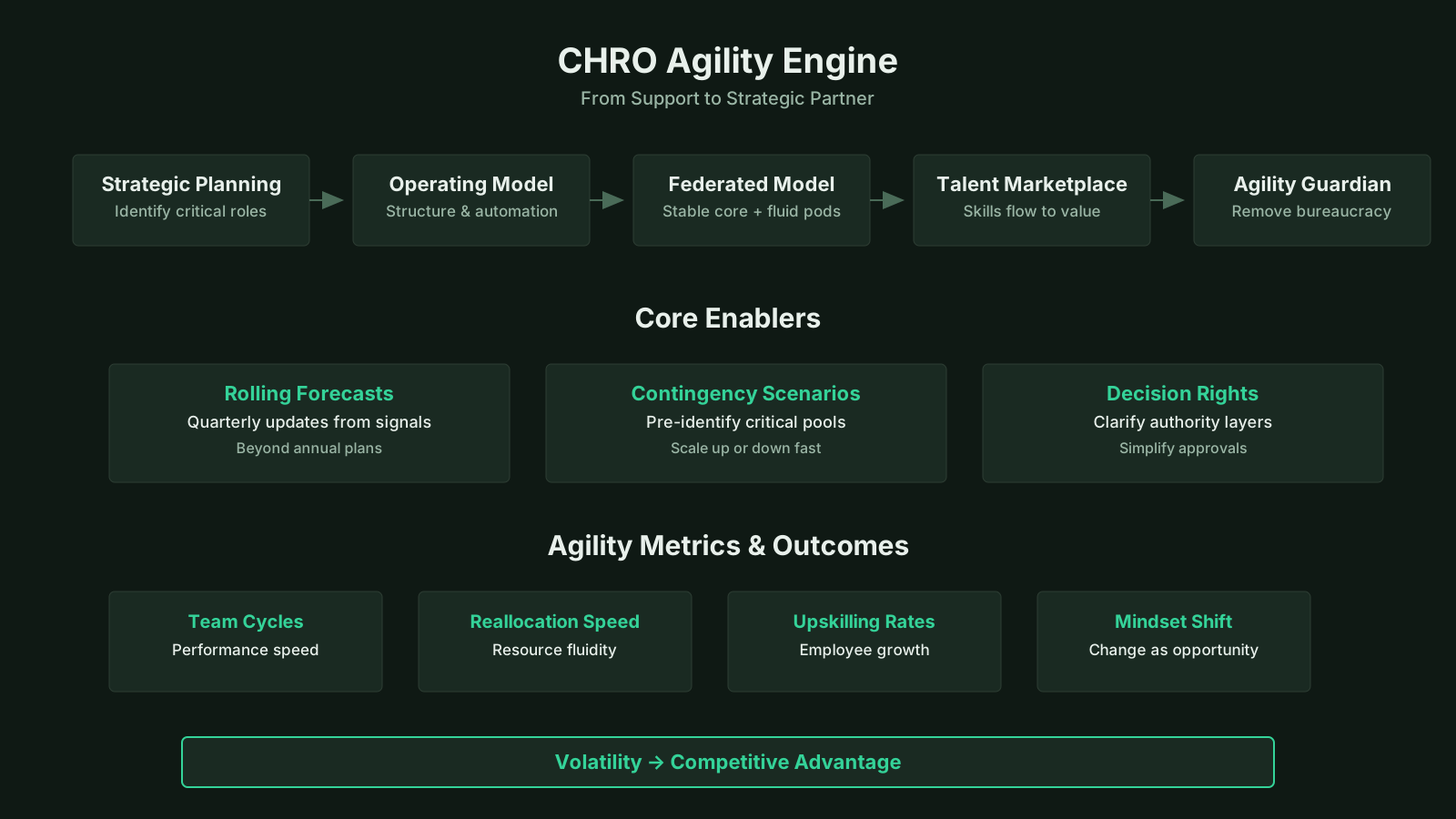
Every chief human resources officer today stands at the intersection of business strategy and human potential, charged with designing organizations that can thrive in uncertainty and planning workforces that are future-ready. The mastery of organizational design and strategic workforce planning is no longer a niche competency but the very core of the CHRO mandate. As enterprises grapple with digital disruption, skills shortages, and the demands of a multigenerational, distributed workforce , the ability to architect the company’s structure and forecast its talent needs with precision separates transformative leaders from those who merely fill seats. Executive education programs such as a senior management certificate program have emerged as vital accelerators for HR leaders seeking to build these critical capabilities. This deep exploration provides a roadmap for CHRO mastery, weaving together the latest frameworks, evidence-based practices, and implementation realities that define excellence in the modern people function.
CHRO Mastery: Summary of Key Topics
| Key Concept | Summary |
|---|---|
| Strategic Architecture | The CHRO architects operating models that directly convert business strategy into organizational capabilities, transcending legacy administrative functions. |
| Workforce Planning | Predictive analytics and continuous scenario modeling enable real-time alignment of talent supply with shifting competitive demands. |
| Agile Structures | Fluid networks, pods, and cross-functional agile teams replace rigid hierarchies to compress decision cycles and amplify collaboration. |
| Organizational Resilience | Resilience depends on modular operating designs, cross-trained talent pools, and integrated workforce forecasting that absorb external shocks. |
| Culture Alignment | Company culture operates as the core organizational operating system, requiring deliberate alignment through leadership behaviors and performance metrics. |
| Skills-Based Planning | Leading firms deconstruct job roles into precise skill clusters, unlocking dynamic resource allocation and targeted capability building. |
| Labor Analytics | Merging internal talent data with external labor market intelligence sharpens location strategies and mitigates attrition risk proactively. |
| Change Management | Structural transformation succeeds when the CHRO operates as the chief change catalyst, synchronizing people, processes, and technology. |
| AI Integration | AI and automation compel role redesigns focused on human-machine collaboration to elevate productivity ceilings. |
| Board Advisory | CHRO mastery culminates in board-level influence, rigorously evaluating human capital implications of corporate growth agendas. |
The Strategic Imperative of Organizational Design and Workforce Planning
The conversation around organizational design and strategic workforce planning has shifted dramatically over the past decade. Once relegated to annual headcount exercises and static org charts, these disciplines now occupy a central role in the boardroom agenda. For the CHRO, the journey begins with a fundamental recognition that the organization’s structure is its primary competitive advantage. How work flows, how decisions are made, and how talent is deployed directly determine speed to market, innovation capacity, and customer experience. Strategic workforce planning, meanwhile, is the mechanism that operationalizes that structure, ensuring the right people with the right skills are in the right roles at the right cost. The contemporary CHRO must view these two practices as inseparable, a dynamic system that continuously aligns human capital with evolving business strategy. The widespread pursuit of a CHRO organizational design and workforce planning certificate underscores the urgency with which leaders are upgrading their expertise in this domain.
From Administrative HR to Strategic Architecture
The evolution of the CHRO role from chief personnel officer to strategic architect is well documented but often misunderstood. It is not simply about having a seat at the table; it is about what you bring to that table. Today’s CHRO translates market shifts into organizational capabilities, defining the operating model that enables the business to deliver on its promise. This requires deep fluency in the enterprise’s value chain, competitive landscape, and growth ambitions. The administrative legacy of HR still matters—payroll accuracy and compliance are non-negotiable—but they are table stakes. Strategic architecture means designing flatter, more agile structures that reduce bureaucracy and push decision-making closer to the customer. It means challenging the assumption that scale requires hierarchy and instead exploring network-based models where cross-functional teams form and reform around work rather than enduring silos. This transition depends on a CHRO’s ability to speak the language of business, using data to show how structural choices affect productivity, engagement , and financial performance.
Why Traditional Workforce Planning Fails in the Digital Age
Conventional workforce planning, with its retrospective focus and spreadsheet-driven forecasts, collapses under the weight of modern volatility. It assumes a stable environment where past trends predict future needs, a premise that digital disruption has rendered obsolete. The half-life of skills is shrinking, whole job categories are being redefined, and talent markets have become global and liquid. In this context, a static annual plan is outdated the moment it is approved. The failure of traditional models lies in their inability to account for the rapid emergence of new roles, the blending of technical and soft skills, and the sophisticated alternatives to full-time employment such as the gig economy, contingent workers, and talent platforms. Strategic workforce planning, by contrast, is a continuous discipline that uses predictive analytics, external labor market intelligence, and scenario modeling to anticipate demand and pinpoint supply gaps before they become crises. The CHRO who masters this shift moves from reacting to talent shortages to shaping talent ecosystems proactively, often building on the frameworks taught in a CHRO organizational design and workforce planning certificate program.
Essential Takeaways
- Integrated Organizational Design and Workforce Planning
- Treating organizational design and workforce planning as an integrated discipline enables Chief Human Resources Officers to continuously realign talent capabilities with shifting business priorities.
- HR Leaders as Strategic Organizational Architects
- By designing flatter, networked operating models, HR leaders accelerate decision making, dismantle bureaucratic silos, and embed agility into the organizational fabric.
- Continuous Predictive Analytics for Talent Management
- Moving beyond static annual forecasts, organizations that deploy continuous predictive analytics gain real-time insights into talent risks and opportunities, enabling proactive workforce orchestration.
Core Principles of Modern Organizational Design
Modern organizational design is not about drawing boxes on a chart; it is about engineering the conditions for collaboration, innovation, and execution. The CHRO must operationalize a set of core principles that break from the industrial-era model of command and control. These principles emphasize fluidity over fixity, outcomes over tasks, and networks over hierarchies. While the specific blueprint varies by industry and strategy, the underlying philosophy remains consistent: the structure must serve the strategy, not the other way around. This means challenging the default to centralize or decentralize based on fads and instead making deliberate choices about where to place accountabilities, how to coordinate across boundaries, and what formal and informal mechanisms will be used to get work done. A deep understanding of organizational design is a key learning outcome for those pursuing a CHRO organizational design and workforce planning certificate.
Moving Beyond Hierarchies: Networks, Pods, and Agile Structures
The limits of hierarchical structures are evident in the slow pace of decision-making and the disengagement they foster. Progressive organizations are experimenting with and adopting networked models where influence and information flow through connections rather than ranks. Pod structures, popularized by agile software development and now spreading to marketing, finance, and even operations, bring together multidisciplinary teams aligned to a customer outcome or product. These pods are typically small, autonomous, and long-lived, with shared goals that transcend traditional functional silos. The CHRO’s role is to design the system within which these pods operate: defining the minimal viable hierarchy for governance and risk, setting the rules of engagement between pods, and ensuring that the talent marketplace supports fluid movement. Agile structures demand a fundamentally different approach to leadership, performance management, and rewards, all of which fall squarely within the people function’s remit. The transition is not without friction, requiring significant change management and a redefinition of career paths away from upward progression toward growth through skill and impact expansion.
Designing for the Future: Flexibility, Scalability, and Resilience
An effective organizational design is one that can absorb shocks and scale without losing its identity. The CHRO must build flexibility into the operating model so that the enterprise can reconfigure resources quickly as priorities shift. This might involve modular designs where business units or functions can be spun up or wound down with minimal disruption. Scalability means that processes, systems, and cultural norms are intentionally designed to work at ten thousand employees as well as they do at one thousand. Resilience, a quality tested during the global pandemic, involves redundancies not just in supply chains but in talent. Cross-training, knowledge management, and succession planning for critical roles ensure that single points of failure do not cripple the organization. Strategic workforce planning and organizational design converge here: the workforce plan quantifies the talent needed for multiple futures, while the organizational design creates the structural capacity to absorb that talent in a way that maintains productivity and engagement. This integrated view is a hallmark of the CHRO who has moved beyond siloed HR practices to enterprise-wide systems thinking.
The Role of Culture in Organizational Design
Culture is the operating system of the organization, and it must be intentionally aligned with the chosen design. A networked, agile structure cannot thrive in a culture that rewards individual hoarding of information or risk aversion. The CHRO must diagnose the current culture, define the desired cultural attributes that support the strategy, and architect interventions to close the gap. This goes far beyond superficial perks; it involves shaping the behaviors that leaders role-model, the stories that are celebrated, and the metrics that are measured. For example, if the design calls for cross-functional collaboration, then performance evaluations, bonuses, and recognition programs must reward team contributions over individual heroics. If innovation is the goal, then the culture must tolerate intelligent failure and allocate time and resources to exploration. Changing culture is notoriously difficult, but it is not mysterious. It requires systematic reinforcement through leadership development, communication, and the redesign of people systems. The CHRO, as the steward of culture, must see these levers as part of the organizational design toolkit, not separate initiatives.
Strategic Workforce Planning: A Continuous, Data-Driven Discipline
Strategic workforce planning has grown from a niche forecasting activity into a sophisticated, data-driven practice that directly informs capital allocation, digital transformation, and M&A strategy. For the CHRO, it represents the most visible demonstration of business acumen. The objective is not to predict the future with perfect accuracy but to build an organization that is prepared for a range of plausible futures. This preparation involves modeling talent supply and demand under different economic and strategic scenarios, identifying critical roles and scarce skills, and developing a portfolio of build, buy, borrow, and bot strategies to close gaps. Leadership in this area increasingly requires formal learning experiences, such as those embedded in a CHRO organizational design and workforce planning certificate, to master the analytical and strategic dimensions of the discipline.
The Shift from Headcount Planning to Skills-Based Planning
The fundamental unit of workforce planning is changing. For generations, the organization was understood as a collection of jobs, each with a title, a description, and a box on the org chart. Today, the leading edge is shifting to a skills-based view, where work is decomposed into tasks and capabilities, and talent is viewed as a portfolio of skills that can be deployed dynamically. This shift has profound implications for the CHRO. Recruitment moves from filling a req to acquiring a skill set that may be applied across multiple projects. Learning and development become focused on building skills heatmaps for the entire organization and offering micro-targeted upskilling. Performance management evolves from evaluating role adherence to assessing skill application and growth. For strategic workforce planning, skills inventories powered by AI and graph technology allow the CHRO to simulate the impact of a new business strategy on the skill base of the company, identifying what exists internally, what must be developed, and what must be sourced externally. This granularity transforms the conversation with the CFO from a blunt headcount reduction request to a nuanced discussion about re-skilling investments and the true cost of talent attrition.
Integrating Internal and External Labor Market Analytics
No organization is an island, and strategic workforce planning must pierce the boundary of the firm to incorporate rich external labor market data. The CHRO needs to understand not just internal supply—who works here, with what skills, at what cost—but also the external dynamics: talent availability in key geographies, competitive demand for critical roles, compensation trends, and emerging skills in the broader industry. Platforms that scrape publicly available data from professional networks, job postings, and patent filings provide a real-time view of where talent is flowing. This intelligence is invaluable for location strategy decisions, such as where to open a new engineering hub or how to price a role in a hypercompetitive market. Integrating internal and external data also allows the CHRO to predict flight risk with greater accuracy, model the impact of employer branding on hiring quality, and build more realistic long-term plans. The role becomes one of a talent market analyst, using the organization’s size and brand as levers rather than constraints. Mastering these analytical techniques is a common focus of executive education programs, solidifying the reputation of a CHRO organizational design and workforce planning certificate as a career accelerator.
Scenario Planning and Workforce Segmentation
A robust strategic workforce plan is not a single point forecast but a set of scenarios that prepare the organization for divergent outcomes. The CHRO works with the executive team to identify the key uncertainties that could shape the business—technology breakthroughs, regulatory changes, competitive moves—and then model the talent implications of each. One scenario might assume aggressive growth in a new digital product line, requiring a rapid build-up of AI and experience design skills. Another might reflect a recessionary environment where cost optimization and workforce restructuring become priorities. By segmenting the workforce into categories based on strategic importance and skill scarcity, the CHRO can develop differentiated plans. High-impact, scarce roles may warrant a build strategy with heavy investment in internal academies, while more commoditized, easy-to-fill roles can be managed with a flexible contingent model. This segmentation ensures that precious resources are allocated where they drive the most strategic value, and it prevents the common error of applying blanket policies that treat all talent as equally critical. Scenario planning also builds organizational muscle memory for agility; when the unpredictable happens, the leadership team has already discussed the trade-offs and can act with speed.
Essential Insight Summary
- Data driven strategic workforce planning
- Strategic workforce planning leverages advanced analytics to guide decisions on capital allocation, digital transformation, and M&A, creating an organization agile enough to navigate multiple plausible futures.
- Shift to skills based planning
- Workforce planning is moving beyond static job titles to a fluid skills-based model, where talent is treated as a dynamic portfolio of capabilities that can be rapidly deployed across shifting project demands.
- Internal and external labor analytics
- By fusing internal workforce metrics with external market intelligence on talent supply, compensation trends, and competitive demand, organizations sharpen location strategies and refine hiring priorities.
- Scenario planning for divergent futures
- Robust workforce plans model a spectrum of futures around pivotal uncertainties like technology breakthroughs or regulatory changes, equipping the organization to flexibly respond to different talent landscapes.
- Workforce segmentation for resource allocation
- Segmenting the workforce by strategic importance and skill scarcity enables CHROs to craft targeted build, buy, borrow, or bot strategies, concentrating resources where they drive the greatest impact.
The CHRO's Toolkit: Frameworks, Certifications, and Development
Mastery of organizational design and strategic workforce planning is not an innate trait but a cultivated competence, built on a foundation of proven frameworks and continuous learning. The modern CHRO draws on a range of conceptual models to diagnose problems, design solutions, and communicate vision. At the same time, the complexity and stakes of the role have driven demand for formal certification programs that validate expertise and provide structured learning paths. These credentials serve both as a signal of professional commitment and as an intensive immersion in the latest tools and case studies. The decision to pursue a CHRO organizational design and workforce planning certificate reflects a deliberate investment in the capabilities that distinguish strategic HR leaders from their transactional peers.
Applying the Star Model and Galbraith's Organizational Design Framework
Jay Galbraith’s Star Model remains one of the most enduring and practical frameworks for organizational design. It posits that an organization’s design is effective only when five key elements—strategy, structure, processes, rewards, and people—are in alignment. The CHRO plays the integrator role, ensuring that each element supports the others. For instance, if the strategy emphasizes customer intimacy, the structure must put customer-facing decisions close to the front line, processes must facilitate rapid problem solving, rewards must incent cross-selling and relationship depth, and people practices must select and develop empathetic, commercially astute talent. The Star Model provides a diagnostic lens; when a design fails, the CHRO can systematically check for internal misalignments rather than chase symptoms. This framework is often a centerpiece of the curriculum in any rigorous CHRO organizational design and workforce planning certificate, because it translates abstract principles into actionable levers. Beyond Galbraith, the CHRO must also be conversant with McKinsey’s 7S model, Kotter’s dual operating system, and the principles of socio-technical systems theory to select the right tool for the context.
The Value of a CHRO Organizational Design and Workforce Planning Certificate
A specialized certificate in organizational design and workforce planning goes beyond generalist HR credentials by focusing intensely on the strategic skills that define the top leadership tier. For the aspiring or sitting CHRO, the certificate offers a structured opportunity to step back from the operational fray and immerse in case-based learning with peers from diverse industries. Participants engage with complex simulations that require them to redesign a troubled division, build a 5-year workforce plan for a company facing technological disruption, or navigate a merger that demands cultural integration. The curriculum typically covers advanced analytics, including predictive modeling and workforce segmentation, as well as change management methods essential for implementing design changes. Because the certificate is often taught by a blend of academic thought leaders and seasoned practitioners, it bridges the gap between theory and application. Completion signals to boards and CEOs that the HR leader possesses a rare and valuable blend of business strategy and human systems expertise. It is not an exaggeration to say that a CHRO organizational design and workforce planning certificate can be a decisive factor in career progression, opening doors to board advisory roles and enterprise-wide transformation leadership.
Building Capabilities Through Executive Education and Peer Learning
Capability building for the CHRO extends beyond formal certificates into a continuous practice of peer learning and reflection. The complexity of organizational design and workforce planning means that no single framework provides all the answers. Executive education programs, whether immersive on-campus experiences or virtual cohorts, create safe spaces for leaders to share war stories and test new ideas. Peer networks formed during these programs become lifelong resources for benchmarking and advice. The best CHROs also cultivate a habit of learning from adjacent fields, drawing on network science, behavioral economics, and design thinking to enrich their organizational interventions. They commission research partnerships with universities to study the effects of a new team structure on innovation, demonstrating a scientist-practitioner mindset. In-house development of the HR leadership team is equally critical; the CHRO must build a bench of directors and VPs who are equally fluent in strategic workforce planning, ensuring that the capability is embedded in the function rather than residing in a single expert. This approach to capability building transforms the HR department into a strategic innovation hub, a marked evolution from its administrative past.
Implementation: Navigating Change and Driving Adoption
Even the most brilliant organizational design or workforce plan is worthless if it cannot be implemented. The CHRO’s path to implementation is fraught with political resistance, cultural inertia, and the sheer operational difficulty of rewiring established systems while the business continues to run. Successful implementation demands that the CHRO act as the chief change agent, orchestrating a complex program that touches every employee. It requires relentless communication, visible sponsorship from the top, and a deliberate sequence of interventions that build momentum. The failure rate of large-scale transformations is discouragingly high, but it can be mitigated by a disciplined approach that treats the implementation itself as a design challenge.
Leading Transformation as a Chief Change Agent
The CHRO who leads a redesign or a workforce transformation must embody the change they seek. This begins with framing the narrative: connecting the new design or plan to the company’s purpose and strategy in a way that creates a compelling case for change. Employees must understand not just what is changing, but why, and how it benefits them and the customer. The CHRO then must model the new behaviors, whether that means working in a more agile way, using data transparently, or breaking down siloes through visible cross-functional collaboration. Resistance is inevitable and should not be met with avoidance but with empathy and inquiry. Often, the loudest critics have the most valuable insights into where the design will break at the operational level. By engaging them in problem-solving, the CHRO can convert resistors into designers. The pace of change is a critical judgment call; push too fast and you risk burnout and error, but push too slowly and momentum dissipates, leaving the organization stuck in an uncomfortable limbo. The CHRO must calibrate this pace based on organizational readiness, which is itself a diagnostic task that draws on workforce planning data and cultural surveys.
Aligning People, Processes, and Technology
Organizational design and workforce planning do not exist in a vacuum. They must be embedded in the operational fabric of the company through the alignment of people systems, processes, and technology. Recruiting must be tuned to the skills and attributes of the future organization, not the past. Learning management systems must support rapid re-skilling and the tracking of skill acquisition at scale. Performance management must be redesigned to reflect team outcomes, project-based contributions, and skill development rather than narrow individual goals tied to static job descriptions. HR technology platforms, particularly cloud-based human capital management suites, now offer modules for workforce modeling, skills inference, and organizational visualization. The CHRO must drive the adoption of these tools, ensuring they are integrated with financial and operational data to create a single source of truth. Process alignment means stripping away redundant approvals and reporting lines that the new design renders unnecessary. This holistic alignment is where many transformations stumble; the structure changes on paper, but the underlying rhythms and systems reinforce the old ways of working, creating a painful dissonance that employees experience as chaos. The CHRO’s diligence in sweating the details of alignment is the difference between a transformation that sticks and one that collapses.
Measuring Success: KPIs and Maturity Models
What gets measured gets managed, and the CHRO must define a clear set of key performance indicators to track the impact of organizational design and workforce planning initiatives. Traditional HR metrics like time-to-fill or engagement scores are insufficient. The CHRO needs outcome-based metrics that link to business performance: productivity per employee, revenue per employee, innovation rate as measured by new product revenue, customer satisfaction indices, and internal mobility rate. A maturity model can be a useful diagnostic, allowing the organization to plot its journey from ad-hoc, reactive workforce activities to a future-proof, predictive capability. Stages might progress from operational headcount tracking, to strategic gap analysis, to dynamic skill-based planning, and finally to an integrated, AI-augmented talent ecosystem that self-optimizes. Each stage comes with a specific set of practices, technology requirements, and leadership behaviors. By transparently tracking both leading indicators such as the percentage of critical roles with identified successors and lagging indicators like the cost of unfilled critical positions, the CHRO can build credibility with the CFO and the board. Measurement also serves an adaptive purpose, enabling rapid course correction. If a new agile structure is intended to speed up decision-making but surveys and cycle-time data show no improvement after six months, the CHRO must investigate the root causes and adjust the design or implementation approach without defensiveness.
Essential Insight Summary
- Chief Change Agent Role
- To drive transformation, the CHRO must personify the change, crafting a persuasive vision while consistently demonstrating new behaviors and empathetically transforming skeptics into active contributors.
- Calibrating the Pace of Change
- By analyzing workforce analytics and cultural feedback, the CHRO can calibrate the pace of change to sustain momentum without overwhelming the organization.
- Aligning People, Processes, and Technology
- Achieving alignment demands reconfiguring recruitment, learning, performance management, and HR platforms to reinforce the new operating model, while systematically removing legacy practices that undermine coherence.
- Outcome-Based Performance Metrics
- The CHRO should establish outcome-oriented metrics such as revenue per employee, productivity per employee, and internal mobility rates to forge a direct line of sight between transformation initiatives and tangible business results.
- Maturity Model for Transformation
- A maturity model enables organizations to chart a course from basic headcount monitoring to predictive, AI-driven talent optimization, with clearly defined practices for each phase of advancement.
Future Horizons: The Next Frontier for CHROs
The landscape of organizational design and strategic workforce planning will continue to evolve at an accelerating pace. The CHRO who achieves mastery today must also develop the capacity to scan the horizon and prepare the enterprise for what comes next. Emerging technologies, shifting societal expectations, and new employment models will rewrite the rules. The future-ready CHRO does not merely react to these trends but actively experiments and learns, positioning the organization as a shaper of the new world of work. This forward-looking posture is increasingly expected by CEOs and boards, who see the CHRO as a critical sensor for the external environment.
AI, Automation, and the Augmented Workforce
Artificial intelligence and automation are not just workforce planning variables; they are fundamentally altering the nature of organizational design. As routine cognitive and physical tasks are automated, the remaining human work becomes more creative, interpretive, and relational. The CHRO must lead the redesign of jobs around human-machine collaboration, defining the new interfaces where AI provides recommendations and humans exercise judgment. This augmented workforce requires new competencies: data literacy, algorithmic thinking, and the ability to manage a hybrid team of people and digital agents. Workforce planning must now account for a "bot-to-task" ratio as well as a headcount, modeling the optimal blend of human talent and digital labor for each process. The CHRO will need to address the ethical implications head-on, crafting principles for fair AI usage in hiring and promotion, and designing upskilling pathways for employees whose roles are displaced. The organizational design may shift toward smaller core teams of highly skilled strategists, supported by a flexible periphery of on-demand talent and AI tools. This is not a distant future but a present reality in many sectors, and mastery demands that the CHRO become architect of an augmented ecosystem, not just a manager of people.
The CHRO as Enterprise Strategist and Board Advisor
The ultimate expression of CHRO mastery is the elevation of the role to that of a enterprise strategist and trusted board advisor. This occurs when the CHRO is not just consulted on people matters but is integrally involved in shaping corporate strategy from the outset, because the people dimension is recognized as the binding constraint or the enabling factor. Board conversations about entering new markets, executing digital transformation, or executing a turnaround increasingly require sophisticated workforce analysis and organizational feasibility assessments. The CHRO who can present a data-rich board deck on the talent implications of a strategic acquisition, including cultural integration risks and key retention analysis, becomes indispensable. This strategic advisory capacity is built over years of delivering credible, fact-based insights and demonstrating a deep understanding of the business model. The CHRO organizational design and workforce planning certificate is but one step on this journey, providing the intellectual toolkit and peer network. Ultimately, mastery is demonstrated in the quality of the conversations the CHRO provokes: not "how many people can we cut?" but "what organizational capabilities do we need to build now to win in three years, and what is the most efficient, humane way to build them?" That is the difference that defines the modern enterprise strategist.
The journey to CHRO mastery in organizational design and strategic workforce planning is demanding and continuous, demanding a blend of analytical rigor, systems thinking, and profound empathy. It requires the leader to oscillate between the thirty-thousand-foot view of the enterprise and the granular reality of individual careers. The pursuit of formal development through a CHRO organizational design and workforce planning certificate reflects a commitment to this craft. As the boundaries between strategy, finance, and people blur, the CHRO is uniquely positioned to lead the integrated enterprise of the future. The frameworks, skills, and mindsets explored here form the foundation, but it is the courage to challenge orthodoxy, the humility to learn from failure, and the conviction to put people at the center of design that will ultimately define a legacy. In a business world defined by constant change, the CHRO who masters these disciplines becomes the organization’s most valuable architect of sustainable success.
Advance Your Career with Professional Certification
Earning a project management certification can significantly accelerate your career trajectory by validating your expertise in leading complex initiatives and delivering measurable results. As organizations increasingly rely on structured methodologies to navigate change, professionals with a project management certification are often preferred for senior roles because they bring proven frameworks that reduce risk and improve efficiency. Beyond individual advancement, certified project managers contribute directly to organizational success by standardizing processes, enhancing team collaboration, and consistently meeting strategic objectives. This alignment of personal growth with business outcomes makes the credential a worthwhile investment for anyone serious about leading high-impact projects.
In an era where customer-centric innovation drives market leadership, a professional product management certification validates your ability to bridge technical execution and business strategy. This credential demonstrates mastery of modern frameworks, stakeholder alignment, and data-driven decision-making, making you a more competitive candidate for senior roles. For organizations, certified product managers reduce costly missteps by applying disciplined roadmapping and lifecycle management, directly accelerating time-to-value and boosting cross-functional efficiency. Ultimately, investing in a structured certification path fosters the adaptive mindset needed to shepherd products from conception to sustained growth, elevating both individual careers and bottom-line results.
Earning a professional human resources certification equips HR leaders with the advanced competencies needed to drive organizational design and strategic workforce planning, directly aligning talent architecture with long-term business goals. This credential validates your mastery of complex frameworks and signals to stakeholders that you can transform workforce data into actionable insights, fostering agility and resilience. For aspiring CHROs, certification bridges the gap between operational HR and C-suite leadership, ensuring you can design structures that promote innovation while optimizing costs. Ultimately, it accelerates career growth by positioning you as a strategic partner who shapes culture and sustains competitive advantage through intentional people strategies.