In an era where business agility has shifted from a competitive edge to a baseline requirement, the product owner role stands as one of the most misunderstood yet critical positions in modern organizations. Many professionals rush into the Certified Scrum Product Owner (CSPO) certification assuming it is simply a course about writing user stories, but the truth is far more layered. The CSPO credential from the Scrum Alliance has become a signal that you understand value delivery, stakeholder alignment , and the delicate art of maximizing product outcomes without formal authority. This article goes deep into what the certification actually involves, how the training works, what the exam looks like, and how to prepare in a way that sticks beyond the test. It is written for aspiring product owners, project managers transitioning into agile roles, and anyone who needs to make sense of the CSPO journey.
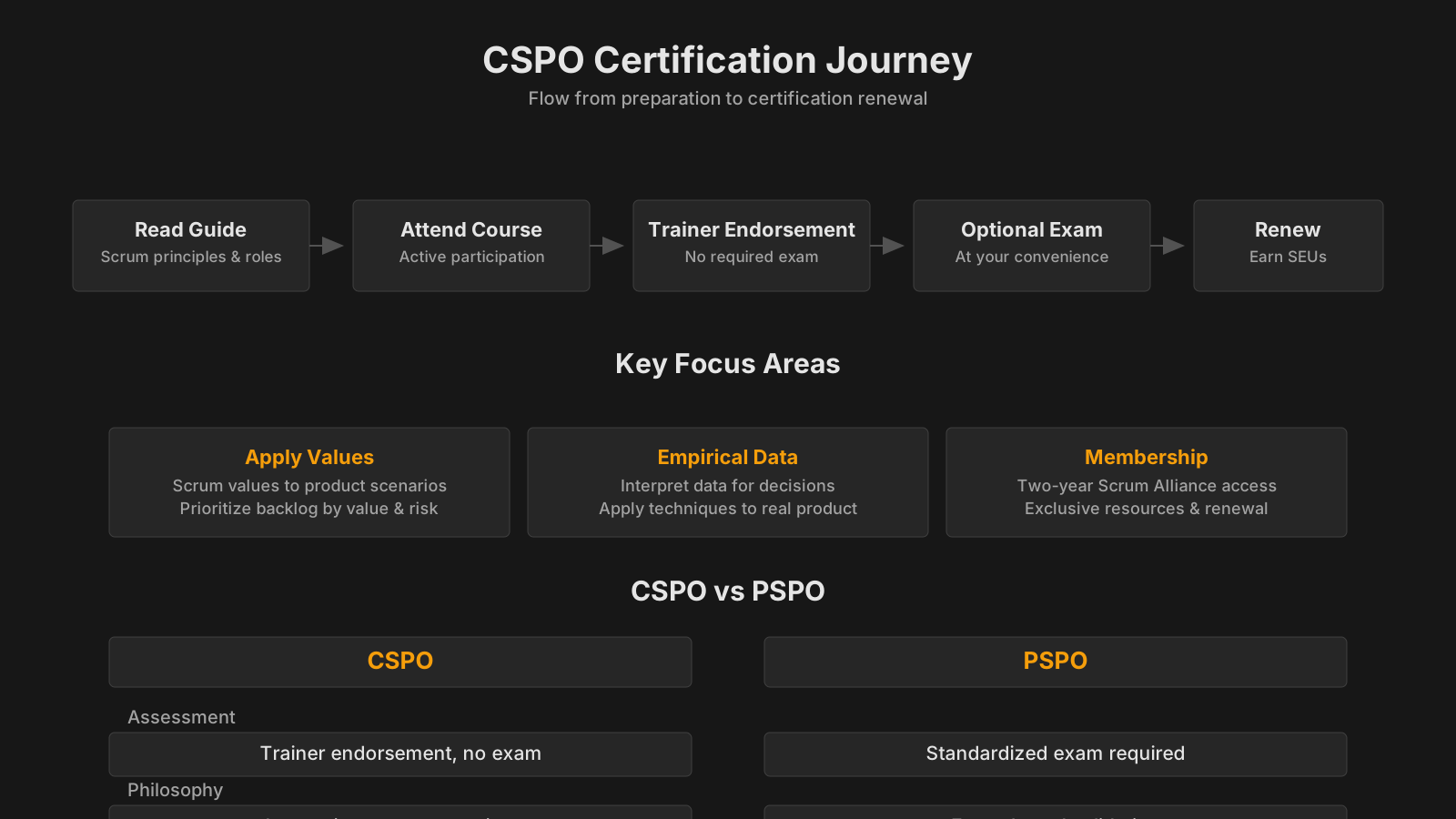
Key CSPO Certification & Exam Topics at a Glance
| Concept | Summary |
|---|---|
| Certified Scrum Product Owner (CSPO) | The CSPO credential from the Scrum Alliance validates your ability to drive value delivery, align diverse stakeholders, and optimize product outcomes through rigorous application of the Scrum framework. |
| Scrum Alliance | Established in 2001 by agile thought leaders, the Scrum Alliance mandates live, instructor-led training to foster deep interactive learning and a vibrant professional community for product owners. |
| Product Owner Role | The product owner steers product value by continuously refining the backlog, negotiating trade-offs, and rallying the team around a shared vision, all while leading through influence rather than direct authority. |
| Training Requirement | Aspiring CSPO professionals must attend an instructor-led course taught by a Certified Scrum Trainer (CST), which prioritizes immersive discussions and real-world application over rote memorization. |
| Assessment and Renewal | The CSPO assessment evaluates genuine comprehension of Scrum principles, and the credential must be renewed every two years by earning Scrum Education Units (SEUs) to maintain its active status. |
| Backlog Ownership | Product owners cultivate a well-groomed, value-ordered backlog where each item is crisply defined, continuously reprioritized, and directly linked to business objectives. |
| Stakeholder Alignment | CSPO training equips you with techniques for stakeholder negotiation and for motivating cross-functional teams through an inspiring product vision, not hierarchical directives. |
| Value Maximization | At every sprint boundary, the product owner makes evidence-based decisions on the next highest-value increments, balancing user needs, market dynamics, and business viability. |
| Accountability | While product owners bear full accountability for backlog integrity and product results, they exercise leadership through negotiation, empathy, and influence rather than command-and-control. |
| Continuous Learning | The Scrum Alliance fosters lifelong professional growth via Scrum Education Units, ensuring your CSPO remains relevant and you stay connected to the evolving agile community. |
What the CSPO Certification Actually Represents
The Certified Scrum Product Owner designation is granted by the Scrum Alliance, one of the largest and oldest agile certification bodies globally. Unlike some certifications that lean heavily on a body of knowledge alone, the CSPO is built on the principle that you learn the framework through active participation and guided discussion. This means the mandatory training course is not just a formality, it is the core of the certification experience. People often ask whether the CSPO is an entry‑level or intermediate credential, and the answer depends on the context. For someone completely new to Scrum, it serves as a foundational credential, while for an experienced product manager moving into an agile environment, it validates that you understand the Scrum framework specifically, which differs from traditional product management in several subtle ways.
At its heart, the Scrum Alliance CSPO certification is designed to affirm that you can function as a product owner within a Scrum team according to the rules and spirit of the Scrum Guide. That includes understanding how to create and refine a product backlog , articulate clear backlog items, collaborate with stakeholders, and work closely with the development team and Scrum Master . The certification does not promise to make you a great product leader overnight. Instead, it establishes a shared vocabulary and a set of practices that reduce the friction between business intent and technical execution. Over time, companies have started asking for it in job descriptions, not because a certificate proves competence, but because it signals a commitment to learning the mechanics of agile product delivery, which speeds up onboarding into real‑world teams.
The CSPO has evolved alongside the product owner role itself. Early in the agile movement, the product owner was often a subject matter expert temporarily assigned to a team. Nowadays, it is commonly a full‑time role demanding strategic vision, market awareness, and deep empathy for users. The certification curriculum has been updated to reflect this shift, though some old‑school training providers still teach the basics as if the product owner is simply a backlog manager. It is crucial to separate the certification requirements from the broader career path. The CSPO course covers the fundamentals, but mastering product ownership requires years of practice, countless tough conversations, and a mindset that balances data with instinct. In many ways, the certificate is the start, not the endpoint.
The Scrum Alliance as the Certifying Body
The Scrum Alliance was founded in 2001 by Ken Schwaber, Mike Cohn, and other agile pioneers. It remains a member‑driven organization focused on transforming the world of work through Scrum practices. Their certification ecosystem includes the Certified ScrumMaster, Certified Scrum Product Owner, Certified Scrum Developer, and a ladder of advanced credentials. The CSPO is often taken alongside or after the CSM because the two roles interact so tightly, yet it is completely feasible to pursue only the CSPO if your focus is product leadership. The organization mandates that all CSPO candidates complete a live training experience led by a Certified Scrum Trainer or a Registered Education Provider. This instructor‑led requirement is non‑negotiable, which is a departure from many online self‑paced Product Owner certification models. This approach preserves the interactive, conversation‑driven nature of Scrum learning and avoids the pitfall of people memorizing terms without understanding application.
One aspect that surprises many newcomers is the lack of a formal eligibility verification beyond course attendance. Anyone can enroll; there is no prerequisite for years of experience or a specific educational background. This openness has made the CSPO accessible to career changers, technical leads, business analysts, and startup founders who want to embed agile thinking into their work. However, the open door does not mean the content is diluted. The exam, introduced in recent years to strengthen the certification’s rigor, tests whether you truly absorbed the concepts from the training and the Scrum Guide. The Scrum Alliance also requires renewal every two years through the collection of Scrum Education Units, which encourages continuous learning. This model keeps the credential current and ties you into a broader community of practitioners.
Core Takeaways on CSPO Certification
- Active participation training requirement
- The CSPO’s required instructor-led course is a hands-on, facilitated experience that embeds the Scrum framework through active exercises and collaborative dialogue rather than passive memorization.
- Validation of Scrum Product Owner role
- Earning the CSPO validates your ability to manage the product backlog, align stakeholders around a shared vision, and collaborate effectively with developers and the Scrum Master in strict accordance with the Scrum Guide.
- Signal of commitment, not mastery
- Organizations value the CSPO because it demonstrates a candidate’s dedication to learning Agile frameworks and shared vocabulary, which reduces onboarding time, yet the certification is only the foundation and true expertise develops through sustained, real-world product ownership.
- Accessible entry with renewal obligation
- With no prerequisites, the CSPO welcomes professionals transitioning into product roles, while the required exam and mandatory renewal through Scrum Education Units every two years ensure the credential remains rigorous and promotes ongoing skill development.
Understanding the Product Owner Role Before You Step Into Training
Many people sign up for a CSPO course without a clear picture of what a product owner actually does day to day. The Scrum Guide defines the product owner as responsible for maximizing the value of the product resulting from the work of the Scrum team. That sounds abstract, so let’s ground it. In practice, a product owner spends a large chunk of time talking to users, customers, and internal stakeholders to understand their problems and opportunities. They then translate those insights into a prioritized product backlog, making constant trade‑off decisions about what to build next. They are the single person accountable for the backlog, but the role is deeply collaborative. They need to communicate the vision clearly enough that the developers can make good decisions independently while still staying aligned with the overall direction.
The product owner’s responsibilities in Scrum go beyond writing user stories. They include ordering the backlog, ensuring that items are clearly expressed and understood, and making sure the development team knows what is most valuable to work on in each sprint. The product owner also engages in sprint planning to help the team understand the “why” behind the work, participates in sprint reviews to gather feedback, and continuously refines the backlog so that it remains a source of truth, not a dusty document. What makes the role challenging is that it carries immense accountability without formal authority over the development team. You cannot command the team to work faster; you inspire them with a compelling vision and negotiate scope with stakeholders who all believe their request is the most urgent one. This tension is the reason why product ownership is often described as equal parts art and science, and why the CSPO training invests time in stakeholder management techniques and value definition.
Some organizations confuse the product owner with a project manager or a proxy for the business. The product owner is not a task assigner, nor a gatekeeper who approves every tiny decision. They are more of an entrepreneur embedded within the team, constantly asking “what is the next best investment of our limited development capacity?”. The CSPO training helps you internalize these nuances, but it is your real‑world context that will force you to adapt the role to fit your company’s culture. In a startup, you might be the founder doing everything. In a large enterprise, you might have product managers above you and multiple stakeholder groups to placate. The certification does not prescribe a single right way to handle all scenarios. Instead, it gives you the core pattern so you can recognize when you are deviating from Scrum principles and make intentional trade‑offs rather than accidental ones.
Inside the CSPO Training Course
The mandatory CSPO training is the heart of the certification experience. You cannot simply buy a book and take the exam; you must attend a live, instructor‑led course that runs for a minimum of 16 hours across two consecutive days. Some providers offer the training over four half‑days or in a blended format that still includes live sessions. The requirement for synchronous learning is one of the most valuable parts, because it forces you to wrestle with the material in real time, ask questions, and hear how other people in different industries interpret the role. The best trainers use a mix of short lectures, group exercises, simulations, and case discussions. A poorly facilitated course can feel like a series of slides about Scrum theory, while a great one leaves you exhausted but full of practical techniques you can apply on Monday morning.
When selecting a provider for your CSPO training course , it’s wise to look beyond just price. The instructor’s experience in product management and their ability to connect frameworks to real situations matter more than a flashy slide deck. Read recent reviews, look for trainers who have actually served as product owners or coached product teams, and check whether the course includes optional post‑training support like sample exam questions or alumni communities. Some providers now integrate the exam preparation directly into the training agenda, offering a few hours of dedicated review on the second day. Others leave you with the material and expect you to study independently after the course. Knowing which style suits your learning preference can make a big difference in how confident you feel going into the test.
What the Course Material Covers
Every accredited CSPO course must cover the fundamental Scrum framework, the product owner accountabilities, and techniques for managing the product backlog. Beyond this foundation, trainers have flexibility, which means the experience can vary widely. Most courses walk you through the Scrum theory, the empirical pillars of transparency, inspection, and adaptation, and the five Scrum values of commitment, focus, openness, respect, and courage. From there, they dive into the specifics: how to create a product goal, how to formulate hypotheses about value, techniques for splitting large items into smaller ones, and how to conduct effective backlog refinement sessions. Many courses also include modules on stakeholder mapping, user story mapping, and the basics of release planning. Some even touch on scaling frameworks like LeSS or Nexus if the trainer senses the room is interested, though these are not part of the official CSPO learning objectives.
An often underestimated part of the training is the amount of hands‑on practice. You will likely be put into small groups to simulate a product ownership scenario: deciding what to build for a fictional product, ordering a backlog with incomplete information, and negotiating with a stakeholder played by the trainer. These simulations force you to confront the messiness of real prioritization where every decision has an opportunity cost. The discussions that emerge during these exercises are where the deepest learning happens, because you see how different people weigh customer impact, technical risk, and business strategy. If you enter the course expecting just to take notes, you might miss the value of these interactive components. The truth is that the CSPO training is not a lecture to be consumed; it is a workshop to be experienced.
Delivery Formats and the Live Interaction Requirement
Most training providers today offer both in‑person and live online options. The online courses are conducted via video conferencing platforms like Zoom or Microsoft Teams, with breakout rooms simulating the small‑group exercises. In‑person training offers denser networking and fewer distractions for some people, but the online format has become incredibly polished since 2020. The Scrum Alliance requires that live online courses still be highly interactive, with cameras on and active participation. You cannot simply log in and listen while multitasking; trainers are expected to engage every attendee. If you are someone who learns best through physical presence and whiteboard work, an in‑person class might be worth the travel. If flexibility and reduced travel cost matter more, a well‑run virtual course can be equally effective, provided you carve out a distraction‑free space for those two days.
Whichever format you choose, the time commitment is intensive. Sixteen hours of active learning over two days means your brain will be processing a lot of information quickly. It helps to skim the Scrum Guide beforehand, even if just for 20 minutes, so that terms like sprint, increment, and definition of done are not completely foreign when the trainer uses them. You are not expected to be an expert walking in; that’s the whole point. But some light pre‑reading reduces the cognitive load and lets you spend more mental energy on the nuances of product ownership rather than basic definitions. Many trainers send a pre‑course email with recommended readings or videos, and it is well worth following those suggestions.
Core Takeaways on CSPO Training
- Mandatory live course requirement
- The CSPO certification mandates live, instructor-led training of at least 16 hours over two consecutive days, enabling real-time dialogue and cross-industry peer exchange that deepens practical understanding of product ownership.
- Choosing a trainer and provider
- Choosing a CSPO course should prioritize the instructor’s hands-on product management experience and teaching style over price, while also verifying recent reviews and post-training support such as alumni communities or sample exam resources that sustain learning beyond the classroom.
- Hands‑on practice and simulations
- Through small-group simulations of authentic product ownership scenarios, participants grapple with complex prioritization decisions and strengthen their judgment by debating trade-offs across customer impact, technical risk, and business strategy.
- Delivery formats: in‑person vs. online
- In-person and live online delivery both provide the required immersive experience; online courses demand cameras on and active engagement, and either format can succeed when matched to your learning preferences and your capacity to eliminate environmental distractions.
- Preparation and time commitment
- Although the course welcomes beginners with no prior Scrum knowledge, scanning the Scrum Guide before the 16-hour intensive helps anchor key concepts, enabling you to engage more deeply during the live sessions.
The CSPO Exam Structure and What to Expect
After completing the training course, you gain access to the CSPO exam, which you can take online at your own pace within a given timeframe, usually 90 days. The exam consists of 50 multiple‑choice questions that must be answered within 60 minutes. To pass, you need to correctly answer at least 37 questions, which translates to a 74 percent score. The format is fairly standard: each question presents a scenario or a conceptual prompt, and you choose the best answer from four options. There is no negative marking, so guessing on difficult questions carries no penalty. The questions are designed to test your understanding of the Scrum framework, the product owner accountabilities, and the proper application of Scrum practices, not obscure trivia. The exam is administered online through the Scrum Alliance’s platform, and you are allowed to reference the Scrum Guide and your course notes during the attempt. A timer on the screen helps you keep track, but 60 minutes is generally enough if you have internalized the core concepts.
What many candidates find tricky about the CSPO exam format is that the questions often require you to think about what a product owner should do in a specific situation, rather than simply reciting a definition. For example, a question might describe a scenario where stakeholders are adding requirements mid‑sprint and ask what the product owner’s best response is according to Scrum principles. The correct answer is rarely the most accommodating or the most rigid option; it is the one that respects the team’s focus while still addressing value. This blend of theory and practical judgment can surprise people who memorized the Scrum Guide line by line but didn’t reflect on how those rules play out in team dynamics. That’s why the training course and any practice exams you can find are so valuable; they train your brain to think like a Scrum practitioner.
Topics Covered in the Exam Questions
The exam content aligns closely with the CSPO learning objectives published by the Scrum Alliance. You can expect questions on the Scrum framework fundamentals, including the five events, three artifacts, and three accountabilities. The product backlog and backlog refinement get a lot of attention, as they are the primary instruments of the product owner. You will see questions about how to order the backlog, what makes a backlog item ready for a sprint, and who is responsible for estimating the work. Additionally, the exam touches on the sprint goal, the definition of done, the role of the product owner in sprint planning and sprint review, and the relationship between the product owner and the Scrum Master. There is also a focus on stakeholder collaboration, how to handle multiple stakeholders with conflicting needs, and the importance of delivering value incrementally. Some questions may probe your understanding of empirical process control and how transparency enables inspection and adaptation.
A smaller portion of the exam addresses the Scrum values and how they manifest in daily work. For instance, you might be asked which value is most clearly demonstrated when a product owner openly shares a difficult trade‑off with the team. The answers are not designed to trick you, but they do require you to connect values to behaviors. Another area that appears regularly is the boundary between the product owner and the development team; questions often test whether you know that the product owner is accountable for what gets built and in what order, but the development team is accountable for how the work is done. This separation is central to Scrum and is easy to misunderstand if you come from a command‑and‑control background. Knowing these boundaries deeply will not only help you pass the exam but also serve you in countless conversations with engineering managers later.
Practical CSPO Exam Preparation Strategies
Given that the exam is open‑note and grounded in a framework you just spent two days actively learning, you might wonder why preparation is even needed. The challenge lies in the clock. Sixty minutes for 50 questions means you have just over a minute per question, and some scenario‑based items take longer to parse. You do not want to waste time searching the Scrum Guide for every answer; that approach is a trap. Instead, effective CSPO exam preparation strategies focus on building enough fluency that you can answer most questions from understanding, reserving the guide only for the few questions that hinge on a specific phrase you cannot recall. The best preparation begins during the training itself, not after. Actively engage in discussions, take notes on the patterns your trainer emphasizes, and pay close attention to the mini‑scenarios and examples because those often mirror exam question structures.
After the training, one of the most effective things you can do is to read the Scrum Guide cover to cover, slowly and deliberately. It is only about 14 pages, yet most people skim it once and miss the subtle language. For the CSPO exam, you need to notice the precise wording around accountabilities. For example, the Guide says the product owner “is accountable for effective Product Backlog management,” and it lists five specific activities that constitute that management. The exam will test whether you know that the development team can help with refinement, but the accountability cannot be delegated. It is these little distinctions that separate a pass from a fail. As you read, highlight or note sentences that feel like they could become a question, particularly anything phrased as a definition or a rule.
Using Practice Tests and Quizzes
Practice questions are a powerful tool if used correctly. There are several online platforms that offer free CSPO practice exams, some provided by training companies and others by community sites. The quality varies, so test a few sources against the Scrum Guide to see if they align. Good practice questions will challenge you to apply the framework, not just recall terms. After taking a set of questions, review both your correct and incorrect answers. For each mistake, go back to the Scrum Guide or your notes and read the relevant section. This active retrieval and correction process cements the knowledge far better than passive re‑reading. Aim to do at least two full simulated exams under timed conditions so you get comfortable with the pace. If you consistently finish with time to spare and score above 80 percent, you are in a strong position.
Some candidates fall into the trap of hunting for exact exam dumps or leaked questions. Apart from the ethical concerns, this approach often backfires because the certified question bank is large, and memorizing answers without understanding the principles leaves you vulnerable to slight wording changes. The Scrum Alliance regularly updates its exam content to align with the current Scrum Guide, so old question sets may reference outdated concepts. A smarter path is to form a small study group with others from your training cohort. Discussing scenarios together reveals blind spots. For example, one person might be confused about whether the product owner must attend the daily scrum, while another can explain that the product owner is not required but may be invited. These discussions mimic the collaborative nature of Scrum and solidify your mental models.
Reviewing the Scrum Guide Beyond Surface Memorization
Many people read the Scrum Guide and think they understand it, then stumble when a question asks about a nuance. To go deeper, try summarizing each section in your own words without looking at the text. Then compare your summary to the original. This exercise exposes where your interpretation drifts from the official framework. For instance, many practitioners believe the sprint retrospective is about fixing problems, when the Guide frames it as a way to identify improvements to increase quality and effectiveness. Small shifts like that matter on an exam that values precision. Another technique is to teach the material to someone else, even if just a patient friend. Explaining the product owner’s role in simple terms forces you to organize your thinking and reveals gaps. If you cannot clearly explain why a product owner is not a committee but a single person, you might need to revisit that section.
It also helps to map the Scrum events to the product owner’s specific responsibilities. In sprint planning, the product owner proposes how the sprint could increase product value and ensures that the selected product backlog items align with the product goal. In the sprint review, the product owner presents what was accomplished and discusses what to do next based on feedback. The daily scrum is for the developers, but the product owner may attend to answer questions about the backlog. Understanding these event‑level details is not just for the exam; it is the daily rhythm of a Scrum team. When you internalize this rhythm, the exam questions about who does what during which event become intuitive rather than a memory test.
Key Exam Prep Takeaways: Fluency Over Memorization
- Build fluency during training
- Engage actively in discussions, identify the patterns your trainer highlights, and study mini-scenarios carefully, as they tend to mirror the structure of real exam questions.
- Master the Scrum Guide precisely
- Read the 14-page Scrum Guide slowly and deliberately, highlighting definitions and rules, and zero in on the precise wording of accountabilities such as the product owner's non-delegable responsibility for effective Product Backlog management.
- Use practice tests strategically
- Take timed simulated exams, cross-check all answers against the Scrum Guide, and avoid exam dumps entirely, since memorizing answers without understanding principles leaves you vulnerable to reworded questions.
- Deepen understanding by teaching
- Summarize each section of the Scrum Guide in your own words and then teach the material to someone else; this process reveals gaps in your interpretation and clarifies nuances, such as the product owner being a single person rather than a committee.
Common Challenges in the CSPO Journey and How to Address Them
One of the first hurdles people encounter is simply finding the time for a two‑day immersive course. Professionals in demanding jobs sometimes postpone their certification, waiting for a quiet period that never arrives. The trick is to schedule it like any other non‑negotiable commitment and block your calendar fully, including an evening after each day to decompress. Another challenge arises from the diversity of the participant group; you might have a room (physical or virtual) where some people have years of Scrum experience and others have none. This can cause some sessions to feel either too basic or too advanced. The best response is to engage with the pace honestly. If you are more experienced, use the exercises to practice articulating your decisions clearly, which strengthens your coaching muscle. If you are newer, ask the “obvious” questions because others are likely wondering the same thing. The CSPO exam challenges often mirror these classroom dynamics: people with deep experience sometimes overthink simple questions, while newcomers might miss the practical nuance because they focused too much on theory. Both groups benefit from grounding themselves in the Scrum Guide’s exact language.
After the course, procrastination on taking the exam is a silent killer. With a 90‑day window, it’s easy to believe you have plenty of time, and then suddenly the deadline is a week away and work projects have consumed your attention. A practical approach is to schedule the exam on the calendar within two to three weeks of completing the training, while the material is still fresh and before life intervenes. If you fail on your first attempt, the Scrum Alliance allows you to retake the exam at no additional cost after a brief study period, though the exact retake policy should be confirmed with your provider. This safety net reduces the anxiety, but it’s not an excuse to go in unprepared. Treat the first attempt as your primary shot, and view any retake as a backup, not a strategy.
Another subtle challenge is the gap between Scrum theory and your organization’s reality. Learners sometimes feel disheartened when their workplace practices conflict with what the training teaches. It is extremely common to return from a CSPO course fired up about proper backlog refinement, only to find a culture where stakeholders bypass the product owner or engineering priorities override everything. This friction can make the exam feel abstract and irrelevant. The mental shift that helps is to view the certification as a lingua franca. You learn the pure framework so you can communicate what good looks like and influence change over time. You do not need to implement perfect Scrum on day one; you just need to know the target you are aiming toward. The exam, in this sense, is not a test of your current workplace; it is a test of your understanding of the intended model.
How the CSPO Credential Influences Your Career
Adding CSPO after your name signals to employers and colleagues that you have invested in learning the most widely adopted agile framework for product development. While a certificate alone will not land you a senior product role, it often provides the initial credibility needed to be considered for product owner, technical product manager, or even business analyst positions that involve backlog management. Recruiters frequently use the CSPO keyword as a screening filter, so having it on your resume helps you get past automated systems. Beyond the resume value, the certification can accelerate your understanding of the product owner craft, which means you are less likely to stumble through your first months in a new role. The CSPO credential benefits also extend to internal mobility. Many organizations prefer to promote from within for product roles, and being certified demonstrates proactive learning, which can tip the balance in your favor when competing against a peer without the certification.
The community aspect of the Scrum Alliance is another under‑appreciated advantage. Once certified, you gain access to member‑only resources, local user groups, and global events like the Global Scrum Gathering. These networks can be lifelines when you face a tough stakeholder situation or need to benchmark your team’s maturity. The Scrum Alliance also offers an advanced Certified Scrum Professional–Product Owner credential that builds on the CSPO, requiring deeper experience and continuing education. For those who want to climb the agile career ladder, the CSPO becomes a stepping stone toward roles like product lead, head of product, or agile coach with a product focus. It does not guarantee those outcomes, but it removes an obstacle that might otherwise slow you down.
It is also worth noting that many people find the CSPO useful even if they never officially hold the title of product owner. Business analysts, UX designers, data analysts, and project managers who understand the product owner’s perspective collaborate more effectively with Scrum teams. They ask better questions, contribute to backlog discussions with more clarity, and help bridge the gap between business stakeholders and developers. In that sense, the certification has a ripple effect that improves team dynamics beyond just the designated product owner. The investment in two days of training and an exam often yields a return through fewer miscommunications and wasted development cycles, though such returns are hard to quantify on a resume.
Core Career Impacts of CSPO
- Screening filter and credibility
- Recruiters routinely rely on the CSPO keyword when filtering candidates, and the certification immediately signals competence for product owner, technical product manager, and business analyst roles that center on backlog management.
- Accelerated onboarding and learning
- The certification compresses the learning curve for product ownership, equipping you with battle-tested practices that prevent trial-and-error mistakes in the initial months of a new position.
- Community access and career ladder
- Scrum Alliance membership opens the door to exclusive knowledge libraries, local practitioner meetups, and international gatherings, while the credential establishes a clear foundation for advancing to product lead, head of product, or agile coach.
- Ripple effect across team roles
- Even professionals outside the product owner title, such as business analysts, UX designers, and project managers, adopt a product-centric lens that sharpens backlog conversations and eliminates costly misunderstandings across functions.
Integrating CSPO Knowledge Into Real‑World Product Ownership
Passing the exam is a milestone, but the real challenge begins afterwards when you have to apply Scrum principles in environments that are often messy. Many new CSPOs struggle with the sheer volume of stakeholder input and the pressure to commit to exact timelines. The training teaches you to forecast using empiricism, not promise fixed scope by a fixed date, but business stakeholders often want commitments. Navigating this tension requires that you combine the CSPO frameworks with soft skills that the course may not cover in depth. You learn to create a transparent backlog with relative estimates, to use product goals to frame conversations, and to say no in a way that feels collaborative rather than adversarial. None of this is easy, but the CSPO gives you a foundation of concepts to fall back on when you feel pressured to revert to waterfall thinking.
Sprint reviews become your primary mechanism for building trust through evidence rather than status reports. By demonstrating a working increment and discussing what you learned, you shift the conversation from “are you on track?” to “what should we do next based on what we now know?”. This subtle shift, which the CSPO training emphasizes, can transform a tense stakeholder relationship into a partnership. Many organizations also expect the product owner to be deeply involved in discovery work, testing assumptions before they even reach the backlog. While the CSPO curriculum touches on product discovery lightly, you will likely need to supplement with books and courses on lean startup, design thinking, or continuous discovery habits. The CSPO certification is not intended to cover all aspects of product management; it is specifically about the product owner role in the Scrum framework. Recognizing this boundary helps you seek the right additional knowledge without feeling that the certification was incomplete.
Frequently Asked Questions About the CSPO Certification
Many common queries circle around the differences between the CSPO and other product certifications. The CSPO certification FAQ topics often start with how it compares to the PSPO from Scrum.org. The PSPO (Professional Scrum Product Owner) does not require a mandatory course, and its exam is considered more challenging by many. The CSPO, by contrast, requires the course but focuses heavily on application during training. Neither is inherently better; the choice depends on whether you prefer a guided learning path with a live instructor or a self‑study approach with a tougher exam. Another frequent question is whether the CSPO expires. The certification is valid for two years, after which you need to renew it by earning and logging Scrum Education Units (SEUs). Renewal keeps you engaged with the agile community and ensures your knowledge stays current, which is important as the Scrum Guide evolves over time.
People also ask about the total cost, which varies by training provider and region but typically ranges between a few hundred to over a thousand dollars for the course and exam fee combined. Some providers bundle the exam fee; others charge separately. It is smart to check what is included before purchasing, because the exam fee and any retake policies are not always transparent. Another question that comes up repeatedly is whether you can fail the CSPO exam. Yes, you can. If you score below 37 correct answers, you fail. You will then have an opportunity to retake it, usually without additional cost, though the specific retake window and number of attempts allowed are determined by your training provider and the Scrum Alliance’s policies. The failure rate is not publicly published, but anecdotally, most people who actively participated in the training and did some review pass on the first attempt. Those who treat it as a checkbox exercise sometimes stumble.
Some prospective candidates wonder if the certification is worth it for someone with years of product management experience. The answer depends on your goals. If you already understand Scrum deeply and have a track record of successful product delivery, the CSPO may not teach you anything earth‑shattering. However, it can still serve as a formal credential that validates your knowledge to new employers or clients who value standardized certifications. In a job market where initial screening algorithms and recruiters look for specific keywords, having it can open doors that would otherwise remain closed. For experienced professionals, the two‑day course can also be an opportunity to benchmark your practices, learn a few new facilitation techniques, and network with others in similar roles. It is rarely a waste of time if you go in with curiosity.
Essential Answers to CSPO FAQs
- CSPO versus PSPO choice
- The CSPO mandates an instructor-led course that emphasizes applied, collaborative learning, whereas the PSPO permits self-paced preparation but features a more rigorous exam, making the right path contingent on your preferred learning style.
- Two-year renewal with SEUs
- CSPO certification remains valid for two years and requires renewing through Scrum Education Units (SEUs), a process that ensures your expertise stays aligned with evolving Scrum Guide practices.
- Cost and exam retake details
- Total costs vary significantly by provider and region, but most actively engaged participants pass on the first attempt, and standard retake policies typically include additional attempts at no extra charge.
- Value for experienced product managers
- Beyond its role as a respected credential for career advancement, the CSPO offers seasoned product managers a structured opportunity to benchmark their practices, acquire new techniques, and expand their professional network.
Moving Forward After Earning Your CSPO
Once you have the certification, it is wise to set a learning plan for the months ahead. The CSPO alone will not make you a great product owner, but it gives you a map of concepts to deepen. Start applying backlog management techniques immediately, even if your current workflow is only semi‑Scrum. Find a mentor who has walked the path and can give you feedback on your backlog refinement sessions or stakeholder communications. Consider joining a local agile community of practice where you can share struggles and hear how others solve similar problems. Many CSPOs begin their Scrum certifications journey and then move on to the CSM to better understand the Scrum Master’s perspective, which makes them more effective collaborators. Others pursue product‑specific learning around analytics, user research, and product strategy. The certification is not a finish line but a doorway into a wider discipline.
It is also healthy to recognize the certification’s limits. No two‑day course can make you an expert in negotiating with executives or managing a product P&L. Those skills come from experience, coaching, and sometimes painful failures. The CSPO does, however, provide a lens through which to view those experiences. When a stakeholder demands a feature that you suspect is a waste of time, the framework gives you vocabulary to discuss value and assumptions rather than just saying no. When the development team seems disengaged, the Scrum values and the product goal can be rallying points to reignite purpose. Over time, these tools become second nature, and the certification itself fades into the background as your practical identity as a product owner takes center stage. That is exactly how it should be.
In the end, the CSPO certification is a significant but manageable commitment that can accelerate your understanding of Scrum and product ownership. The mandatory training makes it a social learning experience, the exam ensures you internalized the framework, and the ongoing renewal requirement nudges you toward continuous growth. It is not a magic ticket, but for many people, it marks the point where they stopped talking about agile and started living it. If you go into the process with genuine curiosity and a willingness to engage deeply with the material, you will likely find that the value extends well beyond the certificate itself, shaping how you think about collaboration, value, and the potential of well‑run teams.
Advance Your Career with Professional Certification
Earning a recognized credential in project management gives you an edge when employers screen for leadership readiness. A flexible PM certification online program lets you build skills in risk planning, budgeting, and stakeholder communication without stepping away from your current role. The curriculum typically mirrors PMI’s process groups and includes realistic exam simulations. Recruiters often view this certification as immediate proof that you can deliver complex initiatives on time.
The product manager role demands a rare mix of customer empathy and strategic thinking. Pursuing a certified product manager credential helps you formalize those abilities through structured training in backlog refinement, roadmap creation, and cross-team influence. Many preparation courses use case studies that reflect the decisions you face daily in a product lifecycle. Holding this certification often shortens the path to senior product roles.
HR practitioners who combine experience with formal credentials frequently gain access to higher-level advisory positions. Intense HR training and certification walks you through compliance frameworks, total rewards design, and talent analytics using the same scenario-based methods found in SHRM and HRCI exams. The process forces you to audit your own practices against industry standards. Organizations use these certifications to identify professionals capable of shaping culture and driving measurable workforce outcomes.