Every leader wants their teams to work together more closely. The logic seems unassailable: cross-functional projects , real-time chat groups, shared dashboards, and tighter alignment must surely accelerate decisions and improve outcomes. Yet walk the corridors of most growing companies and you hear a quieter counter-narrative. People spend more hours in coordination conversations than in focused work. Decisions that once took a phone call now traverse three Slack channels, a Zoom alignment session, and a thread of email clarifications. The machinery of collaboration, built with the best intentions, slowly becomes a tax on the very speed it was meant to create. This phenomenon has a name that is gaining traction among business analysts and organizational researchers: the coordination cost paradox. It describes a situation where adding more collaborative structures, more communication tools, and more integration points does not streamline work but rather introduces hidden frictions that quietly sap productivity. The paradox is especially insidious because traditional financial metrics usually applaud the initiative—more meetings signal active management, more group chats suggest transparent culture—while the true economic burden remains invisible on the spreadsheet.
The coordination cost paradox has been examined from multiple angles in recent academic work, and the picture is consistent: as coordination intensity rises, so do opportunity costs that conventional accounting systems never catch. A decision to add a weekly cross-department sync might look cost-free except for the calendar invite, but in reality it pulls highly compensated thinkers away from value-creating analysis . Multiply that by dozens of such touchpoints across the organization and the aggregate drag becomes enormous. Yet because this drag is categorized as overhead, it rarely triggers the same scrutiny as a direct expense line item. Managers might even celebrate the new level of collaboration without realizing that the same team now delivers output at a slower rhythm. The paradox holds a mirror to a common blind spot in how organizations measure productivity —and if it is not confronted, scaling collaboration can become a self-defeating exercise.
The following exploration draws together findings from supply chain economics, engineering-to-order manufacturing, apparel industry dynamics, logistics outsourcing, hybrid work research, project management, and business process management. Each perspective adds a layer of nuance to the coordination cost paradox, and collectively they offer a robust framework for diagnosing when collaboration has crossed the line from enabler to bottleneck. Rather than advocating for less cooperation, the insights suggest a more disciplined approach to coordination design: one that asks hard questions about the real cost of every new interaction demand and actively seeks to substitute low-friction digital integration for high-friction human alignment rituals.
The Coordination Cost Paradox: Key Takeaways
| Key Concept | Summary |
|---|---|
| Coordination Paradox | Introducing additional collaborative frameworks and communication channels often generates latent friction that erodes throughput rather than expediting it. |
| Hidden Costs | Conventional accounting classifies coordination tasks as undifferentiated overhead, obscuring the opportunity cost incurred when highly skilled professionals are diverted from deep, value-generating work. |
| Opportunity Cost | Enterprises routinely undervalue the economic toll of coordination because the output surrendered to redundant meetings and persistent messaging never surfaces as a tangible cost on financial statements. |
| Digital Tools | Integrated business intelligence platforms can intensify the paradox by creating tacit expectations for continuous monitoring and immediate response, layering on coordination requirements that impede execution velocity. |
| Bottleneck Creation | In engineer-to-order manufacturing, cross-functional digital integration multiplied decision touchpoints and inter-operation discussions, generating fresh bottlenecks even as information traveled faster. |
| Supply Chain View | Supply chain research demonstrates that coordination intensity, when not expressed as an opportunity cost, consistently evades management review, despite constituting a significant share of labor expense. |
| Non-Value Activities | Excessive status reporting, repetitive clarification cycles, and cognitive switching triggered by notifications represent coordination waste that steadily degrades productive output. |
| Measurement Blindness | The paradox endures because leadership frequently champions activity-based collaboration metrics like meeting cadence and chat volume, failing to perceive the parallel erosion of sustained output. |
| Disciplined Design | Rather than calling for reduced cooperation, the findings point to a deliberate design strategy that replaces high-friction alignment ceremonies with low-friction, digitally embedded coordination. |
| Scaling Pitfall | Left unaddressed, the coordination cost paradox turns scaling collaboration into a self-defeating effort that decelerates progress instead of accelerating it. |
The Hidden Price Tag of Every New Group Chat: Unveiling the Coordination Cost Paradox
When a department launches a new group chat, the immediate thought is rarely about cost. The software license might be negligible, and the time to type a message feels trivial. But what gets overlooked is the cumulative effect of these communication channels on the attention economy of the team. A study on supply chain cost modeling argues that traditional accounting frameworks simply do not see the productivity erosion that comes from non-value-added coordination activities—things like excessive status updates, redundant clarification loops, and the mental context-switching that follows every notification. As a research paper published by Inderscience Publishers describes, standard cost models treat these interactions as generic overhead, failing to attach a monetary value to the lost opportunity of what individuals could otherwise be doing. This blindness creates a productivity paradox: collaboration projects may be rejected because their imagined savings seem small on paper, or they may be approved without any recognition of the quiet burden they impose.
One reason the coordination cost paradox remains hidden is that it lives in the gap between actual output and potential output. An engineer who attends three alignment meetings a day still produces something—just less than she could if those hours were protected. The delta does not appear as a negative line on a profit-and-loss statement; it is simply forfeited. The economic cost model proposed by Chiadamrong and Wajcharapornjinda brings this delusion into focus by introducing opportunity cost as a metric for evaluating coordination intensity. Their work shows that unless organizations explicitly measure what is sacrificed when key people spend time in coordination, they will consistently underestimate how much collaboration is costing them. The interesting part is that this isn't a marginal effect—the accumulation across hundreds of micro-interactions can represent a substantial percentage of total labor expenditure, yet it stays entirely off the management radar.
Digital tools, often positioned as the solution to coordination overhead, can deepen the problem in surprising ways. Integrated business intelligence systems that link sales, engineering, and production promise to cut lead times by making information instantly accessible. And sometimes they do. But the very act of creating cross-operation digital visibility forces new coordination demands that didn't exist before. When a production planner suddenly has a live feed of what the sales team is promising, that transparency creates an implicit obligation to monitor, react, and adjust—none of which was required in the old siloed model. So the tool adds value, but it also adds a new layer of coordination work. Unless the organization deliberately redesigns its coordination architecture to absorb that new complexity, the overall pace of execution may actually slow down. This is a classic manifestation of the paradox: more connection doesn't automatically equal more speed if the connective tissue itself consumes oxygen.
Hidden Coordination Cost Insights
- Invisible Productivity Erosion
- Conventional cost models fail to capture the cumulative mental strain and fragmented focus caused by constant group chats and meetings, treating these interruptions as benign overhead rather than tangible productivity leakage.
- Opportunity Cost of Coordination
- Organizations need to explicitly quantify the trade-offs when key personnel spend time on coordination tasks, because the aggregate effect of micro-interactions can consume a significant share of labor budgets without ever appearing in financial reports.
- Digital Tool Burden Paradox
- Integrated platforms frequently impose hidden duties of continuous monitoring and rapid response, generating extra coordination overhead that slows execution unless organizations deliberately redesign workflows to accommodate this added complexity.
When Collaboration Becomes a Bottleneck in the Coordination Cost Paradox
In some manufacturing settings, the push for extreme collaboration happens for the most rational of reasons. An engineering-to-order small-to-medium enterprise, for example, faces intense pressure to deliver customized products with lead times that rival standard make-to-order competitors. The natural strategic response is to digitally link previously separate functions so that information flows without delay. According to research published by Emerald Publishing, a case study of exactly this kind of firm showed that adopting a unified product family architecture and connecting sales, product development, and production preparation delivered significant gains in delivery performance. The company managed to achieve ETO lead times that were once thought impossible. But the same research uncovered an uncomfortable undercurrent: the state-of-the-art cross-operation integration directly challenged the existing supply chain coordination model. The digital links that made rapid information exchange possible also multiplied the number of decision points and inter-operation conversations required to keep everything aligned.
This coordination cost paradox surfaced in the form of new bottlenecks that the technology itself introduced. The business intelligence dashboards gave everyone visibility, but that visibility demanded consensus on how to interpret data, synchronize priorities, and resolve conflicts that were previously handled locally. The SMEs studied by Bejlegaard, Sarivan, and Waehrens found that while lead times fell, the long-term influence of increased interoperability on coordination strategies remained uncertain. In other words, the initial win might erode if the organization does not evolve its coordination mechanisms to handle the very complexity it created. The findings suggest a cautionary principle: any investment in collaboration infrastructure must be accompanied by an equal investment in simplifying the coordination rules of the game. Without that, the organization ends up with more connections but less operational tempo—a perfect illustration of why well-meaning collaboration can quietly turn into a bottleneck.
What makes this especially treacherous is that the slowdown is often masked by the apparent success of the digital implementation. When a dashboard shows real-time metrics and managers see tasks moving across functions, they assume efficiency has improved. But the measure of true throughput might be declining because teams are spending more time managing the tool and the interdependencies it reveals than they spent managing the work before. The coordination cost paradox reminds us that adding integration layers is not a neutral act; it alters the very physics of how work flows, and the new friction points may be invisible until the organization's velocity has already dropped.
Why Your Best-Intentioned Teams Move Slower Together: The Coordination Cost Paradox in Action
High-cost industries like apparel manufacturing in the European Union face a different flavor of the paradox. When managers try to implement small-series production that is more sustainable and responsive to on-demand trends, they encounter tensions between cost control, flexibility, and risk. These tensions push them toward more supply chain collaboration, knowledge development, and process innovation. On the surface, this is entirely sensible: by working closer with partners and sharing insights, firms expect to overcome the inherent trade-offs. Yet a study published by Emerald Publishing reveals that these collaborative responses generate their own set of organizing tensions. The very mechanisms adopted to manage complexity end up adding layers of temporal separation, where short-term sacrifices are made to accommodate long-term process development, and the learning tensions that result often go unrecognized by management.
The coordination cost paradox emerges here as a creeping drag on team speed. When a fashion company decides to co-develop a new line with a fabric supplier through a series of iterative meetings, the intent is to cut time-to-market by aligning specifications early. But the reality can be that the team now spends hours in alignment sessions that delay the design team's ability to prototype. The knowledge development is valuable, yet the immediate coordination load reduces the team's capacity to execute. Harper's research on paradoxical tensions in the EU apparel industry found that managerial responses to these challenges did not involve structural changes; instead, they leaned into synthesis through product-operations efficiency and deeper collaboration. While this sounds thoughtful, it can inadvertently slow the operation because the added collaboration creates friction that stacks up over multiple cycles. Managers may perceive the activity—meetings, joint planning sessions—as progress, even as the overall speed of delivery quietly declines.
Organizations sometimes treat collaboration as an unalloyed good, pouring it onto any process that feels broken. But the coordination cost paradox suggests that collaboration is a resource that itself consumes resources. When teams are already overloaded with interdependencies, adding more coordination touchpoints doesn't lubricate the mechanism; it gums it up. The apparel industry example is instructive because it highlights how even in contexts where sustainability and customization demand intense cooperation, there is a point beyond which additional collaboration starts delivering negative returns. Identifying that inflection point requires a discipline that most firms lack, because the metrics they track—project milestones, partner satisfaction—do not capture the hidden slowdowns.
Core Insights on the Coordination Cost Paradox
- Collaboration generates its own tensions
- The very mechanisms EU apparel firms rely on to manage complexity, including tighter supply chain integration and knowledge co-creation, inadvertently generate temporal disconnects and hidden learning frictions.
- Coordination drag on team speed
- When a fashion brand co-develops a product with a supplier through iterative meetings, the alignment sessions intended to compress time-to-market end up postponing the design team's ability to prototype.
- Managerial misperception of progress
- Managers often mistake coordination activities such as meetings and joint planning for genuine progress, even as the mounting coordination burden silently erodes overall delivery speed.
- Collaboration consumes resources
- Treating collaboration as an unabashed good overlooks its real consumption of time and attention. Adding more coordination touchpoints gums up an overloaded team instead of lubricating its work.
- Difficulty spotting the inflection point
- Firms struggle to identify the point beyond which further collaboration drags down performance because their tracked metrics overlook the subtle erosion in delivery speed.
The Real Cost of Constant Alignment Meetings
Alignment meetings occupy a sacred space in corporate culture. The belief that getting everyone in the same room (or video call) ensures clarity is deeply ingrained. And indeed, synchronization of actions toward a shared goal requires some form of explicit communication. However, as researchers from SAGE Publishing have clarified, there is a conceptual fog around terms like collaboration, coordination, and cooperation that leads organizations to default to meetings as a one-size-fits-all solution. The systematic review by Castañer and Oliveira distinguishes these concepts by their temporal stage and type of goal, revealing that many meetings are assembled to achieve coordination when a simpler mechanism would suffice. The result is a proliferation of standing meetings that consume enormous tracts of collective time without proportional benefit.
The real cost of constant alignment meetings isn't just the salary hours burned in the room; it's the opportunity cost of what people aren't doing. When a senior engineer spends six hours a week in cross-functional syncs, that's six hours of design work lost to the company. But the more subtle cost is cognitive: the fragmentation of attention that makes deep work nearly impossible on meeting-heavy days. The coordination cost paradox makes this expense invisible because traditional cost accounting treats meeting time as a sunk overhead, not as a variable drag on output that could be redesigned. Some organizations are beginning to see that digital integration can replace many of these meetings by providing real-time business intelligence that makes status updates and alignment discussions redundant. The earlier-noted case of the engineering-to-order SME that implemented cross-operation digital integration showed that lead times approached make-to-order levels precisely because the digital tools reduced the need for constant human synchronization.
The Coordination Cost Paradox of Excessive Meetings
When the coordination cost paradox plays out through an over-reliance on meetings, the damage compounds because meetings beget more meetings. A decision made in a cross-team alignment session often spawns action items that require pre-meetings, follow-up meetings, and offline discussions. Before long, the meeting load becomes self-perpetuating. The research by Castañer and Oliveira suggests that many organizations fail to distinguish between when formal alignment is necessary and when information transfer can occur through less intrusive channels. They treat frequent interaction as a proxy for effective synchronization, not recognizing that the interaction itself is a cost. The paradox here is that reducing the number of alignment meetings—by investing in better digital dashboards or by clarifying decision rights—can actually improve coordination more than adding yet another weekly sync. But that requires a counterintuitive leap: less collaborative activity can lead to more effective collaboration. Until leaders grasp this, they will continue to schedule their way into a slower organization.
The Many Faces of the Coordination Cost Paradox in Modern Work
Beyond meetings and cross-functional chats, the paradox manifests in several contemporary work trends that were meant to increase flexibility and performance but inadvertently introduced new coordination burdens. Outsourcing, hybrid work arrangements, and radical transparency initiatives each carry their own version of the paradox, often undetected until performance metrics start to erode.
The Outsourcing Coordination Cost Paradox in Logistics
Outsourcing logistics is a textbook strategy for focusing on core competencies while leveraging specialist providers to cut costs and improve service. Yet the act of shifting activities to an external partner does not eliminate coordination; it merely relocates it across organizational boundaries. A study of logistics service providers in Morocco, published by 4S go, s.r.o., found that industrial companies entrusting their logistics to third parties face a paradox of collaboration and coordination. The anticipated performance gains are frequently diluted by the need to manage a dense web of information exchanges, contract oversight, and joint problem-solving that generates transaction costs. These costs are rarely factored into the outsourcing business case because the metrics focus on unit price reductions and service-level improvements without measuring the hidden coordination overhead that the arrangement creates internally.
This coordination cost paradox becomes visible when managers complain that they spend more time managing the supplier relationship than they ever did running the logistics function in-house. The irony is sharp: the very move that was supposed to free up time ends up consuming it in different forms. The research by Ben kaddour, Rajaa, and Medouri highlights that while the practice of logistics outsourcing continues to grow, the collaboration/coordination paradox remains unresolved. Firms add collaborative planning sessions, quarterly review meetings, and integrated IT platforms with their providers, all of which are necessary, but none of which come without a cost. What appears on paper as a more responsive supply chain may in practice be a slower one, because the coordination load reduces the organization's ability to focus on the strategic opportunities it was supposed to pursue.
The Hybrid Work Coordination Cost Paradox
The shift to hybrid work brought enormous flexibility benefits, but it also introduced a structural separation that undermines effortless coordination. When some team members are in the office and others remote, the spontaneous hallway conversations and quick desk-side clarifications disappear. In their place come scheduled check-ins, asynchronous message threads that stretch for hours, and careful documentation to bridge the location gap. A recent exploration published by MDPI reveals what researchers call the differentiation-integration paradox of hybrid work. At the individual level, employees integrate their work and personal roles more seamlessly, but at the team level, the structural differentiation across locations prevents effective integration and coordination. The result is that while each person may feel more autonomous, the collective ability to move swiftly on interdependent tasks suffers.
Here, the coordination cost paradox works through the medium of location dispersion. The very policies designed to give people autonomy—the choice to work from home—create a demand for explicit coordination that would not exist if everyone were co-located. A simple question that might have taken ten seconds to resolve in person now requires a message, a waiting period, and possibly a follow-up. Multiplying that across every lunch break and water-cooler moment that is lost yields a significant drag on team throughput. The research by Manole, Curșeu, and Trif suggests that organizations often fail to recognize this drag because they measure individual productivity in hybrid settings but overlook the team-level coordination costs that slowly accumulate. The paradox is not an argument against remote work; it is a call to design coordination mechanisms that compensate for the loss of informal synchronization, rather than simply layering on more meetings and digital checkpoints that themselves become burdens.
The Transparency-Driven Coordination Cost Paradox
Radical transparency is often championed as a cure for organizational inefficiency. Open data, visible dashboards, and accessible communication archives can reduce information asymmetry and empower better decisions. But transparency also has a dark side. When employees know that their work is constantly visible, they may shift effort away from actual production toward managing impressions—crafting updates, justifying decisions, and preemptively aligning with stakeholders. A seminal article by Ethan Bernstein, published through SAGE Publishing, describes a transparency paradox where increased observability does not automatically improve performance; instead, it can drive behaviors that slow down real work. In the context of the coordination cost paradox, transparency creates new coordination obligations because people feel compelled to constantly explain and calibrate their actions to avoid misinterpretation.
The coordination cost paradox deepens as transparency tools multiply the audience for every move. A product manager who updates a roadmap now has five different stakeholder groups watching, each with its own interpretation. To preempt conflict, she schedules a round of pre-alignment meetings, drafts detailed rationales, and spends hours in chat threads clarifying nuances. All of this activity may appear productive because it generates visible communication artifacts, but it subtracts from the time she could spend actually refining the roadmap design. The paradox reveals that transparency without clear boundaries can create a coordination tax that outweighs its informational benefits. Designers of collaborative systems must therefore consider not just what information is shared, but what the observation of that information will do to the cognitive load of the team.
Core Takeaways on Coordination Paradoxes
- Outsourcing shifts the coordination burden
- Firms that outsource logistics often find that managing supplier relationships generates hidden transaction costs which absorb the time and cost savings they expected to gain.
- Hybrid work erodes informal coordination
- Without spontaneous in-person exchanges, hybrid teams fall back on slower, formal coordination routines that diminish collective throughput despite preserving individual flexibility.
- Transparency fosters impression management
- Radical transparency tends to divert employee energy into crafting curated status updates and defensive justifications, directly undermining the productivity gains it was intended to unlock.
The Coordination Cost Paradox in Project Management and Process Innovation
Project-driven organizations face a distinct version of the paradox because they must balance two competing imperatives: learning between projects to avoid repeating mistakes, and unlearning within projects to adapt to unique circumstances. This dual demand inherently involves coordination, and the way firms structure that coordination determines whether they speed up or slow down over time.
Sustainable Project Collaboration and the Coordination Cost Paradox
Sustainable project management practices often champion collaborative business arrangements like partnering to improve delivery outcomes and embed environmental and social goals. There is strong intuitive logic behind this: when project stakeholders from different organizations share knowledge and align objectives, they can achieve efficiencies that no single entity could. However, the actual evidence is more nuanced. Research published by MDPI on sustainable project management through collaboration found that uncertainties persist about the optimal strategy for fostering and maintaining collaboration. A case study of an infrastructure maintenance contract revealed that while extensive collaboration promoted sustainable deliveries through organizational learning, the coordination costs required to maintain such arrangements were not fully addressed. The upshot was that the project achieved its sustainability goals, but perhaps at a higher operational cost than expected.
The coordination cost paradox surfaces here in the tension between collaborative depth and operational efficiency. Every partnering workshop, joint risk analysis, and integrated planning session generates value, but it also consumes resources that could be deployed elsewhere. The study by Larsson and Larsson underscores that different collaborative practices affect diverse aspects of project management, and that simply layering on more collaboration without understanding its cost profile can dilute the very performance gains it seeks to create. For project sponsors and managers, the lesson is to explicitly evaluate the coordination overhead of collaborative initiatives and to look for ways to streamline the interaction without sacrificing the learning. Otherwise, the project may deliver sustainable outcomes while quietly eroding its own margin.
Innovation Projects and the Coordination Cost Paradox
Innovation-intensive environments rely on project-based organizational structures to break away from rigid functional silos and respond rapidly to market shifts. Such structures are critical for balancing learning between projects and unlearning within projects—processes that are inherently coordinative. Yet the presence of company-specific predispositions for team coordination is necessary but not sufficient for sustaining continual innovation. Doctoral research from the University of Toronto, examining how organizations can sustain continual innovation in highly competitive markets, points out that even when firms have a strong appetite for coordinating across project teams, that coordination itself can become a barrier if it is not calibrated correctly. The predisposition to coordinate can lead to an excessive standardization of communication rituals that stifle the very creativity the organization seeks to unleash.
This coordination cost paradox is especially dangerous in innovation contexts because the damage is hard to detect. When a brilliant research team is pulled into weekly status meetings to coordinate with marketing and manufacturing, the immediate output might still look acceptable—patents are filed, prototypes are built. But the pace of ideation slows because the daydreaming and unstructured exploration that drive breakthroughs cannot flourish on a tight schedule. Hoffbauer’s work suggests that sustaining innovation requires not just coordination mechanisms but intentional slack that protects teams from excessive interaction demands. Without that, the firm ends up with perfectly coordinated mediocrity: everything aligns, but nothing astonishes. The paradox teaches that organizations must treat coordination as a scarce resource, allocating it carefully to the points where it yields the highest collaborative return while shielding creative core processes from its overreach.
Business Process Management's Hidden Coordination Cost Paradox
Business Process Management, or BPM, has long promised to bring discipline and efficiency to how work gets done. Process models serve as blueprints for design, enactment, and analysis, and they can enable significant productivity improvements when deployed thoughtfully. Yet the introduction of BPM technology has both managerial and technical ramifications that introduce coordination costs of their own. A comprehensive survey by van der Aalst, published by Hindawi, explains that while BPM can make processes transparent and measurable, the effort to model, monitor, and continuously improve those processes creates a new coordination layer that overlays the actual work. Every process change requires stakeholder alignment, every deviation triggers exception handling meetings, and every performance dashboard generates discussion sessions. The hidden cost of BPM is not in the software but in the human coordination needed to keep the process machinery running smoothly.
The coordination cost paradox in BPM environments often appears as a creeping formalization that substitutes process adherence for genuine problem-solving. Employees spend more time updating process documentation and attending process improvement workshops than they save from the efficiencies the process claims to deliver. Meanwhile, the dynamic nature of business means that the processes are never fully stable, so the coordination loop is continuous. Van der Aalst’s survey notes that while BPM can provide a solid foundation for operational excellence, the managerial burden of coordinating the BPM lifecycle should not be underestimated. Companies that mistake BPM adoption for an automatic efficiency gain risk falling into the trap where the coordination needed to manage the processes outweighs the gains the processes produce. Recognizing this paradox early allows leaders to design leaner governance structures that preserve the value of process discipline without smothering the organization in coordination overhead.
The coordination cost paradox cuts across industries and organizational functions, but its common thread is the mismatch between the visible activity of collaboration and the invisible erosion of productive capacity. What makes it so persistent is that organizations rarely measure what they are losing. Accounting systems track the cost of collaboration tools and the salary of the meeting participants, but they do not measure the intellectual output that never materialized because the team's attention was fragmented. The economic cost model perspective suggests that the solution starts with making opportunity cost visible: asking, for every new coordination channel, what is the next best use of the time being consumed? If leaders adopted that simple discipline, many standing meetings and group chats would not survive the scrutiny.
Another takeaway from the accumulated research is that digital integration is not a substitute for coordination design—it is a transformation of it. Tools that connect people and data across functions also create new interdependencies that demand active management. The engineering-to-order case shows that the firms that benefit most from such tools are those that simultaneously simplify the coordination rules, reducing the number of handoffs and decision points even as they increase visibility. Technology should be used to make coordination less frequent and more targeted, not to amplify the volume of coordination interactions. That distinction is the difference between leveraging digital tools to escape the coordination cost paradox and using them to accelerate into it.
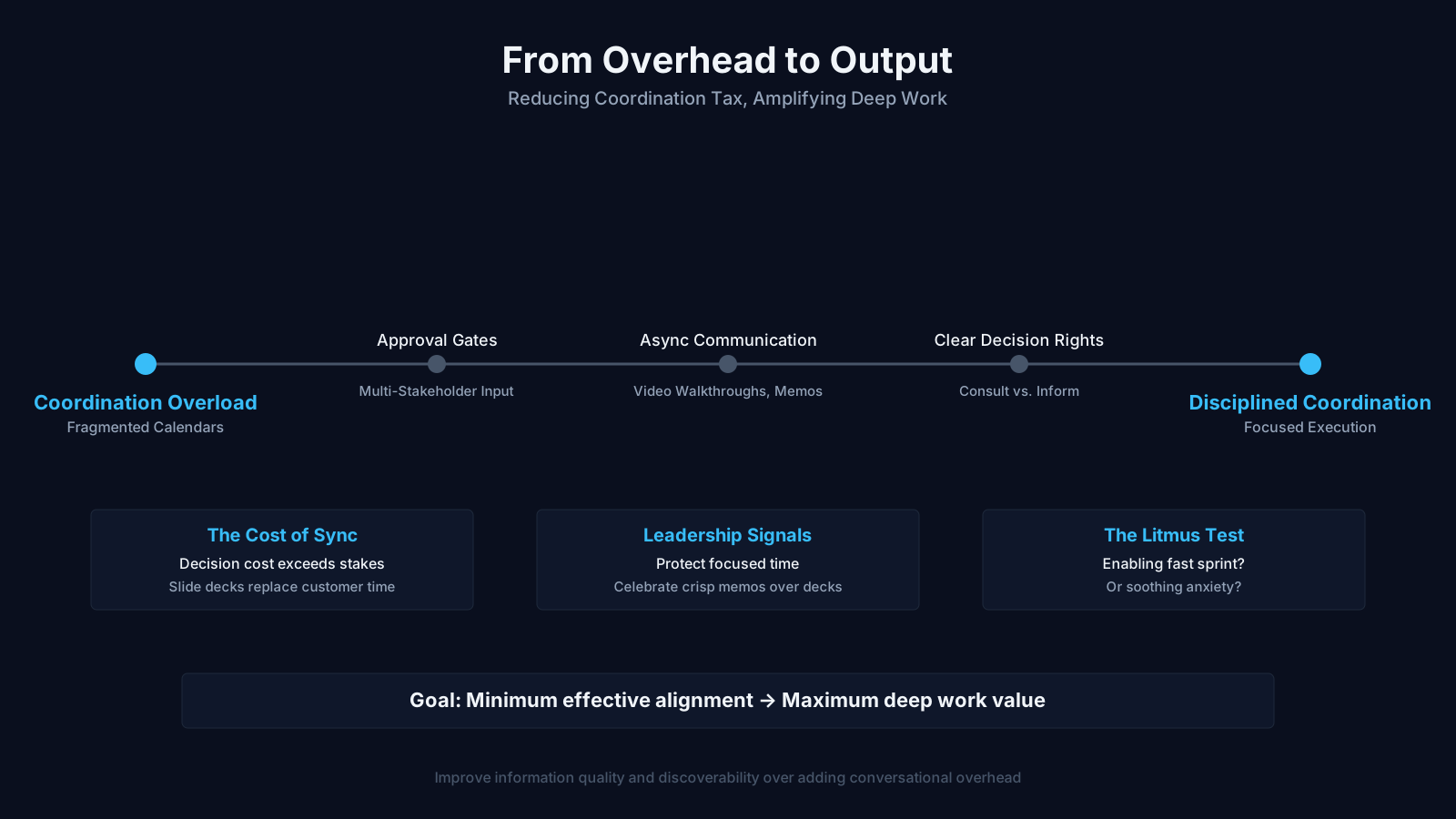
For managers working in hybrid environments, the paradox demands a redesign of team interaction patterns. Rather than trying to replicate office-style spontaneity with more scheduled meetings, teams can experiment with asynchronous coordination protocols that preserve autonomy while ensuring synchronization. The research on differentiation-integration suggests that effective hybrid coordination requires clear norms around response times, ownership of information, and the deliberate creation of virtual "collision spaces" that mimic the informal exchanges of a co-located team without the overhead of formal meetings. The goal is not to eliminate coordination but to shift it from a high-cost, synchronous mode to a low-cost, asynchronous one wherever possible.
Ultimately, the coordination cost paradox is not an argument against collaboration. It is a call for intentionality. Every organization needs some amount of coordination to align efforts and avoid duplicated work, but the sweet spot is smaller than our cultural assumptions suggest. The most productive teams often have less coordination than their managers think—they just have the right kind. When a team can move forward with minimal alignment because roles are clear, information is accessible, and trust eliminates the need for constant verification, it operates at a speed that others can only envy. Getting there requires resisting the default impulse to add another group chat, another sync, another integration layer. It requires asking whether the new coordination demand will genuinely accelerate the work or merely consume the time of the people doing it. That question, deceptively simple, cuts to the heart of the paradox and points toward a more sustainable way to work together.