Earning the PMP certification can reshape a project manager’s entire career trajectory, and finding the right PMP Certification Training Course in Los Angeles, USA is often the first deliberate step in that transformation. The city’s economic fabric pulls together industries that could not be more different from one another, aerospace and entertainment, healthcare and tech, yet they all converge on one constant: complex initiatives that need skilled oversight. A training course selected thoughtfully becomes more than a test preparation mechanism; it builds the judgment and habits that carry through decades of professional work.
Los Angeles is not a single industry town. It is a sprawling network of aerospace contractors, entertainment studios, tech startups, healthcare systems, and massive infrastructure projects. Project managers in this city navigate creative unpredictability, strict regulatory environments, and fast-moving digital initiatives all at once. The PMP credential, managed by the Project Management Institute, signals to employers across all these sectors that a professional has the rigor, vocabulary, and mindset to deliver complex work predictably. The certification is widely considered the global standard for project management excellence, and Los Angeles employers from Fortune 500 companies to boutique consultancies include it in job descriptions routinely. But passing the PMP exam is not easy. It demands disciplined study, a solid grasp of the PMBOK Guide, and the ability to apply situational judgment to hundreds of scenario-based questions. This is precisely why so many professionals search for a structured PMP certification training course in Los Angeles that fits their schedule and learning style.
The decision to pursue a PMP is rarely a casual one. Professionals in Los Angeles often feel the weight of the opportunity cost before they even begin: long commute hours, demanding roles, and the ever-present pull of a city that rewards constant hustle. Yet the investment almost always pays back, sometimes within the first year, not just in salary increments but in the kind of role mobility that makes a career feel generative rather than static. The interesting part is that the Los Angeles market, more than many others, tends to reward the combination of formal project management credentials and the intangible skill of navigating relationship-driven industries. That blend is exactly what a well-designed training course cultivates.
PMP Training in Los Angeles: Summary of Key Topics
| Key Concept | Summary |
|---|---|
| Career Transformation | A PMP certification elevates a project manager’s career trajectory, and a thoughtfully selected training program instills the judgment and systematic habits that support decades of impactful work. |
| Cross-Industry Demand | Los Angeles is a nexus of aerospace, entertainment, healthcare, and technology sectors, each demanding rigorous oversight of complex initiatives. A structured PMP course equips local managers with adaptable, high-stakes project skills. |
| Employer Validation | Among Los Angeles employers, from Fortune 500 firms to boutique consultancies, the PMP credential signals methodological rigor, a common professional language, and the capacity to impose order on complexity. It is frequently listed as a required or strongly preferred qualification. |
| Return on Investment | Despite the upfront time commitment imposed by LA’s long commutes and intense workloads, professionals typically recoup their investment within the first year through salary increases and expanded role mobility, yielding a compounding career advantage. |
| Entertainment Sector | The entertainment industry, once skeptical of formal frameworks, now actively recruits PMP-certified project managers who can assess risk in financial terms, orchestrate dependencies between creative and operational pipelines, and enforce accountability without stifling innovation. |
| Aerospace & Defense | Southern California’s aerospace and defense sector is built on earned value management, stringent compliance requirements, and government contracting protocols. PMP training provides immediate, practical alignment with these daily operational realities. |
| Instant Credibility | In a relationship-driven market like Los Angeles, the PMP credential acts as an immediate trust accelerator, establishing credibility with vendors, clients, and internal stakeholders from the first meeting. |
| Salary Premium | In Southern California, PMP holders command a substantial salary premium over non-certified peers, typically recouping training and exam expenses several times over within eighteen months. |
| Career Mobility | The credential unlocks cross-sector mobility into construction, technology, content production, and healthcare by demonstrating that holders can rapidly acquire domain knowledge using a disciplined framework for managing complexity. |
The Value of PMP Certification in the Los Angeles Job Market
When you scroll through project management job listings across Southern California, the pattern is unmistakable. A large percentage of roles, especially those above the coordinator level, either require a PMP certification or list it as a strongly preferred qualification. This is not just a keyword filter; hiring managers have learned over years that the certification brings a shared language and a demonstrated ability to structure chaos. In a city where project budgets can cross into the tens of millions overnight and stakeholder maps can include studio executives, city officials, and investor boards all on the same weekly call, the consistency of a PMP-certified approach is genuinely valued. Project management jobs in Los Angeles that require or prefer a PMP certification span from aerospace engineering to digital marketing campaigns, and the range keeps widening as more industries adopt projectized structures.
Los Angeles is a microcosm of the broader US trend, but some nuances make it distinctive. The entertainment industry, for instance, has historically been allergic to formal project management frameworks, viewing them as bureaucratic impositions on creative freedom. That perspective has shifted dramatically in the last decade. Streaming wars, complex co-production agreements, and data-driven content strategies have pushed major studios and production houses to look for people who can speak both the creative and the operational languages. A production project manager who holds a PMP can articulate risk in financial terms, map dependencies between post-production and marketing, and design workflows that protect the creative process without letting it spiral. The same cross-functional language is prized in healthcare, where massive hospital campus expansions in areas like Westwood or Orange County demand project leaders who can align clinical, regulatory, and construction teams.
How Los Angeles Industries Reward PMP-Certified Project Managers
The aerospace and defense sector, long anchored in Southern California, has one of the most rigorous project management cultures anywhere. Government contracts impose earned value management requirements, strict documentation protocols, and audit trails that can feel overwhelming without formal training. PMP-certified project managers moving into these roles often find that the exam’s emphasis on process integration, cost management, and procurement maps directly onto the daily realities of defense contracting. Meanwhile, the tech ecosystem in Santa Monica, Playa Vista, and Culver City operates at a faster tempo. Here, the PMP’s recent integration of agile and hybrid approaches makes the credential relevant even in environments where the word waterfall might make engineers cringe. It is not about picking a single methodology; it is about having the fluidity to choose what works for the project.
Beyond technical fit, there is a professional signaling effect that matters more in Los Angeles than people often admit. The city runs on relationships and reputation, and a PMP credential provides a kind of instant credibility that cuts through the initial small talk. When you walk into a meeting with a mixture of vendors, clients, and internal stakeholders, the letters after your name do a quiet but persistent amount of work. They suggest that you have been through the gauntlet, that you understand the cost of rework and scope creep not as abstract concepts but as expensive realities. That signaling accelerates trust-building in a business culture where time compression is the norm.
Salary and Career Trajectory with a PMP in Southern California
The salary differential associated with PMP certification is well documented, but the numbers only tell part of the story. PMI’s regular salary surveys have consistently shown that PMP holders in the United States earn a significant premium over non-certified peers. In Southern California, where the cost of living pushes baseline compensation higher already, that premium translates into real purchasing power difference. It is not uncommon for a mid-career project manager to see a base salary jump that covers the cost of the training course and exam multiple times over within the first eighteen months. More meaningful, though, is the way the certification shifts the kind of roles you get considered for. Suddenly you are not just the person who executes; you are the person who designs the execution framework.
Career trajectories in Los Angeles tend to be nonlinear, and that is actually where the PMP provides the most value. A project manager might start in construction, pivot into tech, consult for a content studio, and then land in a healthcare PMO. Each move becomes less risky when you carry a credential that transcends industry language. The certification signals that you can learn domain knowledge quickly because you already have a system for organizing complexity. Employers in Los Angeles, especially those who have struggled to find project managers with both soft skills and process discipline, are increasingly willing to bet on that portability. The bet usually pays off.
Key PMP Certification Takeaways for LA
- Cross-Industry Demand
- A PMP certification signals project leadership capability that is consistently required or strongly preferred across Los Angeles anchors like aerospace, technology, entertainment, and healthcare.
- Entertainment Industry Shift
- Major studios now actively recruit PMP-certified managers who can fuse creative vision with operational rigor, a combination essential for managing intricate co-productions, streaming platform launches, and cross-functional timelines.
- Salary and Career Mobility
- PMP holders in Southern California secure a clear salary uplift and gain access to senior roles that allow them to design scalable execution frameworks, accelerating both their career trajectory and enterprise-wide impact.
Key Components of a PMP Certification Training Course in Los Angeles
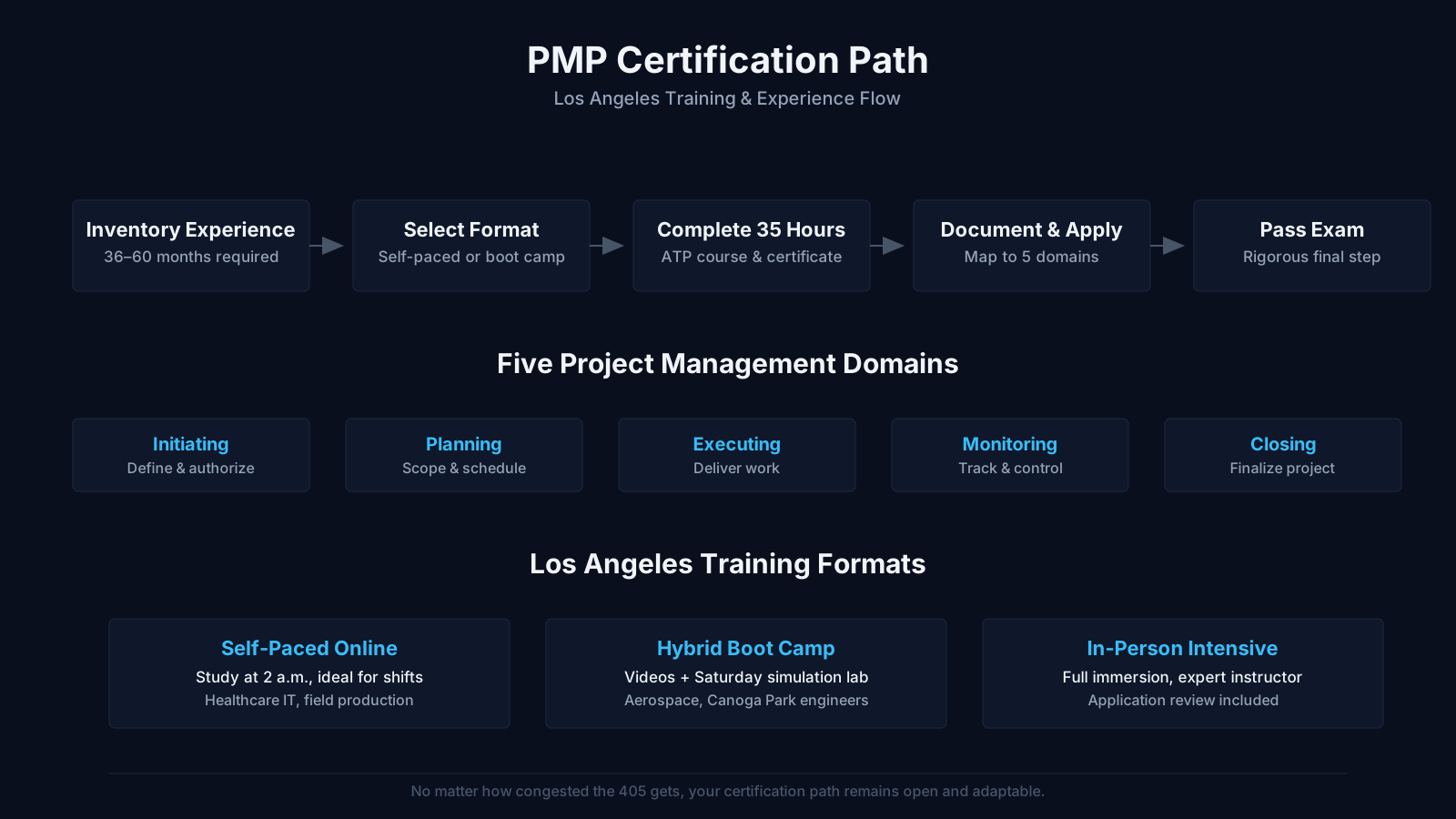
The Project Management Institute sets a hard barrier for exam eligibility: every applicant must complete 35 contact hours of formal project management education. This requirement is the engine behind the entire training course marketplace, but the best courses treat those 35 hours as a floor, not a ceiling. In Los Angeles, where competition among training providers is intense, you can quickly separate the courses that exist only to check a box from those that genuinely prepare you to sit for the exam with confidence. The distinction often boils down to three elements: curriculum depth, instructional methodology, and post-course support. A comprehensive PMP exam prep course in Los Angeles should feel less like a lecture series and more like a structured apprenticeship in thinking like a project manager.
One of the most overlooked aspects of course selection is the alignment between the provider’s materials and the actual Exam Content Outline published by PMI. A course that simply rehashes the PMBOK Guide page by page will leave you dangerously underprepared for the situational and scenario-based nature of the real exam. The modern PMP test assesses judgment far more than recall. You need to understand process groups and knowledge areas, absolutely, but you must also know when to deviate from a standard process, how to handle a troubled vendor relationship, and what communication style fits a specific cultural context. The training course that drills these nuances turns the exam from a memory test into a professional assessment.
The 35 Contact Hours Requirement and How LA Training Providers Fulfill It
That 35-hour requirement can be met through a variety of formats, and Los Angeles providers have adapted their offerings to match the fragmented scheduling reality of working professionals. Classroom-based bootcamps often compress the hours into a single intensive week. Weekend cohort programs stretch them over a month or two, with Saturday and sometimes Sunday sessions. Self-paced online options, often the most flexible, supply the hours through recorded lectures, interactive modules, and quizzes that track your progress. What matters is not just the quantity of hours but the quality of engagement during them. A live instructor-led course, whether in a classroom or virtual, tends to produce better outcomes for learners who need accountability and the ability to ask questions in real time.
Los Angeles providers that are PMI Authorized Training Partners, or ATPs, have met a set of quality standards regarding instructor qualifications, course materials, and student support. Working with an ATP is not mandatory to sit for the exam, but it does provide some assurance that the course content has been reviewed for alignment with PMI’s expectations. Many of these organizations have downtown Los Angeles classrooms, satellite locations in Burbank and Irvine, and online cohorts that run on Pacific time, which feels like a small detail until you realize that a course scheduled for Eastern time adds early-morning friction that can sabotage your learning momentum over weeks.
Curriculum Alignment with PMI’s Exam Content Outline
The current PMP exam is built around three domains: People, Process, and Business Environment. The People domain, which covers team management, conflict resolution, leadership, and stakeholder engagement, makes up nearly half the exam. Too many training courses still overweight the process domain because that was the historic emphasis. A well-designed course in Los Angeles will dedicate significant time to the interpersonal competencies, often using scenario-based exercises drawn from real project conflicts. This is where local instructors who have worked in LA industries can bring the material to life. They can describe a situation where a principal engineer refuses to follow the change control process and then facilitate a discussion on how to respond in a way that aligns with PMI’s ethical and leadership standards without torching the relationship.
Process rigor still matters, of course. The integration management, scope management, schedule management, cost management, quality management, resource management, communications management, risk management, procurement management, and stakeholder management knowledge areas form the skeleton of the curriculum. But the exam no longer asks you to recite input-output diagrams. It presents you with a partially broken project and asks what you, the project manager, should do first. That shift is exactly why training courses that emphasize practice exams and post-question debriefs are far more effective than those that rely on slide decks and memory drills. A good Los Angeles training program will teach you to recognize the pattern behind each question, not just the correct answer.
Simulation Exams and Practice Question Banks
One of the most anxiety-producing elements of the PMP exam is its sheer cognitive endurance requirement. You face 180 questions over 230 minutes, with two scheduled breaks. That is a marathon of analytical reading. Training courses that include full-length simulation exams serve a dual purpose: they build mental stamina and they expose gaps in your understanding that selective practice cannot reveal. A practice question bank that contains over a thousand items, ideally with detailed explanations for both correct and incorrect choices, becomes a learning tool rather than just an assessment tool. The best Los Angeles providers grant extended access to these question banks for months after the course ends, so you can spiral back through areas of weakness without feeling rushed.
The quality of the simulation questions matters enormously. Some low-cost question banks are written by people who have not taken the exam recently, and they can create false patterns that actually harm your performance. Look for providers who explicitly align their questions with the current Exam Content Outline and who update their banks regularly. Some Los Angeles instructors have built their own question sets based on years of student feedback about what actually appears on the test, and these are often the most valuable resources you can find. They do not merely test knowledge; they train your ability to eliminate distractors quickly, a skill that often determines whether you finish the exam with time to review or rush through the final section.
Choosing the Right PMP Certification Training Course in Los Angeles
The moment you start researching training options, you will encounter a crowded landscape of promises, pricing tiers, and delivery formats that can induce decision paralysis. In a metropolitan area the size of Los Angeles, geography itself becomes a variable. A weekend class in Westwood might look perfect on paper until you map out the Saturday morning drive from Pasadena. The economics are equally tricky: some programs bundle exam fees and study materials into a single price, while others keep bare-bones tuition low and charge separately for everything else. There is no universal formula, but there is a consistent set of criteria that separate the programs that deliver career impact from those that merely provide a certificate of completion. Finding a top-rated PMP training provider in Los Angeles is less about brand recognition and more about fit with your learning profile and logistical reality.
A common mistake is to choose a course based primarily on price or on the charisma of a sales representative during an info session. A better approach is to reverse-engineer from the exam itself. Ask how many of the provider’s students pass on the first attempt, not because a high number guarantees your success, but because it indicates that the course methodology is battle-tested. Ask to see a sample of the instructional materials. If the slides are dense with text and the practice questions feel trivial, your study burden just doubled because you will have to supplement aggressively with external resources. In Los Angeles, where several training companies have delivered thousands of hours of live instruction, you can often find candid reviews from former students on professional networking platforms. Read those reviews not for overall ratings but for specific mentions of instructor engagement, post-class support, and question bank quality.
Evaluating Instructor Expertise and PMI Authorized Training Partners
The instructor is arguably the most important variable in any live training program. A PMP certification training course in Los Angeles taught by a career educator who has never managed a non-academic project will feel very different from one taught by a practitioner who has run large-scale initiatives in LA’s actual industries. Both can help you pass the exam, but the practitioner-turned-instructor often weaves in stories and judgment calls that make the abstract frameworks memorable. Some of the most effective instructors in the Los Angeles area are former or current program managers who decided to teach because they enjoy developing talent. They tend to answer the question behind the question, and they do not get flustered when a student challenges a PMBOK interpretation with a real-world edge case.
PMI’s Authorized Training Partner designation is not a guarantee of instructor quality, but it does impose a minimum standard. ATPs are required to use licensed course materials that have been reviewed for content accuracy and alignment, and their instructors must meet certain experience and continuing education thresholds. The designation also makes it easier to verify that you are receiving the 35 contact hours in a format PMI will accept without friction. Beyond the ATP badge, look for instructors who hold multiple credentials themselves, such as the PMI-ACP for agile or the PfMP for portfolio management. This breadth usually indicates that they understand how the PMP fits into the larger architecture of project management practice, which leads to richer classroom discussions.
Classroom-Based versus Virtual PMP Certification Training Courses for LA Professionals
The choice between sitting in a physical classroom and logging into a virtual session has become far more nuanced than an old debate about discipline. In Los Angeles, where commuting can consume two hours each way, the value proposition of an in-person course has shifted. A five-day classroom bootcamp in Glendale might deliver unmatched intensity and peer bonding, but the hidden cost in time and exhaustion can undercut your ability to absorb material in the afternoons. Virtual live courses, if they are designed for active engagement rather than passive consumption, can approximate much of the classroom energy while preserving time you would otherwise spend inching along the 101. The key is interactivity: breakout rooms, live polling, and instructors who call on participants by name maintain the kind of accountability that pre-recorded on-demand courses lack.
Some Los Angeles professionals opt for a hybrid logic that is not always advertised. They attend a virtual course during the week for conceptual grounding, then join a local study group that meets in person at a coffee shop or a library on weekends. This arrangement lets them get the best of both worlds, the flexibility of remote learning and the camaraderie and accountability of face-to-face interaction. The PMI Los Angeles Chapter often facilitates such study groups, and they can become unexpectedly powerful networks. The person you drill earned value formulas with on a Saturday morning might be the same person who refers you into a role two years later.
Accelerated Boot Camps versus Weekend Cohort Programs
The boot camp model, typically four or five consecutive days of full-day instruction, promises exam readiness in a compressed window. For some learners, this approach works brilliantly. The immersion creates a forced focus that shuts out work distractions and builds mental momentum. The risk, however, is that the pace leaves little room for reflection, and if you are not already comfortable with fundamental project management concepts, you might spend the week barely keeping your head above water. Weekend cohort programs, spread across several weeks, allow time for consolidation between sessions. You can go back to your workplace on Monday and immediately test a concept from the weekend against your actual projects, which deepens retention far more than re-reading a textbook ever could.
The right choice depends heavily on your cognitive style and your life obligations. A professional supporting a major product launch will probably struggle to carve out a full week out of the office, while someone between roles or with generous professional development leave might thrive in the total immersion. The Los Angeles training market has enough density that you can find multiple start dates for both formats almost any month of the year. That flexibility is worth leveraging. If you sign up for a boot camp and realize a week before that a client demand has thrown your calendar into chaos, most reputable providers will let you reschedule, though their policies on refunds versus credits vary widely.
Key Insights for Choosing LA PMP Training
- Focus on pass rates and material quality
- First‑attempt pass rates and sample instructional materials offer truer insight than price or sales charisma, showing whether the course’s methodology has been proven under real exam conditions and whether it reduces the need for extensive supplementary study.
- Instructor expertise outweighs brand
- An instructor who is a seasoned practitioner, especially one holding multiple PMI certifications, enriches the learning experience with real‑world examples and nuanced judgment calls that turn abstract frameworks into memorable, applicable knowledge.
- Consider commutes and hybrid formats
- Given LA traffic, a live virtual course saves considerable time and energy, while a hybrid approach that pairs virtual weekday classes with in‑person weekend study groups combines flexibility with the accountability of face‑to‑face interaction.
PMP Exam Preparation Strategies: Beyond the Training Course
Even the most thorough training course in Los Angeles will leave you with work to do. The course equips you with a mental model of the exam, teaches you the terminology, and sharpens your test-taking instincts, but the long-term retention required for a first-attempt pass depends on a disciplined self-study routine. Too many candidates finish a boot camp, feel a surge of confidence, and then schedule their exam for the following week only to discover that the confidence was fragile. The material settles through repetition over time, not through a single pass. A realistic timeline after a training course typically spans four to eight weeks of targeted review, practice exams, and active recall exercises. A structured PMP exam study plan in Los Angeles should account for the city’s particular rhythm, leaving room for work intensity spikes while protecting non-negotiable study blocks.
Los Angeles life does not pause for exam preparation. If your study plan looks perfect on a spreadsheet but collapses under the first week of real-world demands, it was never a good plan. A more durable approach nests study sessions inside existing routines. Early morning hours before the commute chaos, lunch breaks carved out for flashcard review, and one longer weekend session each Saturday or Sunday can accumulate to enough volume without triggering burnout. The trap to avoid is letting an entire week pass without touching the material. Even fifteen minutes of retrieved practice on a busy Wednesday maintains the neural pathways that a four-hour Sunday session will build upon. Consistency is not a platitude; it is the mechanism by which fragile knowledge becomes durable.
Creating a Study Plan that Fits the LA Lifestyle
Mapping out a study plan in Los Angeles means acknowledging that your most intellectually demanding work happens in the morning, before the day’s cognitive load sets in. For many, that window is between six and eight o’clock. You might not want to crack open a practice exam at dawn, but spending those minutes on a focused topic, stakeholder engagement strategies one day, risk response planning the next, builds a layer cake of competence before the sun even fully rises. After a full day of managing actual projects, your brain will resist more project management theory, so the evening is better suited for passive review, audio summaries during a workout, or re-reading notes from the morning session.
The plan must also account for life’s interruptions without treating them as failures. A week when a major deliverable consumes every waking hour is not a reason to abandon the schedule; it is a signal to shift into maintenance mode where you do just one practice question a day and listen to a short podcast on PMP mindset. The psychology matters. The candidates who pass are not the ones who study the most total hours but the ones who never fully disengage from the material for more than a few days at a time. In Los Angeles, where work can swing from quiet to all-consuming overnight, that resilient relationship with the study process is often the decisive factor.
Using PMP Study Groups in Los Angeles and Online Forums
Isolation is a silent killer of PMP exam preparation. When you study entirely on your own, you can easily reinforce misconceptions because no one is there to challenge your reasoning. Study groups, whether organized by the PMI Los Angeles Chapter or formed organically among colleagues, introduce a social accountability and a diversity of perspective that self-study cannot match. When a group member explains why they chose one answer over another, they reveal their mental model of the PMBOK framework, and you can compare it with your own. Those moments of peer explanation often produce deeper learning than instructor-led sessions because they force you to articulate and defend your interpretation.
Online forums offer a similar benefit at scale, though the signal-to-noise ratio varies. The PMP subreddit and other professional communities are filled with people sharing exam experiences, study resources, and cautionary tales. The risk is that you can absorb inaccurate information or become anxious from horror stories about exam difficulty. The value lies in the aggregated wisdom about which practice simulators most closely resemble the real test and which knowledge areas tend to trip up first-time test takers. In Los Angeles, some study groups have taken a hybrid approach, meeting once every two weeks in person at a co-working space or coffee shop in a centrally accessible neighborhood like Mid-Wilshire or near LAX, and staying connected through a messaging group in between.
Mastering Situational and Agile Questions on the PMP Exam
Situational questions, the ones that describe a project scenario and ask what the project manager should do next, account for a large portion of the exam and cause the most consistent trouble. These questions test your ability to apply the PMI mindset, which sometimes means choosing the more consultative, ethics-driven, or process-respecting option over the one that mirrors real-world expediency. Training courses in Los Angeles that emphasize role-play and group case analysis give you a leg up here because they force you to confront the gap between what you would actually do in your company and what the exam expects. Closing that gap takes deliberate practice, not just reading explanations.
The agile and hybrid content, integrated into the exam since the major revision a few years ago, adds another layer. The PMP no longer treats agile as a separate track; it expects you to understand when an adaptive approach is appropriate and how to blend it with predictive practices. A project manager in Los Angeles might encounter this choice frequently, running a hardware development with a waterfall backbone while managing a software component with scrum. The training course that devotes whole modules to tailoring decisions, lifecycle selection based on project characteristics, and the facilitation of agile ceremonies within a governance framework will serve you far better than one that treats agile as a brief appendix. Many candidates underestimate this domain and end up guessing on questions they could have confidently answered.
Understanding the Investment: PMP Training Costs and ROI in Los Angeles
The financial outlay for PMP certification in Los Angeles can vary widely, from around nine hundred dollars for a self-paced online course to over three thousand dollars for a premium live boot camp with all study materials included. Then there is the PMI membership fee, which provides a discount on the exam fee, and the exam fee itself. For a non-member, the total cost including training, membership, and exam can land somewhere between two thousand and four thousand dollars. That is not a trivial sum, and it forces a hard question: will the certification generate enough incremental income, job security, or career mobility to justify the expense. The answer, across most Los Angeles industries, leans heavily toward yes, but the calculus depends on your specific starting point and the strategic use you make of the credential. Weighing PMP training cost against long-term ROI in Los Angeles requires looking beyond salary surveys to the less quantifiable aspects like promotion velocity and network expansion.
The immediate return often comes from salary negotiation. Even if your current employer does not automatically grant a raise upon certification, the PMP makes you more competitive for internal advancement and for external opportunities. In the Los Angeles market, where project management recruitment is highly active, certified professionals frequently receive interview requests at a higher rate than non-certified peers with similar experience levels. The certification acts as a filtering mechanism that gets your resume past the initial screening, and in a market with hundreds of applicants for some roles, that alone can be worth the investment. The longer-term return accumulates as you move into senior and program-level positions where the premium amplifies.
Typical Price Ranges for PMP Certification Training in LA
Self-paced online courses in Los Angeles typically sit at the lower end of the spectrum, from approximately four hundred to twelve hundred dollars. These often include recorded video lectures, digital study guides, and some number of practice questions, but they lack the real-time interaction that many learners need. Live virtual courses with an instructor range from one thousand to two thousand dollars, often spread over several weekends or evenings. The premium in-person classroom bootcamps, especially those held in central business districts or at well-equipped training centers in Burbank, Irvine, or downtown Los Angeles, can push toward the three-thousand-dollar mark, sometimes including the exam fee as a bundled component. Some providers offer a guarantee of free retraining if you do not pass, which can provide peace of mind and should be considered part of the value equation.
It is worth noting that some community colleges and continuing education programs in the greater Los Angeles area offer PMP preparation courses at significantly reduced tuition, sometimes just a few hundred dollars. These programs can be excellent, particularly if the instructor is a seasoned practitioner, but they often follow an academic calendar that does not align with a professional’s urgent timeline. They also tend to focus heavily on theory and light on the intensive exam simulation that commercial providers emphasize. If you have the luxury of time and learn well in a slower-paced academic environment, this route can offer substantial savings, but you should supplement aggressively with external practice exams.
Employer Sponsorship and Reimbursement Trends
Many Los Angeles-based companies, especially larger organizations with formal talent development functions, will cover all or part of the PMP training and certification expenses. The arrangement can take several forms: direct payment to the training provider, reimbursement upon successful completion, or a professional development stipend that the employee controls. The best time to explore this is before you commit to a course. A conversation with your manager that frames the certification in terms of business value, better risk management on current projects, standardized processes that reduce rework, is far more persuasive than a request that sounds like a personal career investment. When you can show how the skills gained will directly address a pain point the organization is currently experiencing, the approval rate rises sharply.
If your employer does not offer sponsorship, there is still a tax angle worth investigating. In some cases, the training costs and exam fees can be deducted as professional development expenses, though you should consult a tax advisor for your specific situation. Additionally, PMI offers discounts to members for the exam, and some Los Angeles training providers offer early-bird pricing or alumni discounts for professionals who have previously taken other certifications through them. Patching together these savings can knock several hundred dollars off the total cost, making the entire endeavor feel more manageable.
Long-Term Career Return for Los Angeles Project Managers
The durable value of a PMP in Los Angeles extends far beyond the initial salary bump. The certification becomes a permanent credential that follows you across industries, roles, and even geographic moves. In a city where the average professional will likely change employers several times over a career, the PMP provides continuity of professional identity. It signals to every new hiring manager that you have been externally validated against a global standard, not just praised by previous supervisors. For those who aspire to roles like program manager, portfolio manager, or PMO director, the PMP often serves as the prerequisite that makes further certifications and advancement possible.
There is also an underappreciated networking dimension. Attending the PMI Los Angeles Chapter events, volunteering for chapter committees, or even becoming an instructor yourself down the line opens doors that no job board posting can. You begin to meet the people who know about roles before they are publicly listed. In Los Angeles, where so much hiring happens through warm referrals, this network effect can compound the return on your original training investment many times over. The certification is not the endpoint; it is a platform that you can continue to build on for decades.
Key Insights on PMP Investment Value
- Total cost range in LA
- The total investment for PMP certification in Los Angeles, covering exam fees, PMI membership, and required training, typically ranges from $2,000 to $4,000, with costs varying by course format and provider reputation.
- Immediate ROI from certification
- Earning the PMP immediately strengthens a professional's marketability in Los Angeles, driving higher interview requests and improving internal promotion outcomes by acting as a trusted signal of project leadership capability.
- Training format price tiers
- Training formats span a clear price spectrum: self-paced online programs are available for $400 to $1,200, live virtual instructor-led courses range from $1,000 to $2,000, and intensive in-person bootcamps can reach $3,000, frequently including free retraining should a candidate not pass on the first attempt.
- Community college savings
- Los Angeles community colleges provide PMP preparation at a fraction of the cost, often just a few hundred dollars; however, their semester-bound schedules and limited exam simulation mean candidates typically need to supplement with additional practice tests and self-study.
- Employer sponsorship tactics
- Many large Los Angeles employers sponsor PMP training expenses; success in securing funding improves dramatically when the business case emphasizes tangible outcomes, such as enhanced risk mitigation, reduced project rework, and stronger stakeholder confidence.
The PMP Exam Experience in Los Angeles
Walking into a Pearson VUE test center or sitting down at your home desk for an online proctored exam represents the culminating moment of months of effort. The Los Angeles area has multiple Pearson VUE locations, typically in office parks near major freeway intersections, making it relatively straightforward to find a seat within a reasonable drive from most parts of the county. Some candidates prefer the controlled silence of a test center with its provided noise-canceling headphones and strict protocols, while others feel more comfortable in their own workspace. The decision often comes down to your tolerance for ambient noise and your confidence in your home internet connection. PMP exam centers in Los Angeles tend to book up quickly during popular testing windows, especially at the end of quarters, so planning your application and scheduling well in advance is genuinely important.
The exam environment is intentionally neutral, no personal items, just you, the screen, and the time clock. That neutrality strips away the familiar cues of your study space and can trigger a form of cognitive shock if you have not practiced under similar conditions. Several Los Angeles training courses now offer a proctored simulation exam at a test center or via the same online proctoring software used by Pearson VUE, which serves as a dress rehearsal. The candidates who go through that rehearsal often report lower anxiety on exam day because the interface, the break procedures, and the sense of being observed are no longer novel stressors. It is a small investment that yields disproportionate emotional dividends.
Pearson VUE Test Centers and Online Proctoring Options
The physical test centers in Los Angeles are designed to meet standardized security requirements. You will be asked to empty your pockets, store your belongings in a locker, and possibly pass through a metal detector. The proctor will provide you with a dry-erase notepad or laminated sheets for note-taking. The workstations are spaced to minimize visual distraction. The two scheduled ten-minute breaks are strictly timed, and you must sign out and sign back in. For some, the rigid structure is oddly calming; there is no ambiguity about what is allowed and what is not. Others find the ritual intrusive. The online proctored option allows you to take the exam at home or in a private office, but you must ensure your workspace is completely clean, with no papers, no additional monitors, and no interruptions. The proctor will ask you to pan your webcam around the room, and any violation can result in immediate termination of the exam.
Choosing between the two formats often depends on your home environment. If you live in a Los Angeles apartment with thin walls, city noise, and roommates who might accidentally walk in, the test center may be the safer bet. If you have a dedicated home office with a door you can lock and reliable fiber internet, the online option eliminates commute time and lets you keep your morning ritual intact. Some candidates who live in the further reaches of Los Angeles County, such as Santa Clarita or the Inland Empire, find that the drive to the nearest test center adds enough fatigue to warrant the online choice. The training course you choose should ideally prepare you for either format by familiarizing you with the digital tools, calculator, whiteboard, and strikeout feature available on the exam interface.
What to Expect on Exam Day and How Training Courses Prepare You
Beyond the environmental logistics, the psychological and physical endurance demands of exam day cannot be overstated. The exam is not just intellectually challenging; it is a physiological event. Many candidates report that the first sixty questions feel manageable, the middle sixty become a grind, and the final sixty require reaching into a depleted reservoir of concentration. A training course in Los Angeles that administers at least one full-length simulation under timed conditions gives you an experiential map of that fatigue curve. You learn when your accuracy starts to dip and what countermeasures, a quick sip of water during a break, a mental reset technique, actually work for you.
The content of the exam itself will feel familiar if your training course did its job well. You will see risk scenarios, change request dilemmas, stakeholder communication breakdowns, and procurement conflicts that mirror the practice questions. The difference is that the real exam tends to have fewer obvious wrong answers. Multiple options often seem plausible, and your task is to select the one that best aligns with PMI’s standard of practice. The training course that taught you to read the final sentence of each question first, to identify the process group and knowledge area quickly, and to flag uncertain answers for later review has already equipped you with a tactical approach. The rest is a matter of trusting your preparation and managing your pace so that you finish with at least a few minutes to revisit flagged questions.
Maintaining Your PMP Certification and Advancing Your Career in LA
Passing the exam is a milestone, not a finale. The PMP certification requires you to earn sixty professional development units, PDUs, every three years to maintain your active status. This ongoing requirement can feel like a burden, but it is better understood as a built-in mechanism to keep your skills current and your network alive. In Los Angeles, earning PDUs is remarkably easy if you engage with the local professional community. The PMI Los Angeles Chapter hosts monthly meetings, webinars, workshops, and an annual conference that all count toward your PDU requirements. Beyond formal events, activities like writing project management articles, presenting at conferences, or mentoring emerging project managers also generate PDUs, and they simultaneously raise your profile. Earning PDUs through PMI Los Angeles Chapter events transforms a compliance task into a genuine professional development rhythm.
Many Los Angeles project managers discover that the post-certification period is when their careers begin to accelerate in unexpected ways. The PMP credential opens the door to more complex assignments, and the community connections you build while earning PDUs often lead to those assignments. You might volunteer to help organize a chapter event and end up in conversation with a senior executive who is looking for someone to lead a high-visibility initiative. These serendipitous intersections happen with surprising frequency in the Los Angeles project management ecosystem, in part because the chapter leadership actively tries to create them. The city’s scale and diversity mean that even niche interests, such as sustainability in construction project management or agile adoption in media, have enough critical mass to support specialized PDU-earning gatherings.
Earning PDUs through Los Angeles PMI Chapter Events
The PMI Los Angeles Chapter is one of the larger chapters in the United States, and its programming reflects that reach. Monthly chapter meetings often feature keynote speakers from industries that shape the region, aerospace executives, entertainment technology leaders, public infrastructure directors, who share case studies that are applicable across sectors. These events typically earn you one to two PDUs per session, and attending them regularly builds a steady accumulation without the last-minute scramble that many certificate holders dread. The chapter also organizes study groups for advanced certifications like the Program Management Professional or the PMI Agile Certified Practitioner, which attract PMP holders looking to deepen their expertise.
Volunteering with the chapter is a particularly high-leverage way to earn PDUs while building organizational leadership skills that directly complement project management. You might serve on the communications committee, help organize the annual professional development day, or become a mentor for new PMP candidates. These roles teach you how to run a volunteer project, manage distributed teams with varying commitment levels, and navigate internal politics, all experiences that transfer back to your day job. In a Los Angeles business culture that values demonstrated initiative, chapter leadership roles often appear on resumes as markers of professional maturity and community contribution, subtly setting you apart from peers with identical technical qualifications.
From PMP to Program Manager: Growth Paths in Southern California
The PMP credential is rarely the final stop for ambitious project managers in Los Angeles. Once you have established your project-level credibility, the natural next question becomes about scaling impact: how do you manage multiple interdependent projects toward strategic outcomes, how do you build a project management office, how do you influence organizational governance. The program manager and portfolio manager roles that answer these questions are prevalent in large Southern California employers, and they almost always require a PMP as a foundation. From there, additional certifications like the PfMP or the PMI-ACP, combined with a demonstrated track record of successful large-scale delivery, form a powerful career narrative.
The growth path is not purely vertical. Some Los Angeles project managers choose to deepen their domain expertise within an industry, becoming the go-to expert for, say, healthcare construction projects or media technology deployments. Others pivot into consulting, either joining established firms with strong Los Angeles presences or launching independent practices that serve small and mid-sized businesses. The PMP provides the portable credibility that makes such transitions possible. The certification alone does not guarantee success, but it removes a barrier that would otherwise require years of personal reputation-building to overcome. In a market as networked as Los Angeles, that acceleration is significant.
The decision to pursue a PMP certification training course in Los Angeles is, in the end, a bet on your own capacity to grow. It is a structured challenge that mirrors the very project management principles it teaches: define your objective, scope your effort, secure your resources, manage your risks, monitor your progress, and when the exam screen declares that you have passed, you get to close a project that will pay dividends for the rest of your professional life. The training course is the vehicle, but the destination is a career that feels increasingly within your own control.
Core Insights on PMP Renewal and Career Advancement in Los Angeles
- PDU requirements as career development
- Earning 60 PDUs every three years becomes a strategic opportunity when fulfilled through PMI Los Angeles Chapter events, turning a compliance mandate into continuous professional growth and meaningful networking.
- Volunteering for high-impact PDUs
- Contributing to the PMI Los Angeles Chapter through committee service or mentorship not only yields PDUs but also develops leadership competencies that distinguish your resume and elevate your standing in the project management community.
- Career paths after PMP certification
- The PMP certification serves as a gateway to higher-level positions, including program and portfolio manager or subject matter expert roles in the competitive Southern California market, and gains additional leverage when complemented by credentials such as PfMP or PMI-ACP.
- Networking serendipity in LA ecosystem
- The chapter’s large and diverse community creates a landscape of serendipitous opportunities, where active event participation can lead to high-visibility assignments and valuable executive connections.
Advance Your Career with Professional Certification
Project management certifications give professionals a structured way to demonstrate leadership and delivery skills. The BVOP program offers a modern curriculum that integrates agile principles with traditional planning. Becoming a certified project manager through BVOP means you've mastered both technical and adaptive approaches. It prepares you for roles that demand flexibility without sacrificing control over scope and timelines.
Product management credentials sharpen your ability to connect market needs with development teams. The BVOP approach focuses on value delivery and product lifecycle thinking rather than just feature releases. Earning a product owner certification validates your competence in backlog prioritization and stakeholder negotiation. This credential suits those moving into strategic product roles from adjacent fields.
HR management is shifting toward data-driven decision-making and employee experience design. A specialized certification shows you can handle workforce planning with modern tools and frameworks. The HR management certification from BVOP covers agile HR practices and organizational development in depth. It helps you move beyond administrative duties into shaping company culture and talent strategy.