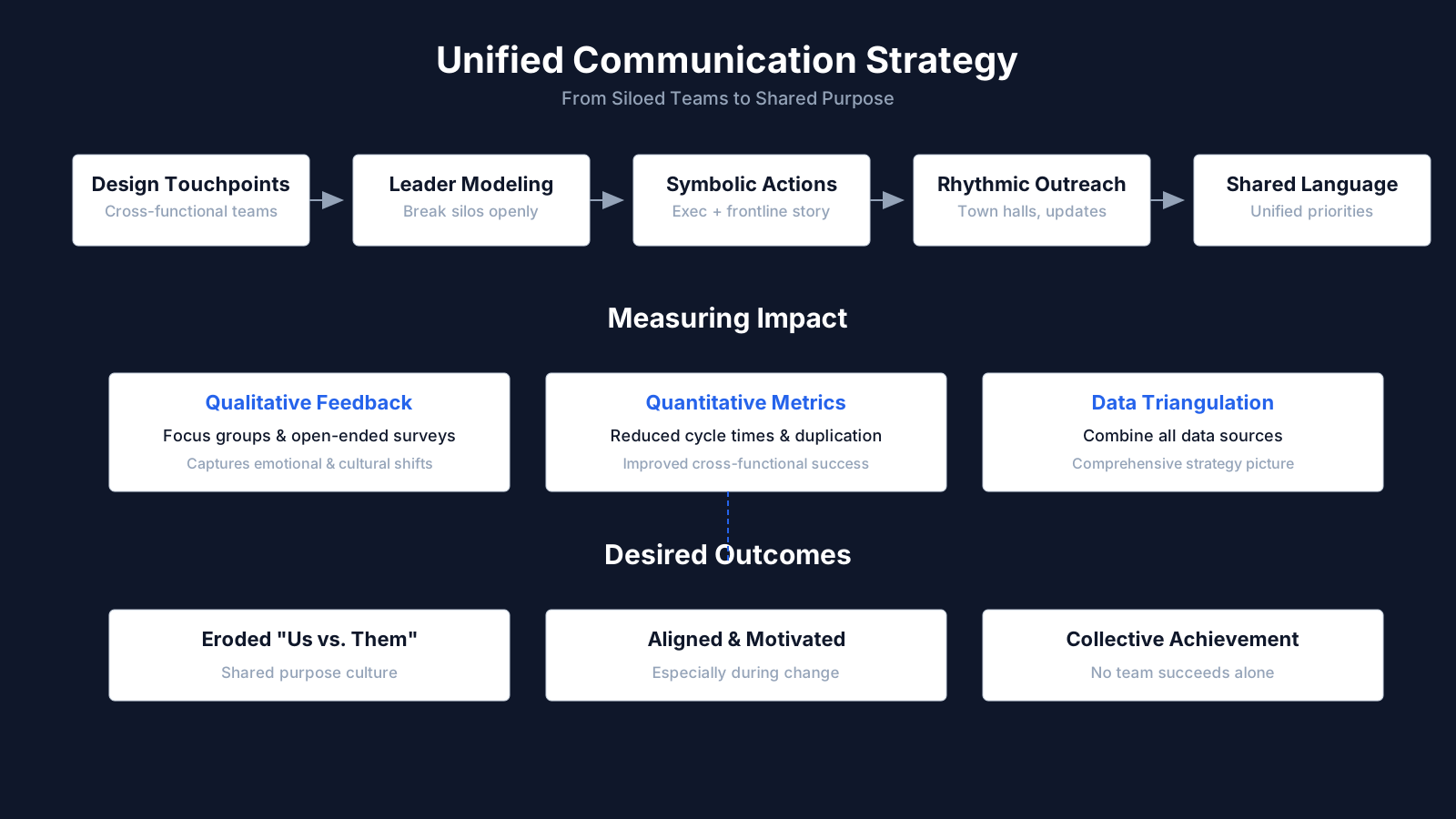
When internal communication breaks down, organizations fragment into disconnected islands. A carefully crafted communication strategy that unites your organization is not a luxury reserved for periods of calm; it is the central nervous system that transforms fragmented efforts into a cohesive, high-performing whole. Without a deliberate and inclusive approach to information flow, even the most brilliant strategic plans crumble under the weight of misalignment, duplicated work, and eroding trust. This article presents a comprehensive framework for building an internal communication strategy that weaves together disparate teams, functions, and geographies into a single aligned entity driven by a shared purpose.
The urgency of this work has never been greater. Remote and hybrid working models have dissolved the watercooler conversations that once transmitted cultural norms and tacit knowledge. Employees are bombarded with messages across Slack, email, intranets, and video calls, yet they often feel less informed and less connected than ever before. Against this backdrop, the ability to cut through the noise with clarity and consistency becomes a definitive competitive advantage. A unifying communication strategy is one that deliberately links everyday tasks to the organization’s larger mission, making every individual feel that their contribution matters and that they are part of something larger than their immediate job description.
This article will guide you through the diagnostic, design, and execution phases of crafting such a strategy. You will learn how to audit your current communication landscape, define narratives that resonate across cultural and demographic lines, leverage leadership as a communication multiplier, choose the right channels without succumbing to tool overload, and build measurement loops that keep the strategy adaptive. Along the way, we will debunk persistent myths, such as the belief that more communication is always better or that a single town hall can unite a workforce, and we will explore what evidence-based management practices actually show about building lasting alignment.
Summary: A Communication Strategy That Unites Your Organization
| Key Concept | Summary |
|---|---|
| Fragmentation Risk | Splintered internal communication breeds operational silos that obstruct strategic execution and erode institutional trust. |
| Hybrid Imperative | The shift to remote and hybrid work has dissolved informal watercooler networks, making intentional communication architectures vital for sustaining clarity and cohesion. |
| Cost of Misalignment | Divergent strategic narratives fuel duplicated effort, stalled initiatives, workforce disengagement, and preventable turnover as confusion multiplies. |
| Agility Through Alignment | A coherent communication framework establishes shared context, enabling teams to make rapid, autonomous decisions without bottlenecking escalation. |
| Meaning Centricity | Communication that curates and contextualizes information transforms raw data into shared meaning, ensuring employees grasp the strategic "why" behind decisions. |
| Communication Audit | A structured diagnostic combining network analysis, employee listening, and qualitative interviews uncovers hidden gaps and alignment fractures. |
| Leadership Amplification | Leaders act as communication amplifiers, deliberately cascading strategic priorities and modeling radical transparency to embed trust and clarity. |
| Channel Discipline | A disciplined channel architecture matches message type to the most effective medium, preventing tool fatigue and ensuring signal cuts through organizational noise. |
| Sentient Metrics | Beyond open rates, measuring message comprehension and employee sentiment in real time enables continuous strategy refinement for lasting resonance. |
| Shared Purpose | An intentional communication strategy stitches daily work to the overarching mission, fostering a culture where every individual senses their role in advancing a common goal. |
Why You Need a Communication Strategy That Unites Your Organization
Many leaders assume that because messages are being sent, communication is happening. Yet volume does not equal understanding, and understanding does not automatically generate commitment. The cost of disjointed communication is staggering: projects stall because priorities are unclear, employees disengage because they cannot see the connection between their work and the company’s direction, and good people leave when they feel out of the loop. A deliberate communication strategy that unites your organization directly addresses the root cause of these dysfunctions by establishing a single source of truth, a consistent rhythm, and a clear feedback loop that reinforces trust.
The True Cost of Fragmented Messaging
When different departments interpret strategy through their own narrow lens, the organization begins to pull in opposing directions. Marketing launches a campaign that contradicts the product road map because product managers were not looped into the narrative. Finance imposes cost controls that frontline teams see as arbitrary because no one explained the strategic rationale. These misalignments are not merely operational nuisances; they are strategy execution failures that bleed resources and erode cross-functional collaboration. Research on organizational alignment consistently shows that companies with highly aligned communication practices achieve faster decision-making, lower employee turnover, and higher customer satisfaction scores.
The hidden cost often appears in the emotional and cognitive load placed on employees. When people have to constantly fill in the gaps with guesswork, they experience higher stress and lower confidence in leadership. Over time, this creates a culture of speculation where the informal grapevine becomes the primary source of information, undermining official channels. A unifying communication strategy replaces ambiguity with transparency, replacing the emotional exhaustion of uncertainty with the psychological safety that comes from knowing where the organization is headed and why.
Alignment as a Multiplier of Strategic Agility
In an era of rapid change, some executives fear that a structured communication plan will slow them down. The opposite is true. A communication strategy that unites the organization builds the shared context that enables teams to make fast, autonomous decisions without constantly escalating for approval. When everyone understands the non-negotiables of the strategy and the boundaries within which they can experiment, agility thrives. This is the principle behind mission command in military doctrine and agile scaling frameworks in business: a well-communicated intent empowers decentralized execution.
Consider a global technology firm that shifted from a top-down quarterly planning process to a rolling communication cadence anchored in a clear North Star narrative. By ensuring that every team leader could answer the same three questions—where we are going, why it matters, and what success looks like—the company reduced alignment meetings by 25 percent and accelerated product launch cycles. The communication strategy did not add bureaucracy; it removed the need for constant realignment because the foundational message was continuously reinforced and accessible.
Moving Beyond Information Overload to Meaning-Making
One of the most damaging myths in internal communication is that a well-informed workforce is a unified one. Information without interpretation creates noise. A unifying communication strategy curates and contextualizes information, helping employees not just receive data but understand its significance. This is the difference between announcing a new acquisition and telling the story of how that acquisition advances the company’s mission, brings new capabilities, and creates opportunities for employees. Meaning-making is the art of connecting dots, and it requires a deliberate editorial mindset within the communication function.
Organizations that excel in this area treat internal communication as a product, not an announcement pipeline. They segment their audiences, tailor messages to address the “what’s in it for me” question, and relentlessly reinforce the core narrative through multiple modalities. They measure not just open rates but comprehension and sentiment. Ultimately, they recognize that unity is not achieved by blasting the same message to all; it is achieved by ensuring that every message, regardless of its specific audience, ladders back to the same strategic themes and values.
Core Takeaways on Unified Communication Strategy
- Cost of fragmented messaging
- When messaging is inconsistent, projects lose momentum, employees become disengaged, and turnover rises as cross-functional misalignment takes root and trust in leadership gradually crumbles.
- Alignment drives strategic agility
- A unified communication strategy establishes a shared context that enables faster, more autonomous decisions, bypassing the drag of constant approvals and alignment meetings.
- Meaning-making over information overload
- Simply transmitting information creates noise; effective strategies instead curate and frame messages to help employees recognize the significance and connect daily tasks to strategic goals.
- Treating communication as a product
- Top-performing organizations segment audiences, tailor messages to what matters to each group, and gauge understanding and sentiment rather than relying on vanity metrics like open rates.
- Replacing ambiguity with transparency
- A unifying strategy alleviates emotional and cognitive load by cutting out guesswork, replacing speculation with psychological safety through clear, rationale-backed direction.
Diagnosing Your Organization’s Communication Gaps
Before redesigning your strategy, you need a frank assessment of how communication currently flows. This diagnostic phase is often skipped because leaders assume they already know where the breakdowns are. Yet the view from the executive floor is notoriously incomplete. A rigorous audit combines quantitative data from surveys and platform analytics with qualitative insights from focus groups, exit interviews, and cross-functional shadowing. The goal is to map the formal and informal communication networks and identify where alignment fractures occur.
Common patterns emerge in organizations with weak unifying strategies. Middle managers become bottlenecks because they lack the context or confidence to cascade messages. Frontline employees learn about important changes from external media before hearing it from their supervisors. Teams duplicate effort because they are unaware of adjacent projects. By systematically cataloging these pain points, you can prioritize interventions that will yield the highest alignment impact. The diagnostic should also assess the health of upward communication, because a strategy that only broadcasts down is not a strategy that unites; it is a directive that isolates.
Mapping the Employee Journey and Critical Moments of Truth
Every organization has high-stakes moments where alignment is either cemented or lost. These include leadership transitions, strategic pivots, reorganizations, crisis events, and even routine milestones like quarterly business reviews. Mapping the employee journey through these moments allows you to design a communication strategy that is proactive rather than reactive. For each moment of truth, specify the key message, the preferred sender, the channel, and the expected emotional response you want to elicit.
For example, during a reorganization, the immediate need is to reduce anxiety and provide clarity on roles. A unifying strategy would ensure that before any all-employee announcement, managers have talking points, one-on-one meeting guides, and dedicated Q&A forums to support their teams. This turns the manager from a passive recipient of a company-wide email into an active agent of alignment. When the employee journey is mapped with this level of detail, communication ceases to be a series of disconnected broadcasts and becomes a carefully orchestrated conversation that guides people through change with empathy and precision.
Uncovering the Shadow Communication Networks
Alongside formal channels, every organization has shadow networks: group chats, social media groups, informal lunches, and the proverbial hallway conversations. In a hybrid world, these shadow networks have migrated to encrypted messaging apps and unofficial Slack channels. Smart communication strategists do not try to eliminate these networks; they seek to understand them and integrate their signals into the overall strategy. When you monitor the themes and sentiments circulating in these spaces, you gain an early warning system for misalignment.
Moreover, you can feed the shadow networks with accurate, timely information by equipping influencers and natural communicators within those groups. This is not about surveillance; it is about recognizing that trust resides in peers and local leaders as much as in the C-suite. A communication strategy that unites your organization harnesses the power of peer-to-peer validation. By identifying and enabling key connectors, you amplify the core narrative through authentic, trusted voices, which often achieves far greater resonance than another corporate email.
Architecting a Communication Strategy That Unites Your Entire Workforce
The architecture of a unifying communication strategy rests on four interdependent pillars: a compelling core narrative, a structured cadence that respects people’s attention, a channel ecosystem designed for clarity rather than complexity, and a leader-led cascade that personalizes the message. These pillars must be designed together; ignoring one weakens the entire structure. The goal is to create what communication scholars call a “line of sight” for every employee, linking daily work to team goals, department objectives, and the overarching company mission.
Designing this architecture requires moving beyond the generic notion of “good communication” and making explicit choices about what you will and will not communicate. Not every update deserves a push notification. Not every success story needs a company-wide email. The strategy must filter noise, distinguish between must-know, should-know, and nice-to-know information, and assign appropriate channels for each category. This discipline prevents overload and ensures that when a true strategic message does arrive, it is noticed and taken seriously.
Establishing a Core Narrative That Unites Your Organization
A core narrative is more than a vision statement posted on an intranet. It is a living story that explains why the organization exists, what it is trying to achieve, and the role each person plays in that journey. A narrative that truly unites consistently answers five questions: Why are we here? Where are we going? How will we get there? What does it mean for you? And how can you contribute? These answers must be simple enough to be retold in a manager’s own words yet rich enough to remain meaningful as the business context evolves.
Crafting this narrative is not solely the job of the communications department. It requires deep collaboration with the CEO and executive team to unearth themes that resonate on both a logical and emotional level. The best narratives emerge from a blend of data-driven strategic intent and human storytelling. For instance, a healthcare company navigating digital transformation might anchor its narrative not in the technology itself but in the story of a specific patient whose life was improved because of faster data sharing. When employees can attach emotion to strategy, alignment shifts from intellectual agreement to personal commitment.
Segmenting Audiences to Strengthen a Strategy That Unites Your Organization
Unity does not mean uniformity. A communication strategy that unites your organization respects the diversity of roles, regions, and experiences within the workforce. Effective audience segmentation goes beyond basic demographics such as department or location. It considers informational needs, preferred channels, digital literacy levels, language preferences, and the degree of change impact a particular group is experiencing. A frontline retail worker, a remote software engineer, and an office-based HR professional each have distinct realities that must be acknowledged in the communication design.
Segmentation enables you to tailor the core narrative without diluting its essence. For example, the message about a new sustainability initiative might highlight operational changes for the supply chain team, customer-facing narratives for the sales team, and brand reputation implications for the marketing team. Each version still ladders back to the same strategic priority, but the relevance is heightened. This approach also reduces the risk of cynicism that arises when employees receive generic messages that fail to address their specific challenges. Focusing on relevance as much as reach builds the credibility that underpins unity.
Leadership Alignment as the Cornerstone of a Unifying Strategy
No communication strategy can unite an organization if the leadership team is not visibly aligned. Employees are exceptionally skilled at detecting discrepancies between what leaders say and what they do, and between what different leaders emphasize. The first step in any communication strategy rollout must be to align the senior leadership team around a single set of messages and commitments. Leadership alignment workshops, where executives collaboratively refine the narrative and agree on shared talking points, are foundational investments that prevent the confusion of mixed signals later.
Once aligned, leaders must commit to a communication rhythm that extends well beyond the quarterly town hall. Regular, informal interactions—short video updates, “ask me anything” sessions, and visible participation in internal social channels—demonstrate accessibility and consistency. Crucially, the strategy must equip leaders with the skills and support to have these conversations effectively. Many brilliant strategic communicators at the top struggle to translate their vision into the operational language that frontline managers need. Coaching leaders to master the art of translation, linking global strategy to local impact, is a high-leverage activity that turns leadership alignment from a conceptual goal into a lived experience for the workforce.
Choosing Channels That Foster Inclusion Rather Than Overload
The channel ecosystem is where strategy meets daily experience. A common failure pattern is to multiply channels in an effort to reach everyone, only to fragment attention and create more places for messages to get lost. A unifying communication strategy selects a deliberately limited set of channels, each with a clear role. For instance, the intranet might serve as the canonical home for durable strategic content, while a collaboration platform like Microsoft Teams or Slack handles team-level updates and a dedicated mobile app reaches frontline workers without corporate email access.
The design principle is inclusion, not just reach. Inclusive channel choice means ensuring that shift workers, deskless employees, and those with limited bandwidth can access the same core messages as their office-based peers. This might involve digital signage in break rooms, printed one-pagers in multiple languages, or audio briefings that workers can listen to during commutes. The strategy must also specify channel etiquette to combat fatigue: no critical messages after hours, clear subject line conventions, and an explicit expectation that not every message requires an immediate response. By curating the channel experience, you protect attention and signal that you respect your employees’ cognitive capacity, which itself builds trust.
Core Blueprint for Workforce Unity
- Four interdependent communication pillars
- A unifying communication strategy demands a compelling narrative, a disciplined cadence, a well-defined channel ecosystem, and a leader-led cascade, deliberately aligned so that every employee sees how their daily efforts connect directly to the company’s mission.
- Strategic noise reduction and filtering
- The approach filters out noise by separating must-know, should-know, and nice-to-know information, then assigning dedicated channels to each tier so that critical strategic messages are unmistakably prioritized and genuinely absorbed.
- Respectful segmentation over uniformity
- True workforce unity emerges when the core narrative is adapted for different roles and regions without weakening its fundamental meaning, which amplifies local relevance and credibility while defusing the skepticism that one-size-fits-all messaging often breeds.
Operationalizing the Strategy Through a Sustainable Communication Cadence
A communication strategy that unites your organization is not a one-time campaign; it is a permanent operational rhythm that becomes part of the organizational muscle memory. This cadence should map to the natural cycles of the business—annual planning, quarterly reviews, monthly all-hands, weekly team syncs—so that communication feels integrated rather than additional. Each touchpoint reinforces the strategic narrative and provides an opportunity for two-way dialogue. Designing this drumbeat requires balancing consistency with flexibility, allowing for ad hoc urgent messages without derailing the routine events that employees have come to rely on.
The cadence must also account for what communication professionals call “signal refresh.” A core narrative that is not revisited and recontextualized loses its power over time. The annual company kickoff is not enough; the strategy must be woven into quarterly business reviews, team stand-ups, and even performance conversations. When an organization systematically links its operational rituals to the strategic narrative, alignment becomes self-reinforcing. Employees begin to anticipate the updates, connect the dots autonomously, and hold one another accountable to the shared direction.
Equipping Managers to Be Effective Communication Conduits
Managers are the single most credible source of information for individual contributors. A communication strategy that fails to empower managers fails to unite. The strategy must therefore include a manager enablement framework that goes beyond forwarding leadership emails. Managers need concise briefing packs before major announcements, suggested scripts that they can adapt to their team’s context, and guidance on handling difficult questions. They also need scheduled time to discuss strategy with their teams, not just cascade tasks.
Many organizations underestimate the communication anxiety that managers feel when they lack complete information. Providing “safe harbor” phrases and a direct feedback channel to ask clarifying questions before an announcement reaches their teams transforms managers from reluctant messengers into confident advocates. Over time, this investment creates a community of communicators who organically reinforce the unifying narrative, detect emerging misalignment early, and surface frontline insights that enrich the strategy itself. The manager-enablement loop turns communication from a centralized function into a distributed capability, which is the ultimate expression of a strategy that unites.
Integrating Change Management and Communication into One Discipline
Communication and change management are often treated as separate workstreams, but in a unifying strategy they must operate as one. Every strategic communication is, to some degree, a change communication. Whether the message is about a new performance management system, an acquisition, or a shift in values, the goal is to move people from awareness to understanding to commitment. The ADKAR model, which outlines the stages of awareness, desire, knowledge, ability, and reinforcement, provides a useful lens for designing messages that meet employees where they are in their personal change journey.
Integrating change management means that the communication strategy includes deliberate moments for reinforcement. A single town hall may generate awareness, but without follow-up microlearning modules, peer discussions, and visible role modeling by leaders, that awareness fades. The most unifying strategies treat communication as a campaign with a long tail, sustaining energy through stories of early wins, testimonials from peers, and clear recognition of those who embody the new direction. This sustained approach acknowledges that unity is built incrementally, through repeated and consistent experiences, not through a single inspiring speech.
Measuring What Matters to Keep Your Unifying Strategy on Course
A communication strategy without measurement is merely good intentions. Yet many organizations measure the wrong things, such as email open rates, without connecting those metrics to behavioral or business outcomes. A unifying communication strategy demands a dashboard that tracks reach, relevance, understanding, and ultimately, the alignment that follows. Modern measurement frameworks blend quantitative data from pulse surveys and engagement platforms with qualitative insights from sentiment analysis and manager feedback loops.
The measurement system should be simple enough to sustain but robust enough to diagnose problems. Leading indicators might include comprehension scores from quick polls after key messages, while lagging indicators track employee net promoter score, internal mobility rates, and strategy execution metrics such as project milestones met. Critically, the data must be segmented to reveal which groups are drifting out of alignment, so interventions can be targeted rather than blanketed. This evidence-based approach transforms internal communication from a cost center into a strategic enabler with demonstrable return on investment.
Using Feedback to Refine a Communication Strategy That Unites Your Organization
Feedback is the lifeblood of a dynamic unifying strategy. The best communication strategists design listening posts that are as rigorous as their broadcast mechanisms. This includes periodic “alignment audits” where cross-functional panels assess whether messages are penetrating as intended, anonymous suggestion tools that allow employees to flag confusion without fear, and structured debriefs after major announcements to capture the questions that emerged in team meetings. This feedback must be analyzed not defensively but with genuine curiosity about how the strategy can improve.
A common mistake is to collect feedback without closing the loop. Employees who take the time to share their experience deserve to see that their input led to tangible changes. When the communication function publicly acknowledges adjustments made in response to employee feedback—such as simplifying language, increasing translation speed, or changing the frequency of updates—it models the very transparency and two-way respect that the strategy seeks to instill. This closes the alignment loop, reinforcing that the organization is not just talking at people but engaging with them as co-creators of the company culture.
The Role of Data Privacy and Ethical Listening
As communication measurement becomes more sophisticated, the ethical dimension becomes paramount. Passive monitoring of sentiment through collaboration tool analytics, email metadata, or network analysis must be governed by transparent policies and, in many jurisdictions, employee consent. A strategy that unites cannot be built on a foundation of surveillance that breeds distrust. The most progressive organizations co-create their measurement approach with employee representatives, explaining clearly what data is collected, how it is anonymized, and how it will be used to improve the employee experience rather than to evaluate individuals.
Ethical listening also means being mindful of the interpretative limits of data. A drop in sentiment scores after a restructuring announcement may simply reflect the natural emotional cycle of transition rather than a failure of communication. Misinterpreting such data can lead to ill-advised additional messaging that inadvertently compounds distress. The unifying strategy requires a human-centered approach to analytics, where data is a conversation starter with managers and teams rather than a weapon to enforce compliance. This nuanced stance maintains trust and ensures that measurement serves the goal of unity rather than undermining it.
Core Insights on Strategic Measurement
- Dashboard for alignment tracking
- An effective strategy depends on a measurement dashboard that tracks reach, relevance, understanding, and alignment, blending quantitative pulse survey data with qualitative sentiment analysis to reveal both scale and depth of strategic engagement.
- Leading and lagging indicators
- Leading indicators such as comprehension scores from quick polls provide early warning signals of misalignment, while lagging indicators like employee net promoter score and internal mobility rates validate whether strategy execution is taking root over time.
- Closing the feedback loop
- Merely soliciting feedback erodes credibility if not followed by visible action; organizations must publicly showcase how employee input drove specific refinements, thereby embedding transparency and deepening mutual respect.
- Ethical and transparent listening
- Ethical measurement relies on transparent policies and explicit employee consent to avoid the perception of surveillance; the data should initiate constructive dialogue and foster continuous improvement, not serve as an instrument of enforcement.
Overcoming Resistance and Embedding the Strategy in Organizational Culture
Any attempt to centralize or reframe communication will face resistance. Functions that have enjoyed autonomous messaging often fear losing their voice or their speed. Senior leaders accustomed to firing off all-employee emails without editorial review may perceive the strategy as bureaucratic. Frontline workers who have been burned by past “transparency initiatives” may greet the new approach with skepticism. Anticipating and addressing these sources of friction is not a sign of weak strategy; it is a hallmark of implementation maturity.
The most effective way to overcome resistance is to involve dissenters early in the design process. Inviting critical voices to pilot new templates, co-create the narrative, or serve on an internal communication advisory board transforms potential blockers into champions. It also surfaces legitimate concerns that, if addressed, make the strategy more robust. For instance, a business unit leader who argues that the core narrative does not fit her local market reality might help the team craft a localization guide that preserves strategic alignment while adapting to regional nuances. This collaborative approach honors the complexity of the organization and builds a sense of shared ownership over the communication strategy.
Leading Through Skepticism with Transparency and Consistency
When the strategy is rolled out, skeptical employees will watch for gaps between rhetoric and reality. The only antidote is relentless consistency. Leaders must not only deliver the aligned messages but also visibly change their own behaviors: referencing the core narrative in decision criteria, celebrating wins that illustrate the narrative, and acknowledging openly when things go wrong. Transparent vulnerability—admitting a misstep and explaining the corrective course—can be one of the most powerful unifying acts a leadership team can take because it demonstrates that the strategy is not propaganda but a genuine compass.
Over time, consistency builds a new cultural expectation. New hires are onboarded with the narrative from day one, performance evaluations include alignment contributions, and internal accolades go to those who translate the strategy into action. When alignment becomes part of “how we work around here,” the communication strategy evolves from a managed initiative into a self-sustaining cultural norm. At that point, the organization no longer needs to enforce the strategy; it simply is the way informed, engaged, and united people operate together.
Adapting the Strategy Through Organizational Evolution
No unifying communication strategy survives unchanged. Mergers, acquisitions, new CEO appointments, and external disruptions will demand that the narrative and cadence be revisited. A truly resilient strategy includes a built-in governance mechanism for this adaptation, such as a cross-functional editorial board that meets quarterly to review message effectiveness and refresh the narrative based on new strategic priorities. This governance ensures that evolution feels intentional rather than reactive, and that continuity is maintained even as the specifics change.
During periods of extreme turbulence, such as a global pandemic or a sudden market shock, the unifying strategy proves its worth. Organizations that had already established trust and a clear cadence were able to pivot their communication to crisis mode without losing alignment, because employees were accustomed to receiving honest, frequent updates. Those without that foundation struggled to be heard above the noise. The lesson is clear: a communication strategy that unites your organization is both a steady-state tool for performance and an emergency infrastructure for resilience. It is never a finished product but a living system that matures alongside the organization.
The Future of Communication Strategies That Unite Your Organization
As artificial intelligence and natural language processing become embedded in the workplace, the potential to personalize and scale unifying communication will increase dramatically. AI can help tailor the core narrative to individual learning styles, surface relevant information proactively, and flag emerging pockets of misalignment before they become entrenched. However, the human touch remains irreplaceable. The essence of a unifying strategy is relational, not technological. AI should be deployed in service of deepening human connection, not replacing it with automated broadcasts that feel hollow.
The future also demands that internal communication strategies expand to include the extended enterprise of contingent workers, gig economy participants, and partner ecosystems. A truly unified organization is one that shares its purpose and priorities not just with employees but with everyone who contributes to its mission. This broader scope requires a communication architecture that crosses corporate boundaries while maintaining security and cultural integrity. Leaders who master this extended alignment will build organizations that are not only internally cohesive but also magnetically attractive to external collaborators.
Ultimately, a communication strategy that unites your organization is an expression of leadership philosophy. It declares that every individual deserves to understand the bigger picture, that alignment is a shared responsibility, and that the collective intelligence of an informed workforce far exceeds the isolated genius of a few executives. When you invest in this kind of strategy, you are not just sending messages; you are building the cognitive and emotional infrastructure for sustained success. The result is an organization that moves with one heartbeat, yet celebrates the diverse rhythms of its people, an entity capable of weathering disruption and seizing opportunity with remarkable collective clarity.
Core Takeaways on Unified Communication
- AI as a relational tool
- Artificial intelligence can personalize messaging and surface misalignment early, yet its primary value lies in deepening human connections, not in substituting automated blasts for genuine dialogue.
- Extending alignment beyond employees
- A truly unified organization extends its strategic alignment beyond traditional employees to encompass contingent workers, gig participants, and partners, so that shared purpose permeates the entire extended enterprise.
- Leadership philosophy in communication
- A unifying communication strategy reflects a leadership conviction that every individual deserves clarity on the organization’s direction, and that fostering alignment is a collective accountability, not a top-down command.
- Building cognitive infrastructure
- Investing in this approach builds the cognitive and emotional infrastructure needed for an organization to operate with unified clarity while honoring its diversity of thought and experience.
Equip Middle Managers as the Last-Mile Translation Layer
Most communication strategies overinvest in the launch event and underinvest in what happens twenty-four hours later on the team floor. A town hall can generate energy, but frontline employees form their real interpretation of a message when their direct supervisor explains what it means for Tuesday's work. If that manager is uncertain, defensive, or simply repeats the corporate slide deck without local context, alignment dies at the point of translation. The solution is to treat middle managers as an explicit communication channel, not a distribution list. They need time to digest, ask questions, and practice the tricky parts of the message before they are expected to deliver it to their teams.
In practice this means building a cascade protocol that activates within a day or two of any major announcement. Senior leaders should hand managers a one-page conversion guide that goes beyond talking points. It should name what changes for the team, what explicitly stays the same, the likeliest objections, and where to escalate edge cases. Then managers should hold a short structured conversation with their people rather than forwarding an email and hoping for the best. This local interpretation work often looks messy, especially when the strategy itself is still emerging. That is exactly where sensemaking for managers becomes the core skill, because the goal is not to have perfect certainty but to help a team move forward with a shared hypothesis and an honest description of what is still unclear.
The final piece is to measure the quality of that last-mile translation, not just the reach of the broadcast. A simple pulse check after the cascade can ask two questions: can employees state what the message means for their own work, and do they know where to raise concerns or exceptions? Tracking manager confidence before the team conversation and employee clarity after it gives you a leading indicator of strategic alignment. It also forces communication teams to stop confusing volume with effectiveness. When the cascade works, you get fewer repeated all-staff emails and fewer off-cycle rumors, because people already know what matters and why it matters in their corner of the organization.
Advance Your Career with Professional Certification
Earning a respected certification validates your expertise in global best practices and signals to employers your commitment to driving projects to successful completion, making you a stronger candidate for leadership roles. A PM certification online not only deepens your knowledge of risk management and agile frameworks, but it also equips you to speak a common language that unites cross-functional teams around clear goals and accountability. For organizations, a corps of certified project managers translates directly into higher project success rates, reduced wasted budget, and a resilient culture that adapts quickly to change. Ultimately, this credential bridges the gap between individual ambition and enterprise-wide strategy, turning communication into a competitive advantage.
In today’s competitive business landscape, earning a professional product management certification validates your expertise and demonstrates a commitment to mastering the strategic skills that drive product success, making you a more attractive candidate for leadership roles. Structured product management training equips you with frameworks for market analysis, roadmapping, and cross-functional collaboration, which directly contribute to an organization’s ability to deliver customer-centric innovations and achieve sustainable growth. Ultimately, certified product managers become unifying forces, aligning teams around a shared vision and translating ambiguous goals into actionable plans that boost both career trajectory and company-wide performance.
Earning a professional human resources certification validates your expertise in modern people management practices, directly boosting your credibility for leadership roles and salary advancement. For organizations, certified HR professionals bring strategic frameworks that improve talent retention, compliance, and culture alignment, transforming the function from administrative support to a core driver of business success. This commitment to continuous learning ensures you stay ahead of evolving regulations and workforce trends, making you an indispensable asset in building cohesive, high-performing teams.