For any professional navigating the fast paced world of IT service management, understanding the ITIL 4 Foundation certification is a pivotal step that unlocks modern service delivery concepts, demystifies the official exam, and provides a tangible career boost. This credential represents far more than a simple line on a resume. It reshapes how individuals and organizations think about value co creation, adapt to digital transformation, and integrate established best practices with emerging Agile Essentials , Build, Measure, Learn , and DevOps workflows. The following comprehensive guide walks you through every essential concept, proven exam strategies, and the long term professional value of holding an ITIL 4 Foundation certificate, always grounding the discussion in evidence based management and realistic workplace contexts.
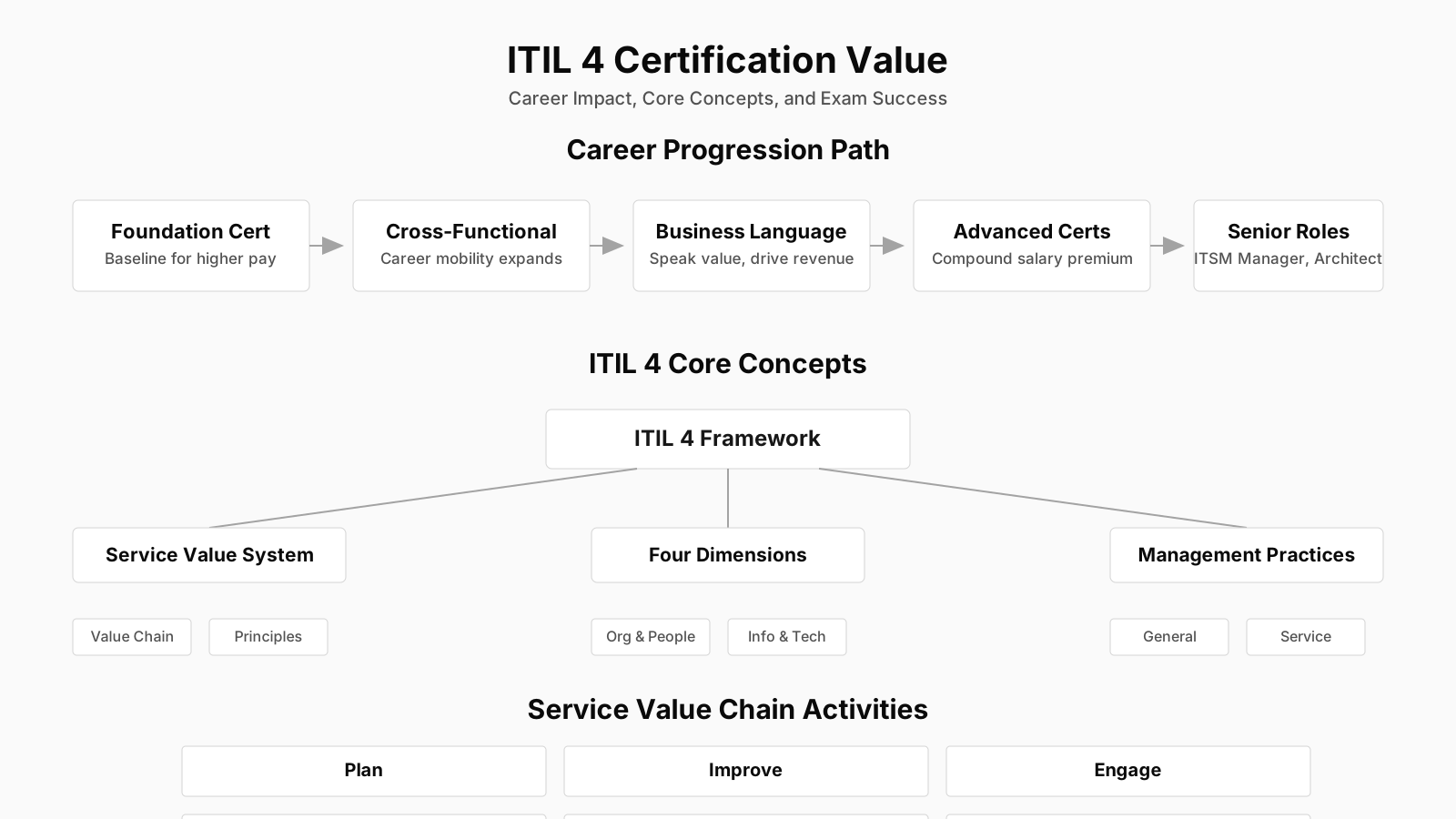
ITIL 4 Foundation: Key Topics at a Glance
| Key Concept | Summary |
|---|---|
| Certification Overview | ITIL 4 Foundation serves as the entry point to the ITIL 4 certification scheme, delivering a robust grounding in the Service Value System, guiding principles, and 34 management practices that underpin modern, digital-era service management. |
| Exam Details | The PeopleCert-administered, closed-book exam presents 40 multiple-choice questions over 60 minutes. Candidates must answer 26 correctly (65%) to demonstrate foundational comprehension across the entire ITIL 4 syllabus. |
| Evolution from ITIL v3 | ITIL 4 marks a decisive shift from the rigid, 26-process model of ITIL v3 to a flexible, value-driven architecture of 34 management practices designed to integrate natively with Agile, DevOps, and Lean, enabling organizations to adapt at the pace of digital transformation. |
| Service Value System | The Service Value System (SVS) is the central operating model that converts incoming demand and opportunity into realized value. It orchestrates five interconnected elements: guiding principles, governance, the service value chain, practices, and continual improvement, securing strategic alignment from intent to outcome. |
| Value Co-Creation | Value is defined solely by the service consumer’s perception and is co-created through active, ongoing collaboration between provider and consumer. This repositions the relationship from one-way delivery to shared accountability for outcomes, experience, and continuous adaptation. |
| Guiding Principles | The seven guiding principles , ‘Focus on value’, ‘Start where you are’, ‘Progress iteratively with feedback’, ‘Collaborate and promote visibility’, ‘Think and work holistically’, ‘Keep it simple and practical’, and ‘Optimize and automate’ , function as a universal lens for decision-making, shaping culture and behavior at every organizational level. |
| Four Dimensions | Holistic service design demands balanced attention to all four dimensions: Organizations & People, Information & Technology, Partners & Suppliers, and Value Streams & Processes. These dimensions define the constraints and enablers that govern effective value delivery. |
| Management Practices | ITIL 4 replaces prescriptive processes with 34 adaptable management practices grouped into General, Service, and Technical categories. At the Foundation level, 15 core practices are emphasized, empowering organizations to tailor capabilities to their unique context and maturity. |
| Career Impact | Globally recognized as a prerequisite for service management roles, ITIL 4 Foundation bridges technical and business communities with a shared vocabulary. It is routinely specified for positions from service desk analyst and IT service manager to digital transformation lead. |
| Exam Strategy | Success requires applied understanding of how SVS components interact in practice, not rote recall. Candidates should prepare for scenario-driven questions that test the ability to interpret situations using guiding principles, value chain activities, and dimensions to identify the most appropriate course of action. |
Understanding the ITIL 4 Foundation Certification and Its Core Framework
ITIL 4 Foundation is the entry level qualification in the ITIL 4 certification scheme, designed to provide a broad understanding of the key concepts, principles, terminology, and end to end service management model that organizations worldwide rely on. Unlike previous iterations that often focused on a rigid set of processes, ITIL 4 introduces a flexible, holistic operating model called the Service Value System, or SVS. This system repositions ITIL from a standalone process library into a framework that integrates seamlessly with contemporary approaches such as Lean, Agile, and DevOps. Because the Foundation certification establishes a common language across technical and business teams, it has become a de facto requirement on job descriptions ranging from service desk analysts and IT managers to product owners and digital transformation leaders.
The certification is owned by AXELOS and delivered through PeopleCert, the accredited examination institute. To earn the ITIL 4 Foundation designation, candidates must pass a closed book exam consisting of forty multiple choice questions within sixty minutes. A score of twenty six correct answers, representing sixty five percent, is required to pass. The exam is administered either Ace Your Remote PMI & Scrum.org Exam: Tech Requirements Checklist or at a physical test center, ensuring accessibility for busy professionals around the globe. While the content is foundational in nature, it demands more than rote memorization. It requires a conceptual grasp of how the various components of the SVS interact to transform uncertain demand into tangible value through services.
The Shift from ITIL v3 to ITIL 4: Why the Update Matters
Many professionals first encountered ITIL through the extensive five volume set of ITIL v3, which was published in 2007 and updated in 2011. That version became synonymous with the twenty six processes spread across the service lifecycle stages of service strategy, design, transition, operation, and continual service improvement. While this model brought significant structure to IT operations, its linear process centric view sometimes created silos and made it difficult to respond to rapid change. Criticisms emerged over the years that ITIL v3 felt bureaucratic, document heavy, and disconnected from the iterative, collaborative spirit of modern software development.
ITIL 4, released in early 2019, deliberately moved away from the rigid lifecycle terminology. It replaced the bundle of processes with a more adaptable concept of thirty four management practices, from which fifteen are emphasized at the Foundation level. The key philosophical shift is that ITIL 4 treats all components of an organization as part of a dynamic value system rather than a static set of procedures. This opens the door for organizations to select and adapt practices based on their unique context, making the framework compatible with small startups, regulated enterprises, and hybrid cloud environments alike. The Foundation certification reflects this modernization, focusing less on memorizing inputs and outputs and more on understanding value streams, collaboration, and continual improvement.
Decoding the Service Value System: The Heart of ITIL 4 Foundation
The Service Value System is the central architectural model of ITIL 4, and mastering it is essential for both passing the exam and applying the framework at work. Every service organization operates within this system, which transforms incoming opportunity and demand into value for customers and stakeholders. The SVS has five core components: the guiding principles, governance, the service value chain, practices, and continual improvement. These elements are not sequential steps but rather an interconnected web that enables the organization to adapt quickly to changing circumstances while maintaining strategic alignment.
At its core, the SVS emphasizes the co creation of value. Unlike older models that viewed service as simply delivering a product or resolving an incident, ITIL 4 Foundation teaches that value is always perceived by the service consumer and is cocreated through ongoing interaction between the provider and the consumer. This subtle but profound shift means that service desks, development teams, and business relationship managers are all part of a single value stream rather than isolated handlers of tickets or feature requests. For the exam, candidates must be comfortable explaining how the SVS components work together, describing the flow from opportunity and demand through the service value chain, and recognizing how governance sets the boundaries within which teams can innovate freely.
The Guiding Principles that Shape Modern Service Management
Seven guiding principles sit at the heart of ITIL 4 Foundation and function as universal recommendations that shape behavior and decision making across any organizational level. These principles are not industry specific; they apply equally to a public sector digital transformation, a financial services compliance team, or a healthcare IT department rolling out a new electronic health record system. The guiding principles are: focus on value, start where you are, progress iteratively with feedback, collaborate and promote visibility, think and work holistically, keep it simple and practical, and optimize and automate.
For example, the principle “start where you are” encourages teams to assess current capabilities, processes, and measurements before introducing sweeping changes. A common misstep in IT transformations is the wholesale adoption of a framework without considering what already works, leading to resistance and wasted effort. By applying this principle, a retail organization that already has a mature incident management process can integrate it directly into its value streams instead of reinventing the wheel. The Foundation exam frequently asks candidates to match a scenario with the most applicable guiding principle, so understanding the practical intent behind each one is far more valuable than memorizing the list. Real world application requires a mindset shift where leaders model these principles daily, creating an environment where collaboration and simplification become cultural norms rather than slogans.
The Four Dimensions of Service Management: A Holistic View
To ensure that services are designed and delivered in a balanced manner, ITIL 4 Foundation introduces four dimensions that must be considered simultaneously. These dimensions are organizations and people, information and technology, partners and suppliers, and value streams and processes. If an organization focuses only on technology while ignoring people skills and culture, even the most sophisticated tooling will fail to deliver value. Similarly, ignoring the partner and supplier dimension can create critical vulnerabilities, as many modern services rely on cloud providers, SaaS vendors, and outsourced support functions.
Consider a mid sized logistics firm migrating its legacy dispatch system to a cloud based platform. The organization and people dimension demands that dispatchers, drivers, and IT staff receive adequate training and that their roles are redesigned to support the new workflows. The information and technology dimension addresses data security, integration with GPS tracking, and system reliability. The partners and suppliers dimension involves vetting the cloud provider, negotiating service level agreements, and planning for vendor lock in risks. Finally, the value streams and processes dimension maps how a customer order triggers a coordinated series of activities across people, technology, and partners. The ITIL 4 Foundation exam expects candidates to recognize that these four dimensions are not isolated pillars but overlapping lenses that shape every service relationship.
The Service Value Chain and Its Interconnected Activities
While the Service Value System provides the big picture, the service value chain is the operating model that defines six interconnected activities used to respond to demand and generate value. These activities are plan, improve, engage, design and transition, obtain or build, and deliver and support. They can be combined in multiple sequences to form flexible value streams, meaning the same chain can handle everything from resolving a minor incident to launching a new digital product. The chain replaces the rigid lifecycle stages of ITIL v3 with a far more adaptable model that acknowledges that real work rarely follows a linear path.
A practical illustration helps ground this abstract concept. When a telecommunications company receives a high priority customer complaint about network latency, the engage activity captures and triages the issue. The deliver and support activity coordinates field engineers and tier two support to restore service quickly. Later, the improve activity might analyze incident trends to propose a permanent fix, triggering a value stream that includes design and transition to test the solution and obtain or build to procure new equipment. Throughout these flows, planning ensures that resources are allocated appropriately and that changes align with business objectives. For the ITIL 4 Foundation exam, it is vital to understand the purpose of each chain activity and to be able to identify how they link together to form a sample value stream without imposing a rigid order.
ITIL Practices: The Practical Engines of Daily Operations
The final major concept area of the Foundation syllabus covers the ITIL practices, which are sets of organizational resources designed for performing work or accomplishing an objective. ITIL 4 recognizes thirty four management practices, grouped into three categories: general management practices, service management practices, and technical management practices. The Foundation exam concentrates on fifteen of the most universally applicable practices, including incident management, service desk, change enablement, service level management, continual improvement, and several others. Each practice is described in terms of its purpose, key activities, success factors, and relevant roles, but without the excessive prescription that might have characterized earlier versions.
For instance, the incident management practice is no longer described as a rigid workflow that must be configured exactly the same way across all organizations. Instead, ITIL 4 Foundation teaches that the purpose of incident management is to restore normal service operation as quickly as possible and to minimize the negative impact on business operations. How an organization achieves that can vary dramatically depending on its size, industry, and tooling. This flexibility makes the practices more durable and easier to adopt alongside other frameworks like Site Reliability Engineering, which emphasizes blameless postmortems and error budgets. Candidates preparing for the certification should focus on the intent of each practice and its connection to the service value chain, rather than trying to memorize every sub process that might exist in a textbook implementation.
Core Takeaways on ITIL 4 Foundation
- Entry level certification purpose
- The ITIL 4 Foundation certification equips professionals with a comprehensive grasp of the ITIL framework, including its guiding principles and the Service Value System, enabling organizational adaptability and service excellence.
- Shift from ITIL v3 to ITIL 4
- ITIL 4 replaced the prescriptive ITIL v3 service lifecycle with 34 flexible management practices, prioritizing the creation of value through integrated value streams and cross-functional collaboration rather than process adherence alone.
- Service Value System components
- The Service Value System integrates five core components: guiding principles that inform decisions, governance that sets direction, a service value chain that orchestrates activities, adaptable practices, and embedded continual improvement, ensuring a holistic approach to service management.
- Value co creation concept
- The curriculum emphasizes that value is defined by the service consumer’s perception and emerges through active collaboration; ongoing provider-consumer interactions jointly shape outcomes and drive mutual benefit.
- Exam structure and requirements
- To earn the certification, candidates must complete a 40-question, closed-book exam in 60 minutes, achieving a score of 26 out of 40 (65 percent) to pass.
How to Ace the ITIL 4 Foundation Exam and Secure Your Certification
Earning the ITIL 4 Foundation certificate is a straightforward process when approached with a structured study plan and the right resources. The exam is designed to be achievable for newcomers to service management, but it does require a disciplined preparation strategy that balances conceptual understanding with the ability to apply terminology to fictional scenarios. Many candidates underestimate the exam by treating it as a simple vocabulary test, only to discover that the questions require analyzing short case studies and choosing the best fit among seemingly plausible options. A deliberate approach that includes accredited learning materials, active recall techniques, and timed practice exams dramatically increases both confidence and first attempt pass rates.
Exam Structure, Question Types, and Passing Score Details
The ITIL 4 Foundation exam consists of forty multiple choice questions, each offering four possible answers. The standard time allowance is sixty minutes, which provides sufficient margin for candidates who carefully read each prompt but does not leave room for lengthy deliberation on any single item. For non native English speakers who take the exam in English, an additional fifteen minutes are granted, making the test accessible to a global audience. The passing mark is twenty six correct answers out of forty, translating to a sixty five percent threshold.
Question formats include standard multiple choice with a single correct answer and, less frequently, negative questions that ask for an exception or a misunderstanding. A typical question might present a brief scenario in which a team is struggling with frequent failed changes and ask which practice would best address the root cause. Another might describe an organization adopting an agile mindset and ask which guiding principle supports an iterative approach. The exam blueprint published by PeopleCert explicitly weights the content domains, with the practices category representing the largest share at roughly sixty five percent of the marks. This weighting tells candidates exactly where to invest the majority of their study time, ensuring that every practice area is understood in the context of the SVS.
Key Resources and Study Strategies for the ITIL 4 Foundation Exam
Access to high quality study resources is a critical success factor. PeopleCert requires that candidates either attend an accredited training course delivered by an Authorized Training Organization or acquire an exam voucher that validates their readiness, but independent study using the official ITIL 4 Foundation publication is a common and highly effective path. The core textbook, titled “ITIL Foundation: ITIL 4 Edition,” outlines the entire syllabus in a clear narrative format and includes sample questions. Complementing this with a reputable online practice exam simulator helps build the mental stamina needed for the real test and reveals knowledge gaps that passive reading often hides.
Effective study strategies go beyond highlighting passages. Creating mind maps that link the guiding principles to specific value chain activities, for example, strengthens associative recall. Writing out the definition, purpose, and key terms for each of the fifteen foundation level practices in one’s own words forces deeper processing. Teaching a simplified version of the Service Value System to a colleague or study group reinforces understanding and exposes unclear areas. Setting a schedule of four to six weeks with two to three hours of focused study per session allows the material to settle, making it far more likely that the candidate will correctly interpret scenario based questions rather than relying on superficial keyword matching during the high pressure exam environment.
Mastering the ITIL 4 Foundation Concepts Through Practice Tests
Practice exams are the single most impactful tool for bridging the gap between knowing the concepts and acing the ITIL 4 Foundation exam. A high quality practice test replicates the timing, question style, and difficulty of the official assessment, providing immediate feedback on both correct and incorrect responses. The real value emerges from the review process. When a candidate selects an incorrect answer, analyzing why the correct option aligns with the SVS logic and why the distractors are misleading builds the analytical muscles needed on exam day.
It is advisable to begin with untimed, topic specific quizzes during the initial study phase to isolate weak areas, such as the four dimensions or the nuances between service request management and incident management. As the exam date approaches, transitioning to full length, timed simulations under realistic conditions eliminates surprises and reduces anxiety. Many successful candidates aim for a consistent score of eighty percent or higher on practice exams before booking the official test. This margin accounts for variations in question wording and ensures that knowledge is robust enough to handle the inevitable tricky items. Practice tests also highlight the importance of reading each question carefully, because a single word like “not” or “except” can completely invert the intended answer.
The Day of the Exam: Practical Tips for ITIL 4 Foundation Success
On exam day, whether testing at home or in a test center, a few practical measures can make a significant difference. For online proctored exams, candidates should perform a system check well in advance, ensure a quiet and clutter free workspace, and have their government issued identification ready. Understanding the proctoring rules about breaks, talking aloud, and looking away from the screen prevents unnecessary interruptions or disqualification. For test center exams, arriving early, carrying the required ID, and storing personal items as instructed reduces last minute stress.
During the exam, managing time is straightforward. With forty questions in sixty minutes, candidates can spend approximately ninety seconds per question. A smart tactic is to quickly scan the entire exam and answer the straightforward factual questions first, marking more complex scenario items for review. This builds confidence and ensures that easy points are secured. When encountering a difficult scenario, mentally mapping it to the Service Value System and identifying the engaging and deliver and support activities often illuminates the correct practice or principle. Flagging a question for review and returning with fresh eyes frequently leads to the right choice, because the brain continues to process the scenario subconsciously while working through other items.
Boost Your Career with ITIL 4 Foundation: Tangible Benefits and Pathways
Beyond the immediate achievement of passing an exam, ITIL 4 Foundation delivers concrete career value that compounds over time. It signals to employers and clients that the holder shares a common vocabulary for discussing service quality, risk, and continual improvement. This common language reduces miscommunication across departments, speeds up onboarding in new roles, and positions the certified professional as someone who can bridge the gap between technical execution and business strategy. For many organizations undergoing a digital transformation or consolidating their IT operations after a merger, hiring ITIL certified staff becomes a risk mitigation strategy, because those individuals are already trained to think in terms of value streams and cross functional collaboration.
Career Value of ITIL 4 Foundation for IT Professionals at Every Level
The ITIL 4 Foundation certification is not reserved for a single job title. Service desk analysts who earn the credential immediately stand out for their ability to classify incidents and service requests correctly, which improves resolution times and customer satisfaction. IT managers leverage the Foundation knowledge to visualize their team’s work as value streams, identifying bottlenecks in the transition from development to operations. Project managers and product owners use the guiding principles to adapt their workflows, ensuring that stakeholder requirements are continuously validated and that projects do not become detached from the service value chain. Even professionals in human resources, procurement, and compliance find the Foundation useful because the four dimensions explicitly connect people, partners, and processes in a way that mirrors their day to day responsibilities.
Real career acceleration happens when the certification is paired with domain expertise. A cybersecurity analyst who understands the service configuration management practice can advocate for accurate configuration management databases that inform vulnerability assessments. A cloud architect who internalizes the keep it simple and practical principle designs solutions that are easier to support and operate, thereby reducing the total cost of ownership for the business. Because the ITIL 4 Foundation framework is vendor neutral and adaptable, it complements technical certifications from AWS, Microsoft, Cisco, and others rather than competing with them. This synergy makes the certified professional a more versatile asset, capable of contributing to architectural decisions, process improvements, and customer experience initiatives alike.
Integrating ITIL 4 Foundation Knowledge into High Demand Roles
Digital transformation initiatives and the rise of DevOps have created a demand for professionals who can operate at the intersection of stability and speed. The ITIL 4 Foundation curriculum directly addresses this need by embedding concepts like the service value chain, which replaces rigid handoffs with fluid, responsive value streams. For a site reliability engineer, the incident management and problem management practices provide a structure for escalating and analyzing failures without contradicting the blameless culture of SRE. The guiding principle of collaborate and promote visibility supports the transparency required for effective post incident reviews and shared dashboards.
In product management, the Foundation’s emphasis on value co creation changes the conversation from delivering features to achieving outcomes. A product manager who understands the engage and design and transition activities can map customer journeys onto the service value chain, ensuring that feedback loops are built into every sprint. This integration allows the team to pivot quickly when user behavior indicates a mismatch between the product roadmap and real needs. During hiring processes, candidates who can articulate how ITIL 4 practices align with Agile ceremonies, such as embedding change enablement into sprint planning, demonstrate a sophisticated grasp of modern service management that sets them apart from peers who view ITIL and Agile as mutually exclusive.
Salary Impact and Global Recognition for ITIL 4 Foundation Holders
While no certification guarantees a salary increase, labor market data consistently shows that ITIL credentials correlate with higher earning potential, particularly when combined with relevant experience. Survey reports from global skill and salary platforms frequently place ITIL Foundation among the top paying entry level certifications for IT service management roles. The incremental value emerges because certified professionals help organizations reduce service downtime, shorten incident resolution times, and implement structured continual improvement programs that translate directly into cost savings and revenue protection. Employers recognize that hiring a team with a baseline of shared ITIL 4 Foundation knowledge accelerates process maturity and reduces internal training overhead.
Global recognition is another powerful career lever. Because ITIL is adopted by multinational corporations, government agencies, and nonprofits across North America, Europe, the Middle East, Asia Pacific, and Africa, the Foundation certification is a portable asset. A professional who earns the credential in London can carry that same designation to Sydney or Singapore without needing to translate or revalidate it. This portability supports career mobility, particularly for consultants and service integrators who work with clients in different regions. It also aligns with the growing trend of remote and hybrid work, where distributed teams rely on a common service management framework to maintain cohesion and consistent service quality across time zones.
ITIL 4 Foundation as a Gateway to Advanced Certifications and Leadership
The Foundation certification is the mandatory prerequisite for the ITIL 4 Managing Professional and Strategic Leader advanced streams, which together form the pathway to the ITIL Master designation. After completing Foundation, professionals can pursue modules such as Create, Deliver and Support, Drive Stakeholder Value, High Velocity IT, and Direct, Plan and Improve. These intermediate certifications deepen expertise in areas like hybrid project delivery, customer journey mapping, digital operating models, and organizational change leadership. Each of these modules builds directly on the Foundation concepts, extending the service value chain and practices into specialized contexts.
For those aspiring to management and leadership roles, the progression path creates a structured professional development plan. A service desk manager who has mastered the Foundation level can later take the Drive Stakeholder Value module to refine user experience design, journey mapping, and supplier relationships. An IT operations director can pursue Direct, Plan and Improve to strengthen strategic planning, governance, and risk management capabilities. By the time a professional reaches the ITIL Strategic Leader level, they are equipped to sit at the executive table and shape the organization’s digital strategy. This clear ladder of advancement transforms the Foundation certification from a single accomplishment into the first deliberate step of a long term career investment.
Core Career Benefits of ITIL 4 Foundation
- Common vocabulary and risk mitigation
- ITIL 4 Foundation equips you with a shared vocabulary for service management and risk, minimizing misunderstandings and enabling you to align technical delivery with business objectives.
- Versatility across roles and domains
- The certification complements any role, from service desk analyst to cloud architect, by blending domain expertise with vendor-neutral ITIL practices, making you a more versatile contributor in digital transformation and DevOps environments.
- Salary impact and global recognition
- Compensation data shows that ITIL Foundation certification correlates with higher earning potential, as certified individuals help organizations minimize downtime and implement continuous improvement programs that generate tangible cost efficiencies.
Putting ITIL 4 Foundation Concepts to Work in the Real World
Knowledge becomes valuable only when it is applied. The ITIL 4 Foundation certification provides a rich set of mental models, but the real career boost comes from translating those models into daily behaviors, process improvements, and cultural shifts. Organizations that successfully embed the SVS, guiding principles, and practices into their operations often start small, selecting a single value stream to optimize and deliberately avoiding a “big bang” rollout that can overwhelm teams and provoke resistance. The following real world applications illustrate how professionals at any level can begin applying Foundation concepts immediately after earning the certification.
Applying the Guiding Principles to Everyday Operations
One of the most accessible ways to use ITIL 4 Foundation knowledge is to adopt the guiding principles as a personal checklist for decision making. When a team faces a recurring service outage, instead of jumping to a complex technical root cause analysis tool, the principle keep it simple and practical prompts them to first verify the basics: Are recent changes documented, and has anyone checked the configuration management system for unauthorized modifications. When colleagues propose a large scale tool replacement, progress iteratively with feedback encourages a pilot with a single business unit before committing the entire organization.
A concrete example comes from a regional healthcare network that used the guiding principles to overhaul its patient appointment scheduling service. By focusing on value, the project team interviewed patients and clinicians to understand that reducing wait time confirmation calls was the primary outcome desired. Starting where they were, they mapped the existing manual process before automating it, preserving familiar notification steps that patients trusted. Throughout the implementation, collaborating and promoting visibility through shared dashboards allowed the help desk and clinical staff to track appointment changes in real time, slashing missed appointments by a measurable margin without introducing unnecessary complexity.
Leveraging the Service Value Chain to Drive Efficiency
Mapping real work to the service value chain activities uncovers duplication, waiting, and handoff delays that fragments teams and frustrates customers. A financial services company that processed thousands of daily customer onboarding requests found that the steps of identity verification, account provisioning, and welcome letter generation were spread across three departments that rarely communicated. By explicitly defining a value stream that connected the engage activity when customers submitted applications, the obtain or build activity to configure accounts, and the deliver and support activity to send confirmation communications, the company reduced the average onboarding time from four days to less than twenty four hours.
The value chain mapping also revealed that many internal escalations classified as incidents were actually service requests that could be automated through a self service portal. The IT team applied the service request management practice, standardizing the fulfillment of common requests like password resets and software installations. By decoupling these requests from the incident management queue, the service desk freed up resources to focus on genuine service disruptions, improving both employee experience and mean time to resolution. This shift required no additional headcount, only a reorganization of work that the Foundation concepts made visible and actionable.
Building a Culture of Continual Improvement with ITIL 4
Continual improvement is woven throughout the ITIL 4 architecture, not merely treated as an afterthought. The improve activity of the service value chain and the continual improvement practice itself provide a structured yet lightweight approach for fostering a learning organization. Rather than restricting improvement to large project postmortems, ITIL 4 Foundation encourages teams to embed small, frequent improvements into their everyday routines. A logistics company’s IT department, for example, instituted a fifteen minute weekly huddle where any team member could propose one small improvement inspired by an incident, a customer comment, or a process bottleneck.
These proposals were logged in a simple shared list aligned with the ITIL continual improvement model: what is the vision, where are we now, where do we want to be, how do we get there, take action, and check the result. One suggestion to add a brief knowledge article template to the service desk tool resulted in a twenty percent drop in repeat incidents within a month. By celebrating small wins and linking them back to the guiding principles, the department cultivated a habit of initiative that mirrored the lean philosophy of Kaizen. Over time, this culture of incremental refinement becomes a durable competitive advantage that no tool implementation can replicate on its own.
Adapting ITIL 4 Foundation to Agile and DevOps Environments
A persistent myth is that ITIL and Agile are incompatible. The ITIL 4 Foundation syllabus explicitly dismantles this false dichotomy. The service value chain does not prescribe a waterfall sequence. It simply identifies the types of activities that must happen for value to flow, leaving the cadence and methods entirely open to the organization. A software team practicing Scrum can overlay its sprint events onto the chain without any conflict. Sprint planning corresponds to plan, daily standups embody collaborate and promote visibility, and the sprint itself performs obtain or build followed by deliver and support. The change enablement practice integrates with DevOps by authorizing pre approved standard changes through the CI/CD pipeline, so that routine deployments do not require manual approval gates that kill velocity.
When an ecommerce company adopted a continuous delivery model with automated testing and infrastructure as code, its leadership worried that imposing ITIL practices would reintroduce bureaucratic gates. Instead, using the Foundation’s flexible approach, they defined standard changes for feature flag deployments and normal changes for database schema alterations that required a brief safety review. The problem management practice was applied not as a lengthy root cause analysis document but as a blameless postmortem session conducted within a week of a major incident. This adaptation preserved the speed of deployment while creating a systematic way to learn from failures, proving that ITIL 4 Foundation serves as a tuning framework for high velocity environments rather than an obstacle to them.
Overcoming Common Implementation Pitfalls and Resistance
Introducing new service management concepts can generate skepticism, especially in teams that have experienced overly tactical, tool centric ITIL implementations in the past. The ITIL 4 Foundation certification prepares professionals to anticipate and defuse this resistance by emphasizing narrative, collaboration, and evidence. Rather than presenting the Service Value System as a mandatory compliance framework, effective practitioners frame it as a diagnostic lens. When a project is stuck, asking “Where in the value chain is the delay occurring, and which practice might help?” shifts the conversation from blame to problem solving.
Another frequent pitfall is attempting to adopt every practice at once. The Foundation curriculum itself cautions against this, through the drive to think and work holistically while also keeping things simple. A pragmatic approach is to select two or three practices that directly address an active pain point and implement them lightly, gathering feedback before expanding. For example, if a managed services provider is hemorrhaging revenue due to missed service level targets, they might initially focus on service level management and incident management, leaving the more strategic practices until foundational stability is achieved. This iterative, feedback driven deployment mirrors the core message of ITIL 4 and demonstrates to colleagues that the framework is a servant, not a master.
The Long Term Journey from Foundation to Organizational Impact
ITIL 4 Foundation is not a finish line but an entry point into a broader professional development and organizational maturity journey. The concepts it introduces evolve in the mind of the practitioner as they encounter complex real world scenarios. A newly certified professional might first use the service desk practice to refine ticket categorization. A few years later, that same professional, now in an architecture role, uses the same principles and value chain mental model to design a multi supplier ecosystem that delivers personalized financial services across digital channels. The continuity of the framework means that early knowledge never becomes obsolete; it simply deepens and connects to more sophisticated capabilities.
For organizations, investing in a critical mass of ITIL 4 Foundation certified staff creates a network effect where improvement ideas flow horizontally rather than being mandated from the top. When service desks, development teams, and business analysts share the same foundational language, cross functional initiatives such as customer experience redesign or cloud migration accelerate because less time is spent translating between competing terminologies. The ultimate career boost comes from being recognized as a node in that network, someone who not only understands the individual practices but can orchestrate them into coherent, value driven services that make a measurable difference to customers and the bottom line.
Advance Your Career with Professional Certification
Earning a professional project management certification validates your expertise in industry-standard frameworks and demonstrates a commitment to continuous improvement that employers highly value. By investing in structured project management training , you gain proven methodologies to deliver projects on time and within budget while effectively managing risks and stakeholder expectations. This credential not only accelerates your career progression by opening doors to senior roles but also enhances organizational success through consistent project delivery and a common language that aligns teams across departments.
In today's competitive landscape, earning a professional product management certification validates your strategic thinking and customer-centric approach, giving you an edge in the job market. This credential not only equips you with proven frameworks to drive product success but also signals to employers your commitment to best practices, often leading to faster promotions and higher earning potential. For organizations, certified product managers reduce risk by applying structured discovery and delivery methods, which directly enhances collaboration, innovation, and business outcomes.
Earning a professional HR management certification validates your expertise in modern people strategies, from talent acquisition to compliance and performance management, which directly enhances your credibility with employers and peers. This credential not only sharpens your strategic decision-making skills but also significantly boosts your earning potential and job stability in a competitive market. Moreover, certified HR professionals are better equipped to drive employee engagement, foster inclusive cultures, and align workforce goals with business objectives, directly contributing to long-term organizational success.
