The journey from a promising startup to a sustainable, large-scale enterprise is one of the most demanding transitions in business. Leaders who attempt this journey quickly discover that the skills that built the initial success are not the same skills that scale it. Lead the Leap: CEO Mastery in Scaling Organizations is not about a single dramatic gesture or charismatic speech; it is a sustained, deliberate practice of building systems, developing people, and making choices that compound. The leap in question is not merely financial growth, but a fundamental shift in how the organization thinks, operates, and adapts. For a CEO, mastering this phase means evolving personally faster than the organization grows, a challenge that requires both strategic clarity and deep self-awareness.
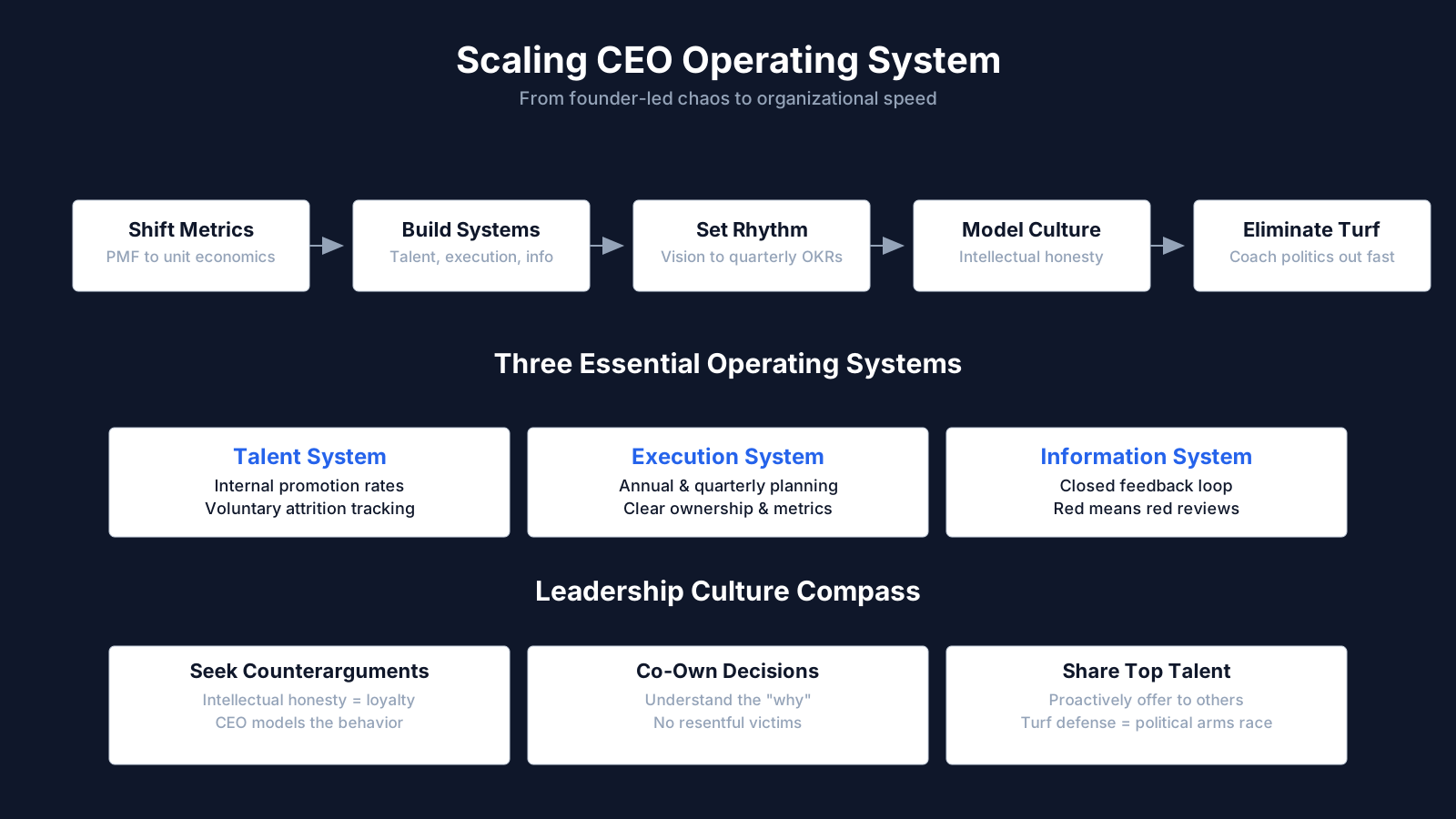
Lead the Leap: Summary of Key Topics
| Key Concept | Summary |
|---|---|
| Evolving Mindset | Organizational scale demands that the CEO's personal evolution outpaces company growth, transitioning from hands-on operator to systemic leader. |
| Strategic Codification | Strategic vision achieves traction only when distilled into a concise framework that guides trade offs and concentrates resources against fragmentation. |
| Context over Control | The CEO's primary role shifts from centralized decision maker to architect of context, establishing parameters that unlock autonomous and aligned team decisions. |
| Grounded Ambition | Sustainable scaling balances visionary ambition with operational discipline by rigorously pressure testing plans against financial data and team bandwidth. |
| Structural Foresight | Proactive organizational design defines information arteries and decision rights early, forestalling the bottlenecks and politics that impede growth. |
| Scalable Hierarchy | Beyond fifty to seventy people, embracing a deliberate hierarchy distributes cognitive burden and prevents the CEO from becoming a decision choke point. |
| Outcome Accountability | Cross functional teams granted clear missions and outcome ownership accelerate execution, provided alignment guardrails like OKRs and quarterly rhythms are in place. |
| Talent Architecture | The CEO must act as chief talent officer, recognizing that direct investment in leadership capability represents the most potent scaling lever available. |
| Cultural Integrity | Growth demands vigilant cultural stewardship, employing codified values, weekly rituals, and selective hiring to preserve identity against headcount dilution. |
| Relentless Self-Awareness | Mastery hinges on profound self-awareness to manage ego, surrender operational control, and personally model the adaptability required from the organization. |
The Strategic Vision as the Scaling Compass
Without a coherent strategic vision, scaling becomes an exercise in chaotic acceleration. The CEO must articulate a destination that is ambitious enough to inspire, yet specific enough to guide daily tradeoffs. Many organizations plateau not because they lack market opportunity, but because the strategic vision has not been translated from a founding idea into an organizational logic that hundreds or thousands of employees can internalize. A scaling CEO continuously refines the company’s core purpose , value proposition, and competitive differentiators, ensuring they remain sharp as the organization adds organizational layers and complexity.
Defining the True North with Clarity
A strategic vision that works for a fifty-person company often breaks down at five hundred people. In the early stages, alignment happens organically through frequent informal contact. At scale, the vision must be codified into a memorable framework that resists dilution. The most effective CEOs use tools like the mission-vision-strategy cascade, but they go further by linking the vision to observable behaviors and measurable outcomes. This means articulating not just what the company does, but what it refuses to do. Strategic clarity at scale is as much about exclusion as it is about ambition. A clear “no” to lucrative but off-strategy opportunities prevents the fragmentation of resources that quietly kills scaling momentum.
The CEO mastery in scaling organizations involves moving from being the chief decision-maker to the chief context-setter . Instead of telling teams what to do, the leader creates boundaries and principles within which teams can autonomously decide. This shift requires a level of discipline that many entrepreneurial leaders find uncomfortable. They must resist the urge to intervene in every conflict or to greenlight every project personally. The vision becomes the invisible hand that guides thousands of decisions the CEO will never witness, and its effectiveness is only as good as the consistency of its communication .
Balancing Ambition with Operational Reality
A grand vision disconnected from operational realities breeds cynicism. The scaling CEO must be the bridge between the aspirational future and the constraints of today. This means frequently pressure-testing the strategic plan against financial data, customer feedback, and team capacity. Many leadership teams fall into the trap of setting growth targets based solely on market potential, ignoring the internal friction that rapid hiring, process immaturity, and cultural strain introduce. Mastery lies in sequencing the vision into achievable milestones that build credibility and capability iteratively.
The CEO should champion a rhythm of strategic reviews that are brutally honest about what is slowing the organization down. It is common to discover that the limiting factor is not external competition but internal coordination debt, where the cost of cross-functional alignment grows faster than revenue. Addressing this requires the CEO to make tough calls about pausing certain initiatives, delaying geographic expansion, or even rethinking the organizational structure. Balancing ambition with reality is not pessimism; it is the strategic patience that prevents premature scaling from destroying value.
Core Insights on Strategic Vision as Compass
- Vision as scaling anchor
- A coherent strategic vision anchors rapid growth by providing a shared destination that informs daily trade-offs and prevents organizational stagnation.
- From founder to context-setter
- The CEO must shift from chief decision-maker to architect of context, establishing boundaries and principles that empower autonomous, aligned decisions across the organization.
- Clarity through exclusion
- True strategic clarity at scale emerges when leadership explicitly defines what the company will not do; rejecting tempting but off-strategy opportunities safeguards focus and prevents resource dilution.
- Bridging vision and reality
- The CEO must continuously pressure-test the strategic vision against hard data, customer signals, and operational capacity, ensuring aspirations remain credible and do not breed cynicism.
- Strategic patience over speed
- Balancing ambition with operational health demands difficult decisions, such as pausing new projects or postponing expansion to resolve coordination debt and avert the risks of premature scaling.
Building a Scalable Organizational Architecture
Organizational structure is often treated as an administrative afterthought, yet for the CEO leading a scaling leap, it is a primary lever of value creation. The structure determines information flow, decision rights, and accountability. A poorly designed architecture creates bottlenecks, slows reaction time, and breeds internal politics. The CEO must evolve the structure proactively, not reactively, anticipating the strains that growth will place on communication and coordination.
From Flat to Functional: The Right Time for Hierarchy
The myth of the perpetually flat organization persists in entrepreneurial culture, but empirical evidence suggests that beyond a certain size, ambiguity of authority causes more harm than hierarchy. When a company grows past roughly fifty to seventy people, the lack of clear reporting lines and functional groupings leads to decision paralysis and overload at the top. Mastering the scaling leap means embracing structured hierarchy not as bureaucracy but as a distribution of cognitive load. The CEO shifts from managing individuals to managing a team of functional leaders who each own a domain.
The transition is fraught with risk. Founders often fear that introducing layers of management will kill the entrepreneurial spirit. However, the greatest risk is staying flat too long and creating a brittle organization where all information flows through the CEO. The solution is to design hierarchy with high autonomy at each level, ensuring that managers are coaches and strategic thinkers, not micromanagers. The CEO’s role is to select and develop leaders who can operate within a framework of empowered accountability, and to model the behavior of letting go.
Designing Teams for Autonomy and Alignment
The modern scaling organization borrows from product-led and agile philosophies to create cross-functional teams that own outcomes, not just tasks. The CEO must champion the restructuring from siloed functions to value-stream-aligned teams. This is a profound shift in how work is organized and requires redesigning planning, budgeting, and performance evaluation. Teams given clear missions and the authority to solve problems independently can move much faster than those dependent on top-down directives.
However, autonomy without alignment is anarchy. The CEO must install the guardrails of strategy and culture that keep teams from pulling in opposite directions. Regularly scheduled alignment sessions, such as quarterly business reviews and OKR (Objectives and Key Results) planning, provide the necessary synchronization. The CEO’s mastery is evident in how well these teams understand not only their own objectives but also how they interconnect with the broader organizational goals. This systemic awareness prevents the local optimization that can degrade the overall customer experience.
Talent Mastery: The CEO’s Most Critical Lever
Scaling an organization is fundamentally a talent endeavor. No amount of strategy or process can compensate for having the wrong people in key roles, particularly in the leadership team. The CEO must shift from being the chief evangelist and doer to being the chief talent officer, personally invested in the quality, development, and deployment of human capital. This is not a task that can be fully delegated to human resources; it requires the CEO’s judgment, time, and emotional intelligence.
Hiring for Adaptability Over Credentialism
In the race to fill seats, companies frequently over-index on past experience and prestigious credentials while underestimating adaptability. The scaling environment is by definition changing constantly, so a candidate who was perfectly configured for a previous stage may become a bottleneck at the next. The CEO must insist on selection processes that test for learning agility, comfort with ambiguity, and alignment with core values. Past success in a large, stable corporation does not predict success in a high-growth, fluid one, and the reverse can also be true.
Behavioral interviewing, realistic job previews, and rigorous reference checks become essential. The CEO should personally interview candidates for roles that set cultural or strategic direction, modeling the depth of assessment expected. Moreover, hiring for adaptability means looking for individuals who have demonstrated growth across different contexts, who have failed intelligently and learned, and who can articulate how they would approach problems they have never seen before. This approach reduces the likelihood of bringing in people who will defend the past rather than build the future.
Developing Leaders Who Can Lead Leaders
The scaling leap demands a multiplication of leadership, not just an addition of managers. The CEO must create an internal leadership development engine that prepares high-potential individuals for the complexity of leading other leaders. This involves formal programs, but more importantly, it requires stretch assignments that force people to grapple with strategic ambiguity, cross-functional conflict, and P&L ownership. The CEO should personally mentor the top layer of emerging leaders, using real-time challenges as development cases.
One of the most difficult transitions for a founder-CEO is accepting that loyalty and tenure are not sufficient qualifications for senior leadership. Sometimes the people who were instrumental in the early days lack the cognitive bandwidth or strategic ability for scaled leadership. The CEO must make these decisions with compassion but without delay, finding alternate roles where possible, but never preserving a blocking seat out of misplaced loyalty. Lead the Leap: CEO Mastery in Scaling Organizations often comes down to the courage to upgrade the team before the team limits the organization’s trajectory.
The Art of Letting Go: Delegation as a Scaling Force
Delegation is not simply assigning tasks; it is transferring ownership of outcomes. For many CEOs, this is psychologically difficult because their identity is intertwined with being the problem solver. Yet, a CEO who cannot delegate effectively becomes the single point of failure and the ultimate constraint on growth. Mastery involves building a decision-making framework that specifies which decisions the CEO reserves for themselves and which are pushed down, along with the criteria and context needed to make them well.
Effective delegation requires the CEO to invest time upfront in clarifying desired outcomes, providing the necessary resources, and then stepping back, tolerating the discomfort of watching someone else approach the problem differently. The payoff is immense: the organization develops decision-making muscle, the CEO regains strategic time, and employees feel genuine ownership. The scaling leap is unachievable without this distributed ownership, because the sheer volume and complexity of decisions exceed any one person’s capacity.
Core Insights on Talent as CEO Lever
- CEO as chief talent officer
- The CEO's direct stewardship of talent quality and development is essential, because even the most brilliant strategy unravels when key leadership roles are filled by the wrong individuals.
- Hiring for adaptability over credentials
- Selection processes should emphasize learning agility and comfort with ambiguity over conventional markers like past experience or prestigious credentials, effectively preventing leadership bottlenecks that stall scaling.
- Developing leaders of leaders
- The CEO must construct a systematic internal pipeline, leveraging stretch assignments and personal mentoring to equip high-potential individuals for the nuanced responsibility of leading other leaders.
- Courage to upgrade the team
- Loyalty and long tenure alone cannot justify retaining senior leaders; the CEO must act with both compassion and decisiveness to transition individuals who lack the capacity for scaled roles.
- Delegation as ownership transfer
- Effective delegation demands that the CEO transfer complete ownership of outcomes, accept diverse methods, and institute a clear decision-making framework to avoid becoming the organization's primary growth bottleneck.
Operational Scaling Without Losing Agility
As organizations grow, the informal, ad-hoc processes that once sufficed become liabilities. However, the instinct to over-standardize can suffocate the very agility that made the company successful. The CEO’s challenge is to introduce just enough process to reduce chaos and manage risk, while preserving the capacity for rapid iteration and local adaptation. This delicate balance defines operational scaling.
Process Standardization That Enables, Not Restricts
Process for its own sake is the enemy. The CEO must champion a process philosophy where standardization serves the front-line employees and ultimately the customer. Every new policy or step should be evaluated against a simple question: does this reduce friction or add it? Lean management principles teach that the best processes are co-designed with the people who execute them, not imposed by a distant operations team. The CEO should sponsor cross-functional sprints to streamline workflows, eliminating steps that no longer add value.
A common mistake is to implement enterprise resource planning or workflow tools prematurely or rigidly, assuming technology will enforce good process. Without cultural buy-in and adaptation, these systems become despised overhead. The CEO’s role is to frame process improvement as a collective quest for operational excellence, not a compliance exercise. When teams understand that good process frees them from firefighting and enables them to do more meaningful work, resistance diminishes. The scaling organization needs consistent processes for financial controls, hiring, and quality assurance, but beyond these, latitude should be given to teams to adapt methods.
Data-Driven Decision-Making at Speed
Intuition and gut feel have their place in a startup’s early days, but at scale, the CEO must lead the cultural shift toward evidence-based management. Data literacy becomes a core competency, and the CEO models this by requesting data before forming opinions and by asking incisive questions that poke at the quality of the analytics. This does not mean becoming paralyzed by analysis. The goal is to accelerate decision speed by reducing uncertainty and providing objective feedback loops.
The operational backbone for this is a modern data stack that integrates customer, financial, and operational data into dashboards that are accessible and understandable. The CEO does not need to be a data scientist, but must be able to distil insights from metrics and to hold the organization accountable to leading indicators. One of the most powerful scaling practices is the regular review of a small set of key metrics that track customer health, unit economics, and employee engagement. These metrics act as an early warning system, allowing the CEO and leadership team to course-correct before small issues become crises.
Culture as the Invisible Operating System
Culture is often dismissed as a soft concern, but for a scaling organization, it is the hardest to repair and the most consequential. It is the sum of behaviors that are rewarded and tolerated, and it operates whether the CEO consciously shapes it or not. Left unattended, culture fragments into subcultures that can become toxic or misaligned. The CEO’s mastery lies in intentionally cultivating a culture that scales with the organization, reinforcing the values that drive performance and resilience.
Codifying Values Before They Codify You
In the early stages, the founders’ personalities and daily interactions define the culture. As the organization grows and new employees arrive who have never worked directly with the founders, that cultural transmission breaks down unless the values are made explicit and systemic. The CEO must lead the effort to articulate the organization’s core values not as aspirational wall art but as behavioral expectations that are woven into hiring, performance reviews, recognition, and even terminations.
The values must be specific and tradeoff-oriented. For example, stating “integrity” is meaningless without defining what integrity looks like when it costs money or delays a project. The CEO must personally tell stories that illustrate values in action, celebrating employees who made difficult decisions that aligned with the values even at short-term cost. These stories become the folklore that sustains culture. The most successful scaling CEOs are relentless in their use of symbols and narratives to keep the values alive across geographies and generations of employees.
Rituals and Symbols That Sustain Connection
As the organization disperses across floors, buildings, and time zones, the sense of shared identity can erode rapidly. The CEO must be the steward of rituals that create belonging and reinforce the culture. These are not frivolous social events but structured interactions that embed values. An all-hands meeting where customer stories are shared, a quarterly award that recognizes cross-functional collaboration, a “failure forum” where leaders openly discuss mistakes without blame all these rituals normalize the behaviors the organization needs to survive.
The CEO’s physical and digital presence matters. In a hybrid or remote scaling context, the CEO must be intentional about how they show up. Video messages that convey vulnerability, site visits that are not just for presentations but for genuine listening, and consistency in responding to employee questions are all ritualized acts of leadership. The scaling leap often causes a sense of loss among long-tenured employees who mourn the intimacy of the small company. The CEO must acknowledge this loss honestly while painting a picture of a different, but equally meaningful, kind of community that scale can offer.
Core Takeaways on Cultural Architecture
- Intentionally shaping the operating system
- Culture, like an operating system, governs every interaction and tends to default to informal power dynamics, requiring the CEO to deliberately orchestrate it to prevent fragmentation into toxic subcultures as the company scales.
- Codifying values with behavioral specificity
- Values only become actionable when translated into specific, tradeoff-revealing behaviors that are embedded in hiring rubrics, performance evaluations, and recognition programs, with the CEO’s storytelling transforming these into a shared organizational folklore that guides daily decisions.
- Rituals as anchors for shared identity
- Purposeful rituals like all-hands meetings, cross-functional awards, and failure forums anchor shared identity across distributed teams, while the CEO’s consistent visibility in both physical and digital channels helps veteran employees cope as the small-company intimacy gives way to scale.
Financial Frameworks for Sustainable Expansion
Growth consumes cash, and growth without financial discipline can be fatal. The CEO must be the guardian of the organization’s financial health, ensuring that the pursuit of scale does not outrun the economic fundamentals. This requires a deep understanding of the business model, a commitment to transparency, and the discipline to make unpopular tradeoffs when growth metrics decouple from value creation.
Unit Economics as the Scaling Gatekeeper
Before scaling any channel, product line, or region, the CEO must demand clarity on unit economics. The lifetime value to customer acquisition cost ratio, payback period, and contribution margin per unit are the vital signs that indicate whether growth is healthy or destructive. Many scaling failures occur because companies aggressively pursue top-line growth while ignoring that each incremental customer is destroying shareholder value. The CEO must set clear financial thresholds that act as gates for further investment, and must resist the temptation to override these gates in the name of momentum.
This discipline extends to pricing strategy, which is one of the most underutilized levers in scaling. CEOs often underprice out of fear of losing customers or because they anchor on cost rather than value. Regularly auditing pricing, experimenting with packaging, and understanding willingness to pay are essential activities that the CEO should champion. Strong unit economics create the oxygen that funds innovation and allows the organization to weather downturns, a critical insurance policy for any scaling enterprise.
Capital Allocation: Beyond the Burn Rate
Effective capital allocation distinguishes great CEOs from average ones. In a scaling organization, the demands on capital are intense: hiring, marketing, infrastructure, and sometimes acquisitions. The CEO must develop a framework for allocating resources that aligns with strategic priorities and expected returns. This means moving beyond simplistic budgeting to a dynamic resource allocation process where underperforming investments are cut and high-return opportunities are amplified.
The CEO must also manage the balance between growth investments and profitability. The dialogue with investors and the board should be grounded in a realistic plan that shows the path to sustainable cash flow. When the CEO masters the financial narrative, they earn the trust and patience of stakeholders, which is invaluable when the organization needs to pivot or invest heavily. Financial mastery is not about being a CFO; it is about being able to articulate the economic engine of the business and to make resource decisions that build long-term resilience.
Innovation While Scaling: The CEO’s Dual Mandate
A common pitfall in scaling organizations is that the very systems built to deliver efficiency suppress the innovation that fueled growth. The CEO must protect the capacity to explore new possibilities while simultaneously driving operational excellence. This dual mandate, executing the current business model while inventing the next one, is one of the most intellectually and organizationally challenging aspects of leadership.
Creating Space for Experimentation Amidst Execution
The operational demands of a scaling company can absorb all available time and talent, leaving nothing for exploration. The CEO must deliberately carve out space for innovation. This might involve setting aside a dedicated innovation fund, giving certain teams explicit permission to operate outside standard processes, or acquiring a small team whose sole mandate is to challenge core assumptions. The physical or organizational separation of exploratory work from the core business is often necessary to prevent the immune system of the mature organization from killing new ideas.
However, the CEO must also insist on disciplined experimentation. Not every idea should be funded, and innovation cannot be a refuge from accountability. A portfolio approach, where a small number of high-risk, high-reward bets are managed with venture-style metrics alongside incremental improvements, allows the organization to learn without betting its survival. The CEO’s role is to model learning from failure, treating unsuccessful experiments as valuable data rather than career-ending mistakes.
Acquisitions as Accelerators, Not Distractions
Acquisitions can dramatically accelerate a scaling strategy, but they are also notorious for destroying value and derailing culture. The CEO who chooses the acquisition path must be prepared for the intense integration work that follows. Acquisitions are not the finish line; they are the starting pistol for a complex organizational change. The most successful acquirers have a clear thesis tied to their strategic vision, whether it is talent, technology, market access, or capability, and they assess cultural compatibility with as much rigor as financials.
During integration, the CEO must be visibly involved in setting the tone and ensuring that key talent from the acquired entity is retained and feels valued. The natural instinct to impose the acquiring company’s processes on the new team must be balanced with humility and a willingness to adopt better practices from either side. The scaling CEO treats acquisitions as a learning opportunity, using each transaction to refine their integration playbook, and knowing when to walk away from deals that look good on spreadsheets but pose unacceptable cultural risk.
Core Insights on Scaling Innovation
- The CEO's dual mandate
- The CEO must deliver today's business results with operational excellence while actively shielding the resources and experimentation necessary to invent the organization’s next growth engine.
- Creating deliberate space for experimentation
- To prevent near-term operational demands from starving future oriented work, the CEO must ring-fence dedicated innovation funds, authorize teams to bypass standard processes, or physically separate exploratory units from the core business.
- Disciplined experimentation with portfolio approach
- The CEO should manage innovation as a balanced portfolio of high-risk breakthroughs and incremental gains, applying venture capital style accountability metrics and treating failures as essential learning data rather than career limiting mistakes.
- Acquisitions as strategic accelerators
- Successful acquisitions hinge on a clear strategic thesis tied to talent, technology, market access, or distinctive capability, with cultural compatibility scrutinized as rigorously as financials and the CEO visibly leading integration efforts.
- Balanced integration and learning from deals
- During integration, the CEO must retain pivotal talent, adopt the superior practices from each side, and methodically refine the integration playbook after every transaction, while remaining resolute enough to walk away from deals presenting unmanageable cultural risk.
Navigating the Inevitable Crises of Growth
No scaling journey is without crises. Product failures, leadership conflicts, cash crunches, and reputational threats are part of the terrain. What distinguishes a masterful CEO is not the avoidance of crisis, which is impossible, but the response to it. How the leader behaves under pressure sets the organizational norm for resilience and learning for years to come.
When Culture Cracks: Diagnosing and Repairing
Rapid growth can stretch the culture to a breaking point. Symptoms include escalating internal politics, eroding trust, silo wars, and a rise in talented employees leaving. The CEO must not ignore these signals or attribute them solely to “growing pains.” A systematic diagnosis is required, often involving confidential interviews, engagement surveys, and a hard look at who is being rewarded and promoted. Culture cracks typically originate from a gap between stated values and actual leadership behavior.
Repair begins with the CEO acknowledging the problem openly and accepting responsibility. It then requires concrete actions: realigning incentives, addressing toxic leadership regardless of business results, and reinvigorating the values through renewed rituals. In some cases, the CEO must make the painful decision to part ways with a high-performing leader whose behavior violates the culture. These moments define the CEO’s character and send an unmistakable signal about what truly matters. The cultural repair process is slow and non-linear, demanding sustained attention over quarters, not weeks.
Leadership Transitions: Founder to CEO Evolution
One of the most profound crises in scaling is the personal evolution required of the founder. The very traits that sparked the initial success—intensity, hands-on product obsession, distrust of formal management—can become liabilities. The founder must transition from being the chief problem solver to being an architect of an environment where others solve problems. This is an identity-level change that many resist, and boards often grapple with the decision to replace a founder with a professional CEO. The tragedy is that many such transitions fail because the board and the founder do not truly partner on the developmental journey.
Lead the Leap: CEO Mastery in Scaling Organizations requires the founder to engage in deep personal work, often with an executive coach, to unlearn reactive habits. This includes learning to find satisfaction in the success of others, developing the patience to let teams struggle without intervening, and building a life outside the company to maintain perspective. When a founder successfully makes this evolution, the organization gains the immense benefit of institutional memory combined with scalable leadership. When they cannot, a thoughtful transition plan, ideally with the founder moving into a role that plays to their strengths, is the next best path.
Measuring What Matters: KPIs for Scaling Success
In a scaling organization, what gets measured gets managed, but the wrong metrics can drive disastrous behaviors. The CEO must select a small, balanced set of key performance indicators that reflect the health and progress of the entire enterprise, not just the commercial engine. These metrics must be transparent, frequently discussed, and used for learning rather than for punitive control.
Leading Indicators That Predict Scale Traps
Revenue growth and profitability are lagging indicators; they tell you what happened, but not what is about to happen. The CEO must identify the leading indicators that predict future performance. These often include metrics like customer onboarding time, employee ramp-up time to full productivity, internal net promoter score, and the ratio of product bugs reported versus resolved. These data points provide early signals of operational strain or quality erosion long before they manifest in financial results.
The scaling CEO creates a dashboard of these leading indicators and reviews them with the same rigor as financial statements. When the employee engagement score among mid-level managers dips, it is a predictor of future attrition and cultural fragmentation. When customer health scores decline, it predicts churn. The CEO’s discipline in tracking these metrics and asking probing questions shifts the organization’s focus from firefighting to prevention. It also democratizes information, enabling leaders at all levels to make proactive adjustments aligned with enterprise health.
Core Insights on Scaling KPIs
- Balanced metric selection
- A CEO must deliberately select a compact, balanced set of KPIs that reflect holistic enterprise health, not just commercial results, to prevent metrics from triggering destructive organizational behaviors.
- Leading versus lagging indicators
- Because revenue and profitability merely confirm past performance, an effective CEO identifies forward-looking indicators like customer onboarding time that reliably forecast future business outcomes.
- Early warning dashboard discipline
- A disciplined review of a leading-indicator dashboard, treated with the same rigor as financial statements, surfaces early signs of operational strain or quality erosion long before they damage financial performance.
- Proactive prevention over firefighting
- Tracking leading metrics such as employee engagement and customer health scores pivots the organization from reactive firefighting to proactive prevention, empowering leaders to make adjustments that continuously safeguard enterprise health.
The Personal Mastery of the Scaling CEO
The organization’s ceiling is set by the CEO’s own development. Scaling leadership demands an uncommon combination of intellectual, emotional, and physical stamina. Neglecting self-mastery is not a personal failure; it is a strategic risk that can cascade into poor decisions, damaged relationships, and burnout. The CEO who leads the leap successfully treats their own growth as a continuous improvement project.
Cognitive Resilience and Decision Hygiene
The volume and weight of decisions in a scaling organization can lead to cognitive overload and decision fatigue. The CEO must implement practices that preserve cognitive bandwidth for the most consequential choices. This involves structuring the day to batch decisions, delegating operational calls, and protecting time for deep, uninterrupted thinking. Decision hygiene also means documenting the rationale for major decisions so that the organization can learn from them and so that the CEO can audit their own judgment over time.
Mindfulness, reflection, and physical exercise are not optional luxuries; they are part of the equipment of leadership. CEOs who build routines that include adequate sleep, movement, and periods of disconnection consistently perform better under chronic stress. They are less reactive, more creative, and better able to hold the ambiguity that scaling entails. The organization watches the CEO closely, and a leader who models sustainable performance gives permission for others to do the same.
Building Your Personal Advisory Board
Isolation is one of the hidden dangers of the CEO role, and it intensifies as the organization scales and internal relationships become more formal. The CEO needs a personal advisory board: a small group of trusted peers, mentors, and coaches who have no agenda other than the CEO’s success and wellbeing. These individuals provide honest feedback, offer different perspectives, and serve as a pressure-release valve during tough times. They are often other CEOs from non-competing industries who understand the unique pressures of the role.
Engaging with a personal advisory board requires humility and discipline. The CEO must be willing to show vulnerability and to hear uncomfortable truths. Formalizing this support structure, whether through organized CEO peer groups, a paid advisory board, or an individual coach, is an investment in decision quality and emotional health. The scaling leap is too demanding to be navigated in isolation, and the wisest CEOs actively construct a support ecosystem rather than relying on incidental social support.
Lead the Leap with Conscious Evolution
The journey of scaling an organization is not a single leap but a series of leaps, each requiring the CEO to shed an old operating system and adopt a new one. There is no final plateau of mastery, only a continuous practice of observing, learning, and adjusting. The CEOs who thrive are those who embrace the paradoxes: holding a passionate vision while staying ruthlessly open to data, building systems while championing human creativity, and driving for results while nurturing culture. Lead the Leap: CEO Mastery in Scaling Organizations is ultimately a commitment to conscious evolution. It is a recognition that the organization is a living system and that the leader’s primary role is to create the conditions in which that system can adapt, grow, and fulfill its purpose for all stakeholders. This is not just a professional endeavor but a profoundly human one, demanding the best of one’s intellect, heart, and character.
Core Insights on Conscious Evolution
- Scaling as continuous transformation
- Sustainable scaling demands that CEOs continually replace legacy mental models and operational frameworks with emergent approaches, treating evolution itself as the enduring practice.
- Embracing leadership paradoxes
- Effective CEOs navigate the tension between holding a compelling visionary course and remaining rigorously receptive to market feedback, fusing disciplined execution with creative improvisation, and aligning performance outcomes with a thriving organizational culture.
- Organization as living system
- The leader’s fundamental task is to cultivate an environment where the organization self-organizes, learns, and perpetually renews its capacity to serve the evolving needs of customers, employees, and the broader ecosystem.
- Holistic human endeavor
- Conscious leadership calls upon the entirety of a person: analytical rigor, emotional attunement, and moral courage, transforming the role into an expression of whole-person integrity rather than a set of managerial competencies.
Advance Your Career with Professional Certification
In today's fast-paced business landscape, professional project management certification equips leaders with the structured methodologies and strategic foresight needed to scale organizations efficiently. Earning a PM certification online demonstrates a commitment to mastering resource optimization, risk mitigation, and stakeholder alignment, which are critical when guiding a company through growth phases. Formal training transforms reactive managers into proactive visionaries who can lead complex initiatives without compromising quality or team morale. By validating your expertise, this certification becomes a powerful career accelerator that directly contributes to sustainable organizational success.
Earning a professional product management certification validates your expertise in market analysis, strategic roadmapping, and cross-functional leadership, making you a more competitive candidate for senior roles. For organizations, certified product managers drive alignment between business goals and customer needs, reducing costly missteps and accelerating time-to-value for new initiatives. This credential signals a commitment to continuous learning and best practices, which can boost your credibility with stakeholders and open doors to higher-impact assignments. As companies scale, having certified talent ensures a disciplined approach to product lifecycle management, fostering sustainable growth and innovation.
As organizations scale, the complexity of managing talent, culture, and compliance intensifies, making a professional HR management certification a strategic asset for leaders who want to drive sustainable growth. Earning a human resources certification validates your expertise in modern people strategies, from workforce planning to performance optimization, and signals a commitment to ethical, data-driven decision-making. This credential not only enhances your credibility when advising C-suite peers but also equips you with frameworks that directly improve employee retention and organizational agility. In a competitive landscape, certified HR professionals are positioned as trusted architects of company culture, capable of turning human capital into a true competitive advantage.