The waterfall methodology, with its clearly defined phases, heavy documentation requirements, and specific criteria for when to use it, often sparks heated debates among project managers. Some see it as an outdated relic, while others rely on its predictability for mission-critical work. In environments where requirements are stable and the cost of failure is high, a sequential approach can be the safest bet. This article unpacks the phases, documentation, and selection factors that still make waterfall a viable choice.
Many people trace the waterfall approach back to a 1970 paper by Dr. Winston Royce, who described a sequential development process for large software systems. The twist is that Royce actually included feedback loops and cautioned against a purely linear implementation, yet the industry latched onto the stepwise diagram and labeled it “waterfall.” The name stuck, and the model evolved into the rigid sequence we know today: you finish one phase completely before moving to the next. Understanding this origin helps clarify why the methodology is both praised for its rigor and criticized for its inflexibility.
Despite the rise of agile frameworks, waterfall has not disappeared. Industries like construction, aerospace, healthcare device manufacturing, and large-scale infrastructure often embed waterfall-like phase-gate processes into their project lifecycles. When you cannot easily iterate because concrete has already been poured or a regulatory submission must be complete and unchangeable, a sequential plan backed by comprehensive documentation becomes essential. The sheer predictability of having every step mapped out from the start can comfort stakeholders who simply cannot afford to learn as they go.
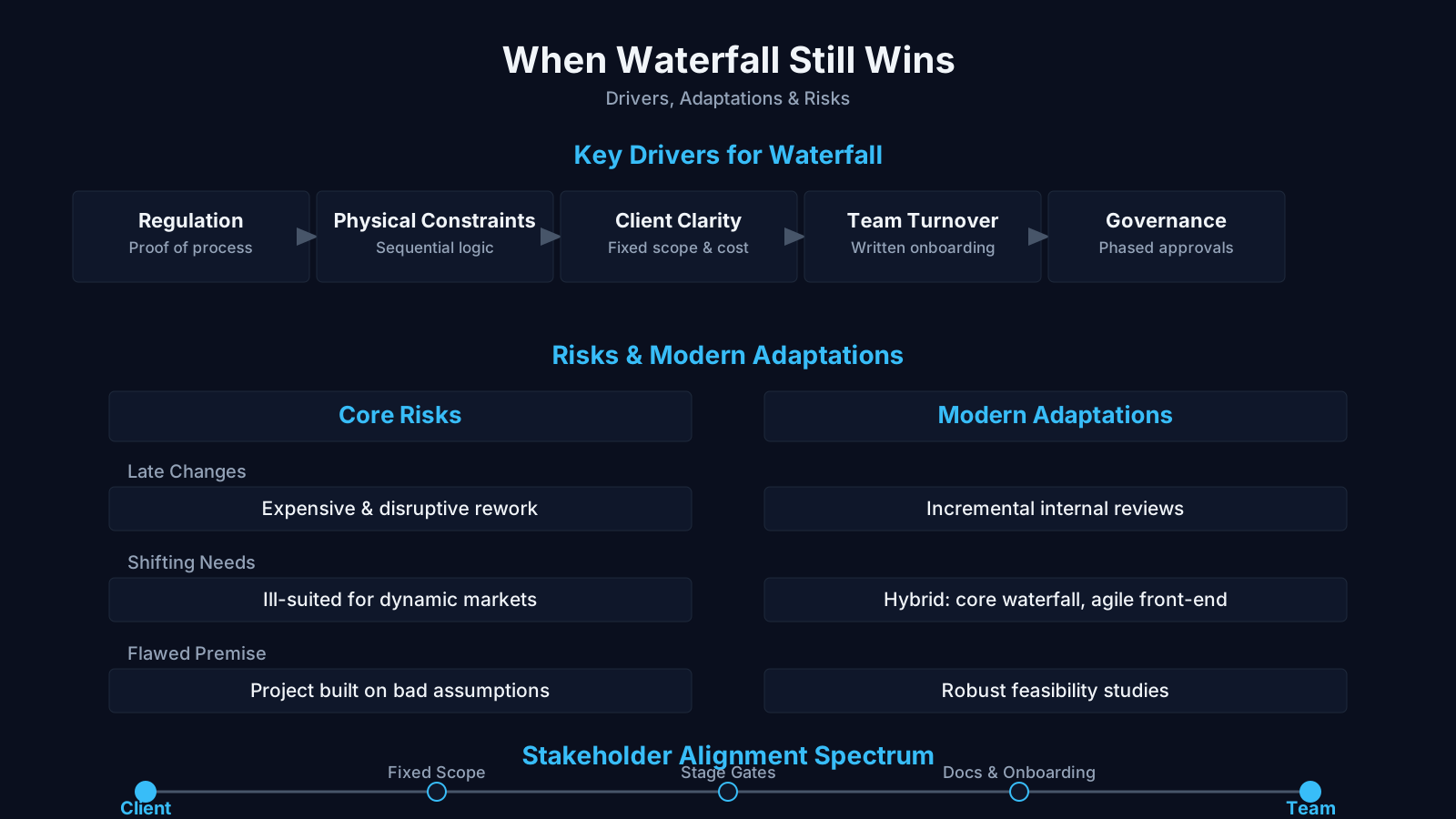
Waterfall Methodology at a Glance: Phases, Documentation & When to Use It
| Key Concept | Summary |
|---|---|
| Origins and Industry Adoption | Dr. Winston Royce’s 1970 paper described iterative feedback loops, yet the market embraced a rigid linear interpretation that still defines the classic Waterfall model. |
| Optimal Application Domains | Waterfall excels in construction, aerospace, medical device manufacturing, and large-scale infrastructure where regulatory mandates and physical dependencies make iterative development prohibitively costly or impractical. |
| Sequential Lifecycle Structure | The model progresses through strictly ordered phases: requirements, design, implementation, testing, deployment, and maintenance, with each phase dependent on signed-off deliverables from its predecessor, so reversing direction is inherently difficult. |
| Requirements Specification | This foundational phase produces a binding requirements document that captures all functional and non-functional needs, demanding formal stakeholder approval before any design work commences. |
| Architectural and Detailed Design | The design phase translates approved requirements into high-level system architecture and detailed component specifications, maintaining full traceability to ensure every requirement is addressed. |
| Construction and Coding | Developers build the product strictly from the approved design specifications; any deviation triggers a formal change control process that evaluates impacts on budget, schedule, and downstream work products. |
| Independent Verification | A dedicated testing phase follows implementation, using test cases derived directly from requirements and design documents to verify that the built system conforms precisely to approved specifications. |
| Formal Change Control | After phase sign-off, any modification requires a rigorous change request because late-stage alterations grow exponentially more expensive and cascade into all downstream documentation and deliverables. |
| Schedule and Cost Certainty | A fully mapped sequential plan provides the predictability essential for stakeholders in mission-critical environments where learning through iteration is unacceptable and schedule fidelity is paramount. |
| Documentation as a Strategic Asset | Comprehensive documentation creates an auditable legal trail in regulated industries and acts as an early verification mechanism that exposes ambiguous or contradictory requirements before they propagate through the lifecycle. |
The Core Phases of the Waterfall Methodology
A project following the waterfall model moves through a series of distinct stages, each with its own objectives, deliverables, and exit criteria. The waterfall phases typically begin with requirements and end with maintenance, and progress is visualized as a cascade that cannot easily reverse. Once a phase is completed and signed off, the team does not go back without a formal change request. This linearity forces thorough upfront work and reduces the ambiguity that can plague later stages. The following subsections break down each phase in practice.
The Sequential Order of Waterfall Phases
The underlying logic of the phases is that each one builds on the previous, creating a natural dependency chain. Requirements feed into design, design shapes implementation, implementation is verified by testing, and so on. Deviating from this order is possible but typically signals that the earlier work was insufficient, triggering a formal change management process. This enforced sequence can feel stifling to creative teams, but it also serves as a protective mechanism against scope creep and half-baked solutions. The interesting part is that the order itself acts as a quality filter, because a flawed requirement will cascade into every downstream document and task, making it impossible to ignore.
Requirements Gathering and Analysis
Everything in a waterfall project rests on a clear and detailed requirements document, often called a business requirements document or a software requirements specification. During this initial phase, business analysts and stakeholders meet extensively to tease out what the final product must do, what constraints exist, and what success looks like. The goal is to capture every functional and non-functional requirement upfront because later changes become exponentially more expensive. Analysts typically conduct stakeholder interviews, facilitate workshops, and review existing documentation. Once the raw requirements are gathered, they organize them into a structured document that is circulated for feedback and formal approval.
The approval step is more than a formality. It represents a contractual handshake between the business side and the technical team, locking in expectations for the rest of the project. If a requirement is missing or ambiguous, the project will pay for it later. That is why experienced waterfall teams spend a disproportionate amount of time on this phase, sometimes longer than all other phases combined. The output is often a numbered list of requirements with priorities and traceability to business objectives. Sign-offs from executive sponsors, product owners, and regulatory bodies may be required before the project can move into design.
System Design
The design phase translates the approved requirements into a blueprint for the solution. In software, this includes architectural decisions, database schema, user interface mockups, and integration points. In non-software projects, design might involve engineering drawings, structural calculations, or process flow diagrams. The output is a detailed design specification that will guide the implementation team. This phase is often split into high-level design, which addresses the system’s broad architecture and interaction with external systems, and detailed design, which gets down to module-level specifications. Each design document must trace back to the requirements it fulfills, a practice that turns documentation into a verification tool long before any code is written.
Design reviews in a waterfall project are formal affairs. Architects, senior developers, and sometimes external experts sit together and scrutinize the design for feasibility, scalability, and alignment with requirements. Changes requested at this stage are relatively cheap compared to changes discovered during testing. The minutes of these review meetings often become part of the project’s legal audit trail in regulated industries. Once the design is baselined, the implementation phase begins, and the design document becomes the single source of truth that developers or builders must follow.
Implementation
Implementation is where the actual code is written, the building is constructed, or the product is manufactured. In a waterfall project, this phase begins only after the design has been fully approved. The team works from the design specifications, which should theoretically leave little room for interpretation. A project manager tracks progress against a schedule built from the design’s work breakdown structure. The emphasis is on strict adherence to the documented plan, with any deviation requiring a formal change request that gets evaluated for its impact on cost, schedule, and other requirements.
Even though the testing phase comes later, developers still perform unit tests on individual modules. However, system-wide integration testing waits until the dedicated testing phase. This separation can lead to a phenomenon where defects found late require significant rework. In practice, many waterfall teams mitigate this risk by conducting informal design walkthroughs and peer reviews during implementation. Still, the fundamental assumption is that the design is correct and complete, so the developer’s job is to build exactly what is specified, not to question the specification.
Testing
In the waterfall model, testing is a distinct phase that occurs after implementation is completed, though often it is subdivided into unit, integration, system, and user acceptance testing. All testing is planned during the design phase, with test cases derived from the requirements and design documents. The testing phase rigorously verifies that the product meets the specified requirements and that it functions correctly in the intended environment. A traceability matrix maps each test case back to a requirement, proving that nothing was missed.
The challenge is that testing happens late. If a fundamental misinterpretation of a requirement is discovered now, the cost to fix it can be enormous because the design and implementation may already be complete. This is the classic waterfall weakness that agile proponents highlight. However, in contexts where requirements are truly stable and well-understood, the risk is low. For many engineering projects, the physical world provides constraints that make late surprises unlikely. You know a bridge must bear a certain load, and you design and test for it. The testing phase confirms that the real structure matches the calculations, and if it does not, you have a serious problem that would have been equally serious no matter the methodology.
Deployment
Deployment involves releasing the finished product to the end users or into production. In software, this could mean installing on servers, conducting data migration, and providing training. In physical or infrastructure projects, it might involve handing over a facility to operations. The deployment phase includes final checks, release notes, and often a formal go-live decision where stakeholders sign off that the product is acceptable. Because the waterfall approach has produced a mountain of documentation by this point, deployment procedures are usually laid out step by step, leaving little room for improvisation. This can be a blessing when a cutover window is tight and there is no time for on-the-fly problem-solving.
In practice, deployment often reveals small gaps between the documented requirements and real-world use. But the role of the deployment phase is not to remake the product; it is to deliver it as specified. Any suggestions for improvement get fed into a future maintenance or enhancement project. That clear separation between delivery and improvement is one of the structural reasons waterfall works well in contractual settings where the customer has agreed to a fixed scope and any extras are billable.
Maintenance
Once the product is live, the maintenance phase handles any issues, updates, or minor enhancements that arise. In the pure waterfall model, major enhancements would trigger a new project lifecycle starting again from requirements. Maintenance activities are governed by the same documentation and sign-off discipline, ensuring that any change is carefully assessed before implementation. The original design and requirements documents serve as the baseline against which all changes are evaluated. Over time, maintenance teams rely heavily on that documentation to understand why certain decisions were made years ago, especially when the original developers are no longer available.
Core Takeaways on Waterfall Phases
- Sequential phases build dependency
- Each phase's output becomes the mandatory input for the next, so the strict sequence serves as a built-in verification gate: downstream activities expose defects in earlier work while correction is still relatively inexpensive.
- Requirements anchor the project
- Detailed functional and nonfunctional requirements are elicited, documented, and formally approved early; this locked baseline acts as the contract for all subsequent work, as late-stage changes trigger costly replanning and rework.
- Design ensures requirements traceability
- Approved requirements are systematically transformed into architectural and component-level designs, with each design decision explicitly traced back to its source requirement to verify completeness and simplify future impact assessments.
- Implementation follows the baselined design
- Developers construct the system strictly according to the frozen design specification; any necessary deviation must go through a formal change control board that evaluates implications for cost, schedule, and requirement fulfillment.
Documentation in the Waterfall Methodology
Documentation is the backbone that holds a waterfall project together. Unlike agile approaches that value working software over comprehensive documents, waterfall makes documentation the primary artifact for communication, verification, and compliance. The waterfall methodology documentation requirements demand that every phase produces formal, reviewed, and approved documents before the next phase begins. This creates a paper trail that can be invaluable for audits, training, and future maintenance. Without it, the entire premise of sequential handoffs collapses.
The volume of documentation can be intimidating. A large-scale waterfall project might generate a stack of documents including a business case, a project charter, a requirements specification, a high-level design document, a detailed design document, test plans, test reports, deployment guides, and operations manuals. Each of these has a defined owner, a review process, and a sign-off gate. The sign-off is not merely a bureaucratic hoop. It forces stakeholders to engage with the material and formally accept the implications, which shifts responsibility and reduces the risk of later disputes.
How Waterfall Documentation Supports Regulatory Compliance
In regulated industries like pharmaceuticals, aviation, and finance, documentation is not optional. Regulators often require proof that a product was built according to a validated, repeatable process. The waterfall model’s natural output fits perfectly here because every design decision can be traced back to a user need and then traced forward to a test case and a release note. An auditor can walk through the document chain and confirm that the product was built correctly. That traceability is not an afterthought; it is designed into the methodology from day one.
When a medical device company submits documentation for FDA approval, for instance, the agency expects to see a requirements traceability matrix, design documents, verification and validation records, and risk management files all aligned. A waterfall process, with its distinct phases and formal baselines, naturally generates exactly these artifacts. The front-end investment in documentation pays off when the approval process accelerates because regulators can quickly understand what was built and why. Failing to produce such documentation can delay a product launch by months or result in a rejection.
The Role of Sign-Offs and Baseline Documents
The sign-off ceremony at the end of each phase is more than a checkpoint; it is a risk transfer mechanism. When the requirements document is signed, the business owner acknowledges that the documented requirements reflect their needs. When the design is signed, the architects take ownership of the blueprint’s correctness. Those signatures create accountability and force a final, hard look at the work before it progresses. In the absence of a signed baseline, a project can drift without anyone feeling personal responsibility for the direction, which is a recipe for costly mid-course corrections.
Baseline documents also serve as the reference for change control. If someone later requests a new feature, the project manager can point to the signed requirements and say, “That was not in scope; we can do it, but it requires a change request that will adjust the timeline and budget.” This contractual clarity is especially valuable in vendor-client relationships where the scope of work is tied to payment milestones. Without a solid documentation baseline, disagreements about what was originally agreed upon become almost inevitable.
The Burden of Heavy Documentation
It would be dishonest to ignore the downsides. Heavy documentation takes time and resources, and in fast-moving markets, the paperwork can delay the delivery of valuable features. Writing a hundred-page requirements document takes weeks, and then circulating it for review and approval adds more weeks. During that time, business conditions can shift. A team might spend months documenting a product that is no longer exactly what the market wants. This is the classic criticism and one reason agile methods emerged. But in the right context, that upfront investment can save much more time later by preventing rework and confusion.
Another pain point is that documentation can create a false sense of security. Having a signed-off design does not guarantee the design is correct; it only means the reviewers agreed it was correct based on the information available at the time. The waterfall methodology does not have a built-in mechanism to detect misunderstandings that survive the review process until testing reveals the gap. Experienced project managers address this by investing in early prototypes, rigorous reviews, and bringing in domain experts who can sniff out hidden assumptions, but those practices sit on top of the methodology rather than being part of its core.
When to Use the Waterfall Methodology
The decision of when to use waterfall is not a matter of tradition or preference but a careful reading of the project’s attributes. Waterfall thrives when requirements are known, stable, and unlikely to change during the project’s lifespan. It also works well when the delivery team needs to be tightly coordinated through documentation rather than conversation, perhaps because the team is distributed across time zones or involves multiple external vendors. The following scenarios illustrate the fit.
Projects with Fixed Scope and Low Uncertainty
When a project’s scope is well understood and the technology is mature, the waterfall approach can deliver predictable results on a predictable schedule, which is exactly what many senior stakeholders crave. Building a standard commercial office building, for example, has known engineering requirements, permitting processes, and construction methods. The design can be fully finalized before ground is broken, and the sequence of tasks is clear. There is little need for iterative discovery because the building type has been built thousands of times before. In such cases, the waterfall phases map directly onto the natural project flow.
Similarly, internal IT projects like a server migration or a payroll system upgrade often involve clear, unchangeable specifications. You know the payroll system must calculate taxes according to fixed rules, process direct deposits, and generate compliance reports. Those requirements are not going to change mid-project because the tax authorities have already defined them. Spending time on a detailed requirements specification and a robust test plan upfront helps ensure the migration happens without disrupting payroll runs. The cost of a mistake in payroll is measured in employee trust and legal penalties, so the rigor of waterfall is entirely appropriate.
When to Use Waterfall in Physical and Infrastructure Projects
Physical projects offer a clear illustration. You cannot build half a bridge, test it with real traffic, and then iterate on the design. The phases of design, foundation work, structural erection, and paving must happen in a set order, and the documentation, engineering calculations, permits, and inspections serve as gates that prevent catastrophic mistakes. The waterfall methodology mirrors this reality almost perfectly. When the project involves heavy capital expenditure, material procurement, and regulatory inspections, the upfront investment in complete design documentation is not excessive; it is the minimum required to get a building permit.
The same logic applies to hardware development, where tooling costs are so high that you must freeze the design before cutting molds. A consumer electronics firm designing a new device often goes through a waterfall-like process: requirements for features and industrial design, followed by detailed mechanical and electrical design, then prototyping, testing for compliance, and finally manufacturing ramp-up. Any late design change could mean scrapping expensive tooling and delaying mass production by months. The linear, documentation-heavy approach reduces the chances of such costly surprises.
Regulatory and Compliance-Driven Environments
When a project must prove compliance with external regulations, waterfall’s inherent documentation and phase-gate structure become an advantage rather than a burden. Regulators rarely care about a team’s agile maturity; they care about evidence of a controlled process. The waterfall model, with its clear phases, signed baselines, and traceability from requirements to testing, maps easily onto what auditors expect to see. This is why pharmaceutical companies, aerospace manufacturers, and nuclear facility operators often default to a waterfall or waterfall-hybrid approach even when they incorporate some iterative technical practices.
In these environments, skipping a document or proceeding without a signed approval can have legal consequences. The phase-gate reviews are not just project management checkpoints but compliance milestones that must be documented for external review. A change request that alters a safety-related requirement can trigger a revalidation of the entire chain. Waterfall’s discipline helps ensure that nothing falls through the cracks, because the methodology does not allow you to quietly bypass a step. That rigidity can be a source of great comfort to a quality assurance department that is ultimately responsible for the product’s safety.
When Agile is a Better Fit: Understanding the Limits
Waterfall becomes a liability when requirements are uncertain, the market is evolving rapidly, or the end users do not yet know what they need. If you are building a new consumer mobile app in a competitive space, spending six months documenting requirements before writing a line of code will almost guarantee that the app is outdated by the time it launches. In such cases, an iterative approach that delivers working increments and collects user feedback is far more effective. The waterfall methodology, with its resistance to change and late testing, would amplify every mistaken assumption into a costly rework loop.
It is also worth noting that waterfall assumes a handoff culture where different teams specialize in each phase. Requirements analysts hand off to designers, designers hand off to developers, developers hand off to testers. That separation can work if the documentation is flawless, but in practice, small misunderstandings accumulate and create defects that only surface at the end. Agile and iterative models address this by forming cross-functional teams that collaborate throughout the project, continuously integrating and testing. For exploratory or innovation-driven work, that collaborative flow is usually superior. Recognizing when not to use waterfall is just as important as recognizing when it fits.
Key Takeaways on Waterfall Fit
- Stable Requirements and Fixed Scope
- Waterfall is a natural fit for projects with clearly defined, stable requirements, such as payroll system upgrades or standard commercial construction, where upfront specifications eliminate ambiguity and prevent cost-intensive scope changes.
- Physical and Infrastructure Construction
- Waterfall’s sequential phases, detailed documentation, and stage-gate inspections mirror the linear progression of infrastructure and hardware development, helping avoid catastrophic errors and exorbitant late-stage rework.
- Regulatory and Compliance Environments
- In heavily regulated industries such as pharmaceuticals, aerospace, and nuclear operations, waterfall’s formal phase-gate reviews, signed baselines, and requirements traceability produce the audit-ready evidence that regulators and auditors demand, reducing compliance risk.
- Limits in Uncertain Markets
- Waterfall becomes a constraint when requirements are nascent or market dynamics shift rapidly, as in competitive consumer mobile app development; iterative methods are inherently better at absorbing user feedback and adapting to changing needs.
The Waterfall Methodology in Hybrid Project Environments
Pure waterfall is rare in modern practice, but the thinking behind it persists in hybrid models that combine upfront planning with iterative delivery. Many large organizations have adopted a framework in which the overall project follows a waterfall structure for budgeting, approvals, and major milestones, while the development work inside each phase uses agile or lean methods. The hybrid waterfall practices allow teams to capture the benefits of rigorous documentation and predictable governance without sacrificing the flexibility of iterative execution. It is a pragmatic compromise that acknowledges messy realities.
A common pattern is to use waterfall for the requirements and design phases, producing a baseline of approved documents, and then to run a series of agile sprints for implementation, all while maintaining the same traceability and change control processes. The testing phase might still be a distinct gate, but it is informed by continuous integration and automated testing that happens during the sprints. The deployment phase then becomes the final handoff, supported by all the documentation generated upstream. This hybrid approach is often found in enterprise software development for sectors like banking and insurance, where the regulatory need for documentation coexists with a desire for faster delivery.
In hybrid models, the documentation does not disappear; it evolves. Instead of writing a massive design specification upfront and freezing it, teams might maintain a living architecture document that is reviewed at phase gates. The gate reviews still require formal sign-off, but the content can be updated incrementally if changes are justified through the change control board. This shifts the burden from predicting everything perfectly at the start to maintaining discipline throughout the project. In practice it often works better because people are more willing to update a document they know is still alive than to challenge a baselined artifact that seems set in stone.
The lesson from hybrid implementations is that the waterfall methodology is best understood as a set of principles about sequence, documentation, and governance, not a straitjacket. The phases can be scaled up or down depending on project size and risk. A small internal project might still benefit from a lightweight requirements document and a design review before coding starts, even if it does not follow a full waterfall process. The core value is the discipline of thinking before building, and that remains a good idea regardless of methodology label.
Ultimately, the waterfall methodology, its phases, documentation rituals, and the wisdom of knowing when to use it all boil down to one question: does the cost of late change outweigh the cost of upfront planning? When the answer is yes, the waterfall approach remains a powerful tool in the project manager’s kit. It is not a relic of a bygone era but a designed response to environments that punish uncertainty. Understanding its inner workings, from the sequential phases to the documentation chain and the strategic selection criteria, equips a project manager to make a deliberate choice rather than following a trend blindly. And making a deliberate choice, based on the nature of the work, the tolerance for change, and the consequences of failure, is what professional project management is about.
Advance Your Career with Professional Certification
Earning a project management certification sharpens your ability to plan schedules, control budgets, and communicate with stakeholders across industries. The structured knowledge helps you reduce scope creep and deliver outcomes that align with business goals. Many employers now list it as a baseline requirement because it signals that you can handle complex initiatives without constant supervision.
Structured product management training fills the gap between theoretical frameworks and the daily chaos of prioritization and roadmap adjustments. It focuses on customer discovery, data-driven decision making, and cross-functional collaboration, which are rarely covered in business school. Professionals who complete this type of program often move from reactive feature building to leading strategic product direction.
Becoming a certified HR manager demonstrates deep competency in employment law, talent acquisition, and organizational development. This credential serves as a differentiator when you are competing for roles that require you to design compensation structures or mediate complex employee relations issues. It also provides you with a network of peers and updated practices that keep your department compliant and people-focused.