New York City is a place where ambition meets opportunity, and for project managers, few credentials open doors faster than the Project Management Professional certification. If you are searching for NYC PMP training that will not only help you pass the exam but also propel your career to the next level, you have come to the right place. The PMP is more than just a line on a resume; it is a global benchmark of project leadership , signaling that you can manage budgets, timelines, stakeholders, and risks in complex environments. In a market as competitive as New York, where industries from finance and technology to construction and healthcare demand skilled project leaders, earning your PMP can be the single most transformative step you take. This article will explore every facet of PMP certification training in New York City, from selecting the right program and understanding the exam structure to effective study strategies and post-certification career advancement.
NYC PMP Training: Key Topics at a Glance
| Key Concept | Summary |
|---|---|
| PMP Value | The PMP certification serves as a globally recognized standard for project leadership, unlocking a measurable salary uplift and accelerating career progression within New York City's highly selective professional landscape. |
| Market Relevance | Across New York's dominant sectors including financial services, technology, construction, and healthcare PMP-certified professionals are relied upon to steer multifaceted initiatives through rigorous regulatory and timeline constraints. |
| Exam Domains | The examination evaluates three performance domains: People (42 percent) targeting team leadership and stakeholder engagement, Process (50 percent) covering technical project delivery, and Business Environment (8 percent) assessing strategic alignment and organizational impact. |
| Exam Structure | Delivered as 180 scenario-based multiple-choice questions over 230 minutes, the exam prioritizes applied judgment and PMI-standard best practices over rote recall of terminology. |
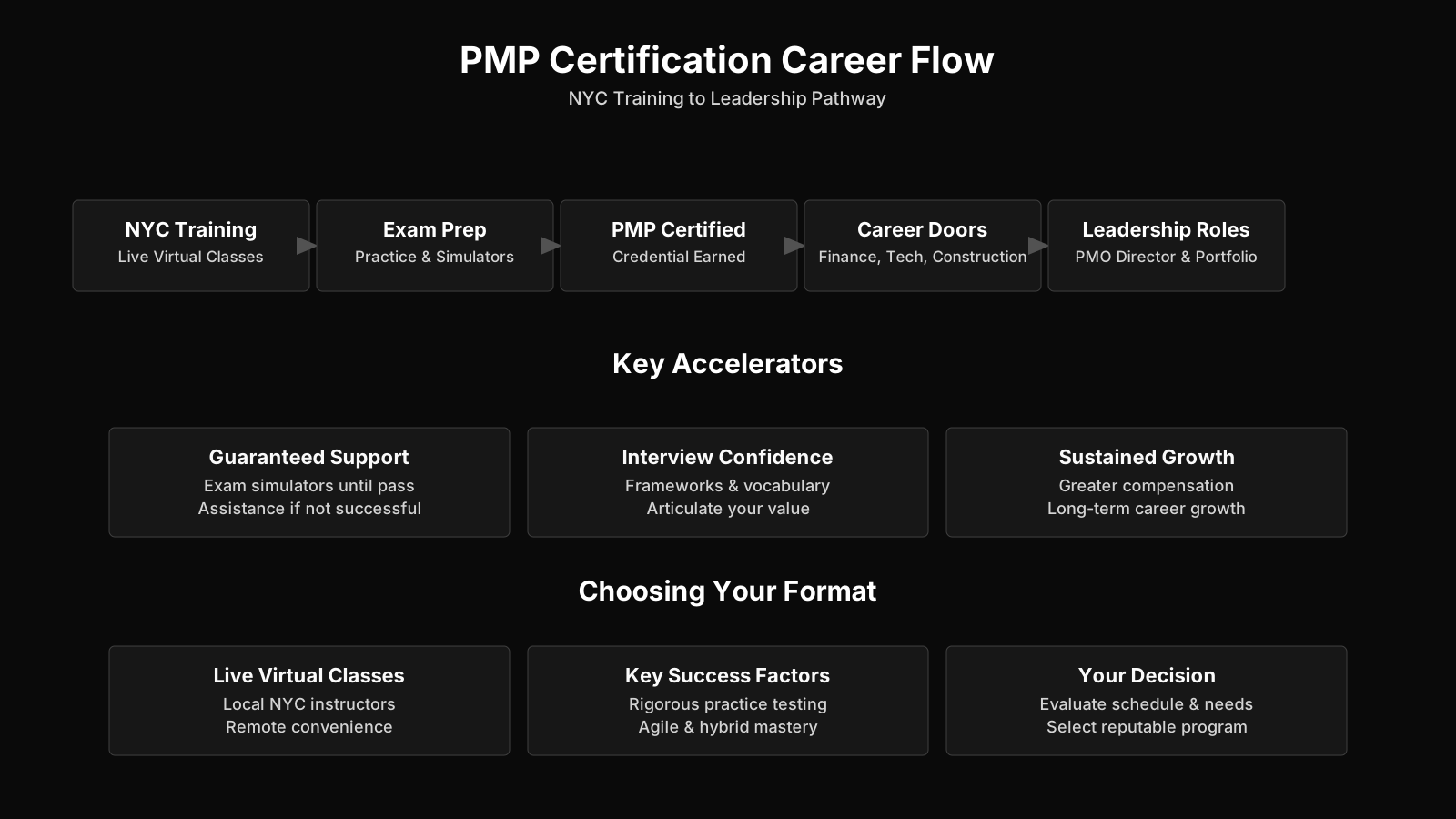
| Training Focus | High-quality NYC-based training blends rigorous practice examinations, full-length simulators, and structured discussions of ethical dilemmas to bridge real-world experience with PMI's standardized frameworks. |
| Agile Content | Given the exam's substantial emphasis on agile and hybrid methodologies, robust training programs now embed Scrum, Kanban, and blended delivery models into their core curriculum rather than treating them as supplementary topics. |
| Program Selection | Selecting an optimal training path hinges on individual learning preferences and scheduling needs, with formats spanning intensive in-person bootcamps, instructor-led virtual classrooms, and flexible self-paced online modules. |
| Career Impact | PMP holders gain access to senior-level positions such as program manager and PMO director, while the credential increasingly functions as a baseline filtering criterion among New York's top recruiters. |
| Local Context | Leading NYC PMP programs incorporate region-specific case studies drawn from Wall Street initiatives and major infrastructure projects, ensuring classroom concepts transfer directly to local professional environments. |
| Exam Difficulty | Seasoned project managers frequently misjudge the exam's rigor; success demands responding according to PMI's prescribed best practices rather than relying on ingrained workplace habits and personal shortcuts. |
Why PMP Certification Matters in the New York City Job Market
The New York metropolitan area is one of the most dynamic economic hubs in the world, hosting headquarters of Fortune 500 companies, burgeoning startups, and nonprofit organizations with global reach. In this ecosystem, project management is the connective tissue that turns strategy into execution. Employers are increasingly demanding evidence that their project managers possess not only experience but also a standardized, rigorous understanding of project management principles . The PMP certification, issued by the Project Management Institute, is the gold standard that fills that need. For professionals in New York, holding a PMP often translates into a significant salary premium. According to PMI’s Earning Power Salary Survey, PMP holders in the United States earn a median salary that is substantially higher than their non-certified peers, and in high-cost, high-salary markets like New York City, the differential can be even more pronounced. Beyond compensation, the certification accelerates career progression by qualifying you for roles such as senior project manager, program manager, PMO director, and even C-suite positions. Recruiters and hiring managers in New York also use PMP as a filtering criterion, meaning that without it, your resume may never reach a human reader, regardless of your actual experience.
Another factor that makes PMP certification particularly valuable in New York is the city’s sector diversity. In construction and real estate, massive development projects require strict adherence to timelines, budgets, and regulatory compliance, all areas covered extensively in the PMP framework. In financial services, technology rollouts, compliance initiatives, and product launches demand robust risk management and stakeholder communication. In healthcare, from hospital expansions to electronic health record implementations, project managers must navigate highly regulated environments while delivering value. NYC PMP training courses are often designed with this local industry breadth in mind, incorporating real-world case studies from Wall Street, Silicon Alley, and major infrastructure projects. This contextualization ensures that what you learn in the classroom translates directly to the challenges you face at work. Furthermore, the certification is not just about technical knowledge; it emphasizes leadership, strategic thinking, and business acumen, which are essential for moving from tactical project delivery into organizational leadership. In a city where the next career opportunity might be just a coffee chat away, the PMP credential acts as a universal signal of your capability and commitment.
Key Takeaways on PMP Value in NYC
- Salary premium and career advancement
- PMP-certified professionals in New York City command a substantial salary premium and gain access to senior roles such as program manager and PMO director.
- Recruiter filtering criterion
- Many New York hiring managers treat PMP certification as a non-negotiable screening criterion, so even highly experienced candidates risk being filtered out if they lack it.
- Industry-specific relevance
- The PMP framework is applied across New York's major industries such as construction, financial services, and healthcare, where local training programs consistently integrate real-world case studies to address sector-specific challenges.
Understanding the PMP Exam Structure and Content Domains
Before you commit to any NYC PMP training program, you need a clear picture of what the PMP exam actually tests. The exam is built around three core domains that represent the modern role of a project manager: People, Process, and Business Environment. The People domain accounts for approximately 42 percent of the exam and covers team leadership, conflict management, emotional intelligence, and building collaborative cultures. This reflects a fundamental shift in the profession away from a purely process-oriented view toward the human skills that make or break projects. The Process domain, representing about 50 percent of the questions, addresses the technical aspects of managing projects, including scope, schedule, budget, quality, and risk across various development life cycles. The remaining 8 percent falls under the Business Environment domain, which examines how projects align with organizational strategy, compliance obligations, and external factors like market conditions and regulatory changes. The exam itself consists of 180 multiple-choice questions with a time limit of 230 minutes, plus two ten-minute breaks. The questions are a mix of situational, knowledge-based, and formula-related items, many of which require you to interpret a brief scenario and choose the best management response according to PMI standards and the PMBOK Guide. There is no fixed passing score; instead, PMI uses psychometric analysis to determine whether you have met the competency threshold.
Effective NYC PMP training will go beyond simply covering the PMBOK Guide and dive deeply into the application of concepts in realistic scenarios. The exam is not a memorization test; it assesses your ability to think like a project manager facing ambiguous constraints and conflicting stakeholder expectations. This is why a high-quality training program will integrate hundreds of practice questions, exam simulators, and facilitated discussions that force you to grapple with ethical dilemmas, scope creep, and resource conflicts. Many New York professionals underestimate the exam’s difficulty because they assume their years of experience will carry them through. While experience is invaluable, the PMP exam often requires you to answer questions based not on what your company does, but on what PMI considers best practice. This can cause friction for experienced managers who have developed their own habits. A rigorous training course will help you recognize these gaps and adjust your thinking to align with the exam’s expectations. The distinction between predictive, agile, and hybrid approaches is also a critical element. The PMP exam now incorporates a significant amount of agile and hybrid content, so a comprehensive NYC PMP training program should cover the Agile Practice Guide, common agile frameworks like Scrum and Kanban, and the criteria for tailoring methodologies to project needs.
Choosing the Right NYC PMP Training Program for Your Needs
New York City offers an abundance of PMP training options, from intensive weekend bootcamps at universities to live online courses and self-paced e-learning platforms. Selecting the right one begins with an honest assessment of your learning style, schedule, and budget. If you thrive in a structured, collaborative environment with face-to-face interaction, an in-person classroom course in Manhattan, Brooklyn, or Long Island might be the best fit. These courses typically run for four to five full days, covering all exam content and often including post-course support. For busy professionals who cannot afford to take several days away from work, live virtual instructor-led training provides the same interactive experience with the flexibility of attending from home or office. Self-paced online programs are the most flexible and often the most affordable, but they demand exceptional discipline and are best suited for individuals who are comfortable learning independently and can commit to a consistent study schedule without external prodding. Whatever format you choose, ensure the provider is a PMI Authorized Training Partner, as this guarantees the curriculum meets PMI’s quality standards and that your contact hours will be accepted for the exam application. Authorized partners also have access to official PMI learning resources and up-to-date exam content outlines, which is critical because the exam evolves regularly.
Evaluating NYC PMP Training Providers: Key Criteria
When evaluating NYC PMP training providers, look beyond glossy marketing and consider several essential factors. First, examine the instructor’s qualifications. A great PMP instructor is not just a certified project manager but also an experienced educator who can explain complex topics clearly and engage a diverse audience. Ideally, the instructor should have years of project management experience in industries relevant to New York’s economy, such as finance, technology, or construction, and be able to share firsthand stories that illuminate abstract concepts. Second, investigate the comprehensiveness of the study materials. A quality course provides more than just PowerPoint slides; it should include a detailed study guide, a question bank with hundreds or thousands of practice questions, full-length simulated exams, and memory aids for formulas and processes. The best providers also give you access to an online portal where you can track your progress, review performance analytics, and revisit recorded sessions. Third, ask about the post-training support. Does the provider offer exam coaching, a forum to ask questions after the course ends, or a guarantee that you can retake the course if you do not pass? In New York, where the pace of life is relentless, having a support system that extends beyond the classroom can make the difference between a first-attempt pass and a costly retake.
Accelerating Success with Intensive NYC PMP Training Bootcamps
For many New York professionals, the intensive bootcamp format has become the gold standard for PMP preparation. These programs compress the entire curriculum into a concentrated burst of learning, often spanning four consecutive days. The immersion removes the distractions of daily work and allows you to fully inhabit the project management mindset. In a city where time is the ultimate luxury, the efficiency of a bootcamp is appealing, but it requires participants to clear their schedules completely and come ready to absorb a high volume of information. The best NYC PMP training bootcamps use a blend of lecture, group exercises, and continuous quizzing to keep energy levels high and reinforce retention. Some even provide catered meals and comfortable learning spaces in Midtown or Downtown Manhattan, creating an experience that feels like a professional retreat. The social dynamic of a bootcamp is another underappreciated benefit. You will be surrounded by peers from across industries, and the shared struggle of mastering earned value management or risk response strategies can forge lasting professional relationships. After the bootcamp, you should plan for at least three to four weeks of self-study to solidify your knowledge and complete practice exams before scheduling the actual test.
Online PMP Training: Flexibility for New York’s Busy Professionals
Not everyone can step away from work for a multi-day in-person session, and that is where online PMP training shines. The online learning landscape has evolved dramatically, and the best live virtual courses now rival the classroom experience with breakout rooms, digital whiteboards, and real-time polling. These courses are typically delivered over several weeks with evening or weekend sessions, making them ideal for professionals with demanding jobs and family commitments. For those who prefer to learn at their own pace, on-demand video courses allow you to consume content whenever you have spare moments, whether on the subway, during a lunch break, or late at night. The key to success with online NYC PMP training is active engagement. It is easy to passively watch videos without retaining much, so you must take notes, pause to answer questions, and consistently test yourself. Many platforms incorporate adaptive learning technology that identifies your weak areas and directs you to targeted lessons, making your study time far more efficient. Before committing to an online provider, check the expiration date of your access and whether the content is updated for the current exam content outline. The PMP exam undergoes periodic changes, and studying outdated material is a common and expensive mistake.
Core Takeaways on PMP Program Selection
- Assess Your Learning Style First
- Identify the program format that best complements your learning preferences, balancing structured in-person bootcamps, interactive live virtual sessions, and fully flexible self-paced online courses to deepen retention and sustain motivation.
- Verify PMI Authorization
- Confirm that the provider holds PMI Authorized Training Partner status, ensuring the curriculum adheres to rigorous quality standards and that all earned contact hours are unquestionably accepted during the PMP exam application.
- Evaluate Instructor and Materials
- Choose programs led by instructors who bring real-world project management expertise and supplemented by comprehensive resources such as detailed study guides, large question banks, and full-scale simulated exams that closely mirror the testing experience.
- Plan for Post-Training Support
- Select a provider that extends its value beyond the classroom with dedicated exam coaching, active peer forums, or a retake guarantee, giving you continuous support to pass confidently within New York’s competitive professional environment.
Building an Effective PMP Study Plan in the Context of New York Life
Creating a realistic study plan is one of the most underrated aspects of passing the PMP exam, especially in a city where long work hours and social obligations compete for every free minute. The first step is to set a target exam date that gives you enough time to prepare without being so far off that you lose momentum. For most people, eight to twelve weeks of dedicated study after completing a formal training course is a sweet spot. During this period, your goal should be to accumulate roughly eighty to one hundred hours of additional study, broken down into manageable daily and weekly goals. A common and effective rhythm is to study for one to two hours each weekday evening and then dedicate a longer block on Saturday or Sunday for full-length practice exams. To make this sustainable in New York, treat your study time like a non-negotiable meeting on your calendar. Let your family and friends know about your commitment and find a consistent study location, whether it is a quiet corner of your apartment, a library branch, or a co-working space. The noise and energy of the city can be a gift when you need motivation, but during focused study hours, you must create a bubble of concentration.
Harnessing NYC PMP Training Resources for Deep Learning
While your formal training course gives you the foundation, deep learning occurs when you actively engage with the material long after the class ends. One of the most effective techniques is to create your own study aids rather than relying solely on prepackaged materials. Mind maps, for example, are excellent for visualizing the connections among the 49 processes, their inputs, tools and techniques, and outputs. Building these maps by hand or with digital tools forces you to mentally organize the knowledge and reveals gaps in your understanding. Another powerful method is to teach the concepts. Find a study partner, ideally someone else preparing for the PMP in New York through local PMI chapter events or online forums, and take turns explaining topics like critical path method, Monte Carlo analysis, or servant leadership. When you have to articulate a concept clearly enough for someone else to understand, you solidify your own comprehension exponentially. Additionally, place heavy emphasis on practice questions. You should aim to complete at least one thousand practice questions, carefully reviewing both correct and incorrect answers. Pay attention not just to the right answer but to why the other options are wrong. Over time, you will begin to recognize patterns in how PMI phrases questions and the types of traps they set, such as distinguishing between a change request and an issue log entry when a stakeholder asks for something new.
Overcoming the Unique Challenges of Studying in New York City
Studying for the PMP exam while living and working in New York comes with unique distractions and stressors. The city’s relentless pace can make it hard to slow down and focus, and the temptation to socialize or attend events can derail even the most committed study plan. One practical strategy is to turn your commute into learning time. New Yorkers spend a significant portion of their day on subways, buses, or walking; by listening to PMP audio lessons or using flashcard apps, you can reclaim those hours. Noise-canceling headphones are a worthwhile investment for creating a mobile study sanctuary. Another challenge is mental fatigue from demanding jobs. It is difficult to absorb new information after a day of back-to-back meetings. Combat this by doing your most challenging study, such as tackling earned value formulas or complex situational questions, early in the morning when your mind is fresh, and reserving lighter review activities for evening. Connect with the New York City chapter of PMI, which often hosts study groups, workshops, and networking events. Surrounding yourself with others who share your goal provides accountability, encouragement, and a forum to ask questions. Remember that the PMP journey is not a sprint; it is a marathon that tests endurance as much as intellect. Small, consistent actions each day will carry you across the finish line.
Applying Project Management Concepts to Your Own PMP Preparation
A useful meta-exercise during your NYC PMP training is to treat your own exam preparation as a project. Define your scope clearly: passing the PMP exam. Break down the deliverables: completing the training course, finishing a study guide, taking practice exams, and submitting the application. Identify your stakeholders: yourself, your employer if they are sponsoring you, your family who must support your study time. Develop a schedule with milestones and use a tool like a Gantt chart or a Kanban board to track your progress. Identify risks to your plan: workload surges, unexpected travel, illness, or loss of motivation. Create risk response strategies: building buffer time into your schedule, preparing a mobile study kit, or scheduling a study break with a friend to re-energize. This approach not only helps you stay organized but also reinforces the very project management skills you are learning. When you encounter a process like Develop Schedule or Monitor Risks in your study materials, you will be able to connect it to a tangible, real-world experience. This depth of understanding will serve you well on the exam, where situational questions often require you to draw upon practical application rather than rote memorization.
Key Takeaways for Practical PMP Study
- Treat exam prep as a project
- Define the project scope as passing the PMP exam and decompose the work into discrete deliverables such as completing a training course, studying official guides, taking practice exams, and finalizing your application.
- Identify stakeholders and schedule
- Recognize that you, your employer, and your family are primary stakeholders in your study plan; then build a milestone-based schedule using a Gantt chart or Kanban board to visually track progress and maintain accountability.
- Plan for risks and responses
- Anticipate risks like sudden workload spikes, business travel, illness, or waning motivation, and develop targeted response strategies such as building in buffer time or preparing a mobile study kit to protect your progress.
- Reinforce learning through practice
- Applying project management processes such as Develop Schedule and Monitor Risks to your own exam preparation transforms abstract theory into tangible experience, making it far easier to answer situational questions on the exam.
Submitting Your PMP Application and Understanding the Prerequisites
Before you can sit for the PMP exam, you must navigate the application process, which has specific educational and experiential requirements. If you hold a four-year degree, you need a minimum of 36 months of unique, non-overlapping project management experience within the last eight years. If you have a high school diploma or associate degree, you need 60 months of experience. In both cases, you must also complete 35 contact hours of formal project management education, which your NYC PMP training course should provide. The project management experience must be documented on the application with detailed descriptions covering the five process groups: Initiating, Planning, Executing, Monitoring and Controlling, and Closing. Be prepared for a potential audit by PMI; a percentage of applications are randomly selected for verification. If you are audited, you will need to provide supporting documentation and have your supervisor or project sponsor verify your experience. The application can feel intimidating, but a good training provider will guide you through it, often providing templates and examples of acceptable experience descriptions. Take the time to craft clear, concise summaries of your projects that align with PMI terminology without exaggerating or misrepresenting your role. Honesty and precision are paramount. Once your application is approved, you have one year to schedule and take the exam, and you can take it up to three times within that eligibility period if necessary.
Test-Taking Strategies for the PMP Exam
Walking into the PMP exam, whether at a Pearson VUE testing center in New York or through an online proctored session, you need a clear strategy for managing the clock and the mental fatigue. Begin by quickly scanning through the exam to get a sense of question length and complexity, then start answering the questions you are confident about, flagging the rest for review. This builds momentum and ensures you bank all the easy points early. Keep a steady pace; with 180 questions in 230 minutes, you have roughly one minute and fifteen seconds per question. However, some situational questions will take longer while shorter definitional questions may take seconds, so aim for an average rather than obsessing over each individual clock tick. Use the strikeout feature to eliminate obviously wrong answers, which improves your odds if you need to guess. Pay very close attention to the wording: PMP questions often include qualifiers like “first,” “next,” “best,” or “except,” which fundamentally change what is being asked. When you encounter a question that describes a scenario, always step back and ask yourself what process group you are in and what the project manager’s immediate responsibility is according to PMI standards. Do not rush into an action that skips proper analysis or change control procedures. The two ten-minute breaks are essential; use them to stand up, stretch, hydrate, and clear your mind. Avoid discussing the exam content during breaks as this is a violation of PMI’s candidate agreement. When you finish, you will receive a preliminary pass or fail result on the screen, followed by an official score report within a few days.
Core Test-Taking Tactics for the PMP
- Scan and bank easy points first
- Scan the entire exam to spot questions you can answer confidently, lock in those easy points without delay, and flag uncertain items to revisit, ensuring you build momentum and bank a solid score from the outset.
- Maintain a steady average pace
- Rather than monitoring each question's clock, aim for a consistent average pace of roughly 75 seconds per question across the 180-item exam, allowing you to complete all sections comfortably.
- Use strikeouts and read qualifiers
- Leverage the strikeout feature to eliminate clearly incorrect answer choices, instantly sharpening your odds when you need to guess, and scrutinize qualifiers such as "first," "next," "best," or "except" because they fundamentally reshape the question’s intent.
- Identify the process group first
- For every situational question, identify the relevant process group upfront and then clarify the project manager’s immediate PMI-aligned duty, so your answer reflects the correct context-driven action.
- Take full advantage of breaks
- Make full use of the two ten-minute breaks to stand, stretch, and rehydrate, and resist any temptation to discuss exam content, as this directly breaches PMI's candidate agreement.
Leveraging Your PMP Certification for Career Advancement in New York
Passing the PMP exam is a career milestone, but the real value is realized in how you leverage the credential after certification. In New York City’s competitive job market, a PMP is not just a badge; it is a conversation starter that can lead to promotions, new roles, and higher compensation. Immediately update your LinkedIn profile, resume, and professional bio to include the PMP designation. Connect with recruiters who specialize in project management and IT, finance, construction, or healthcare roles, and set job alerts for positions that list PMP as a preferred qualification. You will find that the credential opens doors at companies that previously seemed out of reach. Many large New York employers, including major banks, tech firms, and consulting agencies, maintain a structured project management career ladder where PMP is a requirement for advancement beyond a certain level. Once you have the certification, you become eligible for these pathways. Additionally, the PMP qualifies you for roles such as PMO manager, program manager, portfolio manager, and director of project management, all of which carry significant responsibility and command premium salaries in the New York market.
Beyond immediate job moves, consider how the PMP framework can transform your current role. You now possess a vocabulary and methodology that enables you to communicate more effectively with executives, clients, and cross-functional teams. You can introduce improved project governance, risk management processes, and reporting mechanisms that make your projects more predictable and successful. This track record of delivering results will naturally attract career-advancing opportunities. The New York professional network is dense and interconnected, and the PMP certification gives you access to an exclusive community of over a million credential holders worldwide, including a robust local chapter. Attend PMI NYC events, join special interest groups, and participate in mentorship programs. These connections often lead to job referrals, board positions, and speaking engagements that further elevate your profile. In a city where reputation is everything, being known as a PMP-certified project leader can differentiate you in a sea of talented professionals.
Maintaining Your PMP and Continuing Professional Development
Earning the PMP is not a one-time achievement; it requires ongoing maintenance through the Continuing Certification Requirements program. Every three years, you must earn 60 professional development units, or PDUs, to renew your credential. These PDUs are divided into education and giving back categories. Education PDUs can be obtained through formal courses, webinars, reading, and self-directed learning. Giving back PDUs involve activities such as creating content, volunteering, or working as a project management practitioner. In New York, opportunities to earn PDUs are abundant. The local PMI chapter holds monthly events with expert speakers, many technology conferences happen within the metro area, and countless online platforms offer on-demand learning. A smart approach is to plan your PDU accumulation proactively throughout the cycle rather than scrambling in the last few months. This approach turns maintenance into a structured professional development plan that deepens your expertise and keeps you current with evolving practices. Additionally, consider pursuing advanced certifications like the Program Management Professional for managing complex programs, the PMI Agile Certified Practitioner to deepen your agile skills, or the PMI Risk Management Professional for specialization. These advanced credentials stack on top of your PMP and position you as a thought leader in the New York project management community.
Essential Summary for PMP Renewal
- Ongoing Certification Maintenance
- PMP holders renew their credential by earning 60 professional development units (PDUs) over three years, combining continuous education with activities that contribute back to the project management community.
- Proactive PDU Planning
- Strategically accumulating PDUs across the three-year cycle converts certification upkeep into a purposeful professional development plan that progressively deepens expertise and adapts to emerging project management trends.
- Stacking Advanced Credentials
- Adding advanced certifications such as the Program Management Professional (PgMP) or PMI Agile Certified Practitioner (PMI-ACP) atop the PMP strengthens domain specialization and elevates your influence as a recognized thought leader.
Common Pitfalls and How to Avoid Them in Your NYC PMP Training Journey
Despite the success of thousands of New Yorkers who earn their PMP annually, many candidates stumble into preventable traps. One of the most frequent is underestimating the time commitment required and trying to prepare in a rushed, frantic manner. This often results in exam failure and the need for a retake, which is both expensive and demoralizing. Treat the process with the respect it deserves and allocate the recommended study hours. Another pitfall is relying too heavily on a single source of information, such as just reading the PMBOK Guide or only taking a course. Effective preparation requires triangulation: a training course for structure, the PMBOK Guide and Agile Practice Guide for reference, a comprehensive study guide for depth, and a vast question bank for practice. Diversify your materials and engage with the content in multiple ways. A third common mistake is neglecting the agile and hybrid content. The new exam incorporates a significant amount of agile principles, and candidates who prepare with a purely predictive mindset often struggle. Ensure your NYC PMP training covers agile thoroughly, and make a point of studying the Agile Practice Guide as a core text, not an afterthought. Emotional management is another challenge. The pressure of the exam, often compounded by high expectations from employers or oneself, can cause test anxiety that undermines performance. Practice relaxation techniques, get sufficient sleep in the week leading up to the exam, and arrive at the testing center early to settle your nerves.
The Future of Project Management Careers in New York
The demand for skilled project managers in New York is not a passing trend; it is a structural feature of the city’s economy. As organizations continue to undergo digital transformation, respond to climate change, and adapt to hybrid work models, the need for professionals who can deliver complex initiatives will only intensify. The PMP certification is evolving alongside these trends, incorporating sustainability, artificial intelligence, and new ways of working into its framework. By obtaining your PMP now, you are positioning yourself at the forefront of the profession, ready to lead projects that matter. New York will continue to be a magnet for large-scale infrastructure overhauls, fintech innovation, media production, and healthcare advancement. Project managers who combine the PMP credential with industry-specific knowledge, such as a background in construction law, healthcare compliance, or software development, will be especially sought after. The rise of the gig economy and project-based consulting also means that many New York professionals are building portfolio careers, and a PMP provides the credibility to command premium contract rates. While no certification can guarantee success, in a city that rewards preparation and performance, the PMP is one of the most reliable investments you can make in your professional future. By committing to thorough NYC PMP training and a disciplined study regimen, you will not just pass an exam; you will develop a mindset and a skillset that will serve you for the rest of your career.
Core Insights on NYC PMP Careers
- Sustained demand for PMs
- New York’s demand for skilled project managers remains entrenched and resilient, driven by ongoing digital transformation, sustainability mandates, and the normalization of hybrid operating models.
- Evolving PMP certification
- The PMP now embeds sustainability, artificial intelligence, and adaptive delivery methods to maintain its relevance amid accelerating industry change.
- Value of specialized knowledge
- Project managers who augment the PMP with deep expertise in areas such as construction law, healthcare compliance, or software development will command premium demand in New York.
- Credibility for portfolio careers
- The PMP establishes the professional credibility required to negotiate premium rates across New York’s expanding gig economy and project-based consulting landscape.
Advance Your Career with Professional Certification
Earning a professional project management certification validates your expertise, boosts your earning potential, and signals to employers that you can lead complex initiatives effectively. For those serious about career advancement, investing in structured project management training ensures you build the practical skills and knowledge needed to pass rigorous exams like the PMP. Certified project managers drive higher project success rates, making your credential a strategic asset for any organization seeking predictable, efficient outcomes. Ultimately, this certification opens doors to senior roles and demonstrates a commitment to excellence.
Earning a professional product management certification validates your expertise and signals to employers that you possess the strategic, analytical, and leadership skills needed to drive product success. Becoming a certified product manager equips you with proven frameworks for market analysis, roadmap planning, and stakeholder alignment, which directly contribute to better product outcomes and higher team performance. Organizations increasingly seek certified professionals because they bring a disciplined approach to turning ideas into revenue-generating solutions, reducing costly missteps. Ultimately, this credential accelerates your career growth by opening doors to senior roles and higher earning potential while ensuring you stay current with industry best practices.
Earning an HR management certification validates your expertise in modern people operations, from strategic workforce planning to compliance and employee development. In a competitive job market, an HR management certification sets you apart, demonstrating a commitment to staying current with evolving labor laws and technical skills. For organizations, certified HR leaders drive better recruitment, retention, and culture, directly impacting the bottom line. This credential not only accelerates your career trajectory but also equips you to handle complex challenges with confidence and ethical clarity.