Most organizations believe they make decisions quickly enough. The mandate comes from the top, the analysis is performed, and a course of action gets selected. But the actual throughput, the number of meaningful choices an enterprise can process and execute in a given week, often does not match leadership’s perception. The decision throughput problem describes a scenario where the gap between intended decision-making speed and the organization’s real-time capacity to resolve options becomes a drag on performance. It is not about a single bad call or a hesitant manager. It is a systemic issue, visible once you look at the friction points across teams , technologies, and cultural norms. When people talk about agility, they typically refer to product development cycles or marketing pivots. Yet beneath those visible processes, a quieter bottleneck is clogging the path: the inability to move from signal to choice to action without accumulating unreasonable delay. This article explores what that means and what to do about it.
In many firms, the machinery of choice looks efficient on a process diagram. A project requires approval, data gets gathered, a meeting is held, and a decision is made. But the reality is messier. Digital traces left in enterprise systems show that actual workflows rarely follow the neat specification. The same task loops back for clarification, threads get lost in email, and the escalation path becomes a circular detour. Decision throughput becomes the limiting factor, not because people are lazy, but because the infrastructure for processing choices was designed for a slower era. Understanding this problem requires looking at the interplay between formal authority, information flows, cultural incentives, and the digital tools meant to help.
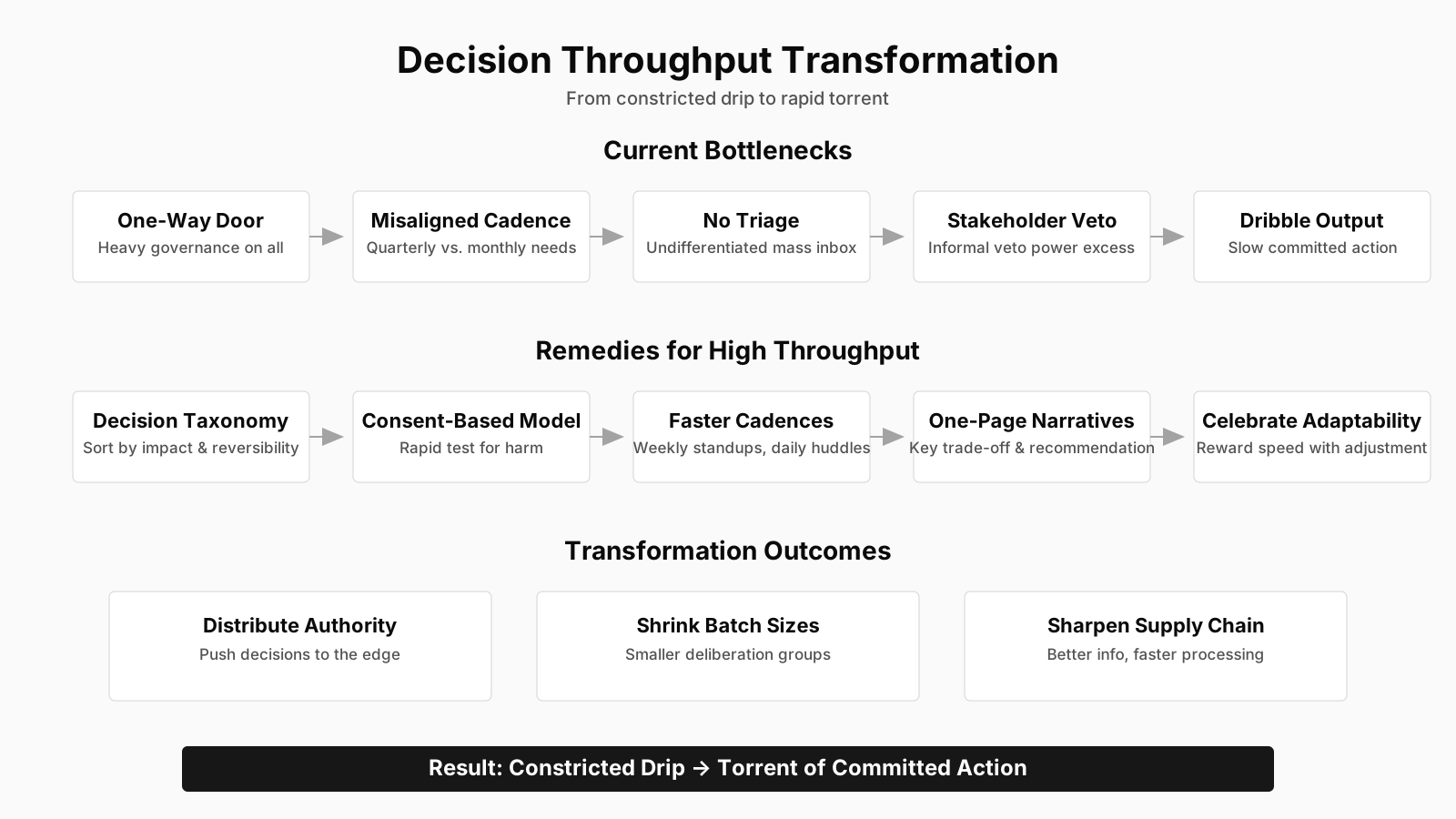
The Decision Throughput Problem: Summary & Key Topics
| Key Concept | Summary |
|---|---|
| Decision Throughput Problem | When an organization's actual capacity to process choices lags behind its strategic ambition for speed, performance drag accumulates in unseen queues, silently eroding momentum. |
| Hidden Queues | Unsubmitted decisions carry no waiting time metric, so employees instinctively hoard choices, depressing overall throughput to protect perceived individual efficiency. |
| Bottleneck Formation | Constraints consistently crystallize at the human technology interface, where inadequate investment in adaptive culture and upskilling turns AI adoption into a choke point rather than a catalyst. |
| Financial Consequences | Compounding latency across internal handoffs metastasizes into direct revenue leakage, escalating operational costs, and a measurable decline in strategic agility. |
| Authority Concentration | Centralizing approval for all non-trivial decisions creates an unmonitored queue that acts as a governor on the entire organization's output. |
| Structural Conflict | Clashing operational philosophies, like lean workflows competing against ERP systems configured for push logic, generate paralysis precisely at the friction points where they overlap. |
| Measurement Gap | Process mining consistently exposes a radical divergence between idealized process charts and real workflows, rendering critical bottlenecks invisible to managers anchored to the official map. |
| Human Technology Interface | Fear of being held accountable for trusting opaque AI outputs drives employees to demand redundant manual recalculations, introducing deliberate stalls into the decision pipeline. |
| Organizational Agility | Enterprise agility is ultimately constrained by decision throughput, overshadowing even the speed of product development or tactical market pivots. |
| Systemic Nature | This dysfunction is systemic, emerging from the friction between interdependent teams, legacy technologies, and embedded cultural norms, not isolated human errors. |
What Is the Decision Throughput Problem and Why It Hurts Your Bottom Line
A decision throughput problem emerges when an organization’s formal decision protocols fail to align with the messy, event-driven reality of daily work. Process mining architectures that combine agent-based systems with event logs can reveal these discrepancies with startling clarity. Researchers have shown that even when a company has explicit rules for how decisions should flow, the lower-level digital footprints rarely conform to those higher-level models. What you see in the logs are shortcuts, rework loops, parallel approvals that were never supposed to coexist, and long periods of waiting where no one is accountable. As documented by Bemthuis and colleagues in their study of emergent behavior analysis published by the IEEE, such discrepancies mean that decision bottlenecks remain invisible to managers who rely solely on process charts [3] . Without a diagnostic layer that connects specification to execution, the organization operates with a kind of decision myopia, unaware that choices are piling up in hidden queues.
This gap has direct financial consequences. When a customer request requires three internal handoffs and each handoff adds a two-day delay, the cost compounds. Revenue opportunities that depend on a timely proposal vanish as the clock runs out. Operational costs rise because people spend more time chasing statuses than executing. And strategic agility erodes because the leadership team, seeing only sanitized summaries, makes adjustments based on an illusion of speed. The interesting part is that these delays are not evenly distributed. They cluster around specific types of decisions where the human-technology interface breaks down. A decision that involves cross-functional data becomes stuck because no one has the authority to reconcile conflicting numbers. A choice requiring risk assessment throttles because the analytics team is overloaded . The bottom line takes a hit from a thousand tiny delays that compound into weeks of lost momentum.
Think of it like a factory where the assembly line moves at one pace but the quality control station at the end cannot keep up. The whole throughput suffers. In the cognitive work of modern organizations, decisions are the units of output. If the decision pipeline clogs, everything downstream stalls. The problem is often mistaken for a talent issue or a motivation gap, when in reality the rules and tools for processing choices were never engineered for the volume and speed required.
Core Insights: Decision Throughput Problem
- Misalignment between rules and reality
- Process mining uncovers consistent deviations from standard procedures, surfacing decision blockages that remain hidden in static process documentation and skew leadership's understanding of true workflow velocity.
- Compounded financial and operational costs
- Friction at handoff points, status inquiries, and missed revenue windows compound subtly across the organization, with the steepest costs occurring at the seams where human judgment meets system constraints.
- Decisions as units of output
- Viewing choices as the organization's core units of production reveals that when decision flow stagnates, all subsequent knowledge work seizes up, a dysfunction commonly mistaken for individual capability gaps rather than a throughput bottleneck.
How Bottlenecks Form and Keep Your Best Choices Waiting
Bottlenecks in decision throughput often form at the messy intersection where human workers meet new technology. In small- and medium-sized enterprises particularly, resource constraints amplify every friction point. The research on Vietnamese manufacturing SMEs highlights that leadership must intentionally drive a data-driven, digital, and conducive culture while simultaneously strengthening employee skills and competencies to enable effective adoption of artificial intelligence. When that orchestration fails, the very tools meant to accelerate choices instead slow them down. A predictive model spits out a recommendation, but the manager does not trust it and requests a manual recalculation. A dashboard displays real-time inventory levels, but the procurement team continues to use their own spreadsheets because no one trained them on the new system. The bottleneck is not the software; it is the underinvestment in the human side of the technology interface.
The same research, integrating resource orchestration and knowledge-based view perspectives, shows that AI adoption acts as a pivot for enhancing supply chain agility and risk management, which together support supply chain resilience. But the pivot only turns if the organizational levers are in place. Without employee-centric mechanisms that build capability and a culture that rewards data-driven experimentation, decisions stall. Employees hesitate because they fear being blamed for a wrong choice when they do not fully understand the AI’s logic. The bottleneck feeds on uncertainty. In such environments, the best choices, the ones requiring a blend of algorithmic insight and human judgment, wait the longest.
Another form of bottleneck arises from conflicting frameworks within the same decision scope. When a company pursues both lean production and enterprise resource planning implementation, the person responsible for the choice often receives contradictory signals. Lean thinking emphasizes pull, rapid replenishment, and minimal inventory. An ERP system, configured in a traditional push-oriented way, might generate work orders that ignore downstream capacity. The decision-maker oscillates between philosophies, unable to reconcile the two. This is not indecisiveness; it is a structural conflict where the organization has not provided an integrative model. The throughput chokes because every choice that touches this interface becomes a negotiation rather than an execution.
Bottlenecks also accumulate when authority is too concentrated. If one person has to sign off on every capital expenditure above a trivial threshold, no matter how small, the queue behind that person grows. The interesting thing is that organizations rarely measure this queue explicitly. They track the time to approve, but not the waiting time of the decisions that haven’t yet been submitted because the process itself discourages submission. People learn to hoard decisions, bundling them into infrequent meetings, effectively lowering the throughput to match the bottleneck’s capacity.
The Real Cost of Dragging Your Feet on Every Decision
Procrastination on organizational choices has a price tag that shows up in lost turnover, higher sustainability risks, and poor technology investments. In make-to-order environments, the failure to systematically identify and manage production bottlenecks has been shown to directly undermine profitability. A structured drum-buffer-rope methodology, when applied through action research, improved both business turnover and profitability by surfacing the real constraint and scheduling work around it [4] . The insight is that decision delays about resource allocation in production are not merely operational nuisances; they are strategic leaks. When a company cannot decide quickly which orders to prioritize, the entire system swings between idleness and overtime, and customers leave.
Supply chain sustainability decisions add another layer of cost when throughput is slow. Multiple-criteria decision support models developed for the fashion industry reveal that without a timely, holistic analytical framework, companies risk choosing strategies that look good on one dimension while ignoring critical interdependencies. Poh and Liang, in their work published by MDPI, demonstrated that an overly simplistic Analytic Hierarchy Process model recommended reverse logistics, but a more comprehensive Analytic Network Process model that captured environmental, economic, and social feedback loops actually favored a socially leagile supply chain [5] . The difference is not academic. A company that implements the wrong sustainability initiative because its decision process was too shallow to see the trade-offs will invest millions in a suboptimal direction. The delay in arriving at the right choice, or the failure to revisit the choice as new data emerges, creates a costly misalignment between intent and outcome.
Urban manufacturing clusters present another illustration. In city multifloor manufacturing clusters, the absence of a decision support model for lean supply chain management leads to excess road transport transfers and bloated inventory, wasting energy and extending lead times. When decisions about shipping frequency, stock placement, and supplier coordination are made reactively, without a model that minimizes those variables, the cumulative operational cost becomes enormous [7] . The interesting part is that this cost is diffuse; no single line item in the profit-and-loss statement screams “decision delay,” but the margin erosion is real and persistent.
Indecision about enterprise software architecture is yet another costly bottleneck. A study by Slamaa and colleagues in IEEE Access provided a roadmap for migration system-architecture decisions using Neutrosophic-ANP, a method designed to handle the inconsistency inherent in expert judgments [8] . Companies that cannot make a migration decision, oscillating between monolithic and microservices architectures, accumulate technical debt. Time to market suffers, stability issues multiply, and the very crisis that should spur action, like the COVID-19 pandemic, instead reveals how brittle the decision process has become. A firm that waits too long to migrate finds itself unable to scale remotely, paying the price in lost business continuity. These examples collectively show that dragging feet on decisions, whether on production flow, sustainability strategy, logistics, or software, drains resources in ways that traditional accounting rarely isolates.
Core Insights: Hidden Costs of Hesitation
- Production bottleneck paralysis
- The failure to promptly pinpoint and resolve manufacturing constraints using a structured approach like drum-buffer-rope drains profitability directly, because erratic production flow forces the system to swing between idle capacity and costly overtime, steadily undermining customer trust.
- Shallow sustainability analysis
- Lacking a timely, integrated decision model that captures environmental, economic, and social interdependencies, organizations may commit millions to initiatives that appear sound but produce deep misalignment between strategic intent and real-world impact.
- Diffuse logistics inefficiencies
- Making reactive trade-offs in urban manufacturing clusters regarding shipping frequency, inventory positioning, and inter-firm coordination creates a steady drain on margins through excess transport costs, inventory bloat, and energy waste that never surfaces on any individual line item.
- Technical debt from software indecision
- Vacillating between monolithic and microservices architectures without a disciplined migration framework slowly accumulates stability debt, erodes speed to market, and renders the firm incapable of scaling in moments of crisis when agile adaptation is most critical.
Who Has the Authority to Decide and Why That Slows Everything Down
Authority to decide sits at the heart of throughput. In some organizations, the same person holds the keys to both strategic and operational choices. Powell and his colleagues, in their research on lean production and ERP systems in SMEs published by Taylor & Francis, found that decisions regarding lean practices and ERP configuration are typically made by a single individual [2] . On the surface, this concentration of authority should speed things up. There is no need to negotiate across departments or escalate. But the reality is more complicated. The scientific debate about whether ERP systems can effectively support pull production means that this lone decision-maker must navigate two incompatible frameworks without institutional guidance. The same person weighs the merits of just-in-time replenishment against the system’s planned-order logic, and the friction internalizes as delay. The capability maturity model they developed illustrates that even with a single decider, the lack of a structured assessment tool for how the current ERP supports pull production leads to prolonged experimentation and half-measures.
At the other extreme, authority can be so widely distributed that no one feels empowered to make a binding call. The city multifloor manufacturing cluster scenario is a perfect example. Multiple actors, manufacturing clusters, city logistics nodes, and suppliers, each hold a piece of the puzzle. The decision about minimizing road transport transfers or regulating supplier lead time cannot be made by any single entity without coordination. Wiśnicki and his co-authors designed a mathematical deterministic decision support model to address precisely this fragmentation [7] . The model justifies the minimization of transport transfers, stock levels, and lead times, providing a shared logic that can align the different authorities. Without such a structured tool, the decision space becomes a negotiation battleground where each party optimizes locally, and the global optimum never gets chosen. The throughput of decisions slows down because every choice requires multi-party alignment that no one is tasked with orchestrating.
There is also a subtle problem of authority ambiguity. When a decision requires input from legal, compliance, finance, and operations, but the final signatory is not clearly defined, the process drifts. People assume someone else has the authority, and meanwhile the proposal sits. This is the organizational equivalent of a traffic intersection with no stop signs or traffic lights. Everyone inches forward, trying to read the intentions of others, and throughput collapses. Even in firms that invest in decision rights matrices, the dynamic nature of modern choices outpaces static documentation. A choice about a new product line’s pricing may involve real-time competitive data, which makes the pre-assigned authority of a regional manager suddenly seem inappropriate, yet no one updates the delegation, so the decision gets escalated unnecessarily.
In practice, authority bottlenecks are often masked by busyness. The executive who must approve every request appears decisive because they respond quickly, but the hidden cost is the quality of those decisions. When throughput is artificially constrained, the executive processes choices in batches, often relying on heuristics that ignore nuance. The organization adapts by simplifying the options presented, but that simplification strips away context, leading to poorer outcomes. Speed, in this case, is an illusion, because the downstream rework from a poorly informed choice consumes far more time than a proper deliberative process would have required.
When Too Much Information Becomes Analysis Paralysis
More data does not always yield faster decisions. It frequently does the opposite. The phenomenon is well known: when decision-makers face an overwhelming volume of information, they retreat into endless analysis, unable to commit to a course of action. This is especially acute in small- and medium-sized enterprises, which often lack the internal mechanisms to convert raw data into actionable intelligence. A study of 280 Vietnamese manufacturing SMEs published in the International Journal of Production Research, authored by Dey and colleagues, found that leadership plays a critical role in overcoming this paralysis [1] . The research shows that leaders must deliberately cultivate a data-driven, digital, and conducive culture while simultaneously strengthening employee skills and competencies. Without these organizational behavioral mechanisms at the human-technology interface, the sheer volume of available data becomes a hindrance rather than a help.
The same study reveals that artificial intelligence adoption, when properly supported, serves as a pivot for transforming data from a paralyzing flood into a resource for enhancing supply chain agility and risk management. AI adoption enabled firms to derive appropriate responses to unprecedented disruptions through data-driven decision-making. When a sudden supply shortage hits, a company with analytics maturity can process multiple signals, recommend a reroute, and present the option with confidence scores. A company without that capability stares at a spreadsheet of raw numbers and calls an emergency meeting. The difference in decision throughput is stark. Analysis paralysis is not a cognitive flaw of the individual; it is an organizational failure to equip people with the interpretative layers that make information digestible and actionable.
Information overload also thrives in environments where every data point is given equal weight. When a marketing report, a financial forecast, and a vague customer complaint all arrive in the same inbox with no prioritization, the human mind struggles to sort signal from noise. The interesting part is that many firms invest in data collection infrastructure but underinvest in sense-making structures. Dashboards proliferate without clear accountability for who acts on which metric. The result is a collective staring contest with the data, followed by a decision deferred until the next quarterly review.
There is a cultural dimension as well. If the organization historically punished mistakes, people will attempt to gather one more piece of data before committing, hoping to eliminate all risk. The quest for certainty is a known enemy of speed. The Vietnamese SME study underscores that a conducive culture, one that treats decisions as experiments rather than final verdicts, is a prerequisite for breaking the paralysis. When leadership signals that it is acceptable to act on incomplete information and adjust later, decision throughput increases, not because the analysis is sloppy, but because the threshold for action is lowered to a manageable level.
Core Takeaways on Analysis Paralysis
- Leadership and culture drive data use
- Leaders must intentionally shape a culture that prizes data-informed decisions while equipping teams with the analytical skills to translate overwhelming information into precise, actionable insights.
- AI bridges data flood and decisions
- When supported by clear governance and integrated workflows, AI transforms paralyzing data streams into a strategic asset that powers supply chain agility and real-time risk mitigation, enabling faster, more confident responses.
- Prioritization and sense-making are essential
- Analysis paralysis takes hold when organizations fail to distinguish signal from noise and assign clear ownership for metrics, but it can be overcome by building structured sense-making layers and cultivating a bias toward action, even when data is incomplete.
Technology That Clears the Logjam in Your Decision Pipeline
Technology can be a powerful decongestant if it is deployed with an understanding of how human decision-makers interact with it. Artificial intelligence, for example, when embedded into supply chain processes, can accelerate the cycle from disruption detection to response. The Vietnamese manufacturing study noted earlier provides evidence that AI adoption positively influences circular economy practices, supply chain agility, and risk management. The mechanism is straightforward: AI sifts through the data, identifies patterns, and surfaces recommendations, allowing the human to focus on value judgments rather than data crunching. The key, however, is that the technology must be accompanied by organizational readiness. Without employee skills and a data-driven culture, the AI becomes another shelfware solution that nobody trusts.
Another avenue for clearing the logjam is the systematic integration of collaborative robots into manufacturing workflows. Sullivan and his team at the University of Wisconsin, Madison, developed a sequential approach for cobot integration that encompasses planning, analysis, development, and presentation stages. This structured method ensures that decisions about where and how to deploy cobots are not made in isolation but with input from roboticists, manufacturing engineers, and business administrators. By breaking a complex technological adoption choice into discrete phases, the organization can process the decision more rapidly because each phase has clear deliverables and go/no-go criteria. The cobot integration framework essentially converts an ambiguous, high-stakes decision into a series of smaller, manageable ones, each with its own throughput.
Enterprise resource planning system architecture migration is another area where technology itself can impose a decision logjam if not addressed proactively. When a company needs to move from a monolithic ERP to a service-oriented or microservices architecture, the choice involves trade-offs among performance, time to market, stability, future-proofing, network considerations, and cost. The Neutrosophic-ANP method developed by Slamaa and colleagues offers a way to handle the inconsistency in expert judgments that often paralyzes these decisions. By providing a systematic roadmap, the technology does not merely support the decision; it becomes the engine that processes the conflicting criteria and produces a defensible recommendation. In a case study applied during the COVID-19 crisis, this approach enabled an organization to make a migration decision that would otherwise have been deadlocked by competing engineering opinions.
Process mining architectures also contribute directly to clearing the pipeline by exposing where the actual decisions are getting stuck. The agent-based approach from Bemthuis and colleagues allows an organization to model emergent decision behavior from event logs, revealing hidden loops and wait states. When a manager can see that the average time to approve a purchase order spikes every Friday afternoon, they can adjust capacity or policies accordingly. Technology that shines a light on the friction points turns the decision throughput problem from a vague sense of frustration into a solvable operational metric.
Building a Culture That Rewards Speed Over Perfection
A culture that truly values speed over perfection is not about cutting corners. It is about recognizing that in many business decisions, the cost of delay exceeds the cost of imperfection. The lean production literature offers instructive parallels. When a company applies lean principles to its decision processes, waste, whether in the form of excessive review cycles, unnecessary approvals, or waiting for perfect information, becomes the target. Powell’s research on lean and ERP in SMEs shows that aligning IT systems with pull production can accelerate material flow, but the same philosophy applies to information flow. Just as lean manufacturing seeks to minimize inventory between workstations, a lean decision culture seeks to minimize the inventory of pending choices between approval stages.
The short interaction between lean thinking and decision-making is that every decision step should pull from the next based on actual need, not push based on a predetermined schedule. If a quarterly review can be replaced by a trigger-based review that happens only when conditions change, throughput increases without sacrificing quality. The capability maturity model developed in that research provides a way to assess how well the current system supports such pulling of information. When the ERP system is configured to enable just-in-time replenishment rather than generating piles of planned orders that require manual override, the operator’s decision to release a kanban becomes nearly instantaneous. The culture that enables this is one where perfectionism about inventory levels gives way to a rhythm of responsive adjustments.
In urban manufacturing clusters, the decision support model for lean supply chain management explicitly minimizes the number of road transport transfers and the amount of stock stored in manufacturing buildings and logistics nodes. By using value stream mapping within this model, organizations can pinpoint non-value-adding steps in their supply chain decisions. A manager who sees that a particular approval step adds no value but adds three days to the process is more likely to eliminate it if the culture celebrates removal of waste. This is where leadership must model the behavior. When a leader publicly acknowledges a fast, imperfect decision that achieved a good enough outcome, they send a signal that speed has value. Contrast this with the more common ritual of dissecting a fast decision that went wrong, which teaches everyone to add one more layer of review next time.
Cultural transformation requires that speed be embedded as a deliberate operational objective, not just a slogan. Metrics that track decision cycle time from initiation to closure need to appear on dashboards alongside financial indicators. When a team sees that its average time to close a customer pricing request is nine days while a competitor does it in three, the pain becomes tangible. Lean decision cultures celebrate the elimination of those days as a win, not as a sacrifice of analytical rigor. The interesting nuance is that speed often improves quality anyway because decisions made closer to the event rely on fresher, more relevant data.
Core Insights on Speed Culture
- Cost of delay exceeds imperfection
- The penalty for waiting for perfect information frequently surpasses the risk of moving forward with timely but incomplete data.
- Lean decision culture minimizes pending choices
- A lean decision culture eliminates approval backlogs between stages much like lean manufacturing removes work-in-progress inventory between workstations.
- Trigger-based reviews replace scheduled cycles
- Event-driven reviews, activated by specific milestones or market shifts, accelerate decision throughput and sustain relevance without compromising rigor.
- Leadership models speed with metrics
- Leaders model speed by publicly praising timely, good-enough decisions and by tracking decision cycle times as a core performance indicator.
Measuring How Fast Your Organization Actually Processes Decisions
Measuring decision throughput starts with defining what a decision looks like in your organization. It could be a purchase order approval, a change request, a hire, a product feature priority, or a pricing exception. The collaborative robot integration framework from Sullivan’s group at the University of Wisconsin offers a template for how to break down a complex decision into measurable phases: planning, analysis, development, and presentation [6] . By mapping a decision type to such a stage model, an organization can track how long each phase takes and where the logjam occurs. The method explicitly requires input from roboticists, manufacturing engineers, and business administrators, ensuring that measurement does not happen in a silo. In a case study with a small-to-medium enterprise, they demonstrated that a staged approach transforms an opaque, unstructured evaluation process into a measurable sequence of sub-decisions, each with its own timeline and completion criteria.
The same principle applies to any recurring decision. A company can define the decision lifecycle for a new product launch: market sensing, concept approval, resource commitment, and go-to-market. Then it logs the clock. When most of the elapsed time turns out to be between concept approval and resource commitment, the root cause can be investigated. Is it because the financial model takes two weeks to build? Or because the steering committee only meets monthly? Measurement makes the problem actionable.
Frameworks like Neutrosophic-ANP or the agent-based process mining architecture mentioned earlier provide the analytical backbone for this measurement. Process mining, in particular, extracts the digital exhaust from ERP, CRM, and workflow systems to reconstruct actual decision paths. You see not only the total cycle time but also the waiting time, the rework loops, and the dead ends. This data often surprises management teams who believed their processes were efficient. The discovery that a simple capital request bounces among four cost centers before final approval is a revelation that prompts redesign.
It is critical to measure not just the mean but the distribution of decision times. Averages can hide dangerous tails. A decision that usually takes three days but sometimes takes forty-five days can cause major disruption when it involves a key customer. Monitoring the 90th percentile and setting improvement targets reduces the variability that creates fire drills. Some organizations begin by simply counting the number of decisions open at any given time and the age of the oldest one. That simple metric, displayed prominently, can be a powerful motivator to clear the backlog.
Measurement also requires a clear assignment of decision ownership. If a decision’s clock starts when the request is made, but nobody is accountable for moving it through the phases, the measurement only documents the failure. Part of the throughput infrastructure is the assignment of roles: who drafts, who reviews, who approves, and who implements. The cobot integration framework demonstrates that when each phase has designated experts and explicit criteria, the decision processes faster because there is no ambiguity about who needs to act next. Applying this discipline across the organization turns decision making into a true business process, one that can be engineered for speed, quality, and resilience.