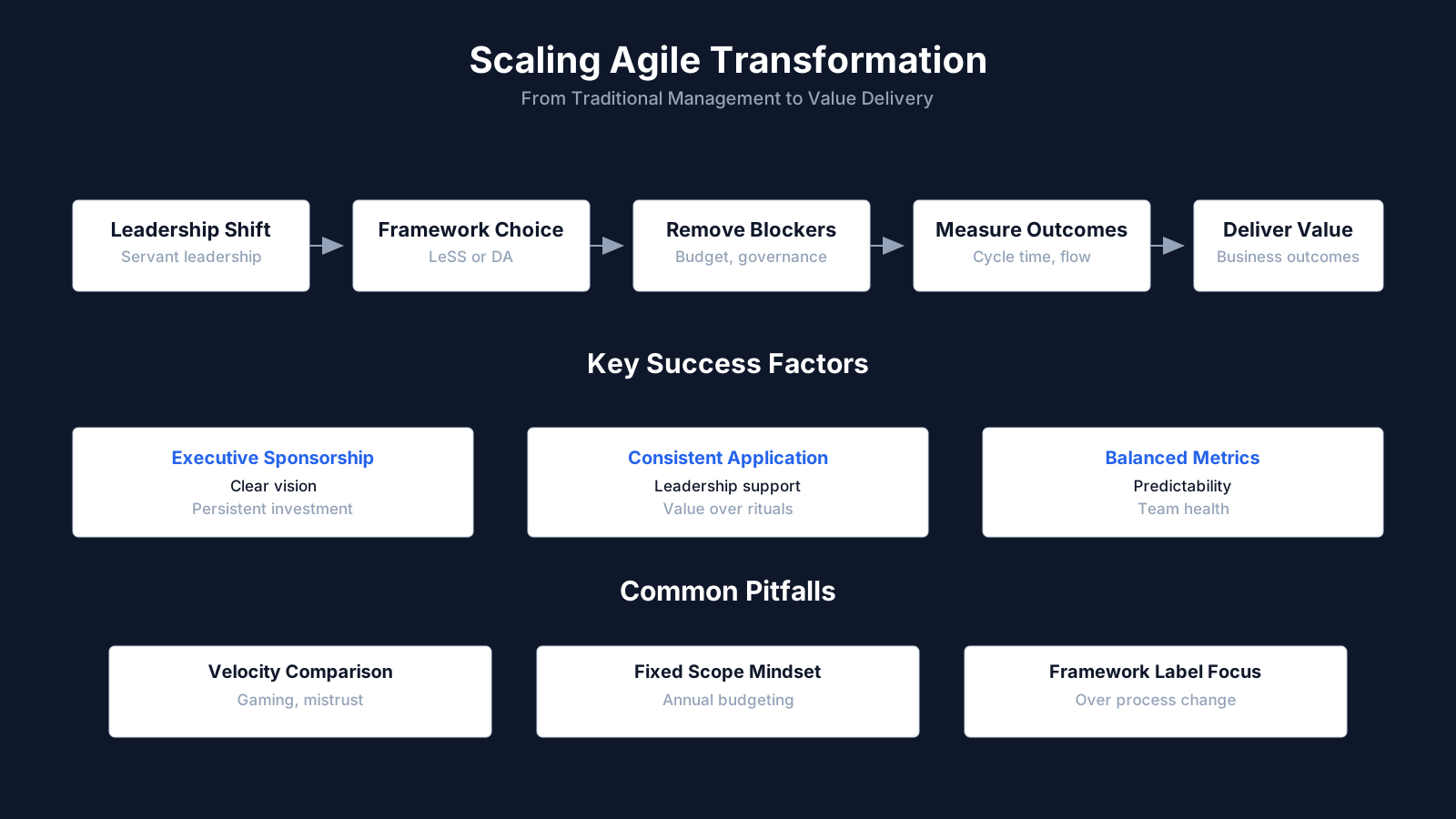
Scaling agile across large enterprises is not simply a matter of running more standups or hiring more Scrum Masters. It is a deliberate organizational change that touches strategy, budget, culture, and technology in ways that team-level agile adoption never does. Many leaders underestimate how quickly structural friction appears when autonomous teams collide with annual planning cycles, centralized compliance functions, and legacy system dependencies. This guide looks at what actually changes when an enterprise commits to agile transformation, where the scaling models help, and where they tend to create new problems if applied without context.
Agile at team level usually succeeds because the unit is small enough to self-organize around a clear product or service. Enterprise scale introduces layers of coordination, shared platforms, multiple product lines, and a patchwork of legacy processes that were never designed for iterative delivery. The shift is not about making the whole company look like a software team. It is about creating conditions under which many teams can make fast decisions while the larger organization still maintains coherence, compliance, and strategic alignment.
The interesting part is that most enterprises already have pockets of agile success. The question is how to connect those pockets without crushing them with heavyweight governance. That is the core tension of scaling agile across large enterprises.
Agile Transformation: Key Topics at a Glance
| Core Concept | Key Summary |
|---|---|
| Structural Friction | Autonomous delivery teams routinely lose momentum when annual planning cycles, compliance requirements, and legacy system constraints impose coordination overhead that leadership often underestimates. |
| Enterprise Complexity | Coordination layers, shared platform dependencies, and legacy governance processes accumulate at enterprise scale, creating structural barriers to rapid, iterative delivery. |
| Scrum Limits | Scrum teams may sustain a reliable two-week cadence while external constraints such as shifting monthly priorities, annual budget cycles, and multi-step approval chains prevent finished work from reaching users. |
| Scaling Models | Frameworks like SAFe offer extensive process guidance, yet structural change alone has limited impact when funding, measurement, and governance remain tied to project-based milestones rather than product outcomes. |
| Organizational Readiness | Before selecting a scaling framework, leaders should identify where value delivery stalls, which decision rights are unclear, and which functions generate the greatest coordination friction. |
| Managerial Impact | Autonomous, self-organizing teams often threaten managerial roles that are built around task assignment and status reporting, creating cultural resistance that undermines transformation. |
| Hybrid Approach | An effective hybrid model uses lean portfolio management to govern funding, Scrum or Kanban to manage delivery, and lightweight synchronization events to coordinate cross-team dependencies without heavy process overhead. |
| Pilot Sequencing | Early scaling pilots succeed most often when selected for visible leadership sponsorship, moderate technical complexity, and a clearly defined product owner with measurable outcome metrics. |
Understanding Agile Transformation in Large Enterprises
The real challenge of an agile transformation in large enterprises is that the existing operating model was designed for predictability and control, not adaptability. Planning horizons, approval gates, funding categories, and role descriptions all assume that work can be specified well in advance. Agile challenges that assumption by making learning part of the delivery process, which means governance must change too. Otherwise the organization ends up with agile teams inside a non-agile system, and the teams absorb the pressure without gaining real autonomy.
The Difference Between Team-Level Agile and Enterprise Agility
Team-level agile is mostly about how a small group plans, executes, and improves its own work. A Scrum team can deliver increments every two weeks and still be trapped inside a system where priorities shift monthly, budgets are fixed annually, and deployments require three external approvals. Enterprise agility is about the speed and ease with which the whole organization can change direction based on customer feedback or market conditions.
One useful way to think about this is through the flow of value. In a single team, value flows from backlog to working software quickly. In a large enterprise, value moves through portfolio prioritization, funding requests, staffing, design reviews, security signoffs, and operational readiness checks. Each of those steps can become a hidden backlog. Scaling agile means reducing the delay in those handoffs, not just increasing the velocity of individual teams.
It is sometimes observed that organizations confuse activity with progress. Teams produce more user stories, but customers do not receive value faster because the surrounding system has not changed. That distinction between team agility and enterprise agility matters more than the choice of scaling framework.
Why Traditional Scaling Approaches Often Break Down
Traditional scaling approaches tend to add layers of coordination on top of teams. The assumption is that more synchronization meetings, more reporting, and more standardized practices will create alignment. In practice, this often produces a mechanical version of agile that looks busy but lacks the feedback loops that make agile useful.
A common failure pattern is copying a framework structure without understanding its underlying assumptions. For example, organizing people into tribes, squads, and chapters may improve cross-team communication, but if the organization still funds work by project and measures utilization, the new structure will not change decision-making. The structure becomes decoration.
Another breakdown happens when the transformation is driven exclusively by the IT or engineering function. Agile values can conflict with finance, procurement, and portfolio management practices. If those functions are not involved from the start, they will continue to impose traditional constraints, forcing teams to work around them rather than with them.
Common Misconceptions About Enterprise Agile
One misconception is that scaling agile means standardizing every team on the same tool and the same ceremony format. In reality, consistency is useful for shared vocabulary, but too much standardization removes the local adaptation that agile depends on. Teams working on regulated core systems have different constraints than teams building customer-facing mobile experiences.
Another misconception is that agile removes the need for planning. Large enterprises still need roadmaps, capacity planning, and risk management. The difference is that plans become hypotheses to be tested rather than commitments to be defended. Budgeting cycles can remain, but the unit of planning shifts from detailed tasks to outcomes.
Finally, many assume that agile transformation has a clear end state. It is better understood as a continuous evolution. The practices that work at one stage of maturity may need to be adjusted as teams mature, products change, and new constraints emerge.
Key Insights on Enterprise Agility
- Governance must adapt with agile
- Traditional operating models built for predictability and control constrain agile teams unless planning, funding, and approval processes are redesigned to reward iterative learning and rapid adaptation.
- Team agility versus enterprise agility
- A Scrum team can deliver working software every two weeks while still being held back by monthly priority shifts, fixed annual budgets, and multiple approval chains, so genuine enterprise agility requires the broader organization to redirect resources and priorities just as quickly.
- Structure alone does not drive change
- Reorganizing into tribes, squads, and chapters improves communication, but without shifting funding from projects to products and shifting metrics from utilization to customer outcomes, decision-making and value delivery stay fundamentally unchanged.
Choosing a Scaling Framework That Fits Your Organization
Choosing the right scaling agile framework comes down to organizational context more than vendor claims or popularity. Frameworks such as SAFe, Large-Scale Scrum, Scrum@Scale, Disciplined Agile, and Nexus each solve different problems, and none of them will work well if treated as a complete operating model. The goal is to use a framework as a starting point, then adapt it around your value streams, regulatory environment, and existing leadership culture.
SAFe, LeSS, and Other Leading Approaches
SAFe, the Scaled Agile Framework, is often chosen by large enterprises because it provides detailed guidance on portfolio management, budgeting, roles, and ceremonies. It can be useful in environments that need structure and have strong program management traditions. However, its complexity can be a drawback if the organization implements every element without first understanding the problem it is solving.
Large-Scale Scrum, or LeSS, takes a different path. It extends Scrum principles to multiple teams working on the same product, emphasizing simplicity and empirical process control. LeSS works well when there is strong product ownership and a genuine willingness to flatten hierarchy. It tends to struggle in environments with highly fragmented products or deeply embedded project management cultures.
Scrum@Scale focuses on scaling the Scrum roles and events across networks of teams, with explicit attention to an executive action team and a transformation backlog. Disciplined Agile offers a toolkit approach, allowing teams to choose practices from multiple frameworks based on context. Nexus is designed for multiple Scrum teams working on a single product, with integrated increments and cross-team dependencies.
None of these frameworks is inherently better. The choice depends on the number of teams, product complexity, regulatory demands, and how much change the leadership team can absorb.
Assessing Organizational Readiness Before Choosing a Framework
Before committing to a framework, it helps to map where value flows, where decisions bottleneck, and which functions create the most friction. Some organizations have strong team-level agile but weak portfolio-level flow. Others have clear portfolios but teams that struggle with basic collaboration. The framework should address the binding constraint, not the latest trend.
Readiness also includes the ability of middle management to operate in a different role. If the organization has many managers whose primary job is assigning work and collecting status, moving to a model based on self-organizing teams will create insecurity. A framework cannot resolve that on its own. It requires leadership development and honest conversations about how roles will change.
Another readiness factor is technical architecture. If systems are tightly coupled and releases require extensive regression testing, even the best scaling framework will not deliver faster time to market. The framework may expose the technical debt, but it cannot eliminate it without architectural investment.
Hybrid Models and Contextual Adaptation
In practice, large enterprises rarely adopt one framework in pure form. Hybrid models are common, with some business units using SAFe for portfolio alignment while others use Scrum or Kanban at team level. The danger is not hybridity itself; it is the lack of shared principles underneath the mixed practices.
A workable hybrid approach might use lean portfolio management for funding and prioritization, Scrum or Kanban for team delivery, and a lightweight cross-team synchronization pattern for dependencies. The key is to make conscious choices about which elements to combine and to revisit those choices as the organization learns.
Leaders sometimes ask whether they can mix frameworks without confusing teams. The honest answer is that mixing frameworks is less confusing than forcing one model where it does not fit. The confusion comes from inconsistent vocabulary, conflicting metrics, and unclear decision rights, not from having multiple practices.
Building an Agile Transformation Roadmap
An effective agile transformation roadmap sequences change in waves rather than attempting a big-bang rollout across every department. This approach allows the organization to learn from early pilots, adjust the playbook, and build internal credibility before expanding. The roadmap should be outcome-based, with clear experiments and feedback loops instead of a rigid project plan with fixed milestones.
Defining the Vision and Business Outcomes
The transformation needs a compelling reason that goes beyond adopting agile for its own sake. Leaders should define what better looks like, such as faster customer response, reduced time to value, fewer production incidents, or improved employee engagement. Those outcomes become the reference point for measuring progress and resolving conflicts during the change.
It helps to translate the vision into a few measurable goals that are easy to communicate. For example, reducing the time from idea to production deployment or increasing the percentage of features validated with customers before full buildout. These goals should reflect business value, not just delivery metrics like velocity or story points.
Without clear outcomes, the transformation becomes a series of training events and process changes that may not change results. People revert to old behavior when they do not understand why the change matters.
Sequencing Pilots and Waves of Adoption
Scaling agile across large enterprises works best when early wins come from areas with strong leadership support, manageable complexity, and a clear product focus. Pilot teams can experiment with new ways of working, develop local practices, and generate evidence that the change is possible. Those teams also create internal coaches and champions who help later waves.
After the first pilots, the rollout can expand by value stream or business unit rather than by geography or reporting line. This matters because dependencies and customer journeys usually cut across functional silos. Scaling along a value stream exposes those dependencies early and forces the organization to address them.
Waves should be planned, but not overplanned. Each wave provides learning that shapes the next one. If the initial plan is too detailed, leaders will defend the plan instead of responding to new information, which is the opposite of agile behavior.
Governance Without Killing Autonomy
Large enterprises cannot operate without governance, but governance can be redesigned to support agile teams rather than slow them down. The shift is from gate-based approvals to continuous oversight based on working software and real metrics. Risk management, compliance, and financial control do not disappear; they become embedded in the delivery process.
One practical approach is to replace stage gates with lightweight decision reviews at the portfolio level. Teams document key decisions and risks as they emerge, and governance bodies review them at regular intervals. This reduces the temptation to hide issues and avoids the large batch of approvals that often precedes a release.
Autonomy should be granted in proportion to demonstrated competence and alignment. Teams that consistently deliver value and manage risk well can earn more latitude. Teams that struggle may need more support, but the response should be coaching and system improvement, not a retreat to command and control.
Core Insights on Agile Roadmap Planning
- Wave-based rollout sequencing
- Adopt a phased rollout by piloting agile practices in successive waves, which allows the organization to learn and adapt before scaling rather than imposing a disruptive simultaneous change across all departments.
- Outcome-based roadmap structure
- Structure the roadmap around explicitly defined business outcomes, using iterative experiments and feedback loops to guide direction instead of a project plan with fixed milestones that limits adaptation.
- Define what better looks like
- Leaders need to define a concrete vision of improvement, citing measurable targets such as faster customer response, shorter time to value, fewer production incidents, and higher employee engagement, then use these benchmarks to evaluate progress and settle competing priorities.
- Select pilots strategically
- Choose initial pilots in domains that combine committed leadership, moderate complexity, and a distinct product focus, enabling teams to produce credible results and create internal momentum for broader organizational adoption.
Leadership and Culture Change for Scaling Agile
Leadership culture often determines whether an enterprise agile transformation sticks or fades after the initial excitement. Senior leaders set the tone by how they make decisions, respond to failure, and reward behavior. If they continue to demand certainty where there is none, teams will learn to game the system instead of delivering real value.
The Role of Senior Leadership in Agile Transformation
Senior leaders do not need to run daily standups, but they must understand enough about agile to remove systemic blockers. Their role includes aligning the organization around outcomes, funding value streams rather than projects, and creating space for teams to experiment. When leaders delegate the transformation entirely to middle management or external consultants, it often loses authority and momentum.
Leaders also need to model the behavior they expect. This means asking questions instead of giving orders, using data to guide decisions, and admitting when assumptions were wrong. In large organizations, employees watch leadership behavior more than they read transformation slide decks.
A practical step is to create a transformation leadership team that meets regularly to inspect progress and remove obstacles. This group should include leaders from finance, HR, compliance, and operations, not just technology. Without cross-functional representation, the transformation can become an IT initiative rather than an enterprise change.
Shifting from Command-and-Control to Servant Leadership
Command-and-control leadership is still common in large enterprises because it feels efficient in a crisis. However, it creates dependency and slows decision-making when applied to complex product development. Servant leadership shifts the focus from directing tasks to enabling teams with context, boundaries, and resources.
For middle managers, this shift can be uncomfortable. Their value used to come from knowing what everyone was doing and telling people what to do next. In an agile organization, their value comes from coaching teams, managing dependencies, improving flow, and developing people. This is not a downgrade, but it is a significant identity shift that requires support.
Some managers may not want to make the shift. That does not automatically make them bad employees, but it does mean they need honest conversations about fit. Ignoring this issue leads to passive resistance and stalled transformation.
Managing Resistance and Psychological Safety
Resistance is a normal response to change, especially when people fear losing status, expertise, or job security. The response should be empathy and engagement, not dismissal. Leaders should name the concerns openly and explain how roles will evolve. Silence creates rumors and fear.
Psychological safety is the belief that people can speak up, ask questions, and disagree without being punished. In agile transformation, psychological safety matters because teams must surface risks, admit uncertainty, and challenge unrealistic deadlines. Without it, the organization gets a false sense of progress.
Building psychological safety starts with how leaders respond to bad news. If a team reports a problem and the leader reacts with blame or anger, others will hide problems in the future. If the response is curiosity and support, the organization learns faster. This is a practical leadership behavior, not a soft skill.
Organizing Teams and Architecture for Enterprise Agility
Getting the right enterprise agile team structure in place means organizing around value rather than functional silos. In traditional enterprises, work moves through analysis, development, testing, and operations as separate departments with handoffs between each. Agile structures try to reduce those handoffs by creating cross-functional teams that can deliver a complete slice of value.
Team Topologies and Value Stream Alignment
Team topologies provide a useful language for thinking about how teams interact. Some teams are stream-aligned, meaning they own a specific product or customer journey. Others are platform teams, enabling teams, or complicated-subsystem teams that support the stream-aligned teams. This helps avoid the trap of treating every team as identical.
Aligning teams to value streams surfaces dependencies that were previously hidden inside functional silos. It also clarifies who is accountable for a customer outcome. When a stream-aligned team owns a journey end to end, it can prioritize based on real customer needs rather than internal handoff schedules.
Reorganizing around value streams is not just about redrawing boxes on an org chart. It changes reporting lines, budgeting, and performance expectations. It may need to happen gradually, starting with a few value streams and expanding as the organization learns to manage the new boundaries.
Decoupling Systems and Technical Architecture
Technical architecture can be a hidden blocker to scaling agile. If many teams depend on the same monolithic system with a shared release cadence, individual team autonomy becomes limited. Decoupling systems through well-defined APIs, service boundaries, and modular architecture allows teams to deploy independently.
Architectural work should be treated as a product concern, not an afterthought. This means dedicating capacity to refactoring, platform development, and tooling. Without that investment, teams accumulate delivery debt and the transformation stalls even when processes look good.
Large enterprises often have legacy systems that cannot be decoupled quickly. In those cases, the goal may be to create an incremental modernization path rather than a big-bang rewrite. Teams can extract services gradually while maintaining safety and regulatory compliance.
Communities of Practice and Center for Enablement
As teams become more autonomous, they still need ways to share knowledge and maintain consistent standards. Communities of practice bring together people with similar skills, such as testing, product management, or user experience, to share practices and solve common problems. These communities are voluntary and practice-oriented, not reporting structures.
A center for enablement acts as a lightweight internal consulting function. It provides coaching, tools, templates, and guidance without becoming a bottleneck. Unlike a traditional center of excellence, it does not own delivery or approve every decision. It helps teams become self-sufficient.
The balance between autonomy and alignment depends on context. Regulated industries may need more consistency in documentation and controls, while customer-facing digital units may need faster local adaptation. Communities of practice can hold that tension without reverting to central control.
Key Takeaways on Team Structuring
- Cross-functional teams minimize handoffs
- Agile structures shift the focus from departmental task passing to end-to-end delivery by forming cross-functional teams that own a complete slice of value, reducing handoffs across analysis, development, testing, and operations.
- Value stream alignment reveals dependencies
- Aligning teams to value streams brings previously hidden dependencies to the surface, enabling stream-aligned teams to prioritize against actual customer demand while the organization gradually expands adoption as it learns to manage the new boundaries.
- Decoupled architecture enables team autonomy
- Autonomy remains constrained when teams share a monolithic system and a common release cycle, so establishing well-defined APIs, service boundaries, and modular architecture lets individual teams deploy independently while communities of practice preserve cross-team expertise.
Planning, Budgeting, and Measuring at Scale
One of the biggest obstacles to scaling agile is the way enterprises plan and fund work. Traditional annual budgeting and project-based funding often force teams to commit to detailed scope before they understand the problem. Shifting to lean portfolio management helps connect strategy to execution while preserving the flexibility agile teams need.
Moving from Project Funding to Product Funding
Project funding treats each initiative as a temporary effort with a start and end date, a fixed budget, and a defined scope. Product funding instead invests in durable teams aligned to products or value streams, with ongoing funding based on demonstrated value. This reduces the overhead of endless business cases and allows teams to pivot without starting over.
In practice, the shift can be gradual. A company might start by creating a small innovation fund that uses product-based funding for a few high-priority initiatives. As those initiatives show results, the model can expand. The key is to change the conversation from how much money is spent to what outcomes are produced.
Finance leaders need to be part of this conversation from the beginning. They can help design funding thresholds, value metrics, and reporting cadences that satisfy fiduciary responsibilities without freezing priorities for a year.
OKRs, KPIs, and Outcome-Based Measurement
Objectives and key results, or OKRs, can help align multiple agile teams around shared outcomes without dictating how the work is done. OKRs work best when they are few, transparent, and reviewed frequently. They are not a replacement for team-level metrics but a way to connect those metrics to strategic goals.
KPIs should reflect value delivered to customers, not just output. Metrics such as lead time, deployment frequency, change failure rate, and time to restore service are useful for delivery health. Customer outcome metrics such as activation, retention, task completion, and satisfaction are useful for product value. Both matter, and they should be viewed together.
One common mistake is to measure everything and improve nothing. Teams get overwhelmed by dashboards, while leadership focuses on a few vanity metrics. The better approach is to choose a small set of indicators tied to the transformation goals and review them regularly with a learning mindset.
Portfolio Kanban and Lean Portfolio Management
Portfolio kanban makes work visible across the enterprise, including the steps from idea to delivery. It helps leaders see where work queues up, where too much is in progress, and which initiatives are blocked. Limiting work in progress at the portfolio level forces prioritization and reduces context switching.
Lean portfolio management combines this flow view with financial governance and strategic alignment. It creates regular cadences for portfolio reviews, where leaders inspect value delivered, adjust funding, and retire low-value initiatives. This replaces the annual planning ritual with a continuous process.
The shift is not just a tooling change. It requires leaders to make prioritization decisions explicit and to accept that some work will not be funded. In many enterprises, the hardest part is saying no to pet projects, but without that discipline, portfolio flow will remain congested.
Talent, HR, and Performance Management in an Agile Enterprise
Agile transformation will eventually collide with HR practices. Job descriptions, career ladders, hiring processes, and performance reviews were mostly designed for individuals working in stable, siloed roles. Updating agile talent management practices is essential because people will not fully embrace new ways of working if their rewards and promotions still depend on old behaviors.
Redefining Roles and Career Paths
Traditional career paths reward depth in a single function and advancement into management. Agile organizations need people who can collaborate across disciplines, coach others, and deliver customer value. This does not mean every developer must become a manager. It means creating parallel paths for individual contributors, product leaders, agile coaches, and technical specialists.
Roles such as product owner, Scrum master, and release train engineer may be new to the enterprise and need clear expectations. These roles are not simply project manager with a different title. They have distinct accountabilities, and confusing them creates tension and duplicated effort.
HR can support the transformation by working with delivery leaders to define roles based on actual work and outcomes. It helps to involve employees in this redesign so that role changes feel fair and transparent.
Agile Hiring and Onboarding Practices
Hiring for agile organizations should focus on collaboration, learning ability, and problem-solving rather than only technical credentials or years of experience. Behavioral interviews, pair exercises, and work simulations can reveal how a candidate handles ambiguity and feedback. These practices take time but reduce the risk of bringing in people who cannot work in a cross-functional environment.
Onboarding should include more than tool access and company policies. New hires need to understand how value flows, who makes decisions, and how to contribute from the first sprint. Pairing new employees with experienced team members and exposing them to real customer problems accelerates their integration.
Agile hiring also benefits from reducing bureaucratic delays. If the approval process takes months, high-quality candidates may take other offers. Slight process changes, such as sharing interview feedback quickly and involving the team in the final decision, can make a meaningful difference.
Performance Reviews and Compensation Alignment
Traditional performance reviews often reward individual output and stack ranking, which can undermine team collaboration. Agile organizations still need performance management, but the emphasis shifts to outcomes, customer impact, and how people contribute to team health. Peer feedback, regular coaching conversations, and objective data can replace the annual forced distribution.
Compensation alignment is tricky. Some companies experiment with team bonuses or profit sharing tied to product outcomes, while others retain individual adjustments supplemented by peer input. There is no universal best practice, but the system should not reward hoarding knowledge, blaming others, or maximizing personal utilization at the team's expense.
HR should test changes in a few teams before rolling them out broadly. This allows the organization to see what works in its culture and adjust. It also sends a signal that the company is willing to experiment with its own practices, not just demand experimentation from delivery teams.
Core Takeaways on Agile Talent
- Old HR practices hinder agile adoption
- Traditional job descriptions, career ladders, and performance reviews were designed for stable, siloed roles; organizations need to revise these practices because people will not adopt new ways of working while rewards and promotions still depend on old behaviors.
- Parallel career paths for agile roles
- Agile enterprises should establish parallel career paths for individual contributors, product leaders, agile coaches, and technical specialists, and they must involve employees in redesigning these paths so that role transitions feel fair and transparent.
- Hiring for collaboration and learning
- Agile hiring should prioritize collaboration, learning agility, and problem-solving over technical credentials alone, and it should rely on behavioral interviews, pair exercises, and work simulations to uncover how candidates handle ambiguity and respond to feedback.
Common Pitfalls When Scaling Agile Across Large Enterprises
Learning from typical agile transformation pitfalls can save an enterprise months of frustration and wasted investment. Many of these failures are not caused by agile itself but by applying it mechanically, ignoring organizational context, or treating the transformation as a one-time event. Recognizing the patterns early helps leaders intervene before cynicism spreads.
Scaling Too Fast or Too Slow
Scaling too fast often looks like a mandate to train thousands of people, adopt a framework everywhere, and reorganize in a single quarter. This creates the appearance of transformation while leaving the underlying systems unchanged. Teams learn the vocabulary but not the reasoning, and management declares success based on training attendance rather than value delivery.
Scaling too slow can be just as damaging. If the transformation remains a pilot for years, the rest of the organization treats it as an experiment that will eventually be abandoned. Early adopters burn out, and the old model continues to dominate decision-making. The transformation loses legitimacy.
The right pace depends on the organization's ability to learn and absorb change. It usually works best to scale in waves, with each wave building on evidence from the previous one and executive sponsorship remaining visible throughout.
Copying Framework Mechanics Without Culture Change
Some enterprises adopt the ceremonies, artifacts, and roles of a scaling framework without changing how decisions are made. Teams hold sprint reviews but leaders still demand detailed status reports. Product owners are appointed but cannot actually prioritize. Retrospectives happen but nothing changes. The result is agile theater that increases overhead without improving flow.
Culture change is not about posters and values statements. It is about repeated behavior. If managers consistently ask teams what they delivered rather than what customers learned, the culture will remain output-driven. If failure is punished, teams will hide risks. The framework cannot fix these dynamics.
Leaders should identify a small number of behavior changes that will be visibly reinforced. For example, stop asking for percent complete and start asking what value was released and what was learned. This kind of shift, repeated consistently, has more impact than a hundred workshops.
Ignoring Middle Management Dynamics
Middle managers are often the most affected by agile transformation because their traditional coordination and reporting roles change. If leaders ignore this group, those managers can become blockers, consciously or not. They may hold onto decisions, filter information, or create unnecessary reviews.
The better path is to involve middle managers early in designing their new roles. Many can become value stream leads, agile coaches, people managers, or domain specialists. Their institutional knowledge is valuable, but it needs to be redirected from command work to enablement work.
Some managers may leave or resist. That is sometimes a signal that the transformation is taking hold, not that it is failing. However, leaders should avoid framing this as a purge. It is a role evolution, and people deserve clarity and support as they choose their path.
Sustaining Agile Transformation in Large Enterprises
Sustaining an agile transformation is often harder than launching one. After the initial training and reorg, old habits creep back when leaders face pressure or when key sponsors move on. Building mechanisms for sustaining agile transformation means embedding learning, feedback, and adaptation into the operating rhythm instead of relying on a transformation office to hold it all together.
Creating Feedback Loops and Learning Systems
Agile depends on short feedback loops at multiple levels. Teams need feedback from customers, from each other, and from the market. Leaders need feedback on whether their decisions are helping or hindering delivery. Without systematic feedback, the organization cannot tell if the transformation is working or just generating activity.
Learning systems can include regular retrospectives, value stream mapping, customer feedback channels, and transformation metrics reviews. The key is to act on the information. A retrospective that produces no follow-up is worse than no retrospective because it teaches teams that reflection is pointless.
Leaders should model learning too. A monthly transformation review can look at what was tried, what worked, what failed, and what will change next. This creates a rhythm of improvement that outlasts individual personalities.
Measuring Transformation Maturity Over Time
Maturity models can be useful if they focus on outcomes and behaviors rather than just process compliance. A simple maturity framework might assess team autonomy, customer focus, delivery cadence, quality practices, and leadership support. The goal is to identify gaps and target coaching, not to produce a score for its own sake.
Organizations should be honest about maturity. Some teams may still need command-and-control support in certain contexts, while others are ready for high autonomy. Treating maturity as a linear ladder can mislead leaders into pushing every team to the same level regardless of context.
The measurement should be used to improve the system, not to rank teams. If teams fear that low maturity scores will lead to punishment, they will game the assessment. The purpose is diagnosis, not judgment.
Adapting to Remote and Hybrid Work
Remote and hybrid work changed how agile practices happen. Distributed teams cannot rely on the same physical collaboration cues, but many practices transfer well with deliberate design. Virtual whiteboards, asynchronous updates, and clear documentation become more important when people work across time zones.
The challenge is not just tooling but inclusion. If some team members are co-located and others are remote, the remote people often miss informal conversations and decisions. Teams need explicit agreements about how decisions will be shared and who needs to be consulted before a choice is made.
Scaling agile in hybrid settings may require slower decision-making for some topics to allow asynchronous input. That feels slower upfront but reduces rework and improves buy-in. The enterprise should support teams with reliable collaboration platforms and training on effective remote facilitation.
Sustaining Agile: Core Takeaways
- Guard Against Habit Regression
- Agile habits erode quickly under stress or leadership churn, so sustaining the transformation demands explicit safeguards that reinforce new behaviors when the original momentum fades.
- Embed Feedback Into Operating Rhythm
- Rather than outsourcing change to a dedicated transformation office, teams need feedback loops and adaptive planning embedded in their recurring meetings, reviews, and decision cycles.
- Follow Through on Retrospectives
- When retrospectives end without visible action, they erode trust and teach teams that reflection is performative, so every review must assign owners and deliver measurable follow-up.
- Assess Maturity by Outcomes
- Effective maturity assessments measure observable outcomes and behaviors, including team autonomy, customer responsiveness, delivery cadence, and quality practices, instead of rewarding check-the-box process compliance.
Making Agile Transformation Stick Across the Enterprise
The lasting agile transformation success factors are not secret, but they are easy to overlook in the rush to adopt new practices. Clear outcomes, visible leadership, honest feedback, and a willingness to adapt the operating model all matter more than any framework detail. When those conditions exist, scaling agile becomes a series of manageable experiments rather than a chaotic reorg.
Your Next Steps for Scaling Agile
Start by mapping one value stream from customer request to delivered outcome. Identify where delays happen and which decisions require the most handoffs. That single flow view will reveal more about what needs to change than a hundred maturity assessments.
Then choose a small number of teams with supportive leaders and a real product focus. Give them the autonomy and support to try new ways of working, and make sure their progress is visible to the rest of the organization. Learn from what works and what does not before expanding.
Finally, involve finance, HR, and compliance early. They control many of the constraints that will shape the transformation. Treating them as partners rather than obstacles turns potential blockers into problem solvers. Scaling agile across large enterprises is ultimately an exercise in system change, and the system will only change if all parts participate.
Advance Your Career with Professional Certification
In complex enterprise Agile transformations, professionals often discover that a project management certification provides the structured risk, budget, and stakeholder communication skills that agile frameworks alone do not cover. This credential helps you translate executive expectations into iterative delivery plans without reverting to rigid waterfall controls. Many scaling initiatives stall because team leads lack formal training in dependency mapping and resource forecasting across multiple squads. A focused certification program closes that gap by teaching hybrid governance models, earned value analysis for agile releases, and conflict resolution across distributed teams.
Product owners working across five or more Scrum teams face a distinct challenge: maintaining a coherent product vision while negotiating feature trade-offs with conflicting business units. Earning a product owner certification deepens your ability to write outcome-based backlog items, measure feature adoption, and sequence releases using weighted scoring methods. This training also covers pricing and packaging decisions that sit outside the typical Scrum guide but directly affect product success. In scaled environments, certified product owners report fewer stakeholder escalations because their prioritization logic is transparent and tied to customer evidence.
Scaling Agile across an enterprise rarely fails because of engineering; it fails because performance reviews, compensation bands, and career paths still reward individual heroics over team outcomes. A human resources certification equips HR business partners to redesign job architectures around cross-functional roles, implement team-based incentives, and coach managers through the shift from command-and-control to servant leadership. This credential also covers how to handle role elimination, retraining budgets, and legal risks when traditional project manager titles disappear. Without HR expertise in agile operating models, even the best technology rollout will face quiet resistance during annual review cycles.