In the modern enterprise, the Chief Operating Officer occupies a singular position at the intersection of strategy formulation and operational reality, a vantage point that makes mastering strategic change leadership and a COO's roadmap to alignment essential for any transformation initiative. When a company embarks on significant change, whether a digital overhaul, a merger integration, or a fundamental business model pivot, the risk of misalignment between the executive vision and front-line execution is the silent killer of value. This article provides a comprehensive, evidence-based guide that COOs and aspiring operations leaders can use to advance to the C-suite and navigate the entire change lifecycle, connecting leadership intent with measurable organizational coherence.
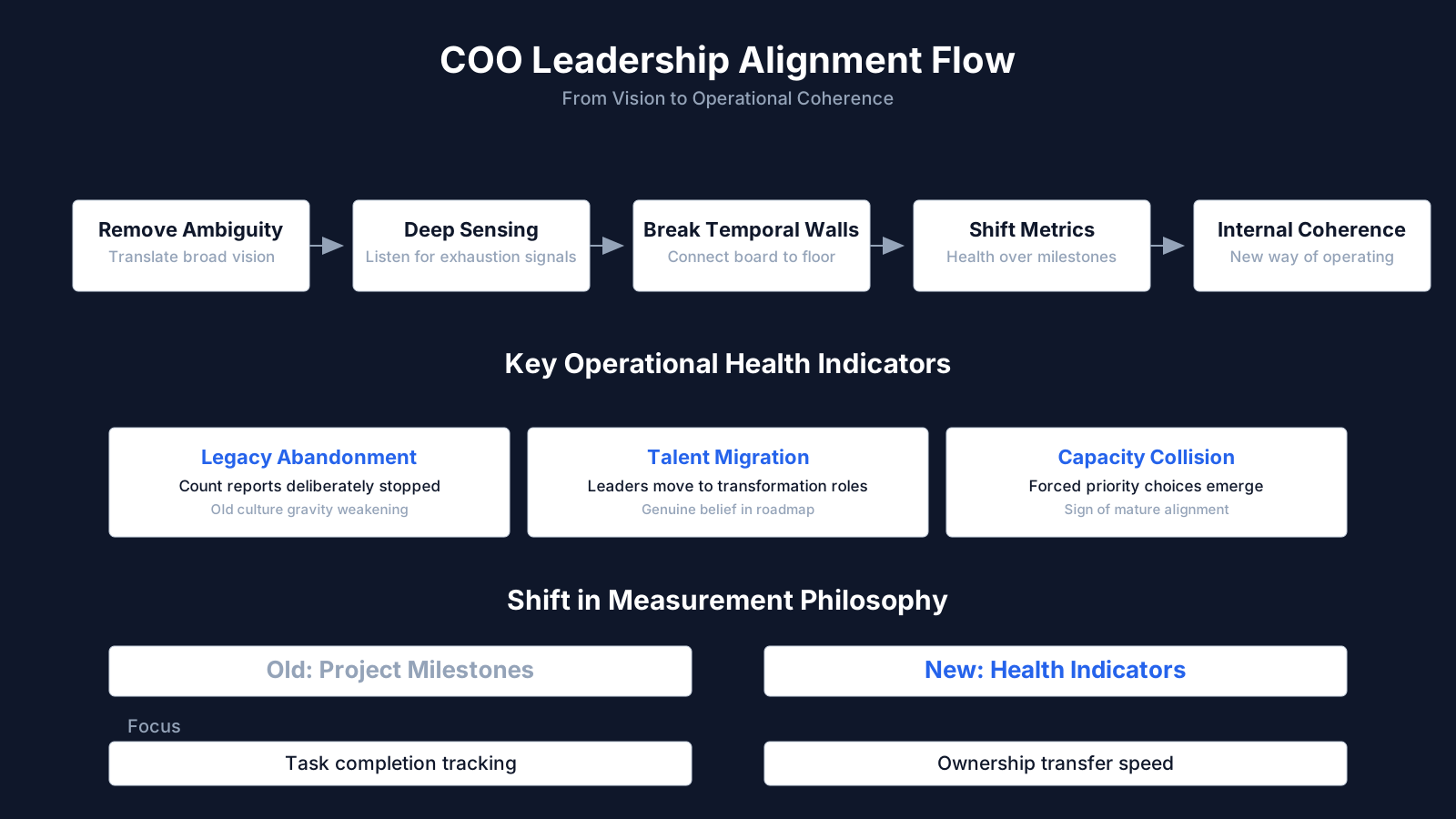
Strategic Change Leadership: Key Takeaways at a Glance
| Key Concept | Summary |
|---|---|
| COO Mandate | The COO transforms executive vision into operational reality by crafting the architecture of large-scale change, integrating systems design principles with human performance dynamics. |
| Change Failure | Over 70% of transformation programs derail due to neglected cultural and social dynamics rather than strategic flaws, casting the COO as the enterprise's early detector of systemic misalignment. |
| Adaptive Leadership | Strategic change leadership requires the COO to distinguish technical, solvable problems from adaptive challenges that demand fundamental shifts in organizational values, beliefs, and entrenched habits. |
| Alignment Paradox | Organizational alignment is a dynamic equilibrium that must be actively curated, balancing enterprise-wide process integrity with local adaptation to prevent structural rigidity. |
| Incentive Coherence | Tactical change leadership entails auditing goal cascades to confirm departmental KPIs collectively reinforce the strategic north star, rather than pulling in conflicting directions. |
| Alignment Audit | A rigorous alignment probe examines whether employees can clearly articulate the strategy, trace a direct line from it to daily work, and trust that leaders are authentically committed to the change. |
| Frozen Middle | To mobilize the frozen middle, the COO must liberate middle managers from broken structures, equipping them with the skills, decision rights, and dedicated time to lead transformation, not merely supervise. |
| Operating Framework | A pragmatic model synthesizing Kotter's change stages, agile Scrum rhythms, and the McKinsey 7S framework gives the COO a structured yet adaptive roadmap to sustainable alignment. |
| Must-Win Battles | The COO crystallizes three to five non-negotiable shifts in the operating model as the transformation's anchors, focusing organizational energy and preventing fragmentation of effort. |
The Unique Mandate of the COO in Strategic Change Leadership
The Chief Operating Officer is rarely the sole architect of the corporate strategy, but they are almost always its primary engineer and translator. While the CEO articulates the "why" and "what" of change, the COO must construct the "how" at scale. This role demands a distinct form of strategic change leadership that blends systems thinking, process design, and human performance management. A COO who defaults to a purely transactional project management approach will find that new processes crumble under the weight of old cultural norms . True change leadership from this seat requires seeing the organization not as a machine to be recalibrated but as a complex adaptive system where alignment emerges from shared purpose, psychological safety , and suitably designed enabling structures.
Research from organization development consistently shows that transformation programs fail at alarming rates, often exceeding 70 percent, not because the strategy was flawed but because the implementation ignored the social circuitry of the company. The COO, overseeing the vast middle of the organization including supply chains, customer service functions, and internal service delivery, is positioned to detect early signals of misalignment long before they surface in boardroom dashboards. This proximity to operational truth makes the COO an indispensable change architect who must catalyze commitment rather than merely command compliance. The roadmap to alignment is, therefore, a living discipline of feedback, adaptation, and relentless communication of the operational narrative.
The days when a COO could simply issue a directive and trust the hierarchy to cascade it are long gone. In a world of hybrid work , matrixed reporting, and empowered knowledge workers, strategic change leadership for a COO involves constructing a coalition of informal influencers, middle managers, and process owners who serve as the capillary system of change. The COO must embody what leadership scholar Ronald Heifetz calls adaptive leadership , distinguishing between technical problems that can be solved with existing expertise and adaptive challenges that require shifts in values, beliefs, and habits. Most large-scale realignment efforts contain a mixture of both, and the COO who treats an adaptive challenge as a technical project will waste millions and exhaust organizational goodwill without moving the needle on the behaviors that matter most.
The Alignment Paradox in Complex Organizations
One of the most persistent myths in management is that alignment is a static state that, once achieved, remains fixed. In reality, organizational alignment is a dynamic equilibrium that must be actively curated through every wave of change. The alignment paradox states that the very structures created to ensure consistency, such as rigid standard operating procedures or centralized approval gates, often ossify the organization and make it incapable of adapting to market shifts. The COO's roadmap to alignment must therefore balance the need for process integrity with the flexibility required for local adaptation, a concept known in lean management as standardized work with built-in kaizen.
A common failure pattern occurs when the executive team designs a transformation that looks perfect on a strategy map but fractures at the handoff between departments. The sales function might be incentivized to push a new product portfolio while the operations team is still measured on cost-per-unit metrics that penalize the complexity of that new offering. Tactical change leadership involves auditing these goal cascades with forensic precision. Alignment without incentive coherence is little more than a wish. The COO must possess the authority and political capital to renegotiate departmental key performance indicators so that they collectively point toward the strategic north star rather than pulling the organization apart in a hundred contending directions.
Diagnosing Misalignment Before It Cripples Execution
Effective strategic change leadership begins with an honest, sometimes painful diagnosis of the current state of alignment. Many COOs make the mistake of launching transformation roadshows that proclaim a glorious future without first mapping the hidden vectors of resistance and fragmentation. A more rigorous approach borrows from the field of human resources and organizational development by conducting an alignment audit. This is not a traditional employee engagement survey with vague questions about satisfaction. Instead, it probes whether employees at multiple levels can articulate the strategy in their own words, whether they see a clear line of sight between their daily work and the strategic priorities, and whether they believe their leaders are genuinely committed to the change or merely paying lip service.
When conducting this diagnosis, the COO should pay particular attention to the "frozen middle." These are the directors and senior managers who are often portrayed as obstacles to change. In many instances, these individuals are not naturally resistant but are trapped in structures that force them to become custodians of broken processes. Strategic change leadership from the COO role requires rehabilitating this layer of management by providing them with the capability, the mandate, and the time to lead rather than simply to supervise. A roadmap to alignment that does not explicitly invest in the capability uplift of middle managers will discover that the organization’s connective tissue has been severed, leaving the senior team floating in a strategic void disconnected from the operational core.
Core Insights on COO Change Leadership
- Engineer of the "How"
- The COO converts the CEO’s strategic vision into scalable operations by weaving together systems thinking, rigorous process design, and astute human performance management.
- Social Circuitry of Change
- Transformation programs frequently stall when implementation overlooks the organization’s informal social circuitry, and the COO’s closeness to operational truth enables early detection of misalignment before it derails progress.
- Adaptive Leadership Required
- The COO must distinguish technical problems from adaptive challenges, because treating a deep shift in values and habits as a routine project squanders both resources and organizational goodwill.
- Dynamic Alignment Equilibrium
- Organizational alignment is a dynamic equilibrium that demands continuous curation, balancing process integrity with local adaptation to prevent the ossification that rigid structures create.
- Incentive Coherence Audit
- The COO must renegotiate departmental key performance indicators so they collectively converge on the strategic north star, averting fragmentation caused by conflicting incentives.
The Foundational Framework for Strategic Change Leadership and the COO’s Roadmap to Alignment
To move the enterprise from confusion to coherence, the COO needs a practical operating framework that is not overly academic but is stringent enough to withstand the pressures of quarterly targets. The model that has proven most resilient across industries blends the clarity of John Kotter’s eight-step change model with the agility of Scrum-based delivery and the systemic perspective of the McKinsey 7S framework. This synthesis provides a robust structure for a COO's roadmap to alignment without becoming a bureaucratic planning exercise that delays action. The COO must orchestrate these elements into a coherent rhythm that synchronizes the speed of decision-making with the speed of trust-building.
In this framework, the COO identifies a small set of critical shifts in the operating model that serve as the non-negotiable anchors of the transformation. Rather than attempting to change twenty things at once, which scatters energy and confuses the organization, the COO defines three to five "must-win battles." These battles are not functional projects like upgrading the enterprise resource planning system; they are cross-cutting behavioral and process shifts that, if won, create a domino effect of positive alignment. Communicating these battles through a storytelling arc rather than a project charter helps the organization comprehend the journey. The COO uses these stories to frame the operational narrative, explaining how the procurement department’s move to strategic sourcing is not merely a cost-cutting exercise but a critical enabler of the innovation strategy that the CEO announced.
The Role of OKRs and KPI Architecture in Driving Coherence
No amount of inspiring rhetoric will sustain strategic change leadership if the measurement and reward systems remain anchored to the old world. This is where the COO must revolutionize the organization’s goal-setting architecture by deploying Objectives and Key Results (OKRs) alongside traditional KPIs. While KPIs monitor the health of ongoing operations, OKRs galvanize the leaps forward that define the transformation. A frequent mistake is using OKRs as a cascading waterfall from the top, which stifles the horizontal collaboration that is the hallmark of true alignment. The COO’s roadmap to alignment advocates for a bi-directional goal-setting process where the strategic intent is set by the leadership, but teams negotiate how their key results will roll up to that intent.
Operational alignment fractures when teams achieve their local OKRs but the customer outcome remains unfulfilled. For example, a product team might release a feature on time, the marketing team might generate the targeted number of leads, and the operations team might hit its service level agreements, yet the combined customer experience is disjointed. To counteract this, the COO must install a layer of shared, cross-functional outcome metrics. These are the alignment guardians. They measure things like end-to-end customer onboarding time, the effectiveness of the quote-to-cash process, or the speed of closing quality issues in the supply chain. By making teams jointly accountable for these horizontal metrics, the COO sews the seams between functions and prevents the siloed optimization that is the enemy of strategic change leadership.
Architecting the Transformation Management Office for Agility
Traditional program management offices are often the graveyards of alignment, filled with Gantt charts that bear no resemblance to the evolving reality of the business. A modern COO requires a Transformation Management Office (TMO) that acts as an agile enabler rather than a compliance auditor. This entity functions as the nerve center of the COO’s roadmap to alignment, providing real-time visibility into interdependencies, facilitating trade-off decisions, and maintaining the integrity of the change narrative. The TMO staff is a blend of project managers, change management specialists, and data analysts who work in short cycles to detect when a workstream is drifting out of alignment with the strategic intent and to bring leaders together for rapid problem-solving.
This TMO does not manage the individual projects tactically, those remain the responsibility of the delivery teams. Instead, it manages the integration of those projects. The COO sponsors the TMO to have the hard conversations about resource allocation. In many organizations, the most dangerous words during a transformation are "we can do it all." Strategic change leadership demands the discipline to sequence initiatives based on capacity and dependency, explicitly deciding what not to do. The COO uses the TMO to enforce this portfolio discipline, preventing the organization from slipping back into a harmful pattern of overload where every initiative is a priority and none receives the dedicated focus required to change deep-rooted habits. This ensures alignment is preserved by avoiding the fragmentation of attention that invariably stalls momentum.
Leading Through the Human Dynamics of Strategic Change Leadership
Operational processes and governance structures are the tangible half of the COO’s roadmap to alignment; the intangible half resides in the realm of human emotion, identity, and group dynamics. A transformation inevitably triggers a mourning process for an old identity that employees understood and perhaps mastered. The COO who leads change like a hostage negotiator, demanding surrender to the new way, will face passive sabotage and an underground resistance. In contrast, strategic change leadership that acknowledges the loss, honors the past’s contributions, and paints a vivid picture of a future where individuals can find renewed purpose is far more effective.
One of the most underutilized levers available to a COO is the deliberate design of rituals. Alignment is not the offspring of a single all-hands meeting or a memo. It is forged in the repeated, symbolic acts that signal what is truly valued. When a COO personally participates in a root-cause analysis session on the factory floor, celebrates a team that shut down a misaligned legacy process, or holds a leader accountable for not modeling the new collaboration behaviors, these acts speak louder than any strategy document. The roadmap to alignment involves mapping the organization’s key rituals and systematically reprogramming them. The format of the weekly operations review changes from a dry report-out to a problem-solving session. The annual budget cycle shifts from a political negotiation to a strategic resource allocation dialogue. These behavioral nudges make the change tangible and unavoidable.
Building the Change Coalition Across the C-Suite and Beyond
A lone COO cannot impose strategic change leadership on a skeptical executive committee. Alignment is a team sport at the apex. The COO must invest time in building a guiding coalition with the Chief Human Resources Officer (CHRO), Chief Financial Officer (CFO), and Chief Information Officer (CIO). The COO and CHRO partnership is particularly vital because the skills, mindsets, and cultural norms required for the new strategy must be translated into talent acquisition, development, and succession plans. If the CHRO is not a full partner in the COO’s roadmap to alignment, the organization will hire and promote for the competencies of yesterday, ensuring that the new culture is stillborn.
Beyond the executive suite, the COO mobilizes what author and change management expert Daryl Conner terms the "change sponsor spine." This is a network of leaders at every level who personally own the realization of the alignment in their areas. These sponsors are not passive communicators of messages from above; they are actively engaged in removing obstacles for their teams, tailoring the change message to local contexts, and confronting the performance issues that arise when someone refuses to adopt the new operating model. The COO ensures that this sponsor spine is not an afterthought but is equipped with a consistent toolkit of talking points, data, and decision rights. Regular sponsor check-ins, facilitated by the TMO, maintain the cohesion of this network and surface pockets of misalignment before they become entrenched.
The Communication Architecture for Sustained Engagement
Organizational communication during transformation often fails because it is too polished, too infrequent, and too one-directional. The COO's strategic change leadership must champion a communication philosophy of radical transparency and dialogic engagement. This means admitting what is not known, sharing raw data instead of curated slide decks, and creating frequent, structured forums where questions are not only allowed but actively solicited. A powerful practice is the "consume, comprehend, commit" framework. The COO ensures that communication is designed first for consumption, making it simple and visceral, then facilitates comprehension through dialogue, and only then asks for commitment to action. Skipping directly to commitment creates a false alignment of silent, resentful nodding.
In hybrid environments, the communication architecture requires a synchronous and asynchronous rhythm. Town halls and site visits remain irreplaceable for conveying emotional resonance, but they are supplemented by internal social platforms where the COO can share brief video reflections on the week’s progress, comment on a frontline employee’s story of the change in action, or answer candid questions in an AMA (Ask Me Anything) format. The goal is to saturate the informational environment with a consistent and authentic narrative. Misalignment breeds in the silence of an empty communication channel. When the COO fills that channel with honest, forward-moving dialogue, they crowd out the rumor mill that often becomes the de facto change communication strategy in their absence.
Core Insights on Leading Change Dynamics
- Acknowledging Emotional Loss in Change
- Successful change leadership acknowledges the genuine grieving process employees undergo when relinquishing a former identity, and it facilitates a purposeful transition rather than demanding an immediate break with the past.
- Redesigning Rituals for Alignment
- By deliberately mapping and reshaping core organizational rituals such as transforming weekly operations reviews from static report-outs into interactive problem-solving sessions, the COO makes the abstract goals of transformation concrete and daily.
- Building a Cross-Functional Coalition
- Driving alignment at scale requires the COO to forge a formal guiding coalition with the CHRO, CFO, and CIO, ensuring that talent strategies and resource allocations are fully integrated with the emerging strategic direction rather than trailing behind it.
- Mobilizing the Change Sponsor Spine
- The COO activates a distributed network of leaders at every tier who proactively clear operational obstacles, localize strategic messages, and address performance shortfalls, turning passive compliance into sustained, cascading commitment.
- Using Radical Transparency in Communication
- By championing radical transparency and two-way dialogue, the COO guides stakeholders through a structured consume-comprehend-commit cycle that builds genuine ownership rather than hollow agreement.
Operationalizing the COO’s Roadmap to Alignment Through Agile and Lean Methods
Translating the vision of alignment into daily execution requires the COO to adopt an operating rhythm borrowed from agile and lean methodologies, adapted for the scale of a corporate transformation. This is not about forcing every department to run daily scrums; it is about implementing a cadence of inspect and adapt cycles that makes the pursuit of strategic change leadership an iterative learning process. The COO structures the transformation as a series of short, medium, and long loops. The short loop is the weekly operational stand-up where immediate blockers to alignment are identified and unblocked within forty-eight hours. The medium loop is the quarterly business review, restructured to focus on progress against strategic milestones and to reprioritize based on learning. The long loop is the annual strategy refresh, which becomes a confirmation or a pivot rather than a ground-up rebuild.
Within this rhythm, the COO embeds the practice of value stream mapping at an enterprise level. Traditional value stream mapping focuses on a single product line, but the COO applies this lens to the entire transformation itself. The team maps the journey of a strategic initiative from idea to measurable impact, identifying the waiting states, approval gates, and handoff frictions that cause alignment to bleed. This exercise often reveals that the corporate strategy is being held hostage by a handful of bureaucratic choke points. By removing these constraints using lean problem-solving methods, the COO accelerates the flow of value and, crucially, demonstrates to the organization that the change leadership is serious about eliminating the obstacles that frustrate their daily lives. This visible action builds the credibility that sustains the emotional commitment described earlier.
Using Data and Technology as an Alignment Backbone
The digital infrastructure of the organization can either be a powerful ally or a formidable enemy to the COO’s roadmap to alignment. When systems are siloed, data definitions are inconsistent, and reporting lags reality by weeks, the organization is literally unable to see its own misalignment. The COO must sponsor a light but essential layer of digital integration that serves as a single source of truth for the transformation’s vital signs. This does not necessitate a multi-year, monolithic information technology project that delays all change. Instead, it calls for an agile data approach, using APIs and lightweight visualization tools to create an operational alignment dashboard that tracks the horizontal metrics discussed earlier. When a regional team can look at the same live data as the executive team and see how its performance affects the whole, the basis of conversation shifts from blame to collaborative problem-solving, a hallmark of mature strategic change leadership.
Artificial intelligence and process mining technologies offer a new frontier for the COO. These tools can passively observe how work actually flows through the digital exhaust of enterprise systems, contrasting this "as is" process with the intended design. The insight is often shocking to leadership teams that believe their process documentation reflects reality. The COO uses this objective diagnostic to strip away confirmation bias and force a conversation about what is really happening. This factual basis for the change narrative reinforces the alignment message powerfully, because it moves the discussion from subjective opinion to empirical observation. The technology is not a replacement for leadership; it is a magnifying glass that allows the COO to see the micro-fractures in alignment that the naked eye would miss, enabling swift and precise corrective action.
Case Example in Real-World Application
Consider the instance of a global logistics company whose COO was tasked with integrating a recent acquisition while simultaneously moving the combined entity toward a digital freight platform model. The initial program management plan was a perfect waterfall of tasks, but within months, the legacy operations teams were optimizing toward their old utilization metrics while the tech teams were building a platform that the operations teams refused to adopt. The COO employed the roadmap to alignment by first declaring a moratorium on fourteen legacy KPIs that were driving the wrong behaviors. In their place, a single binding metric was established: the speed of a shipment from quote acceptance to in-transit status, measured end-to-end across both legacy entities. This single metric forced the sales, operations, and technology teams to align daily. The COO then established a daily ten-minute call, not to report status, but to review any shipment that had stalled, with the rule that the person who discovered the block was responsible for finding the owner to resolve it, bypassing all hierarchical escalation. This ritual, combined with a relentless narrative about the customer’s experience, rewove the organizational alignment in a matter of weeks, not quarters, and the integration exceeded its synergy targets ahead of schedule.
This example underscores a critical lesson: the COO did not start with a more complex plan. They started by simplifying the measurement field and creating a rapid-response social system. The roadmap to alignment is often about removing the noise that allows teams to feel they are succeeding independently while the enterprise fails collectively. When the COO creates a feedback loop that makes interdependence visible and inescapable, the natural human capacity for cooperation and problem-solving activates. The leader’s job then shifts from pushing change to clearing the path for the alignment that is now being demanded by the work itself.
The COO’s Personal Evolution as a Strategic Change Leader
The internal capability of the COO is as critical as the external roadmap. For a operations executive whose identity was built on flawless execution and control, the ambiguity of transformation leadership can be deeply unsettling. The shift from managing a stable system to leading an emergent one requires a recalibration of personal operating norms. Strategic change leadership at the COO level necessitates a comfort with being the "chief experimenter," someone who pilots new ways of working in their own team before asking the rest of the organization to change. This means the COO must model the vulnerability of admitting that the first approach to a new alignment challenge might be wrong. This modeling is immensely powerful because it gives permission for the entire enterprise to learn rather than to pretend.
Mentorship and peer networks play a vital role in this personal evolution. COOs who navigate drastic transformations successfully often cite a small, trusted group of peers in other industries or a coach who provides a confidential sounding board. The role can be isolating; the CEO is often focused outward on the board and the market, while the COO carries the internal burden of the transformation’s operational execution. Having a space to process the political dynamics, refine the leadership narrative, and restore emotional equilibrium is not a sign of weakness but a high-performance practice. The COO who invests in their own resilience and reflective practice will bring a clearer, more consistent presence to the organization, and consistency of leader behavior is one of the strongest predictors of sustained alignment and trust.
Embedding Continuous Alignment into the Corporate DNA
The ultimate measure of a successful roadmap to alignment is not the completion of a project but the installation of a new organizational capability: the ability to realign rapidly as context shifts. The COO architects this sustained capacity by leaving behind the mechanisms that outlive the transformation. This includes an ongoing strategic alignment cadence in the executive team, where every quarter the team reviews not just financial results but alignment indicators such as cross-functional friction, customer experience coherence, and employee belief in the strategy. It also includes the permanent integration of the change sponsorship network into the formal leadership structure, so that the sponsorship of clarity and connection becomes a core leadership competency, not a temporary assignment.
Human resources systems are the final lock-in mechanism. The competency models for hiring and promotion are updated to include "navigates complexity," "creates followership," and "ensures enterprise alignment above local optimization." Succession planning for the COO role itself begins to value a track record of leading strategic change leadership and crafting alignment as much as a history of cost reduction or efficiency gain. By weaving these expectations into the fabric of talent management, the COO ensures that the next generation of leaders is selected, not by accident, for the adaptive leadership the new organization needs. The transformation then graduates from being an event led by a single executive into a self-sustaining characteristic of the firm’s culture.
Core Insights on the COO's Strategic Evolution
- Embracing the Chief Experimenter Role
- The COO transitions from a control-centric executor to a strategic leader who demonstrates vulnerability and tests novel methods within their own team, thereby legitimizing organizational learning.
- Leveraging Mentorship and Peer Networks
- Successful COOs depend on trusted peers and coaches as confidential advisers to navigate political dynamics, sharpen their leadership narrative, and sustain emotional resilience throughout transformations.
- Embedding Alignment into Corporate Systems
- The COO embeds enduring change by weaving alignment reviews into executive meeting rhythms and reshaping HR competency models to elevate adaptive leadership capabilities above conventional efficiency benchmarks.
Sustaining Momentum When the Inevitable Headwinds Arise
No change process is a straight line. There will be moments when results lag, the market turns, or a key sponsor leaves the company. In these moments, the organization will look to the COO to see if the commitment wavers. Strategic change leadership in the trough of disillusionment is the truest test of the roadmap. The COO must resist the reflex to accelerate by pushing harder, which often causes the organization to turtle up defensively. Instead, the COO uses these moments to reframe the challenge, drawing on the reserves of trust built earlier. They bring the organization back to the purpose, reconnect the daily struggle to the customer impact, and, if necessary, rationally adjust the timeline of the transformation while reaffirming the immovable scope of the core shifts. This is not stubbornness; it is the steady pulse of a leader who understands that alignment, once abandoned and then restarted, is twice as hard to regain.
The COO also leverages early wins as anchors. In the initial design of the roadmap, the COO intentionally built a series of low-investment, high-visibility projects specifically to generate evidence of the new way of working. These "lighthouse" projects serve as proof points that the alignment model works. When morale dips, the COO takes the organization on a virtual tour of these lighthouses, celebrating the teams that achieved improbable results through cross-functional cooperation. This storytelling, backed by data, reinforces the belief that the destination is both attainable and worth the pain of the journey. The COO’s authenticity in these moments, celebrating the messy, non-linear truth of those lighthouse wins rather than polishing them into a fairy tale, solidifies the credibility of the entire change effort.
Measuring the Unmeasurable: Culture and Trust
A purely numerical approach to the roadmap to alignment is incomplete because the most crucial outcomes, such as psychological safety, decision-making speed, and strategic clarity, resist easy quantification. The COO develops a balanced approach to measurement that includes qualitative sensing mechanisms. These might include "alignment pulse checks," short, frequent surveys consisting of two or three carefully crafted statements that employees rate, such as "I see a clear connection between my team’s priorities and the company’s strategic direction." The trend line of these pulse checks, observed over time, is a more reliable indicator of cultural shift than the absolute score. The COO reviews these not to make decisions from the dashboard alone, but to trigger conversations. A falling trend in a particular business unit prompts an immediate "go and see" visit, not a punitive email. This sends the signal that the pursuit of alignment is serious, supportive, and grounded in the reality of the floor.
Network analysis provides another sophisticated lens. By surveying employees about whom they go to for advice, for energy, and for information during the change, the COO can literally map the informal influence network. This reveals whether the formal sponsor spine is actually carrying the change energy or whether a shadow network of skeptics is inadvertently becoming the primary voice. Strategic change leadership uses this intelligence with care, not to target naysayers for discipline but to understand the resistance and bring those influential voices into the design of the solution. The COO invites a respected skeptic onto a design sprint for a problematic process. This act of inclusion often flips a powerful resistor into a champion, transforming a potential alignment liability into a critical asset. The roadmap to alignment is a deeply human endeavor, and these nuanced interventions are far more effective than the blunt instrument of a corporate restructure.
The journey from a misaligned, friction-filled enterprise to a coherent, strategically aligned organization is the defining challenge and the greatest legacy of the modern COO. It demands a synthesis of hard operational rigor and profound human insight, a blend that no textbook can fully impart but that this roadmap illuminates. By approaching transformation with the discipline of a systems architect and the heart of a movement builder, the COO can guide the organization to a state where strategy and execution are not two separate conversations but one seamless, living reality.
Advance Your Career with Professional Certification
In an increasingly complex business landscape, professional project management certification serves as a powerful differentiator, equipping professionals with standardized methodologies to consistently deliver results on time and within budget. Beyond boosting individual career prospects through validated expertise, certified managers drive organizational success by mitigating risks and optimizing resource allocation. Investing in dedicated project management training not only sharpens leadership competencies but also fosters a culture of accountability and strategic alignment across teams. This formal recognition ultimately signals to employers and stakeholders a commitment to excellence, paving the way for transformative growth and sustained competitive advantage.
In today's rapidly evolving business landscape, a professional certification validates your ability to drive product strategy and lead cross-functional teams through complex change initiatives, making you a more credible and effective leader. Earning credentials as a certified product manager signals to employers that you possess the structured frameworks and customer-centric mindset needed to align products with organizational goals, reducing costly missteps and accelerating time-to-market. Beyond opening doors to senior roles, this certification fosters a shared language across departments, directly supporting the kind of strategic alignment that COOs and executives champion during transformational periods. Ultimately, it’s an investment that sharpens both your tactical skills and your capacity to orchestrate meaningful, sustainable growth.
Earning a professional HR management certification signals a deep commitment to mastering modern people strategies, which directly elevates your credibility and opens doors to senior leadership roles. Investing in HR training and certification equips you with up-to-date legal, ethical, and data-driven decision-making skills that reduce organizational risk and improve workforce engagement. For businesses, certified HR leaders are better positioned to align talent initiatives with strategic goals, driving measurable outcomes like lower turnover and stronger performance cultures. Ultimately, this credential is not just a resume booster—it’s a proven pathway to becoming a trusted advisor who shapes lasting organizational success.