The Certified Associate in Project Management (CAPM) often gets treated as a stepping stone into project management, but the reality is more layered than that. People exploring the CAPM certificate want to know the requirements, exam format, and whether the career impact justifies the time and cost. It is a credential that sits in a strange middle space, valuable for some candidates and much less meaningful for others. The answer depends almost entirely on where you are in your career and what you need the certification to do.
Most discussions about the CAPM focus on passing the exam, but the exam is only one piece of the decision. You also need to think about eligibility, maintenance, renewal, and how the credential looks next to real project experience. Some people benefit from the structure the CAPM brings, especially when their work history does not include formal project titles. Others spend months preparing when they should have gone straight for the PMP or focused on work-based proof of delivery.
This article explains how the CAPM works, what it asks of candidates, and what it tends to deliver in the job market. It does not promise that a single certificate will change your career, because no credential does that. But it does give you the practical detail to make a clearer call.
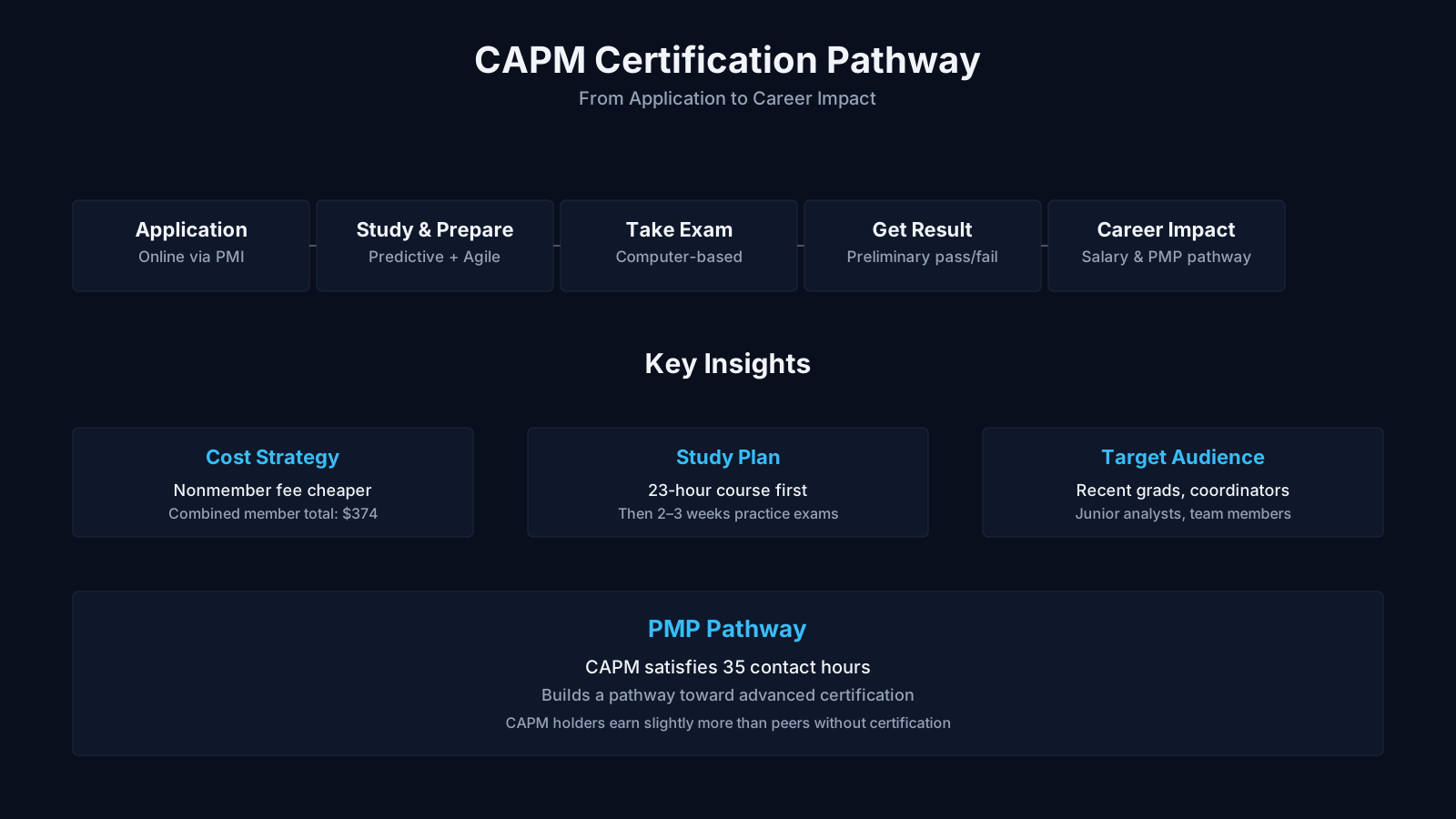
CAPM Summary: Requirements, Exam, and Career Impact
| Key Concept | Summary |
|---|---|
| CAPM Purpose | The Certified Associate in Project Management, or CAPM, is PMI's entry-level credential that validates foundational project management knowledge for professionals seeking formal credibility before accumulating extensive leadership experience. |
| Target Audience | The credential is particularly relevant for recent graduates, project coordinators, and functional specialists who contribute to project work but do not yet hold formal project management titles. |
| Educational Eligibility | PMI accepts secondary education credentials from many countries, which means a four-year degree is not mandatory. Candidates with less common or nontraditional credentials should verify their eligibility with PMI before committing to preparation costs. |
| Training Hours | Candidates can accrue the required project management education hours through PMI chapters, employer sponsored training, university coursework, and accredited online courses, provided the curriculum covers core knowledge areas such as scope, schedule, cost, risk, quality, and stakeholder management. |
| Exam Content | The current exam evaluates proficiency in agile and adaptive methodologies, foundational business analysis concepts, and the broader organizational context in which projects are delivered. |
| Career Impact | Prospective candidates often evaluate whether the CAPM's time and financial investment yields measurable career advantages, including stronger job prospects, increased earning potential, and a faster path into formal project management positions. |
What Is the Certified Associate in Project Management (CAPM)?
The CAPM is a credential awarded by the Project Management Institute. It is designed as an entry-level project management certification for people who want to demonstrate foundational knowledge without needing years of project leadership experience. The certification signals that you understand common project language, processes, and governance concepts. That may sound basic, but the scope has changed in recent years and now reaches beyond traditional predictive project management.
PMI introduced the CAPM to fill a gap between formal education and the much more demanding Project Management Professional certification. The PMP expects candidates to have led projects for thousands of hours, which creates a barrier for new graduates, coordinators, and people changing careers. The CAPM gives those groups a way to show that they have studied the discipline in a structured way.
The credential is tied to PMI standards, particularly the PMBOK Guide, but it is not just a memorization test of process names. The current exam content also asks candidates to understand agile and adaptive approaches, basic business analysis ideas, and the overall context in which projects operate. That broader scope is often underestimated by people who still think of the CAPM as a simple vocabulary quiz.
The origins and purpose of the Certified Associate in Project Management (CAPM)
PMI created the CAPM for people who did not qualify for the PMP but still wanted recognized proof of project management education. The idea was to establish a baseline credential that was less about experience and more about whether someone could speak the language of projects. In practice, it often appeals to recent graduates, project assistants, and functional specialists who coordinate work without a formal project title.
What makes the CAPM interesting is that its role has shifted as project management itself changed. Years ago, much of the exam centered on process groups, knowledge areas, inputs, tools, and outputs. Today the discipline is more hybrid, combining predictive delivery with agile methods and business analysis. The CAPM has adapted to reflect that shift, which means older study advice can leave you underprepared.
How the Certified Associate in Project Management (CAPM) compares to PMP
The PMP is the senior credential in PMI's portfolio and requires substantial project leadership experience. The CAPM is not a lighter version of the PMP in terms of subject matter, but it is far more accessible in terms of eligibility. The key difference is depth and the expectation that a PMP holder can manage projects, not just describe how projects are managed.
Some people ask whether they should skip the CAPM and wait until they qualify for the PMP. That depends on timeline. If you are already close to meeting PMP experience requirements, the CAPM may not add much. If you are years away, the CAPM can serve as an interim credential that builds your foundational knowledge and demonstrates initiative while you accumulate project hours.
CAPM Certification Key Insights
- Entry-level project management credential
- The CAPM is designed for individuals seeking to validate foundational project management knowledge without the extensive project leadership hours required by more advanced credentials.
- Signals core project knowledge
- Earning the CAPM confirms understanding of common project terminology, processes, and governance concepts, offering credible evidence of formal project management training.
- Expanded scope beyond predictive
- The current exam covers agile and adaptive approaches, foundational business analysis concepts, and the broader organizational context in which projects operate, reflecting the shift beyond traditional predictive management.
- Bridge between education and PMP
- PMI introduced the CAPM to bridge the gap between formal education and the more demanding PMP certification, which requires thousands of hours of project leadership experience.
Certified Associate in Project Management (CAPM) Requirements
Understanding the CAPM certification requirements before you pay for an exam is the single most important planning step. PMI has simplified eligibility in recent years, but candidates still get tripped up by small details around education and documentation. The current model focuses on formal project management training rather than on-the-job project experience.
To sit for the CAPM exam, you need a secondary degree, which can be a high school diploma, an associate's degree, or the global equivalent. You also need to complete 23 hours of project management education before you take the exam. There is no project work experience requirement in the current eligibility framework, which makes the credential much more approachable for people early in their careers.
That said, the 23 hours are not optional and cannot be replaced by telling PMI that you have worked on projects. The education has to be completed and documented. This is where many applications stall, because the candidate assumes that general work exposure counts as formal learning.
Educational eligibility for the Certified Associate in Project Management (CAPM)
PMI accepts secondary education credentials from a wide range of countries, and you do not need a four-year degree to qualify. That is one of the reasons the CAPM is often used by people who entered the workforce through non-traditional paths. The education requirement is modest, but it still needs to meet PMI's definition of a secondary degree or international equivalent.
If you are unsure whether your diploma qualifies, PMI's application process will ask for details about the institution and completion date. PMI may later request additional verification during an audit. Most candidates with a standard high school diploma or associate's degree have no issue, but candidates with less common credentials should check before investing in preparation materials.
Project management education hours for CAPM candidates
The 23 contact hours must cover project management topics, not general business subjects. PMI accepts hours from a variety of structured learning sources, including PMI chapters, employer training programs, universities, and online project management courses. The key is that the course content aligns with formal project management concepts such as scope, schedule, cost, risk, quality, and stakeholder management.
You do not need to complete the hours through a course offered directly by PMI, but the course provider should be able to issue a certificate or record of completion. In the application, you list the course name, provider, date, and number of hours. If your application is audited, you may be asked to produce the completion certificate. Keeping a copy of that documentation is a simple risk management step.
Some candidates incorrectly assume that attending project meetings or volunteering for a project team replaces the education requirement. It does not. The 23 hours are for structured learning, not for observing work in progress. That distinction matters because PMI wants evidence that you have covered the discipline in a deliberate way, not that you have simply been around projects.
PMI membership is not an eligibility requirement, but it reduces the exam fee. Many candidates join PMI, pay the membership fee, and then register for the exam at the member rate. Whether that makes financial sense depends on the total cost you are willing to absorb and whether you plan to maintain the certification over time.
CAPM Exam Structure and Content
The CAPM exam structure is a frequent source of confusion because older materials still circulate online. The current exam is offered as a computer-based test with 150 multiple-choice questions and a three-hour time limit. Some of those questions are pretest items that do not count toward your score, though you will not know which ones they are while testing.
The questions are based on PMI's exam content outline, which has evolved to include predictive, agile, hybrid, and business analysis topics. That means the exam is not a simple exercise in memorizing the five process groups and ten knowledge areas from older PMBOK editions. You still need to understand those concepts, but you also need to recognize how adaptive approaches and business analysis fit into the bigger picture.
The exam is delivered at testing centers and through online proctoring in many locations. You receive a pass or fail result, and PMI does not publish a fixed passing percentage. The scoring uses psychometric analysis to account for question difficulty, so the number of correct answers required can vary slightly from one exam form to another.
Certified Associate in Project Management (CAPM) exam format and timing
The three-hour window includes time to read instructions and review your answers, though the clock runs throughout the exam. For most candidates, the pace works out to about one minute and twelve seconds per question if you answer all 150 sequentially. That is usually enough, but only if you do not linger too long on questions that confuse you.
There is no penalty for wrong answers, so guessing is a legitimate strategy for difficult questions. Reviewing marked questions is allowed, and many candidates use the last twenty minutes to revisit items they flagged. The structure is linear rather than adaptive, meaning the exam does not get harder or easier based on your performance.
Domain areas covered on the CAPM exam
PMI's current exam content outline groups questions into four domains. Project management fundamentals and core concepts carry the largest weight at roughly 36 percent. Predictive, plan-based methodologies account for about 17 percent, while agile frameworks and methodologies make up around 20 percent. Business analysis frameworks represent the remaining portion, at approximately 27 percent.
These percentages are drawn from PMI's published exam content outline, and they should shape your study priorities. Many candidates overinvest in traditional process flow memorization and underinvest in business analysis and agile concepts. The exam will ask you to apply foundational knowledge to situational questions, not merely to identify definitions out of context.
The reference material includes the PMBOK Guide seventh edition, the Agile Practice Guide, and foundational business analysis resources. PMBOK 7 is organized around principles and performance domains rather than process groups, which can feel disorienting if you studied older editions. The CAPM still expects you to understand predictive project flow, but the language has changed enough that older books alone are not reliable preparation.
Essential Facts About Exam Format
- Computer-based 150-question format
- The CAPM exam is administered entirely on a computer and consists of 150 multiple-choice questions that must be answered within a single three-hour session.
- Unidentified pretest questions included
- A portion of the items serve as unscored pretest questions that are indistinguishable from the scored questions, so candidates should treat every item as if it contributes to their final result.
- Content expands beyond classic PMBOK
- The current exam content outline spans predictive, agile, hybrid, and business analysis domains, which means relying solely on the traditional five process groups and ten knowledge areas will leave significant gaps in preparation.
- Psychometric scoring with variable threshold
- The exam yields a clear pass or fail outcome, and the number of correct answers required varies slightly by exam form because psychometric equating adjusts for differences in question difficulty.
- Three-hour window with pacing implications
- The three-hour timer includes the tutorial and review periods, leaving an average of approximately one minute and twelve seconds per question when all 150 items are attempted in sequence.
Preparing for the CAPM Exam
A sound CAPM exam prep plan starts with PMI's exam content outline, not with a random stack of books. The outline tells you what domains are tested and how much weight each one carries. After that, you can choose study resources that match your learning style, schedule, and budget. The people who struggle most are often those who skip the outline and try to memorize everything broadly.
Most candidates need several weeks of consistent study beyond the required 23 education hours. The exact time depends on your prior exposure to project management vocabulary and whether you are comfortable with multiple-choice situational questions. A realistic plan often spans four to ten weeks, but there is no universal schedule. What matters more is regular review and practice under timed conditions.
One useful approach is to treat the PMBOK Guide as a reference rather than a cover-to-cover narrative. Focus on the performance domains, principles, and the logic behind tailored delivery. For predictive areas, spend time on how project charters, work breakdown structures, schedules, change control, and risk registers connect. For agile areas, understand iteration, backlog, roles, and how adaptive delivery differs from plan-driven work.
Study resources and learning approach
PMI offers official courses, and many third-party providers offer CAPM prep programs that include video lessons, practice questions, and study guides. The quality varies, so look for resources that reflect the current exam content outline and include realistic question banks. Reading outdated books that focus only on old PMBOK process groups will leave gaps in agile and business analysis knowledge.
Practice tests are one of the most underused tools in CAPM preparation. They help with content recall, but their real value is in building your ability to read a situational question and isolate the relevant project management principle. Many wrong answers come from candidates choosing an option that sounds generally correct but does not match the question's specific context.
Common preparation mistakes
Some candidates spend too much time making flashcards of every input, tool, and output from older editions of the PMBOK Guide. While some process logic is still relevant, the current CAPM exam asks more about judgment, context, and adapting delivery approaches. Memorization will not save you when a question shifts from a predictive project to an agile environment.
Another common mistake is ignoring business analysis. Since business analysis frameworks make up a meaningful share of the exam, skipping that domain is a self-inflicted score reduction. You do not need to become a business analyst, but you should understand the relationship between needs, requirements, solution scope, and project delivery.
Finally, avoid cramming the week before the exam. Project management concepts are interconnected, and cramming tends to produce recognition without understanding. Spaced practice over several weeks builds the kind of connected reasoning you need when the exam asks you to choose between two plausible answers.
Career Impact of the Certified Associate in Project Management (CAPM)
The CAPM career impact is real but conditional. It tends to help most when the candidate lacks a project management title, has limited experience, or is transitioning from a technical or administrative role. In those situations, the credential provides a structured signal that you understand project management fundamentals, which can make a resume easier to defend in an applicant pool.
What the CAPM does not do is replace delivery experience. Employers rarely hire someone to manage a complex project solely because they hold a CAPM. The certification supports employment in coordinator, project assistant, junior analyst, and project support roles, where the ability to speak project language and follow governance processes is valued. From there, you build the experience that leads to more senior project management positions.
The value also depends on the industry and geography. In some sectors, particularly those with formalized project management practices, the CAPM is recognized as a useful early credential. In other environments, employers may not know it well and may not weigh it heavily. That does not make the credential worthless, but it means you should not assume a uniform response from every hiring manager.
Certified Associate in Project Management (CAPM) career impact for early roles
For a new graduate, the CAPM can add structure to a resume that otherwise shows only coursework and internships. It gives you a reason to discuss project management in interviews and helps you talk about scope, stakeholders, risks, and delivery in terms that resonate with project leaders. That can differentiate you from candidates who only describe group assignments in general terms.
For a career changer, the CAPM can signal that you have made a deliberate investment in understanding project work. A functional specialist moving into a coordination role may use the credential to bridge the gap between domain expertise and project delivery language. The certificate alone will not get the job, but it can help the interviewer see that you have moved beyond casual interest.
Salary and recognition effects
The CAPM is not typically associated with a large, immediate salary increase. The certification is designed for people at an early stage, and salaries in project coordinator or project support roles are driven mostly by industry, location, and prior experience. Some employers list the CAPM as a preferred qualification, which may improve screening outcomes, but it is not a guarantee of higher pay.
In job postings, the CAPM appears far less often than the PMP. Where it does appear, it is usually for entry-level or support roles where employers want evidence of formal project knowledge without requiring a more senior credential. That recognition is meaningful, but it should be framed as positioning rather than compensation leverage.
Using CAPM as a pathway to PMP
One of the practical benefits of the CAPM is that it can serve as a structured first step toward the PMP. The project management education you complete for the CAPM may help satisfy the education requirements for the PMP application, though it does not reduce the experience requirement. You still need the required months of project leadership experience that PMI outlines for the PMP credential.
The CAPM also introduces you to PMI's continuing certification system and the discipline of logging education hours. That habit becomes useful later when the PMP asks for professional development units. If you pursue the PMP years later, you will already be familiar with the certification ecosystem, the language, and the application process.
Key CAPM Career Insights
- Best for early career candidates
- The CAPM offers the strongest return for candidates who have not yet held a project management title, who are building initial experience, or who are pivoting from technical or administrative functions.
- Supports entry-level project roles
- This certification strengthens candidacy for project coordinator, project assistant, junior analyst, and project support roles, where a working command of project terminology and governance frameworks is often a baseline requirement.
- Adds resume structure for graduates
- For recent graduates, the CAPM provides a coherent structure for resumes built primarily on coursework and internships and supplies interview talking points on scope, stakeholders, risk, and delivery.
- Salary depends on other factors
- Compensation for coordinator and support positions depends more heavily on industry, geographic location, and prior experience than on holding the CAPM credential alone.
Cost, Maintenance, and Renewal of the CAPM
The CAPM certification cost includes more than the exam fee, though that fee is the largest single line item. As of current PMI pricing, CAPM exam registration is $225 for PMI members and $300 for nonmembers. PMI membership has a separate annual fee, and many candidates join to access member pricing on the exam and future renewals. Retake fees apply if you do not pass on the first attempt.
Beyond the exam fee, you should budget for study materials or a prep course. Some candidates use free or low-cost resources, while others invest several hundred dollars in structured training. The required 23 hours of project management education can be part of a prep course, so the cost of education and exam preparation often overlaps.
Renewal is a recurring obligation that catches some holders by surprise. The CAPM certification cycle is three years, during which you need to earn and report professional development units. These PDUs are earned through ongoing education and other activities that maintain your project management knowledge. If you ignore the renewal cycle, your certification can lapse, and bringing it back may require retaking the exam.
Renewal cycle and professional development units
The current CAPM renewal cycle requires a set number of PDUs over three years, with a smaller total than the PMP. PMI publishes the exact PDU requirements and renewal fees, and the member rate is lower than the nonmember rate. The important habit is to log education activities as you complete them rather than waiting until the end of the cycle.
PDUs can be earned through formal education, self-directed learning, organization meetings, and some giving-back activities, though not all categories carry equal weight. For CAPM holders, the focus is generally on staying current with project management practices, especially as agile and hybrid methods continue to influence the field.
Long-term value relative to cost
The total cost of earning and maintaining the CAPM is modest compared to advanced degrees or long certification programs, but it is still an investment. The value comes from integrating the credential into a broader career plan rather than viewing it as a one-time transaction. If you earn the CAPM and then never use or renew it, the benefit is limited.
For people who stay in project-facing roles, the renewal cycle provides a low-level forcing function to keep learning. That may not be exciting, but it maintains a baseline currency in the field. The cost should be weighed against the likelihood that the credential will actually appear in the job roles you pursue.
Myths and Misconceptions About the CAPM
The CAPM certification value is often misunderstood because people compare it to the PMP using the wrong lens. One common myth is that the CAPM will automatically lead to a project manager title. That is not true. The credential may help you enter project support roles, but project management authority comes from demonstrated delivery, stakeholder relationships, and accountability, none of which a test can prove.
Another misconception is that the CAPM is just a vocabulary quiz and requires minimal preparation. That may have been closer to the truth in older exam versions, but the current exam includes situational questions that test judgment. Agile and business analysis content has raised the breadth of what candidates need to understand, and many people underestimate the reading and reasoning load.
Some experienced professionals assume the CAPM is beneath them. That is also an oversimplification. If you have years of informal project coordination but no formal project management education, the CAPM can fill knowledge gaps and provide a credential that anchors that experience. It is not only for people who have never seen a project.
Does the CAPM guarantee a project management job?
No certification guarantees a job, and the CAPM is no exception. Hiring decisions depend on work history, communication skills, industry knowledge, and the specific demands of the role. The CAPM is best understood as one supporting element among many. In a competitive applicant pool, it can help you clear the first screen, but it will not carry an interview on its own.
People who expect the CAPM to function like a guarantee often become frustrated and then dismiss the credential entirely. That reaction misses the more realistic use case: the CAPM gives structure to an early career narrative and signals that you have invested in formal project management learning. The rest depends on how you apply that knowledge.
Is the CAPM easier than the PMP?
The CAPM is easier to qualify for and shorter than the PMP, but that does not make it trivial. The CAPM asks about foundational concepts across a broad range of topics, while the PMP asks candidates to apply those concepts in complex, experience-based leadership scenarios. The difficulty is different in kind, not just in degree.
People who prepare for the CAPM by casually reviewing a few online summaries often fail. The exam rewards those who understand how project management principles connect across predictive, agile, and business analysis contexts. If you treat it as a box-checking exercise, you may underestimate the preparation needed.
Core Takeaways on CAPM Myths
- No guarantee of project management title
- The CAPM can position candidates for project support roles, but formal project management authority is earned through demonstrated delivery, stakeholder trust, and accountability rather than through a certification exam.
- More than a vocabulary quiz
- The current CAPM exam features scenario-based questions that evaluate judgment, and its inclusion of Agile and business analysis material creates a substantially broader and more demanding reading load than a basic vocabulary assessment.
- Anchors informal coordination experience
- For professionals who have spent years coordinating projects informally without formal project management training, the CAPM closes knowledge gaps and supplies a credential that lends structure and credibility to that practical experience.
- Structures early career narrative
- Rather than functioning as a job guarantee, the CAPM signals a genuine investment in formal project management education and helps early-career professionals articulate a coherent narrative around their emerging expertise.
Who Should and Should Not Pursue the CAPM
The right CAPM candidate profile usually has limited formal project management experience but wants to build a recognized foundation. That includes recent graduates, project coordinators, administrative professionals who support project teams, and technical specialists moving into coordination roles. In these situations, the CAPM can provide a shared vocabulary and a credible entry point.
It also works for people who have been doing project-like work without the title and want to validate their knowledge. A marketing coordinator who manages campaigns, an operations assistant who handles process changes, or a junior engineer who tracks tasks for a construction team might all find the CAPM useful. The credential lets them talk about their work in project management terms.
On the other hand, experienced project managers who already lead complex projects and meet PMP eligibility should generally go directly for the PMP. Taking the CAPM first may delay the more relevant credential and add cost without a proportional benefit. Similarly, someone who has no intention of staying in project-facing work may find the CAPM a poor use of time.
Good-fit scenarios for the CAPM
The CAPM fits well when you need a structured way to learn project management fundamentals, and you are not yet eligible for the PMP. It also fits when your employer values certification but does not require the PMP for early-career project roles. In these contexts, the CAPM can create immediate alignment between your resume and the language used in your organization.
It can also be useful for people who prefer a staged approach to career development. Earning the CAPM builds momentum, creates a deadline, and forces you to engage with project management content in a focused way. That structure is valuable even if the credential itself is only moderately recognized in your local job market.
When you might skip the CAPM
If you already meet the PMP experience and education requirements, going straight to the PMP is often the better strategic move. The PMP has stronger market recognition and is more directly connected to project leadership roles. Taking the CAPM in that situation may feel like treading water when you could be pursuing the credential that matters more.
You might also skip the CAPM if you need a very specific technical certification that your industry values more than general project management credentials. In some fields, a cloud certification, a clinical license, or a supply chain credential carries more weight for the roles you want. The CAPM does not compete with those, and it should not be treated as a substitute.
How Employers and Hiring Managers View the CAPM
If you are wondering how employers view CAPM credentials, the honest answer is that it varies widely. Some hiring managers know the CAPM and treat it as a solid signal of foundational knowledge for project coordinator and project analyst positions. Others rarely see it and may confuse it with the PMP or dismiss it as a short entry-level certificate.
In organizations that use PMI standards heavily, the CAPM has clearer recognition. Government agencies, large IT departments, engineering firms, and consulting practices sometimes list the CAPM as an option in job postings for junior project roles. In those environments, the credential can help your application get past initial screening criteria that require some formal project management training.
In smaller companies or industries with less formal project management maturity, the CAPM may not carry much weight. Hiring managers there may focus on whether you have delivered similar work, even if the title was different. The credential still has personal value as a knowledge foundation, but you may need to explain its relevance rather than expecting instant recognition.
Industry and geographic differences
Recognition of the CAPM tends to be higher in North America, the Middle East, and parts of Asia where PMI credentials are well established. In some European markets, other project management certifications may be more common, depending on the industry and employer. If you work in a market where PMI is not the dominant standard, research local job postings before assuming the CAPM will have the same effect.
In construction, healthcare administration, technology, and government services, project language is embedded in daily operations, so the CAPM can help you speak that language. In creative or product-oriented tech environments, the credential may matter less than shipping outcomes or understanding agile delivery in practice. Context matters more than the certificate itself.
Using the CAPM in an interview
Even when the employer does not ask for the CAPM, you can use the knowledge behind it to strengthen your interview answers. Rather than saying you completed project tasks informally, you can describe how you managed scope, identified stakeholders, tracked risks, and handled change. That framing is often more convincing than listing the credential alone.
The CAPM is not a conversation piece by itself, but it becomes useful when tied to real examples. If you can explain how a course concept applied to a problem you faced at work, the credential starts to look like practical learning rather than exam preparation. That is the difference between an entry-level certificate that sits on a resume and one that actually influences a hiring decision.
Key Insights on CAPM Recognition
- Employer perceptions vary widely
- Some hiring managers recognize the CAPM as credible evidence of foundational project management knowledge for project coordinator and analyst roles, while others confuse it with the PMP or dismiss it as a minor entry-level certificate.
- Strong recognition in PMI-centric organizations
- Organizations that align closely with PMI standards, including government agencies, large IT departments, engineering firms, and consulting practices, frequently list the CAPM as a preferred qualification for junior project roles.
- Screening advantage for junior roles
- Where formal project management training is a baseline requirement, holding the CAPM can move your application past initial screening filters and into the interview pool.
- Varies by industry and region
- The credential carries stronger recognition in North America, the Middle East, and parts of Asia, particularly within construction, healthcare, and government sectors, while it tends to carry less weight in creative agencies and product-focused technology companies.
Making the Final Call on the Certified Associate in Project Management (CAPM)
The CAPM decision factors include your current experience, your target role, your budget, and your timeline. If you are early in your project management journey, the CAPM can provide structure, credibility, and a clear study path. If you already have significant project leadership experience, you may be better served by waiting for the PMP or emphasizing work examples over a new credential.
Be honest about what you expect the CAPM to do. It will not manufacture experience, it will not replace industry knowledge, and it will not automatically raise your salary. What it can do is show that you understand the formal discipline of project management and that you took the time to learn it. In the right context, that is a meaningful differentiator.
The practical next step is to review PMI's current eligibility requirements, exam content outline, and cost schedule. Then map those facts against your own resume. If the CAPM fills a specific gap between where you are and the project roles you want, it is worth pursuing. If it does not, you can move forward with more confidence toward other options.
Advance Your Career with Professional Certification
Professionals seeking to enter project coordination roles often benefit from structured validation. The project management certification verifies your grasp of scope, schedule, and stakeholder communication. Employers frequently filter resumes for this credential when hiring junior project analysts. Completing the required training hours and passing the exam signals readiness to support larger initiatives. This credential can lead to roles like project coordinator or assistant project manager within six to twelve months.
Shifting from feature delivery to outcome ownership demands a different skill set. Many practitioners enroll in product management training to learn discovery, prioritization, and roadmap communication. The curriculum typically covers user interviews, metric selection, and stakeholder alignment. Without this structured practice, product teams often drift into building solutions nobody requested. A focused training program gives you repeatable frameworks for validating demand before committing engineering resources.
HR generalists who want to move beyond administrative tasks need formal recognition of their strategic abilities. Earning an HR management certification demonstrates competence in compliance, workforce planning, and employee relations. Hiring managers in mid-sized firms often look for this credential when filling HR business partner positions. The exam tests practical scenarios like handling leave requests and conducting internal investigations. Passing it can increase your salary potential by 8 to 12 percent according to recent compensation surveys.