The modern business landscape demands that the chief operating officer transcend traditional back office management and become the architect of exceptional customer experience and service delivery. A dedicated COO leadership program designed to excel in customer experience and service delivery equips operations executives with the strategic frameworks, leadership competencies, and practical tools to drive sustainable growth through operational excellence . This intensive development journey redefines the COO role from a cost center guardian to a value creator who aligns every process, technology, and team member behind a unified promise to the customer. As digitalization reshapes industries and customer expectations reach unprecedented heights, the ability to design and orchestrate seamless end to end service experiences has become the defining competitive advantage, and the COO is uniquely positioned to deliver it.
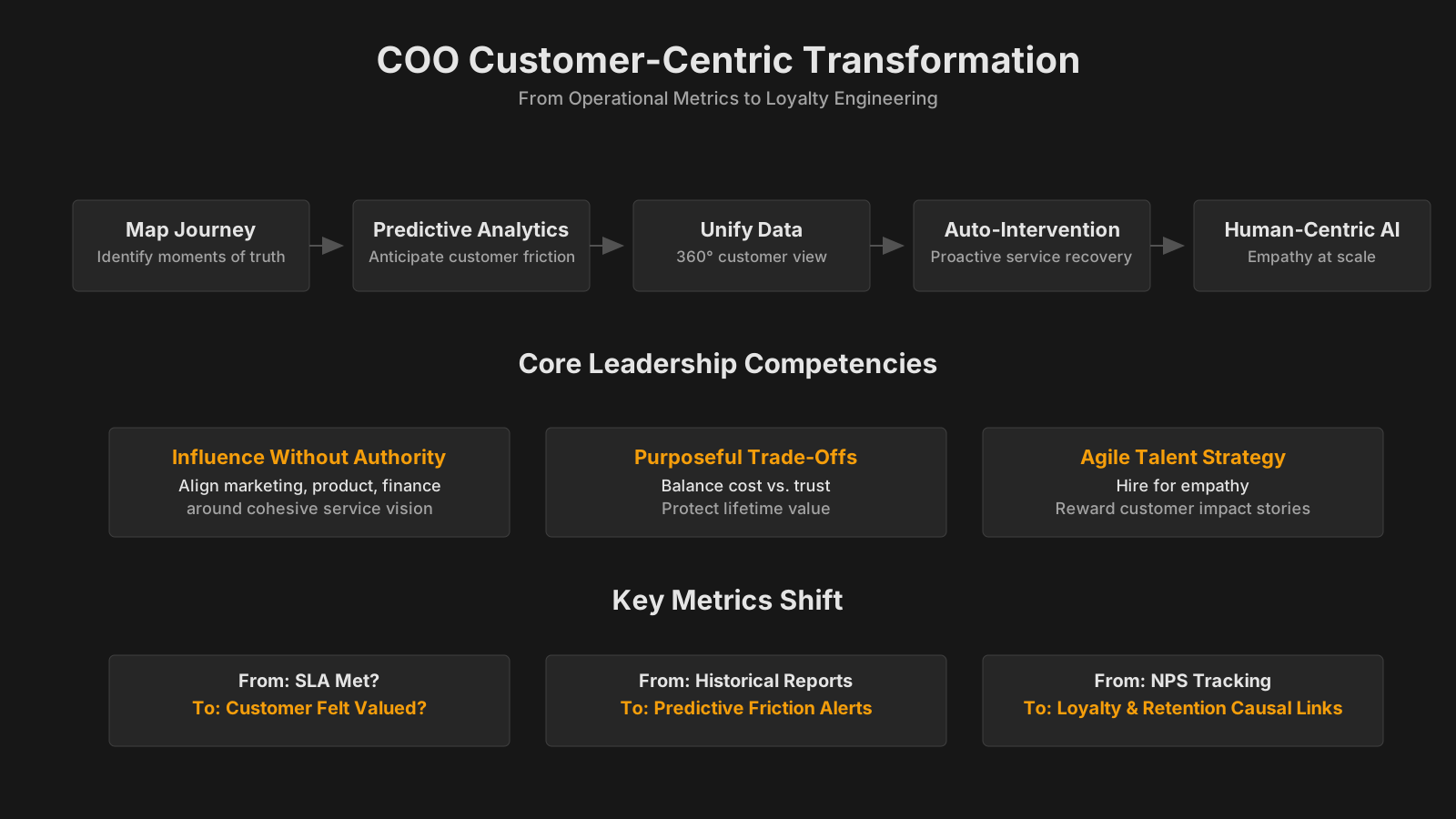
COO Leadership Program: Key Topics at a Glance
| Key Concept | Summary |
|---|---|
| COO Evolution | The modern COO has transformed from a back-office cost overseer into a customer-centric value architect, using operations as a strategic platform for competitive differentiation. |
| Experience Economy | Customer perception now defines the primary competitive battleground, and consistently outstanding service orchestration becomes a complex, difficult-to-imitate organizational capability that creates a genuine barrier to entry. |
| Digital Operations | The COO governs a technology ecosystem that directly shapes customer interactions, requiring a deliberate shift from internal efficiency metrics to customer outcome measures such as effort score and lifetime value. |
| Bridge Building | Effective COOs translate customer insights into operational design decisions by mastering journey mapping, service blueprinting, and human-centered design principles, ensuring that operational choices directly reflect genuine customer needs. |
| Operational Discipline | Customer experience matures into a rigorous operational discipline when COOs apply systematic thinking to design and deliver every interaction, treating pain points as operational defects that demand root-cause resolution. |
| Journey Mapping | COOs map end-to-end customer journeys with the precision of value stream mapping, scrutinizing each touchpoint for system support, workforce capability, policy alignment, and potential failure modes. |
| Service Frameworks | Frameworks such as the Service Profit Chain and Kano Model enable COOs to link employee satisfaction to customer loyalty and systematically prioritize investments that generate sustainable customer delight. |
| Service Delivery | Service delivery excellence is a core COO mandate, requiring mastery of ITIL 4, Lean, and Agile methodologies to build resilient, adaptive service ecosystems capable of absorbing disruption. |
| Cultural Shift | Moving from siloed functions to a journey-oriented operating model demands a fundamental change in working methods, which the COO must personally model and champion across the organization. |
| Proactive Engineering | The COO steers the organization away from reactive complaint handling toward proactive experience engineering, embedding customer focus into every operational process to design interactions that preempt issues before they arise. |
The Strategic Evolution of the Chief Operating Officer in Modern Enterprise
The chief operating officer role has undergone a profound transformation in the past decade, shifting from a primarily inward facing function focused on efficiency and standardization to a dynamic, customer centric leadership position. Historically, the COO was tasked with keeping the lights on, managing supply chains, overseeing production, and ensuring that internal operations ran smoothly and within budget. While these responsibilities remain critical, they now coexist with an urgent mandate to use operations as a platform for competitive differentiation. Today’s most effective COOs understand that every internal process, from procurement to last mile logistics, ultimately touches the customer either directly or indirectly. A COO leadership program focused on customer experience and service delivery helps participants internalize this evolutionary leap and develop the capabilities required to lead it.
This evolution is driven by the convergence of several powerful trends. First, the rise of the experience economy has elevated customer perception to the primary battleground for market share. Products and pricing can often be replicated, but the orchestration of a consistently outstanding customer journey is a complex, organization wide capability that is much harder to imitate. Second, the digitization of operations means that the COO now presides over a vast technology stack that directly enables or inhibits customer interactions. Third, the blurring of lines between products and services requires operations leaders to think in terms of ongoing value delivery rather than one time transactions. A comprehensive leadership program guides COOs through this landscape, helping them reframe their operational metrics around customer outcomes such as effort score, resolution time, and lifetime value rather than just internal efficiency ratios.
The modern COO must be a bridge builder between the front office and back office, translating customer insights into operational design choices. This requires a deep understanding of human centered design principles, journey mapping, and service blueprinting , skills that were once the exclusive domain of marketing or user experience teams. A dedicated program cultivates these capabilities through case study analysis, simulation exercises, and peer learning, enabling COOs to speak the language of customer experience fluently. It also addresses the cultural shift required, because moving from a siloed functional structure to a cross functional, journey oriented operating model demands a new way of working that the COO must model and champion.
Core Insights on the COO's Strategic Evolution
- From efficiency to customer centricity
- The COO role has evolved from pursuing internal cost reduction and standardization to deploying operations as a strategic lever for competitive advantage, directly shaping the end-to-end customer experience.
- Drivers of operational transformation
- The experience economy, digitized workflows, and the merging of products with services compel today’s COO to redefine performance metrics around customer outcomes such as effort score and lifetime value.
- Bridging front and back offices
- Mastering human-centered design and journey mapping enables the COO to convert customer insights into concrete operational decisions, fostering a cultural shift toward cross-functional, journey-oriented execution.
Customer Experience as an Operational Discipline
Many organizations still treat customer experience as a soft initiative driven by surveys, sentiment analysis, and frontline friendliness training. While these elements matter, they barely scratch the surface of what is possible when customer experience is embedded into the operational fabric of the company. A COO leadership program that emphasizes customer experience repositions it as an operational discipline governed by rigor, measurement, and continuous improvement. This means applying the same systematic thinking that operations leaders bring to manufacturing quality or supply chain reliability to the design and delivery of customer interactions.
Operationalizing customer experience begins with understanding the end to end customer journey not as a marketing concept but as a series of interconnected processes, handoffs, and moments of truth. The COO learns to map these journeys with the same precision used in value stream mapping for lean manufacturing. Every touchpoint is examined for its operational DNA: the systems that support it, the employee skills required, the policies that constrain it, and the failure modes that can degrade it. This approach reveals that many pain points labeled as customer service problems are actually operational defects such as inventory inaccuracies, billing system errors, or cumbersome returns processes. By stepping into this analytical role, the COO shifts the organization from reactive complaint resolution to proactive experience engineering.
Program content in this area often includes deep dives into frameworks such as the Service Profit Chain, which links employee satisfaction and operational capability to customer loyalty and financial performance, and the Kano Model, which helps prioritize experience investments based on their potential to delight. Participants also study how leading organizations, from Amazon with its relentless focus on reducing customer effort through operational innovations like one click purchasing and anticipatory shipping, to Zappos with its legendary returns process enabled by warehouse systems designed for flexibility, have turned operations into the backbone of brand promise. The COO leadership program explores these examples not as isolated stories but as replicable patterns of thinking that can be adapted across industries.
Service Delivery Excellence as a Pillar of Competitive Advantage
Service delivery excellence is the tangible manifestation of a customer centric strategy, and it is the COO’s domain. It encompasses the design, deployment, and management of all the resources, processes, and capabilities needed to fulfill customer promises consistently and efficiently. In a world where customers increasingly value outcomes over ownership, service delivery becomes the product. A COO leadership program dedicated to this pillar equips leaders with the ability to build resilient, scalable, and adaptive service delivery ecosystems that can withstand disruption while maintaining quality.
Achieving service delivery excellence requires mastery of several operational frameworks. The ITIL 4 service value system, which has evolved beyond its IT roots to become a general management framework for service organizations, provides one such lens. It emphasizes co-creation of value with customers and continuous improvement through feedback loops. Lean management principles, when applied to service environments, help eliminate waste in the form of unnecessary handoffs, delays, and rework, liberating capacity that can be redirected toward more meaningful customer interactions. Agile methodologies, originally from software development, are increasingly adapted to operations through frameworks such as Kanban and cross functional squads that manage specific customer journeys end to end. The COO leadership program provides guidance on how to blend these approaches into a coherent operating system rather than treating them as competing dogmas.
Beyond methodologies, the program focuses on designing for reliability. Service delivery failures often occur at the seams between teams, departments, or third party partners. The COO learns to apply techniques from high reliability organizations, such as failure mode and effects analysis and structured escalation protocols, to anticipate and mitigate breakdowns before they impact customers. This includes building digital operations centers that provide real time visibility into service performance across the entire value chain, enabling swift intervention when anomalies occur. Participants also explore how to embed resilience through capacity management, business continuity planning, and cross training of teams so that service delivery excellence is not just a fair weather condition but a persistent state.
The COO Leadership Program Approach to Journey Centric Operations
Traditional organizational structures are organized around functions, which naturally creates silos and fragmentation in the customer experience. A core transformation module within the COO leadership program centers on shifting to a journey centric operating model. This does not mean dismantling functional expertise, but rather creating a horizontal overlay that aligns teams around key customer journeys such as onboarding, issue resolution, or renewal. The COO plays the crucial role of designing this overlay, defining the governance, resource allocation, and performance measurement systems that make it work.
In a journey centric model, cross functional pods or squads take ownership of specific journeys from end to end, with the authority to make decisions that span traditional boundaries. The COO leadership program teaches how to identify the highest priority journeys based on customer impact and strategic importance, then how to charter these teams with clear objectives, key results, and decision rights. It addresses the inevitable tensions between functional leaders and journey owners, providing negotiation and alignment techniques that prevent turf wars from derailing progress. Case studies often highlight how global banks have reorganized their mortgage processing around customer journeys, reducing cycle times by half, or how telecommunications providers have created specialized teams for the complex journey of resolving billing disputes, significantly improving satisfaction scores.
Technology is a key enabler of journey centric operations, and the program devotes attention to the architectural requirements. Microservices based platforms, application programming interface gateways, and customer data hubs allow different systems to share information seamlessly, giving the cross functional team a single view of the customer’s current state and history. The COO learns to collaborate with the chief information officer on building this digital backbone, ensuring that technology investments directly support improved journey performance rather than simply automating isolated tasks. This strategic partnership between operations and technology is a recurring theme throughout the program, reflecting the reality that in modern enterprises, operational excellence and digital excellence are inseparable.
Embedding a Culture of Continuous Improvement and Customer Advocacy
No operating model, however sophisticated, can sustain service delivery excellence without a corresponding culture. The COO leadership program places significant emphasis on the cultural transformation required to make customer experience a lived value rather than a poster on the wall. This involves moving from a culture of compliance, where employees follow scripts and procedures out of obligation, to a culture of advocacy, where they are empowered and motivated to create positive customer outcomes. The COO, as the leader of a large portion of the workforce that may never interact directly with external customers, must find ways to make the customer real and present for these teams.
One powerful mechanism involves redesigning performance management systems. Traditional metrics like average handle time or cost per transaction often incentivize behaviors that degrade customer experience. The program guides COOs in developing balanced scorecards that include customer perceived metrics such as first contact resolution, customer effort score, and satisfaction, alongside efficiency metrics. It also explores the use of recognition and reward systems that celebrate acts of customer advocacy, whether by a warehouse worker who catches a potential error or a billing specialist who proactively identifies and fixes a recurring issue. These cultural artifacts signal that taking care of the customer is everyone’s job, not just the contact center’s.
Continuous improvement methodologies, particularly Kaizen and Lean daily management, are repurposed as vehicles for customer centric innovation. The COO leadership program teaches how to establish tiered huddle boards and problem solving cadences where teams regularly review customer feedback, identify process breakdowns, and run small experiments to improve. When a frontline team in distribution notices that late truck arrivals are causing repeated delivery promises to be broken, they are equipped with a problem solving framework to analyze root causes and test countermeasures, rather than simply escalating the issue and hoping someone else fixes it. This democratization of improvement work unleashes a powerful force for elevating service delivery, while also strengthening employee engagement through meaningful participation.
Core Takeaways on Service Delivery Excellence
- Service delivery as the product
- In a world where customers value outcomes over ownership, service delivery excellence becomes the core product itself, requiring COOs to build resilient, scalable, and adaptive ecosystems that consistently deliver on customer promises.
- Mastering blended operational frameworks
- Achieving service delivery excellence requires blending ITIL 4, Lean management, and Agile methodologies into a coherent operating system rather than treating them as competing dogmas, enabling waste elimination and value co-creation with customers.
- Designing for reliability at the seams
- Because service delivery failures typically occur at the seams between teams and partners, COOs must apply high-reliability organization techniques such as failure mode analysis and structured escalation protocols to anticipate breakdowns and maintain quality under any conditions.
Leveraging Technology and Data for Intelligent Service Delivery
The intersection of technology and service delivery is perhaps the most rapidly evolving domain for chief operating officers today. Artificial intelligence, robotic process automation, predictive analytics, and the Internet of Things are not just buzzwords, they are tools that can fundamentally reshape how customer experiences are delivered. A COO leadership program that excels in this area prepares leaders to be informed buyers and strategic deployers of these technologies, always with the customer outcome as the North Star. The risk is that technology is implemented for its own sake, adding complexity without improving the experience, and the program teaches how to avoid this trap.
Intelligent automation can eliminate much of the friction that characterizes traditional service delivery. Repetitive data entry, status checking, and simple transaction processing can be handled by bots, freeing human workers to focus on complex, emotionally nuanced interactions where empathy and judgment are paramount. The COO learns how to identify processes ripe for automation by using criteria such as volume, rule based nature, and impact on throughput time. However, the program also stresses the importance of designing the automated journey with the same care as the human one, ensuring that when a customer needs to escalate from a chatbot to a person, the handoff is seamless and the agent has full context. Nothing frustrates a customer more than repeating information to a human after already providing it to a machine.
Data and analytics form the backbone of intelligent service delivery. The COO leadership program dives into the creation of a customer experience measurement architecture that goes beyond lagging survey indicators to include leading operational signals. For example, a sudden increase in calls related to a specific product batch can trigger an investigation and corrective action weeks before formal complaint data would surface. Machine learning models can predict which customers are at risk of churning based on patterns of service interactions and proactively trigger retention offers. Participants learn how to build a data governance framework that ensures quality, consistency, and ethical use of customer information, a growing concern in an era of heightened privacy regulation and consumer sensitivity.
Mastering Digital Operations and Omnichannel Delivery
Customers today interact with companies through a multiplicity of channels: mobile apps, websites, social media, voice assistants, physical stores or branches, and phone support. They expect to move between these channels fluidly, and they expect the organization to maintain context throughout. Delivering this omnichannel experience is a massive operational challenge that sits squarely within the COO’s remit. The COO leadership program provides a structured approach to omnichannel strategy, starting with the recognition that channels must be orchestrated, not just offered.
The underlying operational requirement is a unified commerce or service platform that centralizes customer profiles, order history, inventory availability, and interaction records. Without this technical foundation, channels remain siloed fortresses. The COO learns to champion the business case for this integration, articulating the cost of channel fragmentation in terms of duplicated efforts, inconsistent information, and lost sales. The program also addresses the operational trade offs inherent in omnichannel fulfillment, such as the decision to use stores as distribution centers for online orders, which requires real time inventory visibility and new picking and packing processes in environments not originally designed for them. Participants examine how retailers like Target and Best Buy navigated these transformations, turning their physical footprints into competitive assets during the e-commerce boom.
Workforce management in an omnichannel environment requires its own set of new skills and tools. The COO must ensure that staffing models account for the varying demand patterns and skill requirements across channels, and that scheduling systems can dynamically deploy agents to chat, voice, or even social media moderation based on real time volume. The leadership program explores how to create flexible, cross trained teams that can pivot across channels while maintaining quality, and how to redesign physical spaces and virtual collaboration platforms to support this integrated mode of working. Ultimately, the goal is to make the operational complexity invisible to the customer, who simply perceives a cohesive, effortless relationship with the brand.
Redefining the Role of the Contact Center as an Experience Hub
For many COOs, the contact center represents the largest concentration of customer facing employees and a significant cost center. The natural instinct has often been to minimize its cost through outsourcing, offshoring, and aggressive efficiency targets. A COO leadership program focused on customer experience and service delivery challenges this view, redefining the contact center as a strategic experience hub that generates insights, builds loyalty, and drives revenue. This shift does not ignore economics, but it frames them within a broader value proposition.
The transition begins with elevating the role of the service agent from transactional resolver to customer success advocate. This requires investment in hiring profiles that emphasize empathy and problem solving over call volume metrics, and training programs that equip agents with the commercial and technical acumen to add value in every interaction. The program presents evidence that organizations with highly engaged service teams see improvements in customer retention and cross sell rates, offsetting higher labor costs. The COO learns how to design career paths that make the contact center a desirable stepping stone to other parts of the organization, rather than a dead end, thereby attracting better talent and reducing turnover, which itself is a major operational cost.
Technologically, the modern contact center is a hub of data and artificial intelligence. Speech and text analytics can mine thousands of interactions to identify emerging issues, competitive intelligence, and customer sentiment trends that are invisible at the aggregate survey level. The COO leadership program teaches how to establish a voice of the customer analytics function that sits within operations and feeds actionable insights to product, marketing, and strategy teams. This transforms the contact center from a cost to be minimized into a strategic asset that informs the entire business. Case studies of companies like American Express, which has long positioned its service as a premium driver of card member loyalty rather than a cost, illustrate the power of this mindset shift.
Developing Leadership Competencies for the Customer Centric COO
Mastering the operational and technical aspects of customer experience and service delivery is necessary but insufficient without the leadership skills to drive organization wide change. A large portion of any COO leadership program must therefore focus on the human and political dimensions of transformation. The COO operates in a complex ecosystem of peers on the executive team, each with their own priorities and perspectives, and must build coalitions that support the customer centric agenda. This requires high emotional intelligence, political savvy, and the ability to communicate a compelling narrative that connects operational improvements to customer outcomes and financial performance.
Influence without authority is a central theme. The COO does not directly control marketing, product development, or front line sales, yet their full cooperation is essential to redesign the end to end experience. The program provides frameworks for stakeholder mapping and engagement, helping participants identify where alignment exists naturally and where there are conflicting incentives that need to be addressed. For example, a sales team compensated purely on new customer acquisitions may resist time consuming onboarding process improvements that reduce churn. The COO learns to surface these conflicts and facilitate tradeoff discussions grounded in data, moving the conversation from opinion to evidence.
Change management competency is woven throughout the program. Drawing on models like Kotter’s eight step process or Prosci’s ADKAR framework, participants learn to structure transformation initiatives in ways that build urgency, mobilize a guiding coalition, and sustain momentum through quick wins and effective communication. The COO leadership program emphasizes that transformation fatigue is a real risk, and that sequencing of changes matters enormously. Leaders are taught to conduct an organizational readiness assessment and to design change plans that respect the capacity of teams already stretched by day to day operations. The best operational strategy will fail if the people expected to execute it are not brought along on the journey.
Building Strategic Partnerships with the C-Suite
The relationship between the COO and other C-suite executives can make or break a customer experience transformation. The COO leadership program dedicates attention to building a productive partnership specifically with the chief marketing officer, the chief information or technology officer, and the chief human resources officer. Each of these relationships has unique dynamics. With the CMO, there is often a natural alignment around customer insights and journey definition, but potential tension over who owns the customer strategy. The program teaches COOs to position operations as the enabler of the brand promise, collaborating on journey design while taking responsibility for delivery excellence.
The partnership with the CIO or CTO is critical because so much of service delivery capability is embedded in technology platforms. The historical relationship between operations and IT can sometimes be strained, with operations viewing IT as slow and expensive, and IT viewing operations as demanding and unclear about requirements. The COO leadership program reframes this as a co-creation partnership, introducing practices like value stream mapping that involve both business and technology stakeholders from the beginning. Participants learn how to co-develop business cases for technology investments that quantify both efficiency gains and customer revenue impacts, creating a shared language of business value.
The CHRO partnership is often overlooked but equally vital. Culture, talent acquisition, performance management, and leadership development sit with HR, and the COO needs these levers to build a customer centric workforce. The program explores how to collaborate on redesigning job descriptions for service roles, developing training curricula that include customer empathy and problem solving, and evolving performance appraisal criteria. When the COO and CHRO jointly champion a shift toward customer oriented behaviors at all levels, the transformation gains institutional durability that outlasts any single initiative.
Measuring What Matters and Driving Accountability
A customer centric operating model requires a new set of metrics and accountability structures. The COO leadership program delves into the design of cascading scorecards that link enterprise level customer metrics, like Net Promoter Score or Customer Effort Score, to operational key performance indicators at the process and team level. The goal is not to hold every department equally accountable for the overall NPS, but to identify the specific operational drivers that each team controls and measure them rigorously. For instance, a warehouse team might be measured on perfect order rate and on time shipment, while a returns processing team is measured on speed of refund and accuracy of inspection. These operational metrics are then statistically linked to customer perception through driver analysis.
Accountability rituals are equally important. The program teaches how to establish operational review cadences where progress on customer experience metrics is reviewed with the same intensity as financial results. This typically includes a daily layer for frontline teams, a weekly layer for department managers, and a monthly strategic review with the executive team. The COO acts as the steward of this rhythm, ensuring that discussions are data rich, focused on root causes, and lead to concrete action plans rather than blame. Visual management tools such as digital dashboards and physical information radiators make performance transparent and keep attention focused on the customer.
Incentive alignment is the third pillar of accountability. The COO leadership program critically examines compensation structures to ensure that they do not inadvertently reward behaviors that harm customer experience. A logistics manager rewarded solely for cost per shipment might choose a cheaper but less reliable carrier. A service manager incentivized on call volume reduction might push customers toward self service channels prematurely, causing frustration. The program guides participants through a process of reviewing incentives across their span of control and, where possible, influencing those in other functions to incorporate customer outcome modifiers. Even modest changes, like adding a small quality component to a predominantly volume based target, can shift behavior meaningfully.
Core Leadership Competencies Summary
- Influence Without Authority
- With no direct authority over marketing, sales, or product functions, the COO builds coalitions by applying emotional intelligence and facilitating data-driven tradeoff discussions.
- Strategic C-Suite Partnerships
- Productive relationships with the CMO, CIO/CTO, and CHRO are essential, so the COO reframes tensions as co-creation partnerships that directly fuel the brand promise and cultivate a customer-centric workforce.
- Change Management and Sequencing
- The COO applies proven frameworks such as Kotter's eight steps and ADKAR to structure transformation initiatives with deliberate urgency and early wins, while conducting readiness assessments to prevent transformation fatigue.
Implementing the COO Leadership Program Insights in Your Organization
Returning from a COO leadership program with new frameworks and enthusiasm is the first step; the real challenge is applying those insights in the unique context of one’s own organization. The program culminates typically with a capstone project or an action plan that participants develop for their own companies, ensuring immediate relevance. Several principles guide successful implementation of the learnings around customer experience and service delivery. The first is to start with a diagnostic that combines hard operational data with qualitative customer journey mapping. Without a clear, fact based picture of the current state, initiatives risk solving the wrong problems or getting mired in internal politics.
A pilot approach is strongly recommended. Rather than attempting to redesign the entire service delivery system at once, COOs should focus on one or two priority customer journeys where the pain is acute and the potential for measurable improvement is high. This allows the organization to learn, build credibility, and demonstrate the value of the journey centric approach before scaling. The COO leadership program provides templates for pilot design, stakeholder communication, and rapid experimentation. It also emphasizes the importance of celebrating and communicating early wins to build momentum and neutralize skepticism. When a cross functional team reduces the time to resolve a major customer issue by forty percent, that story should be told widely, connecting the operational change to human outcomes for customers and employees alike.
Sustaining the transformation over the long term requires embedding the new capabilities into the organization’s DNA. This means updating standard operating procedures, job descriptions, onboarding programs, and technology roadmaps to reflect the customer centric operating model. The COO must resist the temptation to let transformation be a separate program managed by a temporary project team. Instead, the goal is to make it how the company operates. The leadership program often establishes an alumni community or ongoing executive coaching to support COOs through this sustained implementation phase, providing a sounding board and source of accountability as they navigate the inevitable obstacles and setbacks.
Navigating Common Pitfalls in Customer Experience Transformation
Every COO should be aware of the typical failure modes of customer experience initiatives so they can steer around them. The COO leadership program dedicates substantial time to analyzing these pitfalls because forewarned is forearmed. One of the most common is treating customer experience as a side project rather than integrating it into the core operating rhythm. When CX improvement is delegated to a small team without real authority to change processes or budgets, it remains a cosmetic exercise limited to communication tone and complaint handling. The COO’s role is to ensure that CX is central to operational strategy, resource allocation, and daily management.
Another pitfall is an overreliance on surveys and aggregate scores without operational data. An improving Net Promoter Score can mask rising operational costs, while a declining score can trigger blind panic without revealing the specific process failures causing it. The program teaches a balanced measurement system that pairs perception metrics with operational leading indicators. It also warns against setting arbitrary score targets without understanding the drivers and the investment required to move them. A COO who promises the board a twenty point NPS increase without a supporting improvement plan is setting themselves up for failure and potentially toxic gaming of the metric.
Change fatigue and middle management resistance are pervasive challenges. The program equips COOs with practical tactics for engaging middle managers, whose role is often the most dramatically altered by a journey centric transformation. Their responsibilities may shift from supervising function specific tasks to facilitating cross functional collaboration, a change that can feel like a loss of control and expertise. Providing clear role clarity, coaching support, and a compelling vision of how their careers will benefit is essential. The program also advocates for honest, ongoing dialogue that surfaces concerns early and addresses them respectfully, rather than rolling over resistors with top down force, which breeds passive aggressive compliance at best.
The Future of the COO Role and the Continuous Learning Imperative
The forces that have elevated customer experience and service delivery to the top of the COO agenda will only intensify. Artificial intelligence will further automate routine transactions, shifting the human role toward complex, emotionally rich interactions and continuous improvement of automated systems. The boundaries between physical and digital operations will continue to blur, requiring COOs to manage hybrid experiences like augmented reality assisted service or drone delivery fleets. Environmental sustainability and social responsibility will become increasingly integral to customer experience, adding new dimensions to operational decision making around sourcing, packaging, and logistics. A COO leadership program is not a one time inoculation against irrelevance; it is an initiation into a mindset of perpetual learning and adaptation.
Ongoing development for COOs may include advanced courses in data science for executives, participation in industry specific consortia that benchmark operational practices, and reverse mentoring from digitally native members of the workforce. The best COOs also cultivate a personal board of directors, a trusted network of peers from other industries who can provide candid feedback and fresh perspectives. The leadership program often serves as the foundation of this network, connecting participants with a global community of operations executives grappling with similar challenges. Maintaining connection with this community through alumni events, digital forums, and periodic refresher sessions ensures that the COO’s thinking does not become stale or insular.
Ultimately, the COO who excels in customer experience and service delivery is one who sees their role not as a title but as a mission: to ensure that the company’s promises are kept, its values are felt in every interaction, and its operations are a source of pride rather than a source of apology. That mission requires technical mastery, strategic vision, and deep interpersonal leadership. The journey of a thousand process improvements begins with a single insight, and a comprehensive COO leadership program provides precisely the catalyst needed to spark that transformative journey. It is an investment not only in the individual executive but in the very ability of the organization to thrive in an era where how you deliver matters as much as what you deliver.
Core Insights on the Evolving COO Role
- Continuous learning as a mindset
- Sustaining leadership relevance demands a deliberate commitment to upskilling, combining advanced data science fluency, rigorous benchmarking of industry best practices, and reverse mentoring from digitally native colleagues to integrate emerging technologies into core operations.
- Building a personal support network
- Exceptional COOs intentionally cultivate an external advisory circle spanning diverse sectors, regularly tapping alumni forums and selective digital communities to challenge entrenched assumptions and break free of insular strategic thinking.
- Mission-driven operational leadership
- The COO’s ultimate charge is to convert organizational promises into tangible experiences, weaving core values into every process so that operational delivery becomes a trusted hallmark, driven by technical precision, strategic clarity, and authentic people leadership.
Advance Your Career with Professional Certification
In today's competitive business landscape, a professional project management certification validates your expertise in leading complex initiatives and consistently delivering results, making you a more attractive candidate for leadership roles. Earning a PM certification online provides a flexible pathway to mastering industry-standard methodologies like Agile or Scrum, while demonstrating your commitment to continuous improvement. Organizations with certified project managers benefit from higher efficiency, reduced risk, and stronger customer-centric outcomes, directly aligning with strategic goals such as those in a COO leadership program focused on service delivery excellence.
In today's fast-paced business landscape, a product management certification empowers professionals to bridge the gap between customer needs and strategic execution. Becoming a certified product manager validates your ability to lead cross-functional teams, drive product lifecycle decisions, and deliver measurable value. This formal recognition not only accelerates career advancement but also equips organizations with leaders who can consistently translate vision into outcomes, ensuring higher customer satisfaction and competitive advantage.
Earning a professional HR management certification validates your expertise in core areas like compliance, talent strategy, and employee relations, giving you an edge in a competitive job market. It signals to employers that you are committed to continuous learning and capable of navigating complex workforce challenges, which often leads to faster career advancement and higher earning potential. Beyond personal growth, certified HR leaders bring structured frameworks to their organizations, improving retention, culture, and overall business performance through strategic people management. This credential also connects you to a global community of peers and updated best practices, ensuring your skills remain relevant in a rapidly evolving profession.