In a city defined by visionary mega-projects and relentless ambition, project management professionals hold the keys to career transformation. The decision to pursue PMP Certification Training in Dubai represents far more than adding a credential to a resume. It is a strategic investment in a structured methodology, a global language of execution, and a personal commitment to leadership excellence that resonates across every industry in the United Arab Emirates. Dubai’s skyline tells a story of accelerated delivery, and behind every completed tower, infrastructure rollout, and digital transformation lies a team of project managers who understand how to turn uncertainty into measurable outcomes. The Project Management Professional (PMP) certification, offered by the Project Management Institute (PMI), validates that understanding and positions you at the center of the region’s most exciting initiatives.
Understanding the true weight of this certification begins with recognizing Dubai’s unique position as a global business hub where traditional project delivery models intersect with agile innovation , hybrid frameworks, and multicultural team dynamics. Employers in the UAE increasingly filter senior project roles through the lens of PMP certification, not as a rigid checkbox but as evidence of a shared vocabulary for risk , scope, schedule, and stakeholder engagement . When you enroll in a dedicated PMP Certification Training in Dubai, you are essentially learning to speak the language that connects government entities, multinational corporations, and ambitious startups across the Gulf Cooperation Council. This article explores every dimension of that training journey, from the foundational knowledge areas to the nuanced career advantages that emerge when you combine world-class instruction with the unparalleled project environment of Dubai.
We will examine the economic drivers behind the surging demand for certified project managers, the anatomy of a quality training program, the selection criteria for choosing a provider, and the long-term professional habits that distinguish PMP holders from their peers. Throughout this exploration, we remain grounded in evidence-based management practices and the real-world challenges that professionals face when balancing exam preparation with demanding work schedules. The aim is not to sell a myth of overnight success but to provide a transparent, detailed roadmap for those ready to elevate their career with intention and discipline. Let us begin by understanding why Dubai has become such a fertile ground for project management excellence and why the PMP certification holds extraordinary weight in this market.
At a Glance: PMP Certification Training in Dubai
| Key Concept | Summary |
|---|---|
| Strategic Value | PMP certification in Dubai represents a deliberate investment in a universally recognized methodology and execution framework, validating leadership capability across industries and project types. |
| Market Dynamics | Dubai’s relentless pipeline of mega projects and ambitious economic agendas fuel soaring demand for certified project managers who can orchestrate large-scale initiatives and align multifaceted stakeholder groups. |
| Hiring Gatekeeper | UAE employers use PMP certification as a primary filter for senior project roles, treating it as concrete evidence of a consistent approach to risk, scope, schedule, and stakeholder coordination. |
| Cross-Cultural Cohesion | Dubai’s exceptionally diverse workforce requires project managers who can harmonize teams across dozens of nationalities, and the PMP framework supplies a common methodology that reduces friction and accelerates alignment. |
| National Agenda Drivers | The Dubai 2040 Urban Master Plan and UAE Centennial 2071 vision will demand thousands more certified professionals, giving PMP holders strong leverage in compensation negotiations and role selection. |
| Credential Breadth | The PMP is a methodology-agnostic validation of project leadership that tests judgment through realistic scenarios and confirms mastery of predictive, agile, and hybrid delivery approaches. |
| Training Excellence | Leading Dubai training providers blend PMBOK knowledge areas with hands-on interpersonal coaching, equipping professionals to lead multidisciplinary teams in high-stakes environments. |
| Career Acceleration | PMP certification acts as a powerful career catalyst in Dubai’s results-driven market, where government giants and multinational corporations frequently require the credential for senior appointments. |
| Risk Containment | Employers see hiring PMP-certified talent as a direct risk mitigation measure, shielding organizations from project overruns and failures that can exceed hundreds of millions of dirhams. |
| Enduring Professional Discipline | Sustained habits that distinguish PMP holders include rigorous upfront planning, adaptive execution, and relentless stakeholder alignment throughout complex delivery cycles. |
The Growing Demand for Project Management Professionals in Dubai
Dubai’s economic narrative is inseparable from its ability to conceive, fund, and execute projects at a velocity that few other cities can match. From the expansion of Al Maktoum International Airport to the continuous evolution of smart city infrastructure, the emirate operates as a living laboratory for project delivery. This environment creates an insatiable appetite for professionals who can orchestrate complex workstreams , manage diverse stakeholder groups, and maintain quality standards under pressure. The demand is not limited to construction and real estate, although those sectors remain dominant. It extends deeply into financial services, healthcare transformation, logistics, renewable energy, and the burgeoning technology startup ecosystem that has made Dubai its regional home.
Why Dubai Is a Hub for Project Management Excellence
The city’s leadership has intentionally cultivated a regulatory and cultural ecosystem that rewards structured project execution. Free zones such as Dubai International Financial Centre and Dubai Multi Commodities Centre attract global corporations that bring mature project management offices and expect their leaders to hold globally recognized credentials. These organizations do not merely tolerate professional certification; they often mandate it for senior roles. The concentration of such enterprises transforms the local job market into a meritocracy where a PMP designation significantly accelerates career trajectory. In parallel, government entities like the Roads and Transport Authority and Dubai Municipality have embedded PMI standards into their procurement and delivery frameworks, ensuring that certified professionals are not only preferred but often required to lead public sector initiatives.
Another factor is the multicultural composition of Dubai’s workforce. Project managers here routinely coordinate teams spanning fifteen nationalities, multiple time zones, and vastly different communication styles. The PMP framework provides a unified methodology that transcends cultural differences in planning, monitoring, and controlling work. Training providers in Dubai have responded to this reality by designing courses that address not just the theoretical knowledge areas but also the applied interpersonal skills needed to lead diverse teams. When you attend a PMP Certification Training in Dubai, you learn alongside professionals from construction, IT, oil and gas, and healthcare, which enriches the classroom dialogue with cross-industry perspectives that a single-sector program could never replicate.
The Economic Vision and Mega Projects Driving Demand
Looking ahead, Dubai’s 2040 Urban Master Plan and the broader UAE Centennial 2071 vision outline an era of sustained capital investment that will require thousands of additional project management professionals. The expansion of the Dubai Metro, the development of the Dubai Urban Tech District, and the continued growth of the hospitality sector ahead of global events all contribute to a project pipeline that outstrips the current supply of certified talent. This imbalance creates a powerful negotiating position for PMP holders, who can command premium compensation and select from a wider array of challenging assignments. Employers are acutely aware that the cost of project failure in this high-stakes environment can run into hundreds of millions of dirhams, making the comparatively modest investment in a certified professional a clear risk mitigation strategy.
Core Insights on Dubai's PMP Demand
- PMP as a career accelerator
- Multinational corporations within Dubai's free zones frequently require PMP certification for senior project leadership roles, establishing it as a decisive advantage in a fiercely meritocratic market.
- Multicultural workforce coordination
- Project managers in Dubai typically lead teams drawn from more than fifteen nationalities, and the PMP framework supplies a shared methodology that harmonizes distinct communication norms and cultural approaches.
- Demand beyond construction
- Though real estate continues to dominate, robust demand for project management expertise now spans financial services, healthcare, logistics, renewable energy, and the technology startup ecosystem.
- Government adoption of PMI standards
- Government entities such as the Roads and Transport Authority and Dubai Municipality have integrated PMI standards into their procurement frameworks, routinely mandating certified professionals to direct large-scale public sector projects.
- Mega projects driving talent shortage
- The Dubai 2040 Urban Master Plan, combined with sustained capital deployment, has created a pipeline of initiatives that significantly outpaces the supply of certified project managers, granting PMP holders substantial bargaining power.
Understanding the PMP Certification and Its Global Value
Before committing to a training program, it is essential to grasp what the PMP certification actually represents in terms of knowledge, ethics, and professional accountability. Unlike vendor-specific certifications that focus on a single tool or platform, the PMP is a methodology-agnostic validation of your ability to lead projects in any domain. PMI has structured the certification around a comprehensive exam content outline that goes beyond memorization of process groups and knowledge areas. The exam now tests your judgment in realistic scenarios, your understanding of agile and hybrid approaches, and your capacity to navigate the business environment in which projects operate. This shift reflects the reality that modern project management is less about following a static plan and more about adapting to continuous change while protecting business value.
What Is the Project Management Professional Certification?
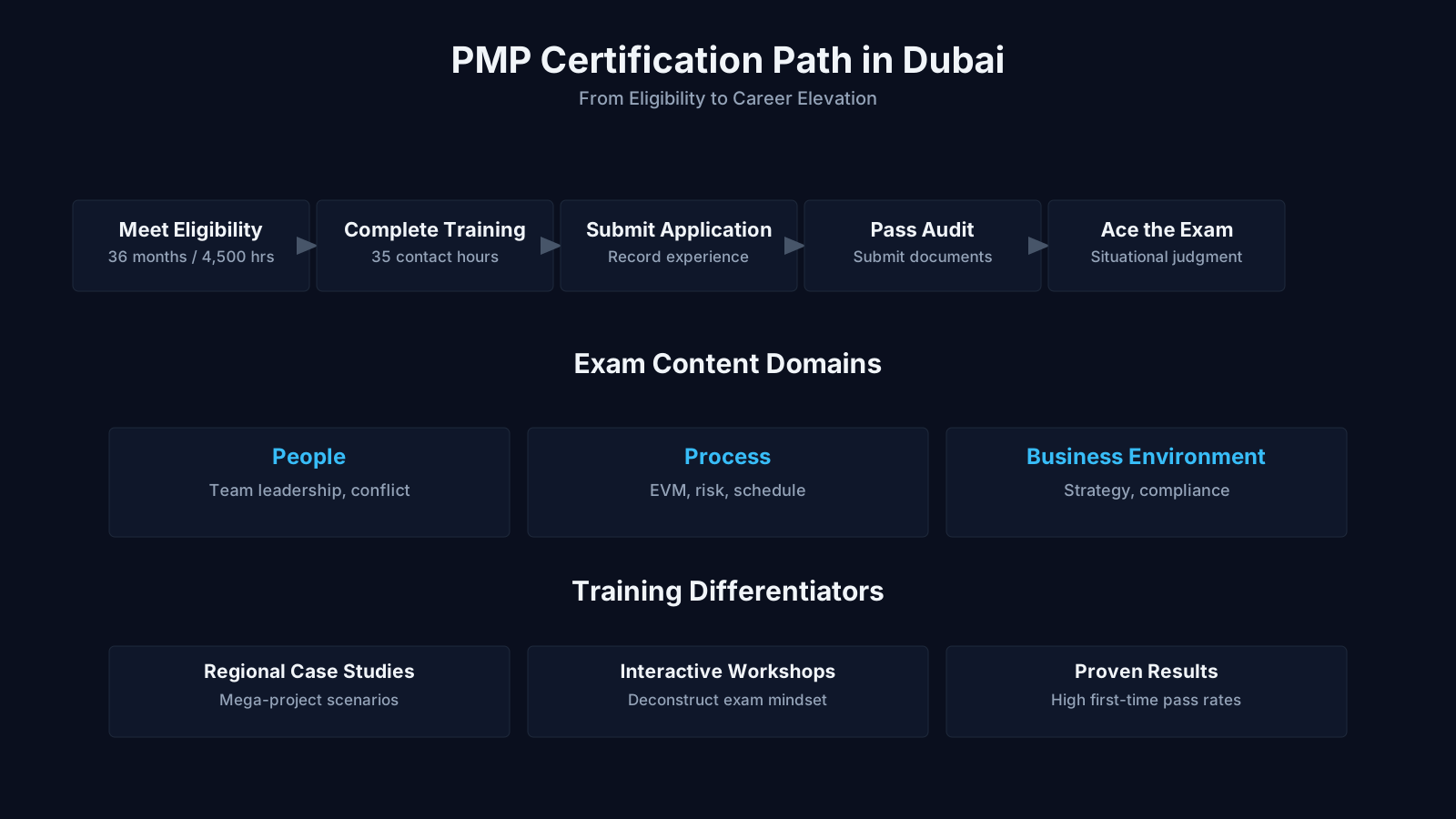
The PMP certification is earned by passing a rigorous 180-question examination administered by PMI after demonstrating qualifying education and project leadership experience. It is not an entry-level credential. Candidates must show that they have spent at least thirty-six months leading projects if they hold a four-year degree, or sixty months with a secondary diploma. This experience requirement ensures that PMP holders have been tested by real-world complexity before they sit for the exam. The certification is built upon the PMBOK Guide, a globally accepted standard that codifies the processes, tools, and techniques of project management. However, the exam itself is not a direct recall test of the guide. It evaluates how you apply the principles of the guide and other referenced materials in situational contexts that often involve conflicting priorities, limited information, and ethical dilemmas.
The PMP Exam Structure and Domains
The current exam content is organized into three performance domains. The People domain accounts for roughly forty-two percent of the exam and covers team leadership, conflict resolution, virtual team management, and servant leadership principles. This emphasis acknowledges that technical competence without interpersonal skill is a major source of project failure. The Process domain constitutes fifty percent of the exam and addresses the technical aspects of delivering projects, including planning, scheduling, budgeting, risk management, procurement, and quality control. The Business Environment domain covers the remaining eight percent and focuses on strategic alignment, organizational change management, and compliance. This tripartite structure ensures that a certified professional can connect team dynamics with delivery mechanics and organizational goals. Any reputable PMP Certification Training in Dubai will structure its curriculum to mirror these domains, dedicating proportionate time to each and reinforcing the connections between them.
Eligibility Requirements for PMP Certification
Understanding the eligibility criteria is a necessary first step because it determines how you will document your experience and what gaps formal training must fill. In addition to the months of project leadership experience, candidates must complete thirty-five contact hours of formal project management education before they can apply. This is precisely where a dedicated training course provides dual value by delivering the required education hours and preparing you for the exam content simultaneously. The PMI application process itself demands meticulous documentation of your project experience, describing the activities you led across initiating, planning, executing, monitoring and controlling, and closing process groups. Training providers in Dubai often include application assistance as part of their package, helping you articulate your experience in a way that meets PMI’s stringent audit standards without exaggeration or omission.
How PMP Certification Training in Dubai Accelerates Career Growth
The correlation between PMP certification and career advancement is well documented in PMI’s own salary surveys, which consistently show a premium for certified professionals across all regions. In the Middle East, that premium is particularly pronounced because of the project-intensive nature of the regional economy. However, the mechanism of acceleration goes beyond a simple salary bump. Training fundamentally reshapes how you think about your daily work, giving you frameworks to diagnose problems faster, communicate more precisely with executives, and coach your team members through ambiguity. This cognitive shift is what separates a credential holder who merely passed a test from a project leader who has integrated the methodology into their professional identity. A quality PMP Certification Training in Dubai creates the conditions for this deeper integration through immersive case studies, group discussions, and post-training mentorship.
Bridging Knowledge Gaps with Structured Training
Many experienced project managers have developed effective but idiosyncratic methods through years of trial and error. While this experiential learning is invaluable, it often contains blind spots in areas like quantitative risk analysis, earned value management, or formal procurement closing procedures. Structured training serves as a systematic audit of your existing knowledge, revealing these gaps in a supportive environment before they become liabilities on the exam or, worse, on a critical project. The best programs employ diagnostic assessments early in the course to map each participant’s strengths against the exam content outline, allowing instructors to tailor the emphasis rather than delivering a one-size-fits-all lecture. This personalized approach is especially valuable in Dubai, where participants arrive with extremely varied educational backgrounds and industry experience.
Learning from Experienced Instructors in Dubai’s Training Market
The calibre of an instructor can make or break the training experience. Dubai attracts project management educators who have led major programs across the Middle East, Europe, and Asia, and who bring war stories that illuminate dry academic concepts. A skilled trainer does not simply read slides; they contextualize the Plan Risk Responses process with an example from a delayed hotel opening on Palm Jumeirah, or they explain the Monitor Communications process by referencing a failed ERP implementation they witnessed firsthand. This blend of formal methodology and lived experience accelerates comprehension and retention. Furthermore, instructors who are active PMI members and registered education providers stay current with the subtle shifts in exam emphasis and can alert participants to emerging trends, such as the increasing importance of servant leadership scenarios in the exam’s People domain.
Networking Opportunities within Dubai’s Professional Community
A classroom, whether physical or virtual, functions as a temporary community of practice where participants share challenges, resources, and referrals that persist long after the course concludes. In Dubai’s transient but tightly connected professional scene, these relationships often translate into job leads, partnership opportunities, and a support system for maintaining the PMP credential over the long term. Many training organizations facilitate alumni groups that meet monthly for knowledge-sharing sessions, and some partner with the PMI Arabian Gulf Chapter to host study groups and professional development events. Investing in a local PMP Certification Training in Dubai means you are not preparing in isolation; you are plugging into a network that reinforces your learning and amplifies your professional visibility.
Key Career Growth Insights from PMP Training
- Cognitive Shift Beyond Certification
- The training reshapes daily work by embedding a strategic lens that turns ambiguous challenges into structured diagnoses, enables clear executive communication, and equips you to coach teams through complexity, thereby integrating methodical thinking into your professional identity.
- Structured Knowledge Gap Audit
- A methodical curriculum uncovers hidden weaknesses in areas like quantitative risk analysis and earned value management, using diagnostic assessments to personalize the learning journey and strengthen precisely the competencies you need most.
- Experienced Instructor Impact
- Instructors in Dubai translate extensive regional program leadership into vivid classroom examples, grounding processes such as Plan Risk Responses in authentic local project stories that sharply accelerate both comprehension and long-term retention.
- Professional Network Integration
- The classroom evolves into a temporary community of practice, sparking job referrals, partnership leads, and lasting professional support through alumni circles and PMI Arabian Gulf Chapter gatherings.
- Regional Salary Premium Advantage
- The Middle East’s project-intensive economy creates a distinct salary uplift for PMP certified professionals, so pursuing local training becomes a strategic move that directly accelerates your career trajectory in the region.
Key Components of a High-Quality PMP Certification Training Course
Not all training programs are created equal, and the proliferation of options in the Dubai market can be overwhelming. To make an informed choice, you need to evaluate programs against a set of evidence-based criteria rather than relying on price or brand recognition alone. The following components distinguish a course that genuinely prepares you for both the exam and your career from one that merely checks the box for the thirty-five contact hour requirement. As you research PMP Certification Training in Dubai, use these elements as a scorecard to compare providers and ask pointed questions during enrollment conversations.
Aligning with the PMBOK Guide and Latest Exam Content Outline
The most fundamental requirement is that the curriculum is mapped to the current edition of the PMBOK Guide and the latest exam content outline. PMI updates these documents periodically, and a course designed for a previous version will leave you unprepared for the domains and weightings described earlier. A high-quality provider explicitly states which edition of the standards their materials reference and demonstrates how each module aligns with specific tasks in the exam content outline. They should also provide official PMI study resources, such as the Agile Practice Guide and the Process Groups Practice Guide, as part of the course package. Avoid any program that claims to teach to the test without thorough grounding in these foundational texts, because PMI’s scenario-based questions require deep comprehension rather than surface-level pattern recognition.
Practice Exams and Simulated Testing Environments
Confidence on exam day comes from repeated exposure to the format, pacing, and cognitive demands of a four-hour, 180-question assessment. An essential component of any serious PMP Certification Training in Dubai is a library of full-length practice exams that replicate the look, feel, and difficulty of the actual test. These simulations should provide detailed answer rationales that explain not only why the correct choice is right but also why the distractors are wrong. This level of feedback transforms error correction into learning. The best programs also include at least one proctored simulation under timed conditions to help you build the mental endurance required for the exam. Pay attention to whether the practice questions include the latest exam types, such as drag-and-drop and hotspot questions, which demand a different kind of recall and application.
Agile and Hybrid Methodologies Integration
Project management in Dubai is increasingly hybrid, with many organizations blending predictive planning for regulatory milestones with iterative development for customer-facing features. The PMP exam reflects this reality by dedicating roughly half of its scenario questions to agile or hybrid contexts. Training programs must therefore go beyond a single module on agile and instead weave agile principles throughout the entire curriculum. When discussing scope management, for instance, a quality course contrasts the work breakdown structure with a product backlog. When covering risk, it compares contingency reserves with the concept of spikes in agile frameworks. This integrated approach prevents the common trap of mentally switching between two separate bodies of knowledge and instead builds a unified decision-making framework that matches how projects actually operate.
Soft Skills and Leadership Development for Project Managers
The People domain of the exam makes it impossible to pass without a sophisticated grasp of motivation theories, conflict resolution strategies, and emotional intelligence principles. A forward-thinking training provider dedicates significant classroom time to these topics, using role-plays, video case studies, and facilitated discussions rather than relying solely on textbook definitions. Participants learn to differentiate between a team that needs a directive style and one ready for a delegating approach, to recognize the early warning signs of groupthink, and to apply the appropriate level of stakeholder engagement based on a power-interest grid. These skills are not abstract exam material; they directly improve your daily effectiveness in Dubai’s culturally diverse project environments where unaddressed interpersonal friction often derails otherwise sound plans.
Choosing the Right PMP Training Provider in Dubai
The decision of where to pursue your PMP Certification Training in Dubai carries implications for your exam readiness, your professional network, and your ongoing relationship with the project management community. Dubai hosts a competitive market of training providers ranging from global giants to specialized local institutes, and each brings a distinct mix of strengths and trade-offs. Approaching this selection process systematically prevents the regret of investing time and money in a program that does not align with your learning style or career ambitions. The following dimensions provide a robust framework for evaluation.
Accreditation and Partnerships with PMI
The most reliable baseline indicator of program quality is the provider’s status as a PMI Authorized Training Partner (ATP). This designation means that the organization’s instructors, materials, and quality management processes have been audited and approved by PMI. ATP programs use official PMI-developed course content, and participants receive access to the PMI Student Bundle that includes digital versions of key publications and a trial version of the PMI Choice learning platform. While non-ATP providers can still offer excellent instruction, their alignment with the exam is not independently verified, placing the burden of quality assurance squarely on you. When evaluating PMP Certification Training in Dubai, ask directly about current ATP status and verify it on the PMI website before committing.
Training Formats: In-Person, Live Online, and Blended Options
Dubai’s professionals face significant time pressures, and the logistics of commuting to a training venue in Business Bay or Dubai Media City can add several hours to an already long workday. Consequently, most reputable providers now offer multiple delivery formats. The traditional in-person classroom format delivers high engagement and spontaneous interaction but demands strict schedule adherence. Live virtual classrooms preserve the interactive element with breakout rooms and real-time polling while eliminating travel time entirely. Blended programs combine self-paced e-learning modules for foundational knowledge with periodic live sessions for application, doubt-clearing, and exam strategy. Your choice should reflect not just personal preference but also an honest assessment of your discipline for self-paced study and your need for peer accountability. The best providers in Dubai allow you to switch between formats if your circumstances change mid-course.
Evaluating Trainer Expertise and Student Support
A provider’s reputation hinges ultimately on the individual trainers who deliver the sessions. Before enrolling, request the profiles of the specific instructors who will lead your cohort, not just the organization’s general list of associates. Look for trainers who hold both the PMP certification and complementary credentials such as PMI-ACP for agile or a master’s degree in a relevant field. Their industry experience should ideally include sectors relevant to the Dubai economy, such as construction, IT, financial services, or energy. Beyond the trainer, evaluate the student support infrastructure. Does the program assign a dedicated mentor or success coach who tracks your progress and intervenes if your practice scores plateau? Is there a structured process for asking questions between sessions, such as a monitored discussion forum or scheduled office hours? These support mechanisms often make the decisive difference between passing and failing.
Cost Considerations and Return on Investment in the Dubai Market
The cost of PMP Certification Training in Dubai can range from approximately AED 2,500 for a bare-bones online course to over AED 10,000 for a premium ATP program with extensive post-training support. Rather than viewing the fee in isolation, calculate the total investment including exam registration, study materials, practice tests, and the opportunity cost of your study time. Then weigh that against the documented salary differential. PMI’s Earning Power Salary Survey has consistently shown that PMP-certified professionals in the Middle East earn a substantially higher median salary than their non-certified peers, often recovering the total cost of training and certification within the first year of post-certification employment. Additionally, many Dubai employers fully or partially sponsor professional development, so inquire with your human resources department before self-funding. A transparent provider will help you build a business case for sponsorship by quantifying the expected impact on project performance.
Core Insights on Provider Selection
- PMI Authorized Training Partner Status
- The provider's active PMI ATP status serves as the strongest indicator of quality, confirming that instructors, course materials, and exam alignment have been independently audited.
- Match Training Format to Your Discipline
- Choose in-person, live online, or blended delivery after candidly assessing your schedule, commute time, and ability to sustain self-paced study without the discipline that cohort-based accountability provides.
- Evaluate Total Investment Against Salary Impact
- Weigh the full cost of training, exam fees, and study materials against the documented salary premium for PMP-certified professionals in the Middle East, where the investment is typically recovered within the first year.
The Application Process and Exam Preparation Strategies
Securing approval from PMI to sit for the examination is a significant project in itself, one that rewards the same planning and documentation rigour that the certification espouses. Many candidates underestimate the time required to draft experience summaries that withstand an audit, and they end up delaying their exam dates or, worse, receiving an application rejection. A strategic approach to application and preparation integrates these administrative tasks with the learning schedule from the very beginning. The best PMP Certification Training in Dubai programs recognize this overlap and provide dedicated sessions on application mechanics as part of their orientation module.
Documenting Your Project Management Experience for PMI
The application requires you to describe, in concise but specific language, the tasks you performed across the five process groups for each project you are claiming. This is not a place for vague generalities like “managed project team.” PMI expects descriptions such as “facilitated sprint planning meetings with a cross-functional team of twelve, including remote developers in India, to prioritize the product backlog based on business value and risk.” Your training provider can guide you in framing your experience using PMI terminology without fabricating or embellishing. The key is to demonstrate leadership and direction, not just participation. Even if your job title did not include the word project manager, you can still claim the experience if you were responsible for delivering project outcomes. This is a particularly important message for functional managers, product owners, and technical leads in Dubai who have been leading projects without the formal title.
Creating a Study Plan alongside Professional Commitments
Realistically, preparing for the PMP exam while holding a full-time project role in a city as dynamic as Dubai demands a disciplined plan. Most successful candidates allocate between eight and fourteen weeks of consistent study, averaging ten to fifteen hours per week. The plan must be more than a declaration of intent; it should specify which modules you will complete each week, when you will take full-length practice exams, and how you will incorporate review cycles for the topics you find most challenging. A training provider that offers a structured study calendar, milestone assessments, and a recommended reading schedule provides a scaffold that reduces the cognitive load of planning and keeps you accountable. Share your plan with your employer and your family, because the temporary reduction in social availability and the mental bandwidth consumed by study require their understanding and support.
Leveraging PMP Training Resources for Exam Readiness
Your training course is the backbone, but supplementary resources round out the preparation. PMI’s own Study Hall platform offers practice questions authored by the same team that develops the actual exam, providing the closest approximation to the reasoning style you will encounter. Many PMP Certification Training in Dubai programs include a Study Hall subscription as part of their package, and you should use it consistently from the midpoint of your preparation onward. Flashcards, mobile quiz apps, and audio summaries can fill the interstitial time during Dubai’s notorious commute traffic. The goal is not to accumulate hours but to achieve a state where you can explain not just the right answer to a practice question but the logic that invalidates every other option. When you reach this level of fluency, you are genuinely ready.
Career Opportunities After Earning PMP Certification in Dubai
The moment your provisional pass result appears on the screen, a new phase of professional possibility begins. Employers in the UAE interpret PMP certification as evidence of not just technical competence but also the perseverance and strategic thinking required to complete a demanding self-improvement project. This perception opens doors to roles that were previously filtered out of your reach by automated applicant tracking systems. The career impact, however, is only fully realized when you actively translate your new knowledge into tangible contributions that your organization can recognize and reward. The certification is a catalyst, not a destination.
Salary Enhancements and Promotion Potential
While individual salary outcomes depend on industry, experience, and negotiation skill, the aggregate data is compelling. PMI’s surveys consistently rank the UAE among the top countries for PMP salary premiums, with certified project managers in Dubai often reporting annual earnings that exceed non-certified peers by a substantial margin. This is particularly true in oil and gas, construction, and information technology, where the certification is often explicitly listed in job descriptions for senior project manager, program manager, and PMO lead positions. Beyond immediate salary, PMP certification frequently serves as a prerequisite for internal promotion to management grades where base pay, housing allowances, and annual bonuses are benchmarked against global rather than regional standards. The credential also strengthens your position during annual performance reviews by providing an objective external validation of your capability that is difficult for an employer to discount.
Industries Actively Seeking PMP-Certified Managers in the UAE
Construction and infrastructure remain the largest employers of PMP holders, driven by Dubai’s continual expansion and the need for highly regulated project controls. The rise of PropTech and sustainable building standards has further increased the demand for managers who understand both traditional construction methodology and agile digital implementation. Financial services, particularly the banking and insurance sectors concentrated in the DIFC, seek PMP-certified managers to lead regulatory compliance initiatives, core system replacements, and fintech product launches. Healthcare is another rapidly growing domain as private hospital groups and public health authorities pursue digital transformation, facility expansion, and accreditation programs that require strict project governance. The technology startup ecosystem, centered in Dubai Internet City and Dubai Silicon Oasis, actively recruits PMP holders who bring process maturity to fast-scaling organizations that risk chaos without structured delivery frameworks.
Expanding into International Project Management Roles
A Dubai-based PMP certification carries global portability. The credential is recognized in over one hundred countries, and the experience of managing projects in Dubai’s multicultural, high-pressure environment is itself a compelling differentiator when applying for roles in London, Singapore, Sydney, or Riyadh. Many multinational corporations rotate high-potential project managers through their Dubai regional offices precisely because the complexity of the market accelerates professional development. Once certified, you become eligible for these global mobility programs. The PMP credential also facilitates transitions into consulting, where firms value the combination of regional experience and globally recognized methodology for their engagements with government and enterprise clients across the Middle East and Africa.
Key Career Outcomes from PMP Certification
- Gateway to Senior Roles
- Earning the certification demonstrates a commitment to strategic leadership and disciplined execution, helping you stand out in applicant tracking systems and unlocking roles that demand proven project leadership.
- Significant Salary Premium
- PMP credential holders in Dubai command a notable salary uplift over their non-certified counterparts, with the premium most pronounced in oil and gas, construction, and IT where complex project oversight is paramount.
- Prerequisite for Internal Promotion
- It serves as irrefutable evidence of your project management competence, directly supporting advancement into management tiers that offer elevated base salaries, housing allowances, and international bonus schemes.
- High Demand Across Key Industries
- Sectors such as construction, financial services, healthcare, and Dubai’s fast-growing tech startup scene actively recruit PMP-certified professionals to steer complex, compliance-driven initiatives.
- Global Career Portability
- With recognition across more than a hundred countries, the PMP combined with the cross-cultural project exposure gained in Dubai positions you as a highly attractive hire for global roles and premium consulting engagements.
Maintaining Your PMP Credential and Continuing Professional Development
Earning the PMP is a significant achievement, but the credential’s ongoing value depends on conscious maintenance. PMI requires holders to earn sixty professional development units (PDUs) every three years and to renew their certification through a relatively modest fee structure. This requirement is not a bureaucratic burden; it is an opportunity to stay current with evolving practices and to deepen specific competencies that align with your career aspirations. A proactive approach to PDU accumulation turns certification maintenance into a structured career development plan rather than a last-minute scramble.
Earning Professional Development Units (PDUs)
PDUs are categorized into Education and Giving Back. The Education category requires a minimum of thirty-five PDUs through activities like attending courses, webinars, conferences, or self-directed reading that aligns with the PMI Talent Triangle, which encompasses technical, leadership, and strategic and business management skills. Many training providers in Dubai offer short courses, masterclasses, and simulation workshops specifically designed to generate PDUs while advancing practical skills. Giving Back PDUs can be earned by volunteering for PMI chapters, mentoring aspiring project managers, creating content, or presenting at professional events. The Dubai project management community offers abundant volunteering opportunities, from serving on chapter committees to judging academic competitions. These activities simultaneously fulfill the PDU requirement and expand your professional visibility and network.
Engaging with PMI Chapters and Communities in Dubai
The PMI Arabian Gulf Chapter is one of the largest and most active PMI chapters in the world, hosting regular events, knowledge-sharing forums, and certification preparation support groups. Becoming an active member of this chapter transforms the PMP from a solitary credential into a gateway to a vibrant professional community. Chapter events often feature senior executives from Dubai’s most prominent organizations discussing real-time project challenges, providing a continuous stream of practical learning that far exceeds what is available through formal continuing education alone. Many members report that their deepest post-certification career opportunities emerged from relationships that began at chapter events. The chapter also advocates for the project management profession with UAE government entities, influencing policy and creating a more favourable market for certified professionals over the long term.
Common Myths and Misconceptions About PMP Certification Training
Despite the credential’s widespread recognition, several persistent myths deter qualified professionals from pursuing PMP Certification Training in Dubai or lead them to approach it with misguided expectations that undermine their preparation. Addressing these misconceptions directly helps you make an informed decision based on facts rather than hearsay. Each of the following beliefs circulates frequently in Dubai’s professional circles, and each deserves a candid examination.
Is PMP Only for Construction and IT Projects?
This myth likely originates from the historical concentration of PMP holders in those two industries, but it no longer reflects reality. The exam content outline and the PMBOK Guide are intentionally domain-agnostic. A marketing campaign launch, an organizational restructuring, a clinical trial, or a film production all fit the definition of a project as a temporary endeavour undertaken to create a unique product, service, or result. Training courses in Dubai increasingly use case studies drawn from events management, healthcare, education, and even government policy implementation to demonstrate the versatility of the methodology. If you lead initiatives with a defined beginning and end, a budget, and a set of deliverables, the PMP framework applies, regardless of your industry label.
Can You Pass the Exam Without Formal Training?
PMI’s eligibility requirement for thirty-five contact hours of formal education means that some form of instruction is mandatory. While it is technically possible to satisfy this through a series of disjointed webinars or a low-cost recorded course, the pass rate data suggests that self-directed learning without interactive instruction and structured practice exams yields significantly lower success rates. The exam’s situational questions test judgment that is best developed through discussion, debate, and expert feedback, not solitary reading. A comprehensive PMP Certification Training in Dubai provides the structured environment where you can make reasoning errors during practice, receive immediate correction, and internalize the decision logic that PMI expects. Beyond exam tactics, the training imparts a professional vocabulary and a conceptual framework that become permanent cognitive tools, a benefit that passive video consumption cannot replicate.
Is the PMP Certification Losing Relevance in Agile Environments?
The opposite is true. PMI has invested heavily in integrating agile and hybrid frameworks into the PMP examination and the broader ecosystem of certifications, including the PMI-ACP for agile practitioners and the Disciplined Agile toolkit. The current PMP exam does not ask you to choose between predictive and agile approaches as mutually exclusive philosophies. It presents scenarios and asks you to select the best course of action based on the project’s context, governance requirements, and team maturity. This contextual decision-making is precisely what employers in Dubai need, because they rarely operate in a pure environment. A PMP-certified professional can confidently lead a project that uses a traditional work breakdown structure for regulatory approvals while employing Scrum for the user interface development stream, and they can explain this hybrid model to stakeholders in a coherent business case. Far from being irrelevant, the PMP now provides a framework for navigating the very complexity that agile adoption introduces at an enterprise scale.
Core Takeaways on PMP Myths
- Industry scope is not limited
- The PMP framework is universally applicable to any initiative with a defined start, finish, budget, and tangible deliverable, spanning fields like marketing campaigns, clinical trials, and film production, far beyond the traditional domains of construction and IT.
- Formal training boosts success
- While PMI mandates 35 contact hours, blending interactive instruction with structured practice exams builds the critical thinking essential for tackling situational questions, yielding markedly higher pass rates compared to self-directed study.
- Relevance in agile environments
- The modern PMP exam has embedded agile and hybrid methodologies, assessing contextual decision-making that equips professionals to navigate complex projects by harmonizing traditional and agile practices with confidence.
The Future of Project Management and Lifelong Learning in Dubai
Project management as a profession is not static. Artificial intelligence, advanced analytics, and the increasing prevalence of distributed teams are reshaping how projects are planned, monitored, and controlled. Dubai’s commitment to becoming a global leader in artificial intelligence and its investment in digital infrastructure ensure that local project managers will be among the first to experience these shifts. A PMP certification obtained through a forward-looking training program equips you with the foundational principles that remain constant while building the adaptability required to incorporate new tools and techniques. The relationship between technology and project management is not one of displacement but of augmentation; the project manager who understands machine learning applications for risk prediction, for instance, becomes more valuable, not less.
The most successful professionals in Dubai treat the PMP not as a one-time achievement but as the initiation into a career-long discipline of learning. They pursue additional certifications in program management, portfolio management, agile, or business analysis based on where their career interests lead. They attend PMI chapter conferences not just for PDUs but to stay connected with the thought leaders who are defining the profession’s next chapter. They mentor junior colleagues, which deepens their own mastery. Dubai’s role as a regional centre for PMI events, including the annual PMI Global Conference satellite sessions, provides an unusually rich calendar of development opportunities that few other cities can match. By completing your PMP Certification Training in Dubai, you position yourself at the centre of this continuous learning ecosystem rather than on its periphery.
Stepping into a PMP training classroom represents a declaration of professional intent. It signals to your current and future employers that you are unwilling to let your career trajectory be determined solely by tenure or circumstance. In a market as competitive and opportunity-rich as Dubai, that signal carries weight. The training itself will test your discipline, broaden your perspective, and connect you with a community of like-minded professionals who share your commitment to excellence. The exam will challenge your judgment under pressure, much as a troubled stakeholder or a sudden regulatory change tests you in the course of a project. And the certification, once achieved, will serve as a globally portable asset that opens doors, commands respect, and provides the methodological grounding to lead with confidence through uncertainty. For the project management professional in Dubai, this journey is not merely an option. It is the clearest path to mastering the craft and elevating a career on the global stage.
Advance Your Career with Professional Certification
Earning a globally recognized project management certification demonstrates mastery of standardized methodologies that immediately enhance your ability to deliver projects on time and within budget, making you a more competitive candidate for senior roles. Beyond individual advancement, certified professionals bring a common language and structured approach that reduces miscommunication and risk across teams, directly boosting organizational efficiency. For those ready to signal their expertise to employers worldwide, a project management certification serves as a tangible, third-party endorsement of critical leadership and process skills that organizations desperately need to navigate today’s complex initiatives.
In today’s competitive business landscape, a product management certification validates your expertise and opens doors to advanced leadership roles, signaling to employers that you possess a structured approach to driving product success. This formal credential not only sharpens your strategic thinking and cross-functional collaboration but also equips you with frameworks that directly improve customer satisfaction and revenue growth, making you an invaluable asset to any organization.
Professional HR management certification is a strategic investment that validates your expertise and keeps you current with evolving workplace laws, talent strategies, and employee engagement practices. Beyond enhancing your resume, dedicated HR training and certification programs equip you with the analytical and leadership skills needed to drive organizational change and build resilient company cultures. Earning this credential not only accelerates your career trajectory but also signals to employers your commitment to ethical decision-making and measurable business impact.