Across boardrooms and innovation hubs, a quiet revolution has been unfolding. For decades, large enterprises relied on rigorous planning, stage-gate approval processes , and the assumption that market research plus a big budget equals successful new products. The results, more often than not, have been disappointing. Corporate innovation labs launch me-too products, budget cycles kill early stage ideas, and internal politics strangle promising experiments. Against this backdrop, the Lean Startup Methodology in the Enterprise: Build-Measure-Learn for Corporate Innovation offers a radically different operating system. It does not ask executives to abandon governance, but to inject speed, evidence, and customer feedback into the very core of how new value gets created. The awkward truth is that most corporate innovation efforts still operate at startup speed's opposite extreme, and the build-measure-learn loop, when transplanted with care, can bridge that gap without blowing up the quarterly earnings report.
Enterprise Lean Startup: Summary Overview
| Key Concept | Summary |
|---|---|
| Lean Startup Methodology | The Lean Startup methodology accelerates corporate innovation by embedding rapid experimentation, validated learning, and customer-centric feedback loops within existing governance, without demanding executives relinquish strategic oversight. |
| Corporate Innovation Failure | Organizations engineered for operational excellence default to linear planning models that assume stable markets, causing most corporate innovation initiatives to underdeliver because they cannot accommodate the nonlinear nature of discovery. |
| Build-Measure-Learn Loop | The build-measure-learn cycle compels teams to interrupt the rush to build, rigorously assess empirical results, and internalize that initial hypotheses are almost always invalid, making iteration the only reliable path to progress. |
| Enterprise Minimum Viable Product | An enterprise MVP reframes the goal from immediate revenue to de-risking the most critical unknown, using prototypes, concierge services, or narrowly scoped feature slices as vehicles for testing the riskiest assumption with minimal resources. |
| Validated Learning | Validated learning replaces hypothetical customer surveys with direct observation of actual behavior in real or simulated settings, converting ambiguous feedback into reliable, actionable evidence for go/no-go decisions. |
| Market Research Pitfalls | Conventional market research frequently generates false positives because customers’ stated preferences in surveys diverge dramatically from their real-world purchasing behavior, making observed action the only trustworthy signal. |
| Organizational Immune Response | Legal, IT, branding, and procurement functions operate as a corporate immune system, rationally mobilizing to neutralize experimentation; innovation teams must deliberately identify and navigate around these antibodies to preserve learning momentum. |
| Innovation Decision Framework | Innovation teams combine fast, scrappy experiments with selective, rigorous validation to produce directional evidence that is both palatable within corporate decision cultures and delivered at the velocity modern markets demand. |
Why Corporate Innovation Fails Without a Build-Measure-Learn Loop
Large organizations are structurally optimized for execution, not exploration. The planning and budgeting cycles, the enterprise resource planning systems, the legal and compliance checks are all designed to reduce variance and maximize predictability. That works beautifully when extending an existing product line by five percent. It becomes a liability when venturing into uncharted territory where both the problem and the solution are uncertain. The typical sequence in a large firm moves from idea to business case to detailed requirements to a lengthy build phase, with customer feedback arriving months or years later, often too late. This linear model assumes that markets are static and that the initial hypothesis is mostly correct, an assumption that rarely holds.
The missing piece is often a deliberate mechanism for rapid, validated learning cycles in corporate innovation. Without it, teams labor in isolation, producing features nobody asked for, and the sunk cost of that effort makes it politically impossible to kill a failing project . The build-measure-learn loop forces a discipline that feels unnatural inside a profit-center culture: stop building long enough to measure, and accept that most initial ideas are wrong. In enterprise settings, this means reevaluating the fundamental rhythm of work, from annual planning rituals to monthly steering committee reviews.
Core Insights on Innovation Failure
- Optimized for execution, not exploration
- Corporate planning cycles and compliance processes are engineered to minimize variance and maximize predictability, qualities that serve incremental improvements but become counterproductive when tackling ambiguous problems and uncharted solutions.
- Linear models assume static markets
- The traditional linear sequence from idea to business case to protracted build phase defers genuine customer feedback by months or years, relying on the dangerous assumption that the initial hypothesis stays largely correct in a marketplace that constantly shifts.
- Missing loop creates sunk cost traps
- Without fast validated learning cycles, teams build unwanted features in isolation while the political weight of sunk costs makes it almost impossible to kill failing projects, which is why the build-measure-learn loop feels so unnatural yet proves indispensable in profit-center cultures.
The Build-Measure-Learn Loop Explained for Enterprise Contexts
The loop sounds deceptively simple. Build a minimum viable version of the product, measure how customers respond with actionable metrics, and then learn whether to persevere or pivot. In a startup, this can happen in a matter of days. In a large company, every verb in that sentence collides with existing processes. Building something quickly often means bypassing IT architecture review boards, procurement procedures, and brand approval checkpoints. Measuring with statistical rigor requires access to customer data that may sit in siloed systems guarded by territorial business units. Learning is frequently reduced to presenting a polished PowerPoint deck that confirms the original hypothesis rather than questioning it.
The enterprise version of the loop demands additional scaffolding. The build phase must be scoped not as a functional release but as a hypothesis test, with explicit constraints on data usage, user exposure, and technical debt. Measurement in this environment benefits from synthetic metrics: small-scale engagement signals, willingness to pay in a limited pilot, or time spent on a particular feature, all gathered without triggering a full privacy impact assessment. Learning becomes an explicit artifact, a documented update to the original assumptions, rather than a gut feeling shared over coffee. This adaptation is not a compromise; it is the necessary translation of a method born in chaos to one that must coexist with SOX controls and ISO certifications.
Adapting the Minimum Viable Product Concept to Complex Organizations
In the classic startup narrative, a minimum viable product is a bare-bones version that still lets you charge early customers and get feedback. In the enterprise, charging money often requires legal terms, tax implications, and a supported billing infrastructure, none of which are minimum or viable. So the concept morphs. An enterprise Minimum Viable Product becomes less about revenue and more about learning the most critical unknown. It might be a clickable prototype shown to five key accounts under non-disclosure agreement, a concierge service where a human mimics a future algorithm, or a micro-feature embedded in an existing platform without a marketing launch.
What makes this viable enough is the clarity of the hypothesis and the equally clear definition of what failure looks like. If the goal is to see whether procurement managers will share supplier data voluntarily, the MVP could be a wizard inside the existing ERP module that captures intent, without any backend integration. The build effort is tiny, and the measured signal is binary. This approach disarms the common objection that "we cannot launch something incomplete; it will damage the brand." When the scope is circumscribed, the audience is controlled, and the purpose is transparently experimental, brand risk is minimal. The real risk is spending eighteen months building the perfect solution that nobody ends up using.
Key Insights on Enterprise MVPs
- Enterprise MVP redefines viability
- Unlike startup MVPs that target immediate revenue, enterprise MVPs deliberately bypass billing, legal, and tax infrastructure to validate the single most critical assumption as rapidly as possible.
- Three practical MVP formats
- These MVPs commonly take the form of a clickable prototype shared under NDA with key accounts, a concierge service where a human mimics the future algorithm, or a micro-feature embedded in an existing platform to capture genuine demand.
- Hypothesis clarity defines success
- An enterprise MVP is viable only when the hypothesis is stated sharply and the failure criteria are explicitly defined before any development begins, making every build choice a measurable learning step.
- Minimal build with binary signals
- A lightweight MVP, such as a wizard inside an existing ERP module that records user intent without backend integration, delivers a clear binary go/no-go signal for a tiny build investment.
- The true danger is overbuilding
- The greatest risk in enterprise product development is not a controlled, small-scale experiment but pouring eighteen months into a flawless solution that attracts no users, proving that overbuilding kills more initiatives than early validation ever could.
Validated Learning vs. Traditional Market Research in Corporate Settings
Large companies invest heavily in market research, focus groups, conjoint analysis, and consultant-led studies. These methods have their place, but they often produce false positives. People say they would buy a product when asked in a survey, then behave differently in the wild. Validated learning, the heart of Lean Startup methodology, replaces asking with observing actual behavior under real, or at least realistic, conditions. In an enterprise context, this means moving from "would you use this feature?" to "here is a working, limited version; let's measure if you click it, ignore it, or ask for something else."
The tension arises because market research is comfortable, well-understood, and defensible in a board meeting. Running a quick experiment with messy data feels irresponsible to leaders who have built careers on polished analyses. To bridge this gap, innovation teams often pair the two: a fast, scrappy build-measure-learn experiment to generate directional evidence, followed by a more rigorous study only if the signal is strong. This layered approach respects the culture while still injecting the evidence-based decision making in corporate innovation that static surveys cannot provide. The real shift is accepting that a wrong answer quickly is more valuable than a precise answer that arrives after the window of opportunity has closed.
Overcoming the Immune System of the Enterprise with Lean Startup Techniques
Every organization has antibodies. When a new, unorthodox team begins bypassing established processes, the corporate immune system activates. Legal flags the lack of a privacy review, IT blocks unapproved cloud tools, the branding team wants to review the rough wireframes, and a senior vice president demands to see a full business case before any prototyping begins. All these reactions are rational from the perspective of the individual function; collectively, they smother experimentation. The build-measure-learn approach does not magically eliminate these forces, but it does provide a frame to negotiate them.
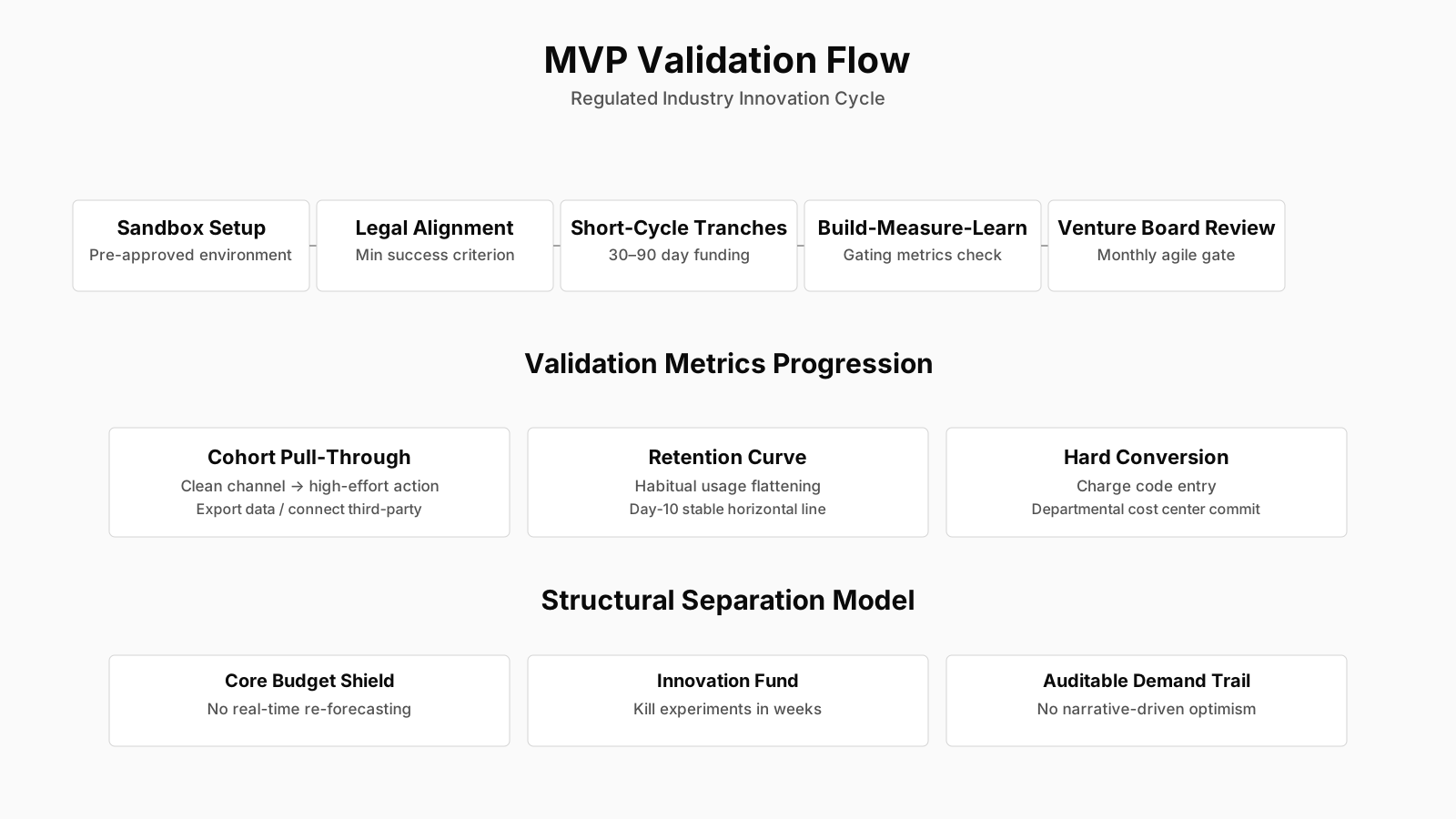
The tactic often begins with pre-negotiated sandboxes. A governance body grants a specific innovation pod limited permissions: the ability to deploy to a controlled environment, access to a sample of anonymized customer data, and a spending cap that does not require a full procurement cycle. This pre-approval transforms the conversation from "can we do this?" to "we are operating within the agreed guardrails." Over time, the immune system learns to tolerate small, contained experiments that end rapidly and report results, turning the
organizational antibodies to innovation
from outright rejection into a cautious monitoring mode. Cultural shift happens not through a manifesto, but through repeated, boring, successful demonstrations that the sky does not fall.
Core Insights on Innovation Sandboxes
Implementing Lean Startup Methodology in the Enterprise: Build-Measure-Learn for Corporate Innovation
The actual implementation rarely follows the neat accelerant-splash of a TED talk. It begins with a handful of frustrated middle managers who secure a tiny budget and permission to try something different, often hidden from the broader organization until a signal emerges. The early wins are small: a feature that was killed quickly before consuming millions, a customer segment discovered through a series of cheap prototypes, or a pricing model validated in two weeks. These wins are then used to justify expanding the method to larger, more visible projects.
What distinguishes successful adoption from a passing fad is the integration with existing project portfolio management. The build-measure-learn cycle must have defined checkpoints that interface with the standard stage-gate process, not replace it entirely. For instance, a team might run three rapid iterations during what the organization calls the "ideation phase." At the end of that phase, they present not a business plan built on assumptions, but a set of validated insights and remaining unknowns, along with the cost of learning. This hybrid model respects the enterprise's need for predictability while allowing for genuine discovery.
Why Lean Startup Methodology in the Enterprise: Build-Measure-Learn for Corporate Innovation Faces Resistance
Resistance seldom announces itself as hostility toward innovation. It appears in the form of reasonable concerns about compliance, brand consistency, resource allocation, and alignment with strategy. In many firms, the budgeting process is annual and rigid, whereas experimentation is iterative and unpredictable. A team cannot request a precise budget for a pivot they have not yet discovered. The resulting mismatch leads to frustration on both sides: the innovators feel stifled, and the finance department sees a project that cannot define its own milestones. This is why a dedicated innovation funding mechanism, separate from operational budgets, often becomes a prerequisite for any sustained build-measure-learn practice.
Another form of resistance comes from middle management whose performance metrics conflict with experimentation. If a business unit leader is measured on short-term revenue growth, allocating engineering time to an uncertain experiment threatens those numbers. The organizational design must offer air cover: either the experiments sit in a separate P&L, or the relevant leaders have a small portion of their bonus tied to the rate of validated learning, not just quarterly delivery. Without that structural adjustment, the enterprise lean startup adoption barriers remain insurmountable, no matter how inspiring the workshops are.
Structuring Teams for Lean Startup Methodology in the Enterprise: Build-Measure-Learn for Corporate Innovation
The typical enterprise structure, with functional silos and handoffs, is the opposite of what the methodology demands. A build-measure-learn team needs a small, cross-functional group that includes product, engineering, design, and often a data analyst, with decision-making authority embedded in the team. Large companies usually split these skills across departments, forcing coordination overhead that kills speed. The structural fix is not a full reorganization, but the creation of temporary pods granted end-to-end responsibility for a specific experiment, with a clear boundary and a limited lifespan.
These pods draw members from their home departments, which requires the functional heads to loan out talent, an uncomfortable but essential step. The most effective setups also include a dedicated innovation coach or an experienced lean practitioner who ensures the team actually runs experiments rather than slipping back into building polished versions. Over time, a cross-functional innovation squad develops its own rhythm and internal trust, producing not just results but also a cadre of internal champions who spread the practice laterally to other parts of the company.
Measuring Success of Lean Startup Methodology in the Enterprise: Build-Measure-Learn for Corporate Innovation
Traditional accounting measures net present value and return on investment over a multi-year horizon, which makes them useless for a two-week experiment. Innovation accounting, a concept from the lean startup movement, proposes a different set of metrics focused on the rate of learning and the reduction of uncertainty. In an enterprise, this might translate to tracking the number of hypotheses tested per quarter, the percentage of those hypotheses validated or invalidated, the cost per learning cycle, and the speed from idea to first customer signal. These numbers feel odd to a CFO, but they can be mapped to financial value by comparing the cost of running ten small experiments against the cost of one failed product built the traditional way.
An additional layer of measurement involves the team's ability to reach a "failure fast" decision point. A metric like "median days from experiment start to pivot decision" reveals the organization's actual rhythm, as opposed to its aspirational one. When these innovation accounting metrics are reported alongside the usual financial KPIs, leadership begins to treat learning as a strategic capability, not a byproduct. The conversation shifts from "what is the ROI of this experiment?" to "how much is it costing us not to know the answer to this question?" and that reframe changes resource allocation patterns.
The Role of Executive Sponsorship in Lean Innovation
Methodologies do not thrive on their own; they depend on political cover. An executive sponsor who understands that most experiments will fail, and publicly rewards the learning from failure, acts as a human shield against the organizational antibody system. Without such a sponsor, teams eventually self-censor, turning experiments into confirmation exercises to protect their careers. The sponsor's role is not to direct the experiments but to protect the space in which they occur. This means intervening when a compliance group overreaches, refusing demands for premature financial projections, and celebrating pivots as signs of rigor rather than indecisiveness.
The most effective sponsors calibrate their involvement carefully. They ask about vision and constraints, not about feature roadmaps. They push for speed, not perfection. In a review meeting, a sponsor might ask, "What was the most surprising thing you learned this month?" instead of "Are you on track against the original plan?" That question signals that executive buy-in for lean experiments is genuine and that learning, not just delivery, is valued. When that tone is set at the top, middle management's resistance often softens because the perceived risk of supporting an experiment drops dramatically.
Core Insights on Executive Sponsorship
- Political cover enables honest experimentation
- When an executive sponsor publicly rewards lessons drawn from failure, they protect teams from organizational pressures that otherwise drive self-censorship and turn experiments into confirmation rituals.
- Protecting the experimentation space
- Rather than directing experiments, the sponsor safeguards the conditions for discovery by blocking compliance overreach, rejecting premature demands for financial projections, and recognizing pivots as evidence of intellectual honesty.
- Calibrated involvement drives results
- Instead of focusing on feature roadmaps, effective sponsors inquire about strategic vision and operational constraints, and they champion speed over perfection to maintain an agile, learning-driven innovation cadence.
- The right questions signal authenticity
- Shifting from "Are you on track?" to "What was the most surprising thing you learned this month?" signals authentic executive commitment, significantly lowering the perceived risk for middle management and softening their resistance to the initiative.
When to Pivot or Persevere: Decision Making in Large Organizations
The pivot is the emotional core of Lean Startup. The decision to change direction, not because you are certain of a new path, but because the evidence suggests the current one will not work, is excruciating. In a startup, the founders can decide over a cup of coffee. In a large corporation, the original idea might have been championed by a powerful executive who now has personal reputational capital tied to its success. The pivot then becomes a political challenge, not just a data-driven one. The data can be crystal clear and still be ignored if the person in authority cannot absorb the reputational hit.
Defusing this requires pre‑negotiated failure criteria, established before the experiment begins. The team, the sponsor, and the relevant stakeholders jointly agree: "If after three sprints we do not see at least a twenty percent engagement rate from the target segment, we will pivot to a different customer segment or problem space." This shifts the decision from a subjective judgment call to a pre-agreed trigger, depersonalizing it. A pivot decision framework that is baked into the governance model, not tacked on post hoc, transforms the dreaded pivot into a routine project management activity, something the organization can metabolize without drama.
Scaling Lean Experiments Beyond the Pilot Phase
Many corporate innovation teams manage to run a successful pilot: a small build-measure-learn project that generates promising signals. The real heartbreak comes during scaling. The infrastructure that supported a hundred users crumbles under ten thousand, the governance that tolerated a quick experiment now demands full documentation, and the original cross-functional pod cannot scale to serve an entire business unit. The transition from exploration to exploitation requires a very different set of muscles, and companies frequently starve the scaling effort, assuming the hard work is done.
A smoother scaling path typically involves a phased handover. The innovation pod retains ownership for a limited period while embedding a few members from the "business as usual" side, gradually transferring tacit knowledge. At the same time, the architecture is hardened incrementally, focusing first on the most critical user journeys identified during the experiment phase. The build-measure-learn loop does not stop when you scale; it just runs at a different cadence, with larger sample sizes and more robust instrumentation. Organizations that sustain scaling lean innovation across business units treat the scaling phase as a continuation of learning, not a separate handoff, and that continuity preserves the original validation logic that got the project this far in the first place.
Essential Insights on Scaling Lean
- Pilot infrastructure fails at scale
- Support systems, relaxed governance, and small cross-functional pods that enabled quick experiments for a hundred users become inadequate when the scope grows to thousands of customers and an entire business unit.
- Phased handover eases transition
- The innovation pod temporarily retains ownership while embedding a few core business unit members, gradually transferring tacit knowledge to create a smoother path to full-scale operations.
- Harden architecture incrementally first
- Initial scaling efforts should concentrate on fortifying the most critical user journeys validated during the experiment phase, rather than attempting to upgrade the entire system at once.
- Learning loop continues at scale
- The build-measure-learn cycle persists after scaling, operating at a different cadence with larger sample sizes and more robust instrumentation to deliver reliable, actionable insights.
- Scale as learning continuation
- Viewing scaling as a natural extension of the learning process, not a separate handoff, preserves the validation logic that originally propelled the project forward.
The Financial Case for Lean Startup Methodology in the Enterprise
Finance departments often view lean startup methods with suspicion, equating experimentation with a lack of fiscal discipline. The reality is the opposite when you compare the cost of a well-run experiment portfolio against the cost of traditional product failures. A typical enterprise new product development process can consume tens of millions before any real customer feedback arrives. By contrast, an innovation pod working with build-measure-learn might spend a few hundred thousand to learn that the concept is flawed, or to discover an adjacent opportunity that is far more valuable. The math is not complicated, but it requires shifting the unit of financial analysis from individual project IRR to the overall portfolio yield of learning investments.
Some organizations create a dedicated innovation fund capped at a small percentage of R&D budget, with explicit acceptance that a seventy percent failure rate is healthy, as long as the remaining thirty percent generate disproportionate returns. The ROI of lean startup in corporate innovation is then calculated across the portfolio, not per experiment. This approach aligns financial incentives with the methodology. A controller who is only measured on minimizing variance will always fight experimentation. A controller who is measured on the strategic cost of uncertainty may actively support rapid validation cycles because they make future forecasts more reliable.
Common Pitfalls and How to Avoid Them
The first pitfall is cargo-culting the vocabulary without changing the underlying behavior. Teams learn to say "MVP" and "pivot" but continue to specify requirements in excruciating detail, measure only vanity metrics like page views, and interpret any customer criticism as a reason to add more features rather than challenge fundamental assumptions. The surface language changes while the deep logic of big-batch delivery remains intact. Countering this requires experienced practitioners embedded in the team, not just occasional coaching from an external consultant who leaves after the workshop.
Another common trap is the "infinite experiment loop." Teams keep running experiments forever, paralyzed by the need for perfect data, and never actually ship anything to the broader market. An enterprise needs a forcing function, such as a fixed number of cycles before a go/no-go decision, to prevent experimentation from becoming a comfortable alternative to commitment. There is also the risk of isolating the innovation team so thoroughly that their outputs are culturally rejected when reinjected into the main business. The best protection is to involve operations people early, not just at the handover, so that the scaling path feels shared and the learnings are co-owned.
Finally, leadership often underestimates the emotional toll of running honest experiments in a high-stakes environment. People who have spent their careers being rewarded for certainty and polished deliverables can find the repeated confrontation with failure deeply unsettling. Without psychological safety and explicit permission to be wrong, the methodology corrodes into a game of managing up. The truly difficult work is not the tools, but the human and organizational psychology that make build-measure-learn possible in a culture built on predictability.
Key Insights on Common Pitfalls
- Cargo-culting the vocabulary
- Adopting startup terminology while clinging to big-batch, requirement-heavy delivery yields no benefit; sustainable change depends on embedding experienced practitioners in the team rather than relying on occasional external workshops.
- The infinite experiment loop
- Teams can loop endlessly through experiments without ever shipping, so leaders must impose a forcing function, such as a fixed cap on experiment cycles followed by a mandatory go/no-go decision, to prevent the methodology from devolving into commitment avoidance.
- Overlooking psychological safety
- Honest experimentation feels personally threatening to individuals rewarded for certainty, so unless leaders grant explicit permission to fail and build genuine psychological safety, the methodology quickly degrades into performative managing upward.
Future of Corporate Innovation: Embedding Lean Principles Permanently
The long-term destination is not a standalone innovation lab, but the integration of lean startup thinking into the everyday fabric of strategy and product management. Some forward-looking organizations have started including "learning velocity" as a metric in their strategic dashboards, right alongside revenue growth and customer satisfaction. Others have begun training product managers not just in agile delivery, but in hypothesis formulation and experiment design as core competencies. These are early signals of a broader shift in which the build-measure-learn cycle becomes as natural to a product team as the monthly sales review.
The most profound transformation might be in how corporate strategy itself gets formulated. Instead of a top-down, five-year plan driven by extrapolation, strategy could evolve into a portfolio of bets, each informed by continuous feedback loops. The planning function shifts from prediction to adaptation, and the role of senior leadership becomes setting the strategic frame while letting the evidence emerge from the ground. That vision is still rare, but the companies that make the most substantive progress with lean startup methods are those that stop treating them as a special project and start treating them as an inseparable component of how the enterprise learns to survive in a world where no amount of market share history guarantees future relevance.
Advance Your Career with Professional Certification
Organizations adopting lean startup methods inside the enterprise need project leaders who can manage iterative cycles without rigid plans. A project management certification sharpens skills in adaptive scheduling, stakeholder communication, and evidence-based decision gates. This credential helps professionals align rapid experiments with business cases, ensuring that each build-measure-learn loop stays within scope and budget. Without formal training, teams often mistake speed for progress and skip crucial validation steps.
In corporate innovation labs, product managers must define minimum viable products and interpret user data quickly. Pursuing product management training equips them with frameworks for hypothesis-driven development, customer journey mapping, and roadmap flexibility. This kind of training teaches how to balance exploratory testing with the strategic priorities of a large organization, so that validated learnings actually influence portfolio decisions. Many internal incubators now require such credentials before staffing product roles.
Lean startup practices demand a workforce comfortable with uncertainty, making talent development a strategic lever. Earning an HR training and certification gives HR professionals tools to design hiring processes that favor learning agility over experience, build feedback-rich cultures, and reshape performance reviews around iteration rather than fixed KPIs. When HR understands experimentation rhythms, they can coach managers to support failing fast without blame, directly fueling the build-measure-learn cycle. Certified HR teams also implement better internal talent marketplaces for cross-functional innovation squads.