Every product leader, entrepreneur, and corporate innovator dreams of launching the perfect solution that captures the market instantly. That dream almost never materializes, and the graveyard of failed products is filled with fully featured offerings that nobody wanted. The antidote to this expensive guessing game is a disciplined, evidence-based approach known as the Build, Measure, Learn feedback loop. At its core lies the Minimum Viable Product, a concept that has been misrepresented, misapplied, and misunderstood since its popularization. This article explores the real strategic power behind Build, Measure, Learn: The MVP Blueprint for Success, offering a comprehensive guide for leaders who want to transform uncertainty into validated learning and drive sustainable growth.
The traditional product development cycle followed a linear, waterfall approach where teams spent months or years perfecting a specification document, then building the entire product in isolation, only to discover at launch that assumptions about customer behavior were dangerously wrong. The modern management landscape has shifted toward Agile Essentials , experimentation, and rapid iteration. The MVP is not simply a stripped-down version of a product. It is a tactical instrument designed to maximize validated learning per unit of effort. Understanding the interplay between building, measuring, and learning is what separates successful product teams from those that burn through capital without generating insight. When executed properly, this blueprint does not just accelerate time to market; it fundamentally changes how organizations make decisions, allocate resources, and manage risk — a discipline explored in depth in PMI-RMP Decoded: Your Essential Guide to Certification & Prep .
In the following sections, we will dissect the components of the MVP blueprint, examine real-world case studies, and address the organizational and human factors that make or break implementation, an area closely connected to Cultivating Courageous Teams: A Leader’s Roadmap to Psychological Safety . We will also confront the common myths that have diluted the concept into a dangerous shorthand for releasing unfinished work. The goal is to provide a robust framework that you can adapt to your specific context, whether you are steering a startup through its seed stage or leading a digital transformation initiative within a large enterprise.
Key Topics in the Build-Measure-Learn MVP Blueprint
| Key Concept | Summary |
|---|---|
| MVP Definition | A Minimum Viable Product is a disciplined experiment designed to maximize validated learning about customers with minimal effort, not merely a stripped-down version of a product. |
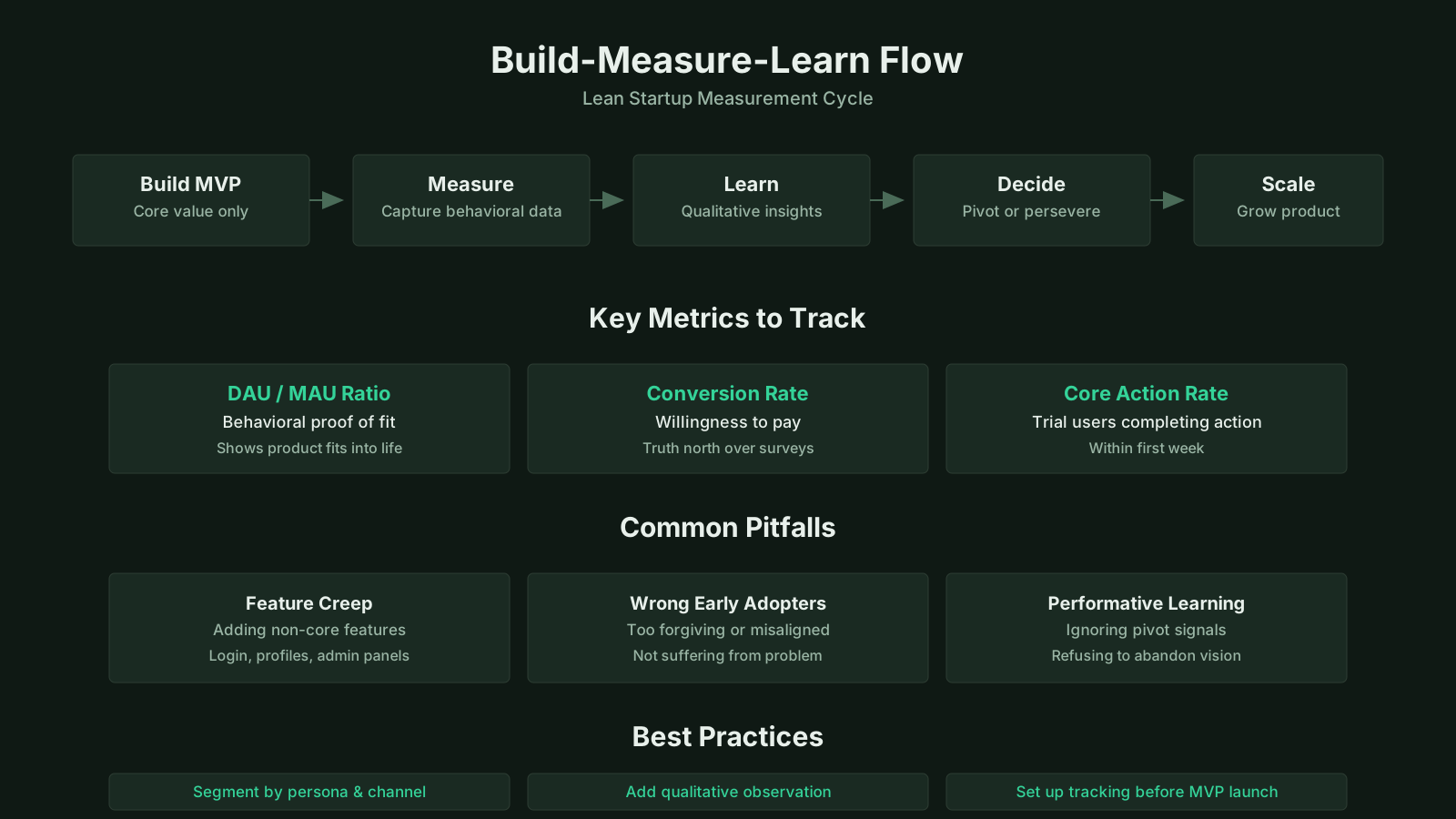
| Build Measure Learn | The feedback loop systematically isolates the riskiest assumption, constructs a targeted minimal test, measures results against predefined benchmarks, and uses evidence to decide whether to pivot or persevere. |
| Strategic Context | Leadership must articulate a clear vision and identify critical unknowns before initiating the loop, ensuring MVPs generate directional momentum rather than devolving into disconnected experiments. |
| Validated Learning | The primary purpose of an MVP is to produce actionable evidence surrounding a core business hypothesis through rigorous measurement and candid analysis. |
| Common Misconceptions | An MVP is not a prototype, a beta release, or a minimal feature set designed to avoid user frustration; it must deliver authentic core value to provoke genuine behavioral signals. |
| Garbage Release | Labeling a defective product fragment as an MVP erodes trust and contaminates data, as users react to compromised experiences rather than the underlying value hypothesis. |
| Measurement Rigor | Teams must control for noise using cohort analysis and split testing to distinguish correlation from causation, preventing spurious successes driven by temporary promotional spikes. |
| Cultural Alignment | Organizations must celebrate validated learning over mere launches and shield teams that produce honest null results, eliminating incentives to manipulate MVPs for favorable metrics. |
| Risk Management | The MVP approach converts raw uncertainty into validated learning, fundamentally reshaping how organizations make strategic decisions and allocate resources. |
| Pivot or Persevere | After analyzing the variance between anticipated and actual outcomes, teams make a data-informed decision to alter their strategic direction or double down on the current path. |
Defining the Minimum Viable Product in Modern Business
The term Minimum Viable Product is frequently invoked in boardrooms and sprint planning sessions, yet a precise, shared definition remains elusive. The original definition, articulated by Eric Ries, describes the MVP as that version of a new product which allows a team to collect the maximum amount of validated learning about customers with the least effort. Crucially, the emphasis is on learning, not on shipping something minimal. The viability criterion is not about whether the product technically functions; it is about whether the product can complete the Build, Measure, Learn loop and deliver actionable evidence regarding a core business hypothesis.
An MVP must be a coherent, end-to-end experience that tests a specific leap of faith. If you are testing whether professionals will pay for a subscription-based career coaching platform, your MVP might be a simple landing page with a scheduling form and a dozen manual coaching sessions conducted via video call. The product is not automated, not scalable, and far from the eventual vision, but it is entirely viable for the purpose of measuring willingness to pay and identifying the most valued features. This is the fundamental distinction: an MVP is an experiment, not a beta release.
The MVP and the Build-Measure-Learn Feedback Loop
The Build, Measure, Learn loop is the engine that propels the MVP blueprint forward. The sequence begins with identifying the riskiest assumption that could kill the initiative. You then build the smallest possible artifact designed to test that assumption. Measurement is not a passive collection of analytics; it requires predefined success criteria and a clear definition of the signal you are seeking. Learning happens when the team analyzes the gap between expected and actual results and makes a data-informed decision to pivot or persevere. Without rigorous measurement and honest learning, the loop collapses into a build-and-release frenzy that mimics agility without its substance.
Many teams struggle because they treat the loop as a mechanical process rather than a scientific method. They build an MVP, observe a spike in sign-ups, and declare victory without isolating the variables. Maybe the spike came from a promotional post on social media, not from genuine product demand. The Build, Measure, Learn framework demands that you control for noise and distinguish between correlation and causation. Cohort analysis, split testing, and qualitative user interviews are indispensable tools here. The loop’s power is not that it is fast; it is that it is falsifiable.
Common Misconceptions About the MVP Concept
One persistent myth is that the MVP is the smallest set of features that can be released without angering users. This definition shifts the focus from learning to user satisfaction, which is a later-stage concern. A genuine MVP might anger some users because it intentionally omits polish and convenience features, but it must still deliver on its core value proposition. If it fails to deliver any value, it is not viable, just minimal. Another misconception equates the MVP with a prototype or a proof of concept. Prototypes test technical feasibility; MVPs test market demand and customer behavior. Confusing these leads to launching products that work technically but solve no real problem.
The most damaging misinterpretation in corporate environments is the "MVP as a garbage release" syndrome. Teams under pressure to show progress push out a buggy, incoherent fragment of a product and label it an MVP to justify low quality. This destroys trust with early adopters and poisons the data because users react to the broken experience rather than the underlying value hypothesis. The MVP blueprint for success requires that the product, however minimal, function reliably enough to elicit authentic behavior. A landing page that crashes during payment processing teaches you nothing about willingness to pay. It only teaches you about technical fragility.
Core Takeaways on MVP Definition
- MVP prioritizes validated learning
- The primary goal of a Minimum Viable Product is to maximize validated learning about customers with minimal effort, not simply to deliver a bare-bones feature set.
- MVP is an experiment, not a beta
- A true MVP operates as a coherent, end-to-end experiment designed to test a specific business hypothesis, setting it apart from a beta release that concentrates on technical refinement.
- MVP must elicit authentic user behavior
- To yield actionable insights, the MVP must function reliably enough to stress-test the core value proposition; an unreliable experience only reveals technical shortcomings, not genuine market demand.
The Strategic Foundation of Build-Measure-Learn
Before a single line of code is written or a single prototype sketched, leadership must establish the strategic context in which the MVP will operate. The Build, Measure, Learn cycle is not a substitute for strategy; it is a mechanism for executing strategy under conditions of extreme uncertainty. The organization must articulate a clear vision of the future it wants to create, along with the critical unknowns standing between today and that future. Without this guiding star, MVPs become random experiments that generate fragmented learning and no directional momentum.
Strategic alignment also determines how much resources and political cover an MVP initiative receives. In many traditional organizations, the failure inherent in validated learning is culturally unacceptable. A well-crafted MVP might prove that a cherished idea is commercially nonviable. If the organization punishes that outcome, teams will game the system by building MVPs that confirm preexisting biases. To embed the MVP blueprint for success into the organizational fabric, senior leaders must celebrate learning, not just launches, and they must visibly protect teams that generate honest negative results. This cultural shift is often harder than the technical execution.
Why Build-Measure-Learn is the Core of the MVP Blueprint for Success
The phrase "Build, Measure, Learn: The MVP Blueprint for Success" encapsulates a truth that many product teams overlook. The order of the words is intentional and non-negotiable. You build first because you cannot measure a hypothesis in the abstract. You measure before you declare learning because intuition dressed up as insight is merely opinion. This disciplined sequence prevents the premature optimization that characterizes so many failed product initiatives. When a team starts with learning, they often fall into analysis paralysis, commissioning endless market research reports that provide no real-world evidence. The act of building something small forces the team to make specific, testable commitments.
Moreover, the loop’s cadence determines the overall pace of innovation. In a startup, a two-month Build, Measure, Learn cycle might be too slow to outrun cash depletion. In a large enterprise, a two-week cycle might be too fast for the legal and compliance functions to absorb. The blueprint’s success depends not on blindly copying another company’s cycle time but on finding the minimum viable tempo that respects the organization’s constraints while still generating rapid learning. The principle is to never let the time between an idea and its empirical test stretch beyond the point where assumptions can go unchallenged.
Planning Your MVP: From Vision to Hypothesis
The most critical step in the MVP process is also the most frequently skipped: translating a product vision into a falsifiable hypothesis. A vision statement like "We want to make it easier for small businesses to manage their finances" is inspiring but not testable. To fuel the Build, Measure, Learn loop, you need a hypothesis that identifies a specific customer segment, a specific job to be done, and a metric that will indicate success. An example would be: "We believe that independent coffee shop owners will pay thirty dollars per month for a tool that automatically categorizes their expenses if we can save them five hours per week." Every element of that hypothesis can be tested with an appropriately designed MVP.
Breaking down the vision into discrete hypotheses forces the team to acknowledge the many leaps of faith embedded in the initiative. Typically, these cluster around desirability, feasibility, and viability. Does the customer have the problem we assume? Will our proposed solution solve it in a way that is noticeably better than alternatives? Can we deliver the solution profitably at scale? An effective MVP blueprint addresses these questions sequentially, because testing viability when desirability is unproven is a waste of effort. Sequencing the hypotheses correctly prevents the team from building infrastructure for a product nobody wants.
Crafting a Falsifiable Hypothesis
A falsifiable hypothesis is one that can be proven wrong. Many product teams inadvertently write hypotheses that are so vague they can always be interpreted as confirmed. "Customers will be interested in a new savings feature" is not falsifiable because almost any response can be rationalized as interest. A better formulation uses a specific observable behavior: "At least forty percent of users who land on the feature page will begin the account setup process within seven days." This clarity sets the stage for meaningful measurement and removes the ambiguity that often plagues post-MVP evaluation.
The art of crafting such hypotheses requires a blend of domain expertise and humility. Experienced product managers and industry veterans bring valuable intuition about customer needs, but they must translate that intuition into tests that can surprise them. If nobody on the team can imagine a scenario where the hypothesis proves false, the experiment is likely too safe. The MVP blueprint for success thrives on bold hypotheses that challenge deeply held beliefs, because those are the ones that produce the most transformative learning, whether the outcome is validation or refutation.
Identifying the Riskiest Assumptions
Every product plan rests on a stack of assumptions, some so foundational that their collapse would render the entire initiative irrelevant. The MVP must be aimed squarely at the riskiest of these. In many product teams, risk is defined operationally as technological uncertainty: "Can we build this algorithm?" While technical risk is real, the risk that kills more products is market risk: "Will anyone care enough to change their behavior?" The Build, Measure, Learn loop is remarkably efficient at resolving market risk because it exposes the product to real users early. Technical risk often can be retired through feasibility spikes that are separate from the MVP.
To surface the riskiest assumption, facilitate a session where the team explicitly lists all the beliefs underpinning the business case. Then, for each one, ask: "If this assumption is false, can we still succeed?" The assumption that elicits a decisive "no" and that has the weakest empirical support is your primary target. Focusing the MVP on that single assumption prevents the common mistake of building a feature-rich first version that tries to answer too many questions at once and ends up providing muddy, unactionable data. Surgical precision in MVP design is a hallmark of mature product practice.
Core Insights on Hypothesis-Driven MVP Planning
- Translating vision into hypotheses
- Effective validation begins by decomposing a broad vision into a concrete, falsifiable hypothesis that pinpoints a distinct customer segment, a specific job to be done, and a quantitative success metric, directly powering the Build, Measure, Learn feedback loop.
- Sequencing desirability, feasibility, viability
- Prioritizing desirability tests over feasibility and viability experiments ensures that no engineering resources are invested in a solution that fails to address genuine customer demand.
- Crafting specific falsifiable statements
- A robust hypothesis defines an observable customer action and a precise threshold, like at least 60% of target users completing onboarding within the first week, so that test outcomes are unambiguous and actionable.
- Targeting the riskiest assumption
- The MVP must isolate the single assumption whose failure would doom the initiative and which currently has the weakest evidence, typically the market risk that the problem is worth solving, rather than a technical execution risk.
The Build Phase: Creating Just Enough to Learn
The build phase of the MVP blueprint is often misunderstood as a rush to produce code. In reality, the most effective MVPs are frequently non-technical or rely on a concierge model where human labor substitutes for automation. The guiding question is not "What can we build?" but "What is the least we need to produce to run a valid test of our hypothesis?" For a hypothesis about demand for a meal delivery service, the MVP might be a simple web form, a manual email to local restaurants, and the founder personally delivering orders in a car. This would be unsustainable at scale, but it is perfect for measuring whether busy professionals will pay a premium for the convenience.
The discipline of the build phase lies in resisting the temptation to add features that make the product feel more complete but do not contribute to the learning goal. Engineers and designers often feel a professional obligation to add polish, clean architecture, and scalability. While these instincts are valuable in later stages, they are distractions during MVP creation. The team must adopt a temporary mindset of decisive minimalism, focusing every sprint on delivering exactly the learning artifact and nothing more. This requires active coaching from product leadership and a shared understanding that technical debt, when incurred consciously for the sake of validated learning, is a strategic investment, not a failure.
Techniques for Rapid Prototyping and Concierge MVPs
Several proven techniques enable teams to build an MVP quickly without engineering resources. The concierge MVP involves manually performing the service that the eventual product will automate. Wealthfront, for example, began by manually constructing investment portfolios for clients, while Zappos famously started with a founder taking photos of shoes in a local store and shipping them after a test purchase. These approaches not only test demand but also immerse the team in the customer’s world, generating deep qualitative insights that shape the eventual automated solution.
Another technique is the Wizard of Oz MVP, where users believe they are interacting with a functional automated system, but a human operates behind the curtain. This works well for natural language processing or recommendation engines. The smoke test is a simple landing page that describes the product and measures conversion rates before any product exists. The Dropbox explainer video, which demonstrated the file synchronization concept before a line of backend code was written, is the canonical example. These high-touch, low-code techniques accelerate the Build, Measure, Learn cycle to days instead of months, providing an unfair advantage to teams that embrace them.
Avoiding the Over-Engineering Trap in the Build-Measure-Learn Process
Over-engineering is the silent killer of MVPs. Driven by a desire to avoid embarrassing failures or to build a foundation for the future, teams slip into adding architectural layers, database schemas, and microservices that have no bearing on the current hypothesis. This not only delays the learning cycle but also creates an emotional attachment to the code, making it harder to pivot if the hypothesis is disproven. The Build, Measure, Learn MVP blueprint for success requires leaders to draw a sharp line between the learning infrastructure and the scaling infrastructure. The code you write for an MVP should almost be considered disposable, because its primary purpose is to generate data, not to serve as the backbone of a production system.
Establishing clear build constraints can prevent over-engineering. Define a time box, such as a one-week build sprint, and a functionality ceiling that aligns precisely with the testable hypothesis. Any work that does not directly contribute to that test should be deferred. This sounds straightforward, but it demands intense facilitation because specialists naturally gravitate toward solving the most interesting technical challenges, not the most mundane manual labor. A culture of celebrated scrappiness, where leaders publicly praise a spreadsheet-driven MVP that yielded a decisive insight, is more valuable than any process document.
The Measure Phase: Data-Driven Validation
The measure phase transforms the MVP from a product artifact into a laboratory instrument. Without rigorous measurement, the team is left with anecdotes and gut feelings that are no better than the pre-MVP state of ignorance. Effective measurement begins long before the MVP is released, with the team defining the specific metrics that will adjudicate the hypothesis. These metrics must be actionable, meaning that the team can clearly state what decision they will make when the numbers come in. If the result is a gray zone of ambiguity, the measurement design has failed.
The trap many organizations fall into is relying on vanity metrics such as total page views, downloads, or raw sign-up counts. These numbers tend to increase over time even when the product is fundamentally broken, creating a false sense of progress. The Build, Measure, Learn loop demands metrics that isolate the behavior of a defined cohort over a specific period and tie directly to the value hypothesis. For a social networking MVP, a vanity metric would be total accounts created. An actionable metric would be the percentage of users who added a friend within the first week after registration and returned to the platform at least three times in the following week. This metric is harder to inflate and more tightly coupled to long-term engagement.
Defining Actionable Metrics for Your MVP Blueprint
Actionable metrics are the fuel of the MVP blueprint. To define them, the team must map the user’s journey from first contact to the key moment of value realization, often called the "aha moment." For an e-commerce MVP, the aha moment might be the first time a customer receives a tailored product recommendation that leads to a purchase they could not have found easily on a competitor’s site. The actionable metric would then be the conversion rate from personalized email to first purchase within a defined window, segmented by user acquisition channel.
Segmentation is critical because aggregate metrics can mask contradictory signals. An MVP for a financial literacy app might show mediocre average retention overall, but a deeper look could reveal that users who imported their bank data in the first session retained at three times the rate of those who did not. This insight is actionable: it directs the team to investigate why import is not occurring and to test interventions that encourage it. The measurement infrastructure must allow for this slicing without requiring a data science team to write complex queries. Modern product analytics platforms make this increasingly accessible, but the discipline of asking the right segmentation questions remains a human skill.
Qualitative vs. Quantitative Feedback Loops
Quantitative metrics tell you what is happening, but qualitative research tells you why. An MVP that shows a disappointing activation rate might indicate that the core value proposition is wrong, or it might indicate that the value is there but the user interface is confusing. The numbers alone cannot distinguish these two scenarios. That is why the most effective Build, Measure, Learn cycles weave qualitative touchpoints directly into the measurement phase. Usability tests, user interviews with both converters and non-converters, and open-ended survey questions provide the narrative that makes the data interpretable.
There is a practical challenge in blending these two streams of evidence. Qualitative insights can be highly compelling but statistically unreliable, while quantitative data can be sterile and misleading if divorced from context. The MVP blueprint for success triangulates truth by treating qualitative findings as hypotheses for further quantitative validation. If five user interviews suggest that a premium feature is priced too high, the next step is not to slash prices but to design a price elasticity test within the existing MVP framework. This cyclical interplay between the two modes of evidence is what separates rigorous product development from reactive guesswork.
Core Takeaways on Measurement Validation
- Actionable vs. Vanity Metrics
- Vanity metrics like total sign-ups generate a sense of false momentum, whereas actionable metrics that reflect specific user behaviors, such as recurring engagement within a predefined window, yield dependable insights for informed decision-making.
- Mapping the User Journey
- Defining actionable metrics demands charting the user's path to the ‘aha moment’ and then segmenting by acquisition channel to uncover conversion rates that signal genuine, repeatable adoption patterns.
- Segmentation Reveals Hidden Insights
- Aggregate metrics often conceal contradictory trends, but segmenting users by pivotal early actions, such as importing data in the first session, exposes actionable patterns that enable precise, intervention-based improvements.
- Blending Qualitative and Quantitative Data
- Quantitative metrics illuminate user behaviors, while only qualitative investigation reveals the underlying motivations; the optimal strategy leverages qualitative discoveries as testable hypotheses for rigorous quantitative confirmation.
The Learn Phase: Pivot or Persevere
The learn phase is where the intellectual heavy lifting occurs. The team gathers the measurement data, overlays the qualitative context, and asks the fundamental question: should we continue on our current path or change course? The decision to pivot is not an admission of failure but a strategic move to build on the validated learning achieved so far. A pivot might mean changing a feature set, a target market, a revenue model, or a distribution channel, while preserving the core vision and the accumulated knowledge. Persevering means the data supports the current hypothesis, and the team can confidently proceed to the next riskiest assumption.
This phase is fraught with cognitive biases. Confirmation bias leads teams to interpret ambiguous data as evidence of success. Sunk cost bias makes it painful to abandon a solution into which significant effort has been poured. Escalation of commitment can push a team to continue long past the point where the data screams stop. To counteract these forces, the decision meeting must be structured with ruthless discipline. The hypothesis and the success thresholds must have been written down before the MVP was built, and the facilitator must hold the team accountable to those pre-registered criteria. Some organizations even appoint a "dissent champion" whose job is to argue forcefully for the pivot option, ensuring that the evidence is stress-tested.
The Decision Framework Within the Build-Measure-Learn MVP Blueprint for Success
A robust decision framework turns the learn phase into a repeatable, defensible process. The framework has three possible outcomes informed by the Build, Measure, Learn MVP blueprint for success: persevere, pivot, or kill. A persevere decision requires that the primary actionable metric met or exceeded the pre-defined success threshold and that the qualitative data revealed no significant hidden risks. A pivot is warranted when the primary metric failed, but the team has identified a specific pattern in the data suggesting a revised hypothesis that could succeed. A kill decision is the rarest but sometimes the most valuable: it occurs when the data disproves the hypothesis so thoroughly that no reasonable modification can rescue the concept.
Embedding a kill option into the process is a sign of organizational maturity. Too many companies have a cultural taboo against terminating projects, which leads to zombies: products that consume resources indefinitely without delivering value. The MVP blueprint for success normalizes the kill decision by celebrating the learning it produces and by rapidly reassigning the team to a new initiative. When a team knows that killing a project will be viewed as a successful experiment rather than a career-limiting move, they are far more likely to design honest MVPs and report the results transparently.
Implementing Build-Measure-Learn in Different Organizational Contexts
The MVP blueprint is not a one-size-fits-all prescription. Its implementation must be adapted to the scale, regulatory environment, and culture of the organization. What works in a ten-person startup operating out of a co-working space will fail in a multinational corporation with established brand expectations and complex compliance requirements. The key is to preserve the spirit of rapid validated learning while acknowledging the real constraints that exist. The alternative, adopting a rigid dogma that ignores context, only fuels the backlash against agile and lean methods.
In larger enterprises, the challenge is often less about the build phase and more about the measure and learn phases. Data may be siloed across departments, legal review cycles can stretch into weeks, and the risk appetite for external-facing experiments is low. In these contexts, an internal MVP variant can be powerful. This involves releasing the minimal product to employees or a hand-picked group of trusted customers under a non-disclosure agreement. The learning is not as externally valid as a public release, but it can often yield sufficient insight to inform a larger investment decision while keeping the organization within its risk tolerance.
MVPs in Enterprise and Regulated Industries
Industries such as healthcare, finance, and aerospace present genuine barriers to the conventional MVP approach. You cannot release a minimally viable pacemaker or a half-complete banking compliance system to customers and measure outcomes. However, the Build, Measure, Learn loop can still be applied by mapping the hypotheses onto non-customer-facing dimensions. For example, an MVP for a new insurance underwriting model might be tested using a synthetic dataset with the company’s existing actuaries, measuring the time saved and the accuracy achieved before any customer policies are affected.
Another adaptation is to front-load the qualitative and desktop research to narrow the uncertainty, then use a heavily scaffolded pilot with rigorous oversight. The regulatory body can sometimes be engaged as a partner in learning, particularly if the innovation aims to improve safety or financial stability. The key is to separate the regulatory risk from the market risk and not let the former become an excuse to avoid all experimentation. The MVP blueprint for success in such environments often involves a longer cycle time and a smaller, more controlled user group, but the fundamental loop remains intact and valuable.
Remote Teams and the Digital MVP
The shift to distributed work has changed the way teams execute the Build, Measure, Learn cycle. Remote teams rely heavily on digital collaboration tools, cloud-based prototyping platforms, and asynchronous communication. This can actually accelerate the MVP process because it forces documentation and rigor that might otherwise live in casual hallway conversations. A remote team that runs a design sprint using a virtual whiteboard, produces a clickable prototype with no-code tools, and shares it with a globally distributed user panel can cycle through Build, Measure, Learn in a matter of days without anyone leaving their home office.
However, remote MVP work also introduces risks. It is harder to pick up on the non-verbal cues and emotional responses that signal a user’s true feelings about a product. Usability tests conducted over video calls can miss the subtle frustration that would be palpable in person. Teams must compensate with deliberate over-communication, recording sessions for detailed review, and using sentiment analysis tools where appropriate. Despite these challenges, the digital-first nature of many modern products means that the remote MVP is often a more authentic representation of the actual user experience than an in-person lab test ever was.
Core Insights on Contextual Adaptation
- Enterprise MVP adaptation strategy
- Data silos and mandatory legal reviews frequently obstruct the Measure and Learn phases in large enterprises, yet releasing an internal MVP to employees or trusted customers under a non-disclosure agreement yields sufficient insight while remaining within acceptable risk boundaries.
- Regulated industry workaround
- Highly regulated industries such as healthcare and finance can still apply the Build‑Measure‑Learn cycle by testing hypotheses on dimensions that never touch the customer, using synthetic data with actuaries to measure time saved and accuracy before any policy changes occur.
- Remote team acceleration
- Digital collaboration tools and asynchronous communication empower distributed teams to fast‑track the MVP process, turning a design sprint into a clickable prototype and testing it with a global user panel in just days.
- Remote MVP risk mitigation
- Remote settings obscure non‑verbal cues and emotional responses during usability tests, so teams must offset this loss with deliberate over‑communication, session recordings, and sentiment analysis tools.
Scaling Beyond the MVP: From Validated Learning to Growth
An MVP that succeeds in validating its core hypothesis reaches a transition point that is almost as dangerous as the initial launch. The temptation is to immediately scale the MVP into a production-grade system by rewriting the fragile, manual-labor-intensive backend and adding the full suite of features that were deprioritized. This approach can destroy the momentum of learning. A more prudent path is to scale incrementally, continuing to apply the Build, Measure, Learn loop to subsequent features and ancillary assumptions. The MVP was designed to test one hypothesis; the next hypothesis might be about pricing tolerance, customer support model, or channel partnerships.
The architecture at this stage needs to evolve from disposable to durable, but not all at once. Identify the components that proved to be value-generating and invest in hardening them. Components that were purely instrumental for learning can be deprecated. This surgical approach to scaling preserves the team’s agility and prevents the sudden accumulation of technical debt that can slow cycle time to a crawl. The organization must also address the human scaling challenge: early adopters who tolerated the MVP’s roughness may now expect a polished experience, and the customer success function must be prepared to manage that transition without alienating the very users who provided the validated learning.
Common Pitfalls and How to Avoid Them
Despite the conceptual elegance of the Build, Measure, Learn loop, practitioners routinely fall into a set of well-documented traps. The first is the empty measure, where teams go through the motions of defining metrics but never actually take action on the data because there is no pre-committed decision rule. The remedy is simplicity: one primary metric, one success threshold, and one scheduled decision meeting with the authority to redirect resources. Another pitfall is the never-ending MVP, where teams add just one more feature before exposing the product to users, driven by a perfectionism that neutralizes the learning benefit. Setting a hard launch deadline that is immovable can break this cycle.
A subtler failure mode is the confirmation-driven test design, where the MVP is constructed in a way that almost guarantees a positive result. For example, testing willingness to pay by offering a free trial with a credit card requirement will capture intent signals, but it may overstate true willingness because many users will cancel before the payment triggers. The team should anticipate this and design a measurement plan that tracks through to actual cash received. Honest experimental design requires the team to explicitly consider how their measurement apparatus could be fooled and to plug those gaps before the data arrives.
Core Takeaways on Pitfall Prevention
- Empty measure trap
- Teams can avoid the empty measure trap by pre-committing to a single primary metric, a specific success threshold, and a scheduled meeting where a binary decision will be enforced.
- Never-ending MVP cycle
- Perfectionism drives teams to layer on features endlessly before launch, nullifying the MVP's learning value; a hard and non-negotiable deadline is the most effective circuit breaker.
- Confirmation-driven test design
- Designing an MVP to guarantee a positive outcome, such as testing willingness to pay via a credit-card gated free trial, inflates true intent because a meaningful share of users cancel before the first charge.
- Honest measurement planning
- Honest measurement requires teams to proactively identify how their tracking might be deceived and to tighten those gaps before data arrives, for instance by measuring actual cash collected rather than indirect intent signals.
The Build-Measure-Learn MVP Blueprint for Success as a Cultural Transformation
Ultimately, adopting the Build, Measure, Learn MVP blueprint for success is less a process change and more a cultural transformation. It requires an organization to become comfortable with being wrong, to invest in learning infrastructure, and to judge progress by evidence rather than by the volume of output. Leaders play an outsized role in this transformation. When a senior executive asks not "When will this feature ship?" but "What did we learn this week that surprised us?", they signal a fundamental shift in values. This shift cascades through the organization, empowering teams to run honest experiments and report honest results.
The organizations that master the MVP blueprint develop a distinctive competitive rhythm. They outlearn their competitors, iterating toward product-market fit with a speed that looks like luck from the outside. They allocate capital more efficiently because they kill losing bets early and double down on the few that show real traction. In an era where technology, distribution channels, and customer preferences shift faster than ever, the ability to learn quickly is not just a tactical advantage. It is the core competency that separates companies that thrive from those that disappear. Embracing Build, Measure, Learn as a management discipline, not a startup fad, is one of the most consequential decisions a leadership team can make.
Making the Loop Survive Organizational Friction
The mechanics of Build, Measure, Learn are easy to understand and hard to keep alive. In practice, the first experiment usually goes well because the team is energized and leadership is curious. The trouble starts when the results challenge a roadmap that has already been socialized. A product leader once told me his MVP showed that customers would not pay for a feature the executive team had already promised to the board. The data was clear, but the decision path was not. The team spent three weeks preparing additional analyses because nobody wanted to be the one to say the word pivot. That delay cost more than the experiment itself. If the loop is going to work, there has to be a pre-agreed decision corridor, not a debate after every result.
One practical way to create that corridor is to fund MVPs separately from normal product development. When a test sits inside the same budget line as a committed feature, the incentive is to justify the spend by shipping something polished. That defeats the purpose. A small validation budget with explicit kill criteria changes the conversation from "did we ship it" to "what did we learn." Finance teams often resist this because it looks like discretionary spending without a clear return. The counterargument is simple: the cost of a dozen small experiments is almost always lower than the cost of one fully built product that misses. Leaders who have internalized this shift stop asking for a business case before the loop and start asking for a learning objective instead.
Teams also need to broaden their definition of what an MVP can be. A stripped-down software product is only one option. Concierge MVPs, where someone manually delivers the service behind the scenes, can reveal willingness to pay before any code exists. Wizard of Oz MVPs, which appear automated but are operated by hand, test the experience without building the backend. Landing page tests measure demand signals such as clicks and signup intent. These forms of validation are often dismissed as not real product work, but they answer the riskiest questions faster. The interesting part is that teams which start with manual or piecemeal experiments tend to build less software overall, because they discover what customers actually need instead of what the roadmap assumed they needed.
Measurement discipline is where most loops quietly fail. Teams track what the analytics tool gives them by default: page views, session length, total signups. Those numbers can move up while the business hypothesis is still false. The MVP blueprint requires a small set of behavioral metrics tied to the specific assumption being tested, usually activation, retention, or willingness to pay. It also requires talking to customers after the numbers come in. A retention curve tells you that people left; it does not tell you why. Combining quantitative results with a handful of structured interviews turns raw data into something closer to validated learning. Without that synthesis, the loop becomes a reporting exercise. When decisions pile up faster than the team can process them, even a well-formed experiment gets stuck waiting for direction. That is the decision throughput problem, and it is usually what separates organizations that learn quickly from those that merely collect data.
Advance Your Career with Professional Certification
Earning a professional project management certification validates your expertise in methodologies that drive projects to completion on time and within budget, making you a more competitive candidate for leadership roles. Becoming a certified project manager signals to employers that you possess standardized skills in risk management, stakeholder communication, and agile practices, which directly contribute to higher project success rates. Organizations benefit from certified professionals who can streamline processes and reduce costly errors, while individuals often see faster career advancement and increased earning potential. Ultimately, this credential bridges the gap between theoretical knowledge and real-world execution, fostering a culture of continuous improvement and measurable results.
Earning a professional product management certification signals to employers that you possess a proven, structured approach to driving product strategy and execution, which directly contributes to organizational success. This formal recognition helps you stand out in a crowded job market and often leads to faster career progression and higher earning potential. To build these critical skills, many practitioners turn to focused product management training that blends theory with real-world application. Ultimately, certified professionals are better equipped to reduce waste, prioritize effectively, and deliver products that truly resonate with customers.
Obtaining a professional HR management certification signals to employers that you possess validated, up-to-date knowledge of labor laws, talent strategy, and compliance—setting you apart in a crowded job market. Moreover, an human resources certification empowers you to design data-driven people initiatives that directly boost retention and productivity, turning the HR function into a true strategic partner. Ultimately, this credential not only accelerates your own leadership trajectory but also fortifies your organization’s culture and bottom-line results.