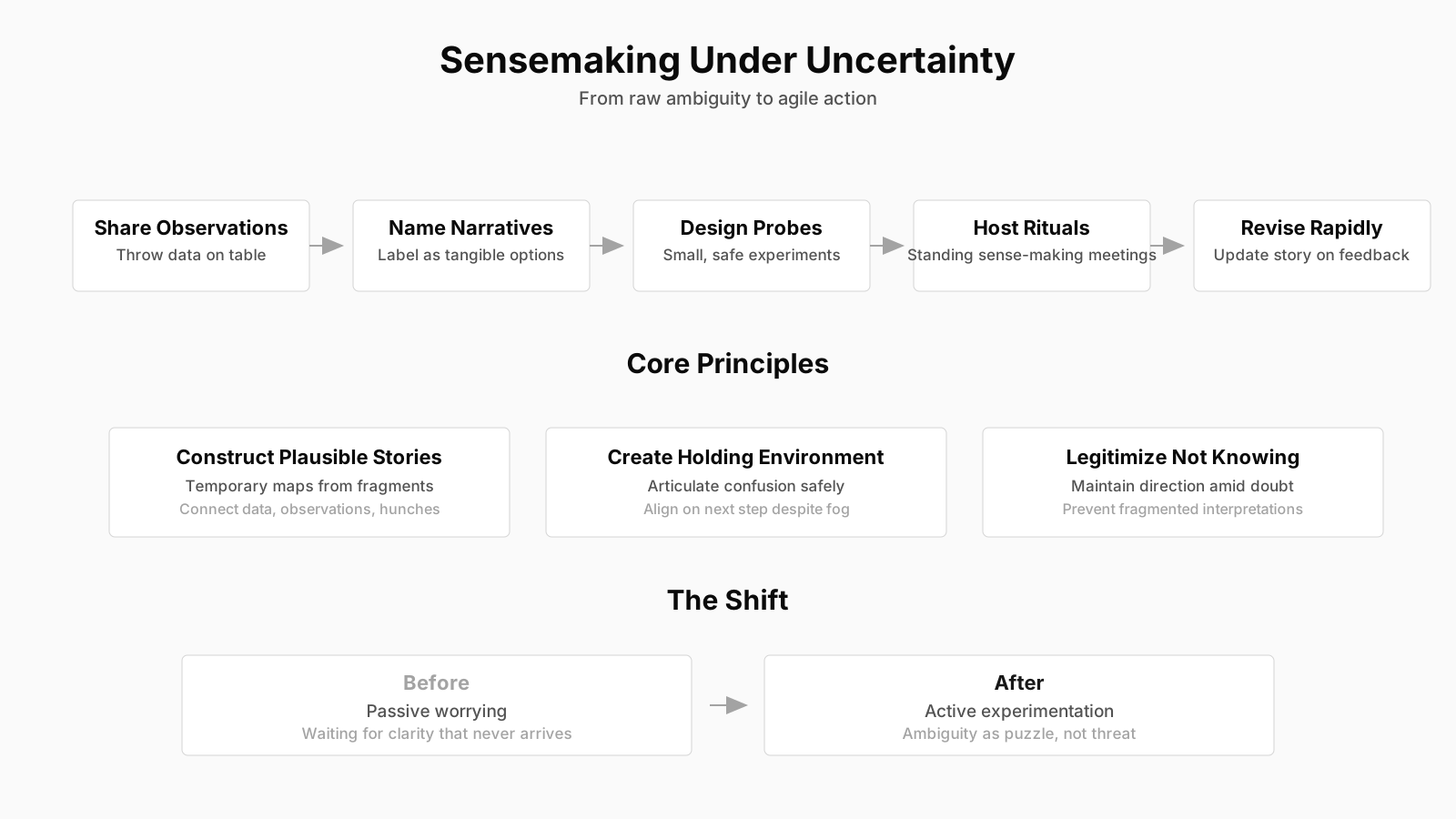
When managers face situations where the old rules no longer apply and the path forward looks more like fog than a road, there is a specific leadership capability that moves them from paralysis to progress. That capability is sensemaking. Sensemaking for managers is not about having the right answer immediately. It is about carving out enough meaning from ambiguous signals so that a team can take the next step. The term itself might sound academic, but the practice is deeply practical, especially in environments shaped by volatility, uncertainty, complexity, and ambiguity, the conditions we often shorten to VUCA. In a world where nothing is clear, the manager who can make sense of the noise, filter out what matters, and help others do the same becomes indispensable. This article explores how managers can build that capability, drawing on decades of research and real-world leadership insight, and provides concrete frameworks to lead when nothing is clear.
Sensemaking for Managers: Summary of Key Concepts
| Key Concept | Summary |
|---|---|
| Defining Sensemaking | Sensemaking is the ongoing process of constructing plausible interpretations for equivocal situations, reducing ambiguity just enough to enable purposeful action without claiming certainty. |
| Navigating VUCA | In volatile, uncertain, complex, and ambiguous conditions, managers who filter signal from noise and co-create a shared narrative become the linchpin of their team’s capacity to act decisively. |
| The Leadership Shift | Teams have moved beyond the myth of the all-knowing leader; they now rely on managers who co-construct clarity by translating fragmented data into compelling stories that spark aligned momentum. |
| Equivocality | Equivocality describes situations rife with multiple, contradictory yet plausible interpretations. The manager’s role is to guide the team toward a workable frame that permits action while actively inviting correction as new insight emerges. |
| Fostering Psychological Safety | When a manager openly engages in sensemaking, acknowledging gaps and exploring aloud, they model that uncertainty is a shared condition, not a personal deficit; this builds genuine psychological safety and encourages the team to contribute unvarnished observations. |
| Retrospective Meaning-Making | Weick’s insight that we often do not know what we think until we see what we say reveals how meaning is constructed retrospectively: sense emerges through acts of expression and reflection on action, not purely from prior analysis. |
| The SIR COPE Framework | The SIR COPE mnemonic, Social, Identity, Retrospective, Cues, Ongoing, Plausibility, and Enactment, distills the seven properties of sensemaking into a practical lens for managers to diagnose and navigate ambiguous challenges. |
| Role of Formal Structures | Formalized mechanisms such as contracts, structured debriefs, and routine sense-check conversations channel attention, provoke deeper reflection, and counteract cognitive biases, thereby sharpening the team’s collective sensemaking capability. |
| The Action-Iteration Loop | When confronting a messy problem, the most effective route is to take a small, deliberate action, observe the consequences, and then retrospectively construct meaning from what unfolded, forming an iterative cycle of sense-informed action and action-informed sense. |
| Plausibility Over Accuracy | Under high uncertainty, sensemaking prioritizes crafting a sufficiently plausible account over attaining perfect accuracy: a coherent story that gives the team enough clarity to take the next confident step while remaining open to ongoing adaptation. |
Why Sensemaking for Managers Matters When Nothing Is Clear
The modern business landscape has made a certain kind of leader obsolete. That is the leader who stands at the front of the room, armed with a fully formed plan and all the answers. Nobody really trusts that person anymore, because the world changes too fast for any single individual to hold complete clarity. Instead, what teams need is a manager who can help them build clarity together, who can transform a chaotic flood of data into a plausible story that enables action. This is the core of sensemaking, and it is earning recognition as a leadership superpower. As a recent Forbes article put it, sensemaking creates hope in uncertainty, turning confusion into momentum and meaning [6] . The ability to make sense in this way is not something you are born with. It is a competency that can be trained and refined, which means managers at any level can develop it [1] .
At its simplest, sensemaking is the process through which people give meaning to their experiences, especially when those experiences are novel, confusing, or contradictory [7] . It is fundamentally about reducing the fog, not eliminating it entirely. In practice, a manager engaged in sensemaking is doing something very specific. They are scanning the environment, noticing small changes that might be significant, connecting dots that others miss, and then translating those insights into a simple, actionable frame for their team. They are not trying to predict the future perfectly. They are trying to make the present workable. The research community has spent decades refining this concept, with Karl Weick as the towering figure in the field, and a recent bibliometric analysis covering thirty-five years confirms that sensemaking has become a central pillar in management research, precisely because it explains how organizations actually deal with ambiguity [5] .
One reason sensemaking for managers has become such a pressing topic is the sheer volume of equivocality in daily work. Equivocality is Weick’s term for situations that can be interpreted in multiple, conflicting ways. A sudden drop in a key metric, for example, could be a temporary blip, a sign of a deeper market shift, or a measurement error. The manager’s job is not to guess which interpretation is true, but to help the team construct an interpretation that is plausible enough to act on, while staying open to correction. This is a fundamentally different stance than the traditional command-and-control leadership model. It requires humility, curiosity, and a willingness to engage in the messy, social process of building shared understanding.
How Sensemaking Helps Managers Lead When Nothing Is Clear
When the environment turns turbulent, the psychological need for meaning skyrockets. People look to their managers not for false certainty, but for the ability to frame the situation honestly and provide a direction for action. This is where sensemaking for managers becomes a direct leadership intervention. By engaging in the process openly, the manager models that it is acceptable not to know everything at the start. This creates psychological safety, which is essential for the team to bring their own observations and interpretations to the table. The alternative is a team operating in silence, each member privately nursing a different anxiety about what is happening, and coordination breaking down. Sensemaking transforms that dynamic. It says, “Here is what we are seeing, here is what we think it might mean, and here is what we are going to try next.” That kind of statement, delivered with conviction but provisional acceptance, is a powerful act of leadership.
The retrospective nature of sensemaking is an especially useful insight for managers. Weick famously captured this with the phrase, “How can I know what I think until I see what I say?” This means that meaning often arises from action and conversation, not from solitary contemplation beforehand. A manager who understands this will be quicker to initiate dialogue, experiment with small actions, and reflect on the outcomes to discover what the situation actually is. In practical terms, when facing a messy problem, the best approach is often not to analyze it to death in a boardroom, but to do something small, watch the reaction, and then retroactively make sense of what just happened. That iterative loop is the engine of progress when nothing is clear.
Core Sensemaking Insights for Leaders
- Collaborative clarity over individual plans
- Leaders foster shared understanding by guiding teams to collectively interpret messy realities, rather than imposing top-down solutions that fail to secure commitment.
- Managing equivocality and multiple interpretations
- When data support conflicting readings, the leader's role is to propose a plausible frame that enables decisive action while remaining open to revision as new insights surface.
- Creating psychological safety in uncertainty
- By openly engaging in joint sensemaking, leaders model that uncertainty is not a personal failing, which encourages candid input and reduces the hidden anxieties that stifle honest dialogue.
- Action before clarity: retrospective sensemaking
- Meaning often crystallizes after taking small, experimental steps and reflecting on their outcomes, aligning with Weick's insight that we discover what we think when we articulate it.
- Iterative loop of action and reflection
- Faced with ambiguous challenges, leaders should spark dialogue, test micro-interventions, and derive understanding retroactively, turning action and reflection into a progressive cycle that moves the organization forward.
The Mechanisms and Process of Sensemaking
To lead with sensemaking, it helps to understand its inner workings. Sensemaking is not a single event but an ongoing, social, and deeply human process. It draws on identity, past experiences, and the constant interplay between action and interpretation. Formal organizational mechanisms can actually support this process. For instance, research into interorganizational relationships has shown that formalization, things like contracts and structured processes, can facilitate sensemaking rather than stifle it. Formalization focuses attention, provokes articulation and reflection, and helps reduce the cognitive biases that creep in when things are left entirely informal [2] . A manager might find that introducing simple, structured routines, such as a weekly “sense check” conversation or a template for mapping assumptions, provides the scaffolding that teams need to collectively make sense of ambiguous situations.
One of the most well-known ways to describe the properties of sensemaking is the acronym SIR COPE, which stands for Social, Identity, Retrospective, Cues, Ongoing, Plausibility, and Enactment [7] . Each of these properties reveals something crucial for the practicing manager. The social aspect reminds us that meaning is constructed in conversation and interaction, rarely in isolation. A manager who isolates themselves to think will miss the richer insights that come from debate and shared reflection. The identity property highlights that how people interpret events is deeply tied to who they believe they are. A team that sees itself as innovative will interpret a market disruption as an opportunity; a team that sees itself as a stable operator will see the same event as a threat. Effective managers actively shape and tend to the team’s identity as part of their sensemaking work.
The Retrospective Nature of Sensemaking and the “SIR COPE” Framework
The retrospective property is tricky for managers accustomed to planning everything in advance. It means we make sense of what has already happened, not what is happening right now in some pure, unmediated way. We filter current experience through the lens of past experiences. A manager overseeing a product launch that is failing will make sense of the failure by looking backward at decisions made months earlier, connecting dots that were invisible at the time. This is why after-action reviews are not just bureaucratic rituals; they are raw fuel for future sensemaking. The cues property explains that people latch onto small details, a single data point, an offhand comment, a strange email, and build entire narratives around them. Managers need to be aware of which cues are grabbing the team’s attention and intentionally introduce other cues that might lead to a more balanced interpretation. The ongoing property means there is no finish line; sense is constantly being renegotiated as new information arrives.
Plausibility over accuracy is perhaps the most liberating aspect of sensemaking for a manager. The goal is not to discover the single objective truth, which is often impossible in a complex situation, but to construct a narrative that is good enough to enable coordinated action without being so distorted that it leads to disaster. A plausible story energizes action; a paralyzed search for perfect accuracy does the opposite. The final property, enactment, describes how our actions shape the environment we are trying to understand. If a manager believes the market is hostile and acts defensively, their actions may provoke defensive reactions from customers and partners, making the market more hostile in reality. The manager’s sensemaking shapes the very world they are navigating. Understanding this feedback loop can make a leader more thoughtful about the stories they choose to believe and tell.
From Enactment to Retention: Building a Shared Story
A foundational model within sensemaking theory breaks the process into three stages: enactment, selection, and retention [12] . Enactment is about taking action and, in so doing, creating the raw material that will later be interpreted. A manager who authorizes a small pilot project, for instance, is enacting a piece of the environment. Selection follows, where the manager and team choose which aspects of the enacted experience to focus on and assign meaning to, based on the team’s identity and the perceived environment. Finally, retention involves storing that selected interpretation in the form of stories, routines, or mental models that will guide future action. The cycle then repeats. Over time, organizations build up a repertoire of these retained interpretations, and this repertoire is what gives them the ability to respond to new situations without starting from scratch each time.
Building a shared story is the crux of retention. The manager acts as the guardian and shaper of the team’s narrative, asking, “What did we learn from that?” and “How will we talk about it going forward?” The story does not need to be heroic or even particularly polished. It just needs to be coherent and shared. When a new team member joins, they absorb these stories as part of their onboarding, quickly learning “how we think around here.” This is sensemaking being passed along, and it explains why some teams are so much more resilient than others. They have richer, more adaptable stories to draw on.
Sensemaking, Sensegiving, and Sensebreaking: The Triad of Leadership Influence
Managers do not simply make sense for themselves; they actively intervene in the sensemaking of others. This is where the related concepts of sensegiving and sensebreaking enter the picture, and together with sensemaking they form a powerful triad of influence [15] . Sensegiving is the act of influencing other people’s interpretations, guiding them toward a particular understanding of events. Sensebreaking is the act of dismantling old, dysfunctional interpretations to clear the ground for new ones. A manager who only makes sense privately and never shares that sense is not leading. Leadership happens in the movement between these modes, in the careful, sometimes difficult work of reshaping how others see the world.
Crises often bring this triad into sharp relief. In a sudden downturn, a manager might first need to engage in sensebreaking, shattering the team’s comfortable assumption that the old strategy was working flawlessly. Then, through intense sensegiving, the manager frames the new reality as something navigable, connecting daily tasks to a broader vision that provides hope. Throughout this, the manager continues their own personal sensemaking, constantly updating their understanding as new information emerges. Research into servant leadership during crises has found that the readiness to shift between different modes of sensemaking is a crucial attribute, allowing leaders to lower barriers and see their personnel with “new eyes” [4] . This ability to toggle between making sense, giving sense, and breaking sense is less about charisma and more about a disciplined attention to meaning-making processes.
Sensegiving: How Managers Can Shape Meaning When Nothing Is Clear
Sensegiving is the bridge between a manager’s private insights and the team’s collective action. It is the manager’s responsibility to frame a situation in such a way that the team does not descend into anxiety or fragmentation. Effective sensegiving does not mean sugarcoating bad news or pretending to have absolute certainty. It means offering a confident, provisional interpretation and inviting others to refine it. A manager might say, “Here is what I am seeing, and here is why I think we should move in this direction. What am I missing?” That invitation is a form of sensegiving that also keeps the sensegiving channel open for feedback. During strategic change, leaders engage in intense sensegiving to diffuse new meanings and practices throughout the organization [3] . The middle manager plays a pivotal role here, translating high-level strategic shifts into localized stories that resonate with frontline employees. That translation work is the daily craft of sensegiving, and it is one of the most undervalued leadership skills in organizations.
Technology and remote work have added a layer of complexity to sensegiving. Without the informal conversations in hallways and coffee corners, managers need to be far more deliberate about providing interpretive frames. A Slack message that simply says, “We missed the target, but we are pivoting” is poor sensegiving. A better approach is a short video or a written note that explains the context, acknowledges the disappointment, offers a tentative explanation, and connects the pivot to a larger purpose. The more ambiguous the environment, the more intentional the sensegiving must be. When nothing is clear, the vacuum of meaning will be filled by rumor and anxiety unless the manager actively fills it with a constructive, honest narrative.
Sensebreaking: Clearing the Ground for New Interpretations
Sensebreaking is often the most uncomfortable part of the meaning-management process. It requires the manager to elegantly dismantle beliefs that have become sacred but are now getting in the way. This might involve questioning an old assumption about customer behavior, challenging a long-held process that is no longer efficient, or gently pointing out that the team’s self-image as a high performer no longer matches the current data. Done poorly, sensebreaking feels like an attack. Done well, it opens up possibilities. The manager who practices sensebreaking skillfully will often use questions rather than statements. “What if that assumption no longer holds?” or “How might we rethink this if we were starting fresh today?” These questions destabilize old mental models without humiliating those who held them.
The connection between sensebreaking and the SIR COPE properties is worth noting. Because sensemaking is tied to identity, breaking a sense threatens the identity of individuals and the team. A sales team that has always prided itself on relationship selling may fiercely resist the notion that the market is shifting to self-service digital channels. The manager cannot simply announce the new reality. They must create experiences that allow the team to see for themselves, perhaps through customer interviews or pilot data, that the old stories no longer fit. This is enactment in service of sensebreaking: letting the environment teach the lesson rather than the manager lecturing. When the team enacts a small experiment and encounters reality, their old sense breaks itself, and they are ready to build a new one. The manager then steps back into sensegiving mode to guide that construction.
Key Insights on the Leadership Triad
- Triad of Leadership Influence
- The dynamic interplay of sensemaking, sensegiving, and sensebreaking defines leadership practice, demanding that managers continuously reshape collective understanding rather than merely transmit information.
- Sensegiving as Interpretation
- Sensegiving provides authoritative yet tentative interpretations paired with an invitation for dialogue, steering teams through uncertain terrain while maintaining psychological safety.
- Sensebreaking for Change
- Sensebreaking deploys thoughtful questioning to gently dismantle legacy assumptions, creating cognitive space for more adaptive interpretations to emerge.
- Crisis Mode-Shifting
- Amid crises, leaders must rapidly alternate between dismantling obsolete assumptions and offering new sense, all while sustaining their own sensemaking to adjust to unfolding events.
- Deliberate Sensegiving Remotely
- In distributed settings, managers must deliberately craft and communicate context-rich narratives, counteracting the tendency for speculation and unease to fill the void left by informal in-person exchanges.
Practical Sensemaking Frameworks for Managers
The theories are valuable, but most managers want tools they can use on Monday morning. Fortunately, sensemaking can be translated into concrete practices and frameworks that fit into the rhythm of regular work. These tools are not rigid formulas. They are structured conversation starters that help teams navigate ambiguity together. One of the most practical is a simple quadrant-based tool called the Complexity Canvas, which turns a murky challenge into a series of structured sensemaking conversations [6] . Another approach is a self-assessment checklist that helps managers evaluate their own sensemaking habits and identify blind spots [1] . And for those interested in deeper leadership development, the concept of elevated sensemaking provides a pathway for growth that goes beyond checking boxes to truly transforming how a leader sees the world [8] .
Strategy-making itself can be infused with sensemaking disciplines. Rather than treating strategy as an annual planning ritual that produces a fixed document, a sensemaking approach to strategy involves disciplined dialogue and norms that encourage inquiry while managing advocacy [13] . The goal is to ensure that all team members contribute to building a shared understanding of market ambiguity. This shifts the manager’s role from that of a strategic decision-maker making calls in isolation to that of a conversation architect, designing the spaces and processes where collective insight can emerge. When nothing is clear, the manager who can structure a conversation that yields sufficient clarity for the next decision is adding massive value.
The Complexity Canvas: A Tool to Lead When Nothing Is Clear
The Complexity Canvas is a deceptively simple framework that can be drawn on a whiteboard or a shared digital document. It divides a challenge into four quadrants: what we know, what we don’t know, what we can control, and what we can’t control. A team staring at a messy problem, a product launch that is stalling, a sudden regulatory change, a competitor surprise, can spend half an hour populating these quadrants. The act of populating them is pure sensemaking. People surface their assumptions, compare their interpretations, and realize that what one person considers a known fact another considers a guess. The conversation quickly moves from anxiety to a form of structured curiosity.
The most actionable quadrant is the intersection of what we know and what we can control. That is where immediate next steps live. The manager can then say, “Looking at this, it is clear we can take these three actions today, regardless of the other uncertainties.” This shifts the attention from resolving ambiguity to working within it. The other quadrants are not ignored; they are monitored. The “don’t know and can’t control” quadrant, which often contains the scariest external forces, becomes a watchlist rather than a source of paralysis. Over time, as the team enacts its actions from the first quadrant, some items will inevitably move. New things will be known, and the process repeats. This iterative use of a simple canvas is a concrete expression of the enactment-selection-retention cycle. It makes sensemaking visible and collaborative, and it is something any manager can facilitate without special training.
Self-Assessment and Elevated Sensemaking for Leadership Growth
Beyond tools, managers benefit from periodically examining their own habits. A self-assessment checklist tailored for VUCA conditions asks questions such as: Do I set realistic priorities even when the big picture is murky? Do I frame change in a way that gives my team a positive sense of forward motion? Am I honest about what I do not know, and do I model that openly? Can I translate ambiguous signals into clear context that helps my team decide what to do next? Do I guide my team in making grounded decisions rather than chasing every new data point? Reflecting on these questions regularly can surface gaps that are not about skill but about mindset [1] . The manager who scores low on acknowledging what they do not know, for example, may be inadvertently projecting false certainty, which discourages the team from contributing their own sensemaking.
For managers interested in deeper development, the concept of elevated sensemaking offers a framework that links sensemaking to vertical leadership growth. Vertical development refers to expanding a leader’s capacity to hold more complexity, to see systems rather than just events, and to integrate multiple perspectives without getting lost in them. Elevated sensemaking fosters this by helping leaders move from reactive patterns to more transformative ones. In practice, this means deliberately seeking out perspectives that challenge your own initial interpretation. It means learning to recognize patterns across different domains, not just within your functional area [8] . A finance manager, for instance, who regularly reads about anthropology or design thinking, is expanding the repertoire of mental models they can draw on for sensemaking. This cross-pollination is not a luxury; it is precisely what enables a leader to see novel solutions in a crisis when standard industry playbooks fail. Elevated sensemaking is a long-term practice, but it pays off precisely when nothing is clear and the old ways of thinking are useless.
Sensemaking, Crisis Leadership, and Organizational Resilience
If sensemaking is valuable in everyday ambiguity, it becomes absolutely critical during a crisis. A crisis, by definition, is a situation where normal routines break down and the stakes are high, and the environment becomes turbulent in ways that exceed the organization’s usual coping mechanisms. Recent empirical research has demonstrated that organizational sensemaking is a key cognitive pathway through which crisis leadership enhances organizational resilience. In other words, it is not enough to have a leader who communicates well and remains calm. That leadership must translate into the collective sensemaking of the organization, enabling everyone to scan the environment, interpret threats, and act in a coordinated manner [9] . The same study also found that the positive effect of sensemaking on resilience is even stronger when environmental turbulence is high, which is precisely the condition that defines a crisis.
This has profound implications for managers. It suggests that building a team’s sensemaking muscle during normal times is one of the best crisis preparations possible. A team that has practiced the Complexity Canvas, that has learned to debate assumptions openly, that has a manager who models sensegiving rather than directive commands, will respond far more resiliently when a real disruption hits. They already have the cognitive and social routines for making sense together under pressure. They do not need to figure out how to do that while simultaneously dealing with the immediate threat. Crisis leadership competencies, as identified in annual reviews of organizational psychology, include not just the more visible traits like decisiveness and communication, but the deeper cognitive work of framing the crisis and facilitating collective interpretation [14] . This is the quiet, invisible work of leadership that often makes the difference between an organization that shatters and one that bends and recovers.
The Role of Sensemaking in Building Resilience When Nothing Is Clear
Resilience is not about bouncing back to exactly where you were before. That is a simplistic view. True resilience involves growth, learning, and adaptation. Sensemaking fuels that kind of resilience by transforming traumatic events into rich material for future interpretation. After a crisis, the retained stories become part of the team’s identity. “Remember when the supply chain broke and we had to completely reimagine our logistics in a week? We figured it out because we had those daily stand-ups where everyone threw their observations on the table.” That kind of story is not just nostalgia; it is a sensemaking resource that will be activated the next time something breaks. The manager’s role in this phase is to facilitate the retrospective sensemaking that converts raw experience into durable learning. This is done not by writing a formal post-mortem report that nobody reads, but by hosting conversations that genuinely explore what the experience meant and how it changes the team’s understanding of itself and its environment.
The link to financial outcomes is also impossible to ignore. Alignment drives results. When a team is aligned around a shared, plausible interpretation, they move faster and waste less energy on internal friction. Investing in sensemaking, therefore, is not a soft skill indulgence. It connects leadership capability directly to business impact. In an era where the half-life of any competitive advantage is shrinking, the ability to continuously resense the market and adapt is a structural advantage. Managers who master this do not just survive uncertainty; they build teams that are antifragile, teams that actually get stronger when exposed to disorder. That is the ultimate promise of sensemaking for managers: the ability to lead with confidence not because you know what will happen next, but because you trust your team’s process for finding a way through, no matter how unclear the path becomes.
Core Insights on Crisis Sensemaking and Resilience
- Build sensemaking capacity in calm times
- Cultivating shared sensemaking routines during stable operations equips teams to interpret ambiguous signals and coordinate swiftly under the pressure of a real crisis.
- Resilience as adaptive growth, not recovery
- True resilience is an adaptive process where crisis experiences are transformed into collective narratives that embed new learning, reinforcing team identity and strengthening the capacity to navigate future disruptions.
- Sensemaking alignment drives financial results
- A unified interpretation of events accelerates decision-making and reduces internal friction, converting sensemaking quality directly into measurable business outcomes and a sustained competitive edge.