When two companies decide to pool resources, share risks, and pursue a common opportunity, the result is often a joint venture, a powerful but precarious undertaking. The statistics are sobering: research consistently shows that half of all joint ventures fail to meet the expectations of at least one parent or dissolve prematurely. Yet when a joint venture works, it can unlock markets, combine complementary capabilities, and create value that neither firm could achieve alone. To build a joint venture that works, leaders must learn to assess, govern, and succeed across organizational boundaries, transforming a promising handshake into a resilient and adaptive partnership. This article explores the assessment frameworks, governance structures, and success factors that separate enduring joint ventures from those that collapse under the weight of misaligned ambitions, cultural friction, and governance breakdowns. Effective risk identification and mitigation are central to the initial assessment; PMI-RMP Decoded: Your Essential Guide to Certification & Prep provides a rigorous framework.
The article covers the following key topics:
| Key Concept | Summary |
|---|---|
| Joint Venture | A joint venture is a distinct legal entity formed by two or more parent organizations to pool resources, distribute risks, and share control over operations, strategic direction, and profit allocation. |
| High Failure Rate | Consistent research indicates that nearly half of all joint ventures fail to achieve their intended objectives or dissolve prematurely, primarily due to misaligned strategic ambitions and weak governance frameworks. |
| Strategic Assessment | A rigorous strategic assessment must quantify whether a formal joint venture creates greater value than sole ownership or a non-equity alliance, accounting not only for financial returns but also for strategic flexibility and operational control. |
| Governance | Governance encompasses the set of formal decision rights, accountability structures, and reporting lines that synchronize decision-making, resolve disputes, and steer resource allocation, ensuring the venture delivers on the parent companies’ shared objectives. |
| Cultural Compatibility | Cultural compatibility, spanning national mindsets, organizational norms, and decision-making styles, is frequently underestimated; bridging gaps requires upfront joint workshops, scenario rehearsals, and dedicated integration plans to prevent operational friction. |
| Living Organism | A joint venture functions as a living organism, requiring continuous investment in talent and culture, a clear and evolving strategic mandate, and governance mechanisms that balance necessary autonomy with clear accountability to sustain performance. |
| Key Success Drivers | Enduring success hinges on embedding performance metrics and feedback loops from day one, combined with a disciplined readiness to amend the original partnership agreement as market dynamics, partner capabilities, and strategic priorities shift. |
| Risk Identification & Mitigation | Systematic risk identification and mitigation form the cornerstone of a joint venture’s viability analysis, requiring a thorough examination of commercial, operational, regulatory, and relational threats before any capital commitment. |
| Situational Leadership | Joint venture leadership must master situational agility, progressively adapting from directive and coaching approaches during launch to supportive and delegating styles as the venture matures, ensuring sustained alignment and growth. |
| Reinforcing Lifecycle | The joint venture lifecycle is a self-reinforcing cycle of rigorous assessment, adaptive governance, and performance optimization, where each stage’s success accelerates momentum for the next and fortifies long-term viability. |
The Strategic Imperative of Joint Ventures
Joint ventures are not a new phenomenon, but they have become indispensable in an era of rapid technological change, globalization, and resource scarcity. They allow companies to share the capital burden of large projects, access local knowledge in foreign markets, or jointly develop new technologies without a full scale merger or acquisition. A joint venture is a legal entity created by two or more parent organizations that contribute equity and share control over the venture’s operations and profits. The strategic rationale can vary widely, from entering a tightly regulated market like China, where a local partner is a regulatory requirement, to co-developing an electric vehicle platform in the automotive industry, as seen in the partnerships between traditional automakers and battery manufacturers.
A common misconception is that a joint venture is simply a transactional arrangement best governed by a watertight contract. In reality, it is a living organism that requires constant nurturing, a clear purpose, and a governance design that balances autonomy with accountability. This demands leadership that can flex between directing, coaching, supporting, and delegating as the venture matures; Mastering Situational Leadership: When to Direct, Coach, Support, Delegate is a natural companion. The decision to form a joint venture should never be driven by convenience or a fear of missing out; it must emerge from a rigorous assessment of whether a partnership truly creates more value than going it alone or pursuing a looser alliance. The initial strategic assessment is the foundation upon which all later governance and success depend, and skipping it is one of the surest ways to invite failure. Transparent, cross-boundary communication is equally foundational— Craft a Communication Strategy That Unites Your Organization can help sustain the alignment that joint ventures need.
Consider the case of Sony Ericsson, a 50/50 joint venture formed in 2001 to combine Sony’s consumer electronics expertise with Ericsson’s telecommunications technology. The strategic logic was compelling, yet the venture struggled for years with product delays, internal rivalries, and the inability to respond quickly to the smartphone revolution. Eventually, Sony bought out Ericsson’s stake, absorbing the business entirely. The venture’s difficulties were not due to a flawed strategic premise, but rather to the complexities of governing two proud and very different corporate cultures under a shared structure that lacked clear decision rights and a unified leadership team. This example underscores that even brilliant strategic assessment must be paired with robust governance if a joint venture is to succeed.
Key Observations
- Strategic rationale for joint ventures
- Joint ventures allow companies to pool capital, tap into localized expertise, and advance technology collaboratively, avoiding the full commitment of mergers and acquisitions.
- Joint ventures as living organisms
- A joint venture demands ongoing stewardship, a clearly defined mission, and a governance framework that carefully balances autonomy with accountability, beyond merely drafting a robust contract.
- Rigorous strategic assessment required
- Forming a joint venture should result from a rigorous assessment confirming that the collaboration creates superior value compared to other strategic options, rather than from expediency or competitive anxiety.
- Sony Ericsson governance failure
- The Sony Ericsson partnership faltered when ambiguous decision-making authority and cultural friction undermined execution, demonstrating that even the most innovative strategy requires equally strong governance structures.
A Blueprint to Assess, Govern, and Succeed in Joint Ventures
Before delving into the specific phases of joint venture development, it is useful to think of the journey as a continuous loop of assess, govern, and succeed. Assessment is not a one time event that happens during due diligence; it must recur as market conditions shift, partner priorities evolve, and the venture matures. Governance is the system of rules, roles, and relationships that channel decision making, resolve conflicts, and allocate resources. Succeeding means consistently delivering on the strategic and financial objectives that justified the venture’s creation, while adapting to learn and innovate together. Each of these elements reinforces the others, and a failure in one domain quickly cascades into the others.
The blueprint begins with a clear articulation of why a joint venture is the optimal vehicle. This requires an honest appraisal of internal capabilities, competitive pressures, and the potential partner’s true intentions. Once the rationale is solid, a multi-dimensional assessment framework should examine strategic fit, financial health, operational compatibility, cultural alignment, and legal and regulatory considerations. Only then can the parties design a governance model that specifies board composition, voting rights, management appointments, and escalation paths for disagreements. Success is not the default outcome; it is the result of embedding performance metrics, feedback loops, and a willingness to revisit the original agreement when circumstances change.
In the following sections, we will unpack each element of assess, govern, and succeed through detailed frameworks, real world illustrations, and a candid view of the pitfalls that can derail even the most promising collaborations. Whether you are a corporate development executive, a venture general manager, or a board member tasked with overseeing a joint venture, the principles outlined here will help you move from passive hope to active design.
Assessing Strategic and Cultural Fit as the Foundation
A joint venture lives or dies by the strength of its strategic logic. Superficial synergy can be seductive, but a joint venture requires a clear, quantified value proposition that both parents can articulate to their own stakeholders. The assessment process must answer two fundamental questions: will the combined entity create value that is significantly greater than the sum of its parts, and can that value be captured fairly by both parties? A classic framework for this analysis is the “better together” test, which examines whether the venture provides access to a new market, a critical technology, a trusted brand, or economies of scale that neither partner could access independently or through a simpler contractual arrangement.
Beyond strategy, cultural compatibility is a dimension that executives often underestimate during the rush of deal-making. Culture, in this context, encompasses national cultural differences, corporate values, decision making styles, risk tolerance, and attitudes toward hierarchy and time. Research using Hofstede’s dimensions or the GLOBE study can provide a high level view of potential friction points, but the real work happens when teams from both sides engage in joint workshops, scenario planning, and site visits. A major European pharmaceutical company learned this the hard way when its joint venture with an Asian partner stalled because the European parent expected immediate, open conflict resolution while the Asian partner’s norm was to build consensus slowly behind the scenes. The venture only recovered after a facilitated cultural bridging program that explicitly created new, shared norms of communication.
Assessing cultural fit also involves understanding each parent’s appetite for control versus empowerment. Some companies instinctively treat a joint venture as a subsidiary to be managed through tight reporting lines and frequent intervention. Others are comfortable granting substantial autonomy to the venture’s leadership. These differences must be surfaced and negotiated before the venture is launched, because they will otherwise manifest as constant low level friction or, worse, as a crisis when a critical decision needs to be made under pressure. A formal cultural due diligence process, often involving external facilitators and psychometric tools, can bring these hidden assumptions into the open.
How to Assess Financial Health and Operational Compatibility
Financial assessment goes far beyond verifying audited statements. It includes stress testing the partner’s ability to fund future capital calls, analyzing the parent’s overall debt structure and credit rating, and understanding whether the joint venture is a strategic priority or a peripheral experiment. In many failed joint ventures, one partner gradually starves the venture of resources because internal priorities have shifted, a risk that can be mitigated through upfront commitments, such as letters of credit or dedicated funding vehicles, and through governance mechanisms that penalize non performance. The financial assessment should also model various scenarios, including a downside case where the venture requires more time to break even or faces an unexpected regulatory hurdle.
Operational compatibility is equally critical. It involves examining how the two organizations actually get work done. One partner may have a highly matrixed organization with decision rights dispersed among many stakeholders, while the other operates with a command and control structure that can make rapid decisions but tends to bypass consultation. When these systems collide inside a joint venture, operational paralysis can set in. A detailed operational mapping exercise that compares IT systems, procurement processes, quality management standards, and health and safety protocols can reveal mismatches early. In one notable energy sector joint venture, the partners spent six months before signing the final agreement aligning their project management methodologies and creating a common digital collaboration platform, an investment that saved years of friction later.
It is also essential to assess each parent’s talent pool and willingness to release high performing individuals to the joint venture. Too often, joint ventures are staffed with employees that the parent organizations are happy to lose, a practice that starves the new entity of the leadership and expertise it needs. A rigorous assessment should define the critical roles, the required competencies, and the criteria for selecting the initial management team, with both parents committing to provide their best people or to fund an external search without delay.
Governance Structures That Power Joint Venture Success
Governance is the architecture that turns a joint venture from a fragile agreement into a functioning organization. Without thoughtful governance, even the most strategically brilliant venture will drift into conflict, indecision, or passive sabotage. The governance system must address three interconnected layers: the board and shareholder level, the management and operational level, and the cultural and relational level. Getting the design right means balancing the legitimate interests of the parents with the venture’s need for speed, agility, and a coherent identity.
Designing the Board and Shareholder Governance Framework
The board of directors is the highest governing body of a joint venture, and its composition is the subject of intense negotiation. A common starting point is proportional representation based on equity share, but this can inadvertently create a deadlock if there is an even split and no tie breaking mechanism. For this reason, many successful joint ventures appoint an independent director or a rotating chairperson with a casting vote. Even better, some ventures include a small number of independent directors with deep industry expertise who can act as honest brokers and provide a longer term perspective unclouded by the parents’ immediate interests. The Dow Corning joint venture between Dow Chemical and Corning, which lasted over seven decades, was governed by a board that included independent directors and had clear protocols for escalating disagreements, a design that insulated the venture from the volatility of the parents’ respective strategic shifts.
Shareholder agreements must carefully delineate the decisions reserved for the board versus those that require supermajority or unanimous consent. Typical reserved matters include changes to the venture’s business scope, major capital expenditures, appointment or removal of senior executives, mergers and acquisitions, and the entry into material contracts. The goal is to protect each parent’s core interests without micromanaging the venture’s leadership. When too many operational decisions are elevated to the board, the venture loses agility. The best governed joint ventures empower a professional management team to run the business within a clear strategic mandate and predefined financial thresholds, reporting to the board through a cadence of quarterly reviews and annual strategy sessions.
Legal Governance and the Art of the Joint Venture Agreement
The joint venture agreement, or shareholders’ agreement, is the master document that codifies the governance framework. Yet it is a myth that a more detailed contract automatically produces a more successful venture. In fact, overly rigid agreements can trap a venture in outdated provisions when the market shifts. The most effective agreements are those that anticipate change and include mechanisms for renegotiation and adaptation. Key clauses that often make or break a venture include the deadlock resolution mechanism, the transfer of shares provisions, the intellectual property ownership and licensing arrangements, and the dividend and distribution policy.
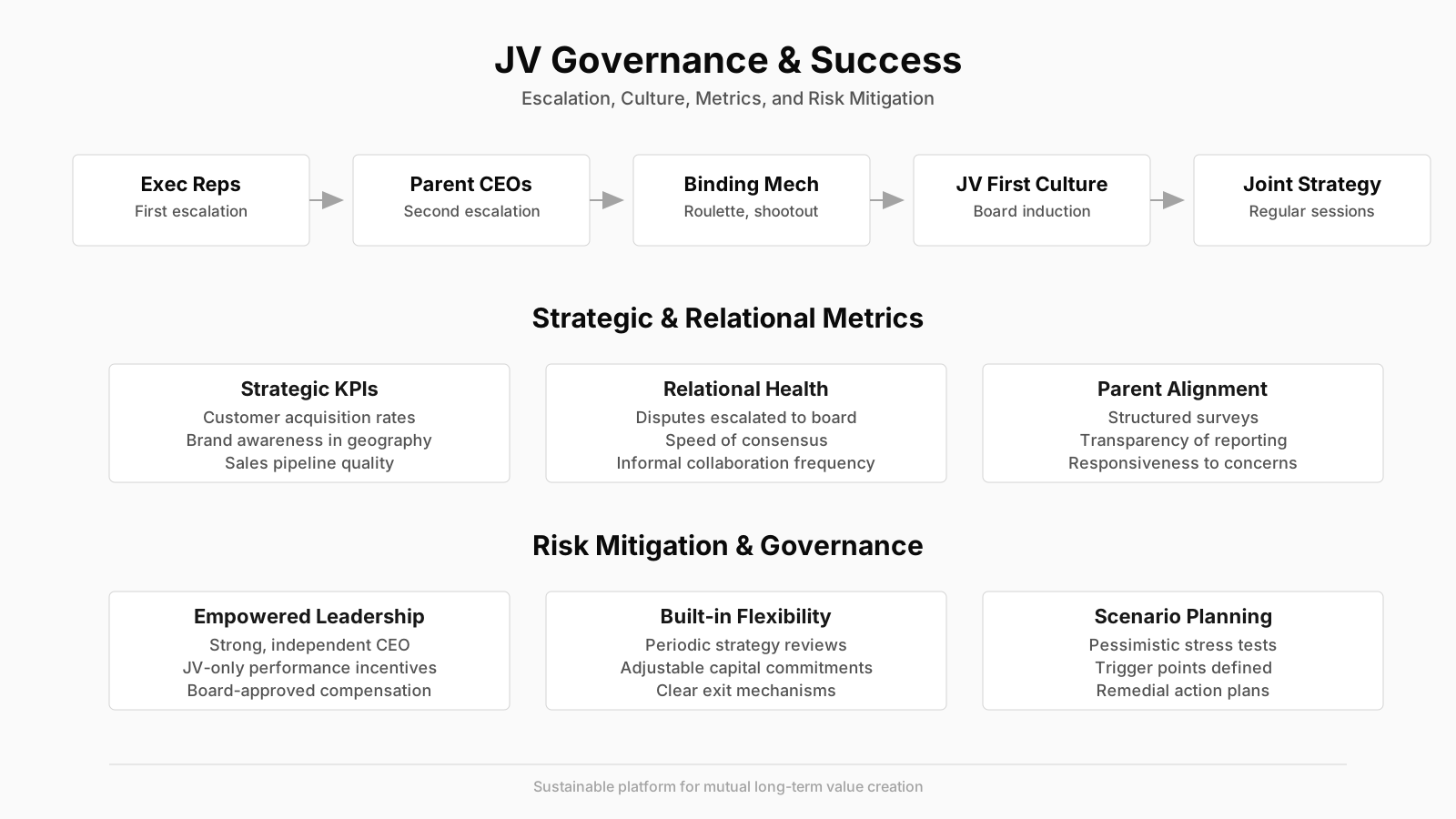
A particularly important governance provision is the deadlock breaking mechanism, which is activated when the board cannot resolve a fundamental disagreement. Options range from a senior executive escalation process, where the CEOs of the parent companies meet to mediate, to a formal put call arrangement, often called a shotgun clause, where one party names a price and the other must either buy or sell at that price. The shotgun clause is a powerful tool but it can be a nuclear option that destabilizes trust if used aggressively. Some ventures prefer a more graduated approach, such as mediation or arbitration by an industry expert. The key is to agree on the mechanism when relationships are warm and rational, not in the heat of a dispute.
Managing Intellectual Property and Value Capture
In technology or innovation driven joint ventures, governance of intellectual property is mission critical. Ambiguity about who owns what, and under what conditions foreground intellectual property can be used, is a frequent source of litigation. A robust governance framework defines three categories of IP: background IP that each parent brings to the venture, foreground IP developed by the venture during its operation, and sideground IP that one parent develops independently but that relates to the venture’s field. The agreement must specify licensing terms, royalties, and restrictions on use after the venture terminates. Many successful joint ventures create a dedicated IP committee with representatives from both parents and the venture’s chief technology officer, tasked with reviewing invention disclosures and patent filings to ensure alignment with the venture’s commercial strategy and each parent’s legal entitlements.
Governing Decision Making and Conflict Resolution on the Ground
While the board sets the direction, the daily governance of a joint venture happens through its management team and the shadow influence of the parent organizations. A common failure mode is the “two boss problem,” where the venture CEO reports to two parent company executives with conflicting priorities. This can be mitigated by appointing a single chairperson of the board who acts as the primary liaison with the CEO, or by establishing a joint steering committee that meets monthly to provide operational guidance and resolve cross functional issues before they escalate. The steering committee should include the venture CEO and senior parent representatives with authority to make decisions, not just observers who must consult back at headquarters after every meeting.
Conflict is inevitable in any partnership. The goal of governance is not to eliminate conflict but to proceduralize it, to channel disagreements into structured dialogues rather than letting them fester or erupt destructively. Some joint ventures adopt a “disagree and commit” protocol: after a set period of debate, the team must align behind a decision, with the dissenting party recording its objection but not blocking action. Others embed formal conflict resolution tiers, moving from direct negotiation to facilitated mediation to binding arbitration. The critical success factor is to institutionalize these processes before conflict arises, because once positions harden, the parties are far less willing to agree on how to disagree.
Key Insights
- Board Design Prevents Strategic Deadlock
- Structuring the board with independent directors or a rotating chairperson who holds a casting vote enables the venture to break deadlocks and pursue a long-term strategy unencumbered by each parent’s immediate commercial biases.
- Agreements Must Enable Adaptation
- Effective joint venture agreements embed pre-agreed mechanisms for periodic review and amendment, ensuring the venture can respond to market shifts without being immobilized by rigid initial terms.
- Intellectual Property Governance Is Critical
- A rigorous IP governance framework that segregates background, foreground, and sideground intellectual property, complete with precise licensing terms and a dedicated oversight committee, significantly reduces litigation risk and keeps the partners commercially aligned.
Human and Cultural Governance to Succeed in Joint Ventures
Even the most elegant governance charter will fail if the human dynamics are neglected. Trust is the invisible glue of any joint venture. It is built through repeated demonstrations of competence, reliability, and goodwill, and it can be destroyed by a single act of perceived bad faith. Leaders of successful joint ventures invest enormous energy in relationship building, from informal dinners between board members to regular town halls where the venture’s employees can see a unified leadership front.
Building Trust and a Unified Leadership Culture
Cultural integration in a joint venture rarely means one culture dominating the other. Instead, successful ventures create a third, hybrid culture that draws on the best elements of each parent while deliberately discarding the dysfunctional ones. This requires a conscious effort to define the venture’s core values, expected behaviors, and leadership principles. In the Starbucks and Tata Global Beverages joint venture in India, for example, the partners spent months co-creating a unique identity that combined Tata’s deep local knowledge and ethical heritage with Starbucks’ relentless focus on customer experience and operational excellence. The venture’s leadership was selected not just for functional skills but for their ability to navigate and bridge the two worlds.
One practical tool is a joint venture culture charter, co-authored by the leadership team and endorsed by both boards, which articulates how decisions will be made, how feedback will be given, how success will be celebrated, and how failures will be handled. This charter serves as a touchstone during times of stress. Furthermore, cross secondments, where employees spend time working inside the partner organization, can accelerate mutual understanding and build a cadre of bilingual and bicultural managers who can shuttle between the venture and the parents, translating not just language but context.
Aligning Incentives and Talent Management
A joint venture’s ability to succeed is directly tied to its ability to attract and retain top talent. If employees perceive the venture as a backwater posting with limited career prospects, performance will suffer. Governance must therefore include a talent philosophy that addresses compensation, career paths, and performance management. Compensation structures should balance market competitiveness with internal equity, and they often require special bonus arrangements tied to the venture’s financial and strategic milestones rather than the parent companies’ corporate schemes. Particularly tricky is the dual loyalty that many seconded employees feel. Explicit agreements on how seconded employees will be evaluated and how their time in the venture will be recognized in parent company promotion processes can prevent the cynicism that corrodes commitment.
Measuring Performance and Adapting to Succeed Over Time
Succeeding in a joint venture means meeting and then exceeding the objectives that justified its creation. But those objectives can evolve, and the venture’s governance must incorporate performance measurement systems that are dynamic and multi-dimensional. Relying solely on financial metrics such as EBITDA or revenue growth is insufficient. Joint ventures need a balanced scorecard that captures strategic milestones, innovation output, customer satisfaction, safety and compliance records, and parent satisfaction surveys. Some ventures go further and establish an independent performance audit function that reports directly to the board, ensuring that the numbers are not politically massaged before they reach decision makers.
Governance Mechanisms to Succeed Through Agile Adaptation
The world changes, and a joint venture that cannot adapt will ossify. Successful ventures build in periodic strategy reviews, often annually, where the board and management together stress test the original business case against new market realities. This is not a bureaucratic exercise; it is a governance imperative. In one particularly instructive case, a logistics joint venture in Southeast Asia discovered through such a review that its original asset heavy model was being disrupted by digital freight platforms. Because the board had a pre-agreed protocol for making strategic pivots, the venture was able to reallocate capital and talent into a new digital division without months of parental renegotiation. The ability to adapt quickly is one of the key reasons why joint ventures should be governed as separate entities with their own delegated authority, not as mere extensions of the parents’ strategy departments.
Key Insights
- Dynamic performance measurement systems
- High-performing joint ventures measure success through a multi-dimensional scorecard that captures strategic milestones, innovation output, customer and parent satisfaction, and safety outcomes, rather than relying on narrow financial metrics such as EBITDA or revenue growth.
- Independent performance audit function
- The most resilient joint ventures establish an independent audit team reporting directly to the board, insulating performance data from political distortion before it reaches key decision makers.
- Periodic strategy review imperative
- Annual strategy reviews, where the board and management jointly stress-test the original business case against current market conditions, are a hallmark of successful joint ventures and a powerful safeguard against stagnation.
- Pre-agreed strategic pivot protocols
- Codified strategic pivot protocols allow the venture to redirect capital and talent within days rather than months, eliminating the need for protracted renegotiations between parent companies.
- Separate entity governance advantage
- To respond nimbly to disruption, joint ventures must operate as autonomous entities with clearly delegated authority, not as extensions of parent-company strategy functions.
The Exit: Governance for the End Game and How to Succeed Even in Departure
Every joint venture eventually ends, whether through a predetermined lifespan, a buyout, a sale to a third party, or an initial public offering. Paradoxically, a well governed exit is one of the clearest indicators of joint venture success. When the partners have built a valuable asset and can exit on predetermined, fair terms, the venture has succeeded on its own terms. The governance framework must therefore include a thoughtful exit strategy at the outset, not as an afterthought. This includes the valuation methodology, tag along and drag along rights, non compete clauses upon exit, and the treatment of jointly developed intellectual property.
Assessing the Right Time to Exit or Restructure
Determining when to exit is a delicate governance judgment. Triggers can include the achievement of the venture’s original purpose, a fundamental divergence in the parents’ strategies, chronic underperformance, or an unsolicited third party offer that creates a value realization opportunity that cannot be ignored. The assessment process for exit should mirror the rigor of the initial partner assessment: it must weigh the financial, strategic, and reputational implications for both parents. A forced exit that leaves one partner feeling cheated can poison the well for future collaborations. The best practice is to build exit review gates into the venture’s lifecycle, perhaps every three to five years, where both boards formally consider whether the joint venture still represents the optimal structure for the shared goal.
When restructuring rather than dissolution is the answer, governance must again prove its flexibility. This could involve changing the equity split, redefining the scope to exclude underperforming product lines, or bringing in a third partner with complementary assets. All of these moves require the same careful dance of assess, govern, and succeed that marked the original creation. The joint venture agreement should explicitly allow for such amendments and specify the approval thresholds required, so that one party cannot block a necessary evolution out of stubbornness or internal politics.
Common Pitfalls and How to Use Assessment and Governance to Avoid Them
After decades of research and practice, the patterns of joint venture failure are well known, yet they repeat with alarming regularity. Understanding these pitfalls is not a gloomy exercise; it is essential risk management. One pervasive pitfall is the assumption that a 50/50 split is fair and will therefore lead to harmony. In practice, equal ownership without a tie breaker often produces paralysis, as neither party can force a decision when they disagree. The solution, as discussed, is to design a deadlock mechanism and to resist the gravitational pull of symbolic equality when a more functional governance arrangement would be a 51/49 split with clear protections for the minority partner.
Another trap is the “set and forget” mindset, where after the launch party, parental attention wanders and the joint venture is left without strategic sponsorship. Governance is not a one time design task; it requires ongoing engagement from senior sponsors who champion the venture within their own organizations and ensure it receives the resources, talent, and political cover it needs. A related pitfall is the failure to manage the information asymmetry between the venture and its parents. When the venture’s management withholds bad news, the board cannot govern effectively. Creating a culture of transparency, reinforced by regular site visits, collaborative IT systems, and a whistleblower policy, is a governance necessity.
Perhaps the most insidious pitfall is the erosion of trust caused by seemingly minor breaches, such as one parent hiring away key venture staff, using venture data for its own competitive purposes, or publicly taking credit for the venture’s successes while blaming the partner for failures. Such actions corrode the relational capital that all governance systems depend upon. The remedy is to clearly codify expected behaviors in the joint venture agreement and in the culture charter, and for the board to hold both parents accountable when those norms are violated.
Essential Insight Summary
- Equal ownership can cause paralysis
- Without a tie breaker, a 50/50 split frequently locks partners into deadlocks that stall critical decisions, making a 51/49 structure with robust minority protections a more functional design.
- Avoid the set and forget mindset
- Ongoing senior sponsorship after launch is vital to continuously secure the resources, top talent, and political backing the joint venture needs to thrive.
- Manage information asymmetry proactively
- Building a transparent culture through regular site visits, shared IT systems, and clear whistleblower policies surfaces emerging problems early, preventing concealed issues from eroding board effectiveness.
- Codify expected behaviors clearly
- Embedding behavioral norms directly into the joint venture agreement and a dedicated culture charter creates an enforceable framework that holds both parents accountable for actions that can corrode trust.
- Protect relational capital from breaches
- Minor transgressions like staff poaching or data misuse can inflict lasting damage on the partnership, so the board must consistently enforce agreed-upon ethical standards to preserve mutual confidence.
Conclusion: Assess, Govern, Succeed as a Continuous Commitment
Building a joint venture that works is not a singular act of legal engineering; it is a continuous practice of strategic alignment, disciplined assessment, adaptive governance, and relentless focus on shared success. The early phases of partner evaluation and due diligence set the stage, but the real drama unfolds in the day to day decisions, the honest boardroom debates, and the cultural interactions that shape the venture’s destiny. Leaders who approach joint ventures with humility, a learning orientation, and a commitment to the loop of assess, govern, and succeed are far more likely to beat the odds and create an enterprise that endures and prospers.
The frameworks and examples explored in this article, from the initial strategic fit analysis and cultural due diligence to the design of board protocols, deadlock mechanisms, and flexible exit strategies, provide a toolkit for practitioners. Yet no framework works without human wisdom and judgment. The most successful joint ventures are those where both parents view the partnership not as a transaction to be optimized but as a relationship to be cultivated, where governance becomes an enabler rather than a straitjacket, and where success is measured not merely in financial returns but in the mutual learning and growth that the collaboration enables. In a world where no company can succeed entirely alone, mastering the art of joint ventures is a strategic capability of the highest order.
Designing Decision Rights Before You Need Them
Most joint venture agreements are detailed about equity splits, board seats, and dividend policies, yet remarkably thin about how decisions actually get made. In practice, the ventures that hold up best are the ones where the parents spend real time mapping decision rights before the ink dries. That means identifying which choices belong to the venture's own management team, which require board approval, and which are so fundamental that they escalate to the parent CEOs. A useful exercise is to run three or four simulated decisions in the first ninety days, such as approving an unbudgeted capital request or replacing a key executive, and watch where the process stalls. If the answer is "we would have to wait and see," the governance design is not finished.
What makes this especially difficult is what some call The Alignment Paradox. Both parent companies can approve the same strategy document and still leave the room with different assumptions about pricing freedom, hiring pace, or technology transfer. The venture team then spends months navigating mixed signals that neither parent intended to send. A practical countermeasure is to set up a quarterly calibration session where each parent separately answers five or six questions about what success looks like, what worries them most, and what they would stop funding if pressure mounted. Comparing those answers side by side often exposes drift long before it shows up in financial results.
Governance also needs teeth, which means tying parent behavior to consequences. Some parent companies pre-fund a small steering reserve that is released to the venture only when both sides deliver agreed contributions, such as seconding promised talent or opening a distribution channel. Others build explicit exit triggers, not because they expect failure, but because a clear, pre-agreed exit reduces the incentive to quietly undermine a partner. When both sides know how a disagreement will be resolved, a buyout will be priced, or a deadlock will be broken, they tend to negotiate more honestly from the start.
Advance Your Career with Professional Certification
Professional project management certification provides a standardized framework that empowers professionals to deliver projects on time and within budget, directly boosting organizational efficiency. A globally recognized project management certification not only sharpens your leadership and risk management skills but also signals to employers a verifiable commitment to best practices, opening doors to senior roles and higher salaries. For businesses, certified project managers consistently drive better stakeholder alignment and resource optimization, turning strategic goals into measurable outcomes and creating a competitive advantage in any industry.
In today's competitive landscape, formal recognition through professional development sets exceptional product leaders apart, and earning a product owner certification validates your ability to steer vision, prioritize value, and bridge business with technology. This structured learning not only deepens your agile and strategic thinking but also signals to employers and partners that you can mitigate risks and drive measurable outcomes—crucial when aligning cross-functional teams in complex ventures. As organizations increasingly seek proof of competence, certified product owners command higher credibility, accelerate trust within joint initiatives, and position themselves as the linchpin between governance and execution. Ultimately, that credential becomes a catalyst for career acceleration and an assurance of sustainable, collaborative success.
In today's competitive business landscape, earning a professional HR management certification validates your expertise in strategic workforce planning, compliance, and talent development, giving you a distinct edge in the job market. This credential not only boosts your credibility but also equips you with advanced frameworks to align human capital with organizational goals, directly impacting productivity and retention. For companies forming joint ventures, certified HR leaders are better prepared to assess cultural compatibility, design equitable governance structures, and harmonize policies across entities—turning potential friction into a seamless collaboration that drives shared success.