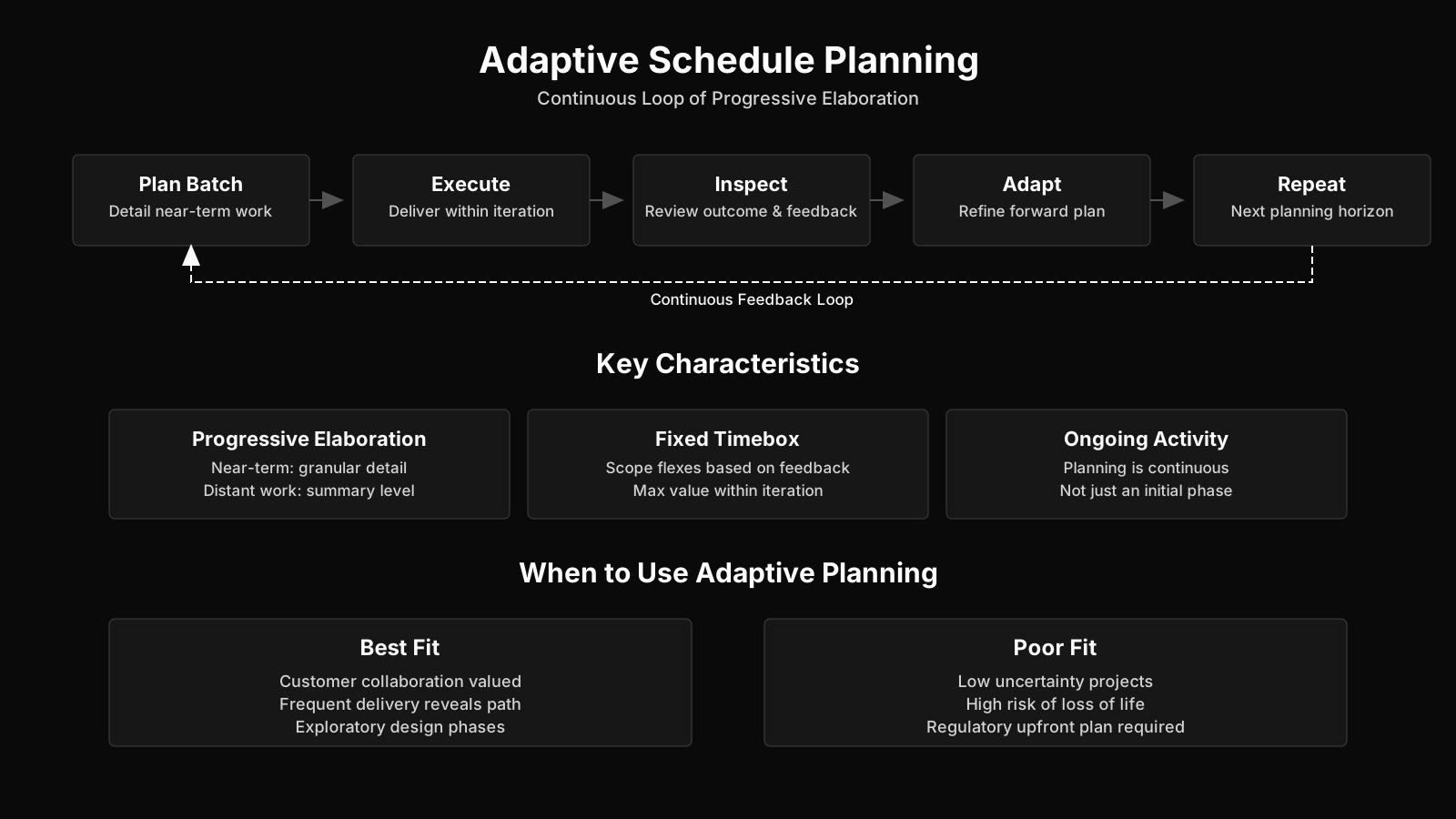
Adaptive schedule planning is a project scheduling methodology characterized by the iterative development and continuous refinement of the project timeline in response to emerging information, stakeholder feedback, and changing conditions. Unlike traditional predictive planning that establishes a fixed schedule baseline early in the project, adaptive scheduling treats the plan as a living artifact, where near-term work is detailed and committed while future work remains at a higher level of abstraction until it enters the immediate planning horizon. This approach is fundamental to agile and hybrid project management but appears across many modern delivery frameworks that operate under uncertainty.
Adaptive Schedule Planning: At a Glance
| Key Concept | Summary |
|---|---|
| Definition | Adaptive schedule planning is a scheduling discipline in which the project timeline is developed iteratively and refined continuously, incorporating emergent data, stakeholder feedback, and shifting constraints to maintain alignment with evolving objectives. |
| Living Plan | In contrast to predictive planning, adaptive scheduling treats the schedule as a dynamic artifact: near-term commitments are defined with precision while deferred work remains intentionally coarse-grained, gaining detail only as it approaches the execution horizon. |
| Planning Horizon | Planning is intentionally constrained to what is reliably knowable. Detailed task breakdowns exist solely for the current iteration, while the broader backlog is sequenced by priority and relative effort, preserving flexibility for later decisions. |
| Origins | The approach synthesizes software engineering frameworks such as Scrum and Extreme Programming, Lean principles like just-in-time scheduling from the Toyota Production System, and iterative decision models including the OODA loop pioneered in military strategy. |
| Timeboxing | Delivery is structured in fixed-length iterations, typically one to four weeks, whose immovable end date enforces rigorous prioritization and compels scope negotiation under real constraints. |
| Estimation | Teams employ relative sizing techniques such as story points paired with empirically derived velocity metrics from completed iterations to generate evidence-based delivery forecasts. |
| Reprioritization | Product owners reassess backlog priority at every iteration boundary, incorporating market shifts, user feedback, and regulatory developments to perpetually optimize the schedule for maximum value realization. |
| Feedback Cycles | Structured touchpoints including daily stand-ups, backlog refinement sessions, and iteration reviews create rapid inspect-and-adapt loops that tether the schedule to actual progress and emergent realities. |
| PMBOK | The PMBOK Guide Seventh Edition integrates adaptive scheduling within its broader guidance on development approach and life cycle selection, advocating iterative execution of the Develop Schedule process for each forthcoming increment rather than a single upfront planning effort. |
| PRINCE2 | PRINCE2 operationalizes adaptive scheduling through its management by stages principle, partitioning the project into discrete stages and restricting detailed planning to the immediate upcoming stage instead of the full project lifespan. |
What Is Adaptive Schedule Planning?
The adaptive schedule planning definition encompasses more than simply leaving room for change; it is a deliberate strategy that structures the scheduling process around iterative cycles, empirical feedback, and progressive elaboration. In this context, the project schedule is not a single monolithic document approved at the outset. Instead, it consists of a high-level roadmap that outlines major milestones and releases, coupled with detailed iteration-level plans that are created just in time for execution. This enables the team to incorporate new knowledge, reprioritize features, and adjust capacity assumptions without triggering a formal change control process for every shift.
At its core, adaptive schedule planning rests on the principle that uncertainty cannot be eliminated by upfront analysis alone. The planning horizon is therefore intentionally limited to the foreseeable future, while everything beyond that horizon remains provisional. Many practitioners find it helpful to contrast this with predictive scheduling, where the entire work breakdown structure is decomposed into activity-level estimates before any work begins. In adaptive environments, detailed task-level sequencing, resource allocation, and duration estimates are produced only for the current iteration or the next few weeks. The remaining backlog remains ordered by priority and relative size, but not yet broken into detailed schedule activities. This distinction is critical because it changes the nature of commitments, shifting from a fixed scope and date contract toward a set of timeboxed deliverables that emerge based on value and feasibility.
Key Insights on Adaptive Schedule Planning
- Iterative strategy with feedback
- Adaptive schedule planning deliberately structures schedules around feedback-driven cycles, empirical learning, and progressive refinement, rather than simply accommodating unplanned change.
- Roadmap plus detailed iterations
- The schedule pairs a high-level roadmap that anchors major milestones and releases with detailed iteration plans that are developed just in time, enabling precise near-term direction while preserving strategic adaptability.
- Limited planning horizon
- Because upfront uncertainty makes exhaustive planning unreliable, detailed scheduling efforts are confined to what is currently foreseeable, and work beyond that horizon is kept deliberately provisional until more knowledge emerges.
- Contrast with predictive scheduling
- Unlike predictive scheduling, which breaks down the entire work breakdown structure into activity-level estimates before execution, adaptive planning reserves detailed estimation for near-term tasks, treating remote work as high-level placeholders.
- Commitments become timeboxed
- The method replaces fixed-scope, fixed-date contracts with commitments to deliver value in short timeboxed increments, where the deliverables' content is shaped by ongoing assessments of value and feasibility.
Origins and Cross-Industry Context
Understanding the origins of adaptive schedule planning requires looking beyond project management into domains that have long grappled with high uncertainty and rapid change. In software engineering, the Agile Manifesto’s preference for “responding to change over following a plan” crystallized a movement that had been experimenting with lightweight, iterative scheduling since the 1990s. Methodologies such as Scrum, Extreme Programming, and the Dynamic Systems Development Method formalized the idea of fixed-length iterations with planning confined to the immediate cycle. Before that, manufacturing systems influenced by Lean thinking, particularly the Toyota Production System, demonstrated the power of pull-based scheduling and just-in-time decision making, where work is authorized only when capacity is available and need is certain, and detailed schedules are not imposed far in advance.
Military strategy also contributed to adaptive planning concepts. Colonel John Boyd’s OODA loop (Observe, Orient, Decide, Act) emphasized the competitive advantage of rapid cycling through decision processes over rigid adherence to a predetermined plan. The idea was not to abandon planning altogether but to make the planning cycle faster than the rate of environmental change. When translated into project scheduling, this means that the frequency of replanning must exceed the frequency of disruptive events. While those military origins are not directly referenced in project management standards, the underlying logic feeds into the iterative cadences that adaptive schedule planning relies upon. Within project management, the concept evolved primarily through software development and later through the expansion of agile principles to non-IT domains, where complex problems and evolving stakeholder needs made predictive schedules untenable.
Key Components and Characteristics
Several key components of adaptive schedule planning distinguish it from traditional schedule development. The first is timeboxing. Work is organized into fixed-duration iterations, typically one to four weeks, with a firm end date that acts as a forcing function for prioritization and scope negotiation. The schedule is driven by the rhythm of these timeboxes rather than by a network of dependencies stretching into the distant future. During each iteration, the team plans only the work they can complete within that period, pulling items from a prioritized backlog.
Another essential characteristic is relative estimation paired with velocity tracking. Instead of estimating absolute durations for every task, teams assign relative size units, such as story points or ideal days, based on comparative complexity. Historical velocity, the amount of work completed in previous iterations, becomes the primary input for forecasting how much can be delivered in future timeboxes. This creates an adaptive feedback loop where schedule forecasts adjust organically as actual performance data accumulates, rather than relying on static duration estimates that may be inaccurate from the start. A common observation in such environments is that a modest decline in velocity for a few iterations can automatically compress the forecasted scope for a release date, prompting conversations about trade-offs long before a crisis emerges.
Frequent reprioritization is a third pillar. Because the schedule is not locked into a fixed sequence of activities, the product owner or sponsor can reorder the backlog every iteration based on shifting market conditions, customer feedback, or regulatory changes. The schedule model is thus continually optimized for value delivery. Supporting mechanisms such as daily stand-up meetings, backlog refinement sessions, and iteration reviews provide the transparency needed to detect problems early and adjust plans without accumulating delay. These ceremonies create short cycles of inspection and adaptation that keep the schedule from diverging from reality. The schedule baseline in adaptive planning is often a release burn-up or burn-down chart that tracks progress against a moving target, rather than a static Gantt chart with hard constraints.
Key Takeaways on Adaptive Scheduling
- Timeboxed iteration planning
- Work is broken into fixed intervals of one to four weeks, each with a firm end date that compels teams to prioritize scope and negotiate trade-offs rather than managing intricate dependency networks.
- Relative estimation with story points
- Rather than estimating in absolute hours, teams assign story points or ideal days to reflect relative complexity, enabling consistent cross-task comparison and reducing the illusion of precision.
- Velocity-driven forecasting loop
- Historical velocity serves as the primary gauge for forecasting future throughput, establishing an adaptive loop in which predictions continuously recalibrate as actual performance data grows.
- Frequent backlog reprioritization
- Product owners reorder the backlog at the end of each iteration, aligning work with evolving market needs, customer insights, or compliance requirements to ensure the schedule consistently delivers the highest-value outcomes.
- Ceremonies and dynamic baselines
- Recurring ceremonies like daily stand-ups, backlog refinement, and iteration reviews surface issues early through radical transparency, while release burn-up or burn-down charts replace rigid Gantt charts as a living schedule baseline, reflecting actual progress rather than fixed constraints.
Adaptive Schedule Planning in Project Management Frameworks
The adaptive schedule planning in PMBOK framework is not called out as a named process, but its principles are embedded in the guidance on development approach and life cycle selection. The PMBOK Guide, Seventh Edition, describes adaptive and hybrid development approaches, noting that in adaptive life cycles, the Planning process group processes are revisited regularly. The Develop Schedule process, which integrates activity sequences, durations, and resources into a schedule model, is performed iteratively. Each iteration produces a detailed schedule for the upcoming increment while maintaining a high-level release plan for the remainder of the project. The concept of a schedule baseline still exists but is typically held at the release or milestone level, with iteration-level baselines set only when an iteration begins.
PRINCE2 addresses adaptive scheduling through its principle of management by stages. A project is divided into management stages, and detailed planning is performed only for the current and next stages. This mirrors adaptive thinking by restricting the planning horizon to what can be reasonably foreseen, while higher-level plans remain at a summary level. The product-based planning technique, with its focus on product descriptions and quality criteria, complements adaptive scheduling by deferring detailed activity planning until the stage boundary, allowing for new insights. The Project Board authorizes one stage at a time, and the schedule is updated at each stage boundary assessment, which provides regular checkpoints for strategic adaptation.
In pure agile settings, Scrum provides the most recognizable instantiation of adaptive schedule planning. Sprint Planning produces a detailed schedule for the sprint, while Product Backlog refinement and Sprint Reviews continuously update the broader release schedule. Kanban departs from iteration timeboxes but still embodies adaptive scheduling through a continuous flow model where work items are pulled based on capacity and classes of service, and the schedule is managed through lead time and cycle time metrics. In hybrid models that combine elements of predictive and adaptive approaches, a master schedule might outline major phase gates and fixed dates for procurement or regulatory submissions, while the internal delivery teams operate with iterative planning cycles. The adaptive element handles the high-uncertainty work, and the predictive shell provides the governance needed for external commitments.
The BVOP Perspective on Adaptive Scheduling
Business Value-Oriented Project Management introduces practices that align naturally with adaptive schedule planning, particularly its treatment of scope as a flexible spectrum rather than a fixed constraint. BVOP adaptive schedule planning concepts are visible in the method’s five-level scope scale, which ranges from Definite to Unlikely, allowing features to migrate between levels as new information emerges without being treated as scope creep. This directly supports the adaptive scheduling principle of adjusting what gets delivered within a given timeframe instead of constantly renegotiating the deadline. The loss of formality around scope change reduces the friction that often causes adaptive plans to stall, because reordering is seen as feedback, not failure.
BVOP also advocates relational effort points for estimation, a practice that reinforces adaptive forecasting. Instead of converting effort into hours, teams compare work items to a reference baseline, which keeps the schedule model decoupled from individual productivity assumptions that often break down in creative knowledge work. When schedule adaptation is needed, the relative sizing framework makes trade-off decisions faster because the impact on velocity and release dates can be visualized without recalculating every activity. This approach fits tightly with the iterative planning cadence and the emphasis on empirical data that characterize adaptive schedule planning across different frameworks.
Essential BVOP Scheduling Insights
- Scope as flexible spectrum
- BVOP views scope as a flexible continuum from Definite to Unlikely, so features shift across certainty levels with new learning rather than being dismissed as scope creep.
- Five-level scope scale
- The five-level scope scale enables adaptive scheduling by letting teams adjust the feature mix delivered inside a fixed timeframe, circumventing the need to continually renegotiate deadlines.
- Reduced change friction
- Lowering the formality of scope changes treats reordering as actionable feedback, not a failure signal, which sustains momentum in adaptive plans.
- Relational effort estimation
- Relational effort points compare work to a reference baseline, detaching the schedule from individual productivity assumptions that consistently break down in creative knowledge work.
- Faster trade-off decisions
- The relative sizing framework speeds trade-off decisions by making the effect on velocity and release dates immediately visible, eliminating the need to recompute every activity.
Practical Application and Use
In practice, adaptive schedule planning application is most common in projects with high requirements volatility, where the problem domain is novel or the technology is emerging. Software product development, digital transformation initiatives, research and development projects, and organizational change programs frequently adopt this approach. The project manager or scrum master facilitates planning events on a regular cadence, roles such as the product owner manage the backlog priority and scope trade-offs, and the team provides the empirical performance data that feeds the forecast. The schedule is not a static document owned by a single planner but a collaborative artifact maintained through continuous communication.
Imagine a team building a new customer-facing platform. They start with a release goal three months out and a backlog of features estimated in story points. Every two-week sprint, they select a set of backlog items, produce a detailed task-level plan for that sprint only, and deliver a working increment. After each sprint, stakeholders review the increment, and market conditions might shift. At that point, the product owner reorders the backlog, perhaps dropping a feature originally planned for month three in favor of a newly critical capability. The release burn-up chart shows that at current velocity, the team can deliver about eighty percent of the originally envisioned scope by the target date, and a conversation about date versus scope trade-offs happens without a formal change request. This represents adaptive schedule planning in motion: the near term is certain and committed, the medium term is forecast based on trends, and the distant term is held loosely enough to absorb change without breaking the plan.
Common Challenges, Pitfalls, and Misconceptions
One of the most persistent adaptive schedule planning challenges is the misconception that it means no planning at all. Teams sometimes interpret the iterative, just-in-time nature of the approach as permission to avoid any forward-looking schedule analysis, leading to chaotic delivery with no predictability. In reality, adaptive schedule planning demands rigorous planning within each iteration and a disciplined approach to backlog refinement, forecasting, and stakeholder communication. The difference is the frequency and granularity of planning, not its absence.
Another common pitfall is treating every schedule change as a legitimate adaptation when it is actually scope creep in disguise. Without clear decision rules and a strong product owner, stakeholders can continuously add low-value features under the guise of new learnings, causing the completion date to drift. A well-run adaptive schedule maintains a trade-off discipline where adding something requires removing something else of equal size, keeping the forecast honest. Additionally, organizations that require firm, up-front budget and date commitments often struggle with the apparent looseness of adaptive scheduling. Bridging this gap requires building a release plan with confidence intervals and communicating the probability of hitting certain dates, rather than offering a single deterministic date. When project governance does not understand probabilistic forecasting, the adaptive approach can be rejected as unprofessional, even when it provides more realistic estimates than a detailed but fragile early plan.
Another practical difficulty is the skill shift required for project managers and schedulers. Moving from a command-and-control schedule to a facilitative planning role can be uncomfortable. The tools used also matter: conventional scheduling software built around critical path method assumptions often impedes adaptive processes. Teams frequently resort to lightweight digital whiteboards, agile project management tools, or even physical boards, which can cause friction when integrating with enterprise reporting systems. Acknowledging these constraints up front and planning for a hybrid tooling strategy is often necessary.
Key Insights on Adaptive Scheduling Pitfalls
- Adaptive planning still requires planning
- Treating adaptive scheduling as an absence of planning invites chaos; in practice the method forces tighter iteration-level planning and constant backlog grooming to sustain predictability.
- Scope creep disguised as adaptation
- Stakeholders often introduce low-value items under the banner of learning; effective adaptive practices enforce strict trade-off discipline by replacing existing work of equivalent size with each new request.
- Confidence intervals instead of firm dates
- Organizations that demand fixed budgets and deadlines clash with adaptability; instead, release plans must convey expected dates as confidence intervals, explicitly stating the likelihood of delivery rather than a single point estimate.
- Project managers shift to facilitators
- Transitioning from command-and-control to a facilitative planning role challenges many project managers and schedulers, but this shift is indispensable for the success of adaptive methods.
- Hybrid tooling strategy needed
- Legacy critical path tools can hinder adaptive workflows; high-performing teams adopt lightweight visual boards while deliberately designing a hybrid tooling strategy that satisfies enterprise reporting requirements.
Relationships to Other Concepts
The distinction between adaptive schedule planning vs rolling wave planning is often a source of confusion because both defer detailed planning for future work. Rolling wave planning, as described in the PMBOK Guide, is a technique where near-term work packages are decomposed in detail while far-term work is left at a higher level. However, rolling wave planning is typically used within a predictive life cycle: the overall scope baseline is fixed, and only the granularity of the work breakdown structure expands over time. The schedule baseline is still set in advance and changes require formal control. Adaptive schedule planning goes further by allowing the scope itself to shift within the time boundary, and the schedule baseline at the release level is regularly recalibrated based on empirical data and reprioritization, not just decomposition. It is a difference in the level of control over scope, not merely the timing of detail.
Progressive elaboration is a related term used in PMBOK that simply refers to the continuous improvement and detailing of plans as more information becomes available. It is a parent concept that applies to both predictive and adaptive environments. Adaptive schedule planning is a specific application of progressive elaboration where the learning cycles are structured as fixed iterations and the output of each cycle directly informs the next slice of the schedule. Schedule compression techniques such as crashing and fast-tracking are not inherently adaptive; they are corrective actions applied to a predictive schedule that is falling behind. However, in adaptive contexts, schedule compression is rarely a formal activity because the schedule is constantly being optimized as the highest-priority work is sequenced first. If a date is threatened, the response is to descope the lowest-value remaining items rather than to add resources or overlap phases artificially.
Velocity and capacity planning are tightly coupled to adaptive schedule planning. Velocity is the empirically derived throughput of the team, used to forecast how many iterations are needed for remaining work. Capacity planning adjusts for planned absences or team changes, ensuring that commitments per iteration are realistic. These concepts replace the traditional focus on activity duration estimates and resource histograms. The connection between adaptive schedule planning and risk management is also notable. By limiting the detailed planning horizon, the approach reduces the likelihood of executing a plan built on assumptions that are no longer valid, directly mitigating the risk of obsolete schedules and the wasted effort of maintaining them.
Evolution and Current Thinking
The evolution of adaptive schedule planning reflects a broader shift in how organizations view uncertainty. Early project management practice, heavily influenced by construction and aerospace, treated schedule indeterminacy as a weakness to be eliminated through exhaustive upfront analysis. The rise of software engineering and the agile movement in the 1990s and early 2000s demonstrated that for complex, knowledge-based work, uncertainty cannot be analyzed away; it must be managed empirically through short feedback loops. This recognition prompted a gradual incorporation of adaptive techniques into mainstream standards, including the heavy emphasis on tailoring in the seventh edition of the PMBOK Guide.
Current thinking acknowledges that adaptive schedule planning is not a one-size-fits-all solution. Projects with low uncertainty, high regulatory constraints, and fixed physical deliverables, such as constructing a bridge or launching a satellite, still benefit from predictive scheduling with rigorous change control. Where the pendulum has swung too far, some organizations have experienced co-ordination challenges across multiple adaptive teams, leading to a renewed appreciation for light-touch synchronization mechanisms such as scaled agile frameworks and regular release train planning events. A maturing view sees adaptive schedule planning as a continuum: a project can be rigidly predictive for some workstreams and aggressively adaptive for others, with integration points at defined cadences.
Modern thinking also emphasizes probabilistic forecasting over deterministic dates. Methods such as Monte Carlo simulation applied to throughput data, rather than activity duration estimates, allow project managers to communicate schedule confidence in terms of likelihoods: for example, an eighty-five percent chance of delivering a feature set by a given date. This aligns with the adaptive philosophy that a schedule is a hypothesis to be validated and updated, not a promise set in stone. The conversation is moving away from tracking variance against an arbitrary baseline and toward managing flow and value delivery. Ultimately, adaptive schedule planning is best understood not as a specific technique, but as a mindset that recognizes the primacy of feedback, values working outputs over perfect plans, and designs scheduling cadences that keep pace with the rate of discovery in the project environment.
Key Takeaways on Adaptive Scheduling
- Uncertainty managed, not eliminated
- Traditional project management sought to eliminate schedule uncertainty through exhaustive upfront analysis, yet complex knowledge work now shows that empirical approaches with rapid feedback loops transform uncertainty into a manageable current rather than a defect.
- Adaptive planning as a continuum
- Adaptive scheduling is now understood as a spectrum, not a binary choice; highly predictive plans remain essential for heavily regulated domains, while blended strategies synchronize adaptive and predictive workstreams at defined cadences through integration points that impose minimal overhead.
- Schedules as testable hypotheses
- Rather than treating schedules as fixed promises, advanced teams deploy probabilistic forecasting via Monte Carlo simulation to express delivery confidence as likelihood distributions, keeping the schedule a living hypothesis that is refined as new information emerges.