Active listening is defined in project management as a structured form of communication in which the listener fully concentrates on, understands, responds to, and remembers what the speaker is saying, while also observing nonverbal cues and suspending judgment. It goes far beyond simply hearing words; it is an intentional, disciplined practice that builds trust, surfaces hidden requirements, resolves conflicts, and strengthens stakeholder relationships across every phase of a project.
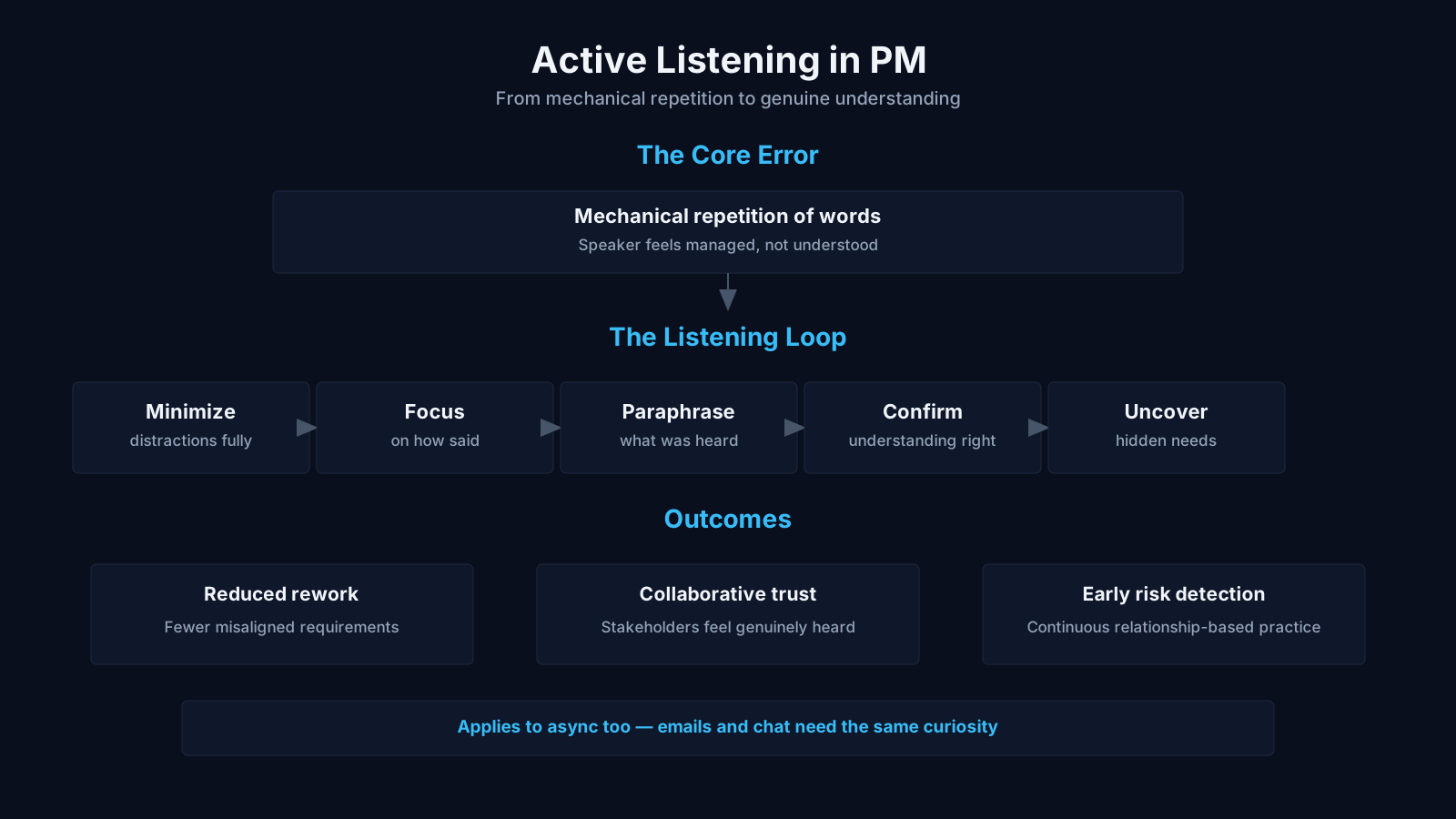
Active Listening: A Quick Summary of Key Topics
| Key Concept | Summary |
|---|---|
| Core Definition | Active listening is a deliberate, structured communication method in which the listener gives full attention, interprets nonverbal signals, and postpones evaluation to build psychological safety and elicit unarticulated requirements. |
| Layered Communication | Stakeholder messages carry explicit demands, hidden concerns, and emotional undercurrents. Active listening decodes all three layers simultaneously to grasp the complete intent. |
| Early Warning System | By catching dissonance between confident words and hesitant posture, active listening functions as a project early-warning system, exposing technical roadblocks weeks before they appear on formal risk registers. |
| Asynchronous Listening | In email and chat, active listening shifts to reading tone, word choice, and omission patterns with the same disciplined curiosity used face-to-face, revealing unstated priorities in written exchanges. |
| Therapeutic Roots | Carl Rogers' client-centered therapy proved that feeling deeply heard unlocks a person's own problem-solving capacity, a foundational insight that active listening brings to stakeholder relationships. |
| Safety-Critical Practice | Aviation crew resource management and clinical medicine treat active listening as a safety-critical behavior that prevents catastrophic errors, lending the skill rigorous operational credibility far beyond its counseling origins. |
| PMBOK Endorsement | The PMBOK Guide lists active listening as an essential interpersonal skill, recognizing that technical prowess alone cannot sustain complex projects without nuanced stakeholder engagement. |
| Undivided Attention | This first component demands total sensory presence: devices are set aside, the judging mind is quieted, and all cognitive resources converge on the speaker to block internal and external distractions. |
| Deferred Judgment | This component requires listeners to hold analysis in abeyance until the complete message has been delivered, tolerating ambiguity despite the brain's instinct to categorize and evaluate prematurely. |
| Reflective Inquiry | Reflecting paraphrases the speaker's core message to confirm understanding and demonstrate full engagement; clarifying follows up with open-ended, non-leading questions that excavate deeper meaning without imposing assumptions. |
What Is Active Listening in Project Management?
Active listening in project management refers to a deliberate interpersonal skill used to decode both the content and emotional subtext of spoken messages. Unlike routine conversation where the mind often wanders to formulating a reply, active listening demands that the project practitioner temporarily set aside their own agenda, assumptions, and urge to jump in with solutions. In the project environment, this skill is not a soft art form reserved for coaching sessions — it is a functional tool that directly shapes requirements gathering, risk identification, stakeholder alignment, and team morale. The discipline rests on the recognition that what a stakeholder says is often layered: there is the explicit request, the unstated concern, and the emotional state that colors it all.
A project manager who actively listens during a status meeting, for example, will detect a developer’s hesitation when estimating a task. That hesitation might be voiced as “I think we’ll be fine,” but the pause and downward glance indicate something else. The active listener notices the mismatch between verbal confidence and nonverbal uncertainty, and then gently probes further. This small intervention can uncover a technical blocker weeks before it appears on the risk register. In this way, active listening functions as an early warning system embedded in everyday interactions, not a standalone process step.
The concept also extends to the written and asynchronous communication that permeates modern projects. Reading between the lines of an email, detecting frustration in a chat message, or interpreting what is left unsaid in a formal report all draw on the same mental posture that active listening cultivates. It is, at its core, a mindset of genuine curiosity about the other person’s frame of reference and a willingness to be surprised by what you learn. Many experienced practitioners argue that active listening is the single most underinvested skill in project leadership, precisely because its results are harder to quantify than those of a Gantt chart or a budget variance report .
Core Insights on Active Listening
- Decoding content and emotional subtext
- Active listening demands that project practitioners suspend their own agenda long enough to decode both the explicit request and the deeper, unspoken concern shaping a stakeholder's words.
- Early warning system in interactions
- Detecting misalignment between confident verbal assertions and hesitant nonverbal cues during status meetings can surface technical blockers weeks before they appear in formal risk registers.
- Extends to written communication
- This same attentive mindset applies to asynchronous communication, where it means interpreting subtext in emails, sensing irritation in instant messages, and noting what remains deliberately unsaid in reports.
- Underinvested skill in leadership
- Seasoned project leaders regard active listening as the most underinvested skill in their domain, because its influence on outcomes is far harder to measure than schedule slippage or budget variance.
Origins and Cross-Industry Foundations
The origins of active listening as a formal concept are often traced back to the work of psychologist Carl Rogers in the mid-twentieth century, who pioneered client-centered therapy and the idea that unconditional positive regard and reflective listening could unlock personal insight. Rogers demonstrated that when a person feels truly heard — without judgment, without premature interpretation — their capacity to solve their own problems increases dramatically. This therapeutic lineage gave active listening a certain reputation as a counseling technique, but over time aviation, medicine, and high-reliability industries recognized its operational value. In cockpit crew resource management, for instance, listening without defensiveness to a junior officer’s concern about weather conditions is not just polite; it is a safety-critical behavior that prevents catastrophic errors.
In clinical medicine, studies have long shown that physicians who interrupt patients after an average of eleven seconds miss crucial diagnostic information. The remedy prescribed in medical education is precisely active listening: letting the patient narrate their experience, using open-ended prompts, reflecting back key symptoms, and only then moving to the diagnostic checklist. Manufacturing and quality management circles adopted similar practices under the Lean umbrella, where “go and see” at the gemba involves listening carefully to frontline workers rather than relying on distant reports.
From these diverse roots, active listening migrated into project management as the discipline matured from a purely technical execution role into a strategic and people-centered function. The Project Management Institute began to list active listening explicitly among the interpersonal skills in the PMBOK® Guide, recognizing that technical competence alone could not sustain complex, cross-functional initiatives. Today, the skill is seen as foundational across predictive, Agile, and hybrid life cycles, even though its application takes slightly different forms in each context. Understanding these origins reinforces the notion that active listening is not a feel-good add-on; it is a risk management discipline borrowed from fields where listening failures have direct, measurable consequences.
Key Components of Active Listening
The key components of active listening in project management break down into a cluster of interrelated mental and verbal behaviors that create a continuous feedback loop between speaker and listener. The first component is paying attention, which seems obvious but is routinely undermined by notification pings, multitasking, and mental rehearsal of one’s own next talking point. Paying attention means directing full sensory focus toward the speaker: maintaining comfortable eye contact, noting body language, putting away devices, and mentally committing to the moment. It also involves an internal quieting of the evaluative mind that wants to label, categorize, or dismiss what is being said.
Withholding judgment forms a second, harder component. The project environment is loaded with triggers that invite snap judgments — a stakeholder might present a scope change that looks unreasonable, a team member might complain about a deadline that seems generous, a sponsor might ask a question that feels uninformed. The active listener disciplines themselves to hear the message fully before allowing evaluation to enter the conversation. This does not mean accepting everything at face value; it means deferring the analysis until sufficient information has been received. In practice, this often feels uncomfortable because it requires tolerating uncertainty longer than most people naturally prefer.
Reflecting is the behavioral component most associated with the technique, and it involves paraphrasing or mirroring back what the speaker has said in order to confirm understanding. A project manager might say, “So if I’m hearing you correctly, the integration testing is showing intermittent failures that only appear under load, and your concern is that the December release date now looks optimistic.” The speaker then has the opportunity to correct, refine, or add nuance. Reflecting serves dual purposes: it verifies accuracy and it signals to the speaker that they have been taken seriously, which often encourages them to share more sensitive information.
Clarifying goes hand-in-hand with reflecting but carries a more proactive note. The listener asks open-ended questions designed to draw out detail without leading the speaker toward a preset conclusion. Instead of “Don’t you think we should just push the date out?” a clarifying question might be “Could you walk me through what you’re seeing specifically during the load tests, and what you think the range of impact could be?” This approach avoids steering the conversation and keeps ownership of the solution with the person closest to the problem.
Summarizing represents a periodic pause in the exchange where the listener brings together the main points, decisions, and open items. In project meetings, this is often the moment where a facilitator confirms action items, but its deeper purpose is to ensure that the collective understanding matches what each participant intended. A summary delivered after a difficult conversation can prevent the kind of misalignment that festers into later disputes. Finally, sharing one’s own perspective in response — but only after the preceding steps have been satisfied — completes the loop, transforming the interaction from a one-way reception into genuine dialogue.
Key Takeaways on Listening Components
- Paying full attention
- Channel your undivided sensory attention to the speaker by removing distractions, holding eye contact, and quieting the mind's tendency to evaluate prematurely.
- Withholding judgment
- Suspend evaluation and analysis until the speaker's full message has been delivered, even when doing so demands tolerating more ambiguity than feels instinctively comfortable.
- Reflecting back messages
- Restate or echo the speaker's core statements to validate understanding and signal that their perspective is genuinely valued.
- Clarifying with open questions
- Pose open-ended questions designed to surface deeper insights while leaving the speaker entirely free to shape the direction of their response.
- Summarizing and sharing perspective
- At natural intervals, distill key points, decisions, and unresolved issues into a cohesive summary, then offer your own perspective to close the communication cycle.
Active Listening in PMBOK and PRINCE2 Frameworks
Active listening appears in the PMBOK® Guide primarily under the umbrella of interpersonal and team skills that support the Communication Management and Stakeholder Engagement Knowledge Areas. In the Seventh Edition’s principles-based structure, active listening aligns directly with the principle of “Be a diligent, respectful, and caring steward” and also underpins effective stakeholder engagement. The guide lists active listening alongside other skills such as emotional intelligence, conflict resolution, and negotiation, positioning it as a foundational competency that enables nearly every project artifact to be built on accurate, undistorted information. When a project manager conducts stakeholder analysis or develops a communications management plan, the quality of those deliverables depends heavily on how attentively they listened during discovery interviews.
Within PRINCE2, the concept is less explicitly named but is woven into the project management team’s responsibilities, particularly in the roles of the Project Manager and Team Manager. The PRINCE2 principle of “Manage by stages” requires that information flowing upward from delivery teams to the Project Board is complete and unvarnished, which depends on a listening climate where bad news can travel upward without fear of reprisal. The focus on “Continued business justification” also forces practitioners to listen carefully to evolving business needs rather than coasting on a stale business case. While PRINCE2 does not prescribe behavioral techniques, its emphasis on role clarity and controlled communication implicitly relies on the quality of listening that occurs within each defined interface.
Agile frameworks and the Scrum Guide treat listening as so central that it almost goes without saying, yet it absolutely is said, particularly in the context of the retrospective. The Scrum Master’s role is frequently described as that of a servant-leader who listens to the Development Team’s impediments, helps the Product Owner listen to stakeholder feedback, and facilitates ceremonies where every voice is heard. The retrospective itself is a structured listening event: the team reflects on the sprint, and the Scrum Master’s primary task is often to create psychological safety so that candid observations can surface. In scaled Agile frameworks like SAFe, active listening becomes even more critical during PI Planning, where dozens of teams must synchronize understandings across a shared cadence; any breakdown in listening at scale multiplies into misaligned commitments.
The BVOP Perspective on Active Listening
Business Value-Oriented Project Management places a particularly sharp emphasis on stakeholder input validation and the creation of a Transparent Board of Project Issues, and here active listening serves as the enabling behavior that makes those structural mechanisms work. BVOPM’s requirement that all roles can raise concerns before a project is authorized presupposes that project leaders listen to those concerns not as noise to be managed but as early signals of systemic risk. The methodology’s frequent touchpoints between the business and the delivery team lose their value if the listening runs one way — if developers are merely briefed rather than heard, or if business stakeholders interpret team questions as resistance. Active listening within BVOPM becomes the lubricant that reduces the friction between the constant feedback loops the methodology demands and the human discomfort with transparency that can otherwise derail them.
Core Insights on BVOPM Listening
- Listening enables structural mechanisms
- Active listening is the critical discipline that transforms BVOPM's stakeholder input validation and the Transparent Board of Project Issues from formal procedures into genuine, decision-grade mechanisms.
- Concerns signal systemic risk
- Stakeholder concerns raised prior to authorization function as early indicators of systemic risk and should be rigorously examined, not dismissed as background noise.
- Bidirectional feedback is essential
- The methodology's frequent business and delivery touchpoints only deliver on their promise when listening flows in both directions, enabling teams to reduce friction and turn transparency into a durable organizational habit.
Practical Application in Project Environments
The practical application of active listening in real project work spans the entire life cycle, from the charter phase through benefits realization, and reveals itself most vividly in moments of tension, ambiguity, and high stakes. During project initiation, a business analyst using active listening techniques can extract the actual business need hidden inside a vague executive request for “a customer portal upgrade.” The sponsor might describe a desired feature, but the active listener hears the underlying frustration with customer churn and probes for root causes that the sponsor has not yet articulated. This early investment of attention prevents the project from being launched with an elegant solution to the wrong problem.
In planning sessions, active listening shows up when a project manager facilitates a work breakdown structure discussion with experts who have conflicting views on effort. Instead of forcing consensus through authority, the manager reflects each contributor’s rationale, asks clarifying questions about underlying assumptions, and allows the group to discover a shared model rather than imposing one. This process takes longer in the moment but drastically reduces the rework caused by plans that never had genuine buy-in. Team members who feel heard during estimation are also more likely to surface risks early, because they trust that their voice will not be dismissed.
Once execution is underway, daily stand-up meetings in Agile teams are often the most concentrated practice ground for active listening. A developer’s brief statement that “I worked on the authentication module yesterday and I’m still on it today” can mask a struggle if the tone is flat or the eyes drop. An attentive Scrum Master or teammate might follow up afterward with a private check-in, uncovering that the developer is stuck on a dependency they are embarrassed to admit. This kind of listening builds the psychological safety that high-performing teams require. In more traditional project environments, the same dynamic plays out in weekly status reviews, where a project manager who listens for what is not being said can detect emerging morale problems or scope creep long before they reach a dashboard indicator.
Stakeholder engagement throughout the project demands a different flavor of active listening, one attuned to politics and organizational undercurrents. A steering committee member might say, “I’m not entirely comfortable with the timeline,” and the project manager must decide whether to take that at face value as a scheduling concern or to dig deeper into whether there is a hidden battle over resource allocation between departments. Active listening in this context often means addressing not only the surface request but also speaking to the unvoiced fears — loss of control, reputational risk, budget exposure — that drive stakeholder behavior. This requires a blend of empathy, patience, and the nerve to ask difficult follow-up questions without making the other person defensive.
During project closing and lessons-learned sessions, active listening takes center stage because the value of the exercise collapses if participants edit themselves. A post-mortem where the project manager dominates the conversation or reacts defensively to criticism will produce a sanitized document that preserves all the same mistakes for the next initiative. When the facilitator instead reflects back critical comments neutrally, asks for concrete examples, and resists the temptation to explain why a bad call was made, the team will often volunteer insights that materially improve future delivery. In program and portfolio contexts, where lessons must be aggregated across many projects, the listening capacity of the PMO staff determines whether institutional knowledge truly accumulates or simply gets archived.
Common Challenges, Pitfalls, and Misconceptions
Many of the most common challenges with active listening in project management arise from the intense time pressure and cognitive load that professionals face daily, leading to a surface-level imitation rather than genuine practice. A frequent pitfall is the illusion of listening: the project manager nods, maintains eye contact, and even echoes the last few words, while internally running through a mental checklist of the next meeting’s agenda. The speaker registers the mismatch between the apparent attention and the hollow quality of the response, and trust erodes quietly. Even experienced practitioners can slip into this pattern when fatigued, and the cumulative effect over a long program can create a culture where nobody feels genuinely heard by leadership.
Selective listening represents another common failure mode, in which the listener unconsciously filters information through a confirmation bias, latching onto data that supports their existing plan and discarding discordant signals. A project manager who has invested months in a particular architectural approach might listen to a consultant’s critique only long enough to formulate a rebuttal, missing the nuance that could save the project from a costly mistake. In Agile retrospectives, a Scrum Master who selectively hears only technical impediments while tuning out interpersonal grievances ends up addressing tools and processes while the real dysfunction — resentment, fear, unresolved conflict — continues to erode team cohesion.
Cultural and virtual communication barriers amplify the difficulty of active listening significantly. In global project teams, differences in conversational pause length, directness, and emotional expressiveness can cause a listener to misinterpret a thoughtful silence as disengagement or an animated tone as aggression. The shift to distributed work and video calls introduces additional layers: camera fatigue, audio lag, and the temptation to check messages during calls all degrade the attentional bandwidth that active listening requires. Without the subtle body language cues available in a co-located room, listeners must work harder to pick up on vocal tone, hesitation, and what a team member chooses not to show on camera.
A stubborn misconception is that active listening equates to being passive, accommodating, or indecisive. Some practitioners resist the skill because they fear it will be perceived as weakness or an inability to drive hard decisions. In reality, active listening done well is one of the most assertive things a leader can do. It communicates that the leader is confident enough to hear inconvenient truths and disciplined enough to examine them before acting. Another harmful misunderstanding is that active listening is a technique reserved for difficult conversations or conflict situations, rather than a default communication posture. Sporadic application creates an inauthentic dissonance; team members quickly sense when the leader is “doing active listening” as a tactic versus embodying it as a habit.
There are also legitimate constraints. In crisis moments when safety or project continuity demands immediate action, the luxury of extended reflective dialogue evaporates. Active listening in such situations compresses into a rapid cycle of clarifying the most critical information and acknowledging emotional states briefly before moving to decisive action. The skill is not to suspend listening, but to accelerate it efficiently. The challenge is that nothing in most project management certification exams prepares practitioners to calibrate their listening depth to the moment. It remains an experiential art, learned often through painful failures.
Key Takeaways on Listening Pitfalls
- The illusion of listening erodes trust
- Even leaders who nod, maintain eye contact, and echo words while mentally absent send detectable cues of insincerity, quietly eroding the speaker's trust in their leadership.
- Selective listening reinforces confirmation bias
- Selective listeners unconsciously fixate on information that validates their existing views while discarding contradictory data, causing them to overlook early warnings that could prevent costly mistakes.
- Cultural and virtual barriers strain attention
- When differing cultural communication styles collide with videoconference fatigue, audio lag, and multitasking, the cognitive resources essential for genuine listening become severely strained.
- Listening is assertive, not passive
- Contrary to the belief that active listening signals weakness, it demands the confidence to confront uncomfortable truths and works best when practiced as a consistent habit, not just a conflict-resolution tool.
Active Listening and Related Project Management Concepts
Active listening sits at the intersection of several broader project management competencies, most notably emotional intelligence, conflict resolution, servant leadership, and facilitation, and understanding these relationships clarifies why it is so difficult to compartmentalize. Emotional intelligence, as popularized by Daniel Goleman and increasingly referenced in PMI’s talent triangle, includes self-awareness, self-regulation, empathy, and social skill. Active listening draws on the empathy component, but it also requires the self-regulation to resist interrupting or judging. A project manager with high emotional intelligence but poor active listening habits will still miss information, because awareness without the behavioral discipline of attention yields little practical benefit.
Conflict resolution models, such as the Thomas-Kilmann instrument, often highlight collaboration as the ideal mode for complex project disputes. Collaboration cannot happen unless each party understands the other’s underlying interests, and active listening is the primary vehicle for surfacing those interests. A project manager mediating a clash between the quality assurance team and a developer over a defect classification, for instance, must first hear the QA analyst’s risk concern and the developer’s workload pressure as separate, equally valid realities. Without that recognition, any compromise will be fragile.
Servant leadership, a concept central to Agile and Scrum, elevates listening from a communication skill to an identity. The servant-leader, as Robert Greenleaf described, begins with the natural feeling of wanting to listen first, and this shapes every interaction. In project terms, that means the Scrum Master listens to the team’s definition of done, the Product Owner listens to the end user’s unarticulated frustrations, and the organization listens to the project evidence rather than imposing top-down mandates. This is a different posture from the traditional command-and-control project manager who prioritizes transmission of directives.
Facilitation is the process skill most obviously twinned with active listening. A facilitated workshop on risk identification, for example, depends on the facilitator’s ability to listen for patterns, draw out quieter participants, and neutrally reflect group sentiment without inserting their own opinion. The distinction between active listening and active questioning is instructive here: questioning is a tool used within the broader listening framework, but it can become interrogation if not balanced by reflection and silence. The skilled facilitator knows when to stop asking questions and simply hold space for the group to speak.
Another connection exists with the practice of negotiation, where active listening is a documented strategy in frameworks like the Harvard Negotiation Project. Listening for the interests behind positions, acknowledging the other side’s perspective before stating one’s own, and using silence strategically are all techniques that rely on deep listening competence. Project managers negotiating contracts, resource allocations, or change requests routinely underestimate how much leverage they gain simply by letting the other party speak fully and then demonstrating understanding before making their case.
Evolution and Current Thinking on Active Listening
The evolution of active listening in project management has mirrored the broader shift from a mechanistic view of projects as processes to a sociotechnical understanding in which human dynamics are recognized as primary determinants of success. Early project management literature focused heavily on scheduling, budgeting, and control, treating communication as an information transfer problem. The rise of Agile methods, complex adaptive systems thinking, and the project economy’s demand for innovation over repetition forced the discipline to confront the reality that most project failures trace back not to poor technical planning but to unspoken assumptions, unresolved conflicts, and stakeholder disengagement.
Recent thinking places active listening in the context of psychological safety and learning organizations. Research at Google’s Project Aristotle, though not a management study per se, found that the highest-performing teams shared one common trait: psychological safety, defined as the belief that one can speak up without negative consequences. Active listening from team leaders and peers is the mechanism that creates and maintains that safety over time. This insight has trickled into project management communities, prompting a reexamination of what it means to run an effective meeting or a retrospective. In many organizations, project managers are now being coached not on how to present more persuasively but on how to listen more receptively.
The remote and hybrid work transformation that accelerated during the 2020s has forced another evolution. With fewer watercooler cues and less ambient awareness, project leaders must now explicitly schedule listening moments that used to occur organically. One-on-one check-ins have taken on outsized importance as the primary venue for the kind of casual yet attentive exchange that reveals morale, hidden blockers, and personal challenges. Some organizations experiment with asynchronous listening protocols, such as recording short video updates and requiring leaders to respond with a reflective summary before offering direction. These adaptations are nascent, and their effectiveness varies, but they reflect a growing recognition that active listening cannot be assumed to happen; it must be deliberately designed into the project communication ecosystem.
Debates persist about the teachability of active listening. Some believe it is an innate trait — you either have it or you do not — while others point to structured skill development programs in counseling, sales, and leadership that produce measurable improvement. The prevailing consensus in professional project management circles leans toward a developmental view: anyone can improve their listening capacity through deliberate practice, feedback, and reflection, though the pace of improvement varies. What is increasingly uncontroversial is the assertion that neglecting active listening in project environments constitutes a form of self-inflicted risk. Inaccurate requirements, avoidable conflicts, and demotivated teams all carry price tags that a listening culture could have mitigated. As the discipline continues to mature, active listening is likely to evolve from an underappreciated soft skill into a core competency with its own assessment metrics, practice rituals, and perhaps even formal accountability within project governance structures.
Key Insights on Listening Evolution
- Sociotechnical shift in project management
- Project management today recognizes that success hinges not on rigid schedules and budgets but on navigating human dynamics, surfacing unstated assumptions, and securing deep stakeholder engagement.
- Psychological safety through listening
- Google’s Project Aristotle revealed that psychological safety is the essential trait of high-performing teams, and active listening functions as the primary mechanism that builds and sustains that environment.
- Designing listening for hybrid work
- Effective remote and hybrid work depends on deliberately designed listening practices, such as scheduled one-on-one check-ins and asynchronous protocols that prompt leaders to reflect before replying.
- Listening as developmental competency
- Active listening is now understood as a buildable capability; ignoring it in project contexts is increasingly seen as an avoidable, self-inflicted vulnerability that merits formal governance.
Active Listening as a Catalyst in Organizational Change
Change initiatives routinely fail not because the technical solution was flawed but because the people affected by the change never felt heard. When a project introduces a new system, process, or structure, stakeholders often experience a loss of control that triggers resistance. Active listening surfaces the specific fears, past grievances, and unspoken assumptions that formal risk registers rarely capture. A business analyst might hear “the new tool is too complicated” while the real message, revealed only through patient, nonjudgmental attention, is “I am worried my expertise will become obsolete.” Distinguishing surface complaints from deeper identity concerns allows project leaders to address the actual source of friction rather than wasting energy on symptoms. Without that layer of listening, even meticulously planned transitions trigger pushback that appears irrational on paper but makes perfect emotional sense inside the minds of those affected.
When applying the ADKAR Model to guide stakeholders through a transition, active listening becomes the primary diagnostic instrument at the Awareness and Desire stages. Awareness requires understanding what the change means from the stakeholder’s vantage point, not just broadcasting a corporate rationale. A project manager who interrupts a skeptical team member with a polished elevator pitch for the change forecloses the very feedback that might reveal a critical flaw in the rollout plan. Desire, on the other hand, hinges on personal motivation, which is rarely built through monologue. Listening to an individual’s specific incentives, career concerns, and thresholds for disruption transforms a generic change message into a personalized case for participation. The practice also prevents the common mistake of assuming silence signals agreement; in many organizational cultures, employees nod politely in meetings while quietly disengaging from the initiative entirely.
Embedded in project governance, active listening alters the rhythm of change checkpoints. Status meetings shift from one-directional reporting to genuine dialogue where anomalies in morale or adoption rates are investigated with the same rigor as schedule variances. A seasoned project leader learns to treat a pause, a hedging phrase, or a drop in eye contact as data points that merit follow-up rather than rushing to the next agenda item. Over time, this discipline cultivates a reputation for psychological safety that shortens the lag between the emergence of a problem and its surfacing, a lag that, when prolonged, turns manageable issues into full-blown crises. The most effective change sponsors are often not the most eloquent speakers but the ones who demonstrate that they have accurately absorbed and acted on what their teams, clients, and end users have told them.