A Change Control Board, commonly abbreviated as CCB, is a formally constituted group of stakeholders responsible for reviewing, evaluating, approving, delaying, or rejecting changes to a project's scope, schedule, budget, or other key baselines. The board acts as a governance mechanism that ensures any proposed modification to the project plan is assessed for its impact on objectives, resource commitments, and overall business value before being incorporated. While the term is most heavily used in predictive and hybrid environments, variations of the change control function appear across virtually all project management methodologies, including Agile frameworks, where the mechanisms are often more decentralized but the governance intent remains recognizable.
Change Control Board Topics at a Glance
| Key Concept | Summary |
|---|---|
| Change Control Board | The Change Control Board (CCB) is the formally designated body that reviews, approves, delays, or rejects modifications to project baselines, including scope, schedule, and budget. |
| Governance Function | Serving as a governance checkpoint, the CCB evaluates each proposed change for its impact on strategic objectives, resource allocation, and expected business value before integration. |
| Methodology Alignment | While formal CCBs are standard in predictive and hybrid projects, equivalent change control functions exist in Agile environments, often distributed among product owners, iteration reviews, and self-organizing teams. |
| Stakeholder Composition | Membership typically includes the project sponsor or delegated authority, the project manager, technical and functional leads, and frequently a customer or end-user representative to ensure balanced decision-making. |
| Authority & Escalation | The CCB charter defines approval thresholds: changes within its mandate are decided directly, while those exceeding predefined impact levels are escalated to a higher governance body, such as a steering committee. |
| Assessment Criteria | Each change request undergoes a structured evaluation of technical feasibility, schedule and cost impacts, risk exposure, quality consequences, and strategic alignment with business goals. |
| PMBOK Process Integration | Within the PMBOK framework, the CCB operates as the formal decision-making entity in the Perform Integrated Change Control process, receiving documented requests, analyzing cross-cutting impacts, and formally approving or rejecting them. |
| BVOP Harm Detection | Under BVOP principles, the CCB also scrutinizes changes for hidden organizational harm such as team overload, excessive documentation, and context switching that undermine sustainable delivery. |
What Is a Change Control Board?
The Change Control Board is the formal body responsible for reviewing, evaluating, and approving or rejecting changes to a project's baselines after the initial project management plan has been agreed upon. In the context of the PMBOK Guide, the CCB is not a stand‑alone knowledge area but an integral part of the Perform Integrated Change Control process within the Project Integration Management knowledge area. Its primary purpose is to prevent uncontrolled scope creep, budget overruns, and schedule slippage by channeling all change requests through a structured decision‑making forum. The board’s authority is not automatic; it derives from the project charter and the project management plan, and its composition, decision‑making thresholds, and procedures are defined in the change management plan.
What gives the CCB its real power is the fact that once a baseline is approved, any deviation requires a conscious, recorded decision. A project manager does not typically have the unilateral authority to approve changes that affect the baseline; they can only implement approved changes. The CCB sits between the request and the implementation, functioning as a filter that separates necessary adjustments from ill‑considered additions. In many organizations, even changes that seem minor, like a slight alteration to a deliverable’s specification, can accumulate downstream costs that the project team does not immediately see. So the board evaluates each request in light of the total system of constraints, not just the immediate task.
Key Takeaways on Change Control Boards
- Formal review body for changes
- The Change Control Board serves as the formal governance committee that reviews, evaluates, and approves or rejects modifications to a project's baselines after the project management plan has been approved.
- Part of integrated change control
- The CCB functions within the Perform Integrated Change Control process, a component of Project Integration Management, rather than operating as a separate knowledge area in the PMBOK Guide.
- Authority derived from project documents
- The CCB's authority originates from the project charter and the project management plan, while its composition, decision-making thresholds, and operational procedures are specified in the change management plan.
- Prevents scope creep and cost overruns
- By subjecting every change request to a structured evaluation against the project's interconnected constraints, the CCB prevents scope creep, budget overruns, and schedule delays.
Key Components and Structure of a Change Control Board
Every effective CCB is built around membership, authority levels, and operating procedures that match the complexity of the project. The composition of the board is not random; it typically includes the project sponsor or a delegate, the project manager, key functional or technical leads, and often a representative from the customer or end‑user side. In larger programs, a senior CCB may exist at the program level, while individual projects maintain their own boards with specified escalation paths. The board’s charter, often documented in the change management plan, lays out the types of changes the CCB can approve on its own and which ones must be escalated to a higher governance body, like a steering committee.
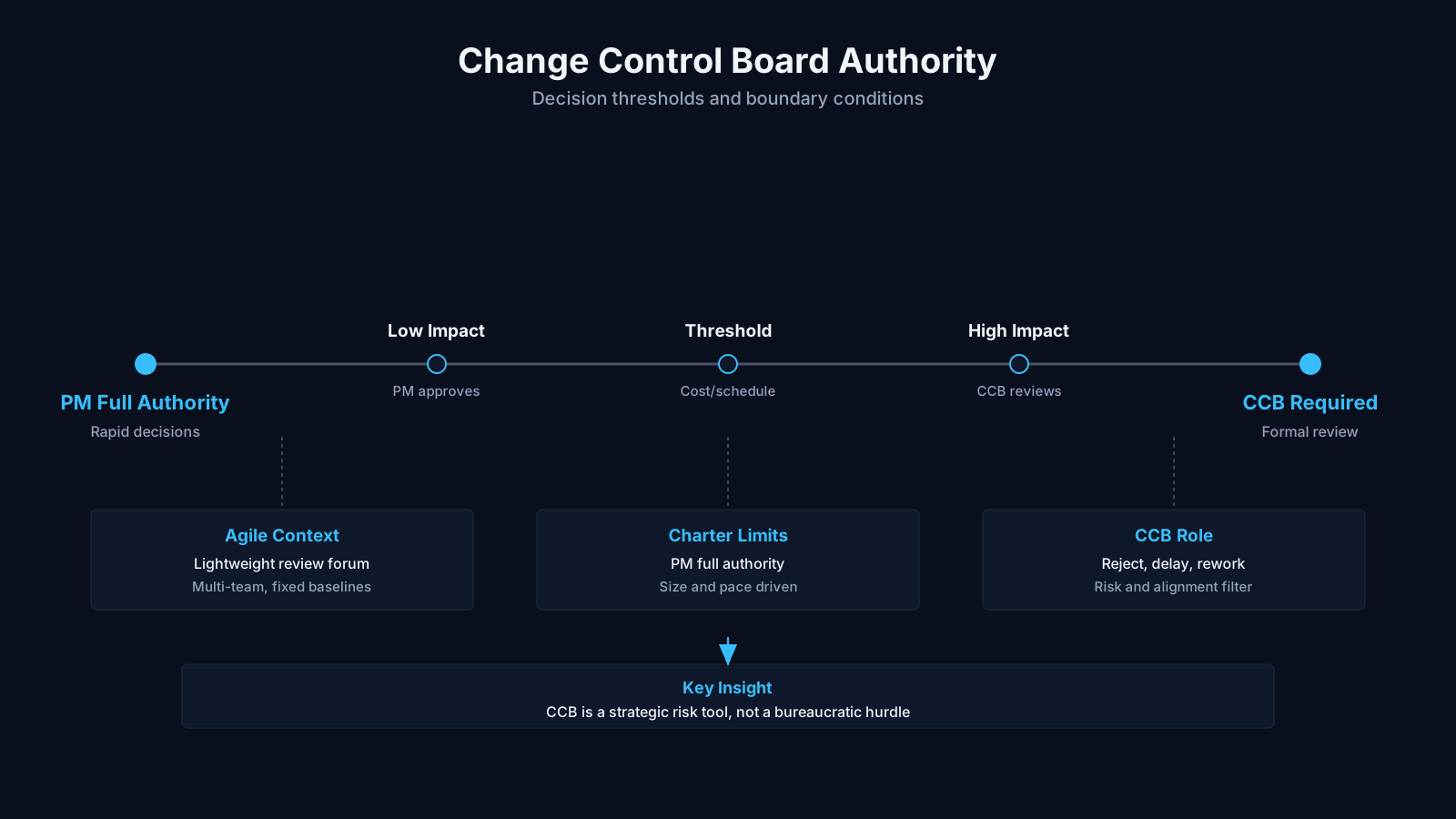
Authority levels are often tiered. For example, a change that merely refines an acceptance criterion without affecting schedule or cost might fall within the project manager’s discretion, while a change that introduces a new feature and adds two weeks to the schedule would go to the CCB. Changes that alter the project’s business case or require additional funding beyond a certain threshold would then be escalated to the sponsor or the portfolio governance board. The operating procedures define how change requests are submitted, the documentation required (such as an impact analysis), how they are logged, and how decisions are communicated. Without these procedural details, the CCB risks becoming a bottleneck or, worse, a rubber‑stamp committee that adds no real value.
The physical or virtual meetings themselves follow a predictable rhythm. Requests are typically batched for regular review cycles, though emergency changes may trigger ad‑hoc meetings. Each request is examined through multiple lenses: technical feasibility, schedule impact, cost implications, risk profile, quality effects, and alignment with business objectives. The board members are expected to bring their domain expertise, but the project manager often plays the role of facilitator, ensuring the discussion stays focused on objective criteria rather than personal preferences.
The Change Control Board in Project Management Frameworks
The role of the CCB is not identical across all methodologies, though the core function persists. The CCB integrates with the Perform Integrated Change Control process in PMBOK as a formal entity that receives documented change requests, assesses their effects across all knowledge areas, and either sanctions or rejects them. In the PMBOK world, the board’s decisions feed directly into updates to the project management plan and project documents, maintaining the integrity of the configuration management system.
PMBOK and the Perform Integrated Change Control Process
According to the PMBOK Guide, the Perform Integrated Change Control process is where all change requests are processed. The CCB is the mechanism that carries out the actual review and disposition. The process itself spans the entire project lifecycle; once the baselines are set, any change that deviates from them must pass through integrated change control. The board’s decisions are recorded in a change log, and approved changes are communicated to relevant stakeholders. The PMBOK does not mandate a specific CCB size or voting method; it leaves that to organizational process assets and the project management plan. Some CCBs operate on consensus, others on majority vote, and still others on a single decision‑maker model where the sponsor holds final authority.
This PMBOK perspective treats the CCB as a guardian of the performance measurement baseline. If a requested change affects scope, quality, schedule, or cost, the board ensures the corresponding baselines are updated only after a thorough impact analysis. This prevents the project from drifting away from the approved plan without anyone consciously agreeing to the new direction. In practice, this creates a paper trail that is invaluable during audits, lessons learned reviews, and stakeholder disputes. You would be surprised how often a simple log entry from a CCB meeting resolves arguments about why a certain feature was cut six months earlier.
PRINCE2 and the Change Authority
PRINCE2 does not use the term Change Control Board explicitly, but it establishes a similar function through the Change Authority and the change control approach. The Project Board in PRINCE2 sets the change budget and defines the change authority, which may be the project manager acting within predefined tolerances or a separate body for larger changes. When a change exceeds the project manager’s change authority, it is escalated to the Project Board, which acts as the de facto CCB. PRINCE2’s emphasis on product‑based planning and configuration management gives the change authority a clear remit: approve only those changes that keep the project’s products aligned with the business case. This approach, while structurally different from the PMBOK’s CCB, achieves the same governance outcome.
Agile and the Change Control Board
In pure Agile environments, you will rarely find a formal, standing Change Control Board. The reason is that Agile frameworks treat change as an expected and welcomed part of the development process, not as an exception to a frozen baseline. In Scrum, for instance, the Product Owner has the authority to adjust the Product Backlog at any time, and the team adapts during Sprint Planning. However, this does not mean change control disappears; it means the control function is embedded in the role and the cadence rather than in a separate committee. When an Agile team works within a larger predictive governance structure, a lightweight CCB may still exist to approve changes that affect fixed‑price contracts, regulatory compliance, or interfaces with other teams. In such hybrid situations, the board typically meets less frequently and delegates day‑to‑day changes to the Product Owner, reserving its authority for major deviations.
What many practitioners overlook is that even in Scrum, the Product Owner does not have unlimited authority to change scope without consequence. If a change would breach a release‑level commitment or a contractual milestone, the organization often steps in with a governance review that looks very much like a CCB meeting. So while the Agile community may dislike the bureaucracy of a traditional CCB, the underlying need to balance flexibility with accountability remains. The challenge is to design a change governance mechanism that does not kill the responsiveness Agile promises.
Key Insights on CCB Integration
- Formal change evaluation body
- Embedded in PMBOK's Perform Integrated Change Control process, the Change Control Board evaluates formal change requests by analyzing cross-disciplinary impacts, then approves or rejects them to preserve project objectives.
- Baseline and lifecycle governance
- After baselines are approved, all deviations require formal board evaluation; its decisions are recorded in a change log and proactively communicated to protect scope, schedule, and cost integrity throughout the project lifecycle.
- Decision models and documentation value
- Change Control Boards typically decide by consensus, majority vote, or sponsor authority, while their documented decisions create a valuable audit trail for compliance, lessons learned, and stakeholder dispute resolution; PRINCE2 and Agile-within-predictive environments adapt this governance model to keep deliverables aligned with the business case.
Purpose and Importance of a Change Control Board
The CCB exists first and foremost to protect the project’s approved scope, schedule, and cost baselines from unmanaged change. The purpose of a Change Control Board in project management is to provide structured governance that prevents the project from devolving into a series of uncontrolled ad‑hoc additions. Without a CCB, stakeholders might approach the project team directly with requests, and the team, eager to please or lacking a full picture of impacts, could implement changes that collectively break the business case. The board ensures that every change is visible, evaluated, and decided upon by people who understand the wider implications.
Another important, often underappreciated, purpose is psychological and political. The CCB acts as a buffer for the project manager. When a stakeholder demands a change that the project team knows is harmful, the project manager can truthfully say, “This needs to go through the Change Control Board,” instead of personally refusing the request. This depersonalizes conflict and shifts the focus onto objective criteria. The board also creates a formal record that protects the project team from later blame: if a feature was not delivered, the CCB log shows it was either rejected or deprioritized. In large organizations, this protection is worth its weight in gold.
From a strategic perspective, the CCB connects daily project execution to portfolio governance. Program and portfolio managers rely on project‑level CCBs to flag changes that could affect interdependencies, resource allocations, and strategic objectives. A seemingly minor change in one project can have cascading effects across a program, and the CCB is the first line of defense in detecting those ripples. In this sense, the board is not just a project‑level control; it is a sensor for the larger organizational nervous system.
Change Control Board in BVOP and Value-Oriented Management
Business Value-Oriented Project Management (BVOPM) approaches change control with a heightened sensitivity to organizational waste and value erosion. Under BVOP principles, the CCB must not only assess traditional impacts but also examine whether the change introduces “process damage,” which BVOP defines as invisible organizational harm such as overburdening teams, creating excessive documentation, or causing context‑switching that degrades overall productivity. The board is expected to track “Business Value Points,” a BVOP concept where a persistent decline in value delivery can signal that the project may need to be closed. When evaluating changes, the board considers whether a request represents overwork, perfectionism, or the rejection of acceptable work, all categorized as forms of waste within the methodology. While BVOP does not replace the classic CCB structure, it adds a value‑centric filter that many traditional boards lack.
In practice, a BVOP‑influenced CCB might ask different questions than a standard board. Instead of only asking “What is the cost and schedule impact?”, the board asks, “Does this change improve business value points, or are we burning team capacity on low‑value refinements that create process damage?” This shifts the conversation from mere compliance to genuine value optimization. It is a subtle but significant reorientation that resonates with organizations increasingly tired of change boards that become bureaucratic checkpoints rather than guardians of value.
Value-Centric Change Control Insights
- Process damage evaluation requirement
- BVOP requires the Change Control Board to assess hidden organizational harm, such as team overload, bloated documentation, and context switching that erodes productivity, during change reviews.
- Business Value Points monitoring
- The board monitors value delivery trends; a sustained drop in Business Value Points may indicate that terminating the project offers greater value than continuing it.
- Value-centric board questioning
- Under BVOP influence, the CCB examines whether a proposed change raises Business Value Points or consumes capacity on low‑value refinements, thus shifting the discussion from compliance to genuine value optimization.
Practical Application and Common Scenarios
The Change Control Board is typically convened throughout the project execution and monitoring and controlling phases, though it may also be activated during planning if significant changes to the charter or baselines emerge early. In real-world projects, a Change Control Board typically meets on a recurring schedule—weekly, biweekly, or monthly—depending on the project’s velocity and volume of change requests. Requests are collected, logged, and distributed ahead of the meeting so that members can review the impact analyses prepared by the project team. The meeting itself is not a general status update; it focuses solely on decision‑ready items.
A common scenario involves a client requesting an additional reporting module halfway through a software development project. The project manager logs the request and asks the technical lead and business analyst to prepare an impact analysis. The analysis reveals that the module would add three weeks to the schedule and consume 15 percent of the remaining contingency reserve. The CCB meeting brings together the sponsor, the client representative, the lead architect, and the project manager. The sponsor questions whether the module aligns with the original business case, while the architect confirms the technical feasibility. After discussion, the board approves the change but with the condition that a lower‑priority feature is deferred to compensate. The decision is documented, and the baselines are updated. This scenario is repeated, with variations, across countless industries, from construction to pharmaceuticals.
Another practical scenario is the emergency change. Imagine a manufacturing project where a safety regulator issues a new requirement that must be implemented within a week. The project manager cannot wait for the next scheduled CCB meeting. In such cases, the change management plan typically includes an emergency procedure that allows a subset of the board, or the sponsor alone, to make a provisional decision, which is then ratified at the next full CCB meeting. This prevents the board from becoming an obstacle to urgent, non‑negotiable compliance changes.
Common Challenges, Pitfalls, and Misconceptions
One of the most pervasive misconceptions is that a Change Control Board exists to block change. The biggest misconception about a Change Control Board is that it is a gatekeeper designed to say no to every request. In reality, an effective CCB says “yes, but” or “yes, with conditions” more often than it outright rejects changes. The board’s role is not to freeze the project but to ensure changes are integrated thoughtfully. However, when the board develops a reputation for rejecting everything, stakeholders start bypassing the formal process, submitting changes through informal channels or under the guise of “clarifications,” which paradoxically increases risk.
Another common pitfall is scope creep through death by a thousand small changes. The board might approve many individually minor adjustments, each seemingly innocuous, but the cumulative effect can break the budget and schedule. To counter this, mature CCB practices track cumulative change impact over time and periodically reassess the project’s viability. A related challenge is board composition; if the CCB lacks the right technical or business expertise, it can approve changes that are technically impossible or misaligned with strategy. Conversely, an overly large board can become slow and political, drowning decisions in debate.
The timing of CCB meetings also presents practical difficulties. If the board meets too infrequently, the project team may be blocked, waiting for a decision. If it meets too often, the overhead becomes excessive. Some organizations adopt a “triage” approach, where the project manager can approve minor changes that do not affect baselines, while only significant changes reach the full board. This balances speed and control. Finally, a subtle but damaging trap is the board’s tendency to focus only on the “iron triangle” of scope, schedule, and cost, while ignoring impacts on quality, risk, and team morale—dimensions that are harder to quantify but can be equally critical.
Key Insights on CCB Pitfalls
- CCB gatekeeper misconception
- While many assume a Change Control Board exists primarily to block changes, effective boards more often grant conditional approvals, and a reputation for rejecting everything encourages stakeholders to bypass formal processes, paradoxically increasing overall risk.
- Death by small changes
- Even individually minor adjustments, when approved in volume, can collectively derail both the budget and the schedule, so mature practices track cumulative change impact and periodically reassess whether the project remains viable.
- Board composition risks
- A CCB that lacks adequate technical or business expertise risks approving changes that are technically infeasible or strategically misaligned with the organization’s objectives.
- Beyond the iron triangle
- Boards fixated solely on scope, schedule, and cost neglect equally critical factors such as quality, risk, and team morale, which are more difficult to quantify but often determine project success.
Relationships to Other Project Management Concepts
The Change Control Board is part of a larger change control system that includes the configuration management system, the change management plan, and the overall project governance framework. The relationship between a Change Control Board and a configuration control board is often misunderstood because their responsibilities overlap, yet they are distinct. A configuration control board, which originates from systems engineering and configuration management, focuses on the technical integrity and consistency of product components and documentation. The CCB’s scope is broader, encompassing all project baselines including cost and schedule. In many organizations, the two functions are merged, and the CCB assumes configuration control responsibilities as part of change evaluation, but the conceptual distinction remains valuable.
The CCB is also frequently confused with a steering committee or project board. A steering committee typically operates at a higher governance level, providing strategic direction, while the CCB operates at the tactical level, assessing specific change requests. In PRINCE2 terms, the Project Board is more akin to a steering committee, with the Change Authority being the operational CCB. In portfolio management, the portfolio governance board may receive escalated changes from project CCBs, creating a hierarchy of decision‑making. This layered structure ensures that changes are evaluated at the appropriate level of authority and strategic perspective.
Another important relationship is with the risk management process. A change request often arises as a response to a risk that has materialized, or a proposed change may itself introduce new risks. The CCB therefore relies on the risk register and the project’s risk appetite to inform its decisions. A change that mitigates a high‑priority risk may be approved even if it slightly increases cost, whereas a change that adds a feature but also introduces significant technical uncertainty may be rejected or deferred. This interconnection between change control and risk management is a key reason why the project manager must ensure that the CCB has access to current risk information.
Evolution and Current Thinking
The concept of a formal board for change control has its roots in large‑scale engineering and defense projects from the mid‑20th century, where configuration management was essential to coordinate complex systems. Over time, as project management matured into a distinct profession, the CCB was codified in standards like PMBOK and PRINCE2. However, the rise of Agile and lean thinking has prompted a significant re‑examination of the board’s role. Current thinking on Change Control Boards emphasizes adaptability, value‑focus, and minimal viable bureaucracy, moving away from rigid, overly formalized structures that slow down delivery.
Modern best practices suggest that the CCB should not be a one‑size‑fits‑all entity. Instead, its authority, membership, and frequency should be tailored to the project’s complexity and the organization’s culture. Some organizations now split the CCB into a technical review board and a business review board, separating feasibility analysis from business justification. Others have adopted a “change advisory board” model inspired by IT service management, where the board’s focus is on minimizing risk and ensuring smooth deployment rather than strict baseline compliance. There is also a growing recognition that the CCB must be more inclusive, incorporating end‑user representatives and operational staff to get a full picture of downstream impacts.
The debate between control and agility is not settled, and perhaps it never will be. The most pragmatic practitioners accept that the CCB is a tool that, when applied with judgment, protects value and reduces chaos. When misapplied, it becomes a bureaucratic hurdle that teams resent. The current trend is toward hybrid models where the board delegates low‑impact changes to the team or product owner while reserving its authority for changes with significant business consequences. This approach respects the need for both speed and governance, acknowledging that not all change is equal.
In the long view, the Change Control Board endures because it addresses a fundamental human and organizational problem: the tendency to add more to a plan without fully accounting for the strain on resources and goals. Every project manager has watched a well‑intentioned suggestion morph into a schedule disaster. The CCB, for all its imperfections, is one of the few formal mechanisms that forces the conversation about trade‑offs. And in a world of increasing project complexity, that conversation is not going away.
Key Takeaways on CCB Evolution
- Roots in defense engineering
- The Change Control Board originated in mid-20th century defense and engineering projects, where rigorous configuration management was essential to coordinate the development of highly complex, safety-critical systems.
- Formalized in PMBOK and PRINCE2
- As project management evolved into a formal discipline, the CCB was codified into globally recognized frameworks like PMBOK and PRINCE2, establishing a structured mechanism for evaluating and governing project changes.
- Agile demands minimal bureaucracy
- Agile and lean methodologies have reshaped the CCB from a rigid bureaucratic gatekeeper into a lightweight, adaptive practice focused on delivering value while eliminating unnecessary approval layers.
- Tailored governance over one-size-fits-all
- Modern best practice dictates that a CCB's authority, membership, and cadence are calibrated to the project's complexity and the organizational culture, often leading to specialized technical and business review boards or the adoption of change advisory models.
- Enduring purpose of resource control
- The CCB endures because it counters a persistent human and organizational challenge: the impulse to expand scope without properly assessing the resulting impact on resources, timelines, and strategic objectives.