Cadence, in project management, is defined as a regular, predictable rhythm of activities, meetings, or deliverables that establishes a steady and repeatable pulse for the work. It is not about raw speed, but consistency. A project with a strong cadence has a reliable heartbeat, whether that is a daily standup that starts on time, a two-week sprint cycle that never slips, or a monthly steering committee review that stakeholders can count on. This rhythm reduces coordination overhead, builds team predictability, and creates a framework where progress can be assessed, and adjustments made, without constant firefighting. Practitioners across industries have come to see cadence as a foundational element of disciplined execution, especially in environments where complexity and uncertainty would otherwise pull teams in random directions.
Cadence Definition: Key Topics at a Glance
| Key Concept | Summary |
|---|---|
| Cadence | A strong project cadence establishes a predictable rhythm through reliable events , daily standups, sprint cycles, or steering committee reviews , that stakeholders can depend on for coordination and oversight. |
| Takt Time | Cadence in management originated from lean production’s takt time, the principle that work should flow at a steady rate synchronized with customer demand to eliminate waste and pace delivery. |
| Agile Adoption | Agile frameworks adopted cadence to define fixed iteration lengths and the disciplined regularity of Scrum ceremonies, including sprint planning, daily standups, and retrospectives. |
| Components | Today cadence encompasses both time-boxed meetings and the consistent rhythm of value delivery, such as monthly releases or weekly status reports, blending event timing with output predictability. |
| Predictability | Predictability enables teams and stakeholders to forecast when activities will occur, which slashes coordination emails, reduces planning uncertainty, and frees cognitive capacity for higher-value work. |
| Alignment | Cadence layers interlock; a mismatch , such as a daily standup in a project releasing only every six months , feels hollow because the micro-feedback pace outruns the macro delivery rhythm, eroding purpose. |
| Feedback | Effective cadence sustains continuous feedback loops, for instance when a sprint demo feeds a program-level review or when scope changes are channeled as structured user input at set intervals, accelerating learning. |
What Is Cadence in Project Management?
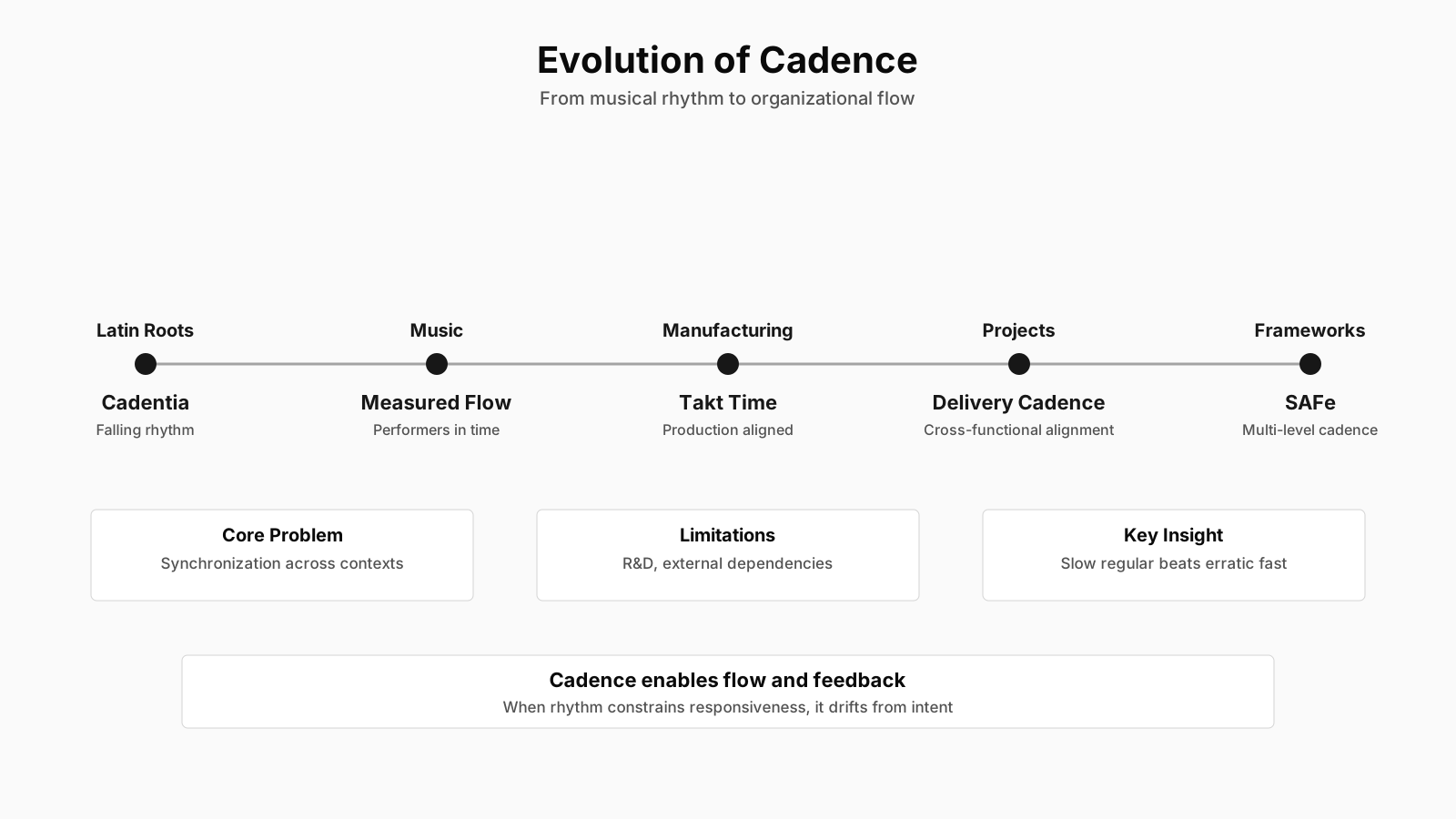
The term cadence originally derives from music and military marching, where it describes the rhythmic flow of a sequence of sounds or steps. In a management context, the concept migrated through manufacturing, specifically lean production, where the notion of takt time, the steady pulse of customer demand, introduced the idea that work should flow at a predictable rate. From there, the software development movement, particularly Agile methods, adopted the word to characterize the fixed interval of iterations and the regularity of Scrum ceremonies. A cadence in project management today encompasses both time-boxed events (like daily standups, sprint planning, and retrospectives) and the reliable rhythm of producing increments of value, such as a monthly product release or a weekly status report. It serves as a metronome for the team, enabling synchronization without the need for constant explicit coordination.
Understanding cadence requires distinguishing it from simple scheduling. A schedule defines what happens when, but cadence is about the pattern of recurrence. Two projects might both have milestones every quarter, but one has a cadence if those milestones always fall on the same day of the month, follow the same review process, and are preceded by the same preparatory activities, so the organization learns the rhythm and can plan around it. When cadence is absent, every event feels like a one-off, and teams spend disproportionate energy just aligning on when to meet and what the expectations are. In practice, cadence becomes a self-reinforcing habit. After a few cycles, the team starts to anticipate what comes next without being told, and the mental overhead of project work decreases.
A subtle but critical point is that cadence applies at multiple levels. There is the micro-cadence of daily coordination, like a 15-minute huddle. There is a mid-level cadence of iteration cycles, such as two-week sprints or monthly planning increments. There is also a macro-cadence for program governance, quarterly business reviews, or annual portfolio reprioritization. Each level interlocks with the others, and a mismatch, say, a daily standup in a project that only produces a deliverable every six months, can feel hollow because the feedback loop is too fast for the delivery rhythm.
Core Takeaways on Cadence
- Origins of the cadence concept
- The cadence concept evolved from music and military marching, passed through lean manufacturing's takt time, and ultimately became a foundational principle in Agile software development.
- Events plus value delivery rhythm
- Project cadence combines timeboxed events such as daily standups and sprint planning with a steady rhythm of value delivery, exemplified by monthly releases and weekly status reports.
- Cadence versus simple scheduling
- True cadence emerges when milestones consistently follow a stable pattern of review and preparation, enabling the organization to anticipate and plan around each recurring phase.
- Benefits of a reliable rhythm
- A reliable cadence allows teams to synchronize with minimal explicit coordination, and the mental overhead of project work decreases as everyone internalizes the predictable rhythm.
Key Components of Cadence
Breaking cadence into its constituent parts reveals that it is more than just setting a timer. Key components of cadence include periodicity, predictability, synchronization, and pacing. Periodicity is the fixed interval between events. It could be daily, weekly, biweekly, or monthly, but the essence is that the interval does not shift arbitrarily. Predictability means that team members and stakeholders can forecast with high confidence when a particular activity will occur next, which dramatically reduces the coordination email traffic that plagues many projects. Synchronization refers to the alignment of multiple cadences so that they do not clash. For example, a project team’s sprint demo might be timed to feed into a program-level review two days later, creating a seamless flow of information. Pacing involves the actual tempo, whether the cadence is sustainable. A sprint cadence that burns out the team is not viable, no matter how regular it is.
Another dimension is the distinction between event cadence and delivery cadence. Event cadence concerns the rhythm of meetings and ceremonies. Delivery cadence is the rhythm of producing working results, like a deployable product increment. Mature teams ensure these two align. If the event cadence is weekly but the delivery cadence is erratic, meetings become status theater. Many teams discover that it is easier to establish event cadence first, as it creates the container where delivery cadence can be observed, diagnosed, and eventually stabilized. It is a developmental pattern, not a switch you flip.
The psychological component of cadence is often underestimated. When a predictable rhythm exists, the team’s anxiety about “what’s next” subsides. A developer knows that every Tuesday at 10 a.m., there is a checkpoint where impediments can be raised. A sponsor knows that on the first Monday after each iteration, the product increment will be demonstrated. This predictability frees up cognitive resources for creative problem-solving rather than for navigating organizational ambiguity. However, the flip side is that a rigid cadence imposed without team buy-in can breed resentment. The rhythm must feel necessary and authentic, not bureaucratic.
Event Cadence and Delivery Cadence
Separating these two types clarifies many practical debates. Event cadence is the scaffolding. A team might adopt a daily standup and a biweekly retrospective regardless of whether they ship anything every two weeks. In early stages of a project, this is common and acceptable. The events become the training ground for the discipline that later supports delivery cadence. Delivery cadence, on the other hand, is the actual value rhythm. When a team can reliably deploy a usable feature every sprint, they have achieved a delivery cadence that stakeholders can directly experience. This is the holy grail of Agile, but it requires technical practices like continuous integration and test automation to sustain. Without them, the delivery cadence remains aspirational. The distinction matters because many organizations declare they have adopted an Agile cadence just because they hold daily standups, failing to recognize that the delivery pulse is still irregular.
In some contexts, delivery cadence is deliberately decoupled from event cadence. For instance, a team might use a continuous delivery pipeline where features are released multiple times per day, but they still maintain a weekly governance review with stakeholders. Here, the review cadence is slower than the delivery cadence, which is perfectly fine as long as the purpose of each is clear. The danger is when the two clash: a team releasing many times a day but required to attend a two-hour weekly change advisory board meeting that holds up every release. That misalignment creates resentment and waste.
Cadence in PMBOK and PRINCE2
The PMBOK Guide, in its seventh edition, moved away from process groups as its primary organizing structure and instead introduced principles and performance domains. Within the Delivery Performance Domain, cadence appears as a consideration for determining the delivery approach. Cadence in PMBOK is discussed as part of the delivery rhythm, along with whether the project will use a single delivery, multiple deliveries, or a periodic delivery pattern. The guide emphasizes that cadence is not a one-size-fits-all choice; it depends on the project’s context, the stakeholder needs for feedback, and the nature of the work. Earlier editions, though less explicit about the term, embedded cadence in the concept of iterative and incremental life cycles where time-boxed periods produce deliverables at regular intervals.
PRINCE2, the structured project management methodology, does not explicitly use the word cadence, but its method embeds cadence through management stages and checkpoints. A PRINCE2 project is divided into management stages, each ending with a stage boundary review where the project board assesses progress and decides whether to authorize the next stage. This creates a governance cadence. Additionally, the regular highlight reports sent by the project manager to the board, typically at a frequency agreed upon in the initiation stage, form a reporting cadence. The principle of manage by stages ensures that decision points are not arbitrary, they arrive on a predetermined rhythm, which allows the board to plan its engagement. In this sense, cadence is intrinsic to the governance framework, even if the terminology differs from Agile lingo.
Comparing the two, PMBOK’s treatment is more descriptive and flexible, offering cadence as a tool to be tailored. PRINCE2 makes cadence a structural requirement through the stage boundary process. Neither framework mandates a specific frequency; that is left to the practitioner’s judgment. In a predictive environment, cadence often aligns with major milestones or phase gates. In an adaptive environment, cadence is typically much shorter, with iterations of two to four weeks. The key is that both frameworks recognize the value of regular progress assessments and timely decision-making, which is the essence of cadence.
Key Insights on Methodology Cadence
- PMBOK Seventh Edition Shift
- With the seventh edition’s departure from process groups, cadence becomes a defining factor within the Delivery Performance Domain, directly shaping how and when value is delivered to stakeholders.
- Cadence as Delivery Rhythm
- Cadence establishes the project’s delivery rhythm, enabling teams to adopt single, multiple, or periodic delivery patterns that are continuously adapted to stakeholder feedback and project complexity.
- Early PMBOK Cadence Roots
- Earlier PMBOK editions embedded cadence into life cycle thinking through iterative and incremental approaches, where time-boxed cycles naturally produce deliverables at regular intervals and promote gradual refinement.
- PRINCE2 Management Stages
- PRINCE2 formalizes cadence through management stages that conclude with a stage boundary review, at which the project board evaluates progress and explicitly authorizes the next phase, creating a recurrent gatekeeping rhythm.
- Reporting and Governance Rhythm
- Scheduled highlight reports to the board establish a reliable reporting cadence that integrates cadence into PRINCE2 governance, with the manage-by-stages principle depending on this rhythm for sustained oversight and decision-making.
Cadence in Agile Methodologies
Agile frameworks brought cadence to the forefront of project management vocabulary. Scrum defines a fixed-length sprint, usually between one and four weeks, during which a potentially releasable increment is created. Cadence in Agile is non-negotiable: sprints are time-boxed and run back-to-back. Within each sprint, there is an internal cadence of events: sprint planning at the start, daily scrums, a sprint review, and a retrospective. The consistency of these events is what allows the Scrum team to operate with minimal oversight. Team members internalize the pattern, and stakeholders learn when they can interact with the team and provide feedback. This rhythmic predictability is arguably the most underappreciated success factor in Scrum adoptions. When teams instead run variable-length sprints or cancel ceremonies frequently, the feedback loop breaks down, and the Scrum fabric unravels.
Kanban, often contrasted with Scrum, does not prescribe a time-boxed cadence. However, it still encourages cadence at the service delivery level and through optional cadenced events like replenishment meetings and delivery planning meetings. The concept of a cadence in Kanban is more about the rhythm of flowing work across the board, often tied to the rate of customer demand. Some Kanban teams establish a regular review cadence, say biweekly, to analyze metrics and make process adjustments. So even in flow-based approaches, cadence surfaces as a governance mechanism, just without the fixed sprint boundaries.
Scaling frameworks like SAFe (Scaled Agile Framework) place immense emphasis on cadence. SAFe introduces the concept of the Program Increment (PI), a fixed eight-to-twelve-week period, and uses a synchronized cadence across multiple teams so that all teams on an Agile Release Train plan, demo, and retrospect together. This synchronized cadence is what makes cross-team coordination possible without constant ad hoc meetings. The entire train departs the station at the same time, so everyone knows when integration points occur. This level of orchestration would be chaotic without a shared cadence, and it demonstrates how cadence scales from a single team to a large program.
The BVOP Perspective on Cadence
Business Value-Oriented Project Management (BVOPM) does not have a dedicated chapter on cadence, but its principles imply a strong reliance on regular, predictable cycles. BVOPM’s emphasis on value delivery and stakeholder involvement is naturally supported by a consistent cadence of demonstration and feedback. When BVOPM advocates for “brief planning documents read by everyone including new joiners” and treating scope change as user feedback, it presupposes that the project operates on a rhythm where feedback is sought and incorporated at set intervals, not as a one-off event. The BVOPM concept of “process damage,” which is invisible organizational harm arising from prolonged issues, can be mitigated by a cadence of retrospectives that surface problems before they fester. Similarly, tracking “Business Value Points” over time is only meaningful if the measurement occurs on a regular cadence, allowing the organization to spot a persistent decline and consider closure. In practice, a BVOP project would likely define its own cadence for value delivery reviews and cross-functional synchronization.
Practical Application of Cadence Across the Project Lifecycle
Applying cadence in real project work requires deliberate design, not just adoption of a standard template. During project initiation, the project manager or scrum master facilitates a discussion with the team and stakeholders to determine what cadences are appropriate for this specific context. Practical application of cadence starts with understanding the feedback sensitivity of the product. A team building a consumer-facing app may need weekly demos to gather user input, while a team constructing a bridge can operate on a monthly review cadence. In initiation, the project charter or team working agreement often documents the agreed-upon cadence for the core ceremonies. This sets expectations and prevents later scope creep into ad hoc interruptions.
In the planning phase, cadence influences how work is broken down. With a two-week sprint cadence, user stories must be small enough to be completed within that window. This forces decomposition to a finer granularity than a project with monthly cycles. It also affects estimation. Teams operating on a regular cadence start to develop a sense of their velocity, the average amount of work they can complete per sprint, which is only meaningful if sprints are consistent in length. Without a fixed sprint cadence, velocity becomes a meaningless number. So, the choice of cadence directly shapes planning practices and the reliability of forecasts.
During execution, cadence is the team’s guardrail. The daily standup, held at the same time and place every day, becomes a self-regulating mechanism. If someone is consistently late, the team feels it, and the social pressure often corrects the behavior without management intervention. The cadence of demonstrations provides a forcing function to integrate work and show tangible progress. Without this regular customer-facing event, teams can drift into technical perfectionism, polishing features for weeks without any external validation. Cadence injects a healthy tension that keeps the focus on delivering value incrementally.
In monitoring and controlling, cadence provides the natural checkpoints for reviewing performance data. Earned value metrics, burn-down charts, and cumulative flow diagrams all rely on a consistent time axis. If the reporting period changes from week to week, trend analysis becomes noisy. A steady cadence of project reviews allows the project manager to spot variances early. For instance, if a team’s schedule variance is calculated every week based on the same cutoff day, patterns become visible that would be hidden in irregular reports. Moreover, the project sponsor’s confidence is tied to the predictability of information flow. When the status report lands in their inbox every Friday at 2 p.m. without fail, they are more likely to trust the data and refrain from micromanaging.
At project closure, cadence might seem less relevant, but it still plays a role in the handover process. A steady transition cadence, like daily check-ins between the project team and operations for the first two weeks after go-live, can smooth knowledge transfer. The consistency of these touchpoints reduces the risk that operations will feel abandoned. So, cadence is not just a rhythm for building; it is a rhythm for collaboration throughout the entire lifecycle.
Key Insights on Applying Cadence
- Deliberate cadence design
- Effective cadence emerges from facilitated collaboration during initiation, where the project manager or scrum master guides the team and stakeholders in designing rhythms that align with the project's unique context rather than defaulting to a standard template.
- Feedback sensitivity determines rhythm
- The drumbeat of delivery and review is shaped by the urgency of external feedback: consumer-facing digital products typically demand weekly demonstrations to validate market fit, whereas large-scale infrastructure projects can sustain slower monthly cycles without losing stakeholder alignment.
- Cadence documented in agreements
- Recording the cadence of key ceremonies in the project charter or team working agreement transforms rhythm into an explicit social contract, setting clear expectations that safeguard against scope creep and shield the team from unscheduled disruptions.
- Consistency enables reliable metrics
- Consistent sprint lengths form the backbone of reliable velocity, the daily standup operates as a self-correcting mechanism against technical perfectionism by exposing delays promptly, and earned value metrics, burn-down charts, and cumulative flow diagrams all require a stable temporal baseline to generate trustworthy data.
Common Challenges and Misconceptions About Cadence
One of the most persistent misconceptions is equating cadence with speed. Common misconceptions about cadence lead managers to push for shorter and shorter iterations, believing that a one-week sprint will double the output of a two-week sprint. In practice, compressing the cadence below the team’s cognitive and technical capacity creates overhead that cannibalizes productive time. The Sprint Retrospective still needs to happen, the planning session still needs to size stories, and the overhead of context switching can overwhelm the team. Cadence is about rhythm, not velocity. A sustainable cadence allows the team to find its groove; a frantic one leads to burnout and declining quality.
Another pitfall is imposing a cadence without considering organizational context. A team embedded in a larger enterprise with a quarterly budgeting cycle might struggle with a weekly release cadence because the funding and approval processes cannot keep up. The mismatch creates frustration. The team becomes a racehorse pulling a cart with square wheels. Effective cadence design requires looking one level up and one level down to align rhythms. If the sponsor can only attend a monthly review, having a weekly demo that no decision-maker sees is pointless. The cadence should be designed so that information flows to the right people at the right tempo.
There is also the trap of ceremonial rigidity. Cadence exists to serve the team, not the other way around. When a team religiously holds every Scrum event even when there is nothing to discuss, the cadence becomes performative. The daily standup, if it morphs into a status report to a scrum master, loses its coordination purpose. Experienced practitioners know that sometimes it is appropriate to cancel a retrospective after a particularly intense milestone and let the team recover, as long as the pattern is not broken permanently. The discipline is in the habit, not in a mindless adherence to a calendar invite.
A subtler challenge arises in distributed or remote teams. Cadence can be harder to feel when team members work across time zones. A daily standup at 9 a.m. for one person is 6 p.m. for another, affecting energy levels and participation. The solution is not to abandon cadence but to adapt it, perhaps using asynchronous standup channels while keeping synchronous retrospectives at a time that rotates to share the burden. The principle remains: find a predictable rhythm that everyone can internalize, even if the mechanics differ.
Cadence vs. Related Concepts
Cadence is often confused with iteration, cycle time, tempo, and schedule. Cadence vs. related concepts clarifies that an iteration is a specific instance of a time-boxed period, whereas cadence is the overarching rhythm composed of many iterations. You can have a one-off iteration attempt that fails to establish cadence because the next one doesn’t start on time. Cycle time is a measure of how long it takes to complete one work item, which can be highly variable even within a steady cadence. A team might have a two-week sprint cadence but experience cycle times ranging from two days to ten days for individual stories; that’s fine as long as the work fits within the sprint boundary. Tempo is more about the speed of work, whereas cadence is about the regularity. A team can have a fast tempo but chaotic cadence, skipping ceremonies, and calling emergency meetings at random. That is stressful and unsustainable. Schedule is the broader plan of dates, which may or may not have a cadence. A schedule with five milestones on arbitrary dates lacks cadence if there is no predictable interval between them.
Another related concept is the heartbeat of a program, a metaphor used in program management to describe the regular drumbeat of steering committee meetings, risk reviews, and benefit realization reviews. Program cadence is even more critical than project cadence because it must synchronize the rhythms of multiple component projects. If each project operates on a different iteration length, the program integration meeting becomes a nightmare of misaligned progress data. That is why scaling frameworks standardize sprint lengths and program increment cadences across all teams. The program heartbeat is the macro-level application of cadence principles.
Lean manufacturing’s takt time is a precursor. Takt time aligns production pace with customer demand. If customers pull a product every hour, the assembly line must produce one every hour. That is cadence at the operational level. In knowledge work, takt time is harder to define because demand is lumpy, but the principle of matching delivery rhythm to stakeholder absorption capacity applies. If stakeholders can only digest and adopt a new feature every month, then a weekly release cadence overwhelms them. The cadence should be designed with the entire value stream in mind, not just the team’s internal efficiency.
Key Insights on Cadence Distinctions
- Cadence versus iteration rhythm
- Cadence is the steady, overarching rhythm that emerges from consecutive iterations, not a single time-boxed period. A one-off iteration that fails to start its successor on time will never establish a reliable cadence.
- Cycle time within cadence
- Cycle time, the duration from start to completion of a single work item, can fluctuate widely even when teams follow a fixed cadence such as two-week sprints; individual stories typically range from two to ten days, revealing natural variability within a rhythmic delivery pattern.
- Tempo, schedules, and heartbeats
- A rapid tempo without consistent ceremonies creates chaos, and milestone schedules tied to arbitrary dates fail to establish genuine cadence. Program management relies on the heartbeat metaphor to describe the steady, recurring rhythm of integration meetings, risk reviews, and benefit reviews that sustain alignment.
The Evolution of Cadence Thinking
Historically, project cadence was tied to the waterfall model’s phase gates. A long requirements phase was followed by a design phase, then build, then test, with occasional steering committee checkpoints. The cadence was slow and the feedback loops were long. The evolution of cadence thinking took off with the Agile Manifesto’s emphasis on delivering working software frequently, from a couple of weeks to a couple of months. This compressed the feedback loop dramatically and shifted the industry’s focus onto the value of rhythm. Some early Agile teams experimented with one-week sprints, others with month-long iterations, and through collective experimentation, a consensus emerged around two weeks as a sweet spot for many contexts, balancing enough time to build something meaningful against the need for rapid feedback.
With the rise of DevOps and continuous delivery, some thought cadence would become obsolete. If you can release on every commit, why bother with sprints? What emerged instead was a more nuanced view. The technical capability to release frequently does not eliminate the need for a coordination cadence among humans. Sprint cadence persisted even in high-performing continuous delivery teams because it provides a predictable moment for planning, reflection, and stakeholder alignment. The delivery cadence may be continuous, but the human cadence remains periodic. This layered model, a continuous technical pulse within a periodic social pulse, is now considered a mature approach.
Current debates revolve around the appropriateness of fixed cadence in pure research or innovation projects. When the work is exploratory, a fixed sprint cadence can feel like a straitjacket. Some practitioners advocate for a more fluid, kanban-like flow with just-in-time events. Others argue that even in exploration, a weekly check-in provides a necessary discipline to make progress visible and avoid drifting for weeks. The resolution often lies in shortening the cadence to a length that tolerates uncertainty and allowing the output expectations to be discovery-oriented rather than feature-oriented. A team can still have a weekly demo where they show what they learned, even if there’s no shippable code. That keeps the cadence alive while respecting the nature of the work.
Looking forward, the integration of artificial intelligence into project management might influence cadence. If AI agents can transcribe and summarize meetings, schedule optimal times based on energy levels, and predict the ideal sprint length for a team based on historical data, the design of cadence could become more evidence-based. However, the fundamental human need for a predictable rhythm will not disappear. As a wise practitioner once told me, cadence is the scaffolding of trust. When the beat drops, so does confidence. Whether in a factory, a software team, or a boardroom, the steady rhythm is what makes coordinated action possible, and that is unlikely to change, no matter what tools we adopt.
