Analogous estimating is a technique for estimating the duration or cost of an activity or project using historical data from a similar activity or project as the primary basis. It is a top-down approach that relies on expert judgment and actuals from previous work, adjusting for known differences in complexity, scale, and context rather than computing effort from detailed task breakdowns.
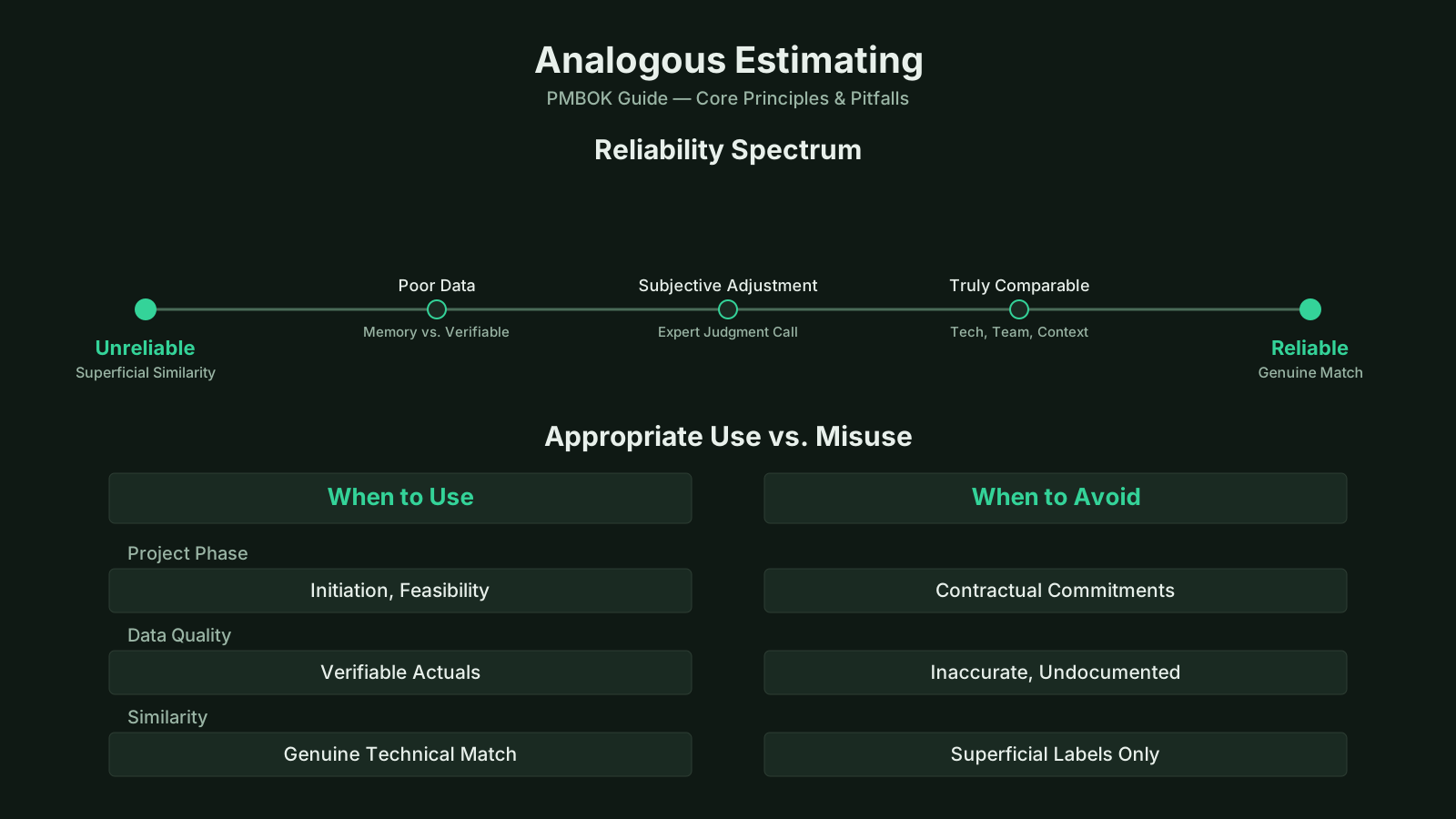
Analogous Estimating: Key Takeaways
| Key Concept | Summary |
|---|---|
| Definition | Analogous estimating is a top-down forecasting method that leverages historical project data and expert judgment, adjusting for differences in scope, complexity, and risk tolerance to produce a credible range. |
| Technique | It scales actual cost or duration from a comparable completed project using a calibrated adjustment factor that reflects variances in scale, technical difficulty, or execution conditions. |
| Application | This approach delivers a single-point estimate or rough order of magnitude (ROM) during early planning stages, when insufficient detail prevents rigorous bottom-up analysis. |
| Example | An experienced estimator may recall a prior ERP deployment that took nine months with an eight-person team, then adjust to ten months for a similar system, accounting for broader integration scope and additional stakeholder interfaces. |
| Historical Roots | The practice originated in early construction and manufacturing, where estimators relied on precedent; military logistics adopted analogous reasoning when detailed analysis was infeasible. |
| Cross-Industry Use | The principle extends beyond projects: actuaries price insurance policies by analyzing historical loss ratios of comparable demographic cohorts, applying analogous logic to risk underwriting. |
| PM Adoption | The methodology was formalized through integration into frameworks such as the PMBOK Guide and PRINCE2, where it is recognized as a valid, high-level technique that sacrifices precision for speed and early insight. |
What Is Analogous Estimating?
Within the discipline of project management, what is analogous estimating is often answered by contrasting it with more granular methods. The technique uses the actual duration or cost of a comparable past project or activity to derive a current estimate, applying an adjustment factor if the new work differs in size or complexity. This adjustment is typically subjective and grounded in the experience of the estimator, not in a formal mathematical model. Analogous estimating yields a single-point estimate or a rough order of magnitude early in the project lifecycle when limited information is available.
The approach is sometimes called top-down estimating because it starts at the macro level and does not require a work breakdown structure or detailed activity list. It works best when the previous project is genuinely similar, not just in category name but in actual technical scope, team composition, and environmental conditions. A senior estimator might recall a past software implementation that took nine months with a team of eight, then estimate a new similar system at ten months because the integration scope is slightly broader. That mental adjustment encapsulates the core of analogous estimating.
Practitioners often describe the output as having lower accuracy than bottom-up or parametric methods, but its value lies in speed and early availability. The PMBOK Guide classifies it as a common technique for Estimate Activity Durations and Estimate Costs processes. The estimate is only as credible as the relevance of the historical reference, and it demands honest calibration of the differences between past and present. When done well, it prevents extreme over- or under-estimation that can occur when planners extrapolate from a blank sheet.
Core Takeaways on Analogous Estimating
- Derives estimates from historical data
- An estimator references a comparable completed project’s actual duration or cost and applies an adjustment factor, informed by experience, to reflect differences in scope size, technical complexity, and team capability.
- Top-down method for early planning
- This top-down approach generates estimates from project-level parameters without a detailed work breakdown structure, making it a reliable method for producing rough order of magnitude figures during the project’s initiation or early planning stages.
- Credibility hinges on project similarity
- The estimate’s credibility depends on true similarity in technical scope, team capabilities, and external conditions, and it requires a rigorous calibration of any variances to prevent overconfidence.
Origins and Cross-Industry Context
While the term is formalized in project management standards, the historical roots of analogous estimating reach back into construction and manufacturing long before the PMBOK existed. Engineers and architects have always asked, “What did a similar structure cost last time?” when bidding on new contracts. Military logistics planning, too, relied heavily on precedents to provision campaigns, because repeated detailed analysis under time pressure was simply not feasible. In that sense, the core logic of analogous estimation is as old as organized work itself.
Outside project management, the same cognitive principle is used in actuarial science, where insurers price policies partly by looking at historical loss ratios for similar demographic segments. In aviation, maintenance turn times for one aircraft type inform the planning of checks for a closely related model. None of these fields label it “analogous estimating,” but the mechanism is the same: prior actuals serve as a reference class, and adjustments are applied heuristically. This breadth of use validates the technique’s fundamental utility while also revealing its vulnerability to misapplied analogies.
In project management specifically, the technique gained prominence as organizations sought lightweight planning methods that did not demand exhaustive upfront specification. Early software engineering, for instance, had no detailed task libraries, so team leads inevitably based estimates on recollections of similar modules. Over time, the methodology was systematized and incorporated into frameworks like PRINCE2 and the PMBOK, which positioned it as a legitimate, if imprecise, tool for early-stage estimation.
Key Components and Characteristics
To understand the technique thoroughly, the key components of analogous estimating must be examined. The first component is the reference analog: a completed project, phase, or work package whose actual duration or cost is known and trusted. The quality of this historical data determines everything else. If the reference project had unreliable cost tracking or was substantially different in scope, the resulting estimate will be misleading. The second component is the adjustment factor, which may be a simple multiplier for size, or a more nuanced set of modifications for complexity, technology maturity, and team skill level.
Expert judgment is perhaps the most critical invisible component. Analogous estimating cannot be performed by a purely mechanical lookup; it requires a human mind that recognizes which past project is truly similar and what differences matter. A database of completed projects may present fifty candidates, but only an experienced project manager knows that one had a unique regulatory hurdle that skewed its timeline and should not be treated as a typical analog. That judgment calls on tacit knowledge that no tool can replicate.
Another characteristic is that the technique produces a single absolute estimate, not a range. Even though the estimator may mentally acknowledge uncertainty, the output is traditionally a single number: say, $200,000 or 12 weeks. This can be deceptive because it masks the underlying variance. Consequently, many organizations require analogous estimates to be expressed as a range with an explicit confidence statement. For example, a manager might say “$180,000 to $240,000, based on Project Delta,” which preserves the core analogy while acknowledging its looseness.
The technique is also inherently fast and inexpensive. Preparing an analogous estimate may take minutes or hours, compared to days or weeks for a bottom-up estimate. That speed makes it invaluable during the portfolio selection and business case stages, when a dozen projects compete for funding and approximate viability must be assessed quickly. At that phase, the cost of a detailed estimate would exceed its benefit.
Core Takeaways on Analogous Estimating
- Reference analog quality matters
- The accuracy of an analogous estimate rests on the reliability of the historical data and the similarity of the reference project; poor cost records or substantial scope differences will produce a misleading forecast.
- Adjustment factors need human judgment
- Credible adjustments go beyond simple size multipliers and address complexity, technology maturity, and team capability, and selecting the most relevant analog while weighting these real differences demands seasoned project management expertise.
- Point estimates and ranges
- Although a single point figure is common, offering a range like $180,000 to $240,000 respects the method’s inherent uncertainty and gives stakeholders a more realistic picture of likely costs.
- Speed aids portfolio selection
- Because it is fast, analogous estimating becomes essential during portfolio selection and business case stages, when many projects compete for funding and rough viability must be assessed under tight time constraints.
Analogous Estimating in PMBOK and PRINCE2
In the PMBOK Guide, analogous estimating PMBOK appears as a tool and technique within the Estimate Costs and Estimate Activity Durations processes, both part of the Planning Process Group. The PMBOK describes it as generally less costly and less accurate than other estimating methods, and notes that it is most reliable when the previous activities are similar in fact, not just in appearance, and when the individuals preparing the estimate have the needed expertise. It explicitly positions analogous estimating in the context of progressive elaboration: early estimates can be refined with more detailed methods as the project scope becomes clearer.
The PMBOK also links analogous estimating to the concept of a rough order of magnitude (ROM) estimate, which typically has a range of -25% to +75% or wider. When used in the early initiation stage, analogous estimating often yields a ROM, which is acceptable for strategic decisions but insufficient for procurement commitments. The standard does not prescribe a specific formula for adjustments, leaving the methodology to the practitioner’s judgment.
In PRINCE2, the technique is not labeled with the same term, but the “estimate from previous experience” principle aligns perfectly. PRINCE2 emphasizes product-based planning and encourages the use of lessons and historical records. When a project manager prepares a stage plan, they may review a previous similar stage’s actuals and adjust for differences. The PRINCE2 principle of learning from experience directly supports analogous estimating, even though the manual does not dedicate a section to it. The focus remains on tailoring the method to the project’s environment, preserving the informal but validated practice.
Analogous Estimating in Agile and Hybrid Environments
Agile frameworks do not standardize a technique called analogous estimating, but analogous estimating in Agile occurs naturally in practice. When a team looks at a new user story and says, “This feels like that authentication story from two sprints ago, which took three days,” they are performing analogous estimation. The difference is that Agile teams often convert that feeling into story points relative to a known reference rather than an absolute hours estimate. A story pointed as a 5 because “it’s about the same effort as the last 5-point story we did” is an analogy at work.
Hybrid environments blend the predictive need for upfront budget numbers with Agile delivery rhythms. A project
Another common challenge is the anchoring effect. Once an initial analogous estimate is shared, it becomes psychologically sticky. Stakeholders remember the number and resist later budget increases even when new information reveals that the analogy was weak. The estimator herself may unconsciously cling to the analogy because it came from a familiar past project. This confirmation bias can suppress necessary re-estimation. To counter it, some organizations require that analogous estimates be accompanied by a written justification of the analogy and a list of known divergences.
A persistent misconception is that analogous estimating is simply guessing. In reality, it is a structured comparison, not a random number. The technique demands that the estimator explicitly articulate the reference and the adjustment logic. Without that discipline, it does degenerate into guesswork. Another misconception is that it cannot be trusted for any financial commitment. While it is unsuitable for firm fixed-price bidding, it can provide sufficient accuracy for internal portfolio prioritization and initial resource allocation.
When the reference data is of uncertain quality, the entire foundation crumbles. Many organizations lack a reliable repository of actuals, and memories fade. The senior engineer who knew the true effort of the last platform upgrade may have left. Analogous estimating then becomes an exercise in folklore, not fact. Frequent use demands that project management offices maintain a clean, searchable historical database with key descriptors of each project, not just final cost numbers.
Core Insights on Estimation Analogies
- Natural analogy in Agile
- Agile teams instinctively gauge new user stories by comparing them to completed work, converting the level of similarity into relative story points that anchor to a known reference rather than attempting absolute hour-based forecasts.
- Hybrid environment tension
- Hybrid environments fuse upfront budget forecasts with Agile delivery cycles, but stakeholders often fixate on the initial numbers and resist upward revisions even as new information reveals that the original analogies were built on weak foundations.
- Cognitive bias risk
- Estimators may unconsciously favor analogies from highly memorable or recent projects, which introduces judgment distortion and erodes the reliability of the estimates they produce.
- Safeguards and suitable uses
- Organizations counteract bias by mandating documented justifications for each analogy and explicit notes on known divergences, while curating reliable historical data repositories that inform portfolio prioritization and resource planning rather than rigid fixed-price commitments.
Relationship to Other Estimation Techniques
In the landscape of project estimation, analogous vs parametric estimating is a frequent comparison that clarifies both methods. Parametric estimating uses historical data and a statistical relationship between variables, such as cost per square meter or duration per function point. It requires a validated model and often relies on many data points. Analogous estimating uses a single holistic comparison and applies subjective adjustment. Parametric is more objective and repeatable; analogous is faster and works when no robust statistical dataset exists. For a bridge, a parametric estimate might use cost per meter of span; an analogous estimate might compare the whole bridge to a recently built one with similar span and load requirements.
There is a natural progression: analogous estimating often gives way to parametric once the organization has accumulated enough project data to build reliable models. Some estimators use both in tandem, producing an analogous estimate as a sanity check against a parametric one. If they diverge sharply, that signals either a problem with the parametric model or a misapplied analogy, prompting deeper investigation.
Bottom-up estimating is the opposite extreme. It requires a work breakdown structure and detailed task-level estimates, aggregated upward. Analogous estimating can be performed with no WBS. Bottom-up offers greater accuracy and granularity but at much higher preparation cost. The two are complementary: an analogous estimate sets a rough budget envelope, and a bottom-up estimate prepared later either confirms or challenges it. A common project management mistake is to produce an analogous estimate early and then treat it as a detailed baseline without further refinement.
Three-point estimating, which uses optimistic, pessimistic, and most likely values, can also benefit from an analogical starting point. The most likely estimate might be derived analogously, while weighted formulas provide a range. This hybrid approach captures the simplicity of analogy while acknowledging uncertainty through the triangular or beta distribution. Program managers sometimes mandate analogous anchoring for each workstream’s initial three-point numbers to ensure they are grounded in organizational reality rather than pure speculation.
Evolution and Current Thinking
The understanding of analogous estimating has evolved from a seat-of-the-pants shortcut to a disciplined early-stage technique. Modern analogous estimating practices often incorporate structured reference class forecasting, a concept adopted from behavioral economics that encourages estimators to consider a distribution of outcomes from a set of similar past projects, not just the single nearest one. This shift reduces the anchoring bias and provides a more realistic range. The reference class is selected based on key attributes like domain, technology, and geography, and the current project is positioned within that distribution.
Current best practices also emphasize documenting the adjustment rationale. Instead of a mental multiplier of “1.15 for complexity,” a brief statement records which specific aspects of complexity differ. This transparency supports lessons learned and allows the estimate to be re-evaluated when more information emerges. Some project management information systems are beginning to embed analogical reasoning engines that suggest similar past projects based on tags and metadata, but the final adjustment still relies on human judgment.
Debates continue around the technique’s rightful place. Some purists argue that analogous estimating should never appear in a project baseline and should be phased out as soon as a proper parametric or bottom-up estimate is available. Others, especially in fast-moving industries like IT infrastructure or events management, contend that for certain classes of recurring work, a carefully maintained analogy is more predictive than detailed task planning because the work is inherently variable and past actuals already absorb many unknowns. The truth is context-dependent; organizations must assess their own portfolio maturity and the cost of estimation fidelity.
One interesting development is the blending of analogical thinking with machine learning. Some project analytics tools cluster historical project actuals and use the cluster centroids as synthetic analogs, producing estimates with less individual bias. While still emerging, this direction points to a future where the human role shifts from selecting the analogy to critiquing an algorithm’s suggestion and adjusting for unique project attributes. Even so, the fundamental logic of analogous estimating, the idea that the past is the best short guide to the future, remains intact and relevant across all project management frameworks.
Key Takeaways on Estimating Evolution
- From shortcut to structured technique
- Analogous estimating has progressed from an informal mental shortcut to a disciplined early-stage technique that now integrates reference class forecasting, a behavioral economics method that anchors estimates in actual historical outcomes.
- Reference classes curb anchoring bias
- Comparing a project against a distribution of comparable past efforts, chosen for similarity in domain, technology, and geography, provides a realistic outcome range and avoids the trap of latching onto a single, deceptively convenient match.
- Documented adjustments support learning
- Replacing vague mental multipliers with written explanations of how specific complexity factors differ builds transparency and allows estimates to be re-examined as new information surfaces.
- Human judgment remains essential
- Even as project management systems increasingly surface analogous projects using tags and metadata, final adjustments still depend on human judgment, shifting the professional's role from picking the analogy to critically evaluating algorithmic recommendations.
