The DevOps approach is defined as a collaborative delivery philosophy that integrates software development, IT operations, and related functions into a single continuous flow of value. In project management, the term refers to a way of organizing execution, quality, and operational readiness so that software-enabled products and services move from concept to production without the traditional handoff barriers. Unlike a sequential life cycle, the DevOps approach does not replace project initiation, planning, or governance; it shapes how delivery work is performed and how operational feedback is absorbed. A common misconception is that DevOps is simply a set of automation tools, but practitioners understand it as a cultural and process shift supported by technology. The concept has strong roots in Agile values, Lean thinking, and software engineering practice, and it has become an important tailoring option in modern project delivery.
DevOps Approach: Key Topics at a Glance
| Concept | Summary |
|---|---|
| Definition | DevOps is a delivery philosophy that integrates development, operations, quality, security, and product functions into one continuous value stream with shared accountability for customer outcomes. |
| Project Management | It aligns execution, quality engineering, and operational readiness so software moves from concept to production with minimal friction, replacing serial handoffs with integrated delivery loops. |
| Lifecycle Fit | DevOps does not replace initiation, planning, or governance. Instead, it shapes how delivery work is executed and how operational feedback informs early decisions, closing the gap between building and running software. |
| Foundations | The approach draws on Agile values, Lean product principles, and disciplined software engineering, serving as a practical tailoring option for organizations seeking faster and more reliable delivery. |
| Execution Model | Planning, coding, building, testing, releasing, deploying, operating, and monitoring function as tightly coupled activities within a continuous pipeline, enabling rapid detection and correction of defects. |
| Project Manager Role | Project managers become flow enablers who expose bottlenecks, improve delivery cadence, and make operational quality transparent, moving beyond schedule and budget administration to end to end value delivery. |
| Cultural Challenge | Adoption is hardest in organizations with strongly siloed units because DevOps reshapes performance expectations, incident ownership, and collaboration norms across the entire delivery chain. |
| Value Deliverables | Deployment scripts, monitoring dashboards, and automation utilities are critical deliverables because they reduce manual risk, accelerate release cycles, and strengthen system reliability. |
What Is the DevOps Approach?
In the context of project and portfolio management, the DevOps approach definition encompasses more than joint development and operations teams. It describes an execution model in which planning, coding, building, testing, releasing, deploying, operating, and monitoring occur as tightly coupled activities rather than isolated phases. The goal is to shorten the feedback loop between the creation of a change and the observation of its real-world behavior. This shifts the project manager's focus from simply tracking schedule and budget to enabling flow, removing bottlenecks, and making operational quality visible throughout the project. Stakeholders outside IT often experience the DevOps approach as a change in delivery rhythm, because working increments reach production more frequently and with greater confidence.
Origin and Cross-Industry Roots
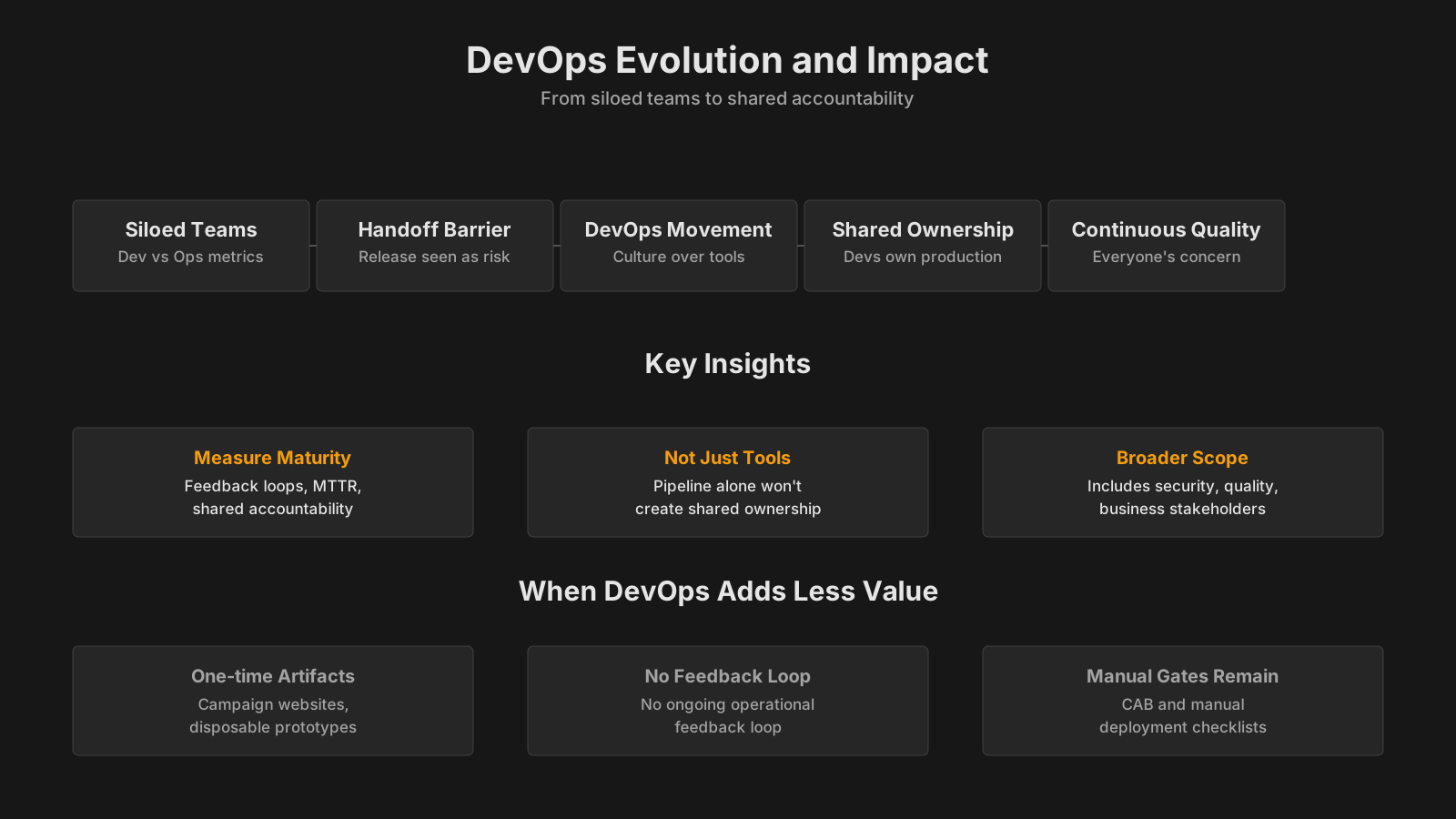
The DevOps movement emerged in software engineering during the late 2000s, although its underlying ideas are older. It borrowed from Lean manufacturing concepts such as small batch sizes, visual management, and the elimination of waiting time between work centers. The term gained public visibility around 2009 through community conferences that brought together system administrators and developers who were frustrated by conflicting incentives. In many organizations, development teams were measured on how quickly they released new features, while operations teams were measured on system stability, creating a structural tension that slowed delivery. The DevOps approach applied manufacturing-style flow thinking to that tension, treating software delivery as a value stream rather than a relay race.
Core Meaning in Project Management
In project management terms, the DevOps approach is not a formal methodology with a prescribed set of roles and ceremonies like PRINCE2 or Scrum. Instead, it is a delivery philosophy that can be layered onto a project's chosen development approach. A project manager may use DevOps principles even when the overall project follows a hybrid life cycle, as long as the work products include software, infrastructure, or digital services. The project manager's role becomes more concerned with integration management, risk in the release pipeline, and stakeholder expectations around operational availability. It also means that traditional phase-gate reviews may need to be adjusted, because completed work is validated continuously rather than only at the end of a phase.
Essential DevOps Approach Insights
- Beyond joint team collaboration
- DevOps functions as an integrated execution model in which planning, coding, building, testing, releasing, deploying, operating, and monitoring operate as tightly coupled activities rather than isolated phases.
- Shortened feedback loop as core goal
- The central goal is to shorten the interval between introducing a change and observing its actual behavior in production environments.
- Project manager focus shifts to flow
- Project managers shift from tracking schedules and budgets to enabling continuous workflow, removing delivery bottlenecks, and surfacing operational quality across the entire project lifecycle.
- New delivery rhythm for stakeholders
- Stakeholders outside IT perceive DevOps primarily as a faster delivery cadence, where working software increments reach production more frequently and with higher reliability.
- Lean manufacturing and flow thinking roots
- DevOps emerged in the late 2000s by adapting Lean manufacturing principles such as small batch sizes, visual management, and wait time reduction to software engineering, treating delivery as a continuous value stream rather than a series of isolated handoffs.
Key Components of the DevOps Approach
The key components of DevOps approach include cultural norms, technical practices, and measurement loops that work together. Culture is the most frequently cited component, since shared ownership between development and operations changes how people respond to failure and ambiguity. Automation is another component, covering infrastructure provisioning, testing, integration, deployment, and monitoring. Feedback systems complete the loop, using telemetry from production to inform planning and design. Without all three components, an initiative can have fast pipelines but still lack the operational insight needed to improve quality. These components are often represented as an infinite loop, emphasizing that delivery is continuous rather than linear.
Culture and Shared Responsibility
Shared responsibility means that a developer does not throw work over the wall to an operations engineer. The team that builds a service also carries accountability for how that service behaves in the hands of users. This cultural component is difficult to adopt in organizations with deeply separated functional units, because it changes performance conversations and incident response. Project managers often see this tension when a project team wants to move faster but operations staff are not included in early planning. The DevOps approach addresses the tension by involving operational specialists early, often during backlog refinement or architecture decisions, rather than during a release event.
Automation and Continuous Delivery
Automation in the DevOps approach covers the entire path from source code control to production deployment. Continuous integration merges work frequently and runs automated tests to detect integration errors quickly. Continuous delivery extends that idea by keeping software in a releasable state and using automated pipelines to deploy to testing and production environments. Infrastructure as code applies the same discipline to servers, networks, and configuration, treating them as versioned artifacts instead of manual changes. For a project manager, these practices change the meaning of project progress, because value is measured by deployable increments rather than by completed documents.
Feedback, Measurement, and Learning
Production telemetry, application logs, and user behavior data provide feedback that feeds directly into the project backlog. Metrics such as lead time, deployment frequency, change failure rate, and mean time to restore are commonly used to understand delivery health. The DevOps approach treats these metrics as signals for improvement, not as individual performance targets. A project manager who understands this will use operational data to support governance decisions, such as whether to invest in stability work or continue feature development. This feedback loop also means that lessons learned are not collected only at project closing; they are absorbed continuously through review of incidents, alerts, and usage patterns.
DevOps Approach in PMBOK and PRINCE2
The DevOps approach in PMBOK is not a formal process group or knowledge area, but it appears as a relevant tailoring consideration within project delivery. The PMBOK Guide Seventh Edition organizes work around principles and performance domains, which gives project teams room to adopt DevOps practices where they support value delivery. Earlier process-oriented editions separated planning, execution, and monitoring into process groups, and DevOps does not map cleanly onto those groups because its activities are continuous. In PRINCE2, the principles and themes remain applicable, but the project manager may tailor the quality theme, change control approach, and management stages to accommodate automated delivery. PRINCE2 does not mandate a specific technical method, so DevOps can be used within a PRINCE2 project as long as controls remain visible.
Fitting DevOps into PMBOK Performance Domains
DevOps aligns strongly with the delivery performance domain in PMBOK Seventh Edition, which addresses scope, schedule, quality, and cadence. It also supports the uncertainty performance domain, because continuous feedback helps identify risks and volatility early. The project manager can document the DevOps approach in the development approach and life cycle section of the project plan, alongside decisions about release frequency. In a traditional PMBOK context, the work breakdown structure may still exist at a high level, but lower-level activities around build, test, and release may be represented as recurring pipeline stages rather than one-time tasks. This requires careful alignment between the project management plan and the technical delivery pipeline.
PRINCE2 Tailoring Considerations
PRINCE2 projects that adopt DevOps still rely on the business case, organization theme, and stage controls. The project board remains accountable for project viability, even if decisions about technical rollout happen frequently. A PRINCE2 project manager may tailor the quality management approach to include automated test results as evidence of quality, rather than only relying on stage-based quality reviews. Change control may also be adapted so that routine low-risk changes flow through the automated pipeline, while higher-risk changes follow formal change authority decisions. This balance preserves governance without forcing every small update through a heavy approval process.
Core Insights on DevOps Integration
- DevOps as tailoring consideration
- Within PMBOK Seventh Edition, DevOps is treated as a tailoring consideration across performance domains rather than as a distinct process group or knowledge area.
- PRINCE2 supports DevOps tailoring
- Because PRINCE2 prescribes no single technical method, teams can integrate DevOps by tailoring the quality theme, change control approach, and management stages while preserving visible governance controls.
- Pipeline stages and change control
- Build, test, and release activities shift from one-time tasks to recurring pipeline stages, allowing routine low-risk changes to move through automation while higher-risk changes remain subject to formal change authority decisions.
DevOps Approach in Agile, Hybrid, and Predictive Environments
Understanding the DevOps approach in Agile project management requires separating Agile delivery from operational readiness. Agile frameworks such as Scrum or Kanban focus on iterative planning and feedback, but they do not by themselves guarantee that a product can be deployed and operated reliably. DevOps extends Agile principles into the operational environment, applying the same concern for small batches, visible work, and continuous learning. Hybrid projects often apply DevOps to software components while maintaining predictive planning for hardware, procurement, or regulatory milestones. Pure predictive projects rarely use DevOps end to end, but they may adopt selected practices such as automated testing or infrastructure automation where software development is part of the scope.
Agile Environments
In an Agile environment, DevOps practices often mature after teams have stabilized basic iterative delivery. The product owner and Scrum master may include operational requirements in the definition of done, such as successful deployment to a staging environment or passing security scans. A common pattern is for the same team to manage development and operational support, which reduces handoff delays and increases accountability. The project manager or Agile team facilitator helps ensure that release planning includes operational stakeholders with authority to approve production changes. This integration makes the Agile cadence more sustainable because operational surprises no longer arrive only at the end of a release.
Hybrid Environments
Hybrid delivery is common in organizations with legacy systems, compliance requirements, or mixed product portfolios. In those settings, the DevOps approach may apply to a customer-facing application while the underlying data platform follows a more controlled release process. The project manager coordinates both streams, using predictive milestones for contractual or regulatory deliverables and automated pipelines for software features. Governance documents may still require stage gate approvals, but the technical evidence presented at those gates includes deployment history, test results, and operational metrics. This evidence can improve decision quality compared with traditional status reports that rely on subjective completion estimates.
Predictive Environments
A fully predictive environment can still borrow specific DevOps practices without abandoning a sequential life cycle. Automated environment provisioning can reduce the time spent in the execution phase, and automated regression testing can support formal verification before a release. However, the cultural principle of shared ownership is harder to achieve when teams are structured around temporary project assignments and handoffs to permanent operations units. The DevOps approach is therefore more commonly seen as a scoped practice in predictive projects, applied to software deliverables or infrastructure automation, rather than a full organizational shift. Project managers should not force DevOps practices onto work that is inherently physical, regulatory, or once-off in nature.
BVOP Perspective on the DevOps Approach
The BVOP perspective on DevOps approach emphasizes cross-functional collaboration and the formal recognition of internally created tools as project products. Business value-oriented project management would view deployment scripts, monitoring dashboards, and automation utilities not as hidden support assets but as legitimate deliverables that contribute to speed and reliability. This aligns with the DevOps idea that operational work products carry real value. BVOPM also treats waste from overwork and handoffs as factors that reduce project benefit, which matches the DevOps focus on minimizing waiting time between development and operations. The perspective reinforces the point that DevOps is not only a technical pipeline but a value-focused way of organizing delivery.
From a monitoring and control view, BVOPM's focus on visible signals can work well with DevOps telemetry. When production metrics show a persistent decline in business value delivery, the organization can examine process damage and waste in the delivery chain. DevOps provides the operational data needed for that review, while the project manager uses governance judgment to decide whether a project should continue. This creates a natural connection between continuous delivery data and portfolio-level decision making.
Core Takeaways on DevOps Value Alignment
- Tools as legitimate deliverables
- BVOP recognizes internal automation scripts and dashboards as formal project deliverables, ensuring they receive the same planning and review attention as customer-facing features because they directly improve delivery speed and reliability.
- Waste reduction through visibility
- Overwork and handoff delays are treated as measurable losses in project value, aligning with the DevOps objective of eliminating idle time and friction between development and operations.
- Telemetry linking delivery and governance
- Production telemetry supplies the operational evidence needed to detect process degradation, and project managers use that evidence to make portfolio-level continuation or adjustment decisions based on objective data.
Practical Application Across the Project Lifecycle
In the practical application of DevOps approach, project managers observe that delivery work becomes more continuous and less dependent on phase boundaries. During project initiation and planning, the team defines release cadence, operational acceptance criteria, and automation investments alongside scope and schedule. This does not mean abandoning project planning; it means planning for a different kind of execution where the pipeline itself is a deliverable. During execution, developers, testers, and operations engineers work in the same workflow, often using Kanban boards to visualize work from backlog through production. Monitoring and controlling use live system data instead of waiting for formal status updates, and closing verifies that operational knowledge has been transferred to the support organization.
Initiation and Planning
Early planning for a DevOps-enabled project includes decisions about cloud environments, deployment policy, security scanning, and operational roles. A project charter may specify that working software must be deployed to production at the end of each sprint, or it may leave release timing to operational readiness reviews. The project management plan should include the development approach, quality metrics, and a communication rhythm that keeps operations leaders informed. In practice, risk registers also change, because technical risks such as environment drift or configuration defects become more visible and more manageable through automation.
Execution and Monitoring
Execution in a DevOps environment is characterized by small, frequent changes rather than large releases. A team may deploy a simple configuration change several times a day, while larger feature work moves through the pipeline in smaller increments. Monitoring is not a separate activity performed by a different group; it is part of the same workflow. Alert thresholds, error budgets, and customer experience indicators are reviewed by the delivery team. This gives the project manager earlier warning of trouble because operational telemetry reveals regressions before they become large-scale incidents.
Closing and Operational Handoff
Project closing in a DevOps approach includes verification that automation is documented, access controls are in place, and the receiving operational team understands the deployment pipeline. Unlike a traditional project where operations may first encounter the product at handover, DevOps projects build operational familiarity throughout execution. The final transition becomes a formality supported by runbooks, dashboards, and shared incident response procedures. Benefits realization can also begin earlier, because release to production is no longer saved until the end of the project.
Common Challenges, Pitfalls, and Misconceptions
Several common misconceptions about DevOps approach continue to create problems in organizations. One is that purchasing automation tools or creating a DevOps engineer role will automatically transform delivery. Another is that DevOps removes the need for project management, governance, or documentation. In reality, the approach shifts governance from phase-based approval to continuous verification, but accountability for budget, scope, and benefits remains. Teams sometimes mistake frequent deployment for business value, releasing changes quickly without evidence that users or the organization benefit. The hardest challenge is usually cultural, not technical, because traditional silos and incentive systems resist shared responsibility for production outcomes.
Cultural Resistance and Organizational Friction
Organizations with strong functional boundaries often struggle because operations teams are not invited into development decisions and developers are not exposed to operational pain. Incentives can work against the DevOps approach when one team is rewarded for feature volume and another for zero changes to production. Managers may need to revise performance goals and incident reviews to emphasize learning rather than blame. This is difficult in regulated industries where change approval processes are deeply embedded. Without explicit executive support, DevOps initiatives can become isolated technical experiments that die when key individuals leave.
Tooling Fallacy and Metric Misuse
The tooling fallacy assumes that automation alone will produce the benefits of DevOps. Tooling can accelerate a broken process, but it cannot fix unclear requirements, poor architecture, or distrust between teams. Metrics also create pitfalls when deployment frequency is celebrated while change failure rate or user satisfaction declines. A balanced view of delivery health is necessary, and the project manager should connect operational metrics to project and portfolio objectives. Misused metrics can drive harmful behavior, such as gaming deployment counts or hiding failed changes by deploying again quickly.
When the DevOps Approach Should Not Be Applied
The DevOps approach is not a universal solution. It is poorly suited to projects where the primary output is physical construction, large-scale civil engineering, or one-time business process redesign with minimal software content. It may also be inappropriate when the organization cannot support continuous operational involvement, such as when a short project team will dissolve immediately after delivery with no stable operations owner. In those cases, selective practices may still help, but adopting the full cultural model would be artificial. The project manager should assess organizational readiness, technical architecture, and risk appetite before proposing DevOps as a delivery approach.
Core Misconceptions and Cultural Hurdles
- Tools alone do not transform delivery
- The purchase of automation tools or the creation of a dedicated DevOps engineer role rarely improves delivery on its own because meaningful gains depend on complementary cultural and process changes.
- Governance and management still apply
- DevOps moves governance from phase-based approvals to continuous verification, yet accountability for budget, scope, and benefits remains intact, so project management and documentation continue to play essential roles.
- Cultural resistance is the main barrier
- Entrenched silos, misaligned incentives, and blame-focused incident reviews often form the largest barrier because they prevent teams from accepting shared responsibility for production outcomes.
Relationship to Other Project Management Concepts
The relationship between DevOps versus Agile is often misunderstood because both share values around collaboration, rapid feedback, and iterative delivery. Agile is primarily a set of values and frameworks for planning and building work in small increments. DevOps extends those values to deployment and operations, ensuring that completed increments are actually usable in production. Lean influences both, with its focus on reducing waste and optimizing flow. ITIL and IT service management emphasize stable processes and service quality, and they can coexist with DevOps when change management is automated and risk-based. Site reliability engineering is a related operational practice that uses engineering approaches to reliability, often incorporating service level objectives and error budgets.
DevOps and Continuous Delivery
Continuous delivery is a technical practice within the broader DevOps approach. It means that code changes are automatically built, tested, and prepared for release, so that deployment to production can happen on demand. A project can adopt continuous delivery without full shared ownership, but it will still face handoff delays if operations approval remains outside the team. Conversely, a team can embrace DevOps culture but lack mature continuous delivery due to legacy systems. These concepts overlap but are not identical.
DevOps and the Project Management Office
A PMO often influences whether DevOps practices succeed. Traditional PMO controls designed for long phase-gate reviews can create friction for teams that deploy changes multiple times a day. More adaptive PMOs support the DevOps approach by tailoring governance, providing value-based reporting, and helping portfolios balance feature work with operational stability. The PMO may also manage dependencies between DevOps-enabled product teams and shared infrastructure or compliance functions. Project managers benefit when the PMO recognizes that delivery speed and governance rigor are not inherently in conflict.
DevOps and Risk Management
DevOps changes the texture of risk management. In a traditional project, release risk accumulates until a big-bang deployment, then spikes. In a DevOps environment, risk is distributed across frequent smaller changes, each with its own rollback or mitigation path. This does not eliminate risk; it changes how the project manager and team identify and track it. Automated tests, canary deployments, and feature flags are technical controls that support risk response. The risk register may include new items such as pipeline security, supply chain vulnerabilities, and loss of operational knowledge if team members depart.
Evolution and Current Thinking
The evolution of DevOps approach has moved from grassroots community practice to a mainstream delivery expectation in many software-enabled organizations. Early DevOps focused on breaking down walls between development and system administration, often through automation and shared on-call duties. The next wave brought infrastructure as code, cloud platforms, and container orchestration, making environments easier to recreate consistently. More recent thinking integrates security into the pipeline, giving rise to the term DevSecOps, which treats security review as a continuous activity rather than a late-stage gate. Current discussions also address platform engineering, value stream management, and the challenge of scaling DevOps across multiple teams.
From Culture War to Operating Model
Early adopters sometimes framed DevOps as a culture war against traditional operations, but mature practice treats it as an operating model. The goal is not to eliminate operations specialists but to make operational knowledge available throughout the delivery process. This shift matters for project managers because it affects team structure, budgeting, and stakeholder engagement. A DevOps operating model may include platform teams that serve product teams, embedded operations engineers, or temporary rotations between development and support roles. These structural choices are organization-specific and should align with the portfolio's value delivery strategy.
Current Debates and Open Questions
Debate continues about whether DevOps is a role, a culture, or a set of practices. Some organizations hire DevOps engineers, while others argue that the title contradicts the principle of shared ownership. Another debate concerns metrics, since no single indicator captures delivery health in all contexts. Scaling DevOps across regulated industries also remains an open challenge, as does maintaining operational discipline when teams change frequently. Project managers should approach the DevOps approach as a context-dependent set of choices, not a certified template. The strongest results come when technical practices are matched by clear governance, realistic risk management, and genuine collaboration across the project team.
Key Insights on DevOps Evolution
- DevOps evolution to mainstream
- DevOps has matured from a grassroots movement into a baseline delivery standard across software-driven organizations, originally centered on dismantling barriers between development and operations through automation and shared operational responsibility.
- Infrastructure as code advances
- Subsequent evolution introduced infrastructure as code, cloud platforms, and container orchestration, enabling repeatable environment provisioning and substantially faster delivery cycles.
- DevSecOps continuous security
- Current practice embeds security directly into the delivery pipeline through DevSecOps, positioning security review as an ongoing responsibility instead of a final checkpoint.
- Culture war to operating model
- Mature DevOps has moved beyond an adversarial stance toward traditional operations and now operates as a formal delivery model that shapes team design, investment decisions, and stakeholder relationships.
- Governance drives DevOps success
- Optimal outcomes emerge when technical execution is paired with transparent governance, pragmatic risk management, and authentic cross-functional collaboration, although scaling DevOps within regulated sectors and sustaining operational discipline remain persistent challenges.