A Change Control Plan is a subsidiary component of the project management plan that formally defines the procedures by which modifications to project baselines, documentation, and other controlled artifacts are requested, evaluated, authorized, implemented, and tracked. It establishes the governance framework that prevents uncontrolled scope creep while ensuring that necessary and beneficial changes are integrated in a disciplined, transparent manner. Without such a plan, project teams operate in a reactive environment where every ad hoc request can destabilize cost, schedule, and quality commitments.
Key Elements of a Change Control Plan
| Key Concept | Summary |
|---|---|
| Definition | The Change Control Plan is the authoritative document that codifies the end-to-end process for submitting, evaluating, approving, executing, and logging modifications to project baselines, ensuring every alteration is traceable and aligned with strategic objectives. |
| Governance | It enforces a governance structure that safeguards project objectives by filtering changes through designated approval tiers, preventing unapproved scope expansions and ensuring each alteration is deliberate, justified, and comprehensively documented. |
| Workflow | The plan defines a unified set of rules and workflows that route all change activity through a repeatable process, specifying approval authorities, evaluation metrics, and decision thresholds that preserve project momentum without compromising rigor. |
| Illustration | When a last-minute marketing request for a landing page arises, an established plan enables a swift impact analysis clarifying resource shifts, schedule effects, and quality trade-offs, so the change is either accommodated through a visible trade-off or deferred without ad hoc disruption. |
| Change Management | Organizational change management addresses the human dimension of transformation by preparing, equipping, and supporting individuals through structured communication, training, and coaching. The change control plan governs the technical process; change management drives adoption and sustained performance. |
| Submission | Every change control plan provides a formal submission channel, typically a standardized request template that captures a clear description, business justification, priority level, cross-functional impacts, and originator accountability, ensuring requests are complete and evaluable on first submission. |
| Re-baselining | For multi-phase projects, the plan often prescribes re-baselining protocols at phase gate reviews to roll verified minor changes into the formal baseline, preventing accumulated deviations from eroding the accuracy of performance metrics and forecast confidence. |
What Is a Change Control Plan?
A change control plan definition in project management centers on a documented set of rules and workflows that channel all change activity through a consistent, repeatable process. It typically begins by identifying which project documents and plans are subject to change control, from the scope baseline and schedule baseline to the requirements documentation and test plans. The plan then outlines the steps a request must follow, the roles authorized to approve or reject changes at different levels, and the criteria used to evaluate each proposed adjustment. In predictive environments, this plan is often drafted early during planning and then approved as part of the overall project management plan. In adaptive environments, the plan may be leaner but no less intentional, often merged with the product backlog management rules or the definition of done.
What makes the concept stick in practice is its role as a filter, not a wall. A well-designed change control plan does not say no to everything; it forces the project team and stakeholders to think through the consequences before a change lands on the schedule. Consider a situation where a marketing lead asks to add a customer portal landing page three weeks before launch. Without a plan, a developer might just build it, overriding the sprint backlog. Costs go up, testing gets squeezed, and the release risks crumbling. With a plan, the same request goes through a rapid impact assessment, gets routed to a product owner, and either gets slotted into the next increment or adjusted with a trade-off. The outcome is not automatic rejection but deliberate choice. That is the real purpose: turning unpredictable impulses into governed decisions.
Core Purpose and Function
The primary function of a change control plan is to maintain the integrity of project baselines while enabling sensible adaptation. It does this by creating a formal communication channel where no change is executed until its ripple effects on scope, cost, time, risk, and quality are understood. The plan also serves as an audit trail, documenting who requested what, why, what was decided, and how the change was eventually implemented. This traceability becomes essential during lessons learned sessions and when contract claims or compliance audits arise. Beyond control, the plan fosters stakeholder confidence. When Steering Committee members see that every request is handled with equal rigor, their trust in the project's governance deepens, even if some of their own requests get denied.
Distinguishing Change Control from Change Management
A common point of confusion is the difference between a change control plan and an organizational change management plan. The former governs project-level modifications to deliverables, baselines, and configuration items. The latter addresses the people side of transformation, dealing with how individuals and groups are moved from current states to future states through communication, training, and coaching. While both can coexist in a large initiative, they operate in different domains. A project manager might have a detailed change control plan for technical scope alterations while the organizational change manager runs a separate stakeholder readiness plan. In smaller projects, that distinction collapses, but the vocabulary still matters. When practitioners talk about a Change Control Plan with a capital C, they are almost always pointing at the project's structural change governance, not the softer human transition framework.
Core Insights Into Change Control Plans
- Documented rules and workflows
- A change control plan establishes a structured framework that channels every change through a consistent, repeatable process, explicitly identifying which project documents are subject to formal control.
- Process steps and approval roles
- The plan specifies the sequential steps for each request, the roles authorized to approve or reject changes, and the decision-making criteria, with predictive environments crafting it upfront while adaptive teams maintain a streamlined version within their backlog rules.
- A filter, not a wall
- An effective change control plan functions as a filter, not a wall, by creating a formal communication channel that compels teams to evaluate ripple effects on scope, cost, schedule, risk, and quality before a change proceeds, instead of simply blocking requests.
Key Components of a Change Control Plan
Understanding the key components of a change control plan helps teams build governance that scales appropriately without becoming process-heavy. While the exact structure varies by industry and methodology, several elements are universally present. The plan normally defines the boundary of control, specifying exactly which artifacts are baselined and thus require formal change procedures. A scope statement, WBS, schedule network diagram, and cost estimates are typical candidates. Contracts and procurement documentation might also fall under the same umbrella. Without this definition, teams waste effort controlling items that never needed formal oversight while leaving sensitive documents exposed to informal tampering.
Change Request Submission and Tracking
Every change control plan includes a mechanism for initiating change requests, often through a standardized template that captures the description, justification, priority, expected impacts, and the originator. The plan then describes the routing logic, how the request moves from submission to initial screening, then to analysis, and finally to a decision authority. A change log, whether maintained in a spreadsheet or a project management information system, gives full visibility into the status of every open request. Tracking is not simply administrative neatness. It allows the project manager to spot patterns, such as repeated requests from the same stakeholder group that signal a misunderstood requirement, and to report on cumulative change volume as a health metric.
Change Evaluation and Approval Criteria
Not all changes are equal, and the plan usually spells out tiered thresholds. A low-impact change that stays within contingency reserves might be approved directly by the project manager, while a change that touches multiple baselines or consumes management reserves escalates to a Change Control Board. Some plans use a financial threshold, others a schedule variance limit. The criteria block out the factors that will be weighed, typically alignment with business objectives, risk exposure, technical feasibility, resource availability, and effect on dependent projects. By making these criteria transparent, the plan reduces political friction. A sponsor who sees her request denied under pre-agreed guidelines is less likely to feel personally rebuffed than one who hits a silent wall.
Change Control Board Roles and Responsibilities
The plan names the members of the Change Control Board or equivalent governance body, specifies their decision rights, and sets meeting cadences. In some organizations, the board is a formal standing committee with functional heads from engineering, quality, legal, and marketing. In others, especially in smaller or Agile contexts, the product owner or a trio of lead architect, product manager, and project manager fills this role. The plan also defines voting rules and quorum requirements, avoiding deadlocks that could stall urgent technical adjustments. Importantly, it establishes an escalation path for appeals when a requester believes a rejection was unjustified, typically through a project sponsor or portfolio board.
Integrated Change Control and Impact Analysis
A sophisticated change control plan does not merely collect approvals; it mandates an integrated impact analysis that examines how a change interacts with every other project constraint. If a feature is added, does it require new test cases? Does it introduce a safety hazard that must be added to the risk register? Could it force a re-architecture that delays integration milestones? This analysis is often documented on the change request form itself or in a linked impact statement. The concept of integrated change control is what elevates the plan from a bureaucratic checkpoint to a strategic decision support tool. The project manager relies on this analysis to present the board with a clear trade-off landscape rather than a binary yes-or-no question.
The Change Control Plan in Project Management Frameworks
A change control plan in PMBOK is formally known as the Change Management Plan, a subsidiary of the project management plan that describes how changes will be managed and controlled throughout the project lifecycle. PMBOK aligns the plan with the Perform Integrated Change Control process, which sits within the Monitoring and Controlling Process Group and integrates across all knowledge areas. The plan is created during the planning phase and is then executed, reviewed, and updated as the project moves forward. The PMBOK emphasis is on ensuring that only approved changes are incorporated into revised baselines and that all change requests, whether approved or rejected, are documented with clear disposition and rationale.
PMBOK and the Change Management Plan
The PMBOK Guide consistently frames the Change Management Plan as a guardrail for baseline integrity. Within the Integration Management Knowledge Area, the plan defines the role of the Change Control Board, the flowchart of change request processing, and the authority levels for approval. It also specifies how changes to configuration items are linked with the configuration management system. For projects that span multiple phases or use rolling wave planning, the plan may include rules for re-baselining at phase gates, ensuring that accumulated minor changes do not distort the performance measurement baseline before a major review.
PRINCE2 Change Theme and Control Approach
In PRINCE2, change control is addressed through the Change theme, with a specific Change Control Approach document drafted during the Initiating a Project process. This approach defines how the project will handle issues, which in PRINCE2 encompass requests for change, off-specifications, and problems. The approach sets out the steps for capturing issues in the Issue Register, assessing their impact, and recommending responses through the Project Board or the Change Authority, a delegated body that can act within predefined limits. PRINCE2 distinguishes between formal change requests and informal suggestions, and like PMBOK, ties change control directly to configuration management so that the status of products remains clear and auditable. The Change Control Approach is reviewed at stage boundaries and refined if needed, reflecting the stage-gate nature of the methodology.
Change Control in Agile and Hybrid Environments
Agile frameworks rarely use the language of a formal change control plan, but the function still exists in the customs around the product backlog, sprint planning, and the definition of done. The product owner holds the authority to accept or reject new user stories, and the team’s velocity and sprint commitment act as the de facto thresholds. A change control plan in an Agile context might be a lean artifact that describes how urgent unplanned work gets injected mid-sprint, what qualifies as a critical bug requiring immediate patching, and how stakeholder requests are triaged via the backlog refinement process. In hybrid models, the plan often adopts a tiered approach: routine functional adjustments flow through the Agile team’s refinement, while architectural overhauls or contractual shifts must pass through a formal Change Control Board. This dual-track design is common in scaled environments where compliance and agility must coexist.
BVOP Perspective on Change Control
Business Value-Oriented Project Management brings an additional lens to change control planning by focusing on what it calls process damage and Business Value Points. A BVOP-informed change control plan may include metrics that track when persistent change instability signals deeper organizational harm beyond mere schedule variance, and categorize waste generated by overwork, perfectionism, or the rejection of previously acceptable work. In such a plan, a steady decline in Business Value Points associated with frequent late-stage changes could trigger a project health review or even a closure recommendation. While this is not a direct override of standard processes, it injects a value-centric early warning mechanism that traditional plans often overlook.
Key Insights on Change Control
- PMBOK's Formal Change Management Plan
- The PMBOK Guide establishes the Change Management Plan as the controlling subsidiary document within the project management plan, defining the end-to-end process for evaluating, approving, and documenting changes throughout the project lifecycle.
- Baseline integrity and documentation
- It safeguards baseline integrity by permitting only approved changes to modify baselines, and it mandates that every change request, whether approved or rejected, is captured along with its final disposition and the supporting rationale.
- Defines governance and authority
- As part of Integration Management, the plan delineates the Change Control Board's composition and mandate, maps the request evaluation workflow, and establishes tiered approval authority to match change impact with decision-making levels.
- Framework-specific adaptations
- PRINCE2 integrates change control with configuration management through the Issue Register and Change Authority, while Agile employs a lightweight artifact that funnels urgent changes into backlog refinement for rapid prioritization.
- Tracking change instability metrics
- A plan informed by BVOP principles monitors instability indicators, surfacing patterns of excessive change churn, and classifies waste arising from overwork, perfectionism, or the unnecessary rejection of otherwise acceptable deliverables.
Purpose and Importance of a Change Control Plan
The purpose of a change control plan extends beyond the obvious need to stop unauthorized work. It creates a level playing field where all changes, regardless of the requester’s seniority, are evaluated through a consistent lens. This prevents the project from becoming a political battleground where the loudest executive gets their pet feature inserted at the expense of the release date. It also protects the team from the burnout that follows constant context switching. When developers know that no one can directly assign them a feature without a traceable request, they can focus on sprint commitments with less anxiety about last-minute heroics.
The plan also serves as a contract of sorts with the sponsor. At the point of project authorization, baselines are signed off with the understanding that deviations will follow a structured path. That understanding preserves the sponsor’s ability to say no to additional costs without later being blamed for delaying innovation. In complex programs where multiple projects share resources, a unified change control plan prevents one project’s scope expansion from quietly siphoning away testing resources from another, an invisible drain that causes program-wide harm.
Practical Application and Use
Change control plan in practice is often tested during the middle and later phases of a project when the gap between original assumptions and current reality widens. Stakeholders who were quiet during requirements elicitation suddenly realize they need a different reporting format or an extra compliance check. The plan kicks in immediately, guiding the project manager to log the request, perform a quick triage, and notify the relevant decision body. Onsite construction projects apply change control through daily site logs and formal variation orders that reference contract clauses. IT infrastructure deployments link change requests to the configuration management database, ensuring that a server patch proposal triggers a review of dependent services. In pharmaceutical product development, the plan dovetails with regulatory change control requirements, where every alteration to a validated process must be assessed for GxP impact and documented for auditors.
A typical scenario unfolds when a client asks for a mid-project database upgrade that promises better performance but introduces incompatibility with legacy interfaces. The request goes into the change log, the technical lead completes an impact statement showing two weeks of interface remediation and a new test cycle, and the Change Control Board weighs that cost against the expected performance gain and the risk of schedule delay. The decision, whatever it is, gets documented, and if approved, the schedule baseline is revised, new funding is allocated, and the team proceeds with clear authorization. That traceable path protects the project manager from later accusations of gold plating or poor forecasting.
Key Insights on Change Control Practice
- Tested as realities diverge
- Change control plans demonstrate their true value in the middle and later project phases, when the widening gap between original assumptions and current conditions exposes the need for disciplined adjustments.
- Late stakeholder requests surface
- Stakeholders who remained silent during requirements elicitation frequently resurface later with demands for additional reporting formats or compliance checks, activating the formal change control process.
- Industry-specific change control formats
- Each industry tailors its change control practices to operational demands: construction relies on daily site logs and contractually referenced variation orders, IT links changes to a configuration management database, and pharmaceutical development enforces strict GxP compliance.
- Typical change review scenario
- A mid-project request for a database upgrade is logged, assessed for impact by the technical lead, and then routed to the Change Control Board, which weighs anticipated performance gains against cost and schedule implications.
- Documented decisions protect managers
- Every approved or rejected change is formally recorded, and approvals prompt baseline updates and funding allocations, forming a traceable decision trail that protects project managers from allegations of gold-plating or inaccurate forecasting.
Common Challenges, Pitfalls, and Misconceptions
One of the most persistent change control plan pitfalls is designing a process so rigid that legitimate adjustments become trapped in endless approval cycles. Project teams start to perceive the plan as an obstacle rather than a shield, and workarounds emerge. A developer informally agrees to a small change during a hallway conversation, and the lack of documentation creates a configuration inconsistency that haunts system integration testing. The plan that was supposed to bring order instead breeds shadow IT and spreadsheet workarounds, which are far harder to untangle than a properly logged change request.
Another frequent mistake is the misapplication of the plan in Agile projects where the backlog itself is the primary change mechanism. Imposing a heavy Change Control Board on a Scrum team can destroy the rhythm of sprint planning and discourage the continuous improvement that the framework counts on. The smarter approach is to tailor the plan to the project’s volatility. A core regulatory deliverable might require full board approval, while user experience tweaks within a feature slice are handled by the product owner’s daily decisions. The plan must define those demarcation lines clearly or become an indiscriminate drag on momentum.
A misconception that refuses to die is the belief that a change control plan will stop scope creep entirely. In reality, the plan cannot prevent stakeholders from asking for more; it can only ensure that the cost of those asks is made visible and that someone with authority makes a conscious trade-off. Scope creep happens when changes are absorbed silently. The plan makes the absorption noisy and political, which is a different problem. It also does not replace the need for good requirements management. If the initial scope was poorly defined, even the best change control plan will struggle to contain the resulting flood of clarifications disguised as changes.
Relationships to Other Project Management Concepts
Change control plan and configuration management are often mentioned together because both deal with the discipline of controlling product states and documentation. The distinction is that configuration management focuses on identifying configuration items, recording their functional and physical characteristics, and reporting their status, while change control governs the process of modifying those items. The two plans must be aligned. A configuration item cannot be altered without a change request, and a change request affecting a configuration item must update the configuration status records. When these two systems are disconnected, project teams end up with version mismatches and test environments that do not reflect the approved product design.
Change Control Plan vs. Configuration Management Plan
In practice, the change control plan references the configuration management plan to define which items are under control and how baselines are established and versioned. The configuration management plan, in turn, relies on the change control plan for the workflow that governs how items transition from one baselined state to another. The separation of concerns helps specialists maintain the integrity of technical deliverables while project management oversees the contractual and scheduling dimensions. On large engineering projects, the configuration librarian role becomes the bridge between the two, ensuring that every approved change is physically implemented in the controlled documentation set before the change is closed.
Change Control and Risk Management
When a change request surfaces, it inevitably carries its own risk profile. The change control plan should mandate that every significant change request undergoes a risk assessment, and the risk register is updated accordingly. Conversely, project risks sometimes trigger change requests; a risk mitigation strategy might require altering the scope or schedule baseline. The change control plan thus becomes an instrument of risk response. Program managers view this connection as critical because a portfolio of interdependent projects can see a single change cascade into risk for adjacent initiatives, and the change control plan’s impact assessment must zoom out to that program-level view.
Change Control and Project Baselines
A change control plan has no teeth without a baseline to protect. The baseline provides the reference point against which deviations are measured. Once a change is approved, the plan’s procedures must include a formal re-baselining step so that future performance measurement does not compare actuals against an obsolete baseline. Some plans allow temporary baselines during a major replanning, while others require a full baseline snapshot at every major milestone. Project accountants prefer a clean auditable chain of baselines, because earned value calculations lose meaning if the baseline float around without documented approval.
Key Takeaways on Change Control Links
- Configuration management versus change control
- Configuration management systematically captures the identity and attributes of configuration items, whereas change control governs the deliberate process of altering them.
- Interdependent change and status tracking
- Modifying a configuration item requires an approved change request, and every such request must update the configuration status records to keep versions synchronized and prevent discrepancies.
- Configuration librarian as bridge
- For large-scale engineering endeavors, the configuration librarian acts as the critical bridge by verifying that every approved change is applied to the controlled documentation before the change can be formally closed.
- Program-level change impact assessment
- Change impact assessment must encompass the program level because an isolated change in one project can cascade into risk for neighboring initiatives and undermine the cost and schedule baselines that program accountants depend on.
Evolution and Current Thinking on Change Control Plans
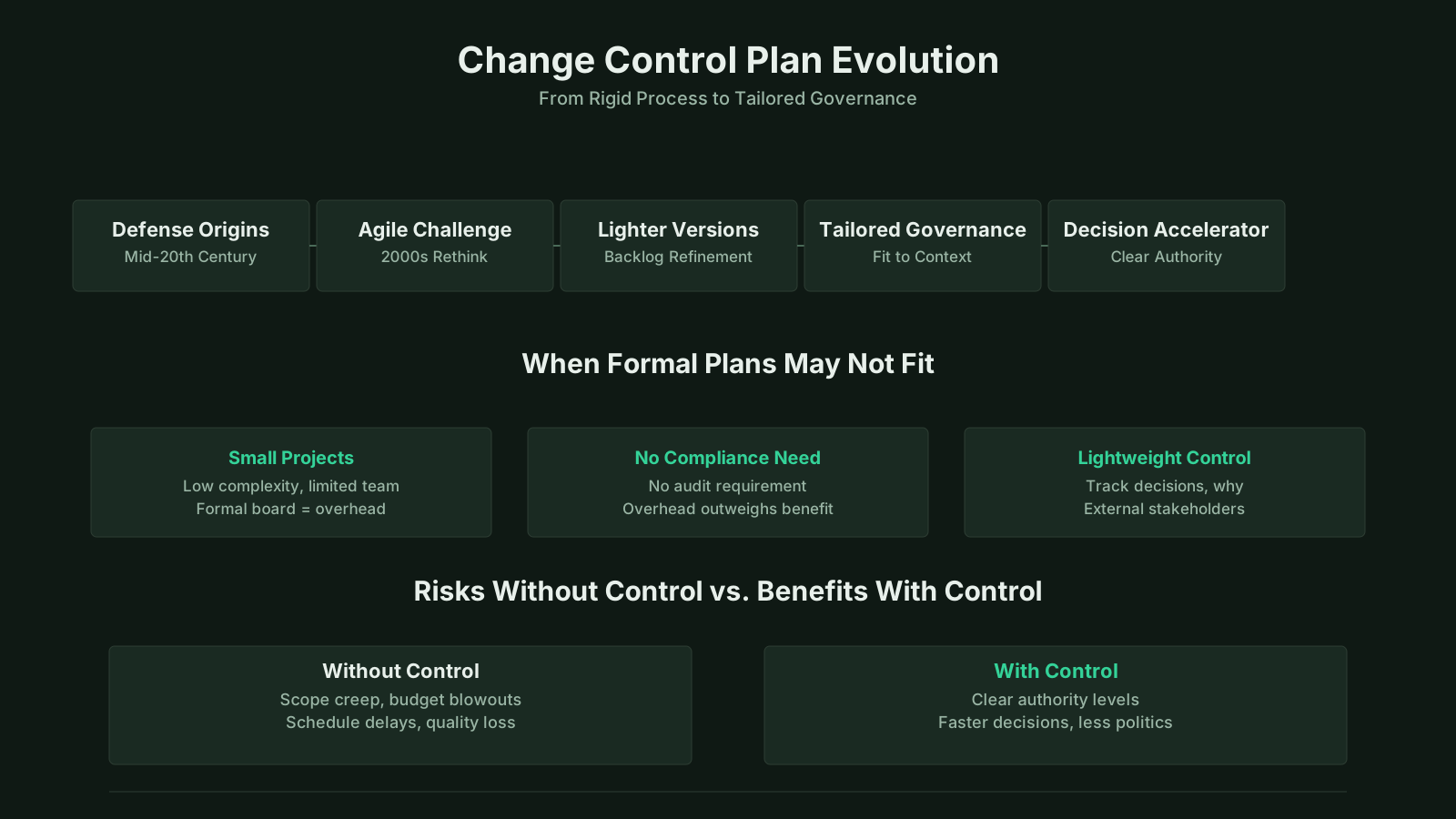
The change control plan evolution over the past decade reflects a broader shift from bureaucratic document-centric control toward risk-based, adaptive governance. Where once a thick binder would sit in a project library, today’s plan is more likely to be a living reference embedded in the project’s collaboration platform, with automated workflows that route requests based on impact thresholds. Organizations that practice DevOps have taken the concept further, embracing the idea that many small, validated changes are safer than a few large, batched ones. In those environments, the change control plan focuses on automated testing gates, feature flags, and canary releases rather than a monthly Change Control Board meeting. The plan for an infrastructure team using continuous delivery might define an emergency change procedure that allows pushing a critical fix to production within minutes, provided it passes a predefined set of automated checks and a rapid peer review, with a retrospective audit within 24 hours.
Current thinking also recognizes the growing role of artificial intelligence in impact analysis. While the plan itself remains a human governance document, tools now help project managers by scanning past project data to predict the likely cost and schedule impact of a proposed change based on similar historical requests. That does not replace the board’s judgment, but it sharpens the data the board sits with. Tailoring remains the central theme of modern guidance. A small internal marketing project does not need a multi-tier board. A life-critical medical device project absolutely does. The mark of maturity in project management is recognizing that the change control plan is not a template to be copied but a governance instrument to be thoughtfully calibrated.