Conscious and unconscious bias in project management refers to the explicit and implicit preferences, assumptions, and mental shortcuts that shape how project managers, sponsors, team members, and stakeholders interpret information, assess uncertainty, and make decisions. Conscious bias is deliberate, recognized, and often openly expressed. Unconscious bias operates automatically and can influence behavior even when it conflicts with a person's stated values or professional standards. In project environments, these biases affect estimation, risk identification, stakeholder engagement, procurement, resource allocation, and progress reporting.
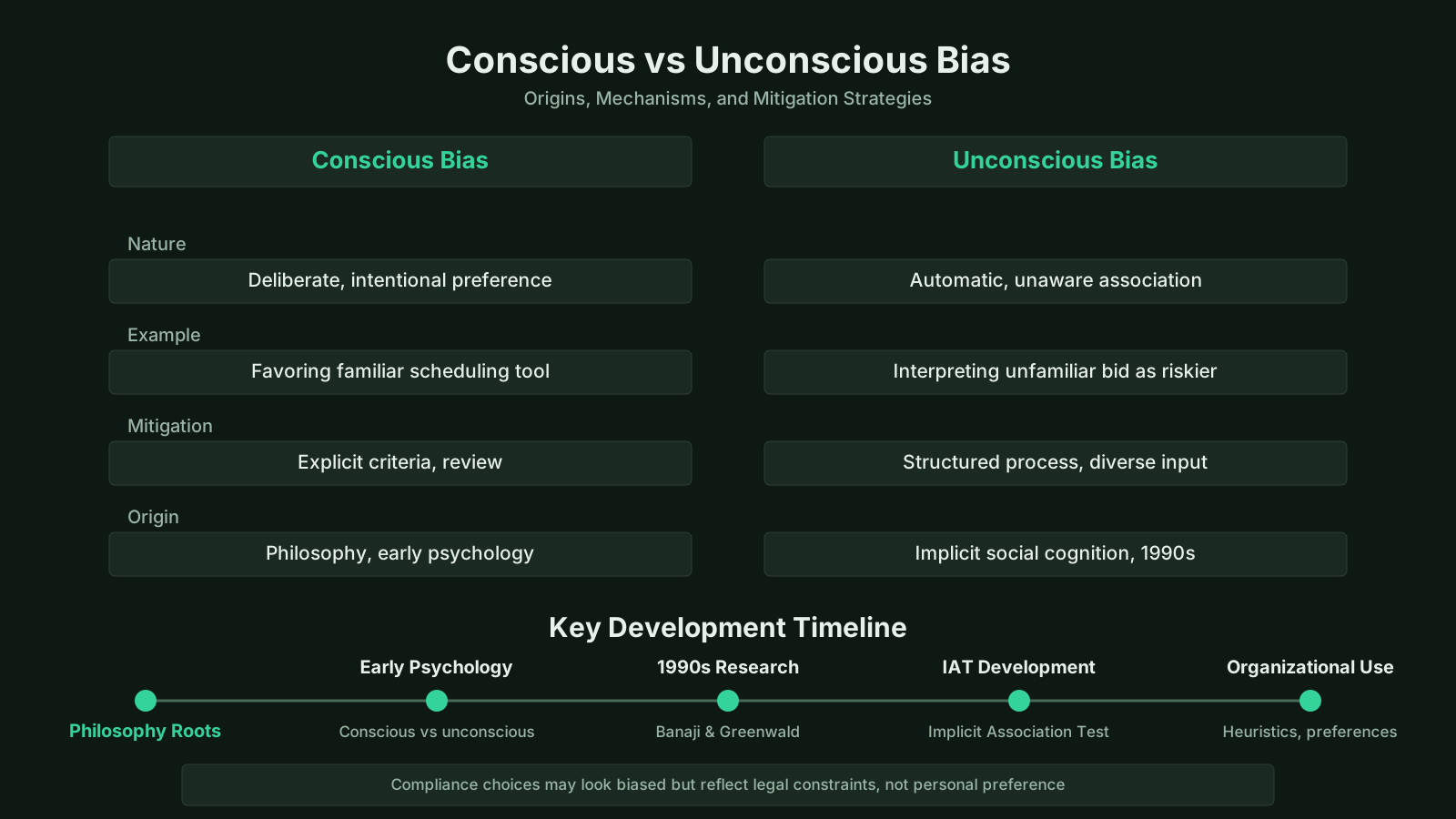
Conscious and Unconscious Bias: Key Points at a Glance
| Key Concept | Summary |
|---|---|
| Definition of Bias | Bias in project management includes explicit and implicit preferences, assumptions, and mental shortcuts that shape how project teams interpret information, evaluate uncertainty, and make decisions. |
| Conscious Bias | Conscious bias reflects explicit preferences and intentional judgments, such as a sponsor favoring a long-standing vendor even when objective selection criteria do not support that choice. |
| Unconscious Bias | Unconscious bias operates below awareness, causing a project manager to trust estimates from a confident presenter while discounting identical data delivered with hesitation. |
| Heuristics | The decision science foundation for unconscious bias comes from Daniel Kahneman and Amos Tversky, whose work demonstrated how reliance on heuristics under uncertainty produces systematic judgment errors. |
| Mitigation Techniques | Mature project environments reduce bias by adopting structured decision rules, independent reviews, standardized rating scales, and other cross-disciplinary controls. |
| Affinity Bias | Affinity bias favors individuals with similar backgrounds, education, communication styles, or professional experience, influencing assignment decisions and determining whose perspectives carry weight in project discussions. |
| Confirmation Bias | Confirmation bias drives project participants to seek, interpret, and remember evidence that reinforces existing assumptions while undervaluing conflicting information. |
| Impact on Estimation | Software development teams use relative estimation and collective review because individual developers are prone to optimism bias and anchoring on the first estimate proposed. |
What Is Conscious and Unconscious Bias in Project Management?
A practical conscious and unconscious bias definition separates deliberate judgments from automatic reactions that occur before a person has fully processed the available evidence. Conscious bias, sometimes called explicit bias, involves attitudes or beliefs that an individual is aware of and may choose to act on. In a project setting, a sponsor might consciously favor a particular vendor because of a long-standing relationship, even when the selection criteria do not support that preference. This is not always corrupt or unethical. It can simply reflect a known preference that the decision-maker has not fully examined.
Unconscious bias, also called implicit bias, operates below awareness. It shapes perception in subtle ways, such as assuming that a team member with a prestigious certification is more competent in all areas, or that a quieter stakeholder has less valuable input. These associations are learned over time and often conflict with a person's stated commitment to fairness. In project management, unconscious bias frequently appears in risk reviews, hiring decisions, stakeholder prioritization, and the interpretation of status reports. A project manager may not realize that they are giving more weight to information from people who resemble their own professional background.
Explicit Bias in Project Work
Explicit bias is generally easier to identify because it can be articulated. A functional manager may state that they prefer experienced internal staff over external contractors, even when external expertise would better fit the project. That preference might be legitimate, but it becomes a problem when it is not tested against the project's actual requirements. Explicit bias can also show up in procurement, where a known preference for a supplier distorts the evaluation of competing bids. The key distinction is that the person can recognize the preference if asked directly.
Implicit Bias in Project Work
Implicit bias is more difficult to detect because it feels like intuition or neutral judgment. A project manager reviewing a schedule might unconsciously accept estimates from a confident presenter and discount estimates from a hesitant one, even when the underlying data are identical. The confidence of the presenter is not a valid basis for schedule accuracy, but it feels relevant. This is why unconscious bias is often more dangerous in complex projects than conscious bias. It does not announce itself, and it tends to survive normal quality checks because the affected decisions still appear reasonable to those making them.
Key Insights on Bias Types
- Conscious bias is deliberate
- Conscious bias occurs when a person knowingly holds and acts on preferences that can override objective standards, such as a sponsor who continues to favor a long-standing vendor even when that choice conflicts with formal selection criteria.
- Unconscious bias is automatic
- Unconscious bias stems from learned associations that activate automatically before a person fully evaluates the evidence, which can put those automatic reactions in direct conflict with their stated commitment to fairness.
- Bias shapes project perception
- Both forms of bias can quietly distort project judgment, for instance when a prestigious certification is taken as proof of broad competence or when input from quieter stakeholders is systematically undervalued.
- Unconscious bias in practice
- Unconscious bias commonly appears in risk reviews, hiring decisions, stakeholder prioritization, and status reporting, particularly when confident estimates are accepted at face value while equally valid but hesitant input is discounted.
Origins and Cross-Industry Context
The origin of unconscious bias in decision science lies in the work of cognitive psychologists Daniel Kahneman and Amos Tversky, who described how people use mental shortcuts called heuristics under uncertainty. These heuristics are efficient, but they produce systematic deviations from rational judgment. Their research introduced concepts such as anchoring, availability, and representativeness, all of which have direct applications in project estimation and risk analysis. The distinction between fast, automatic thinking and slower, deliberate thinking remains a foundational explanation for why bias persists even among experienced professionals.
Outside project management, conscious and unconscious bias has been studied extensively in aviation, medicine, manufacturing, and software engineering. Aviation crews use structured checklists and standardized communication protocols to reduce confirmation bias during abnormal situations. Medical diagnosis has recognized anchoring bias as a cause of missed or delayed diagnosis when clinicians fixate on an initial impression. Manufacturing quality control has long dealt with inspection bias, where expectations about a production line affect how defects are perceived. Software development teams use relative estimation and collective reviews partly because individual developers can be overly optimistic or anchored by the first estimate proposed.
These cross-industry experiences matter for project management because they show that bias is not a personal failure but a predictable feature of human cognition. The same cognitive shortcuts that help a project manager respond quickly to a crisis can distort a risk register or a business case. Borrowing mitigation techniques from other fields, such as structured decision rules, independent reviews, and standardized rating scales, has therefore become common in mature project environments.
Key Components of Conscious and Unconscious Bias
The key components of conscious and unconscious bias include the types of cognitive distortion most frequently observed in project work. These biases do not operate in isolation. A single decision may involve several biases at once, which is why practitioners often find it difficult to isolate a single cause after a project failure. Understanding the main categories helps project managers recognize patterns before they become embedded in baselines, contracts, or governance decisions.
Affinity and Confirmation Bias
Affinity bias refers to the tendency to favor people who are similar to oneself in background, education, communication style, or professional experience. In project teams, this can influence who receives high-visibility assignments, whose opinions carry weight in planning sessions, and who is invited into informal decision loops. Confirmation bias is the tendency to seek, interpret, and remember information in ways that support existing beliefs. A project sponsor who believes a delivery date is achievable may unconsciously ignore early warning signs of delay, while giving heavy attention to reports that confirm the plan is on track.
In practice this means a risk manager may quickly accept evidence that a familiar supplier is reliable and overlook evidence of deteriorating performance. The conclusion feels objective because the manager is genuinely reviewing the data. But the review is tilted toward a preferred outcome from the start.
Anchoring and Availability Bias
Anchoring occurs when the first number or estimate presented exerts disproportionate influence over subsequent judgments. In project estimating, an initial cost figure from a rough business case can anchor the entire project budget, even when scope has expanded significantly. Availability bias occurs when people judge the likelihood of an event by how easily examples come to mind. A recent project failure caused by a cybersecurity breach may lead an organization to overestimate security risks while underestimating more mundane risks such as poor requirements quality.
Optimism and Status Quo Bias
Optimism bias causes people to underestimate the time, cost, and effort required to complete tasks. It is closely related to the planning fallacy, which describes the tendency to produce overly favorable project forecasts despite knowledge of similar past projects that ran late. Status quo bias makes people prefer the current state over change, even when evidence supports a different approach. In change management, this bias appears when stakeholders resist a new process not because the current process is better, but simply because it is familiar.
Core Insights on Bias Components
- Cognitive distortions drive project bias
- Conscious and unconscious bias in projects typically manifests through a recurring set of cognitive distortions that shape how project information is interpreted and acted upon.
- Multiple biases act together
- Because several biases often operate simultaneously, practitioners may struggle to trace a project failure back to one isolated cognitive distortion rather than a reinforcing cluster of them.
- Affinity bias favors similar people
- Affinity bias leads decision makers to favor individuals whose background, education, communication style, or professional experience mirrors their own, shaping who receives high-visibility assignments and whose views influence key choices.
- Confirmation bias reinforces existing beliefs
- Confirmation bias drives people to seek, interpret, and retain information that reinforces their existing beliefs, which can cause a project sponsor to overlook early warning signs of delay and favor reports that portray the plan as on track.
- Anchoring skews estimates and forecasts
- Anchoring occurs when an initial number or estimate exerts disproportionate influence over later judgments, and it reinforces the planning fallacy that leads teams to produce overly favorable forecasts.
Conscious and Unconscious Bias in PMBOK, PRINCE2, and Agile
Understanding conscious and unconscious bias in PMBOK and PRINCE2 is essential because these frameworks rely heavily on professional judgment, documented assumptions, and structured decision points. Bias is not a standalone process or theme in either framework, but it runs through the places where estimates, risk appetites, and stakeholder preferences are formed. The frameworks assume that practitioners can apply judgment rationally, yet the reality is that judgment itself is vulnerable to distortion.
PMBOK Context
Within the PMBOK framework, bias influences planning, risk management, stakeholder engagement, and monitoring and controlling. Risk attitudes, including risk appetite, tolerance, and threshold, are shaped by individual and organizational bias. Expert judgment, a common tool in many processes, can be compromised by overconfidence or confirmation bias. The PMBOK guidance encourages project managers to consider assumptions and constraints explicitly, but the unstated assumptions are often the ones most shaped by unconscious bias. A project charter may contain a business case that is optimistic because the author unconsciously filtered out unfavorable market data. A risk register may reflect availability bias if it overemphasizes risks from recent news rather than risks from project-specific analysis.
PRINCE2 Context
According to PRINCE2, the principle of continued business justification requires regular review of whether the project remains viable. Bias can undermine this principle when the project manager or sponsor interprets benefits data selectively. The management by exception principle is also vulnerable. If a project manager is unconsciously biased toward reporting favorable progress, exception reports may be triggered too late. Similarly, the focus on products helps reduce bias by directing attention to measurable deliverables rather than subjective impressions, but product acceptance decisions can still be influenced by relationships or reputations. Lessons learned processes in PRINCE2 are also subject to hindsight bias, where the outcome of a past decision makes it seem more predictable than it actually was.
Agile Context
Agile methodologies address bias through transparency, feedback loops, and team-based estimation. Planning poker, for example, reduces anchoring by having team members reveal estimates simultaneously rather than sequentially. Sprint reviews and retrospectives create opportunities to surface assumptions that might otherwise remain hidden. However, Agile is not immune to bias. A product owner may prioritize backlog items based on affinity with certain stakeholders. A development team may become overly optimistic about velocity after a few successful sprints. Retrospectives themselves can suffer from groupthink if team members hesitate to challenge dominant opinions. The Agile emphasis on individuals and interactions is valuable, but it also requires explicit attention to how those individuals perceive and interpret information.
Purpose and Importance of Recognizing Bias
The importance of recognizing bias in project management lies in its effect on decision quality, governance integrity, and team trust. Projects operate under uncertainty, and uncertainty is precisely the condition in which cognitive shortcuts become most active. When project managers understand that bias is a normal part of human judgment, they are less likely to treat their initial impressions as facts and more likely to build checks into the decision process.
Recognizing bias improves estimation realism. Many schedule and cost overruns do not come from incompetence but from systematic optimism and anchoring. Recognizing bias also strengthens risk management. A project team that actively questions whether it is ignoring inconvenient information will produce a more honest risk register. Stakeholder relationships improve when project managers notice that they have been favoring some groups over others. Governance bodies make better stage gate decisions when they understand that the project manager's confidence level is not a reliable measure of actual probability.
This is not about eliminating bias entirely, which is not realistic. It is about reducing the gap between perceived decisions and actual evidence. A project manager who says, "I feel confident in this estimate" should recognize that the feeling may come from familiarity rather than data. That awareness alone changes the conversation.
Core Insights on Recognizing Bias
- Bias affects decision quality
- Recognizing bias is essential because it directly shapes decision quality, governance integrity, and team trust at every stage of the project lifecycle.
- Uncertainty activates cognitive shortcuts
- Because projects operate under uncertainty, cognitive shortcuts become especially active, and treating bias as a normal part of human judgment helps managers avoid mistaking early impressions for established facts.
- Bias recognition improves estimation realism
- Schedule and cost overruns usually arise from systematic optimism and anchoring rather than from lack of skill, so acknowledging these patterns enables project managers to develop more realistic estimates.
- Bias recognition strengthens risk management
- When project teams deliberately test whether they are ignoring inconvenient information, their risk registers become more honest and dependable.
- Confidence is not probability
- Governance bodies make better stage gate decisions when they recognize that a project manager's expressed confidence can reflect familiarity rather than actual data or measured probability.
How Bias Affects Estimation, Risk, and Decision-Making
Bias in project estimation and risk management is one of the most costly manifestations of unconscious judgment in project delivery. Estimates form the basis of budgets, schedules, and contracts, yet they are often produced under pressure with incomplete information. In these conditions, anchoring, optimism, and availability biases combine to create forecasts that look precise but are systematically unrealistic. The initial estimate becomes a reference point that is difficult to move even when scope changes or risks emerge.
Estimating and Scheduling
The planning fallacy is a well-established pattern in which people underestimate the time needed for future tasks even when they know that similar tasks have taken longer in the past. This is not simply wishful thinking. It occurs because people construct mental scenarios that focus on the future task in isolation, without fully accounting for interruptions, dependencies, and integration problems. In project management, this shows up when a schedule is built from task-level estimates without reference to historical data from comparable projects. The anchor of an early rough estimate can persist through multiple planning cycles.
Risk Identification and Analysis
Risk identification is supposed to be broad and inclusive, but it is often constrained by what the team can easily recall. A recent data breach makes information security risks feel more probable than they are. A successful previous project with a certain technology makes technical risks feel lower than they might be. Confirmation bias also affects qualitative risk analysis. Once a risk is categorized as low, project managers may unconsciously seek evidence that supports that rating while discounting evidence that suggests it should be higher.
Decision-Making
Project decisions are rarely made with complete information. In the absence of full data, people rely on judgment, and judgment is shaped by bias. A steering committee may reject a project change request because the current plan feels safer, even when the change would reduce long-term operating costs. A project manager may choose a familiar supplier because the familiarity feels like reliability. These decisions are not irrational in the moment. They feel like experience, but experience can simply be accumulated bias if it is never challenged by structured analysis.
Bias in Stakeholder Management and Team Dynamics
Unconscious bias in stakeholder management affects who gets heard, who gets prioritized, and whose concerns are treated as legitimate. Stakeholder analysis is a formal process in project management, but the initial identification of stakeholders is often influenced by visibility and familiarity. Loud, senior, or well-connected stakeholders receive attention, while quiet or less visible groups may be overlooked. This is not usually a deliberate exclusion. It is a natural consequence of how people allocate limited attention.
In team dynamics, affinity bias can shape assignment decisions. A project manager may assign the most critical work to people whose working style mirrors their own. Halo bias, where one positive attribute influences overall judgment, can cause a team member with strong technical skills to be seen as a good leader even when they lack communication or facilitation skills. Groupthink can emerge in high-performing teams when dissent is seen as disloyalty. The result is a project environment that feels harmonious but produces narrow decisions.
A common surprise for new project managers is that team agreement is not always a sign of good decision-making. Agreement can simply mean that the same biases are shared across the group. Diverse teams help reduce this risk, but only if the environment allows disagreement to surface. Psychological safety matters because people will not point out a flawed estimate or a biased risk rating if they fear undermining a senior colleague.
Key Insights on Bias and Teams
- Stakeholder identification bias
- Even when a formal stakeholder analysis follows an objective process, the initial list is often shaped by visibility and familiarity, which can leave quieter or less visible groups underrepresented.
- Affinity bias in assignments
- Affinity bias can lead project managers to hand critical assignments to team members whose working style mirrors their own, rather than to the person with the strongest relevant qualifications.
- Halo bias and groupthink
- Halo bias can cause a single strong attribute such as technical skill to mask missing leadership abilities, while groupthink often equates dissent with disloyalty and undermines the value of agreement as a quality signal.
- Psychological safety matters
- Team members will hesitate to challenge a flawed estimate or biased risk rating when they fear undermining a senior colleague, so psychological safety is essential for honest decision-making.
The BVOP Perspective on Bias
The BVOP perspective treats persistent bias as a form of process damage, the invisible organizational harm that reduces value delivery over time without appearing in standard budget or schedule reports. If project managers and sponsors selectively confirm favorable progress data, a program's Business Value Points may mask declining returns until closure becomes unavoidable. Bias in status reporting, defect analysis, and stakeholder input validation therefore becomes a governance risk rather than merely a soft interpersonal issue.
BVOP's emphasis on a transparent board of project issues, where all roles can raise concerns before authorization, creates a structural check against the silence that often accompanies implicit bias. The methodology's use of predefined root-cause categories in defect analysis also limits the tendency to attribute defects to whatever cause is most familiar or most convenient. This approach reflects a broader principle in mature project environments: bias is best managed through process design, not through individual willpower alone.
Common Challenges, Pitfalls, and Misconceptions
One of the common pitfalls in managing unconscious bias is treating awareness training as a complete solution. Training can help people recognize bias, but it does not automatically change behavior under pressure. Without changes to decision processes, review checkpoints, and accountability mechanisms, the effect of training often decays over time. Project managers should not assume that a one-time workshop has protected their projects from biased estimates or skewed risk reviews.
Another misconception is that unconscious bias is always negative or always discriminatory. Bias is a cognitive shortcut, and shortcuts can be useful in routine decisions. The problem arises in complex, high-uncertainty decisions where the shortcut replaces deliberate analysis. Bias is also not the same as prejudice, even though the two can overlap. A project manager can have an unconscious preference for a familiar software platform without holding hostile attitudes toward other options. The preference becomes problematic only when it prevents fair evaluation.
Practitioners also face the challenge of defensiveness. When bias is raised in a project review, people may feel accused of being unfair or incompetent. This reaction can shut down honest discussion. A more effective framing treats bias as a normal feature of cognition that affects everyone, not as a character flaw. At the same time, overcorrection is possible. Too many checkpoints and too much second-guessing can slow decisions to the point where the project loses momentum. The goal is proportionate oversight, not paralysis.
Key Insights on Bias Management
- Training alone is insufficient
- Awareness training improves recognition of bias but has limited influence on behavior in high-pressure settings, so sustained change depends on redesigned decision processes, structured review checkpoints, and clear accountability.
- Context determines bias impact
- Cognitive shortcuts serve well in routine decisions but become risky in complex, uncertain environments where they substitute for deliberate analysis.
- Bias needs no hostile intent
- A project manager can unconsciously favor a familiar software platform without any negative attitudes toward alternatives, demonstrating that bias arises from cognitive habits rather than character flaws.
- Frame bias as normal cognition
- Describing bias as a universal feature of human cognition reduces defensiveness and prevents project reviews from feeling like accusations of unfairness or incompetence.
- Balance oversight with momentum
- Excessive checkpoints and repeated second-guessing can stall decisions until project momentum erodes, so bias mitigation should be calibrated to preserve both rigor and speed.
Relationship to Other Project Management Concepts
The relationship between bias versus risk attitude in project management is especially important because risk attitude is often treated as a rational preference, while bias is treated as an error. In reality, risk appetite and risk tolerance are shaped by both. An organization may describe itself as risk-averse, but its behavior may reflect optimism bias in low-visibility areas and availability bias in high-profile areas. Understanding this connection helps project managers design risk responses that match actual behavior instead of documented policy.
Bias also interacts with assumption logs. Assumptions are supposed to be explicit, but the selection of which assumptions are recorded is itself influenced by bias. A team may document technical assumptions while ignoring organizational assumptions that feel too sensitive or too obvious to mention. The issue log has a similar vulnerability. Issues that align with the project manager's preferred narrative may be minimized, while issues that contradict it may be escalated too slowly.
Structured decision-making techniques are often recommended as bias mitigation tools. Multi-criteria decision analysis, Delphi technique, and planning poker reduce the influence of a single dominant voice or an early anchor. However, these tools are only as good as their design. A weighted scoring model can still produce biased results if the weights reflect unchallenged preferences. Group decision techniques can be undermined if facilitators do not protect dissenting views. Bias therefore connects to decision-making, team development, stakeholder engagement, risk management, and communication planning across the project lifecycle.
Evolution and Current Thinking
Current thinking on unconscious bias in project management has shifted away from the idea that awareness alone is sufficient. Modern practice emphasizes structural interventions, such as independent estimating, reference class forecasting, predefined decision criteria, and diverse review boards. These approaches do not rely on individuals catching their own biases in the moment, which is often impossible. Instead, they change the environment so that biased judgments are less likely to flow directly into baselines and approvals.
There is also growing attention to algorithmic bias in project management tools. Predictive analytics and artificial intelligence can reduce some human biases, but they can inherit bias from training data or from the assumptions of the people who design the models. A scheduling algorithm that learns from historical project data may reproduce the optimism embedded in past estimates. This does not mean algorithms should be avoided. It means they need the same kind of governance and challenge that human estimates require.
Debates continue about how to measure implicit bias and whether training programs produce lasting behavioral change. The evidence on training effectiveness is mixed, and some researchers argue that context-specific interventions outperform general awareness programs. In project management, the practical response has been to embed bias checks into existing artifacts and ceremonies, such as risk workshops, stage gate reviews, retrospectives, and planning sessions. The field increasingly recognizes that bias is not a separate topic to be covered in a soft skills module. It is a persistent condition that affects every decision point where uncertainty and human judgment intersect.
Key Insights on Bias Evolution
- Structural interventions take priority
- Organizations now favor structural safeguards such as independent estimating, reference class forecasting, predefined decision criteria, and diverse review boards over reliance on individual awareness or willpower.
- Environment design prevents biased judgments
- By reshaping the decision environment, these interventions reduce the chance that biased judgments directly influence cost baselines and approvals, since bias is rarely detectable in real time.
- AI tools can inherit bias
- Predictive analytics and artificial intelligence can mitigate certain human biases, yet they may also carry forward biases embedded in training data or model assumptions, which means they require governance comparable to that applied to human estimates.
- Context-specific checks outperform awareness training
- Given mixed evidence on training effectiveness, project teams integrate bias checks directly into existing artifacts such as risk workshops, stage gate reviews, retrospectives, and planning sessions rather than relying on standalone awareness programs.
