Confirmation bias is defined as the tendency to search for, interpret, favor, and recall information in ways that reinforce existing beliefs, expectations, or preferred outcomes while undervaluing contradictory evidence. In project management, confirmation bias operates as an invisible filtering mechanism. It affects how project managers, sponsors, steering committees, and team members assess progress reports, risk registers, test results, estimates, and lessons learned. A project may have mature governance and still suffer from poor decisions because the people interpreting the data are selectively seeing what they expected to see. This article examines the definition, origins, components, framework implications, practical impact, and common misunderstandings of confirmation bias in a project management context.
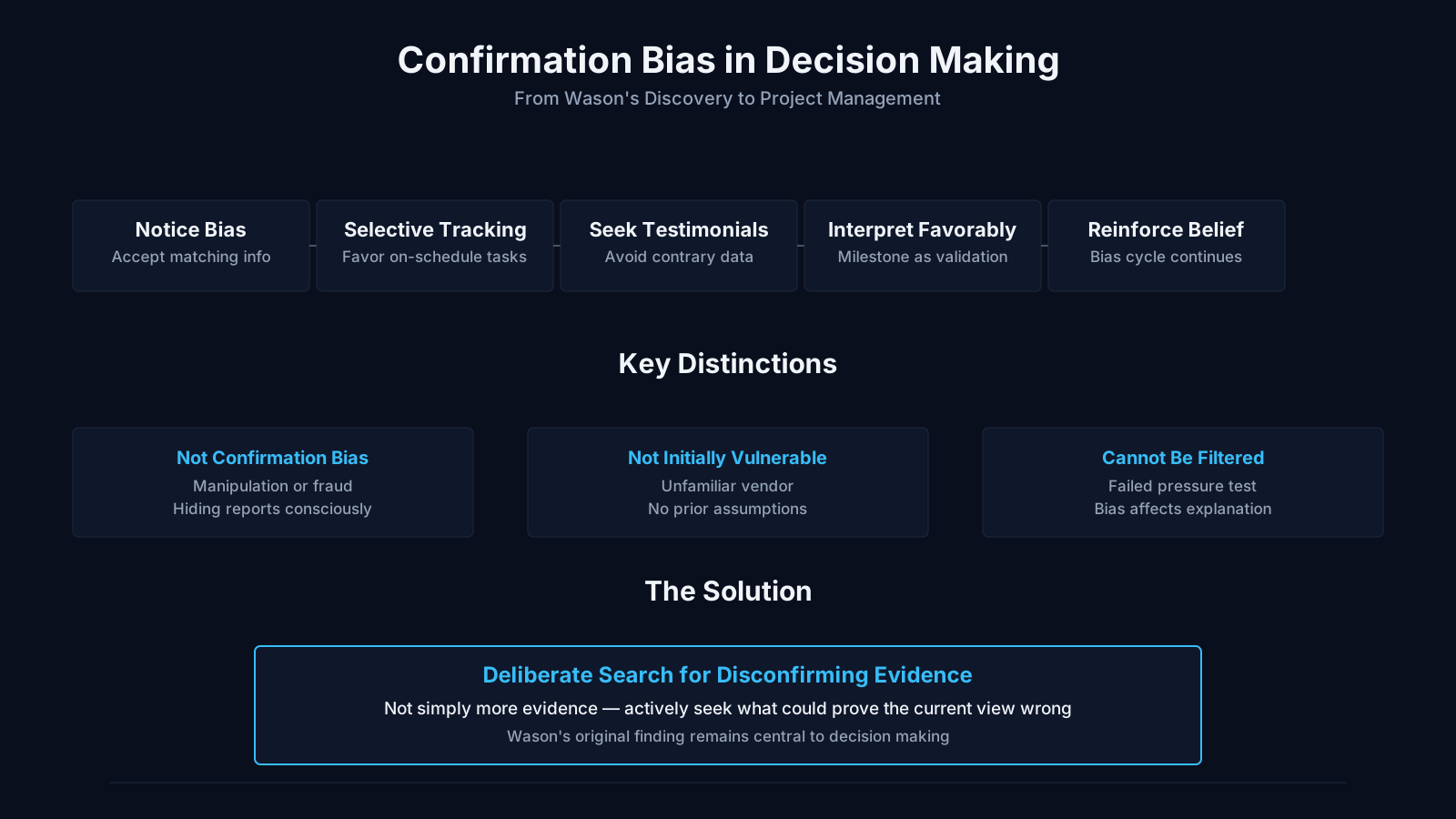
Confirmation Bias: Key Concepts Summarized
| Concept | Summary |
|---|---|
| Definition | Confirmation bias is a cognitive tendency to systematically favor information that validates existing beliefs while undervaluing or dismissing contradictory evidence. |
| Scope | It shapes how project managers, sponsors, steering committees, and team members interpret performance reports, evaluate risks and estimates, and extract lessons learned. |
| Project Management Context | In project settings, stakeholders assign disproportionate credibility to evidence that supports the approved baseline or strategic direction while underestimating early warning signs of schedule, cost, or quality issues. |
| Illustrative Example | A project manager may interpret a single favorable velocity report as definitive proof of recovery while dismissing a steadily rising defect backlog as normal variation. |
| Behavioral Pattern | Individuals typically seek information that confirms their current position and recall successful past decisions more readily than unsuccessful ones, reinforcing confidence in their initial judgments. |
| Sponsor Vulnerability | A sponsor who requests further analysis may be seeking justification for a preferred vendor or solution rather than conducting an objective evaluation of alternatives. |
| Origins | The concept originated in Peter Wason's 1960s experiments on hypothesis testing, which demonstrated how people instinctively seek evidence that confirms their chosen rules rather than evidence that could disprove them. |
| Mitigation Practices | To mitigate this bias, project management has adopted independent cost and schedule estimates, structured stage gate reviews, and formal risk challenge sessions, mirroring safeguards used in aviation and other high reliability industries. |
What Is Confirmation Bias in Project Management?
Confirmation bias in project management refers to a systematic pattern in which project participants give more weight to evidence that supports the approved plan, estimate, or product direction and discount evidence that signals a problem. For example, a project manager may interpret a favorable weekly velocity report as proof that the schedule is recovering while treating a rising defect backlog as a routine quality issue. The bias does not necessarily involve falsifying data or ignoring all warning signs. It is usually more subtle. People ask questions whose answers are likely to confirm their current view, or they remember successful past decisions more vividly than failures.
This makes confirmation bias difficult to detect from inside a project team because the reasoning often looks reasonable on the surface. A project sponsor may demand more analysis while already disregarding findings that challenge the approved business case. A project manager may interpret a two-week schedule slip as a temporary variance even when contractor reports consistently show declining productivity. The formal project controls remain intact, but the human judgment feeding those controls is distorted.
Confirmation Bias Definition and Core Meaning
In the context of project management standards, confirmation bias is not a named process or input. It is a behavioral concept that explains how otherwise sound project controls can fail. The bias operates at the intersection of human judgment, information processing, and decision governance. A project manager does not consciously decide to ignore bad news. Instead, the brain accelerates agreement with data that matches existing mental models and slows down when facing contradictory information. This asymmetry shapes which risks are escalated, which variances are investigated, and which lessons are recorded.
A practical definition for project professionals is that confirmation bias is an unconscious preference for evidence that confirms current project assumptions, expectations, or preferred outcomes. The most dangerous aspect is that it often looks like diligence. A sponsor who asks for additional analysis may appear rigorous, but if the request is aimed at retroactively justifying an already selected vendor or solution, the analysis becomes a confirmation exercise. Likewise, a team may hold exhaustive design reviews yet still overlook usability problems because the reviewers share the same assumption that the design is sound.
The Cognitive Basis of Confirmation Bias
Confirmation bias originates from normal cognitive functioning rather than individual incompetence. Human memory and attention are selective. People seek coherence between what they believe and what they observe. When new information is ambiguous, the brain resolves the ambiguity in favor of existing expectations. This happens faster and with less conscious effort than critical reassessment. The bias manifests in three common ways in project work: selective search for information, biased interpretation of mixed data, and distorted recall of past decisions. These three pathways can operate together, reinforcing the same conclusion.
Consider a project that has slipped once. The project manager now believes the team overestimates uncertainty. When a new risk appears, the manager searches for historical examples of similar risks that did not materialize. The same manager interprets a two-day delay as proof of stable delivery because it falls within an accepted tolerance. Later, when asked about the project's forecasting quality, the manager recalls only the milestones that were met and forgets the effort required to meet them. None of this requires dishonesty. It is simply the mind filtering information through an existing belief.
How Confirmation Bias Differs from Other Project Biases
Confirmation bias is often confused with optimism bias, anchoring, and groupthink, but it is distinct. Optimism bias involves overestimating the likelihood of positive outcomes. Anchoring involves giving excessive weight to an initial number or estimate. Groupthink involves suppressing dissent to maintain team harmony. Confirmation bias is more specific: it is the differential treatment of evidence based on whether that evidence supports an existing view. A project can exhibit confirmation bias without groupthink if team members genuinely disagree but still distort evidence to defend their own positions. A project can also exhibit confirmation bias without optimism bias, for example when a manager selectively accepts evidence that a project is failing and ignores signs of recovery.
Core Insights on Confirmation Bias
- Systematic weighting of supportive evidence
- Project participants affected by confirmation bias systematically overvalue information that aligns with the approved plan, cost estimate, or product direction while undervaluing early indicators of emerging problems.
- Distorted interpretation of project data
- A common manifestation occurs when a project manager interprets a single favorable velocity report as conclusive evidence of schedule recovery while treating a rising defect backlog as ordinary quality fluctuation rather than a warning signal.
- Unconscious and internally invisible
- Because the biased reasoning often appears logically sound to those inside the team, confirmation bias remains difficult to detect even when external contractor reports repeatedly show declining productivity.
- Not a formal project control
- Although it appears nowhere as a named process or input in project management standards, confirmation bias acts as an unconscious filter that degrades the human judgment underlying formal project controls.
Origins and Cross-Industry Context
Origins of confirmation bias lie in cognitive psychology rather than project management literature. The term emerged from experimental studies of human reasoning, most notably associated with Peter Wason's hypothesis-testing research in the 1960s. Wason demonstrated that people tend to seek examples that confirm a rule rather than examples that could disprove it. Later work by Daniel Kahneman and Amos Tversky broadened the understanding of cognitive biases in judgment under uncertainty. Their research showed that systematic errors are common even among intelligent, motivated people. These findings gradually influenced management disciplines because project decisions are inevitably made under uncertainty.
Outside project management, confirmation bias has been studied extensively in medicine, aviation, finance, and law. In medicine, a clinician may anchor on an initial diagnosis and then interpret ambiguous test results as supporting that diagnosis. In aviation, investigators examine how pilots and maintenance crews can miss contradictory signals from instruments or inspection records because they expect a certain system state. In finance, analysts may maintain a bullish view of an asset even as fundamentals deteriorate. These fields developed structured checks such as differential diagnosis, independent inspection, and red team reviews to counteract the bias. Project management borrowed similar ideas, including independent estimates, stage gate reviews, and risk challenge sessions.
Project management differs from these fields in one important way. Projects are temporary, unique, and often governed by incomplete baseline information. There is no long operational history in many cases. This increases reliance on expert judgment and stakeholder assumptions. Confirmation bias becomes especially influential when the evidence is ambiguous and the cost of admitting a flawed assumption is high. The cross-industry lesson is not that project teams are uniquely irrational. It is that temporary organizations need explicit countermeasures because they lack the long feedback loops that eventually expose biased reasoning in stable operations.
Key Components of Confirmation Bias
Key components of confirmation bias are selective exposure, biased interpretation, and biased memory. Selective exposure occurs when project participants seek out data, experts, or reports that are likely to support the current plan. Biased interpretation occurs when the same variance is read as acceptable for a favored workstream but unacceptable for a disfavored one. Biased memory occurs when stakeholders recall past forecasts, decisions, or risks in a way that supports their preferred narrative. These components do not operate in isolation. A project team may collect balanced data, then interpret it selectively, then later remember only the subset that confirmed the eventual outcome.
Selective Information Search
Selective search can be observed in planning, procurement, and benefits analysis. A project sponsor who prefers an internal build may ask the project manager to gather benchmarks from organizations that successfully built similar systems internally. A sponsor who prefers a purchased solution may request examples of failed internal builds. The search itself is shaped by the desired answer. In risk identification, a team may invite experts known to share the project manager's optimism about a new technology. This does not mean the resulting risk register is empty, but it is skewed toward manageable risks and away from fundamental threats.
Biased Interpretation of Ambiguous Evidence
Project data is rarely unambiguous. Schedule variance, defect density, stakeholder survey scores, and cost performance can all be interpreted in multiple ways. Confirmation bias influences which interpretation is chosen. A project manager may view a three-week delay as evidence of improving trend because the monthly delay was four weeks the previous month. A quality manager may view a stable defect rate as success even when the project is adding more functionality, so the defect density per unit of scope is actually rising. These interpretations are not obviously wrong. They become problematic when the same standard is not applied to evidence that contradicts the preferred conclusion.
Biased Recall and Project Memory
Project memory is stored in lessons learned registers, post-project reviews, and the minds of experienced practitioners. Confirmation bias distorts both. At a lessons learned workshop, participants may recall risks that were successfully managed while forgetting risks that were missed entirely. A project manager may remember that a previous estimate was accurate because the project finished on time, without recalling that the finish required two scope reductions and significant overtime. The written record then becomes a source of false confidence for future projects. In this way, confirmation bias persists across projects rather than remaining an isolated event.
Confirmation Bias Across the Project Lifecycle
At initiation, confirmation bias can solidify an unexamined business case. During planning, it can inflate confidence in estimates and assumptions. During execution, it can delay the recognition of variances. During monitoring and controlling, it can shape which metrics are selected and which thresholds are considered meaningful. During closing, it can produce a flattering but incomplete lessons learned report. The bias does not belong to a single phase. Its expression changes, but the underlying mechanism remains the same.
Key Takeaways on Confirmation Bias
- Three core components of bias
- Confirmation bias operates through three mutually reinforcing mechanisms: selective exposure, biased interpretation, and biased memory, each of which can amplify the others as a project unfolds.
- Selective exposure to supporting data
- Selective exposure occurs when project participants gravitate toward data, experts, or reports that validate the current plan, while avoiding evidence that might challenge its assumptions.
- Biased interpretation of variance
- Biased interpretation emerges when identical variance is judged as acceptable in a favored workstream yet unacceptable in a disfavored one, enabling stakeholders to apply inconsistent standards to the same metrics.
- Biased memory of past events
- Biased memory causes stakeholders to reconstruct past forecasts, decisions, or risks in ways that reinforce their preferred narrative, subtly rewriting history to align with current preferences.
- Skewed risk identification results
- When teams consult only optimistic experts or selectively cite favorable benchmarks, the risk register becomes skewed toward manageable risks, leaving fundamental threats underrepresented or unexamined.
Confirmation Bias in PMBOK, PRINCE2, and Agile
Confirmation bias PMBOK implications appear across several performance domains even though the PMBOK Guide does not define confirmation bias as a standalone process. The PMBOK Guide structures project work around process groups and knowledge areas, but human judgment remains embedded in expert judgment, data analysis, and decision-making techniques. In scope management, confirmation bias can influence requirements prioritization by favoring stakeholders who agree with the project manager. In schedule management, it can affect the interpretation of schedule variance. In risk management, it can produce risk registers that confirm the team's preferred view of uncertainty. The formal processes produce documentation, but documentation quality depends on the quality of the judgment behind them.
Confirmation Bias in PMBOK Knowledge Areas
Within the PMBOK framework, Develop Project Charter and Develop Project Management Plan rely on expert judgment and data gathering. If sponsors enter those processes with a fixed solution, they may use market studies and benchmarks selectively. Monitor and Control Project Work requires measuring actual performance against the baseline, but confirmation bias can affect which variances are escalated. Perform Integrated Change Control requires evaluating change requests against the project's objectives. A change request that supports the original plan may receive less scrutiny than one that disrupts it, even if the latter has stronger benefits. Project quality management also intersects with confirmation bias when test results are interpreted through assumptions about what should work rather than what the data actually shows.
The PMBOK Guide's shift toward principles rather than prescriptive processes does not remove the bias. Principles such as demonstrating leadership behaviors and navigating complexity require project managers to challenge assumptions and foster transparent information flow. A project team that claims to follow these principles can still fall into confirmation bias if leadership behavior is perceived as punishing bad news. The guide's emphasis on tailoring also carries risk. Teams may select only those practices that feel comfortable, which can reinforce existing preferences rather than address project-specific vulnerabilities.
Confirmation Bias and PRINCE2 Themes
PRINCE2 addresses confirmation bias indirectly through its principles, themes, and management products. The continued business justification principle requires ongoing assessment of whether the project remains desirable, viable, and achievable. Confirmation bias can weaken that assessment because the project manager and executive may prefer evidence that the original justification still holds. The learn from experience principle asks teams to identify and apply lessons, but biased recall can contaminate the lessons log. PRINCE2 themes such as business case, risk, quality, and progress provide structured records that help expose selective attention. Stage boundaries are particularly relevant because they create formal moments for the project board to reassess assumptions. However, a stage gate only works as an antidote if the board members are willing to question the evidence placed before them.
Confirmation Bias in Agile and Hybrid Environments
Agile frameworks emphasize transparency, inspection, and adaptation. These values are intended to reduce the fear of bad news, but they do not automatically eliminate confirmation bias. A product owner may interpret a successful sprint demo as proof that the product direction is correct, even when only happy-path scenarios were shown. A scrum team may treat stable velocity as evidence of healthy delivery while ignoring rising technical debt. Planning poker helps reduce anchoring and confirmation effects by generating independent estimates before discussion, but the technique only works if participants genuinely estimate rather than align with the senior developer's view. Retrospectives create a container for dissent, yet teams can still settle on comfortable explanations for recurring problems.
Hybrid environments face compounded risk because they combine predictive baselines with iterative delivery feedback. A project may simultaneously use milestone reporting and sprint metrics. Confirmation bias can cause a project manager to favor whichever set of data supports the planned completion date. For example, a milestone report may show green status because gates were passed on paper, while burndown data reveals incomplete work quality. When the two signals conflict, the biased mind selects the one that preserves confidence. Effective hybrid governance therefore requires explicitly comparing both sets of evidence before making decisions.
BVOP Perspective on Confirmation Bias
BVOP perspective on confirmation bias connects the bias to product risk management and defect analysis. Business Value-Oriented Project Management separates product risk from project management risk and uses quantified loss size units with dynamic filtering. This approach can counteract confirmation bias by requiring risks to be assessed against explicit criteria rather than intuitive plausibility. BVOPM also uses predefined root-cause categories during defect analysis, which forces teams to consider multiple failure explanations instead of accepting the first hypothesis that fits their existing beliefs. These practices do not eliminate bias, but they make the evidence review process more structured and less dependent on selective interpretation.
BVOP's Structured Bias Countermeasures
- Risk separation and quantification
- BVOP separates product risk from project management risk and evaluates each through quantified loss size units and dynamic filtering, replacing subjective impressions with consistent, measurable evidence.
- Explicit criteria over intuition
- Because risks are evaluated against explicit, predefined criteria rather than intuitive plausibility, confirmation bias has far less opportunity to distort risk decisions.
- Structured defect analysis categories
- Predefined root-cause categories compel teams to examine several plausible failure mechanisms during defect analysis, preventing them from settling on the first hypothesis that confirms their existing assumptions.
Practical Impact of Confirmation Bias in Project Work
Impact of confirmation bias in projects is most visible in planning, estimating, risk management, status reporting, and stakeholder governance. It rarely appears as a single catastrophic decision. More often, it produces a slow erosion of decision quality. Estimates become untethered from actual performance. Risks are dismissed until they become issues. Status reports turn green because the project manager interprets the data optimistically. Stakeholders lose confidence only after the pattern becomes undeniable. By that point, the project may have consumed substantial time and budget that could have been redirected earlier.
Planning and Estimating
Estimating is inherently uncertain. Confirmation bias pushes estimators to favor data that supports the target date or budget. If an executive has already communicated a delivery date, the team may look for analogous projects that finished within that timeframe. Analogous projects that ran late are treated as exceptions. Parametric estimates may be adjusted by removing outliers that contradict the target. This produces a defensible-looking estimate that confirms the executive's expectation. In many organizations, this is not deliberate padding or fraud. It is the human tendency to construct a coherent story in which the preferred number is plausible.
Risk Management and Status Reporting
In risk management, confirmation bias affects identification, analysis, and response planning. A risk that is unfamiliar or threatening may be ignored because it does not fit the team's mental model of the project. During qualitative risk analysis, probability and impact scores may be assigned in ways that keep the overall risk exposure within an acceptable range. Status reporting compounds the problem. A project manager may present a milestone trend as stable because the project has not missed a gate, while ignoring that gate criteria were progressively weakened. The report itself then becomes evidence that things are on track, reinforcing the original belief.
Stakeholder Engagement and Governance
Steering committees and sponsors are not immune. A sponsor who championed the project may interpret low user adoption as a temporary market condition rather than a product problem. A steering committee may approve a revised business case without questioning whether the original assumptions were invalid. Stakeholder engagement plans often emphasize maintaining support, but they can become tools for managing only favorable stakeholders. Project managers may spend time with stakeholders who support the project and avoid those who raise awkward questions. This selective engagement then produces an ecosystem in which confirmation bias is mutually reinforced.
Consider a project where monthly reports show a small but persistent increase in unresolved defects. The quality manager interprets the increase as a normal result of more testing. The project manager points out that the defect rate per feature has remained stable. The sponsor sees the green status and assumes the project is healthy. None of them notices that the overall defect backlog has doubled over four months because each metric, taken alone, has a comfortable explanation. That is confirmation bias at work. It does not require a single dramatic warning sign.
Common Challenges, Pitfalls, and Misconceptions
Common misconceptions about confirmation bias include the belief that it only affects inexperienced people, that it can be solved by simply wanting to be objective, and that more data automatically corrects it. In reality, confirmation bias is strongest when people are intelligent and motivated because they are better at constructing plausible justifications for their preferred conclusion. More data can deepen the bias if the data is selectively collected or interpreted. Awareness helps, but it is not a complete solution. The bias operates quickly and unconsciously, so even project professionals who know about cognitive biases can fall into the pattern under deadline pressure or political scrutiny.
Why Confirmation Bias Persists in Project Environments
Project environments create conditions that intensify confirmation bias. Time pressure reduces the cognitive capacity for critical reasoning. Hierarchical structures make it costly to contradict a senior sponsor. Business cases create early commitment to a particular direction. Performance reviews reward project managers for delivery confidence rather than early bad news. Sunk costs accumulate once resources are committed. All of these factors increase the psychological cost of updating beliefs. The project manager may not ignore contradictory evidence out of laziness. Contradictory evidence threatens the social and political stability of the project coalition.
When Confirmation Bias Is Most Dangerous
Confirmation bias is particularly dangerous before major milestones, during vendor selection, in safety-critical projects, and when responding to early warning indicators. At a go/no-go decision, selective evidence can lead to approving a project that should have been stopped. During vendor selection, a preferred supplier may be evaluated against criteria weighted after the fact. In safety-critical environments, weak signals from inspections, tests, or incident reports may be rationalized away until a failure occurs. Projects with long feedback loops are especially vulnerable because the cost of being wrong is not immediately visible.
Limitations of the Concept
Confirmation bias should not be used as an excuse for every failed project. Not every favorable interpretation is a cognitive bias. Some judgments are correct. A project may genuinely recover after a schedule slip. A risk may legitimately be low probability. The challenge is distinguishing a reasonable interpretation from a biased one. That distinction requires examining the process used to reach the conclusion. If the process systematically filters out contradictory evidence or applies unequal standards, confirmation bias is a more likely explanation. If the team can articulate what evidence would change its mind, the judgment is probably more balanced.
Core Insights on Confirmation Bias
- Misconceptions about bias
- A common misconception holds that confirmation bias mainly affects inexperienced people, that it can be neutralized by simply wanting to be objective, and that accumulating more data will automatically correct it.
- Bias strengthens with intelligence
- Confirmation bias is often strongest in intelligent, highly motivated individuals because their reasoning skills enable them to construct plausible justifications for preferred conclusions, and selective data collection can further entrench the bias.
- Project environments amplify risk
- Hierarchical structures, premature commitment to a business case, and performance reviews that emphasize delivery over critical scrutiny all intensify the bias, making it especially hazardous just before milestones, during vendor selection, and in safety-critical projects.
Relationships to Other Project Management Concepts
Confirmation bias vs anchoring and optimism bias is a frequent source of confusion in project management discussions. Anchoring occurs when an initial estimate or number exerts excessive influence over subsequent judgments. Optimism bias occurs when project participants overestimate the likelihood of good outcomes. Confirmation bias is the mechanism that protects those optimistic or anchored judgments after they form. A team may anchor on a completion date, develop optimism about hitting it, and then filter all subsequent progress data through confirmation bias. The three biases often combine, but they can also appear independently. Effective analysis separates them because the countermeasures differ.
Confirmation Bias and Risk Attitude
Risk attitude refers to the disposition of an organization or individual toward uncertainty. A risk-seeking sponsor may prefer evidence that the project can achieve an aggressive target. A risk-averse quality manager may prefer evidence that the product has defects. Confirmation bias reinforces whichever risk attitude is dominant because it magnifies evidence that matches the attitude. This can distort quantitative risk analysis. Objective probability distributions may be replaced by subjective judgments that reflect the decision maker's comfort zone. Risk management plans then become documents that justify existing risk preferences rather than tools for balanced assessment.
Confirmation Bias and Lessons Learned
Lessons learned processes are supposed to convert project experience into organizational knowledge. Confirmation bias undermines this conversion by shaping what is remembered and recorded. Teams may document lessons that flatter their decisions and omit lessons that reveal early ignored warnings. At the portfolio level, this creates a misleading knowledge base. Future projects then use these lessons as evidence to support similar approaches. The cycle repeats across programs. A program manager may see a consistent pattern of successful projects because the same flaws are systematically filtered out of the lessons repository.
Confirmation Bias and Other Cognitive Biases
Confirmation bias interacts with sunk cost fallacy, status quo bias, and the availability heuristic. Sunk cost fallacy pushes decision makers to continue investing because they have already invested. Confirmation bias then helps them find reasons to believe the continued investment will pay off. Status quo bias favors keeping the current plan, and confirmation bias selectively highlights the risks of changing course. Availability heuristic makes recent or vivid examples more influential, and confirmation bias directs attention to vivid examples that support the existing narrative. These interactions make individual biases difficult to isolate, which is why project governance often targets decision processes rather than trying to diagnose one bias at a time.
Evolution and Current Thinking on Confirmation Bias
Current thinking on confirmation bias reflects a shift from simple awareness training toward structural safeguards and decision design. Early discussions treated cognitive biases as individual errors that could be corrected by education. More recent project management practice recognizes that biases are persistent and often invisible to the person experiencing them. This has led to interest in independent reviews, reference class forecasting, premortems, and challenge functions that force project teams to consider alternative interpretations. None of these approaches eliminates confirmation bias, but they change the environment in which decisions are made.
From Academic Curiosity to Project Governance
Confirmation bias entered project management through applied behavioral science. As project failures were studied, investigators noticed that many failed projects had abundant warning signs that were dismissed or rationalized. The problem was not always a lack of information. The problem was the quality of interpretation. This shifted attention toward governance mechanisms that would make dissent a formal part of the process. Stage gates, peer reviews, and risk boards emerged as institutional responses. The growing use of data analytics in project management has not automatically reduced the risk. Dashboards can amplify confirmation bias by allowing project managers to select metrics that tell the story they want.
Debates in Project Management Practice
There is some debate about how much debiasing is possible through individual effort. Some practitioners argue that project managers can improve their judgment through training in critical thinking and structured analytic techniques. Others argue that the bias is too deeply embedded for individual correction and that the only reliable answer is to design decision processes that do not depend on unbiased human judgment. The truth is likely situational. In low-stakes decisions with clear feedback, individual awareness may help. In high-stakes project decisions with political pressure and ambiguous data, structural safeguards are probably more effective. Most mature organizations use both, pairing awareness with independent checks and explicit assumptions testing.
Current Practice and Future Direction
Current practice increasingly emphasizes the language of falsifiability in project reporting. A project team is more likely to catch confirmation bias if it defines in advance what evidence would signal that the plan is not working. This idea appears in risk triggers, acceptance criteria, and variance thresholds. When thresholds are defined before execution begins, the team has already committed to a definition of failure that does not depend on after-the-fact rationalization. Future directions may include more rigorous use of decision records that document not just what was decided, but what evidence was considered and what contradictions were set aside. This does not solve the bias, but it creates an audit trail that can expose systematic selective reasoning.
Core Insights: Designing Around Bias
- Education gives way to design
- Efforts to counter confirmation bias have moved beyond awareness training toward structural safeguards and decision design, given that biases persist even when individuals are aware of them.
- Bias remains persistent and invisible
- Because confirmation bias typically remains invisible to those affected by it, modern project management now depends on independent reviews, reference class forecasting, premortems, and formal challenge functions to surface alternative interpretations.
- Institutional safeguards from failure studies
- Research on failed projects shows that warning signs were often dismissed or rationalized, which has driven organizations to adopt stage gates, peer reviews, and risk boards as formal safeguards.
- Data analytics cannot replace judgment
- Greater reliance on data analytics has not automatically reduced bias risk, and many experts now argue that decision processes should be designed to limit dependence on unbiased human judgment.