A Critical Success Factor (CSF) is defined as an essential element, condition, or activity that must be achieved or performed well for a project, program, or portfolio to meet its success objectives. In project management, critical success factor refers to the limited set of circumstances, deliverables, or behaviors that directly determine whether an initiative will succeed or fail. The concept sits upstream from traditional performance measurement because it identifies what has to be true before success can even be measured.
Critical Success Factors at a Glance
| Key Concept | Summary |
|---|---|
| Definition | A Critical Success Factor is an essential element, condition, or activity that must be delivered at a high standard for a project, program, or portfolio to achieve its defined success criteria. |
| Project Management Role | Within project management, Critical Success Factors are the select few circumstances, deliverables, or behaviors that most directly determine whether an initiative achieves its intended outcomes or falls short. |
| Contextual Examples | A hospital's bedside manner and billing efficiency become secondary when the surgical team lacks core safety conditions. Similarly, a missing business process owner can silently delay decisions and erode progress even when schedule reports appear healthy. |
| Origins | The concept emerged from management information systems research when D. Ronald Daniel introduced the term in 1961, and it gained formal recognition after John F. Rockart published a structured, widely cited article in Harvard Business Review in 1979. |
| Rockart's Contribution | Rockart demonstrated how senior executives could isolate the few performance areas where favorable results are absolutely necessary for organizational goal attainment, thereby establishing the concept's structured framework and elevating its strategic visibility. |
| Manufacturing Application | Manufacturing adapted the principle to process reliability by establishing mandatory tolerances, preventive maintenance schedules, and quality control gates that must be satisfied to achieve consistent output quality. |
| Key Components | Effective Critical Success Factors are defined by five essential attributes: specificity, measurability, controllability, direct linkage to objectives, and scarcity. |
| Typical Statements | Representative Critical Success Factors span sustained executive sponsorship, timely regulatory clearance, precise data migration accuracy, and demonstrated user adoption readiness, each signaling a threshold condition for success. |
What Is a Critical Success Factor?
When practitioners ask what is a critical success factor in project management, the answer focuses on enabling conditions rather than final outcomes. A critical success factor is not the same as a successful result. It is an input, condition, or capability that makes the result possible. Executive sponsorship, realistic scope, competent resources, and stakeholder alignment are common examples. The successful result itself might be expressed as completing within budget, meeting quality thresholds, or realizing business benefits.
Critical success factors are inherently context dependent. A pharmaceutical launch project may depend on regulatory approval, while a public infrastructure initiative may depend on land acquisition and community consent. That context dependency distinguishes critical success factors from generic project management practices. Good communication is always helpful, but it only rises to the level of a critical success factor when the project cannot achieve its value without it.
The number of critical success factors should be small. Most practitioners and management researchers suggest between three and seven factors. When the list grows beyond that, it stops being a tool for focus and becomes another inventory of ordinary requirements. A useful test is whether a factor, if missing or badly degraded, would cause the project to fail or lose most of its intended value.
Think of a surgical procedure as a rough analogy. Sterile instruments, a correct diagnosis, stable vital signs, and an available surgeon are critical success factors. The patient recovering without complications is the success criterion. A hospital could have excellent bedside manners and modern billing systems, but those do not matter if the surgical team lacks the core conditions needed to operate safely.
Critical Success Factors vs Success Criteria
One of the most persistent confusions in project management is the relationship between critical success factors and success criteria. A success criterion is a measurable outcome used to judge whether a project has succeeded. A critical success factor is a condition that makes that outcome possible. A project may hit a schedule date but fail to deliver usable functionality because a required integration environment was not available. That missing environment was a critical success factor, even though the schedule criterion was met.
The distinction matters because success criteria are often used retrospectively, while critical success factors are used prospectively and continuously. A project manager can monitor a success criterion by checking earned value or milestone completion. A critical success factor may require softer or earlier detection. For example, the continued engagement of a key business process owner is not always visible in a schedule report, but its absence can stall decisions and quietly erode progress.
Core Insights on Success Factors
- Enabling conditions, not outcomes
- Critical success factors are the enabling conditions that make project success possible; they precede and drive outcomes such as budget adherence or quality compliance, rather than being those outcomes themselves.
- Context determines the factors
- The critical success factors that matter vary sharply by project type: a pharmaceutical launch may hinge on regulatory clearance, whereas an infrastructure initiative often depends on securing land access and community consent.
- Beyond generic good practices
- Good communication is broadly useful, but it becomes a critical success factor only when the project cannot realize its intended value without that specific communication capability.
- Keep the list focused
- Once the list of critical success factors grows beyond the few conditions that truly govern value delivery, it loses its power as a prioritization tool and turns into an unfocused inventory of standard requirements.
- Core conditions drive results
- Just as surgery depends on sterile instruments, an accurate diagnosis, stable vital signs, and a qualified surgeon, projects rely on core conditions that rarely appear in status reports yet remain essential for sustained progress.
Origins and Cross-Industry Context
The origin of critical success factors is usually traced to management information systems research rather than project management practice. John F. Rockart published a widely cited article in Harvard Business Review in 1979 that described how chief executives could identify the few areas where favorable results were absolutely necessary to achieve organizational goals. D. Ronald Daniel had introduced the phrase earlier in 1961 in a discussion of management information needs, but Rockart gave the concept its structured form and broad visibility.
The idea traveled quickly beyond executive information systems. Healthcare administrators used critical success factors to identify conditions for patient safety and accreditation. Aviation safety programs treated checklist items such as stabilized approach and crew communication as critical factors. Manufacturing applied similar thinking to process reliability, where certain tolerances and maintenance activities had to be met for quality output. Those non-project uses reinforced the core insight that not all activities carry equal weight.
In each of those fields, the value of critical success factors came from reducing a complex operation to the few conditions that could not be allowed to fail. That same logic later influenced project portfolio management, benefits management, and governance. The concept entered project management as a planning and control idea, not as a motivational slogan. It was used to decide where management attention should be concentrated.
Key Components and Characteristics of Critical Success Factors
Analysts typically describe the key components of critical success factors as specificity, measurability, controllability, linkage to objectives, and scarcity. Specificity means the factor is concrete enough to guide action. Measurability means someone can determine whether the factor is present or failing. Controllability means the organization can influence it through decisions and resources. Linkage means the factor connects directly to a strategic or project objective. Scarcity means only a small number of factors receive the label.
A well-formed critical success factor often reads as a condition, not a task. It might be stated as sustained executive sponsorship, regulatory clearance, data migration accuracy, or user adoption readiness. A poorly formed one reads like a milestone, such as complete phase one by June. That phrase is really a schedule outcome, not an enabling condition. The difference is practical because tasks can be completed while the underlying condition remains unmet.
Critical success factors can be internal or external. Internal factors include team capability, governance clarity, and decision-making speed. External factors include supplier stability, regulatory timing, and market conditions. Some factors are temporary and phase-specific. A technical certification might be critical during design but irrelevant after deployment. Recognizing that a factor has a lifecycle prevents teams from tracking stale conditions long after they have ceased to matter.
Types of Critical Success Factors
Strategic critical success factors relate to the long-term position of an organization, such as maintaining a distribution network or retaining specialized engineering talent. Project critical success factors relate to a specific initiative, such as securing a data center or completing usability testing. Temporal critical success factors exist only during a particular phase, while enduring factors span the entire lifecycle. External factors are often harder to control but must still be monitored because their failure can be catastrophic.
In program management, critical success factors may apply across multiple component projects. A shared integration platform or a common customer identity system can be a program-level factor. In portfolio management, critical success factors help select and deselect investments. A portfolio may treat capacity of a rare skillset as a critical factor, which then limits how many data migration projects can run at the same time.
Characteristics of Effective Critical Success Factors
An effective critical success factor has an owner. If nobody is accountable for maintaining the condition, it will slip through gaps in the governance structure. It also needs a review rhythm. A factor may be stable in one quarter and deteriorate in the next. Finally, it should be written in language that a sponsor can understand without technical translation. That does not mean the factor is vague; it means the condition is expressed in terms of the value it protects.
Effectiveness also depends on honesty. Teams sometimes choose factors that are already under control because those are comfortable to report. A critical success factor that never changes and never triggers discussion is probably not critical. The most useful factors are the ones that make leaders slightly uncomfortable because they expose dependency, uncertainty, or political fragility.
Core Insights on CSF Components
- Five defining components
- Critical success factors combine specificity, measurability, controllability, clear linkage to objectives, and deliberate scarcity to set them apart from ordinary performance indicators.
- Specificity drives concrete action
- Specificity ensures a CSF is concrete enough to steer day-to-day decisions, focus cross-functional resources, and translate strategic intent into measurable progress.
- Condition-based statement style
- Well-formed CSFs describe conditions that must exist rather than tasks to complete, such as sustained executive sponsorship, regulatory clearance, or user adoption readiness.
- Controllability and internal factors
- For a factor to qualify as a CSF, the organization must be able to influence it through deliberate decisions and resource allocation; typical internal levers include team capability, governance clarity, and decision-making speed.
- Scarcity and strategic scope
- The CSF label is deliberately reserved for a limited set of factors to preserve strategic focus; strategic CSFs typically address long-term positioning, such as maintaining a distribution network or retaining specialized engineering talent.
Critical Success Factor in Project Management Frameworks
In the PMBOK framework, critical success factor PMBOK discussions usually appear in the context of project initiation and planning. The PMBOK Guide describes critical success factors as essential elements or conditions required for project success. They are often documented in the project charter or project management plan so that sponsors and teams share a common view of what cannot be allowed to fail. They inform risk management, assumption tracking, and governance reporting.
Critical Success Factor Definition in PMBOK
The PMBOK definition of critical success factors places them within the broader system of project integration management. When a project manager drafts a charter, high-level risks, constraints, and assumptions are meant to capture factors that could determine viability. The project management plan then translates those factors into baselines and control mechanisms. A factor such as stable regulatory approval may appear as an assumption, a risk, and a schedule dependency at the same time.
PMBOK-based guidance does not elevate critical success factors to a standalone knowledge area. Instead, the concept runs through several processes. In planning, they shape scope, schedule, and quality decisions. In monitoring and controlling, they inform variance analysis and risk reviews. In closing, they help determine whether delivery conditions were actually met and whether lessons should be retained for future initiatives.
Critical Success Factor in PRINCE2
PRINCE2 approaches critical success factor analysis through its principle of continued business justification. A project should have identifiable conditions that justify continued investment. The business case is not a static document; it is reviewed at stage boundaries. Critical success factors appear in practice as those conditions that, if lost, would undermine the business case. A factor may be a regulatory approval, a committed business owner, or a stable supplier arrangement.
PRINCE2 also manages tolerances across time, cost, quality, scope, risk, and benefits. A critical success factor in this context is frequently a tolerance boundary that cannot be breached without escalation because the breach would change the project's viability. This creates a governance linkage. The project board does not need to review every task, but it should review evidence that critical success factors remain intact.
Critical Success Factor in Agile Delivery
Agile frameworks rarely use the label critical success factor, but the underlying logic is present. In Scrum, a stable cross-functional team, a product owner who can make decisions, a sustainable pace, and a clear definition of done are widely recognized conditions without which value delivery degrades. Kanban systems depend on work-in-progress limits and explicit policies. These are enabling conditions, not final success measures.
A common critical success factor in agile delivery is the availability of automated testing infrastructure. Without it, rapid feedback becomes impossible and technical debt accumulates. Another is psychological safety, because teams that fear blame will hide emerging problems until they become delivery failures. Agile practitioners often treat these conditions as team health indicators, but they function as critical success factors under a different name.
Business Value-Oriented Perspective on Critical Success Factors
Business Value-Oriented Project Management treats critical success factor in BVOPM discussions as part of a broader focus on value delivery and waste reduction. In BVOPM, cross-functional teams are explicitly identified as a core success factor because fragmented teams create delays and hidden handoffs. The methodology also recognizes employee-created tools and open-source software as formal products, meaning that a team's ability to build or adapt its own tooling can be a critical success factor rather than an informal convenience.
BVOPM thinking aligns with the idea that a critical success factor is not a bureaucratic artifact. It is an observable condition in the daily work system. If the condition disappears, delivery quality or value capture deteriorates. The framework does not claim superiority over other methods; it simply makes certain enabling conditions explicit and links them to business value points and process waste.
Core Insights on Value-Driven CSFs
- Value delivery and waste reduction
- BVOPM integrates critical success factors into a broader value delivery framework that prioritizes waste reduction and business impact over checklist compliance.
- Cross-functional teams reduce handoffs
- Cross-functional teams represent a critical success factor because fragmented structures create hidden handoffs and delays that erode the speed and quality of value delivery.
- Employee tooling as formal asset
- BVOPM elevates employee-created tools and open-source software to the status of formal products, making a team's capacity to build or adapt its own tooling a critical success factor rather than a peripheral convenience.
- CSFs are observable conditions
- Critical success factors function as observable conditions embedded in the daily work system, directly shaping delivery quality and value capture rather than serving as bureaucratic artifacts.
- Explicit links to value points
- BVOPM avoids claiming superiority over other methods and instead focuses on making enabling conditions explicit, then linking them directly to business value points and measurable process waste.
Purpose and Importance of Critical Success Factors
The importance of critical success factors in project management comes from their ability to focus attention and resources. Projects operate with finite time, money, and management attention. If a project team treats every requirement and risk as equally important, leadership attention gets diluted. Critical success factors concentrate governance on the few conditions where failure would be catastrophic or where positive performance unlocks the intended value.
They also improve decision-making under pressure. When a project faces a resource conflict, the critical success factors help leaders decide what to protect first. If executive sponsorship is critical and slipping, then adding another developer may not solve the real problem. The factor tells the team where the next intervention should occur. This is more useful than a long risk register that ranks everything as high priority.
Critical success factors also connect delivery to benefits. Many projects complete their outputs but fail to realize outcomes because an operational condition was never satisfied. A new system may go live on time, but if process owners do not change their workflows, the expected benefit will not appear. That change readiness is a critical success factor that sits between project delivery and benefits realization.
Why Critical Success Factors Matter in Governance
Project boards and PMOs use critical success factors to define red lines. Without them, status reports can be green while a project is quietly failing. A project can be on schedule but starved of stakeholder engagement. A factor such as the key user group signing off a prototype by a fixed phase catches that condition before it becomes an end-stage crisis. Governance becomes less about reviewing activity and more about checking the conditions that keep the investment viable.
Practical Application and Common Scenarios
Common critical success factor examples in real projects include sustained executive sponsorship, availability of a specific technical environment, regulatory approval by a fixed date, data migration quality, and user adoption among a defined stakeholder group. In a construction context, geotechnical survey accuracy and utility relocation approvals often function as critical success factors. In software delivery, API stability and test data quality frequently play the same role.
Critical success factors are usually identified during initiation and planning. The project sponsor, project manager, and key stakeholders work through the question of what must go right for the project to deliver value. They may use facilitated workshops, assumption analysis, or lessons from previous projects. The identified factors are then documented in the charter, project plan, or benefits management plan. They are not frozen there; they are revisited at phase gates and when major changes occur.
During execution, the factors become monitoring targets. A project manager may check whether the executive sponsor remains engaged, whether the test environment is still available, or whether key business users are participating in design reviews. If a critical success factor begins to degrade, the team raises it before it becomes a full failure. This turns the factor from a planning concept into an early warning system.
Not all critical success factors are risks. Some are positive conditions that enable value. Early access to a lead user group can be a critical success factor for a product development project. The team may need to protect that access, but the factor itself is not a threat. Treating every critical success factor as a risk can create a defensive posture that misses opportunities.
Key Insights on Success Factors
- Real-world CSF examples
- Critical success factors in practice typically include sustained executive sponsorship, availability of the technical environment, regulatory approval by a fixed date, high-quality data migration, and measurable user adoption among defined stakeholder groups.
- Industry-specific factor variations
- In construction, project viability often hinges on geotechnical survey accuracy and timely utility relocation approvals, whereas software initiatives depend on API stability and the reliability of test data.
- Identification during initiation
- During initiation and planning, the sponsor, project manager, and key stakeholders define critical success factors through facilitated workshops, structured assumption analysis, and lessons learned from comparable past projects.
- Documentation in project artifacts
- Once identified, critical success factors are formally documented in the project charter, project management plan, or benefits management plan to establish accountability and traceability.
- Monitoring and early escalation
- Critical success factors are formally reassessed at phase gates and after major changes, allowing teams to surface early degradation signals before they develop into full-scale failures.
Common Challenges, Pitfalls, and Misconceptions
One of the most common critical success factor pitfalls is listing too many factors. When a project identifies fifteen or twenty critical success factors, the concept loses its diagnostic power. Another pitfall is writing success criteria as if they were factors. A statement like complete the project by March is a success criterion, not a critical success factor. The factor would be the availability of a decision-ready change control board that prevents schedule drift.
A frequent misconception is that critical success factors are static. In reality, they can shift between phases. A technical certification may be critical during design but irrelevant after deployment. A community relations factor may become critical only when construction reaches a residential area. Teams that do not revisit their factors may be monitoring conditions that no longer matter while missing new conditions that have become essential.
Another misconception is that critical success factors and key performance indicators are the same thing. A critical success factor is a condition. A KPI is a metric. Executive engagement can be a critical success factor. The number of steering committee decisions made within five working days is a KPI that tracks that factor. Measuring the wrong KPI may give false assurance if the underlying condition has changed.
There are also situations where formal critical success factor analysis is not appropriate. Very small or routine projects may not need the overhead. A simple office move or a minor software patch does not require a facilitated CSF workshop. In highly exploratory work, some factors may be hypotheses rather than fixed requirements. Forcing a premature list can create false certainty and discourage learning.
Relationship to Other Project Management Concepts
The distinction between critical success factors vs success criteria is foundational because one enables and the other verifies. Success criteria define the finish line in measurable terms. Critical success factors define the conditions that must hold during the race. A project can have a clear finish line and still fail because a condition changed halfway through. Conversely, hitting every critical success factor does not guarantee success, but missing a genuine factor generally guarantees failure or value erosion.
Critical Success Factor vs Key Performance Indicator
A key performance indicator is a metric used to assess performance over time. A critical success factor is a condition, not a metric. For example, user adoption readiness can be a critical success factor. The percentage of pilot users completing onboarding within two weeks could be a KPI that tracks that factor. KPIs are useful for measurement, but they should follow the critical success factor rather than define it.
Critical Success Factor and Risk, Assumptions, Issues, and Dependencies
Critical success factors share boundaries with project risk and assumptions. A missing or threatened factor becomes a high-priority risk. An unconfirmed factor is an assumption that must be validated. In dependency management, a critical success factor can be a prerequisite from another project or external body. The same condition may appear in multiple artifacts. Sponsor engagement might appear as an assumption, a stakeholder risk, and a critical success factor. That duplication is acceptable because each artifact serves a different management purpose.
Critical Success Factor and Benefits Realization
In benefits management, critical success factors are often the operational conditions needed to convert outputs into outcomes. A new system may be delivered on time, but if business process owners do not change workflows, benefits will not materialize. That process change readiness is a critical success factor. It connects project delivery to long-term value and helps prevent the common situation where a project was delivered successfully but the intended improvement never arrived.
Key Insights on CSFs and Success Criteria
- Enabling versus verifying success
- Success criteria define the measurable endpoint that indicates whether the initiative has achieved its intended results, whereas critical success factors describe the ongoing organizational or operational conditions that must remain in place throughout execution to make that endpoint attainable. In this sense, success criteria verify outcomes and critical success factors enable them.
- Missing CSFs guarantees failure
- Even a project with clearly defined success criteria can underperform or fail outright when a critical enabling condition deteriorates during execution. While satisfying every critical success factor does not by itself guarantee success, neglecting any genuine factor almost always leads to failure or significant erosion of intended value.
- CSFs connect to risk and assumptions
- Critical success factors occupy the same analytical space as project risks and assumptions, and they become especially visible when a system is delivered on schedule yet fails to generate expected benefits because business process owners do not adopt new workflows. This distinction links immediate project delivery to the realization of long-term value.
Evolution and Current Thinking
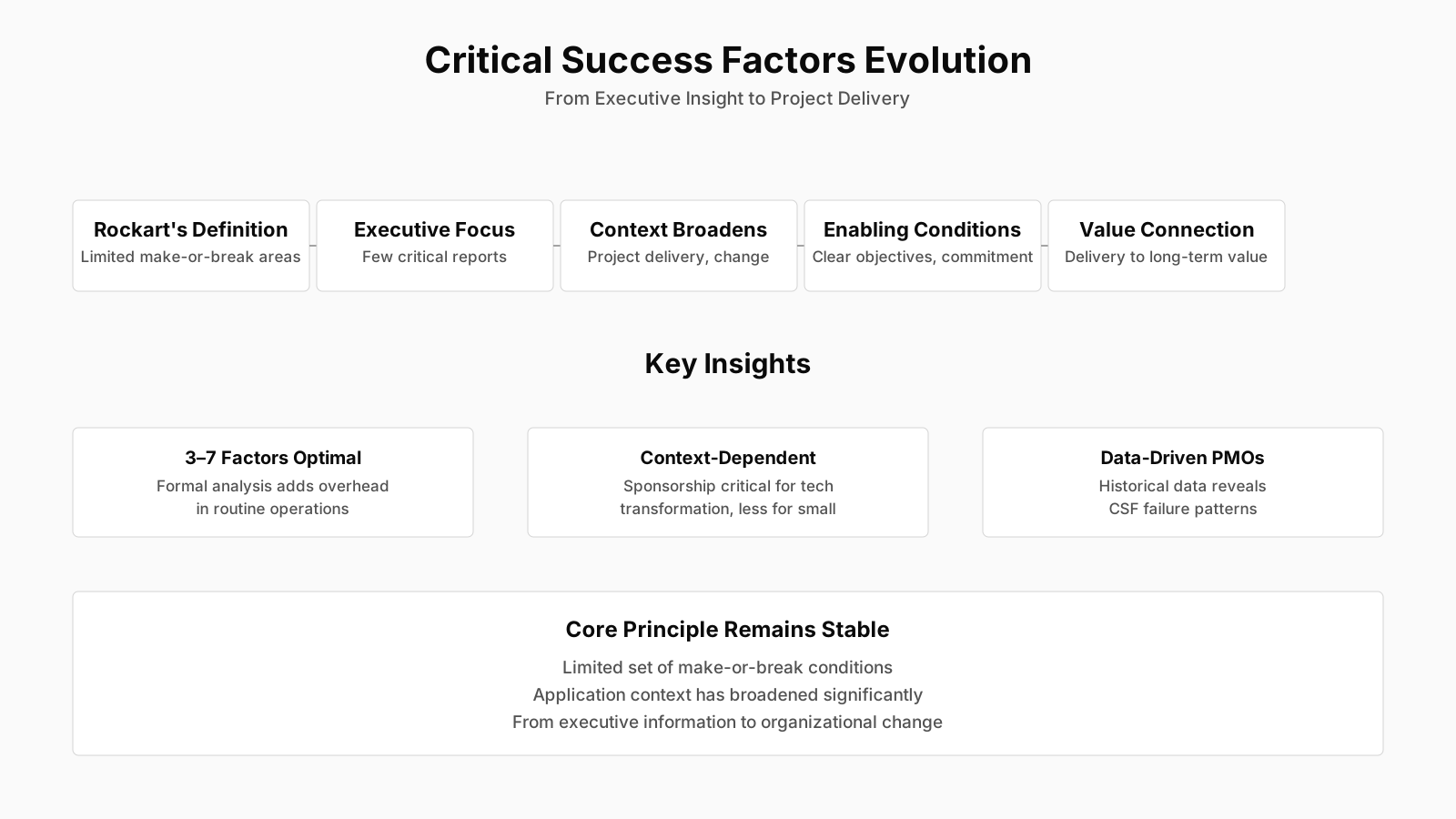
Current critical success factor best practices emphasize co-creation with sponsors and delivery teams rather than top-down declaration. Earlier use of the term was somewhat static and tied to executive information needs. Modern practice treats critical success factors as living conditions that require review at phase gates and major changes. There is also a shift toward separating delivery success factors from value realization factors. A project can be delivered successfully and still not realize benefits if the surrounding business conditions fail.
One debate among practitioners is whether critical success factors should be limited to controllable elements. Some argue that external factors should be tracked separately because teams cannot manage them directly. Others include external factors precisely because they determine success, even when they cannot be controlled. Most organizations settle on a hybrid approach: they identify both types but assign different monitoring and escalation paths.
Another evolving area is the growing recognition of team stability and psychological safety as critical success factors in knowledge work. These are not soft concepts in highly interdependent projects. When a team cannot raise problems early, rework increases and decisions get delayed. Some PMOs are beginning to use historical project data to identify patterns in critical success factor failure, though this practice is not universal and the evidence base is still developing.
The concept has not become obsolete. If anything, complexity has made it more useful. Projects now depend on more external partners, more digital platforms, and more distributed teams. That environment rewards clarity about the few conditions that truly matter. A critical success factor remains a disciplined way to say what cannot be allowed to fail, even when everything else is uncertain.