Continuous Delivery is defined as a software engineering and project delivery practice in which code changes are automatically built, tested, and prepared for release to production through a repeatable pipeline, allowing a project to deliver working product increments at any time with low risk. In project management, continuous delivery functions as a delivery capability rather than a single process, shaping how work packages, quality controls, and release decisions are integrated across the project life cycle.
Continuous Delivery Key Topics Summary
| Definition | Summary |
|---|---|
| Continuous Delivery | Continuous Delivery is a disciplined software engineering practice in which every code change is automatically built, tested, and prepared for release through a standardized, repeatable pipeline, ensuring that production deployment remains a low risk, routine decision. |
| Delivery Capability | Within project management, continuous delivery operates as a formal delivery capability that unifies work package execution, quality assurance, and release authorization across the entire project lifecycle. |
| Continuous Releasability | Unlike sequential delivery models, continuous delivery maintains releasability as an inherent attribute of the product throughout development, so a release decision requires minimal additional engineering effort. |
| Milestone Shift | The practice reshapes milestone evaluation by decoupling earned value and scope completion from a single final integration event, allowing progress to be tracked incrementally. |
| Origins | Continuous delivery originated within software engineering and the broader Agile movement, gaining widespread recognition after Jez Humble and David Farley published their influential 2010 book on the subject. |
| Response to Pain | It evolved as a direct response to the costly integration phases and weekend release efforts common in traditional software projects, where late merging triggered extensive rework and instability. |
| Cross Industry Parallels | Aviation checklists and healthcare safety protocols illustrate how standardized repeatable procedures reduce variance and human error, much as a delivery pipeline systematizes verification and quality gates. |
| Pipeline Evidence | Each pipeline stage supplies distinct evidence: unit tests confirm component correctness, integration tests validate communication between modules, and acceptance tests verify alignment with business rules. |
What Is Continuous Delivery in Project Management?
In a project management context, the Continuous Delivery definition extends beyond automation to include the discipline of keeping the product increment in a releasable state throughout execution. The practice rests on the principle that every change committed to the shared code repository goes through automated compilation, testing, and packaging. If any stage fails, the team stops and fixes the problem before new work proceeds. Unlike traditional phase-based delivery, where product integration and release readiness happen late, continuous delivery treats releasability as a continuous property of the project output.
Practically speaking, this means a project sponsor or product owner could decide on a Tuesday afternoon to release the current version, and the team would face little additional engineering work. The release might still require a governance approval or a scheduled deployment window, but the technical risk of releasing is already retired. That shift changes how project managers think about milestones, because earned value and scope completion are no longer tied to a final integration event.
What is Continuous Delivery in project management, then? It is a delivery approach that makes the output of each work cycle a candidate for production use. The project team does not accumulate partially integrated work. Instead, small batches move through the system continuously. This has implications for quality management, risk management, and stakeholder communication, because progress becomes demonstrable through working software rather than through status reports alone.
The concept also includes release engineering decisions about branching strategies, environment management, and rollback mechanisms. A project may adopt continuous delivery without releasing every change immediately. The defining characteristic is readiness, not release frequency. That distinction is often missed when project teams confuse continuous delivery with continuous deployment, a related but more aggressive practice.
Core Insights on Continuous Delivery
- Releasable state throughout execution
- Continuous delivery in project management extends beyond automation by keeping the product increment in a releasable state during every stage of the project, so the team is always prepared for a release decision rather than waiting until the final phase.
- Automated pipeline with stop conditions
- Every change committed to the shared repository must pass automated compilation, testing, and packaging; any failure halts the team, and the defect is fixed before new work proceeds.
- Releasability as continuous property
- Unlike phase-based delivery that defers integration until the end, continuous delivery treats releasability as an ongoing property of the project output, allowing a sponsor to approve a release at any time with minimal additional engineering effort.
- Shift in project management thinking
- This approach reframes milestones, earned value, quality, risk, and stakeholder communication, since progress is evidenced by working software and requires explicit release engineering choices about branching, environment configuration, and rollback mechanisms.
Origins and Cross-Industry Context
The origin of Continuous Delivery lies in software engineering and the broader Agile movement, with the term gaining prominence through the 2010 book Continuous Delivery by Jez Humble and David Farley. The practice emerged as a response to the painful integration phases and release weekends common in traditional software projects, where code written over months could not be merged without significant rework. Early Agile teams improved iteration speed but often still faced a manual wall between development completion and production availability.
Continuous delivery borrowed heavily from lean manufacturing ideas, particularly the reduction of batch size and the emphasis on single-piece flow. In manufacturing, smaller batches expose defects earlier and reduce work in progress. The same logic applies to project delivery: a small code change that fails is easier to diagnose than a large release containing hundreds of interacting changes. Just-in-time production also influenced the idea that work should be pulled through a system only when downstream capacity exists.
Cross-industry parallels appear in aviation checklists and healthcare safety protocols, where repeatable procedures reduce variance and human error. These fields did not invent continuous delivery, but they reinforced the conviction that disciplined routine, not heroics, produces reliable outcomes. The project management relevance is direct: a delivery pipeline is essentially a set of checks and balances applied to every change, much as a pre-flight checklist standardizes safety verification regardless of pilot experience.
Over time, continuous delivery grew beyond a tooling practice into a management philosophy. It now informs how organizations structure teams, fund project work, and measure progress. The software engineering roots remain visible, but the implications for project governance, risk appetite, and benefits realization are equally important in contemporary project management.
Key Components of Continuous Delivery
The key components of Continuous Delivery form a technical and managerial system that must work together rather than as isolated tools. These components include version control, continuous integration, automated acceptance testing, deployment automation, configuration management, and monitoring. In project management terms, each component corresponds to a quality or scope control point that the project manager and product owner can observe and audit.
A useful way to think about these components is an assembly line where each station checks one specific thing, and defective items cannot move forward. If unit tests fail, the change never reaches integration testing. If integration tests pass but a performance threshold is violated, deployment automation does not proceed. This structure turns quality assurance from a periodic review into a continuous filter.
Continuous Delivery Pipeline
The continuous delivery pipeline is the sequence of automated stages that a change passes through before it is approved for release. Each stage provides a different type of evidence: unit tests show component correctness, integration tests show that assembled pieces communicate, and acceptance tests show that business rules behave as expected. The pipeline also produces artifacts such as packaged binaries, configuration files, and deployment manifests.
In project management, the pipeline is not merely a developer tool. It is a control mechanism that makes project status observable. A project manager can see which changes are queued, which have passed critical gates, and which are blocked. This visibility reduces reliance on subjective status reporting and supports more honest progress tracking.
Automated Testing and Quality Gates
Automated testing is the foundation that gives project stakeholders confidence in frequent change. Quality gates act as decision points within the pipeline where a build can be promoted or stopped. These gates are not simply technical checks; they operationalize the project quality management plan by encoding acceptance criteria directly into executable tests.
When a team writes an automated acceptance test for a user story, that test becomes a living specification. Future changes that break the story are caught immediately. This shifts the role of the quality assurance function away from late manual regression testing toward earlier test design and risk analysis. It does not eliminate manual exploratory testing, but it changes the questions manual testing is meant to answer.
Deployment Automation and Configuration Management
Deployment automation ensures a product can be installed into a target environment without manual heroics. Configuration management keeps environments consistent so that the system tested is the same system released. In project terms, this reduces the variance between development, test, staging, and production environments, which historically creates late-stage defects.
Many failed releases are not caused by bad code but by environment drift. A database schema differs, a network setting is misaligned, or a security certificate expires. Continuous delivery treats infrastructure and configuration as versioned project artifacts, subject to the same change controls as application code. That practice is sometimes called infrastructure as code, and it is a major contributor to deployment reliability.
Key Takeaways on Delivery Components
- Integrated technical and managerial system
- Continuous Delivery's technical and managerial elements form one coherent system whose parts depend on each other, so treating any component as a standalone tool undermines the entire delivery flow.
- Assembly line quality gates
- Every pipeline stage functions as an assembly line quality gate that verifies a single property and halts progress when a defect is detected, ensuring only sound builds advance.
- Layered evidence from stages
- Unit tests establish the correctness of individual components, integration tests validate that assembled components interact correctly across boundaries, and acceptance tests confirm that the system fulfills the defined business behavior.
- Executable acceptance criteria
- By translating acceptance criteria into executable tests, these gates turn the project quality management plan into a practical, continuous filtering mechanism that catches quality issues at every stage instead of only at the end.
- Shifted quality assurance role
- Quality assurance shifts from late-stage manual regression testing to early test design and risk analysis, enabling teams to measure real progress through passing automated checks rather than inflated task completion.
Practical Application of Continuous Delivery in Projects
The practical application of Continuous Delivery occurs across the execution, monitoring, and closing phases of a project, though its influence begins during planning. In the planning phase, the project manager and team decide whether the delivery pipeline itself will be treated as project scope and whether infrastructure work will be scheduled alongside feature work. This decision affects the work breakdown structure, resource estimates, and risk register.
During execution, software changes move through the pipeline continuously. A release manager or product owner reviews the queue of changes that have passed all automated gates and selects which ones to include in a production release. The release decision may be governed by change control boards, regulatory windows, or business priorities. Continuous delivery does not bypass these controls; it provides better evidence for the decision makers.
Monitoring and controlling activities shift from tracking percent complete to tracking pipeline health, lead time, and failure rates. A project dashboard might display how long a typical change takes to reach release readiness, how many builds failed in the last week, and how quickly failures were fixed. These metrics are more actionable than subjective milestone percentages because they reflect actual flow through the delivery system.
At project closing, continuous delivery supports smoother transition to operations. Because deployment runbooks and configuration details are automated and versioned, the operational team receives a repeatable process rather than tacit knowledge. Benefits realization also becomes more immediate, since the product is already in a releasable state and can be put into use as business conditions allow.
Continuous Delivery in PMBOK and PRINCE2
Within the PMBOK framework, Continuous Delivery PMBOK alignment is most visible in the delivery performance domain and in the tailoring of development approaches. PMBOK does not name continuous delivery as a formal process or knowledge area, but its principles map directly to managing project work, controlling quality, and performing integrated change control. The development approach and life cycle tailoring considerations allow an organization to choose a delivery model where product increments are produced frequently and kept release-ready.
PMBOK emphasizes that projects operate within a value delivery system. Continuous delivery supports that view by making the flow from a committed change to a potential release visible and measurable. It also connects to quality management because automated tests and quality gates are specific implementations of the plan quality, manage quality, and control quality processes. Risk management benefits through the reduction of integration risk and the early detection of defects.
Continuous Delivery in PRINCE2
PRINCE2 addresses product delivery through the managing product delivery process, where teams receive work packages and return completed products. Continuous delivery fits naturally into this process because each work package can be designed as a small batch of changes that must pass automated verification before being considered complete. The PRINCE2 quality theme reinforces the need for explicit quality criteria, which in a continuous delivery context become automated acceptance tests.
The change theme in PRINCE2 also interacts with continuous delivery. Because changes move through a controlled pipeline, the project board receives more granular information about the impact of requested changes. Configuration item records, a core PRINCE2 artifact, map directly to the versioned components stored in a continuous delivery repository. This alignment allows PRINCE2 projects to maintain strong governance while still delivering frequently.
Essential Summary of Framework Alignment
- PMBOK value delivery system
- Continuous delivery operationalizes the PMBOK value delivery system by establishing a transparent, measurable pipeline through which committed changes progress to releasable increments.
- PRINCE2 work packages fit
- Within PRINCE2, continuous delivery is embedded in the Managing Product Delivery process by structuring work packages as small, testable batches that must pass automated verification gates before acceptance.
- Configuration records map directly
- PRINCE2 configuration item records align directly with versioned components stored in a continuous delivery repository, creating an auditable link that supports traceability and configuration control.
Continuous Delivery in Agile and Hybrid Environments
Continuous Delivery in Agile environments is a natural extension of iterative and incremental development. Agile frameworks focus on delivering working product increments, but without delivery automation those increments may still require long manual release cycles. Continuous delivery closes that gap by making every sprint or iteration output potentially shippable without further stabilization.
In Scrum, the sprint review often demonstrates a product increment that could theoretically be released. Continuous delivery turns that theoretical possibility into a practical reality. The sprint backlog can include pipeline improvements, test automation tasks, and infrastructure changes, treating delivery capability as first-class work rather than hidden technical debt. This makes capacity planning more honest because the team accounts for the effort required to keep the product releasable.
Continuous Delivery in Scrum and Kanban
Scrum teams using continuous delivery typically maintain a definition of done that includes passing automated tests and successful deployment to a staging environment. That definition aligns the sprint review with release readiness. Kanban teams benefit even more directly because continuous delivery supports a pull-based flow where work items move through the pipeline only when downstream capacity exists. Kanban work in progress limits reduce batch size, which is a core enabler of continuous delivery.
Hybrid project environments combine predictive planning with iterative delivery. In these contexts, continuous delivery may be applied to the software components while other project elements, such as hardware or regulatory documentation, proceed in phases. The project manager must coordinate the different cadences and ensure that the frequent software delivery does not outpace the organization's ability to absorb change. Hybrid approaches succeed when the pipeline is treated as a formal project asset, not an informal developer convenience.
The BVOP Perspective on Continuous Delivery
The BVOP perspective on Continuous Delivery connects delivery automation to value-oriented execution and cross-functional team design. BVOPM treats employee-created tools and open-source software as formal products, which is directly relevant because continuous delivery pipelines often rely on internally built scripts, plugins, and integration utilities that traditional project scope may overlook. BVOPM also emphasizes cross-functional teams as a core success factor, a condition that continuous delivery explicitly requires because testing, operations, and development responsibilities overlap during pipeline design.
In BVOPM terms, a delivery pipeline that is not formally recognized as project work can become invisible process damage. The team may maintain it informally, but the project does not fund its upkeep or treat its failure as a project risk. Recognizing pipeline components as formal products makes their maintenance visible in scope, schedule, and resource planning. This perspective reinforces the management view that delivery capability is itself a project outcome, not merely an operational byproduct.
Core BVOP Delivery Insights
- Formal product recognition
- BVOPM elevates employee-created tools and open-source software to formal product status, ensuring that internally developed pipeline utilities are included in project planning, governance, and oversight.
- Cross-functional team design
- Continuous delivery requires cross-functional teams because pipeline design overlaps testing, operations, and development responsibilities, creating dependencies that isolated functional teams cannot manage effectively.
- Invisible process damage
- A delivery pipeline that lacks formal project recognition becomes invisible process damage, maintained on an informal basis but never funded, risk-assessed, or included in formal project controls.
- Delivery as project outcome
- BVOP reframes delivery capability as a first-class project outcome rather than an operational byproduct, meaning pipeline maintenance must be explicitly represented in scope, schedule, and resource planning.
Purpose and Importance of Continuous Delivery
The importance of Continuous Delivery in project management lies in its effect on risk, feedback speed, and stakeholder confidence. Traditional delivery concentrates risk at the end of a project when many separately developed components are integrated for the first time. Continuous delivery distributes that risk across many small changes, each verified automatically and deployed in a controlled manner.
Feedback speed improves because a product owner can see a working change shortly after it is developed. If the change does not meet expectations, the cost of correction is small because the change is small. This is a project management advantage, not merely a technical convenience. It reduces the likelihood of large-scale rework and improves the accuracy of benefit forecasts.
Stakeholder confidence grows when release readiness is demonstrated continuously rather than promised at a future milestone. The project team can provide evidence in the form of passing test suites, successful staging deployments, and historical pipeline metrics. This evidence base strengthens governance and helps project boards make informed decisions about scope, schedule, and funding.
Continuous delivery also improves the reliability of releases by reducing the manual steps that introduce human error. Repetitive deployment tasks become automated and repeatable. That reliability does not guarantee project success, but it removes a common source of late-stage failure. Projects still fail for business, strategic, or market reasons, but delivery quality becomes a solvable engineering and management problem rather than a recurring source of team burnout.
Common Challenges, Pitfalls, and Misconceptions
A common misconception about Continuous Delivery is that it means every change must go directly to production without human approval. That is continuous deployment, not continuous delivery. Continuous delivery leaves the final release decision with the business, while continuous deployment automates the final step as well. Many project teams adopt continuous delivery intending to release faster but fail because they automate deployment while leaving testing manual or slow.
Flaky automated tests are a persistent challenge. A test suite that fails intermittently without a real product defect erodes trust in the pipeline. Teams may respond by ignoring test results or bypassing gates, which defeats the purpose of the practice. Test reliability requires ongoing maintenance, and project plans often underestimate this effort. The pipeline itself can become a bottleneck if it is not treated as a maintained project deliverable.
Cultural resistance is another common barrier. Operations staff may object to frequent change because they carry the burden of production instability. Developers may resist writing tests because they perceive it as slowing feature work. Project managers may resist because frequent releases complicate traditional milestone reporting. These tensions are organizational, not technical, and they require sustained leadership attention.
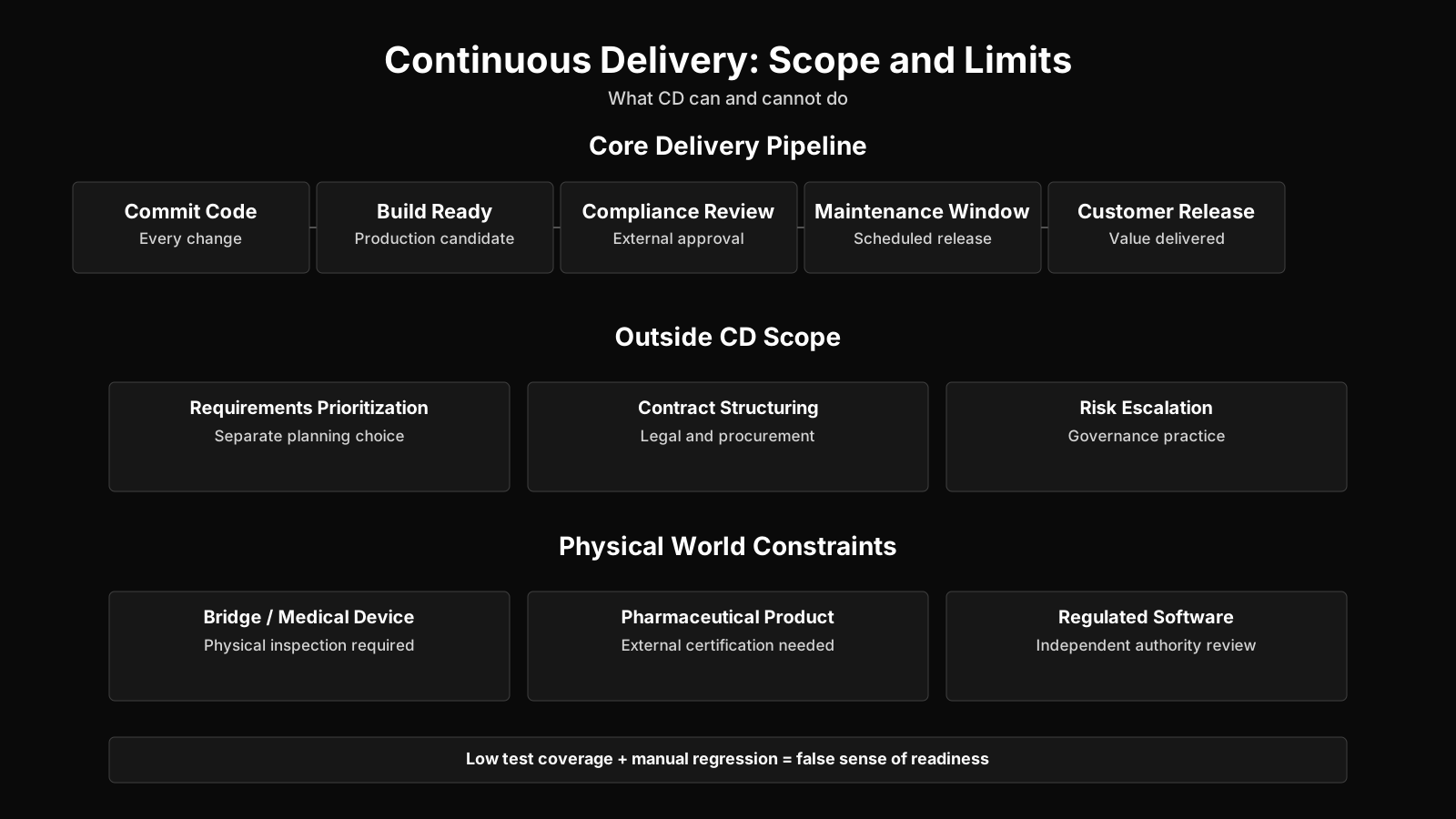
Continuous delivery is also not appropriate for every project deliverable. It applies most naturally to software and digital products. Physical construction, specialized manufacturing, or heavily regulated documentation may not benefit from automated deployment pipelines. Even in software projects, a low rate of change can make the upfront investment in pipeline automation difficult to justify. The decision to adopt continuous delivery should follow from the project context, change frequency, and risk profile, not from industry fashion.
Key Insights on CD Pitfalls
- CD does not mean auto-release
- Continuous delivery stops just short of production and requires a deliberate business decision before release, whereas continuous deployment automatically promotes every validated change directly to production.
- Automation alone is insufficient
- When deployment is automated but testing remains manual or slow, the delivery pipeline stalls at the quality gate and negates the speed advantage that continuous delivery is meant to provide.
- Flaky tests erode trust
- Flaky tests that fail without exposing a real product defect train teams to disregard alerts and bypass quality gates, gradually undermining the entire control mechanism.
- Human resistance is common
- Resistance to continuous delivery often follows role boundaries: operations personnel carry the burden of production instability from frequent changes, while developers perceive test authoring as an impediment to feature delivery.
- Context determines suitability
- Industries such as physical construction, specialized manufacturing, and heavily regulated documentation often gain little from automated deployment pipelines; adoption should be driven by project context and risk profile rather than by industry trends.
Continuous Delivery vs Related Concepts
The comparison Continuous Delivery vs Continuous Deployment is often the starting point for clarifying release strategy. Continuous delivery ensures the product is always ready to release, but a human or governance body approves the release. Continuous deployment removes that approval and automatically sends every passing change to production. Continuous integration is narrower still, focusing only on merging code frequently and verifying with automated builds.
Continuous delivery and DevOps are related but not synonymous. DevOps is a cultural and organizational movement that breaks down barriers between development and operations. Continuous delivery is a specific technical and managerial capability that often emerges from DevOps adoption. A project can practice DevOps without full continuous delivery, and a team can implement a delivery pipeline without broader DevOps transformation, though the results are usually weaker.
Traditional release management groups changes into large releases with detailed runbooks and manual approval gates. Continuous delivery shifts that effort into the pipeline, where release decisions can be small and frequent. Iterative development is also commonly confused with continuous delivery. Iterative development produces working increments on a regular cadence, but those increments may not be technically releasable without stabilization work. Continuous delivery adds the automation and discipline that make releasability continuous.
Evolution and Current Thinking
The evolution of Continuous Delivery has moved from a purely software engineering technique toward a broader value stream management discipline. Early implementations focused on build servers and deployment scripts. Current thinking integrates continuous delivery with security scanning, compliance checks, feature flags, and observability, so that projects can release in highly regulated environments without sacrificing control.
Progressive delivery is a more recent development that uses methods like canary releases, blue-green deployments, and feature flags to expose changes to small groups of users before full rollout. This approach extends continuous delivery by adding controlled experimentation to the release process. Project managers can treat a release as a hypothesis to be validated rather than a one-time commitment, which aligns with benefits realization practices that track outcomes after deployment.
There is ongoing debate about how much automation is appropriate and where human judgment should remain. Some practitioners argue that continuous delivery is primarily a cultural practice and that tools are secondary. Others emphasize measurable pipeline metrics such as lead time, change failure rate, and mean time to recovery. The most credible position is that both matter, and that a pipeline without supportive team behavior will not produce sustained results.
Current project management thinking increasingly treats continuous delivery as a tailorable capability within the overall delivery approach. Organizations select it when the product benefits from frequent release, when the team has the skill to maintain automated tests, and when governance can accommodate smaller but more frequent decisions. The concept has matured from a niche developer practice into a legitimate project delivery strategy with clear implications for scope, quality, risk, and stakeholder management.
Key Insights on Delivery Maturation
- From deployments to value streams
- Continuous delivery has grown from a narrow focus on build and deployment automation into a value stream management practice that connects security scanning, compliance gates, feature flagging, and observability to strengthen release confidence in highly regulated environments.
- Progressive delivery adds experimentation
- Progressive delivery techniques such as canary releases, blue-green deployments, and feature flags limit initial exposure to small user cohorts, enabling teams to test each release as a measurable hypothesis tied directly to business outcomes rather than treating it as a single irreversible event.
- Culture versus measurable metrics
- The field remains split between those who view continuous delivery primarily as a cultural transformation supported by tools and those who treat it as a discipline measured by pipeline metrics such as lead time, change failure rate, and mean time to recovery.