Compliance in product and deliverable is defined as the extent to which a project's products, services, or unique results satisfy the functional and nonfunctional requirements, acceptance criteria, quality standards, and regulatory obligations established for them. The concept spans both the product itself and the individual deliverables that make up or support that product. In project management, compliance is neither a legal afterthought nor a purely technical inspection activity. It is a continuous concern across planning, execution, quality control, and formal acceptance.
The phrase is often used when teams confirm that a deliverable matches its specification and can be formally accepted by the customer or sponsor. Compliance in this sense includes documented evidence, tolerance limits, and traceability from requirement to delivered result. It is closely associated with verification and validation, but it is broader than either. Verification asks whether the deliverable was built correctly according to its specification. Validation asks whether the correct deliverable was built to meet its intended use. Compliance requires both forms of evidence and the organizational or contractual authority to accept the result.
Key Topics Summary: Compliance in Product and Deliverable
| Key Concept | Summary |
|---|---|
| Definition | Product and deliverable compliance assesses the degree to which project outputs meet functional and nonfunctional requirements, acceptance criteria, quality benchmarks, and applicable regulatory obligations. |
| Core Meaning | Compliance signifies verified adherence to every applicable requirement, constraint, and control obligation before a deliverable can be formally accepted as complete. |
| Integration Risk | A module may pass individual technical checks yet still breach integration requirements at the product level, causing defects that surface only when interdependent components operate together. |
| Scope of Compliance | Compliance extends beyond regulatory approval to include internal quality specifications, contractual terms, customer expectations, contractual service levels, and usability requirements. |
| Illustrative Scenarios | In construction, a building may meet local code requirements while failing the contractually specified finish standards. In software, features that pass unit tests often fail integration testing when acceptance criteria are not shared across teams. |
| Historical Development | Manufacturing pioneered statistical process control and conformance testing, later codified through ISO 9000 quality management frameworks and sector regulations. |
| Core Components | Essential components include requirements baselines, measurable acceptance criteria, engineering specifications, applicable standards, regulatory mandates, verification and validation activities, traceability matrices, and formal acceptance evidence. |
| Required Documentation | Compliance documentation typically contains test reports, inspection logs, quality review records, conformity certificates, audit trails, and approved acceptance documentation. |
What Is Compliance in Product and Deliverable?
In project management, compliance in product and deliverable definition refers to the confirmed adherence of a project output to all applicable requirements, standards, and constraints before that output is declared complete. A deliverable is any unique and verifiable product, result, or capability that must be produced to finish a project or phase. An end product is the final good or service that the project is authorized to deliver. Both levels matter. A project may produce a technically compliant software module that fails to comply with the product-level integration requirement, creating a defect that only appears when components interact.
Compliance is often treated as a binary condition. In practice, most projects manage it as a continuum with tolerances, partial compliance, conditional acceptance, and remediation. A mechanical part may comply with dimensional specifications but not with surface finish requirements. A report may comply with content requirements but not with document control standards. The formal decision to accept, reject, or request rework depends on the acceptance criteria and the governance rules established for the project.
This concept should not be confused with regulatory compliance alone. A pharmaceutical project may need regulatory approval, but compliance in product and deliverable also covers internal quality specifications, contract terms, customer expectations, and usability requirements. In construction, an inspection certificate may show that the structure meets the building code, but the client's contractual finish requirements may still be unmet. Compliance therefore combines external mandates with project-specific expectations.
Product-Level and Deliverable-Level Compliance
Compliance operates at two distinct but connected levels. Deliverable-level compliance confirms that a single component, document, or service result meets its own specification. Product-level compliance confirms that the integrated set of deliverables functions as intended in the expected environment. A classic example appears in software projects where each feature passes its unit tests but the combined system fails during integration testing because the interfaces were not governed by shared acceptance criteria. The individual deliverables were compliant. The product was not. Project managers who only track component-level acceptance often miss this distinction until late in the project.
Key Insights on Deliverable Compliance
- Compliance as confirmed adherence
- In product and deliverable definition, compliance means that a project output has been verified against all applicable requirements, standards, and constraints before it is formally declared complete.
- Deliverable versus end product
- A deliverable is any unique and verifiable product, result, or capability produced to complete a project or phase, whereas an end product is the final good or service the project was specifically authorized to deliver.
- Compliance exists on a continuum
- Compliance is typically managed as a spectrum that spans tolerances, partial compliance, conditional acceptance, and remediation, rather than as a binary pass or fail determination.
- Acceptance depends on governance rules
- The formal decision to accept, reject, or request rework for a deliverable rests on the project's established acceptance criteria and governance framework, rather than on technical test results alone.
Origins and Cross-Industry Context
The origins of compliance in product and deliverable lie in quality management and engineering disciplines. Manufacturing developed statistical process control and conformance testing to reduce variation and prevent defective products from reaching customers. Aerospace, defense, and nuclear industries imposed traceability and certification requirements because failures carried catastrophic consequences. Software engineering later adopted many of these ideas through quality assurance, configuration management, and formal testing. In project management, these practices merged with scope verification and acceptance management to form the compliance discipline used today.
Cross-industry experience shaped the expectation that compliance must be planned, measured, and evidenced. In aviation, a component is not compliant simply because it was produced on the same line as a compliant part. It requires its own inspection record tied to the specific serial number. In medicine, a clinical device must demonstrate both technical conformity and suitability for patient use. These industries treat compliance as a chain of evidence that starts with requirements and ends with post-market surveillance. Project managers outside these fields can learn from this rigor without adopting its full weight.
The phrase quality is conformance to requirements became widely associated with Philip Crosby and remains a useful shorthand. It does not capture the full meaning of compliance, because a product can conform to requirements and still be unfit if the requirements were incorrect. Juran's concept of fitness for use adds the validation dimension. ISO 9000 quality management standards later codified many of these practices, emphasizing documented conformance and corrective action. Modern project management reflects both traditions by pairing verification with validation and by linking compliance to business value.
Key Components of Compliance in Product and Deliverable
The key components of compliance in products and deliverables include requirements, acceptance criteria, specifications, standards, regulations, verification, validation, traceability, and formal acceptance evidence. None of these components can establish compliance alone. Requirements define what the deliverable must do or be. Acceptance criteria define the observable conditions that must be satisfied for the deliverable to be accepted. Specifications translate requirements into measurable technical attributes. Standards and regulations provide external constraints that may not be fully captured in the initial requirements.
Verification involves reviewing, inspecting, or testing the deliverable against its specification. Validation evaluates whether the deliverable supports its intended use from the customer's perspective. Both produce evidence that feeds the compliance record. In many organizations, the compliance record includes test results, inspection logs, quality review notes, conformity certificates, and sign-off documentation. This evidence is not created for its own sake. It protects the project from disputes during handover and provides a baseline for future operations, maintenance, or audit.
Traceability connects the original requirement to the design, build, and test activities. A requirements traceability matrix is commonly used in predictive projects to show where each requirement is addressed and where the evidence of compliance lives. Without this link, a team can produce a fully functional deliverable and still struggle to prove compliance because the relationship between requirement and result is unclear. Traceability also enables impact analysis when a requirement changes late in the project.
Types of Compliance Requirements
Compliance requirements generally fall into several categories. Functional requirements describe what the product must do. Nonfunctional requirements address performance, security, usability, reliability, and maintainability. Regulatory requirements impose legal or statutory obligations. Contractual requirements define commercial terms between buyer and seller. Organizational standards reflect internal policies, architectural rules, or quality management system expectations. Each category produces different compliance evidence and different approval paths.
Core Insights on Compliance Components
- Acceptance criteria for deliverables
- Acceptance criteria establish the measurable conditions a deliverable must meet to receive formal sign-off, thereby reducing ambiguity during the review process.
- Specifications as measurable attributes
- Specifications convert stakeholder requirements into measurable technical attributes, enabling objective verification and preventing subjective interpretation.
- Verification versus validation
- Verification confirms that the deliverable conforms to its specification through review, inspection, or testing, whereas validation assesses whether the deliverable fulfills the intended use from the customer's perspective.
- Compliance evidence documentation
- A complete compliance record consolidates test results, inspection logs, quality review notes, conformity certificates, and sign-off documentation to provide an audit trail that prevents handover disputes.
- Requirements traceability matrix
- A requirements traceability matrix links each requirement to its implementation and corresponding compliance evidence, eliminating ambiguity when demonstrating that all requirements have been satisfied.
Compliance in Product and Deliverable PMBOK
In the PMBOK framework, compliance in product and deliverable PMBOK processes appear primarily within Project Scope Management and Project Quality Management. The Validate Scope process formalizes acceptance of completed deliverables by the customer or sponsor. Control Quality measures and records the results of executing quality activities to assess performance and recommend necessary changes. Verified deliverables are those that have been checked through Control Quality for correctness. Accepted deliverables are those that have passed Validate Scope and gained formal sign-off. Compliance sits between these two states.
The PMBOK Guide separates the question of whether the deliverable was built correctly from whether it is acceptable to the customer. This separation is important because a deliverable can pass every internal quality test and still be rejected if it does not meet stakeholder expectations or acceptance criteria. Conversely, a customer may accept a deliverable with minor known defects if the specification allows it. Compliance records must therefore distinguish verification results from acceptance decisions. Work performance data from quality control becomes work performance information through analysis and feeds change requests when noncompliance is identified.
The Seventh Edition of the PMBOK Guide shifts attention from prescriptive processes to performance domains and principles. In the Delivery Performance Domain and Quality Performance Domain, compliance remains central. The focus moves toward demonstrating that deliverables satisfy quality requirements and contribute to intended value. Requirements traceability, quality metrics, and acceptance evidence still exist, but they are framed as part of a broader value delivery system rather than as isolated process outputs.
Requirements Traceability and Quality Metrics
In PMBOK-aligned projects, the requirements traceability matrix links each requirement to its source, deliverable, and verification method. When a requirement lacks a corresponding verification activity, compliance risk increases. Quality metrics define what is measured and how. For example, a construction specification may define a concrete compressive strength requirement and the testing method used to confirm it. A software project may define a response time threshold and the load testing protocol that demonstrates compliance. These metrics make compliance auditable rather than subjective.
Compliance in PRINCE2
PRINCE2 addresses compliance in product and deliverable PRINCE2 through its quality theme and product-based planning approach. Every output is described in a Product Description that includes purpose, composition, derivation, format, and quality criteria. The quality criteria state the measurable attributes a product must demonstrate before it can be approved. The Quality Register tracks planned quality activities, results, and approval status. Acceptance Records provide formal evidence that the product has met its quality criteria and has been accepted by the relevant authority.
PRINCE2 treats compliance as a governance activity rather than a single checkpoint. The project board and project manager define quality expectations from the customer and then translate them into quality criteria and tolerances. The quality review technique is commonly used to assess document-based products through a structured review that identifies defects and confirms resolution. Physical products may be assessed through inspection or testing. In all cases, the emphasis is on planned, recorded, and approved compliance rather than informal judgment.
One distinctive feature in PRINCE2 is the project product description. This document defines the overall product's purpose, composition, customer quality expectations, acceptance criteria, and quality tolerances. Individual product descriptions for component deliverables must align with it. This alignment prevents a situation where each work package produces an acceptable component but the integrated product does not fulfill the original business justification. Compliance in PRINCE2 therefore flows downward from project-level quality expectations to lower-level product descriptions and then back upward through quality records and acceptance evidence.
Key Takeaways on PRINCE2 Compliance
- Compliance via quality theme
- PRINCE2 makes compliance a continuous part of product development by embedding quality expectations into product descriptions and product-based planning, rather than relying on a single final checkpoint.
- Product descriptions define standards
- Each output includes a Product Description that specifies the purpose, composition, derivation, format, and measurable quality criteria required for approval.
- Quality Register tracks approval
- The Quality Register records planned quality activities, logs their results, and tracks the approval status of each product, providing governance with clear visibility into quality performance.
- Acceptance records as evidence
- Acceptance Records provide formal evidence that a product met its quality criteria and was accepted by the relevant authority.
- Two-way compliance flow
- Compliance cascades from project-level quality expectations down into detailed product descriptions and then back up through quality records and acceptance evidence, ensuring that integrated deliverables still meet the original business justification.
Compliance in Agile and Hybrid Environments
In Agile and hybrid environments, compliance in agile project management is built into the team's definition of done, acceptance criteria, and continuous verification practices. A product backlog item is not considered complete until it satisfies its acceptance criteria and the broader definition of done. The definition of done often includes automated tests passed, code reviewed, documentation updated, security checks completed, and integration validated. Compliance is therefore embedded in every increment rather than deferred to a final acceptance phase.
Agile teams frequently pair each user story with concrete acceptance criteria using formats such as Given-When-Then. These criteria provide testable conditions for compliance. Nonfunctional requirements such as performance, security, and accessibility are often expressed as constraint stories or architectural compliance rules. Regulatory compliance can be treated as a product backlog item with its own acceptance criteria and evidence. Teams working in regulated industries may add compliance checks to their continuous integration pipeline so that every build is evaluated against the required controls.
Hybrid projects combine predictive governance with iterative delivery. In these settings, compliance still depends on formal baseline documents and stage gates, but the testing and validation may occur incrementally. A hybrid team may use a product breakdown structure and traceability matrix at the governance level while using definition of done at the team level. The challenge is keeping the compliance evidence from both layers connected. An increment can be accepted by the product owner according to agile criteria but still fail formal stage gate compliance if the required regulatory documentation has not been completed.
Business Value-Oriented Project Management connects compliance to product risk management and defect analysis. BVOPM treats product-level defects through predefined root-cause categories and separates product risk from broader project risk, so a compliance failure is assessed for its impact on business value rather than treated solely as a schedule event. This perspective reinforces the idea that a compliant deliverable without business value is not a successful result.
Definition of Done and Acceptance Criteria
The definition of done is a team-level commitment to quality. Acceptance criteria are item-level commitments to a specific stakeholder need. Both differ from a contract or regulatory standard because they are often created collaboratively by the team, product owner, and customers. A common misconception is that the definition of done replaces formal compliance evidence. It does not. In regulated environments, the definition of done must include the evidence required by law or contract, and that evidence must be traceable and auditable. A fast feedback loop does not eliminate the need for objective conformity records.
Purpose and Importance of Compliance in Project Management
The purpose of compliance in project management is to protect value, reduce rework, and provide objective evidence that the project delivered what it promised. Compliance prevents the handover of products that are functionally incomplete, unsafe, legally nonconforming, or misaligned with customer expectations. When compliance is managed well, acceptance is predictable and disputes are rare. When it is ignored, the project may appear on schedule because deliverables are produced but not truly accepted.
Compliance also supports accountability. In large programs, multiple suppliers and teams produce interdependent deliverables. A clear compliance record shows who approved what, what evidence was reviewed, and which tolerances were applied. This matters during audits, warranty claims, litigation, and post-project reviews. The absence of compliance evidence can be as damaging as a failed test. An organization may have delivered a functioning system but still lose a dispute because it cannot demonstrate conformity to contractual requirements.
Beyond documentation, compliance protects users and the organization from harm. In construction, medical device, aviation, and public infrastructure projects, noncompliance can lead to injury, regulatory penalties, or operational failure. The project management discipline borrows this concern from engineering and quality management. Formal acceptance is not a bureaucratic ritual. It is the point where responsibility for the product's fitness transitions from the project team to the customer or operations owner.
Core Takeaways on Compliance's Role
- Protects value and reduces rework
- Compliance protects project value by reducing expensive rework and demonstrating through objective evidence that the delivered outputs match the agreed scope and quality standards.
- Prevents defective deliverable handover
- A robust compliance process prevents the handover of deliverables that are functionally incomplete, unsafe, legally nonconforming, or misaligned with customer expectations.
- Delivers predictable acceptance
- Effective compliance management makes project acceptance predictable and minimizes disputes, while neglect can leave a project looking on schedule even when key deliverables have not been accepted.
- Builds audit and dispute evidence
- Clear compliance records capture who approved each item, which evidence was reviewed, and the tolerances that were applied, which makes them essential for audits, warranty claims, litigation, and post-project reviews.
- Essential in safety-critical projects
- In construction, medical devices, aviation, and public infrastructure, noncompliance can lead to injury, regulatory penalties, or operational failure; compliance also marks the point at which responsibility for product fitness transfers from the project team to the customer or operations owner.
Practical Application and Common Scenarios
In practice, compliance in product and deliverable examples appear throughout the project life cycle. During planning, the project manager works with the sponsor and key stakeholders to define acceptance criteria and quality metrics. During execution, teams perform inspections, tests, walkthroughs, and reviews. During monitoring and control, the project manager compares measured results against the plan and raises change requests or defect reports when compliance gaps appear. During closing, the final product and deliverable records are reviewed and formally transferred.
Consider a construction project delivering a commercial building. The structural engineer may require a concrete strength test. The local authority may require a fire safety inspection. The client may require specific flooring and lighting levels. Each of these is a compliance requirement with different evidence. The project manager must coordinate the testing, capture the certificates, and ensure each requirement is signed off before handover. A missed fire inspection can delay occupancy even if the concrete quality is excellent.
In a software project, compliance may involve functional acceptance tests, user acceptance testing, security scans, and performance benchmarks. The product owner may accept a feature because it satisfies the user story. The security team may reject the same feature because it violates an architectural control. Both perspectives are valid. The challenge is integrating them into a single compliance picture. Many teams use dashboards or quality gates that combine test results, open defects, risk assessments, and sign-off status to make compliance visible.
Procurement adds another layer. When a supplier delivers a component, the project team must verify that the component complies with the statement of work, technical specifications, and quality requirements before payment and integration. Supplier noncompliance may not be visible until the component is installed. Contract terms often include acceptance periods, inspection rights, and remedies. Compliance management in procurement therefore relies on clear specifications and documented inspection results. Many organizations maintain a compliance matrix that maps requirements to acceptance criteria, test results, and sign-off status. This matrix is not a formal PMBOK artifact, but it is a common practical extension of the requirements traceability matrix.
Who Uses Compliance Activities
Compliance activities involve multiple roles. Project managers coordinate the overall process and ensure records exist. Quality assurance specialists design the checks and audit the process. Technical experts or quality control inspectors perform measurements and tests. Product owners or customer representatives exercise acceptance authority. Project boards or sponsors approve major deliverable transfers. In regulated industries, independent reviewers or notified bodies may also be involved. Each role holds a different part of the compliance evidence.
Common Challenges, Pitfalls, and Misconceptions
Several common misconceptions about compliance in project management create risk. The first is that compliance means only regulatory compliance. In reality, many compliance failures are internal, arising from incomplete acceptance criteria, vague specifications, or ignored nonfunctional requirements. The second is that testing alone establishes compliance. Testing produces evidence, but someone with authority must evaluate that evidence against the criteria and formally accept the result. A test pass is not the same as a compliance decision.
Another pitfall is treating compliance as a final phase activity. Teams that delay verification until the end of the project often discover integration problems when the cost of change is highest. In predictive projects, stage gates and phase reviews help catch noncompliance earlier. In agile projects, continuous integration and frequent product owner reviews serve the same purpose. Compliance risk grows when these checkpoints are skipped to preserve schedule.
Vague acceptance criteria are a persistent source of conflict. If a criterion says user-friendly or high quality, the team cannot objectively measure compliance. The result is a negotiation at the end of the project, often between the project manager and a customer who expected more than the specification required. This is why acceptance criteria must be observable, measurable, and linked to the requirement. It is also why the customer's quality expectations should be captured early and reviewed whenever scope changes.
Compliance can also be overapplied. When every minor deliverable requires multiple layers of sign-off, the compliance process becomes waste. Project managers should scale the depth of verification to the risk and criticality of the deliverable. A cosmetic report may require a simple review and approval. A safety-critical component may require independent certification. Context determines the right level of rigor. Excessive compliance overhead can delay value without materially reducing risk.
Key Takeaways on Compliance Pitfalls
- Failures often originate internally
- Most compliance breakdowns begin inside the organization, where incomplete acceptance criteria, ambiguous specifications, or neglected nonfunctional requirements create gaps that no external audit can close.
- Testing alone is insufficient
- Testing merely generates evidence; a person with formal authority must assess that evidence against the agreed criteria and issue an explicit acceptance before compliance can be confirmed.
- Compliance is not final-phase
- Treating compliance as a final-phase activity often means problems surface too late; predictive projects avoid this through stage gates and phase reviews, while agile projects rely on continuous integration and frequent product owner reviews to catch noncompliance early.
- Vague criteria cause disputes
- Ambiguous requirements like user-friendly or high quality lack objective measurement, so acceptance becomes a negotiation at delivery when the customer expected more than the written specification guaranteed.
Compliance vs Quality and Scope Concepts
Understanding compliance vs quality in project management requires separating related but distinct concepts. Quality is a broader property of fitness for use and conformance to requirements. Compliance is the demonstrated state of meeting specific requirements at a point of acceptance. Quality management includes planning, assurance, and control. Compliance is the evidentiary outcome that emerges when those activities succeed. A product can have high customer satisfaction but still be noncompliant with a contractual documentation requirement. Conversely, a product can be fully compliant with a poorly written specification and still be of low quality.
Compliance also differs from scope validation. Validate Scope confirms that the deliverable has been formally accepted by the customer or sponsor. Control Quality confirms that the deliverable meets the quality requirements. Compliance bridges the two because it supplies the evidence that justifies acceptance. Scope verification asks whether the deliverable is part of the approved scope. Compliance asks whether the deliverable, as built, matches what the scope and quality requirements describe.
Verification and validation are two other commonly confused terms. Verification is about the specification: did we build what the specification says. Validation is about the purpose: does the product work in the real environment. Compliance often requires both. A clinical information system might pass verification tests but fail validation because clinicians cannot use it efficiently in a live hospital setting. The project manager must track both sets of evidence before claiming product compliance.
Relationship to Acceptance Criteria and Definition of Done
Acceptance criteria define the boundary of compliant behavior for a specific scope item. The definition of done defines the team's standard for completeness. Together they create the threshold against which compliance is judged. When acceptance criteria are absent or implicit, compliance becomes a matter of opinion. When the definition of done is weak, teams may claim completion without evidence. Both failures lead to acceptance disputes and rework. Strong compliance management therefore begins with clear, agreed, and testable criteria, not with more inspections at the end.
Evolution and Current Thinking
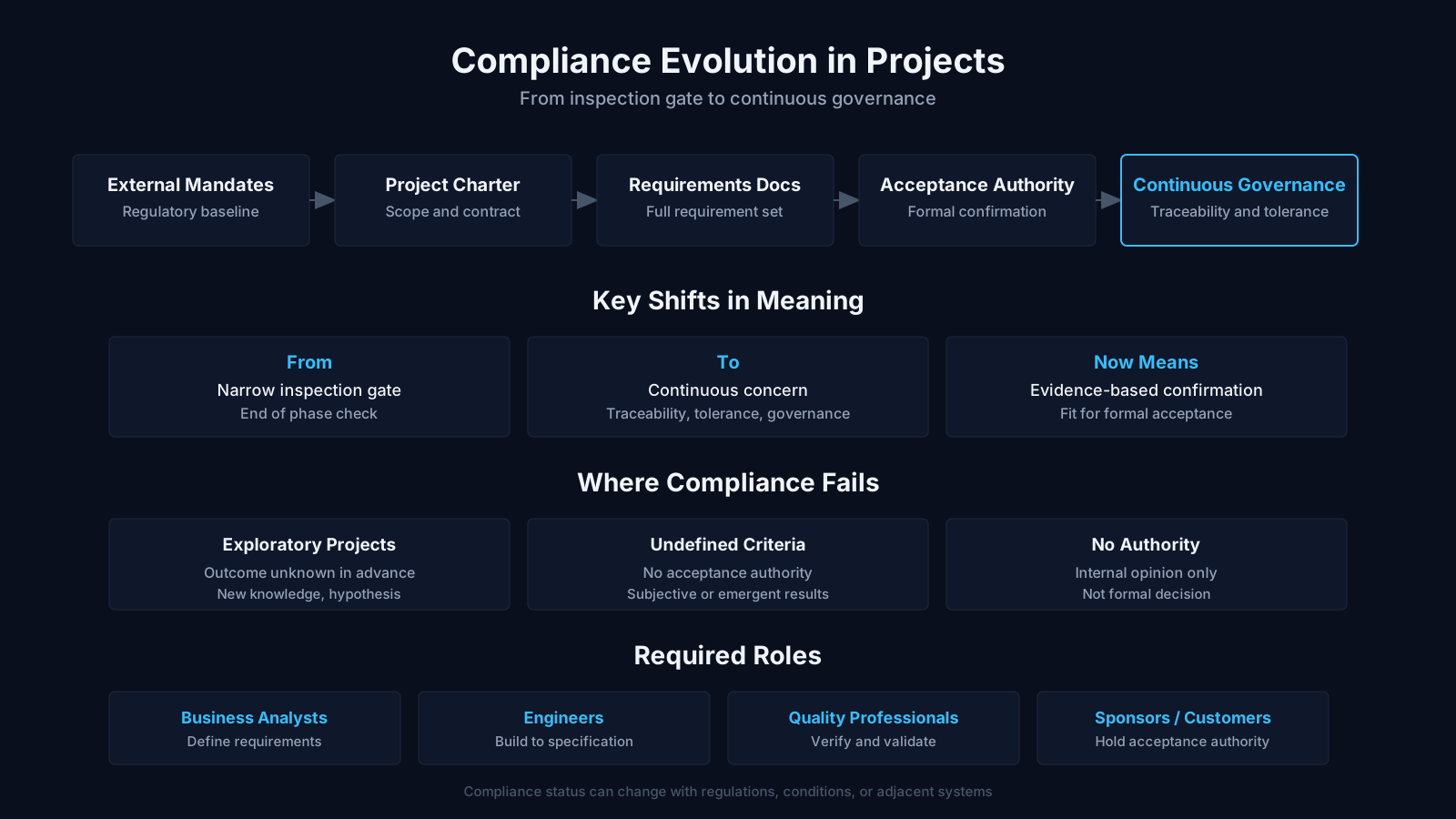
The evolution of compliance in project management has shifted from end-stage inspection toward earlier prevention, continuous verification, and value-based acceptance. Traditional models relied heavily on final inspection and separate quality control departments. Modern approaches integrate compliance into design, development, and delivery. Techniques such as test-driven development, continuous integration, and automated acceptance testing make compliance evidence available earlier and more frequently. This does not eliminate formal acceptance, but it reduces the surprise of discovering nonconformity late.
Current thinking also recognizes that compliance is not the same as value. A deliverable can satisfy every requirement and still fail to produce the expected benefit if the requirements were wrong. This is why value-oriented methods encourage acceptance criteria that connect to business outcomes. The project team should understand not only what the deliverable must do but also why it matters. When requirements change, compliance records must be updated. A previously accepted deliverable may become noncompliant if new regulations or revised standards apply retroactively.
Debate continues about how much compliance evidence is enough. Some practitioners argue that lightweight documentation paired with strong automated checks is sufficient for most software projects. Others maintain that regulated and safety-critical environments need formal traceability, independent review, and signed acceptance records. Both positions are situational. A startup building a mobile application has different compliance obligations than a contractor building a bridge. Project managers should choose the level of rigor based on product risk, regulatory exposure, contract requirements, and organizational policy.
Key Takeaways on Compliance Evolution
- Shift to continuous verification
- Modern compliance practice embeds verification earlier in the delivery lifecycle, using test-driven development, continuous integration, and automated acceptance testing to catch defects before they reach a final inspection point.
- Value-based acceptance criteria
- Because a deliverable can meet every stated requirement and still fall short of business value, value-focused approaches anchor acceptance criteria to expected business outcomes, making measurable business impact the primary test of completion.
- Risk-adjusted compliance rigor
- Project managers should align the intensity of formal traceability, independent review, and signed acceptance records with product risk, regulatory exposure, contractual obligations, and internal policy, particularly because new regulations can change the compliance status of deliverables that were accepted under earlier standards.