In project management, an assignment matrix is a structured grid that maps project work to the individuals, roles, or groups responsible for its completion. Often referred to as a Responsibility Assignment Matrix (RAM), it is a foundational resource management tool that ensures every work package, activity, or deliverable has a clear owner while preventing tasks from being overlooked or duplicated. The matrix provides a visual, at-a-glance summary of who does what, clarifying responsibilities beyond the limitations of textual role descriptions and project plans alone.
Assignment Matrix: Summary of Key Topics
| Key Concept | Summary |
|---|---|
| Responsibility Assignment Matrix (RAM) | A responsibility assignment matrix systematically links each work package from the WBS to a specific individual, role, or team, establishing clear task-level accountability. |
| Purpose | It enforces a single point of responsibility for every deliverable, eliminating work overlaps and gaps while preventing orphaned activities across the project team. |
| Matrix Axes | The structure uses two axes: the scope axis lists decomposed WBS elements, and the resource axis identifies assigned persons, roles, or organizational units. |
| Task Granularity | Detail levels scale from broad work packages to discrete action steps, driven by project complexity, control needs, and the maturity of the WBS decomposition. |
| Supporting Details | Effective matrices include a legend decoding role codes, a last-updated timestamp, and a version number to support auditing, traceability, and configuration management. |
| RACI Roles | In a RACI chart, the Responsible role performs the work, the Accountable role owns the outcome and approves it, Consulted provides expert input before decisions, and Informed receives status after the fact. |
| RACI Suitability | RACI thrives in structured, hierarchical settings where a clear boundary between execution and approval is needed alongside deliberate expert consultation. |
| Agile Context | Traditional assignment matrices often conflict with Agile practices, where self-organizing teams collectively own backlog items and accountability emerges dynamically rather than being preassigned. |
What Is an Assignment Matrix in Project Management?
Within the discipline of project management, the responsibility assignment matrix (RAM) definition centers on its function as a grid that links the work breakdown structure (WBS) to the project's human resources. The PMBOK Guide describes it as a chart that displays the project resources assigned to each work package, enabling project managers and teams to see exactly which individual or role handles each piece of scope. This usage moves the conversation from generic role titles to specific, task-level commitments, which is critical for accountability on medium and large initiatives.
The matrix typically places work packages, deliverables, or activities as rows and project team members or roles as columns. Where row and column intersect, a code or symbol indicates the nature of that person's involvement, for example Responsible, Accountable, Consulted, or Informed in the well-known RACI variant. The visual layout allows a reader to scan horizontally and understand who contributes to a particular work package, or vertically to see everything one person is assigned to. This dual-axis perspective makes hidden imbalances like a single specialist being accountable for too many concurrent work packages immediately evident.
In practice, the assignment matrix operates as a planning artifact that sits between scope definition and resource management. Once the WBS decomposes the project into manageable pieces, the assignment matrix populates each piece with names. The result is a shared reference document that reduces role ambiguity, distribution list guesswork, and the "who does this?" questions that otherwise devour meeting time. While the terms "assignment matrix" and "RACI chart" are sometimes used interchangeably, the broader category of responsibility assignment matrices includes many role-labeling schemes beyond the classic RACI model.
Key Insights on Assignment Matrices
- Grid linking scope to resources
- The assignment matrix translates the work breakdown structure into a clear resource map, instantly showing which role or individual is accountable for each work package.
- RACI codes clarify involvement levels
- At each intersection of a work package and a team member, a RACI code, such as Responsible, Accountable, Consulted, or Informed, defines the precise nature of that person’s participation.
- Dual-axis view exposes workload issues
- A horizontal scan of the matrix reveals every contributor to a deliverable, and a vertical scan surfaces hidden bottlenecks, like a single specialist shouldering accountability for several concurrent work packages.
Key Components and Structure of an Assignment Matrix
Understanding the key components of a responsibility assignment matrix reveals why this tool remains so durable across industries. Every matrix begins with two axes: the scope axis listing work elements derived from the WBS, and the resource axis naming project team members, job titles, or organizational units. The axis that lists tasks can vary in granularity from high-level work packages to lower-level activities or even individual steps, depending on the project's complexity and the degree of control needed.
At the intersection cells, codes convey the type of involvement. The most common codes come from the RACI vocabulary: R for Responsible, A for Accountable, C for Consulted, and I for Informed. Some organizations extend the set with S for Support, V for Verifier, or other bespoke letters. A vital design rule, promoted in PMI standards and by experienced practitioners, is that every work package must have exactly one person or role marked as Accountable. Responsibility can be shared; accountability cannot. A matrix that lacks this discipline tends to generate the diffusion of ownership that it was supposed to eliminate.
Beyond the cell codes, the structure often includes a legend explaining the meaning of each code, a date stamp to show when the matrix was last updated, and sometimes a version number if it is formally configuration-managed. The matrix may also be filtered or organized by project phase, allowing stakeholders to focus on current activities without noise. When a matrix extends over multiple pages, it is common to lock the header rows and columns so the context remains readable during large-scale planning reviews.
Types of Assignment Matrices: RACI, RASCI, and Beyond
Project management practice has evolved a family of assignment matrix types, and the RACI responsibility assignment matrix is the most recognized member. In a RACI chart, the Responsible person executes the work, the Accountable person owns the outcome and signs off, Consulted individuals provide input before a decision or action, and Informed people receive status after the fact. RACI applies well to structured environments where governance demands clear distinctions between doing and approving, and where input from subject matter experts must be deliberately solicited.
A close variation, RASCI, adds Support to the mix. Support roles actively assist the Responsible party but do not carry the same level of ownership. This distinction proves useful in matrix organizations where a centralized function like quality assurance or procurement must contribute to many work packages without being directly accountable for their delivery. Another frequent extension is RACI-VS, which splits the verification and sign-off activities into Verifier and Signatory roles, a separation that appeals to industries with strong compliance requirements such as pharmaceuticals or aerospace.
Beyond the RACI lineage, there are purpose-built assignment coding systems. The DACI model, for instance, specifies Driver, Approver, Contributor, and Informed, and it is often used to clarify decision-making rather than task execution. Some project offices invent custom codes for unique constraints, for example "E" for Escalation contact or "T" for Trainer. The naming is less important than the discipline: whatever letters appear in the matrix, every participant must understand the behavioral expectations tied to each code. Without a shared mental model of what Consulted really means, the matrix becomes decorative rather than operational.
Key Insights on Assignment Matrix Types
- RACI defines core roles
- RACI clarifies accountability by assigning each task four distinct roles: Responsible performs the work, Accountable holds final ownership, Consulted provides expert input before decisions, and Informed receives updates once outcomes are settled.
- RASCI adds a Support role
- RASCI introduces a Support role for contributors who actively assist the Responsible party but bear no final accountability, making it especially suited to matrix organizations where centralized resources work across multiple workstreams without owning deliverables.
- Variants serve special needs
- Additional models like RACI-VS for compliance-driven sectors, DACI for decision rights, and custom designations such as an Escalation contact demonstrate that the real advantage stems from explicit behavioral norms, not the specific letters themselves.
The Assignment Matrix in PMBOK and PRINCE2 Frameworks
In the PMBOK Guide, the assignment matrix in the PMBOK framework sits squarely within the Resource Management knowledge area and is typically created during the Plan Resource Management process. The project manager uses the WBS, the project organization chart, and role descriptions to build a responsibility assignment matrix that becomes part of the resource management plan. The PMBOK treats the matrix as both an output of planning and an input to later processes such as Acquire Resources and Develop Team, because it clarifies gap areas where additional staffing or skills are needed.
The PMBOK does not mandate RACI specifically; it describes the responsibility assignment matrix as a flexible tool that can be adapted with any coding system. It does, however, emphasize that the matrix helps define roles for each work package and ensures that all team members understand their assignments. The standard also connects the assignment matrix to the concept of a RACI chart as one example, leaving room for organizations to adopt simpler or more detailed assignments depending on project complexity and organizational culture.
PRINCE2, the structured project management method, does not require a dedicated assignment matrix artifact by name. Instead, it embeds analogous thinking into its management products and role descriptions. The Product Description includes the person or group responsible for the product's quality, and the Work Package authorizes a Team Manager to deliver specific products. PRINCE2 practitioners often augment these built-in accountability mechanisms with a RAM to avoid ambiguity when multiple teams or suppliers are involved. A tailored assignment matrix in a PRINCE2 environment might link management stages to the Project Board, Project Manager, and Team Manager roles, explicitly showing who handles exception plans, stage boundaries, and product acceptance.
Business Value-Oriented Perspective on Assignment Matrices
The Business Value-Oriented Project Management (BVOPM) methodology brings a cautionary note to the workshop where assignment matrices are born: the whole exercise depends on a WBS that may contain inaccuracies. BVOPM warns that excessive faith in the initial decomposition leads to plans that crack under pressure. From that lens, the assignment matrix cannot be a one-time static reference. Assignment matrix scope management under BVOPM means treating the chart as an artifact subject to continuous refinement as user feedback reshapes the scope definition, using the methodology's five-level scope scale ranging from Definite to Unlikely items.
BVOPM also advocates for cross-functional teams and relentless waste reduction. Practitioners applying this thinking use the assignment matrix not just to delegate tasks but to detect allocation patterns that generate overwork or perfectionism. A role that appears as Responsible on an implausible number of concurrent work packages is a red flag that value delivery may be jeopardized by burnout or bottlenecking. In BVOP terms, such a pattern represents a form of process damage, and the matrix provides the data to call it out and rebalance assignments before schedule slippage becomes unrecoverable.
Core Takeaways on Value-Driven Matrices
- WBS inaccuracies undermine matrices
- BVOPM warns that assignment matrices depend on a work breakdown structure that often contains inaccuracies, making plans overly reliant on the initial decomposition vulnerable to failure under pressure.
- Matrix requires continuous refinement
- The assignment matrix should be maintained as a living artifact and continuously refined as user feedback reshapes the scope definition.
- Five-level scope scale applied
- BVOPM uses a five-level scope scale, from Definite to Unlikely, to guide adjustments in the assignment matrix when scope definitions evolve.
- Detecting overwork and bottlenecks
- Practitioners analyze the assignment matrix for patterns that generate overwork or perfectionism, treating an implausibly high number of concurrent Responsible assignments for a single role as a clear warning sign.
- Matrix prevents process damage
- BVOP identifies these overload patterns as process damage and uses the matrix to rebalance assignments before schedule slippage becomes irreversible.
The Assignment Matrix in Agile and Hybrid Environments
Classic assignment matrices can feel foreign in Agile settings, where self-organizing teams own backlog items collectively and no individual signs up as a permanent Accountable for a task days in advance. Using an assignment matrix in Agile projects therefore requires rethinking its formality. Most Scrum teams maintain a transparent task board and share accountability for sprint goals. The Product Owner is accountable for backlog value, the Developers for delivery, and the Scrum Master for process effectiveness. A static matrix that goes any deeper than this often conflicts with the team's need to swarm, pair, and adapt daily.
Nevertheless, at the program or portfolio layer of scaled Agile frameworks, assignment matrices reappear in a different guise. A matrix may map features or epics to the Agile Release Trains or teams that will handle them, using simple pointers like Lead Team and Supporting Teams instead of RACI codes. In hybrid environments where a predictive governance layer sits above iterative delivery, a tailored RAM often defines who approves the charter, who accepts deliverables at milestones, and who manages stakeholder communication. The matrix then becomes a bridging document that respects Agile delivery autonomy while satisfying traditional controls.
Another Agile-adjacent variant is the skills matrix or competency matrix. While not a responsibility assignment tool per se, it shows which team members possess which skills, enabling fluid task assignment during sprint planning. When combined with a simple mapping of which features need which competencies, it performs a role similar to an assignment matrix without the rigid codes, making it more palatable to teams that reject overhead documentation.
Practical Application and Real-World Use
Managers typically build the assignment matrix early in project planning, once the WBS has enough detail to assign ownership but before committing to resource contracts. Using an assignment matrix effectively starts with a facilitator gathering the core team and walking through each work package, asking who will do the work, who must approve it, who needs to be consulted, and who requires status updates. The discussion itself often uncovers scope gaps, assumed handoffs that do not exist, and stakeholders who were omitted from the communication plan.
Once complete, the matrix becomes a desktop reference for the project manager during execution. It simplifies delegation decisions, clarifies the audience list for status reports, and provides a baseline for assessing whether resource loading is realistic. For example, a project manager who notices that a senior engineer is marked as Accountable on fourteen work packages might negotiate with the sponsor to move some accountabilities or bring in additional capacity. Similarly, during change control, the matrix helps identify exactly who must be consulted and who signs off, preventing changes from slipping through without proper authorization.
The matrix also proves its worth during onboarding of new team members. A newcomer can review the assignment rows relevant to their role and understand their formal obligations within minutes, rather than piecing together responsibilities from dozens of meeting notes. Even experienced project managers sometimes remark that the real aha moment comes not from creating the matrix but from maintaining it; when the matrix is updated with actual assignments as they shift, it acts as a historical record of who did what, which is valuable during lessons learned sessions and post-project reviews.
Key Takeaways on Assignment Matrix Use
- Built early in planning
- The assignment matrix is developed as soon as the work breakdown structure provides sufficient detail for accountability decisions, but before resource contracts are locked in, preserving the ability to refine assignments.
- Facilitated walkthrough reveals gaps
- During a structured walkthrough, a facilitator prompts the core team to define for each work package who executes, approves, consults, and requires updates, surfacing hidden scope gaps, phantom handoffs, and overlooked stakeholders.
- Live reference for execution
- A complete matrix streamlines delegation, establishes who needs status reports, and exposes resource overloads, for instance when one engineer is assigned accountability for fourteen distinct work packages.
- Maintenance builds historical record
- Continuously updating the matrix as roles shift supports change control approvals, accelerates the integration of new team members, and produces a reliable record for future lessons learned discussions.
Common Challenges, Pitfalls, and Misconceptions
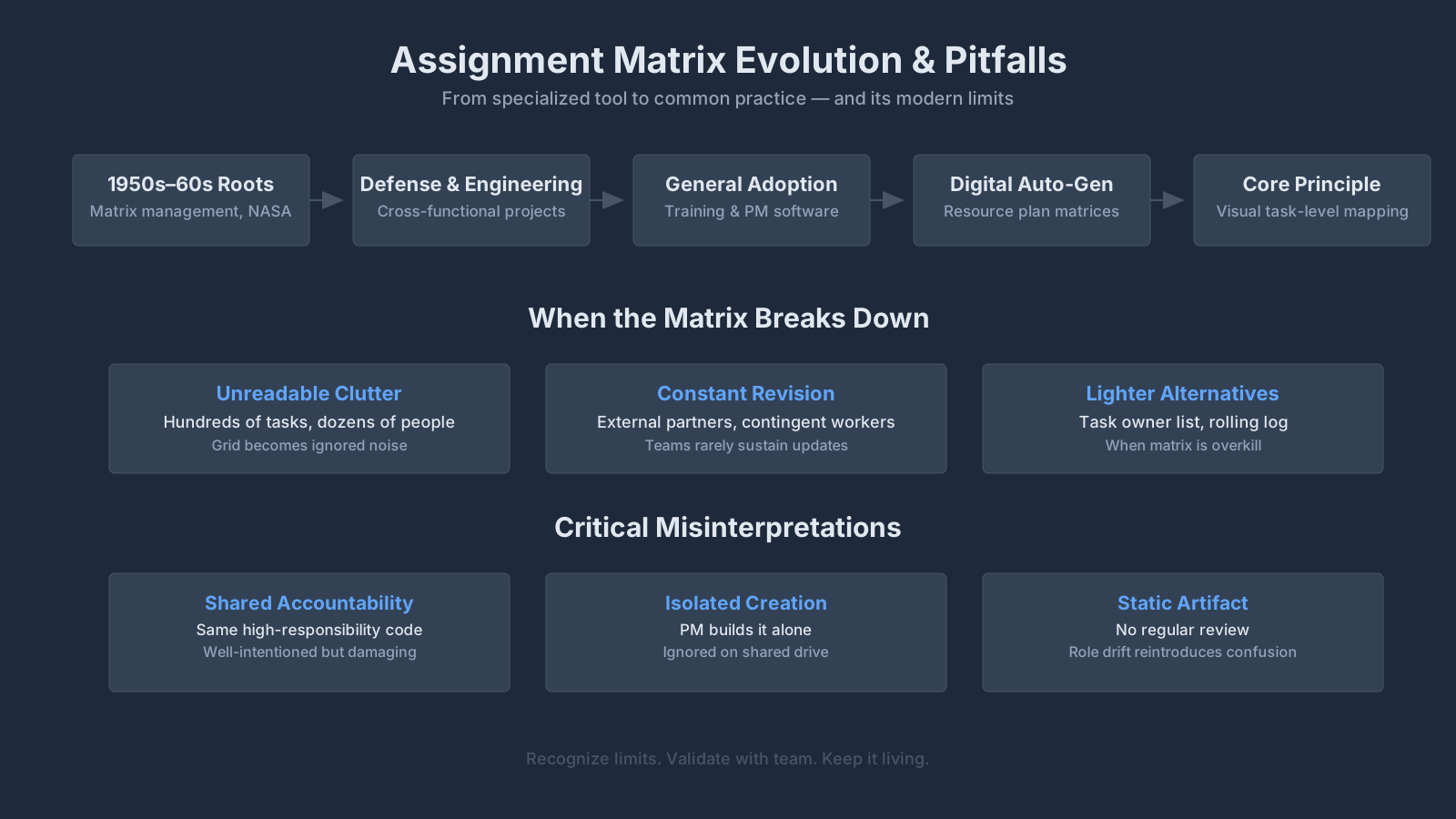
Despite the clean logic on paper, assignment matrices encounter predictable failures in practice, and common assignment matrix pitfalls can significantly undermine their value. The most frequent problem is staleness: a matrix defined at project start is rarely revisited, even as team members rotate off the project or scope details change. An outdated matrix misdirects communication and can lead to people assuming someone else is handling a task that was reassigned weeks ago. Without a disciplined cadence to review and update the matrix, it decays from a decision tool into shelfware.
A second major pitfall is the chronic confusion between Responsible and Accountable. Many team cultures treat them as synonyms, which erodes the entire purpose of the matrix. When multiple people are labeled Accountable for a single work package, accountability dissolves because everyone assumes someone else will ultimately answer for the result. A related misconception is the belief that every cell in the matrix must be filled with a code. In reality, a blank cell is perfectly valid; it simply means a person has no involvement in that work package. Overstuffing the matrix with unnecessary Consulted and Informed assignments creates information overload and slows down decisions that should have been made quickly.
Misapplication to small or informal efforts is another trap. On a five-person team working in the same room, a detailed RACI chart adds friction without clarity. The matrix shines when there are distributed teams, matrixed resources, or compliance needs where handoffs must be proven. Practitioners also note that using the matrix as a blame instrument, pointing to it and saying "You were Accountable, so this failure is yours," damages psychological safety and discourages future honest engagement with the tool.
Relationships to Other Project Management Concepts
The assignment matrix does not stand alone; it is intimately connected to the work breakdown structure, the organizational breakdown structure, and the resource breakdown structure. The assignment matrix and work breakdown structure relationship is foundational because without a reasonable WBS, there is no meaningful list of work packages to assign. The matrix essentially cross-references WBS elements with the OBS, which describes the project's human resources by department, discipline, or reporting line. Together, these structures form a responsibility lattice that links what must be done with who can do it.
The matrix also feeds the project communication plan. The Consulted and Informed columns directly translate into stakeholder engagement requirements, specifying who receives which information and when. During risk management, the matrix identifies owners for risk responses; a risk owner might be marked as Accountable for a mitigation work package that was not previously visible. In earned value management, the assignment matrix supports the identification of control accounts and work package managers, which is essential for establishing performance measurement baselines.
It is important not to confuse the assignment matrix with a project schedule or a resource histogram. The matrix shows assignment relationships, not time phasing or effort estimates. A resource histogram presents the hours per period each individual is planned to work; the assignment matrix reveals what they will be working on and in what capacity. Used together, they give the project manager both the load and the nature of responsibilities, enabling trade-off discussions that neither tool can support alone.
Core Takeaways: Matrix Interconnections
- Integrates with core structures
- The assignment matrix weaves together the work breakdown structure, organizational breakdown structure, and resource breakdown structure into a cohesive responsibility lattice, systematically pairing each work package with appropriately qualified individuals.
- Drives communication planning
- The Consulted and Informed columns directly inform the stakeholder communication specifications, defining which parties receive specific information, when, and in what format.
- Supports risk and EVM
- By designating risk response owners and establishing control accounts with work package managers, the matrix strengthens both risk management and earned value management, ensuring clear accountability for threat mitigation and performance baseline tracking.
- Complements resource histograms
- When combined with a resource histogram, the matrix reveals planned effort hours alongside the qualitative scope of each team member's responsibilities, enabling nuanced resource trade-off discussions that neither tool can support independently.
Evolution and Current Thinking
The concept of formally assigning responsibility to work units emerged from industrial management and systems engineering well before the project management profession coalesced. Over time, the evolution of the responsibility assignment matrix has seen its central role recognized in PMI standards and adapted to the digital workplace. Early matrices were drawn on whiteboards or constructed in spreadsheets and then rarely updated. Today, many project management information systems embed dynamic RAM functionality, automatically surfacing changes to team membership and reflecting them across linked schedules and communication plans.
Current thinking emphasizes the matrix as a living agreement rather than a command structure. Modern practitioners advocate for socializing the matrix collaboratively, using it during team stand-ups to verify that nothing has fallen through the cracks, and revising it openly as understanding of scope matures. Some schools of thought question whether a single matrix is sufficient for complex programs, suggesting that a hierarchy of matrices at the program, project, and work package levels may be more effective. However, there is broad consensus that the core principle, making responsibilities unambiguous and documented, remains non-negotiable for professional project delivery.
Frequently Asked Questions About the Assignment Matrix
The following paragraphs address assignment matrix frequently asked questions that practitioners encounter when introducing this tool to teams or sponsors who are unfamiliar with its purpose.
A common question concerns the difference between an assignment matrix and a RACI chart. A RACI chart is simply one type of assignment matrix that uses the four specific role codes. An assignment matrix can use any coding scheme, such as RASCI, DACI, or a fully customized set of letters. The broader term encompasses the tool category, while RACI describes a particular, widely adopted instance. Knowing this distinction helps managers avoid the trap of assuming that every assignment matrix must rigidly follow RACI when another labeling system might fit their organizational culture better.
Another frequent inquiry is about the right level of detail. A matrix that lists every single task from the schedule becomes unmaintainable, while one that stays at the deliverable level may miss handoff nuances. Most experienced project managers aim for the work package level as a default, then drill deeper only for high-risk or compliance-critical items. The matrix should be detailed enough to prevent ambiguity about who does what, but not so detailed that it requires a full-time resource to keep it current. If the effort to maintain the matrix exceeds the risk of ambiguity, the resolution is clearly too fine.
A question that arises often in hybrid settings is whether the matrix can coexist with self-organizing Agile teams. The answer lies in the matrix's scope and tone. When the matrix captures only governance-level assignments such as product acceptance, compliance sign-offs, and stakeholder consultation, Agile teams usually accept it because it does not dictate how they arrange their daily work. The friction appears when the matrix assigns individuals to specific tasks inside a sprint, which undermines the team's collective ownership. Keeping the matrix at the feature or epic level while letting the team decide who implements what during sprint planning preserves both accountability and autonomy.
Key Matrix Distinctions and Best Practices
- Matrix vs. RACI relationship
- The assignment matrix is a general framework that extends beyond RACI to include variations such as RASCI, DACI, or bespoke role labels designed for specific governance needs.
- Choosing the right granularity
- Seasoned project managers typically set the matrix at the work package level to balance sufficient detail with maintainability, only increasing granularity for tasks carrying significant risk or regulatory obligations.
- Agile-friendly governance level
- Assigning accountability at the feature or epic level safeguards team autonomy and aligns with agile principles, while ensuring clear governance oversight without interfering with sprint execution details.