Celebrating success in project management is the intentional practice of formally or informally acknowledging the completion of milestones, deliverables, or overall project objectives. It goes far beyond simply marking the end of work; it functions as a strategic lever for reinforcing team cohesion, demonstrating value to stakeholders, and creating positive narratives that sustain momentum through subsequent phases or future initiatives.
Celebrating Success: Key Takeaways
| Concept | Summary |
|---|---|
| Definition | Celebrations of success encompass both private team recognition and public stakeholder events, addressing the fundamental human drivers of acknowledgment and closure. |
| Strategic Role | It serves as a strategic lever that fortifies team cohesion, visibly demonstrates value to stakeholders, and constructs positive narratives to perpetuate forward momentum. |
| PMBOK Context | Not confined to a single process group, this practice permeates Resource Management and Stakeholder Engagement, given its profound impact on motivation and collaborative dynamics. |
| Calibration | Seasoned managers approach celebration as a disciplined practice, calibrating timing, audience, format, and messaging to match the project’s scope and emotional rhythm. |
| Scaling | Small Agile teams may opt for a concise demo and informal gathering, while multi-year programs require formalized recognition ceremonies involving executives and key partners. |
| Authenticity | Authentic celebrations acknowledge the project’s real struggles and genuine wins, avoiding sanitized narratives crafted solely for executive audiences. |
| Inclusivity | Inclusive recognition actively surfaces the contributions of quiet achievers and crisis resolvers, preventing the spotlight from falling only on the most visible roles. |
| Psychology | Shared positive experiences trigger oxytocin release, strengthening social bonds, while recognized effort bolsters team members’ self-efficacy and intrinsic motivation. |
What Is Celebrating Success in Project Management?
Within the project management discipline, the term refers to planned acts of recognition that occur at defined intervals or at the conclusion of a project. Celebrating success in project management definition encompasses both private team acknowledgments and public stakeholder events, and it is rooted in the human need for recognition and closure. The practice is not described in any single process group by the PMBOK Guide, but it permeates several knowledge areas — primarily Resource Management and Stakeholder Engagement — because it directly influences motivation, retention, and future collaboration.
Many newer project managers think of celebration as a spontaneous party or a quick round of applause at the final meeting. In reality, experienced program managers treat it as a discipline: the timing, audience, format, and messaging are all calibrated to the size and emotional arc of the work. A ten-person Agile team finishing a six-week sprint might celebrate with a brief demo showcase and some informal social time, while a multi-year, cross-functional program demands more structured recognition events that include executives and external partners. The intent is identical — to pause, reflect, and honor the effort — but the execution scales differently.
There is a subtle but important distinction between celebrating success and rewarding performance. Reward systems often involve compensation, promotions, or formal awards and are typically tied to individual performance metrics. Celebration, on the other hand, is collective and contextual. It says, “We did this together, and it matters.” That distinction is why project celebration surfaces frequently in discussions of servant leadership and team empowerment. The project manager creates the space for celebration but rarely dictates how the team receives it, because authenticity erodes when recognition feels mandated.
Key Takeaways on Success Recognition
- Celebration is planned recognition
- Celebrating success in project management means scheduling deliberate recognition at key milestones or at project closure, fulfilling the team's fundamental need for acknowledgment and a sense of completion.
- Approach scales with project scope
- Skilled program managers tailor timing, audience, format, and messaging to the project's scale, ranging from casual demo showcases for tight-knit Agile teams to executive recognition ceremonies for large-scale enterprise programs.
- Distinct from performance rewards
- Celebrating success differs from performance rewards: rewards are tied to individual compensation and measurable targets, while celebration fosters genuine collective acknowledgment, which the project manager facilitates rather than prescribes.
Key Components of Celebrating Success
When deconstructed, the practice reveals several components that determine its effectiveness. Key components of celebrating success include timeliness, authenticity, inclusivity, connectivity to project goals, and appropriate visibility. If any of these elements is missing or misaligned, the celebration can feel hollow or even counterproductive.
Timeliness means the recognition occurs close enough to the achievement that the emotional connection to the work remains vivid. Waiting three months after a go-live to send a generic thank-you email strips the gesture of meaning. Authenticity requires that the celebration reflects the project’s actual story — its struggles, near-misses, and genuine accomplishments — rather than a sanitized version cooked up for an executive slide deck. Teams are remarkably sensitive to performative praise. They know when a sponsor is going through the motions because a communications plan demands it.
Inclusivity ensures that the quiet contributors, the ones who resolved a technical crisis at midnight or navigated a regulatory labyrinth, are not overlooked in favor of only the most visible roles. Project environments are littered with stories of celebration events where the development lead was thanked effusively while the business analyst who held the requirements together received no mention. That oversight damages psychological safety and erodes trust in future projects. The project manager’s job is to map the web of contributions before the celebration and make sure recognition reaches the edges.
Connectivity to project goals means the celebration explicitly references what the team set out to achieve and how the outcome aligns with strategic intent. Without that link, team members might enjoy the moment but fail to internalize why their work mattered. A brief narrative — “We delivered the new claims system three weeks early, and that directly translates to a 12% reduction in processing time for our customer service teams” — transforms a party into a learning moment that reinforces value delivery. Visibility scales the celebration appropriately: a small internal win should not be broadcast across the organization, but a significant milestone with broad business impact deserves executive attention and external communication.
Crucial Psychological Drivers Behind Celebrating Success
From a behavioral standpoint, celebration taps into well-established theories of human motivation. The act of collective acknowledgment satisfies what psychologists call the need for belonging and esteem, both of which sit near the top of Maslow’s hierarchy. Crucial psychological drivers behind celebrating success include the release of oxytocin during shared positive experiences, which strengthens social bonds within the team, and the reinforcement of self-efficacy when effort is recognized as meaningful.
Herzberg’s two-factor theory offers another lens. Recognition is not merely a hygiene factor that prevents dissatisfaction; when delivered genuinely, it acts as a true motivator that elevates intrinsic drive. Project professionals observe this repeatedly: a team that is thanked in a way that respects their specific skills and sacrifices will approach the next phase with a noticeably higher energy baseline than one that simply moves from deliverable to deliverable without acknowledgment. The effect is most pronounced after grueling periods of high uncertainty, where celebration acts as a pressure-release valve and a cognitive reset.
Interestingly, anticipation of celebration can also shape behavior during execution. Teams that know a genuine, enjoyable recognition event is planned for the sprint review or project closure tend to hold themselves to a higher standard of completeness. It is not that they work harder for a pizza party; rather, the upcoming communal reflection creates a psychological deadline for personal pride. They want the celebration to feel earned, and that desire subtly elevates quality. This is one reason experienced Scrum Masters protect the celebration elements of retrospectives rather than treating them as optional fluff.
Core Takeaways on Celebration Psychology
- Belonging and esteem needs
- Collective acknowledgment fulfills the fundamental human needs for belonging and esteem, which sit at the upper tiers of Maslow's hierarchy of motivation.
- Oxytocin strengthens social bonds
- Shared positive experiences trigger oxytocin release, a neurochemical response that reinforces trust and deepens the social fabric binding a team together.
- Recognition as true motivator
- Herzberg's two-factor theory distinguishes genuine recognition as a true motivator that fuels intrinsic drive, setting it apart from mere hygiene factors that only prevent dissatisfaction.
- Higher energy after authentic thanks
- Teams whose specific contributions and sacrifices receive acknowledgment enter the next phase with markedly higher energy than those who move from one deliverable to the next without pause for recognition.
- Psychological deadline for pride
- The anticipation of authentic celebration establishes a psychological deadline for personal pride, compelling team members to hold their work to a higher standard of thoroughness.
Celebrating Success in Project Management Frameworks
While no framework mandates celebration as a formal process, its presence is woven into the DNA of several methodologies, often implicitly. Celebrating success in PMBOK aligns primarily with the Develop Team and Manage Team processes in the Resource Management knowledge area, where the project manager is responsible for assessing team performance and providing recognition. The Close Project or Phase process also creates a natural moment for celebration, though the standard text focuses more on final product handover, procurement closure, and lessons learned documentation. Savvy project managers overlay celebration onto the closure meeting without displacing any required administrative steps.
In PRINCE2, the principle of “learn from experience” and the project board’s role in authorizing stage boundaries provide clear inflection points where recognition can be integrated. A stage boundary assessment is not just a checkpoint; it is an opportunity to pause and explicitly note what went well before proceeding. Many PRINCE2 practitioners build a short “achievements and recognition” agenda item into each end stage report review, which keeps morale steady across long projects. Similarly, during the final project product handover, the executive’s acknowledgment of the project team’s contribution to organizational objectives serves as a form of structured celebration that aligns with the framework’s control orientation.
Agile environments bake celebration into their rhythm far more organically. Sprint reviews, by design, demonstrate working software to stakeholders, and that demonstration is inherently a celebration of tangible progress. Retrospectives dedicate time to identifying what went well, which, when facilitated skillfully, doubles as a reflective celebration of the team’s strengths. Extreme Programming teams often practice “success bell” rituals, where a completed story or resolved defect triggers a brief team acknowledgment. The frequency and low ceremony of these events maintain a constant undercurrent of recognition that prevents morale depletion over multiple iterations. Critics sometimes dismiss such practices as gimmicky, but when consistent, they rewire the team’s relationship with progress, making incremental wins visible rather than invisible.
The BVOP Perspective on Celebrating Success
Business Value-Oriented Project Management (BVOPM) addresses celebration through its emphasis on non-financial program benefits. The methodology explicitly includes employee engagement and future risk reduction as measurable outcomes, and celebration directly feeds both. A well-designed recognition event strengthens a team’s discretionary effort reserve, which functions as a buffer against burnout during the next complex phase. BVOPM practitioners consider such human-centered outcomes not as soft perks but as program-level deliverables that should be tracked alongside business value points. While BVOPM does not prescribe a specific celebration format, its principles demand that any closing activity reflect honest stakeholder input and reinforce cross-functional respect, which is woven into the methodology’s organizational culture requirements.
Core Insights on BVOP Celebration
- Non-financial benefits approach
- BVOPM positions celebration as a non-financial program benefit, measuring its impact through increased employee engagement and the mitigation of future project risk, both of which formal recognition directly strengthens.
- Discretionary effort reserve buffer
- A carefully designed celebration event reinforces the team's discretionary effort reserve, creating a protective buffer that reduces burnout risk during subsequent complex project phases.
- Human-centered deliverables tracked
- BVOPM practitioners treat human-centered outcomes as formal program-level deliverables, logging and tracking them alongside business value points to ensure these results are never dismissed as intangible niceties.
- Stakeholder input and cross-functional respect
- Although BVOPM leaves the celebration format open, its principles require that any closing activity incorporate candid stakeholder input and visibly reinforce cross-functional respect, embedding these elements into the organizational culture as a methodological expectation.
Practical Application of Celebrating Success in Projects
In practice, celebration appears at predictable points in the project lifecycle, though the form it takes varies widely. Practical application of celebrating success typically begins at the first major milestone, even if that milestone is simply the approval of the project charter or the completion of a proof of concept. Early wins matter disproportionately because they validate the team’s formation and establish a positive feedback loop. A project manager might convene a brief stand-up where the sponsor acknowledges the team’s rapid alignment, or send a carefully written note that connects the milestone to the project’s ultimate purpose.
During execution, many organizations embed recognition into scheduled governance meetings. A program manager might open a monthly steering committee session by highlighting a specific team’s breakthrough, with the business owner present to add context. This integrates celebration into the formal communication fabric without requiring separate events. At the work package level, functional managers or team leads sometimes implement micro-celebrations — a five-minute video call toast when a tricky integration test passes, for example. These micro-moments cost almost nothing but accumulate into a reservoir of goodwill that smooths over inevitable friction.
The project closure phase is where celebration reaches its fullest expression. Here the audience expands to include all stakeholders who contributed, from the core team to end-users who participated in testing to executives who protected the budget. The format might be a formal presentation followed by a catered reception, a project documentary video showcasing the journey, or a simple team dinner where candid stories are shared. The key is that the project manager, sponsor, and key stakeholders use the event to narrate the project’s arc, acknowledging not just the technical success but the human perseverance that made it possible. After closure, the celebration materials — a highlight video, a written retrospective of achievements — often serve as organizational assets that build institutional memory and influence culture.
Common Challenges and Misconceptions Around Celebrating Success
The practice is frequently misunderstood, and those misunderstandings diminish its value. Common misconceptions about celebrating success include the belief that celebration is only appropriate after flawless outcomes, that it wastes resources, and that it inherently creates complacency. Each of these is false and often damaging.
Waiting for perfection before celebrating ensures that most project work goes unrecognized. Every project carries deviations, scope adjustments, and compromises. Celebration is not a verdict that everything was executed perfectly; it is an acknowledgment that people navigated uncertainty and delivered something of worth. A project that faced severe setbacks but still produced business value deserves recognition, perhaps even more so, because the team’s resilience is the story worth reinforcing. The absence of celebration in such cases teaches an organization that effort only counts if the outcome is immaculate, which discourages risk-taking and honest reporting.
The resource-wasting perception persists in cost-focused environments where any non-billable activity invites scrutiny. Yet calculation usually shows that a modest celebration event costs a fraction of the recruiting and onboarding expense that follows demoralized employee turnover. A program manager once noted that a single retained senior engineer, who stayed partly because of a strong team bond nurtured through small celebrations, saved the company more than a decade of celebration budgets. The return is indirect but real. Complacency, too, is a phantom risk. Teams that celebrate well do not stop striving; they consolidate confidence. Acknowledgment of past success sharpens appetite for future achievement when the narrative links the celebration to the next challenge.
Other challenges include cultural mismatches, where a celebration format that energizes one team alienates another. Loud public events might embarrass introverted team members; private, low-key acknowledgments might feel dismissive to those who crave visibility. Global teams face additional complexity because public praise in one culture can be awkward or even humiliating in another. Project managers address this by co-designing the celebration with team members, asking simple questions like “How would you like this win to be recognized?” The question itself is an act of respect and almost always yields a better outcome than assumption.
Key Takeaways on Celebration Misconceptions
- Perfection prerequisite misconception
- When teams postpone recognition until outcomes are flawless, the vast majority of project work goes unacknowledged, since all initiatives navigate deviations, shifting scopes, and necessary compromises.
- Celebration acknowledges resilience
- Celebration does not pronounce perfect execution; it recognizes that people steered through uncertainty to produce something of value, a gesture that becomes even more critical after major setbacks.
- Absence teaches wrong lessons
- Withholding celebration after challenging projects sends the message that effort only matters when results are pristine, a culture that suppresses risk-taking and candid reporting throughout the organization.
- Cost concerns are short-sighted
- A modest celebration costs far less than the recruiting and onboarding outlays triggered by demoralized turnover, and a single retained senior engineer often saves more than the organization’s celebration budget for a decade.
Celebrating Success and Its Relationship to Other PM Concepts
Celebration does not exist in isolation; it interlocks with several adjacent concepts in project management. Celebrating success vs team recognition programs is a frequent point of confusion. Team recognition programs are often formal, HR-driven systems with structured criteria, nominations, and rewards. Celebration is more fluid and project-contextual. A team recognition program might award an employee-of-the-month parking spot months after the fact, while celebration marks a specific project moment in real time. The two can coexist and reinforce one another, but celebration’s intimacy and immediacy give it a different emotional texture.
There is also a strong link to lessons learned and knowledge management. Celebration events that include honest storytelling naturally surface insights about what worked and why. A retrospective that starts with genuine appreciation creates psychological safety for the critical analysis that follows. Teams are more willing to examine failures when they know their successes are seen as well. In fact, some project managers deliberately fold a brief celebratory segment into the lessons learned workshop to set the tone. This marriage of reflection and recognition turns the session from a post-mortem into a balanced narrative.
The relationship with stakeholder engagement is equally important. Celebrations serve as relationship-building platforms with sponsors, customers, and functional managers who may only see the project through status reports. A sponsor who witnesses the team’s pride firsthand develops a more visceral understanding of the project’s value than any dashboard could provide. That understanding often translates into stronger advocacy for future phases or portfolio prioritization. Executive stakeholders rarely remember Gantt charts, but they remember a room full of energized people recounting a tough go-live. Celebration, then, is a subtle form of stakeholder management.
Additionally, the link to project governance should not be overlooked. Governance bodies that require formal phase gate approvals can integrate celebration into the approval meeting itself. When the project board endorses a stage closure and the executive verbally thanks the team, governance and recognition merge. This transforms the governance rhythm from a purely evaluative exercise into one that also motivates, blurring the artificial line between control and support.
The Evolution of Celebrating Success in Project Management
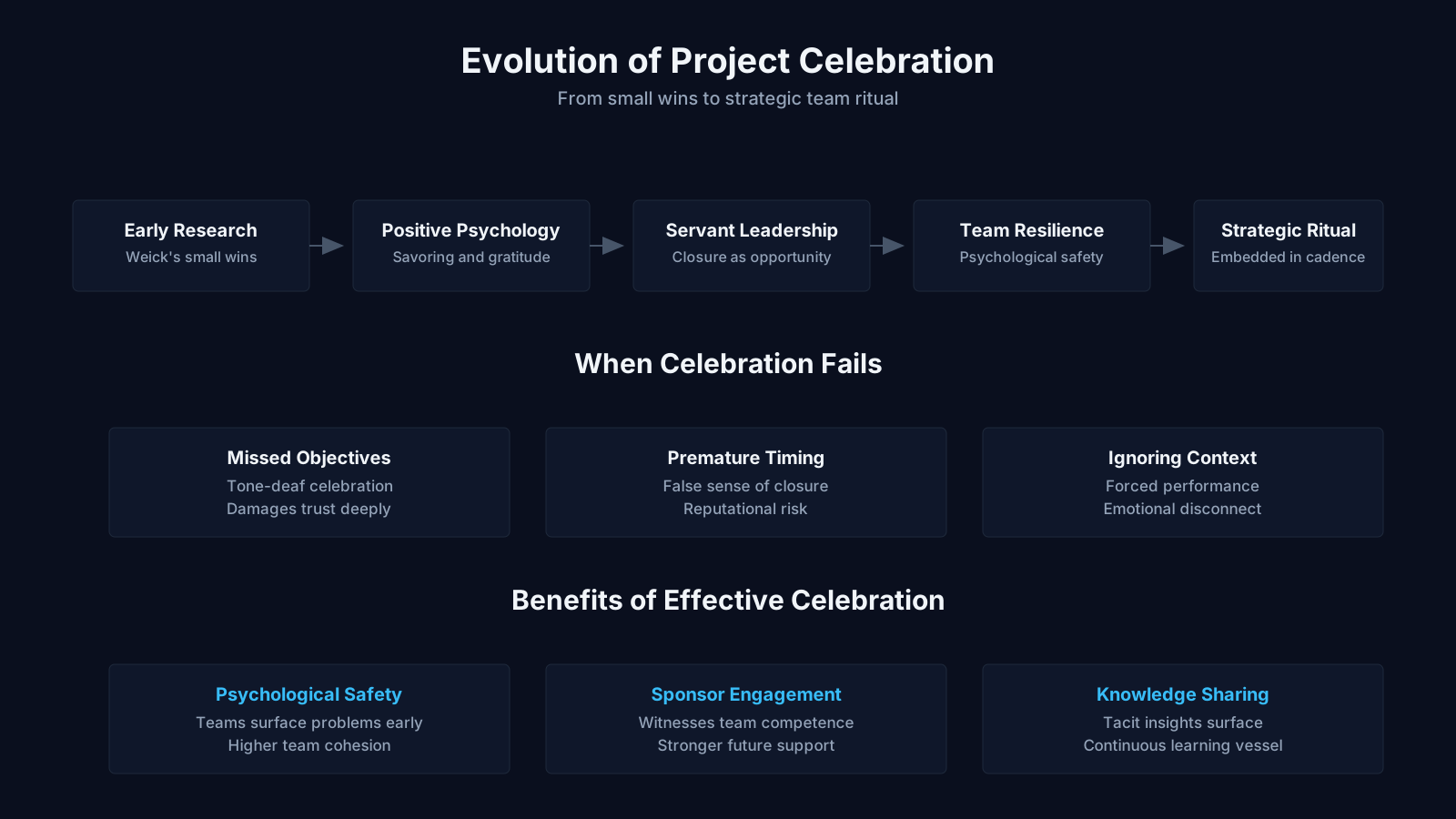
Thirty years ago, celebration in project environments was often informal, sporadic, and leader-dependent. Evolution of celebrating success in project management has mirrored broader shifts toward employee-centric leadership and the rise of Agile thinking. Early PM literature focused almost exclusively on control mechanisms — scope, schedule, cost — and treated human factors as footnote material. As emotional intelligence and servant leadership gained traction, the notion that project managers should deliberately cultivate team morale through recognition moved from soft skill to core competency.
The shift accelerated with the Agile movement, which embedded celebration into recurring ceremonies and made visible progress a central tenet. Then the pandemic-driven dispersion of teams forced another evolution. Remote work destroyed the organic celebrations that once happened spontaneously in hallways and after meetings. Project managers had to become intentional designers of virtual celebration moments, experimenting with video montages, digital kudos boards, and synchronized online events. The best adaptations preserved the authenticity that physical proximity once provided, and many hybrid teams now sustain a blend of in-person and remote celebration rituals.
Current thinking reflects a more nuanced understanding that celebration must be psychologically safe and genuinely inclusive. The focus has moved from the event itself to the narrative arc. Modern practitioners recognize that a poorly executed celebration can do harm by glossing over excluded individuals or overdramatizing a nominal success. The emerging practice is to treat celebration not as a fixed agenda item but as a cultural capability that teams build over time. Some organizations now include “celebration readiness” in their project management maturity models, evaluating whether teams consistently use recognition as a performance and retention tool. While that degree of formalization might seem antithetical, it reflects the growing recognition that celebrating success is not a luxury — it is one of the few renewable sources of team energy in an environment that constantly consumes it.
Debates persist. Some seasoned professionals argue that true celebration requires spontaneity and that planning it kills the spirit. Others counter that without deliberate scheduling, celebration gets squeezed out by deadlines and firefighting. There is truth on both sides. The most effective approach appears to be a hybrid: protect dedicated moments for celebration in the project rhythm, but remain ready to amplify spontaneous wins when they occur. A team that can pause for two minutes after a critical bug fix to simply acknowledge the collective relief is practicing celebration at its most authentic, and no methodology needs to prescribe that moment for it to matter.
Key Insights on Celebration's Evolution
- From informal to structured
- Three decades ago celebration was sporadic and depended on individual leaders, but it has matured into a deliberate, structured practice woven into the daily rhythm of project teams.
- Morale became a core competency
- The growing emphasis on emotional intelligence and servant leadership elevated morale building from a soft‑skill footnote into a recognized, strategic competency within project management.
- Agile accelerated recognition practices
- The Agile movement institutionalized recognition by embedding it into recurring ceremonies such as retrospectives and sprint reviews, making visible progress and peer acknowledgment fundamental to team cadence.
- Virtual celebration requires intentional design
- Distributed teams have adopted video montages, digital kudos boards, and synchronized online events, though the most successful programs deliberately engineer spontaneity and preserve the authenticity of in‑person recognition.
- Inclusivity and celebration readiness
- Modern celebration hinges on psychological safety and genuine inclusion, with forward‑thinking organizations now embedding celebration readiness into maturity models as a measurable lever for retention and performance.