The delivery performance domain is one of the eight project performance domains defined in A Guide to the Project Management Body of Knowledge, Seventh Edition, and it addresses the activities and functions associated with delivering project scope and quality in a way that produces intended outcomes and value.
Delivery Performance Domain: Key Topics Summary
| Key Concept | Summary |
|---|---|
| Definition | The delivery performance domain encompasses the coordinated activities, functions, and controls required to convert approved project scope and quality standards into realized outcomes and measurable value. |
| Deliverable Versus Outcome | This domain separates deliverable completion from outcome achievement and creates value by confirming that each deliverable is sufficiently fit for purpose to activate the intended business result. |
| Integration | Scope verification, quality control, and benefits realization operate as an integrated system within this domain, reducing the handoff friction commonly found in traditional knowledge area silos and enabling faster delivery decisions grounded in evidence. |
| Context | Delivery performance sits within the broader system of project performance domains and interacts continuously with stakeholder, team, development approach, planning, project work, measurement, and uncertainty domains. |
| Purpose | The domain's central question is whether the project produced a solution that resolves the authorized problem at an acceptable level of quality and creates the conditions for intended value. |
| Predictive Tools | In predictive environments, a detailed scope statement, a work breakdown structure, and a requirements traceability matrix provide the structured controls needed to manage delivery and verify that approved requirements are satisfied. |
| Agile Definition | Agile teams use the definition of done as an explicit, shared quality gate confirming that each increment is integrated, tested, documented, and genuinely releasable, which reduces rework and downstream uncertainty. |
| Delivery Cadence and Accountability | The domain requires teams to select a delivery cadence aligned with product characteristics, market dynamics, and the organization's capacity for change. Teams are held accountable for high quality outputs, while outcome accountability is understood to depend on broader system factors beyond the team alone. |
What Is the Delivery Performance Domain?
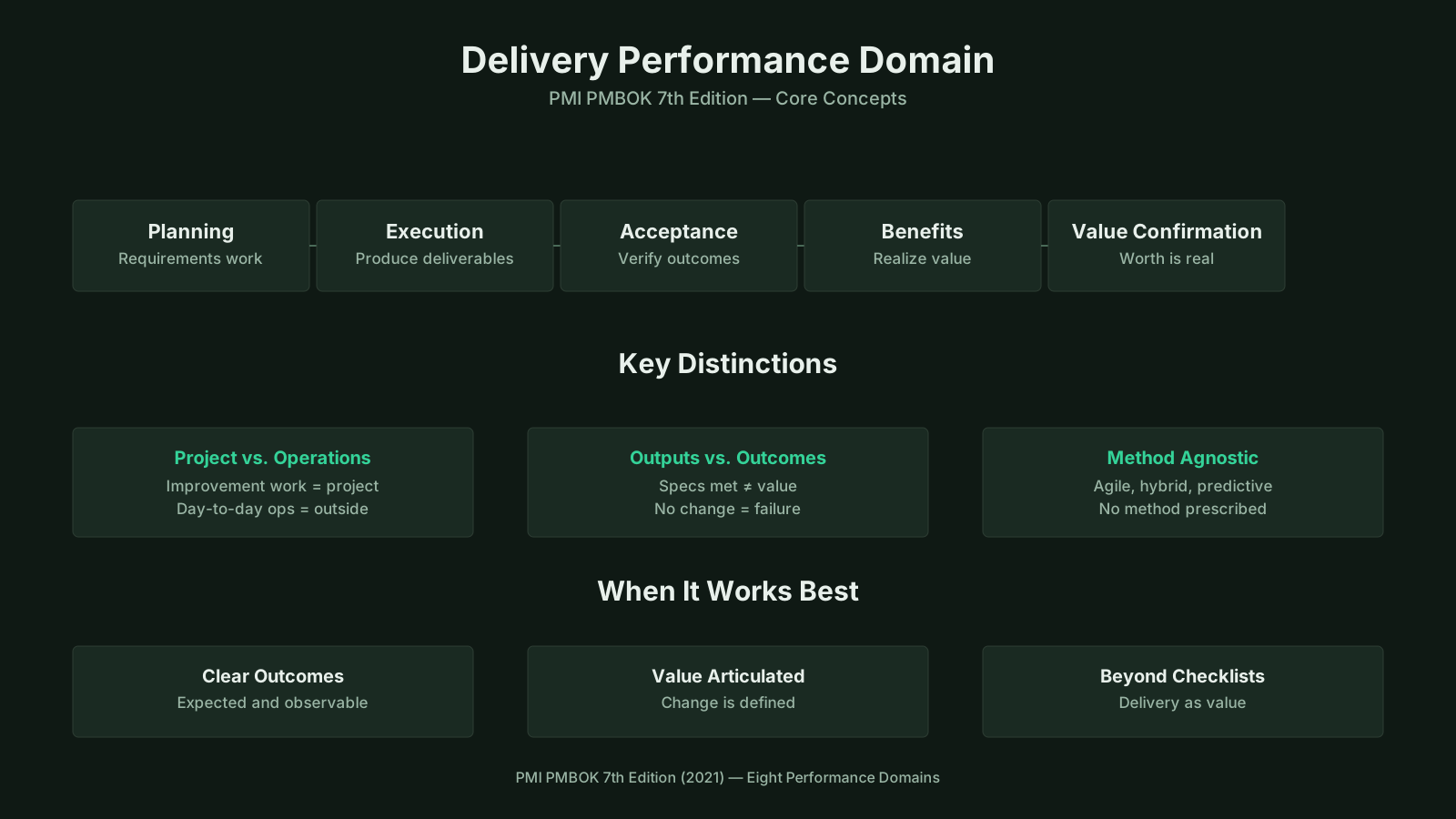
The question of what is the delivery performance domain is best answered by separating two things that often get collapsed in daily project conversations: the deliverable and the outcome. A deliverable is a tangible or intangible output, such as a software module, a bridge, a training program, or a process document. An outcome is the change or benefit that occurs because the deliverable exists and is used. The delivery performance domain is concerned with both, but its real value lies in making sure the deliverable is good enough to trigger the intended outcome.
A delivery performance domain definition therefore includes scope management, quality management, requirements validation, acceptance, and the sequencing of deliverables. It is not a single process or a phase. Instead, it is a way of grouping related project activities that share a common purpose: producing something of worth and confirming that the worth is real. Project managers may recognize elements of scope verification, quality control, and benefits realization inside this domain, but the domain structure allows these elements to interact more fluidly than traditional knowledge area silos.
PMI introduced performance domains in the seventh edition of the PMBOK Guide as a shift away from process groups and knowledge areas. The delivery performance domain sits alongside stakeholder, team, development approach, planning, project work, measurement, and uncertainty domains. It does not replace scope management or quality management. It reframes them around outcomes and value rather than procedural compliance.
In plain terms, if a project is authorized to solve a specific problem, the delivery performance domain asks whether the project actually produced something that solves that problem at an acceptable level of quality. A claims processing system may be delivered on time, but if claims take longer to process after implementation, the delivery domain has not met its purpose.
Core Insights on Delivery Performance
- Deliverables versus outcomes
- The delivery performance domain draws a clear distinction between deliverables, which are tangible or intangible outputs such as software or documents, and outcomes, which are the measurable changes or benefits that arise when those outputs are put to use.
- Domain's core value
- The domain's real purpose is to confirm that each deliverable is sufficiently robust to trigger the intended outcome, rather than merely checking that a deliverable was produced.
- Key management elements
- This domain encompasses scope management, quality management, requirements validation, acceptance, and the deliberate sequencing of deliverables to sustain value delivery.
- PMBOK seventh edition origin
- PMI introduced performance domains in the seventh edition of the PMBOK Guide, shifting the profession from traditional process groups and knowledge areas toward an outcome-focused approach.
- Problem-solving quality focus
- The domain asks whether the project actually produced a solution that genuinely resolves the authorized problem at an acceptable level of quality.
Key Components of the Delivery Performance Domain
Key components of the delivery performance domain span scope, requirements, quality, acceptance, and delivery rhythm. Each component operates differently depending on the development approach, but all of them must be present for the domain to function. Scope defines the boundaries of what will be delivered. Requirements describe the specific conditions, functions, and characteristics that deliverables must satisfy. Quality establishes the standard for whether those requirements are met.
Acceptance is the formal or informal confirmation that a deliverable meets its intended use. In predictive projects acceptance may occur at the end of a phase or at final handover. In adaptive projects acceptance is often continuous, embedded in sprint reviews and user feedback loops. Delivery rhythm refers to the cadence at which deliverables are produced and released. A single large delivery carries different risks and demands different controls than a series of smaller increments.
Scope and Requirements Management
Within the delivery performance domain, scope and requirements are not static documents. They are living definitions of value that must remain connected to stakeholder needs. In predictive environments the project manager typically relies on a scope statement, a work breakdown structure, and a requirements traceability matrix. These artifacts help control unauthorized expansion and ensure each deliverable can be traced to a business or technical requirement.
In adaptive environments requirements are expressed as user stories, backlog items, or features. The product owner prioritizes them based on value, risk, and dependency. The delivery domain still manages scope, but it does so by continuously refining the backlog rather than freezing a baseline. This does not mean scope is uncontrolled. It means scope control happens through frequent decisions about what to build next, not through change request forms alone.
Quality and Acceptance
Quality in the delivery performance domain is measured against two related ideas: conformance to requirements and fitness for use. A deliverable can conform to a specification and still fail in practice because the specification did not capture real user needs. For this reason the domain emphasizes acceptance criteria, definition of done, and verification activities that look beyond simple checklist completion.
Acceptance criteria are the observable conditions that must be true for a deliverable to be considered complete. The definition of done is a broader quality agreement used by agile teams to confirm that work is integrated, tested, documented, and releasable. These tools prevent the common failure of declaring a deliverable finished when it only exists in an incomplete or unstable state.
Delivery Cadence and Value
Delivery cadence shapes how stakeholders perceive progress and how quickly the organization can realize value. A predictive project may deliver all outputs at the end of a year-long schedule. An incremental project may deliver usable pieces every month. The delivery performance domain does not prescribe a single cadence, but it requires the project team to choose a cadence that aligns with the product, the market, and the organization’s capacity to absorb change.
Value realization is not automatic. A deliverable may meet all technical requirements, but if users do not adopt it, the expected value does not materialize. The delivery domain therefore includes activities that validate adoption, measure early outcomes, and provide feedback to the team. This is why delivery is not simply the act of handing over an output. It is the broader effort of making sure the output works in the real world.
Delivery Performance Domain in PMBOK
The delivery performance domain PMBOK framework appears in the seventh edition as part of a deliberate move from predictive process compliance to principle-based project delivery. PMI’s earlier editions organized project management around five process groups and ten knowledge areas. The seventh edition replaced that structure with eight performance domains that describe clusters of related activities. The delivery domain takes much of what was previously called scope management and quality management and connects it directly to outcome generation.
PMI defines the delivery performance domain as encompassing activities related to delivering the scope and quality the project was undertaken to achieve. It includes defining scope, decomposing work, managing requirements, maintaining quality, and validating that outputs produce the desired results. The domain also interacts with planning, measurement, uncertainty, and project work. For example, planning determines how delivery will be managed, while measurement determines whether delivery is succeeding.
Outcomes and Outputs in the PMBOK Delivery Domain
A central distinction in the PMBOK version of this domain is the difference between outcomes and outputs. Outputs are the deliverables produced by the project. Outcomes are the consequences of using those deliverables. The delivery performance domain is accountable for ensuring that outputs are fit to produce outcomes, but it cannot guarantee outcomes alone because external factors such as user adoption, organizational readiness, and market conditions also play a role.
This distinction matters because project success is increasingly defined by value rather than by schedule and budget alone. A project that produces the planned deliverable on time and within cost may still be considered a failure if the deliverable does not change anything meaningful for the organization. The delivery domain keeps the team focused on that larger result without ignoring the technical discipline required to build the deliverable well.
Core Takeaways on Delivery Domain
- Principle-based delivery shift
- PMBOK's seventh edition replaces the five process groups and ten knowledge areas with eight performance domains, marking a decisive shift from predictive process compliance to principle-based project delivery.
- Scope and quality merged
- The delivery performance domain consolidates the former scope management and quality management areas into a single integrated focus, linking deliverable definition and control directly to outcome generation.
- Defining and validating deliverables
- The delivery domain covers scope definition, work decomposition, requirements management, quality assurance, and validation that outputs generate the intended results, while remaining closely integrated with planning, measurement, uncertainty, and project work.
- Outputs versus outcomes
- The domain ensures that outputs are capable of producing outcomes, but it cannot guarantee those outcomes alone because success also depends on external factors such as user adoption, organizational readiness, and market conditions.
Delivery Performance Domain in PRINCE2 and Agile
PRINCE2 does not use the phrase performance domain, but its product-based planning approach expresses many of the same concerns. The PRINCE2 delivery performance domain equivalent is distributed across the quality theme, the plans theme, and the management stage process. PRINCE2 requires product descriptions that define purpose, composition, quality criteria, and quality tolerances for every planned product. This is a highly structured way of defining what delivery means before work begins.
PRINCE2 also separates delivery from project direction through work packages and stage boundaries. A work package is the agreement between the project manager and a team manager for producing one or more products. Stage boundaries provide formal points where the project board evaluates whether the products delivered so far justify continuing. This staged control mechanism is a hallmark of the PRINCE2 approach to delivery performance.
Agile and Hybrid Delivery
Agile teams treat the delivery performance domain in agile as the continuous production of valuable, working increments. Delivery is not a concluding activity. It is the regular pulse of the project. Each sprint or iteration aims to produce a potentially releasable increment that meets the team’s definition of done. Sprint reviews allow stakeholders to inspect the increment and provide feedback that immediately influences the next delivery cycle.
Hybrid projects combine elements of predictive and adaptive delivery. They may use a work breakdown structure for high-level scope while delivering work through sprints or incremental releases. In these projects the delivery performance domain must be deliberately tailored. The team needs enough formality to satisfy governance requirements and enough flexibility to adapt to feedback without losing control of quality and scope.
Purpose and Importance of the Delivery Performance Domain
The purpose of the delivery performance domain is to ensure that a project does not merely complete activities but actually delivers something useful. This is a subtle but crucial shift. Many projects fail not because they miss their schedules but because they deliver outputs that do not solve the original problem. The delivery domain exists to reduce that risk by making value, quality, and acceptance explicit rather than assumed.
Its importance grows as projects become more complex and as stakeholders demand earlier evidence of value. Sponsors are less willing to wait twelve months for a single delivery without seeing intermediate results. The delivery domain encourages teams to think about partial releases, prototypes, pilots, and early feedback mechanisms. This orientation helps organizations manage risk and adjust direction before large investments are fully committed.
The domain also reinforces accountability. It clarifies who is responsible for defining quality, who validates acceptance, and who confirms that value is achieved. Without this clarity, teams may deliver technically correct products that no one uses, or they may spend enormous effort refining features that stakeholders never requested. The delivery domain forces those conversations to happen throughout the project, not only at the end.
Core Takeaways on Delivery Value
- Useful outcomes over completed activities
- The delivery performance domain makes realized outcomes the primary measure of success, ensuring that projects solve the original business problem instead of simply completing scheduled activities.
- Explicit value, quality, and acceptance
- By defining value, quality, and acceptance criteria explicitly, this domain reduces the risk of shipping technically sound products that fail to meet actual user needs or stakeholder expectations.
- Early evidence through incremental releases
- As complexity increases, this domain encourages staged releases, prototypes, pilots, and early feedback loops, which allow sponsors to capture interim value and enable organizations to recalibrate direction before committing substantial resources.
Practical Application of the Delivery Performance Domain
In practice, the delivery performance domain in project management is applied through a mix of planning artifacts, quality controls, and feedback loops. The specific tools vary by life cycle, but the underlying questions remain consistent. What are we delivering? What standard must it meet? Who accepts it? How will we know it produced value? Teams that answer these questions early tend to avoid expensive rework later.
The domain is relevant at every stage of the project life cycle. During initiation it informs the project charter and business case by clarifying what the project must produce. During planning it shapes the scope baseline, quality management plan, and delivery schedule. During execution it guides the actual creation and verification of deliverables. During closing it supports final acceptance, handover, and the transition to benefits realization.
Predictive Environments
In predictive environments the delivery performance domain relies on detailed scope definition, a work breakdown structure, formal quality audits, and staged acceptance. The project manager uses the scope baseline to control change and prevent scope creep. Quality control activities compare deliverables against specifications. Formal acceptance is often documented through signed verification forms or user acceptance testing.
The strength of this approach is its predictability and traceability. The weakness is that it can become rigid if stakeholders discover new needs after the baseline is approved. In such cases the change control process protects the project from uncontrolled expansion, but it can also slow down valuable adjustments. Experienced practitioners often combine early prototyping with formal baselines to balance these pressures.
Adaptive and Hybrid Environments
Adaptive projects apply the delivery domain through backlogs, iterations, continuous integration, and frequent acceptance reviews. The product owner serves as the primary voice of value, while the team owns quality through its definition of done. Delivery occurs in small increments that stakeholders can inspect. This reduces the distance between building something and learning whether it works.
Hybrid projects often use a rolling wave approach. High-level scope is baselined, but detailed requirements are elaborated just before delivery. Quality gates may remain formal, while development occurs in timeboxed cycles. The delivery performance domain in these projects must be tailored to avoid conflict between stage gate reviews and iterative feedback cycles. When tailored well, hybrid delivery preserves governance and improves responsiveness.
Common Delivery Scenarios
Delivery performance concepts apply across industries. In software development, the domain covers release planning, definition of done, automated testing, and user acceptance. In construction, it covers specifications, inspections, punch lists, and occupancy permits. In organizational change projects, it covers training assets, process documentation, and adoption metrics. In each case the team must define what good delivery looks like and verify that the definition has been met.
Project managers, product owners, business analysts, quality managers, and sponsors all participate in the delivery domain. Their roles differ, but their shared objective is the same: create an output that is fit for purpose and confirm that it generates the expected change. The domain is not the exclusive property of any single role, which is one reason communication and shared understanding are so important.
BVOPM Perspective on the Delivery Performance Domain
From a BVOPM perspective on the delivery performance domain, the boundaries of what counts as a delivered product are broader than in some traditional frameworks. Business Value-Oriented Project Management treats employee-created tools and open-source software as formal products rather than incidental byproducts. This means that a script built by a developer to automate testing, or a configuration template assembled for internal reuse, can be considered part of the project’s delivery value if it creates lasting organizational capability.
BVOPM also emphasizes cross-functional teams as a core success factor for delivery. Delivery quality improves when business, technical, and operational perspectives are embedded in the team rather than added through separate review cycles. In practice this reduces handoffs, speeds up validation, and makes acceptance criteria more realistic. The BVOPM view aligns with the broader delivery performance domain emphasis on outcomes, but it places particular weight on team composition and on recognizing non-obvious deliverables.
Key Insights on BVOPM Delivery
- Broadened product definition
- BVOPM elevates employee-created tools and open-source software to the status of formal products, recognizing them as deliberate assets rather than incidental byproducts of project work.
- Capability-based delivery value
- Scripts and configuration templates count as delivery value when they establish durable organizational capabilities that persist beyond the immediate project.
- Cross-functional team composition
- Embedding business, technical, and operational expertise directly within the team improves delivery quality by eliminating the delays and misalignments caused by separate review cycles.
- Reduced handoffs and faster validation
- When diverse perspectives are embedded in the team, handoffs decrease, validation accelerates, and acceptance criteria become grounded in operational reality.
Common Challenges, Pitfalls, and Misconceptions
Several common misconceptions about the delivery performance domain create problems in real projects. One is the belief that delivery only happens at the end of the project, during handover. That view ignores the many delivery-related decisions made during planning, design, and execution. Another misconception is that delivery is solely about outputs. Teams that focus only on outputs may produce technically flawless deliverables that nobody uses or that fail to create the intended business change.
A frequent pitfall is gold plating, the addition of features or polish that stakeholders did not request. Gold plating consumes time and budget while adding little value. The delivery performance domain encourages discipline against this tendency by tying work to requirements, acceptance criteria, and measurable outcomes. Scope creep is a related problem, especially in predictive projects where the baseline is poorly defined or weakly enforced.
In adaptive environments a common issue is the hollow definition of done. A team may mark a story complete when the code is written but not integrated, tested, or documented. That creates false progress and pushes quality problems downstream. Another issue is delivery without acceptance. Teams may demo a feature but never capture formal or informal acceptance, leaving ambiguity about whether the work truly met stakeholder needs.
The delivery performance domain should not be applied as a rigid checklist. It is a framework for thinking and acting, not a governance standard. When organizations treat the domain as a set of mandatory reports, they often recreate the very process-heavy environment that PMI’s domain structure was meant to replace. The domain works best when teams use it to guide conversations about value, quality, and acceptance in a way that fits the project context.
Relationships to Other Project Management Concepts
The delivery performance domain vs project work performance domain distinction is a common source of confusion. The project work domain focuses on managing the processes, resources, and logistics needed to perform project work. It includes physical resources, procurement, learning, and team management. The delivery domain focuses on what the work produces and whether the product meets quality and value expectations. In simple terms, project work is about doing the work; delivery is about what the work yields.
The delivery performance domain also connects closely with the planning performance domain. Planning defines how scope, quality, and delivery will be managed. Delivery provides feedback that causes plans to change. A plan that does not adjust to delivery reality becomes a work of fiction. Similarly, the measurement domain supplies the data needed to judge delivery performance, such as defect rates, cycle time, throughput, and customer satisfaction. The uncertainty domain influences delivery by identifying risks that may compromise quality or value.
Key artifacts associated with the delivery domain include the scope statement, work breakdown structure, requirements documentation, acceptance criteria, definition of done, test plans, quality metrics, and delivery schedules. In agile settings, the product backlog and release plan are central delivery artifacts. These artifacts are not merely administrative records. They are the shared language through which the team, sponsors, and stakeholders negotiate what done means and whether done has been achieved.
Delivery and Work Domain Takeaways
- Work versus delivery domains
- The work domain manages processes, resources, and logistics, whereas the delivery domain evaluates the quality and value of the outputs produced.
- Delivery feedback drives plan changes
- Plans that ignore actual delivery outcomes quickly become unreliable; delivery results must therefore directly inform ongoing plan revisions.
- Measurement domain supplies delivery data
- The measurement domain supplies key delivery performance metrics, including defect rates, cycle time, throughput, and customer satisfaction.
- Core delivery artifacts defined
- Formal delivery artifacts include the scope statement, work breakdown structure, requirements documentation, acceptance criteria, definition of done, test plans, quality metrics, and delivery schedules.
- Agile delivery artifacts central
- In agile environments, the product backlog and release plan function as the primary delivery artifacts that steer ongoing work.
Evolution and Current Thinking
The evolution of the delivery performance domain reflects a broader shift in project management from triple constraint thinking to value and outcome thinking. Early project management standards emphasized delivering on time, on budget, and according to specification. Those factors still matter, but they are now seen as constraints rather than the ultimate definition of success. The delivery domain captures this evolution by placing quality and value at the center of the delivery conversation.
Current thinking increasingly treats delivery as a flow rather than a single event. Teams use cumulative flow diagrams, lead time measurements, and delivery frequency to understand how work moves from idea to usable result. This flow-based view has roots in lean product development and agile software delivery. It challenges the traditional assumption that a project must deliver everything at once. Instead, smaller and more frequent deliveries allow faster learning and earlier benefit capture.
There is ongoing debate about how to measure delivery performance. Some practitioners emphasize output metrics such as story points delivered, features shipped, or milestones completed. Others argue that outcome metrics such as adoption rate, user satisfaction, and business value realized are more meaningful. The most defensible position is that both types of metrics are needed. Output metrics tell you whether the team is producing, and outcome metrics tell you whether the production is making a difference.
The delivery performance domain is likely to remain relevant because it names something that has always been essential but often implicit: a project does not succeed by planning, monitoring, or even executing. It succeeds by delivering. That simple reality explains why PMI placed delivery among its eight performance domains and why practitioners continue to refine their understanding of what delivery truly requires.