In project management, the Deploy Phase is the stage of a project or product lifecycle in which a designed, built, and tested deliverable is released into the operational environment and made available to its intended users. It is the point where project outputs begin to generate value outside the controlled project setting. Deployment includes installation, configuration, data migration, final quality verification, user access enablement, and handover to operations or support functions. The term appears most often in software and technology initiatives, but the underlying concept is equally relevant to infrastructure rollouts, hardware installation, process changes, and other project types.
Deploy Phase: Key Topics Summary
| Key Concept | Summary |
|---|---|
| Deployment Phase | The Deployment Phase is the stage in the delivery lifecycle when a verified, tested deliverable is released into the live operational environment and made available to its intended users. |
| Core Deployment Activities | Deployment encompasses environment preparation, installation and configuration, data migration, final quality verification, user access provisioning, and formal handover to operations or support teams. |
| Broader Applicability | Although the term is most common in software and technology initiatives, the underlying concept applies equally to infrastructure rollouts, hardware installations, operational process changes, and other complex project types. |
| Transition Sequence | Deployment in a project context is not a single event but a coordinated sequence of activities that prepare the environment, move the deliverable into place, verify operational conditions, and formally transfer ownership. |
| Military Origins | The Deploy Phase traces its roots to military planning, where deployment windows were used to coordinate the movement of forces or assets according to strict schedules and readiness criteria. |
| Release Engineering Terminology | Terms such as production environment, smoke test, rollback, feature flag, and cutover emerged from the need to transition code safely from development into systems that users rely on in daily operations. |
| Production Environment Risks | Production environments introduce risks that testing environments cannot fully replicate, including live user traffic, data integrity exposure, and integration dependencies, making deployment a distinct governance control point. |
| Work Package Decomposition | Project managers decompose deployment into discrete work packages because each component can fail independently, and recovery becomes significantly more complex once live users are affected. |
What Is the Deploy Phase?
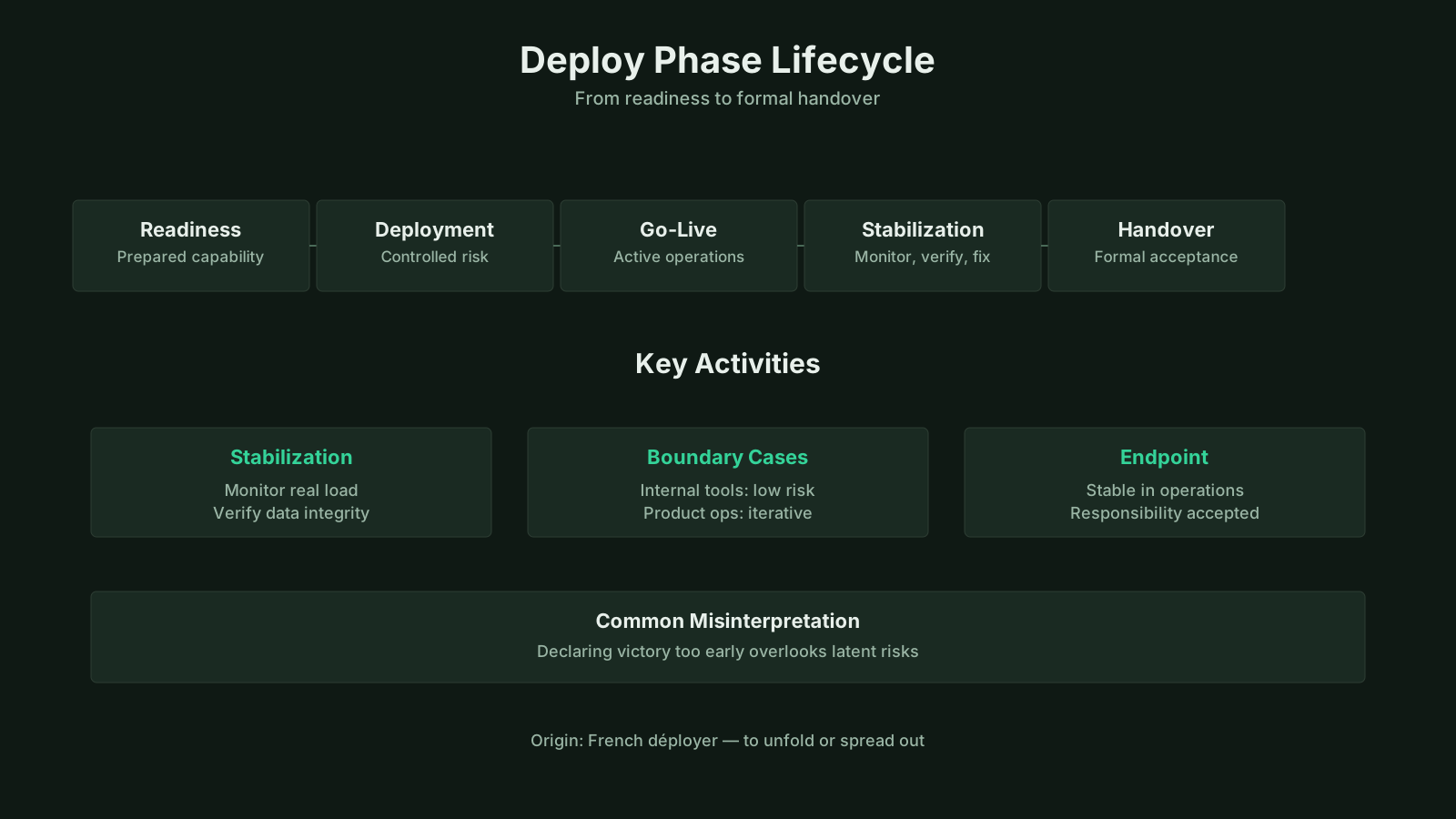
A Deploy Phase definition goes beyond the simple act of flipping a switch. It describes a managed transition from build or test conditions to live use. Within a project context, this transition is not a single event but a sequence of coordinated activities that prepare the environment, move the deliverable into place, verify that it works under operational conditions, and formally transfer responsibility to the people who will run it day to day. The phase can last hours in a small software release or months in a large infrastructure program.
Deployment as a Lifecycle Boundary
The Deploy Phase sits at a natural boundary between creation and operation. Before deployment, the deliverable exists in a controlled project environment where developers, engineers, and project teams can make changes with relatively low operational risk. After deployment, the deliverable is live. Real users depend on it, real data flows through it, and failures have direct business impact. This boundary is why the Deploy Phase has its own governance, approvals, and risk controls. It is often protected by go/no-go decisions, change freezes, and cutover plans.
Different Names for the Same Boundary
Organizations do not always call this stage the Deploy Phase. In some industries it is called the rollout phase, the release phase, the implementation phase, or the go-live phase. In software engineering, deployment and release are sometimes treated as distinct concepts. Deployment refers to moving code into a production environment, while release refers to making a feature available to users. In project management practice, however, the Deploy Phase commonly encompasses both the technical movement and the user-facing availability of the result. The terminology matters less than the shared intent: to put the project output into productive use.
Key Insights on the Deploy Phase
- Managed transition to live use
- The Deploy Phase comprises a deliberate sequence of controlled activities that moves a deliverable from build or test conditions into production, reflecting a managed transition rather than an isolated cutover event.
- Boundary between creation and operation
- Before deployment the deliverable remains within a controlled, low-risk project setting, but once live, real users depend on it and failures carry direct business consequences, which is why the phase is safeguarded by go/no-go decisions, change freezes, and detailed cutover plans.
- Deployment versus release scope
- Deployment focuses on moving code into production, while release focuses on making that capability available to users, so the Deploy Phase must coordinate both the technical movement and the user-facing activation.
Origins and Cross-Industry Context
The origins of the Deploy Phase lie in disciplines where moving assets or capabilities into an operating position is a formal, high-stakes activity. Military logistics uses deployment to describe the movement of personnel, equipment, and supplies into a theater of operations. That usage carries strong connotations of readiness, sequencing, and command-level accountability. These same ideas migrated into construction, telecommunications, manufacturing, and later software engineering. Project management borrowed the term because it captures the transition from preparation to active use.
Military and Logistics Roots
In military settings, a deployment is not simply a movement of resources. It requires detailed planning for staging, transportation, protection, establishment of local support, and coordination with existing forces. The costs of a poorly executed deployment are immediate and severe. This emphasis on readiness and control influenced project managers who plan large technology rollouts. The military concept also introduced the idea of a deployment window, a defined period during which forces or assets move according to a coordinated schedule.
Software Engineering and Release Management
Software engineering gave the Deploy Phase much of its modern vocabulary. Terms like production environment, smoke test, rollback, feature flag, and cutover emerged from the need to move code safely from development into systems that users rely on. Release management practices evolved to handle versioning, dependency checking, environment configuration, and post-release verification. Over time, automation reduced the duration of deployment from weeks to minutes in many organizations. Even so, the phase remains a distinct control point in software projects because the production environment creates risks that testing environments cannot fully replicate.
Manufacturing and Physical Product Rollout
Physical product projects bring their own deployment concerns. A new medical device may need to be shipped, installed, calibrated, and validated at customer sites. A construction project deploys its output when the building is handed over to the owner and occupied. In these contexts, the Deploy Phase includes logistics, on-site acceptance testing, user training, documentation delivery, and warranty conditions. The project output changes hands from the project team to the operational owner, often through formal acceptance and sign-off procedures.
Key Components of the Deploy Phase
The key components of the Deploy Phase vary by project type, but several elements appear across most deployments. Environment readiness, release and installation, data migration, verification, user enablement, and operational handover form the core of the phase. Each component carries distinct risks. Treating deployment as a single amorphous activity often hides those risks. Project managers decompose the phase into work packages precisely because each component can fail independently and in ways that are hard to recover from once live users are involved.
Environment Readiness
The target environment must be prepared before the deliverable arrives. In a software project this means production servers, network access, security controls, database capacity, and monitoring tools. In a physical project it means site preparation, utilities, access routes, and safety systems. Environment readiness also includes configuration baselines. A common failure pattern is discovering that the production environment differs from the staging environment in a way that breaks the solution. Those differences may involve operating system versions, security policies, integration endpoints, or data formats.
Release, Installation, and Cutover
The actual movement of the deliverable is normally governed by a release package or deployment runbook. The package identifies what is being deployed, which version, what dependencies must be satisfied, and what sequence to follow. Cutover is the moment when the old system or process stops and the new one takes over. Some projects use a big bang cutover, where the switch happens all at once. Others use phased, parallel, or pilot-based cutovers to limit exposure. The choice depends on the reversibility of the deployment, the tolerance for downtime, and the complexity of the operating environment.
Data Migration and Integrity
Many deployments involve moving data from a legacy system or an old format into the new solution. Data migration includes extraction, transformation, validation, and reconciliation. Data issues are some of the most common causes of go-live failures. Even when the new system functions exactly as designed, migrated data that is incomplete, duplicated, or misclassified can make the system unusable for real business operations. The Deploy Phase therefore includes data freeze periods, migration rehearsals, and formal reconciliation before users are granted access.
Verification and Early Life Support
Deployment does not end at installation. The project team normally runs a defined sequence of checks after the solution is live. Smoke tests verify that the most critical paths work. User acceptance testing may continue for a short period after cutover. Monitoring teams watch system performance, error rates, and support ticket volumes. Many projects include a hypercare or early life support period, during which project resources remain available to fix problems quickly. This period creates a controlled bridge from project execution to steady-state operations.
User Enablement and Handover
The final component of deployment is enabling people to use the deliverable and formally handing over responsibility. User enablement includes training, documentation, access provisioning, and communication about changes to workflows. The handover transfers technical support, maintenance, and operational ownership to the appropriate teams. A deploy phase is not truly complete until the people who will use and support the result have accepted it. Without that acceptance, the deliverable may be live in a technical sense but not in a business sense.
Core Takeaways on Deploy Phase
- Core deployment components
- The Deploy Phase integrates environment readiness, release and installation, data migration, verification, user enablement, and operational handover into a controlled sequence that determines whether the solution becomes operational.
- Decomposition into work packages
- Project managers isolate these components into distinct work packages because each one can fail independently, and failures become significantly harder to contain and correct after live users are involved.
- Environment readiness varies by project
- Software projects require production servers, network access, security controls, database capacity, and monitoring tools, whereas physical projects demand site preparation, utilities, access routes, and safety systems.
- Staging and production mismatches
- A common failure pattern is discovering only during deployment that production differs from staging in operating system versions, security policies, integration endpoints, or data formats, which can cause the solution to fail in the live environment.
- Data migration safeguards
- During the Deploy Phase, data freeze periods, migration rehearsals, and formal reconciliation prevent incomplete, duplicated, or misclassified data from undermining the system's usability in live operations.
Deploy Phase in Project Management Frameworks
The Deploy Phase in PMBOK terms is not a formal process group, but its activities map directly to several processes in the PMBOK Guide. The PMBOK framework organizes project work into process groups rather than lifecycle phases. Deploy activities typically fall within the Executing Process Group, with associated monitoring and controlling activities. In predictive lifecycle models, the Deploy Phase often appears as a distinct phase near the end of the project lifecycle, after construction and testing and before closure. PMBOK emphasizes the management of deliverables, quality control, risk response, and stakeholder engagement during this phase.
PMBOK Perspective
Within the PMBOK framework, the Deploy Phase draws heavily on the Direct and Manage Project Work process from Project Integration Management. That process produces deliverables and work performance data. The Validate Scope process verifies that the deployed deliverable meets acceptance criteria. Control Quality confirms that the result meets quality requirements before it is accepted. Monitor Risks tracks deployment-specific threats and opportunities. Finally, the Close Project or Phase process ensures that the deployed output is transitioned to operations, customer, or another group with appropriate final acceptance.
PRINCE2 Perspective
PRINCE2 handles deployment through its product-based planning approach and its process model. The Deploy Phase aligns most closely with the Managing Product Delivery process, where teams execute work packages to create and hand over products. The Controlling a Stage process monitors progress against stage tolerances. The Managing Stage Boundaries process reviews what has been delivered and authorizes the next stage. In PRINCE2, acceptance authority is explicit through product descriptions and quality criteria. The final deployment often occurs within the last delivery stage, and formal handover is confirmed during the Closing a Project process.
Agile and Hybrid Environments
Agile frameworks compress the Deploy Phase significantly. In Scrum, each sprint produces a potentially shippable increment, though not every increment is released to customers immediately. The Definition of Done usually includes deployment readiness, meaning the increment could be deployed without additional integration work. Extreme programming and DevOps practices go further by automating deployment through continuous integration and continuous delivery pipelines. In hybrid environments, an organization may plan a larger release window while still delivering internal increments frequently. The Deploy Phase then becomes a release on demand activity rather than a long final stage.
BVOP Perspective on the Deploy Phase
The BVOPM Deploy Phase view treats deployment as an execution and delivery activity in which cross-functional teams are a core success factor. BVOPM also recognizes employee-created tools and open-source components as formal products rather than incidental outputs. This perspective encourages project teams to value deployment artifacts, scripts, and enabling tools as part of the project result. Deployment is evaluated for its contribution to business value rather than for technical completion alone. The phase is considered successful only when the delivered capability is actually used and begins generating measurable value.
Key Insights on Deployment Value
- Cross-functional teams drive deployment
- BVOPM positions deployment as a collaborative delivery discipline in which cross-functional alignment directly shapes execution quality and outcome reliability.
- Tools become formal products
- Internally developed tools and open-source components are formally recognized as primary project deliverables rather than incidental byproducts.
- Artifacts count in results
- Deployment artifacts, automation scripts, and enabling utilities are considered measurable and integral contributions to the final project outcome.
- Business value drives evaluation
- Deployment success is evaluated by its measurable contribution to business value rather than by technical completion alone.
- Usage defines phase success
- The deploy phase is considered successful only when the delivered capability is actively used and starts generating demonstrable business value.
Purpose and Importance of the Deploy Phase
The purpose of the Deploy Phase is to convert project output into realized business value. Everything that happens before deployment creates potential value, but that value remains latent until the result reaches users. The phase also serves as the final major risk gate. It is the last point where the organization can decide to delay, modify, or reverse a solution before full operational exposure. A well-managed Deploy Phase protects the project investment, reduces operational disruption, and creates confidence among users, sponsors, and operational teams.
Value Realization
Benefits do not appear automatically when a project deliverable is completed. They appear when the deliverable is used to change work patterns, serve customers, or improve business processes. The Deploy Phase is the mechanism that connects the project output to those outcomes. A customer relationship management system that is installed but not adopted by sales staff produces no value. Deployment therefore includes the organizational readiness work that makes adoption possible. Value realization is a central test of whether the deployment was effective.
Risk Containment
The Deploy Phase concentrates risk. Technical risks, operational risks, data risks, and adoption risks all peak around cutover. The phase exists in part to contain those risks through structured verification and controlled release. Go/no-go decisions, rollback plans, and phased cutover strategies are all risk containment mechanisms. They allow the organization to limit the blast radius if something fails. A deployment that is rushed, disorganized, or poorly verified can convert a well-executed project into a serious operational incident.
Stakeholder Confidence
Live deployment is often the most visible moment in a project. Sponsors, executives, users, and customers watch how the transition unfolds. A smooth deployment builds confidence in the project team and the solution. A chaotic deployment undermines trust even if the underlying deliverable is technically sound. Project managers often underestimate the symbolic weight of the phase. Stakeholders remember the days surrounding go-live far more clearly than the months of planning and development that preceded them.
Common Challenges, Pitfalls, and Misconceptions
Deploy Phase challenges frequently stem from an overly narrow focus on the technical move and an underinvestment in the surrounding organizational work. Environment drift, incomplete data reconciliation, unclear ownership, and unrealistic user readiness are recurring problems. A common misconception is that deployment is mostly an operational concern, not a project management concern. In reality, the project manager remains accountable for coordinating stakeholders, managing risks, and ensuring that the solution meets acceptance criteria throughout the transition. The phase requires the same discipline as earlier project stages.
The Deployment Window Illusion
Many teams treat deployment as a brief window of intense activity rather than a phase with its own lifecycle. The illusion is that go-live is a few hours on a weekend. In practice, effective deployment starts days or weeks earlier with environment preparation and release planning. It continues after cutover with verification, hypercare, and handover. Compressing all of this into a single high-pressure window increases the chance of missed steps. The window itself becomes a symbol of risk rather than a controlled transition.
Environment Drift and Configuration Drift
Production environments rarely match development or test environments exactly. Over time, manual changes, patches, and configuration updates cause drift. The Deploy Phase exposes those differences in ways that earlier testing cannot. A script may run flawlessly in staging but fail in production because a security policy blocks a port or a database user lacks a required privilege. Teams that treat environment parity as a deployment prerequisite rather than an afterthought reduce this risk. Configuration management practices help, but they do not eliminate the need for production-specific verification.
Underestimating User Readiness
Technical deployment can succeed while the business deployment fails. Users may not know how to use the new solution, may not understand why the change is happening, or may not have access to the right accounts and permissions. Project teams sometimes assume that training delivered weeks earlier remains fresh enough for go-live. A better practice is to tie user enablement closely to the deployment schedule and to provide immediate post-go-live support. The first days of live use are when users form durable judgments about the project result.
Misconceptions About the End Point
Some practitioners assume that deployment ends when the system is live. Others assume that the project ends at the same moment. Both assumptions are problematic. The Deploy Phase continues through early life support and formal handover. The project itself continues to closure, which involves final acceptance, documentation, lessons learned, and release of resources. Confusing technical go-live with project completion can lead to premature resource departure and unresolved operational issues. The phase has a beginning, a middle, and an end, and each part requires active management.
Key Takeaways on Deployment Pitfalls
- Underinvestment in organizational work
- Deployment failures often arise when teams focus too narrowly on the technical move and underinvest in the surrounding organizational work, allowing environment drift, incomplete data reconciliation, unclear ownership, and unrealistic user readiness to become recurring issues.
- Project manager remains accountable
- A common misconception is that deployment is largely operational, yet the project manager remains accountable for coordinating stakeholders, managing risks, and ensuring the solution meets acceptance criteria throughout the transition.
- Deployment Window Illusion
- The Deployment Window Illusion treats go-live as a brief burst of intense activity, but deployment follows its own lifecycle and compressing preparation into a single window invites missed steps, such as scripts that pass in staging yet fail in production because of blocked ports or missing privileges.
- User enablement tied to schedule
- Users may not know how to use the new solution, may not understand the reason for the change, or may lack the right accounts and permissions, so user enablement should be tied to the deployment schedule and supported by immediate post-go-live assistance.
Relationships to Other Concepts
The Deploy Phase vs implementation distinction is useful for clarifying scope. Implementation in a broad sense can include the entire project, from planning through installation and adoption. Deployment is narrower and more specific. It refers to the movement of the completed deliverable into the live environment and the immediate transition that follows. In technology projects, implementation often includes configuration and customization work that happens before deployment. The two terms are related but not interchangeable, and using them precisely reduces confusion among stakeholders and team members.
Deployment vs Delivery
Delivery is the act of producing and providing a project output according to requirements. Deployment is the act of placing that output into operational use. A deliverable can be delivered but not deployed, which happens when a product is completed and accepted but not yet released to users. Conversely, deployment requires that delivery has already occurred. In some methodologies the boundary between delivery and deployment is formalized through acceptance criteria. The distinction matters because project value is usually tied to deployment, not merely to delivery.
Deployment vs Transition
Transition is a broader concept that covers the shift from project mode to ongoing operations. It includes knowledge transfer, support model establishment, contractual handover, and operational readiness. Deployment is one element of transition. A complete transition may also involve organizational change, process redefinition, and service management integration. Projects that treat deployment as the whole transition often miss the long-term operational stability work. The Deploy Phase may trigger transition activities, but the two should not be conflated.
Release Management and DevOps
Release management governs how versions of a product move from development to production. The Deploy Phase is the operational execution of a release decision. In DevOps environments, release and deployment are increasingly automated, but governance still matters. Feature flags allow code to be deployed without immediately exposing functionality to users. This separates the technical act of deployment from the business act of release. Project managers in these environments coordinate the release decision rather than controlling every technical step. The underlying risk logic remains the same, even when the tools change.
Change Management and Communications
The Deploy Phase is deeply connected to organizational change management. Users must understand what is changing, why it is changing, and how their work will be affected. Communication plans, training programs, and stakeholder engagement activities all shape deployment outcomes. A technically flawless deployment can still fail if users resist or if managers do not support the new way of working. Project managers often rely on change management specialists during the phase, especially in enterprise-wide or customer-facing deployments.
Evolution and Current Thinking
The evolution of the Deploy Phase reflects a shift from infrequent, high-risk events toward continuous, automated, and incremental transitions. In the past, deployment was often a lengthy final stage filled with manual checklists and weekend cutovers. Current practice favors smaller releases, more automation, and earlier integration of production concerns into the project lifecycle. This is not a rejection of the Deploy Phase. It is a redistribution of deployment risk and effort across the project. Teams now build deployment readiness into everyday work instead of postponing it to a single dramatic moment.
From Big Bang to Incremental Deployment
The traditional big bang cutover still has its place, especially in physical infrastructure or large enterprise systems where partial operation is impractical. But many projects now use canary releases, blue-green deployments, pilot groups, or phased geographic rollouts. These incremental approaches reduce the number of users exposed to a new solution at any one time. They also allow teams to gather feedback and fix defects before full deployment. The tradeoff is complexity. Managing multiple waves of deployment requires more coordination than a single cutover.
Automation, CI/CD, and DevSecOps
Continuous integration and continuous delivery pipelines have changed what deployment means in software projects. Deployment can occur many times per day with little human intervention. Automated tests, infrastructure as code, and security scanning are integrated into the pipeline. DevSecOps adds security gates early in the process rather than treating security as a final deployment hurdle. This does not eliminate the need for a Deploy Phase concept. It changes the phase from a long manual process into a fast, controlled capability. Project governance adapts by focusing on release policies, approval thresholds, and operational readiness.
Debates on Where Deployment Ends
There is no universal agreement on where the Deploy Phase ends. Some practitioners define the end at successful technical go-live. Others include the entire hypercare period and formal handover. Still others extend deployment to include early benefits realization and user adoption metrics. The debate reflects a broader tension between project management and product management. Project managers tend to define a clear endpoint so the project can close. Product managers often see deployment as part of a continuous lifecycle that never truly ends. Both views are defensible, and the right answer depends on the governance model of the organization.
Key Insights on Deployment Evolution
- Shift toward continuous delivery
- Modern delivery practices have replaced sporadic, high-stakes deployment events with automated, incremental transitions that occur continuously throughout the project lifecycle.
- Legacy manual cutover practices
- Legacy deployment models treated go-live as an extended final phase governed by manual checklists and weekend cutovers, which concentrated operational risk into a single high-pressure window.
- Risk redistribution across lifecycle
- Contemporary teams embed deployment readiness into daily engineering work, so that operational risk and release effort are distributed continuously across the project rather than deferred to a final event.
- Incremental release strategies
- Techniques such as canary releases, blue-green deployments, pilot cohorts, and phased geographic rollouts limit the proportion of users exposed to a new version at any given moment, enabling safer validation.
- CI/CD pipeline transformation
- Automation, continuous integration, continuous delivery, and DevSecOps pipelines have transformed software deployment into a routine, low-friction process, while big bang cutovers remain appropriate for physical infrastructure and large enterprise systems.
Measuring Success in the Deploy Phase
A useful Deploy Phase explained through success criteria includes more than uptime. Deployment success is measured by whether the solution is live, functional, adopted, and supportable. Technical metrics such as error rates, response times, and incident counts matter. Business metrics such as user login rates, transaction volumes, and help desk contacts add important context. The phase is successful when the operational team accepts ownership, users can perform their work, and no unresolved critical issues remain. Success criteria should be defined before the phase begins so that teams know what standard they are being held to.
Leading and Lagging Indicators
Leading indicators during deployment include environment readiness scores, data reconciliation results, smoke test pass rates, and training completion levels. These indicators predict whether go-live will succeed. Lagging indicators include post-go-live incident rates, first-call support resolution, and user adoption levels. A balanced view of the phase requires both. Teams that track only technical failures miss user experience problems. Teams that track only user feedback may overlook infrastructure instability. The project manager integrates these signals into a coherent deployment status picture.
Handover Criteria and Documentation
Formal handover criteria make the end of the Deploy Phase explicit. Operations teams need runbooks, architectural documentation, support contacts, escalation paths, and known issue lists. The deployment is not complete until these artifacts are accepted. Documentation gaps often surface during early life support when operations staff cannot resolve incidents without help from project resources. Clear handover criteria reduce that dependency and create a clean boundary between the project team and steady-state operations. The criteria should be negotiated early, not during the final week of the phase.