Completion criteria are the measurable conditions, standards, or performance requirements that a deliverable, phase, or entire project must satisfy before it is formally regarded as complete. They turn the abstract idea of being done into a verifiable state that can be inspected and agreed upon. In project management, completion criteria exist at multiple levels and appear in predictive, agile, and hybrid delivery methods.
Completion criteria are not limited to the presence of a physical or digital output. They often include quality thresholds, documentation expectations, testing evidence, regulatory approvals, operational readiness, and any condition that determines whether work can be accepted. The term overlaps with acceptance criteria, exit criteria, and the agile Definition of Done, but carries its own broader meaning in project governance.
Because the phrase completion criteria is used in many contexts, its precise role depends on where it sits in the project lifecycle and which framework governs the work. Some organizations use it informally to describe the final checklist for a deliverable. Others embed it in contracts, quality plans, and phase gate reviews. In all cases, the core purpose remains the same: to reduce ambiguity about what finished means.
Completion Criteria: Key Topics at a Glance
| Definition | Completion criteria are measurable conditions, performance standards, and quality requirements that a deliverable, phase, or project must satisfy before it can be formally accepted and closed. |
|---|---|
| Key Components | Quality thresholds, documentation standards, test evidence, regulatory approvals, operational readiness, and stakeholder acceptance conditions are common components of completion criteria. |
| Acceptance | Agreed completion criteria distinguish work still in progress from deliverables that are formally ready for acceptance, handover, or project closure. |
| Illustrative Example | A training curriculum is considered complete only after every module has been delivered, all participant assessments have been scored, and the required minimum pass rate has been achieved and documented. |
| Life Cycle Application | Predictive life cycles document completion criteria in the scope statement, work breakdown structure dictionary, or quality management plan; adaptive life cycles allow these criteria to evolve with iterative feedback and changing requirements. |
| Measurability | A valid completion criterion must be measurable; for example, a product may be required to pass a usability test in which at least eight out of ten representative users complete the core transaction without assistance. |
| Timing | Completion criteria are established before work begins or as early as practical, ensuring they guide execution rather than serving as retrospective justifications. |
| Phase Completion | Phase completion criteria encompass the delivery of multiple work products as well as governance, resource, and readiness conditions that must be met before the project can advance to the next phase. |
| PMBOK Integration | The PMBOK Guide integrates completion criteria into scope definition, scope validation, quality control, and project closing processes, even when the exact term is not used explicitly. |
What Is Completion Criteria?
In a formal project setting, the completion criteria definition refers to the set of observable and agreed conditions that separate work in progress from work that is ready for acceptance or closure. These conditions are usually identified during planning, then verified during execution and confirmed at the point of handover. They can apply to a single work package, a milestone output, a project phase, a release, or the whole project.
A deliverable can exist without being complete. A system can be built but not tested. A report can be written but not reviewed. Completion criteria close that gap by specifying what evidence must exist before the work is considered done. For example, a training curriculum might be considered complete only after all modules have been delivered, participant assessments have been scored, and a minimum pass rate has been recorded. The output itself is not enough.
Completion criteria also shape how teams monitor progress. When criteria are clear, a task is not 80 percent done simply because effort has been spent. It is 80 percent done because a measurable portion of the required conditions has been met. This distinction is practical and not just semantic. It influences estimating, reporting, and the confidence stakeholders have in status updates.
Completion Criteria Definition in Predictive and Adaptive Projects
In predictive life cycles, completion criteria are often documented in the scope statement, work breakdown structure dictionary, or quality management plan. They tend to be detailed early and formally reviewed at phase gates. In adaptive life cycles, completion criteria evolve through team agreements like the Definition of Done and through acceptance criteria on backlog items. The definition is still present, but the timing and precision change.
What remains common across delivery approaches is the need for evidence. A completed deliverable is not a matter of opinion when completion criteria are properly written. It is a matter of verification against stated conditions. This is why the concept is so central to scope validation, quality control, and formal closure.
Key Insights on Completion Criteria
- Definition of completion criteria
- Completion criteria are specific, observable conditions that are agreed in advance and separate work in progress from deliverables ready for formal acceptance or closure.
- Timing of criteria application
- These conditions are defined during planning, actively verified throughout execution, and formally confirmed at handover to ensure the deliverable meets its intended purpose.
- Scope of application
- Completion criteria can be established at any level of the project, from individual work packages and milestone outputs to phases, releases, or the project as a whole.
- Evidence requirement for completion
- Because a deliverable may exist before it is truly finished, completion criteria define the precise evidence required to confirm that all necessary work has been performed and the result is ready.
- Monitoring and documentation
- Clear, measurable criteria prevent progress from being reported as complete based solely on effort; in predictive projects they are documented in the scope statement, WBS dictionary, or quality management plan.
Key Components of Completion Criteria
The key components of completion criteria include measurability, specificity, verifiability, relevance, and time orientation. Without these qualities, criteria become vague statements that invite disagreement rather than resolve it. A strong completion criterion tells a reasonable person what evidence must exist and how it can be checked.
Measurability means the condition can be counted, observed, tested, or documented. A criterion such as the product must be user friendly is not measurable. A criterion such as the product must pass a usability test with at least eight out of ten representative users completing the core transaction without assistance is measurable. The difference changes how the team knows when the work is done.
Specificity means the criterion is tied to a particular deliverable or outcome. Vague completion conditions spread across an entire project create confusion. Completion criteria should indicate which element of the work is subject to the condition, who verifies it, and under what circumstances. Verifiability means an independent person can assess the evidence and reach the same conclusion.
Relevance keeps the criteria connected to the purpose of the work. Including irrelevant administrative or cosmetic conditions can slow completion without adding value. Time orientation means the criteria are defined before the work is completed, or as early as practical, so they can guide the work instead of being invented afterward to justify a decision that has already been made.
Types of Completion Criteria
Completion criteria can be grouped into deliverable completion criteria, phase completion criteria, project completion criteria, release completion criteria, and iteration completion criteria. Deliverable completion criteria address a single output, such as a design document or a configured server. Phase completion criteria include the completion of multiple deliverables plus any governance or resourcing conditions that allow the project to move forward.
Project completion criteria describe the conditions under which the overall project may close. These are not only about the final product. They often include handover to operations, contract closure, release of resources, documentation archiving, and benefits measurement readiness. Release and iteration completion criteria are more common in agile and hybrid settings, where work is completed in planned timeboxes or release trains.
Completion Criteria in PMBOK and PRINCE2
The treatment of completion criteria in PMBOK appears most directly in the processes for defining scope, validating scope, controlling quality, and closing the project or phase. The PMBOK framework does not always use the exact phrase completion criteria, but the concept is embedded in deliverable acceptance, quality metrics, and project closure documents. Teams often record these conditions in the scope baseline, the WBS dictionary, or the quality management plan.
In the validating scope process, the customer or sponsor reviews deliverables against previously agreed acceptance criteria. Completion criteria support validation because they make acceptance evidence based. In the control quality process, internal measurements confirm that the deliverable meets quality requirements before it is presented for formal acceptance. Project closure then verifies that all completion criteria at the project level have been satisfied.
Project charters and project management plans may also contain high level completion conditions for each phase. Phase gate reviews often rely on these conditions to decide whether a project can continue. A phase may be considered complete when its deliverables are accepted, its risks are reviewed, and its exit criteria are met. This demonstrates how completion criteria sit inside broader governance rather than acting as a standalone concept.
Completion Criteria in PRINCE2
According to PRINCE2, completion is managed through product descriptions. A product description sets out the purpose, composition, derivation, format, quality criteria, and quality method for each product. These quality criteria are the measurable properties that a product must have to be considered complete. The acceptance criteria, often defined by the customer, determine whether the product will be accepted.
At the project level, the Project Product Description defines the overall product, including quality expectations, acceptance criteria, and acceptance methods. Completion of the project is assessed against this description. The closing a project process then checks that the products have been handed over and that acceptance records exist. The project is not complete simply because time or budget has been consumed; it is complete because the agreed product criteria have been met.
Key Takeaways on Completion Criteria
- Embedded in PMBOK processes
- PMBOK integrates completion conditions into scope definition, quality control, validation, and project closure rather than treating completion criteria as a separate label.
- Documented across planning artifacts
- Teams document completion conditions in the scope baseline, WBS dictionary, quality management plan, project charter, and project management plan so that each deliverable has a clear, agreed definition of done.
- Validation becomes evidence based
- During scope validation, customers or sponsors assess deliverables against the agreed acceptance criteria, making acceptance a structured decision grounded in evidence rather than a subjective judgment.
- Governance via phase and product criteria
- A phase closes once its deliverables are formally accepted and its exit criteria are satisfied, while the Project Product Description sets the quality expectations and acceptance methods that govern the overall product.
Completion Criteria in Agile and Hybrid Delivery
In agile environments, completion criteria in agile are most commonly expressed through the Definition of Done. The Definition of Done is a shared checklist of conditions that an increment must meet before it can be considered potentially releasable. It typically includes quality standards, testing, integration, documentation, and compliance checks that apply to every product backlog item completed during the sprint.
Acceptance criteria on a user story are more specific than the Definition of Done. They describe what the story must satisfy for the product owner to accept it. A user story about a password reset may have acceptance criteria covering the reset flow and security messages. The Definition of Done adds team level obligations such as code review, automated tests passing, accessibility checks, and deployment configuration. Both layers operate as completion criteria at different levels.
Scrum teams often expand their Definition of Done as they mature. A minimal definition may include only coding and unit testing. A more mature definition may include performance tests, security scans, user documentation, and release notes. This expansion reflects a growing recognition that a feature is not complete when it works in isolation; it must also work in the product ecosystem.
Definition of Done as Completion Criteria
The Definition of Done serves as an organizational or team level completion standard. It protects the product from hidden unfinished work appearing at the end of a release. When a team consistently applies a strong Definition of Done, each sprint produces a transparent, inspected increment. When the definition is weak or inconsistently applied, the team may accumulate technical debt and mistrusted progress reports.
In Kanban and Lean approaches, completion criteria are often represented as exit conditions on workflow states. A work item cannot move from development to testing until certain conditions are met. A work item cannot be marked done until the final exit conditions are satisfied. This makes completion criteria a flow control mechanism, not just a final checkpoint.
Hybrid Environments
Hybrid projects frequently blend predictive phase gates with agile delivery teams. In these settings, completion criteria operate at multiple levels. A phase gate may require a completed architecture review, an approved risk assessment, and a functioning release. At the delivery team level, the Definition of Done still governs individual increments. The project manager must integrate both sets of criteria so that governance does not contradict the team's working agreements.
A common tension in hybrid environments occurs when a phase gate demands documentation that the agile team does not value. Completion criteria then need explicit negotiation. The project may not be complete until both the product capability and the governance artifacts are accepted. Successful hybrid delivery usually makes these expectations visible early rather than surprising the team at the gate.
Purpose and Importance of Completion Criteria
The primary purpose of completion criteria is to create a shared, objective finish line. Stakeholders often have different definitions of done: the developer means the code compiles, the tester means the tests pass, the customer means the feature works in real conditions, and operations means the system is stable. Completion criteria align these perspectives before the work ends, when disagreements are cheaper to resolve.
Completion criteria also protect against premature closure. A project can appear complete because the schedule has expired or the sponsor is impatient, but completion criteria show whether the required conditions actually exist. This is especially important in regulated environments, where evidence of completion may be audited years later. Without documented criteria, the project cannot reliably demonstrate that closure was justified.
At the same time, completion criteria prevent endless work. Without a clear finish line, teams may continue refining, polishing, or adding scope. This can consume budget and delay benefits. Well defined completion criteria give a team permission to stop when the agreed conditions have been met. That does not mean quality is sacrificed; it means the team stops at the defined level of quality rather than pursuing unplanned perfection.
Why Completion Criteria Matter for Governance
Governance bodies rely on completion criteria to make informed decisions at phase gates and closure reviews. A steering committee may not have deep knowledge of every technical detail, but it can review a checklist of agreed conditions and the supporting evidence. Completion criteria translate technical work into a governance language of yes, no, and not yet.
In addition, completion criteria create a baseline for disputes. When a supplier, vendor, or internal team claims that work is finished, the completion criteria provide the reference point for evaluation. If the criteria were approved in a contract or statement of work, they can be used to assess whether payment, handover, or project closure is warranted.
Core Insights on Completion Criteria
- Unified objective finish line
- Completion criteria consolidate diverse expectations into one agreed definition of done, giving every stakeholder a common reference point before work is finalized.
- Reconciling stakeholder definitions
- Since developers, testers, customers, and operations teams often hold conflicting views of what done means, written criteria align these perspectives early, while resolving disagreements remains inexpensive.
- Auditable closure evidence
- In regulated settings where audits may occur years after delivery, documented criteria serve as the evidentiary record that demonstrates project closure was legitimately achieved.
- Governance decision reference
- Governance bodies use the agreed completion criteria as an objective benchmark to assess and validate completion claims from suppliers, vendors, and internal delivery teams.
Completion Criteria vs Acceptance Criteria
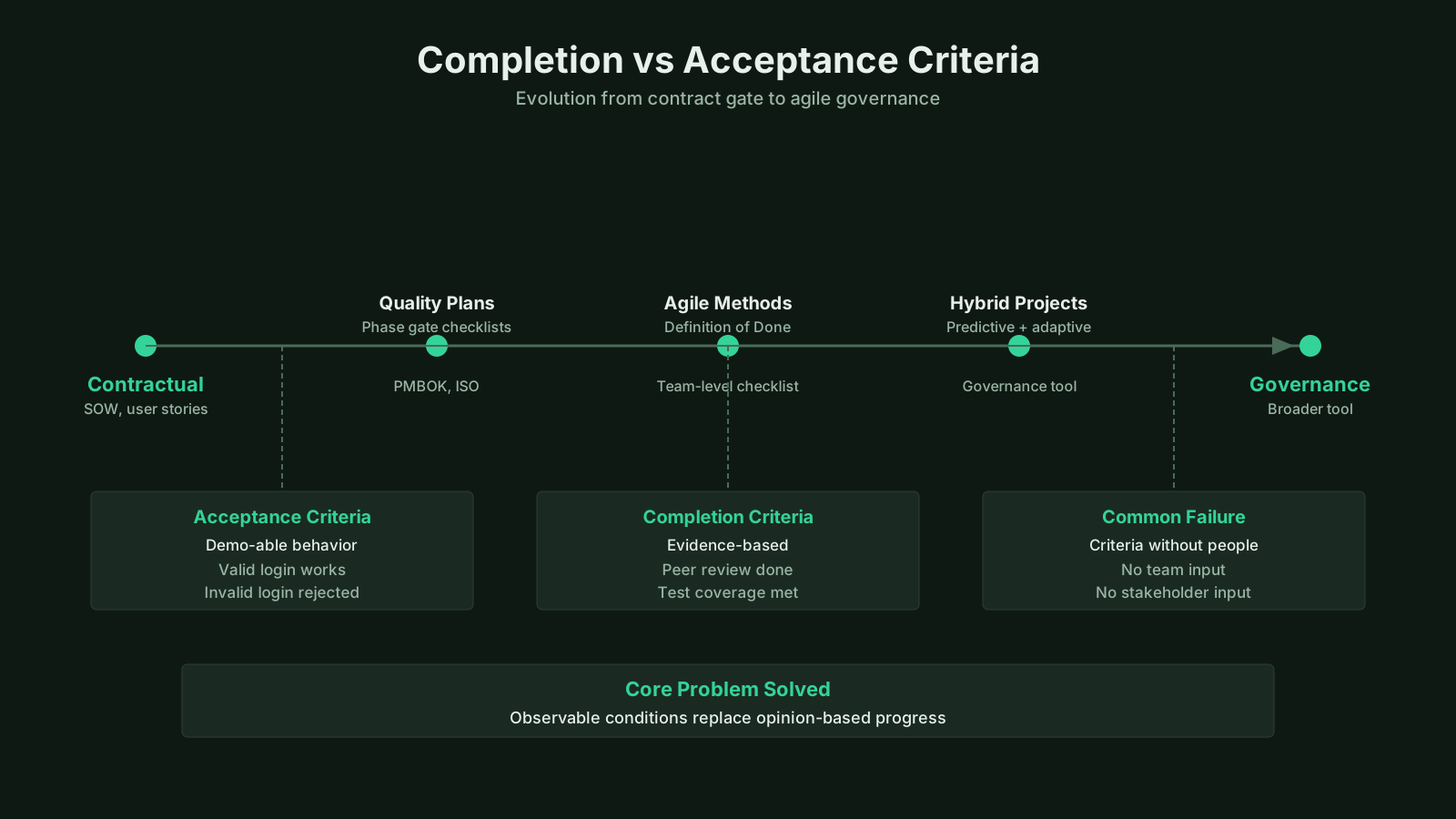
The distinction between completion criteria vs acceptance criteria is a recurring source of confusion. Acceptance criteria are the conditions a specific deliverable or product backlog item must meet before the customer or product owner accepts it. Completion criteria are broader because they include acceptance criteria plus any internal quality, documentation, transition, compliance, or administrative conditions that the organization requires for full completion.
For example, a software feature may meet its acceptance criteria because the product owner can approve the behavior in a demo. But the feature is not complete if the code has not been merged, the test suite has not run, and the release notes have not been drafted. Those additional conditions are completion criteria owned by the delivery team or the organization, not acceptance criteria owned solely by the customer.
Acceptance criteria often answer the question of whether the customer will take the deliverable. Completion criteria answer a broader question of whether the deliverable is truly ready for release, handover, or closure. In some small projects, the two sets may be nearly identical. In complex or regulated work, the completion criteria usually contain many more elements than the acceptance criteria.
Why the Difference Matters in Practice
If a team only tracks acceptance criteria, it may show a feature as accepted while significant unfinished work remains. If a team only tracks internal completion criteria, it may deliver a technically sound product that does not meet the customer's actual need. High performing teams make both layers visible. The completion criteria act as the outer boundary, and the acceptance criteria act as the customer condition nested inside that boundary.
Common Challenges and Misconceptions
Common misconceptions about completion criteria often begin with the belief that they are simply a formality. In reality, poorly defined completion criteria lead to exactly the kind of debate, rework, and delayed closure that formal project controls are meant to avoid. Another misconception is that completion criteria must be fixed at the start. In complex or exploratory projects, criteria often need refinement as requirements and technical understanding mature.
A more dangerous misconception is that finishing on schedule and within budget means the project is complete. A project can meet its time and cost constraints and still fail to meet the agreed quality, scope, or transition conditions. Completion criteria are not the same as schedule performance. Hitting the deadline does not automatically create evidence that the deliverable is done.
Some teams confuse completion criteria with success criteria. Success criteria measure whether the project achieved its broader objectives and benefits, such as increased revenue or reduced processing time. Completion criteria measure whether the project produced the agreed deliverable in an acceptable state. A project can be complete but not successful, or successful in delivering benefits even if some completion conditions were waived by the customer.
Challenges in Defining and Using Completion Criteria
The most common challenge is vagueness. Words like complete, functional, quality, and ready appear frequently but mean different things to different stakeholders. Another challenge is over specification. When completion criteria include dozens of trivial conditions, teams spend too much time documenting compliance and too little time delivering value. The criteria should be comprehensive enough to protect the product but lean enough to remain practical.
Conflicting stakeholder expectations also create problems. A technical lead may believe performance testing is required for completion, while the sponsor may believe a successful demo is sufficient. If these expectations are not reconciled early, the project will face conflict at the very moment when it should be closing. Completion criteria work best when they are co-created and approved by the people who will later verify them.
In exploratory work, fixed completion criteria can be a trap. When the problem itself is not fully understood, the team may not know in advance what good looks like. In such cases, progressive elaboration is more useful than forcing false precision. The criteria may start as high level conditions and become more detailed as the solution emerges.
Key Insights on Completion Criteria
- Completion criteria are not formalities
- Weakly specified completion criteria drive the exact disputes, rework, and delayed sign-off that formal project controls are designed to prevent, and complex projects often require criteria to be refined as technical understanding matures.
- On-time delivery does not equal completion
- A project can meet its schedule and budget while still failing agreed quality, scope, or transition requirements, so completion should be judged against deliverable standards rather than time and cost constraints alone.
- Distinguish completion from success
- Completion criteria confirm that a deliverable meets acceptance standards while success criteria measure broader business value, so a project may be complete yet unsuccessful or successful even when some completion conditions are waived, and vague wording or trivial conditions should be avoided.
Practical Application Across the Project Lifecycle
The practical application of completion criteria changes across the project lifecycle. During initiation, completion criteria are often high level and expressed in the project charter or business case. They help stakeholders understand what will exist when the project is finished. These early conditions are not as detailed as the criteria used during execution, but they set the foundation for later planning.
During planning, the project manager and team decompose high level completion expectations into measurable criteria for deliverables, work packages, and phases. These criteria are placed in the scope statement, the WBS dictionary, quality metrics, and contractual documents. At this stage, completion criteria become part of the baseline. They define what evidence will be collected and who will verify it.
During execution, completion criteria guide daily work. Team members check their output against the criteria before reporting progress. Quality control activities verify the criteria objectively. If a criterion cannot be met, the team assesses whether the work is incomplete, whether the criterion was unrealistic, or whether a change request is needed. Completion criteria are not simply a final checklist; they influence the way the work is performed.
At closing, the project manager gathers evidence against the project level completion criteria. This evidence supports formal acceptance, handover, contract closure, and lessons learned. If any criterion has not been satisfied, the project either continues, obtains a formal waiver, or documents the deviation. Closure is the moment when completion criteria become the official record of what was achieved.
Completion Criteria in Contracts and Vendor Management
In contracted work, completion criteria are often embedded in the statement of work or service level agreement. They define when a supplier has fulfilled its obligations and when payment is due. This can include delivery of a product, successful testing, training completion, documentation handover, and operational support for a specified period. The criteria must be precise because they have commercial consequences.
Vendor managers often distinguish between provisional acceptance and final acceptance. Provisional acceptance may occur when the deliverable passes initial tests. Final acceptance may depend on a stability period, warranty support, or knowledge transfer. Completion criteria support both stages. They give both parties a clear basis for measuring whether the contract is moving toward closure or is blocked by unmet conditions.
Relationship to Other Project Management Concepts
The relationship between completion criteria and project scope is particularly close. Scope defines what will be produced. Completion criteria define how the production of that scope will be recognized as sufficient. A work breakdown structure may state that a software module will be created. The completion criteria state that the module will be reviewed, tested, documented, and integrated. Scope is the what, completion criteria refine the when done.
Completion criteria also interact with quality metrics. A quality metric is a measurement used to assess a quality attribute, such as defect density or response time. Completion criteria set the thresholds for those metrics. For example, a completion criterion may state that no critical defects remain open and that response time remains below two seconds under a defined load. The metric supplies the measurement, while the criterion supplies the acceptable limit.
The concept is related to exit criteria at phase gates. Exit criteria define the conditions that must be met for a project to leave a phase and enter the next one. These often include completion criteria for the phase deliverables, but they may also include resource readiness, risk reviews, budget checks, and stakeholder approvals. Completion criteria are one part of the exit decision, not the whole decision.
Completion Criteria and the Definition of Done
The Definition of Done is an agile expression of completion criteria. It is a team level standard applied to each increment. However, the Definition of Done is not identical to acceptance criteria, and it does not replace product level acceptance. It ensures that accepted work is also technically and operationally complete. This relationship often surprises teams moving from predictive to agile methods.
Completion criteria also connect to project success criteria. Completion criteria establish that the project produced its intended output. Success criteria establish that the output created the intended impact. A customer portal may be complete according to its completion criteria, but the project may not be successful if users do not adopt it. The two sets of criteria answer related but distinct questions.
Core Insights on Completion Criteria
- Scope defines completion criteria
- Completion criteria translate the project scope into observable conditions that allow stakeholders to determine when the delivered outputs are sufficient.
- Work breakdown structure complement
- A work breakdown structure identifies the deliverables to be produced, such as a software module, while completion criteria define the quality thresholds and validation activities required before those deliverables can be accepted, including formal review, testing, documentation, and integration.
- Metrics versus criteria roles
- Quality metrics quantify attributes such as defect density or response time, while completion criteria establish the threshold values that determine whether those measurements indicate acceptable performance.
- Phase gate exit criteria link
- Exit criteria at phase gates encompass the completion criteria for phase deliverables, yet they frequently extend to broader governance checks such as resource availability, risk review outcomes, budget adherence, and formal stakeholder sign-off.
Evolution and Current Thinking
The evolution of completion criteria reflects a move from binary, phase based sign offs toward continuous, evidence based confirmation. In traditional project management, completion criteria were often checked at the end of a phase or project. The work was considered done when a board reviewed the evidence and approved documentation. This model works for defined, stable projects but creates latency in complex work.
Agile methods changed the conversation by placing completion criteria inside every sprint. The Definition of Done made completion a recurring event rather than a single final gate. Continuous integration and delivery extended this further. In DevOps environments, a change may be considered complete only when it is deployed, monitored, and verified in production. This pushes completion criteria beyond the handoff point and into operational reality.
Current thinking also recognizes that completion criteria are not always knowable in full at the start. More teams practice progressive elaboration, defining criteria at a level appropriate to the uncertainty in the work. This is not a lack of discipline; it is an acknowledgment that false precision can be as harmful as vagueness. The criteria mature as the product, technology, and stakeholder understanding mature.
Business Value-Oriented Project Management, or BVOPM, frames scope change as user feedback rather than failure. In that context, completion criteria may be treated as emergent rather than permanently fixed at baseline. This approach reflects a broader trend toward value based completion, where teams adjust the finish line to ensure the outcome remains useful to the customer. It does not mean criteria are ignored; rather, they are updated through structured feedback loops.
Current Debates
There is ongoing debate about whether completion criteria should include benefit realization or only deliverable acceptance. Some argue that a project cannot be called complete until benefits begin to appear, which would push closure far beyond the traditional handover. Others argue that benefit realization belongs to operations and program management, not project completion. Most organizations take a middle position: project completion criteria include readiness for benefit realization, while actual benefits are tracked separately.
Another debate concerns who owns completion criteria. In predictive governance, the project manager and sponsor typically own them. In agile, the team owns the Definition of Done, while the product owner owns acceptance criteria. Shared ownership is now common, but it requires clear authority boundaries. When ownership is ambiguous, completion criteria can become either too lenient or too rigid. The current best practice is not a single standard but a visible, agreed process for defining and revising the finish line as the project context demands.
