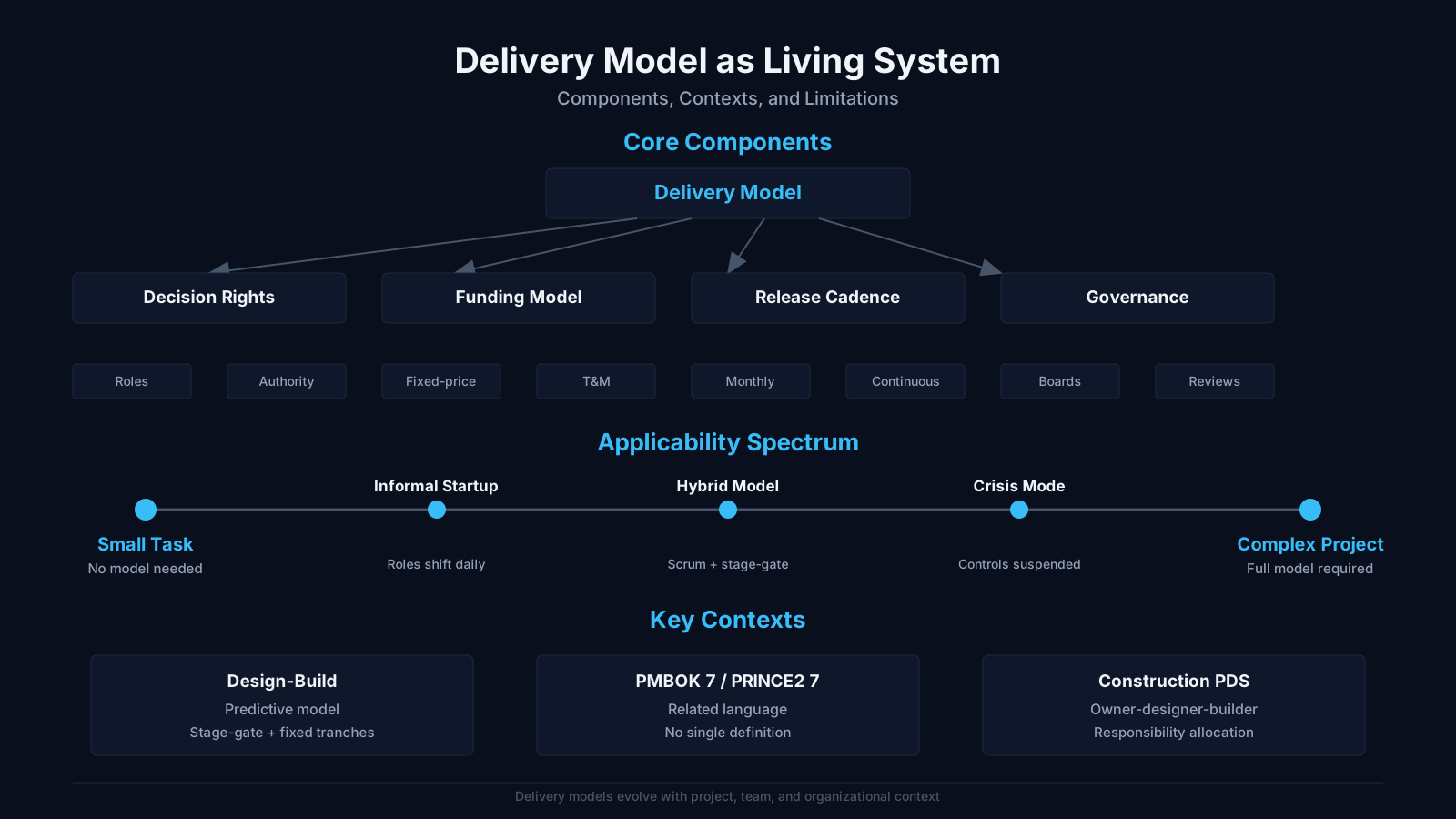
Delivery models in project management are defined as the structured configurations of lifecycle phases, development approaches, governance controls, team structures, and delivery cadence that organizations use to convert project inputs into completed outputs and beneficial outcomes. The term is broader than a single methodology and more specific than a general management philosophy. A delivery model answers how work will be sequenced, reviewed, funded, staffed, and released across the project lifespan. In practice, it sits between high-level strategy and day-to-day task execution, shaping what managers measure, when stakeholders receive value, and how changes are absorbed.
Delivery Models: Summary of Key Topics
| Aspect | Description |
|---|---|
| Delivery Models | Delivery models define how lifecycle phases, development approaches, governance controls, team structures, and delivery cadence are arranged to convert inputs into outputs and measurable business outcomes. |
| Positioning | Delivery models operate between enterprise strategy and daily execution, influencing which metrics managers track, when stakeholders realize value, and how the organization absorbs change. |
| Key Elements | Core elements include predictive or adaptive planning, decision-making protocols, delivery cadence, role authority, and the commercial and sourcing arrangements that support execution. |
| PMBOK Context | In the PMBOK Guide Seventh Edition, delivery models are addressed within the Development Approach and Lifecycle Performance Domain, focusing on cadence, development approach selection, and the rhythm of deliverable production. |
| Agile Approach | Agile frameworks implement delivery models as empirical systems driven by short feedback loops; Scrum, Kanban, and related structures each provide distinct operational patterns. |
| Governance | Governance defines the authority boundaries within a delivery model, specifying which roles may approve scope changes, allocate funding, accept deliverables, or terminate work. |
| Tools and Artifacts | Work breakdown structures, critical path schedules, user stories, backlog refinement sessions, daily coordination events, and kanban boards can be combined across delivery models to reinforce desired delivery behavior. |
| Sourcing | The commercial dimension addresses whether work is delivered by internal staff, external suppliers, or a blended team, and whether contracts are structured as fixed price, time and materials, target cost, or alternative arrangements. |
What Is a Delivery Model in Project Management?
A delivery model in project management refers to the integrated arrangement of processes, roles, controls, and cadences that determines how a project produces and hands over its outputs. Some practitioners use the term interchangeably with development approach, project delivery system, or delivery method, but the delivery model is usually understood to be the wider configuration. It includes not only whether the project follows predictive or adaptive planning, but also how decisions are made, how frequently work products are delivered, which roles hold authority, and how the commercial and sourcing structure supports execution. That breadth is what separates a delivery model from a narrower lifecycle or methodology label.
Within PMBOK, the related language appears in the PMBOK Guide Seventh Edition under the Development Approach and Lifecycle Performance Domain, which covers delivery cadence, development approaches, and the expected rhythm of deliverable production. PRINCE2 7 similarly references delivery approaches and positions PRINCE2 as compatible with predictive, iterative, adaptive, and hybrid ways of working. Agile frameworks treat delivery models as empirical systems built around short feedback loops, with Scrum, Kanban, and other structures offering different operational patterns. None of these frameworks prescribes one universal delivery model, which is a deliberate reflection of how much project context can vary.
The phrase delivery model can cause confusion because it is sometimes used narrowly in construction and software procurement to describe contractual and organizational arrangements. In project management, the term typically carries the broader meaning described above. A project might use a predictive lifecycle but an outsourced delivery arrangement, or an agile lifecycle with a fixed-price commercial structure. The delivery model is therefore not the same as the contract type, the methodology, or the organizational chart alone. It is the combination of these elements that produces the actual delivery behavior of the project.
Key Insights on Delivery Models
- Integrated configuration of practices
- A delivery model aligns processes, roles, controls, and cadences into a coherent framework that determines how outputs are produced, quality-checked, and transferred to the business.
- Broader than methodology or lifecycle
- Beyond methodology and lifecycle, a delivery model specifies decision-making authority, delivery cadence, role accountability, and the commercial and sourcing arrangements that govern execution.
- Recognized in PMBOK and PRINCE2
- PMBOK Seventh Edition frames delivery models within the Development Approach and Lifecycle Performance Domain, and PRINCE2 7 explicitly recognizes predictive, iterative, adaptive, and hybrid approaches as legitimate execution choices.
- No one-size-fits-all model exists
- Because project context varies widely, frameworks deliberately avoid prescribing a universal model, and Agile methods treat delivery as an empirical system driven by short feedback loops and continuous learning.
- Hybrid arrangements are common
- Projects frequently blend delivery styles, for example by combining a predictive lifecycle with outsourced delivery or by matching an agile lifecycle to a fixed-price commercial structure.
Key Components of Delivery Models
The key components of delivery models can be grouped into five practical dimensions that mostly determine how a project behaves. These dimensions are lifecycle structure, governance, team configuration, methodology and practices, and commercial or sourcing arrangements. A change to any one dimension can significantly alter the delivery model, even if the methodology label remains the same. Experienced project managers often find that disagreements about delivery models are not really about agile versus waterfall, but about these underlying dimensions.
Lifecycle and Delivery Cadence
Lifecycle structure describes how the work is divided into phases and how those phases relate to each other. Some models use sequential phases that must complete before the next begins. Others use overlapping or repeated cycles that produce a partial product in each iteration. Delivery cadence defines how often a usable output is released, reviewed, or deployed. A model with monthly releases produces different stakeholder feedback patterns than a model with six-month phase gates, even when both projects are governed by the same organization.
Governance, Controls, and Decision Rights
Governance determines which roles can approve scope changes, allocate funding, accept deliverables, or stop work. In a predictive delivery model, change control boards and stage gate reviews often hold formal authority. In an adaptive model, product owners and empowered teams may make many of those decisions within defined boundaries. The delivery model must align decision rights with the speed of work. A model that expects rapid iteration but also requires multiple committee approvals will create bottlenecks that no methodology can resolve.
Roles, Teams, and Organizational Structure
Team configuration defines whether people are organized into functional silos, cross-functional product teams, or temporary project teams within a matrix structure. Some delivery models rely heavily on specialized roles such as business analysts, testers, release managers, and user experience designers working in sequence. Others rely on generalist team members who can move across analysis, development, testing, and deployment activities. The structure influences communication paths and the cost of coordination, which is a central delivery model consideration.
Methodology, Practices, and Tooling
Methodology and practices include the specific artifacts, events, and techniques used to plan and execute the work. Examples include work breakdown structures, critical path schedules, user stories, backlog refinement, daily coordination events, and kanban boards. Tooling choices often follow from the methodology, but they should not be mistaken for the delivery model itself. A project can use a kanban board inside a fundamentally predictive model, or a work breakdown structure inside a hybrid model, if the overall configuration supports the intended delivery behavior.
Commercial and Sourcing Dimensions
The commercial and sourcing dimension covers whether the work is delivered by internal employees, external suppliers, or a blended team, and whether the contract is fixed price, time and materials, target cost, or another arrangement. Construction projects have long distinguished delivery methods such as design-bid-build, design-build, construction management at risk, and integrated project delivery. Software and service projects show similar variation through staff augmentation, managed services, and outcome-based contracts. A fixed-price contract often pulls a project toward a more predictive model, while a time and materials arrangement can accommodate adaptive delivery more easily.
Types of Project Delivery Models
The types of project delivery models commonly discussed in management literature are predictive, iterative, incremental, adaptive, hybrid, and continuous or lean. These categories describe different relationships among scope definition, timing, feedback, and delivery. The boundaries between them are not as clean in practice as textbook descriptions suggest. Many real projects blend elements from several types and adjust the blend as uncertainty declines or new constraints appear.
Predictive Delivery Models
A predictive delivery model, often called a waterfall model, assumes that requirements can be defined with sufficient confidence before major execution begins. Work is planned sequentially through phases such as feasibility, design, development, testing, and deployment. The model emphasizes formal baselines, change control, and comprehensive documentation. It remains common in construction, infrastructure, and highly regulated environments where late changes are costly or where safety and compliance demand early verification of design.
Iterative and Incremental Delivery Models
Iterative models produce successive versions of the same product to improve clarity or quality through repeated cycles. Incremental models deliver the product in functional portions over time. The distinction matters because iteration is about refining an incomplete understanding, while increment is about releasing a usable slice of scope. Many projects combine these patterns, delivering new increments while iterating on the design of future increments. The PMBOK Guide describes these as distinct development approach categories, though they often coexist in practice.
Adaptive and Agile Delivery Models
Adaptive models accept high levels of uncertainty and use short cycles to generate feedback that informs subsequent decisions. Agile delivery models are a subset of adaptive approaches built on values such as customer collaboration, responding to change, and working software. Scrum provides fixed-length sprints and defined roles. Kanban provides flow-based delivery with work in progress limits. Other models use combinations of timeboxes, continuous discovery, and just-in-time planning. The common thread is an empirical process in which inspection and adaptation replace detailed upfront prediction.
Hybrid Delivery Models
Hybrid delivery models combine predictive and adaptive elements within the same project or across a program. A common pattern is to use a predictive front end for business case approval and architectural planning, followed by iterative or adaptive delivery of system components. Some projects are hybrid by layer, such as predictive hardware development alongside agile software development. Others are hybrid by phase, switching from adaptive design to predictive rollout. Hybrid models are powerful, but they require explicit rules about where the predictive and adaptive boundaries sit.
Continuous and Lean Delivery Models
Continuous and lean delivery models emphasize small batch sizes, limited work in progress, fast feedback, and the removal of delays. These models originated in lean manufacturing and later influenced software delivery through continuous integration and continuous deployment. In project management, a lean delivery model often appears as a kanban-based system where approved work flows through a visual pipeline and is released when ready rather than on a fixed phase schedule. Such models suit operational support, product evolution, and environments where work arrives unpredictably.
Key Insights on Delivery Models
- Six main model categories
- The section distinguishes six primary delivery model categories that dominate contemporary management literature: predictive, iterative, incremental, adaptive, hybrid, and continuous or lean.
- Predictive waterfall approach
- The predictive model relies on stable, well-understood requirements that can be fully specified before major execution begins, then progresses sequentially through feasibility, design, development, testing, and deployment.
- Iteration versus increment distinction
- Iteration refines an incomplete or evolving understanding of the work, while an increment releases a usable slice of completed scope; projects often blend both approaches as uncertainty declines.
- Adaptive and lean patterns
- Adaptive models use short feedback cycles to manage high uncertainty, hybrid approaches combine a predictive approval front end with iterative delivery, and lean systems use kanban pipelines to release work only when it is ready.
Delivery Models in PMBOK, PRINCE2, and Agile Frameworks
Understanding delivery models in PMBOK, PRINCE2, and Agile frameworks requires respecting the different roles these frameworks play. PMBOK describes good practices and performance domains, PRINCE2 provides a process-based governance structure, and Agile frameworks offer specific operational patterns. Each framework allows multiple delivery models to be used within its boundaries. The choice of model is treated as a tailoring decision rather than a fixed requirement.
PMBOK Perspective
The PMBOK Guide Sixth Edition organized project management into five process groups and ten knowledge areas, but it did not prescribe a single lifecycle. It recognized predictive, iterative, incremental, adaptive, and hybrid lifecycles as tailoring options. The Seventh Edition shifts to performance domains and explicitly includes the Development Approach and Lifecycle Performance Domain. Within that domain, practitioners consider delivery cadence, phase structure, and the appropriate development approach for the work. PMBOK also connects delivery models to project performance by emphasizing that the model should support value delivery, stakeholder engagement, risk management, and measurement.
PRINCE2 Perspective
PRINCE2 has always separated its management processes from the technical work of producing products. That separation allows the same PRINCE2 processes to sit on top of different delivery models. PRINCE2 7 makes this even more explicit by discussing delivery approaches and encouraging tailoring. Organizations can apply PRINCE2 principles, themes, processes, and project controls while using predictive or adaptive methods underneath. PRINCE2 Agile combines the governance strength of PRINCE2 with agile delivery patterns, showing that delivery model choice and project governance are not competing concerns.
Agile Perspective
Agile is best understood as a family of delivery models and mindsets rather than one rigid system. Scrum, Kanban, Extreme Programming, and scaled approaches such as SAFe each configure roles, events, artifacts, and cadences differently. The Agile Manifesto does not define a delivery model, but its values push models toward short feedback loops, small batches, direct communication, and continuous improvement. A delivery model in an agile context is often defined by the specific framework plus the surrounding agreements about release frequency, team boundaries, stakeholder involvement, and acceptance criteria.
Purpose and Importance of Delivery Models
The importance of delivery models comes from their influence on risk, value timing, cost, and coordination. A well-matched delivery model reduces uncertainty by creating a predictable rhythm for planning, doing, reviewing, and deciding. It gives stakeholders a clear picture of when they will see outputs and how much influence they can have over evolving requirements. At the same time, it defines the limits of that influence, which is essential for maintaining control without crushing responsiveness.
Delivery models also shape measurement. A predictive model naturally focuses on milestone variance, scope completion, and cost performance against a baseline. An adaptive model focuses on velocity, cycle time, throughput, and the value of completed increments. Selecting the wrong model can make performance look deceptively good or bad. For example, a project with high uncertainty may report excellent baseline adherence while delivering a product that no longer meets user needs. Conversely, an adaptive model used for highly stable work may generate unnecessary churn and weak documentation.
At program and portfolio levels, delivery models matter because they affect consistency, resource planning, and dependency management. A program may contain individual projects using different models, but the interfaces between those projects must be designed deliberately. Portfolio leaders use delivery model choices to balance risk across the portfolio, deciding where predictive discipline is required and where adaptive exploration is acceptable. The delivery model is therefore not only a project-level concern. It is a governance and investment concern that reaches into how an organization funds and reviews work.
Key Takeaways on Delivery Models
- Core influence across dimensions
- Delivery models shape how risk is distributed, when value is realized, how cost is controlled, and how coordination is maintained across the entire initiative.
- Predictable rhythm reduces uncertainty
- A well-matched delivery model establishes a steady cadence for planning, execution, review, and decision-making, which reduces uncertainty and builds dependable delivery rhythms.
- Clear stakeholder expectations
- Delivery models clarify for stakeholders when deliverables will be available, how much influence they can exert over evolving requirements, and where the boundaries of that influence lie.
- Predictive versus adaptive focus
- Predictive models measure milestone variance, scope completion, and cost against an approved baseline, while adaptive models emphasize velocity, cycle time, throughput, and the value delivered in each completed increment.
- Portfolio-level effects and risk balance
- At program and portfolio levels, delivery model choices influence consistency, resource allocation, and dependency management, enabling leaders to balance risk exposure across the entire portfolio.
Practical Application and Use
Delivery model selection in real project environments is rarely a clean academic exercise. It happens through discussions at business case approval, project initiation, and stage boundaries, often involving sponsors, project managers, PMO staff, technical leads, procurement specialists, and key stakeholders. The model is usually documented in the project charter, project plan, or delivery approach section of governance documentation. It may be revisited when risk profiles change, when supplier arrangements shift, or when early results expose flaws in the original assumptions.
Projects with stable regulatory requirements, fixed physical constraints, or high cost of change often gravitate toward predictive models. Infrastructure builds, equipment installation, and compliance-driven initiatives typically benefit from detailed upfront design and formal change control. By contrast, digital products, customer-facing applications, and exploratory research projects often use adaptive or continuous models. These environments reward early feedback and tolerate evolving scope because the cost of change is lower and the cost of building the wrong product is high.
The selection process is influenced by several factors. Uncertainty about requirements pushes toward iterative or adaptive models. Complexity of integration pushes toward more deliberate sequencing and verification. Stakeholder availability affects how often feedback can realistically be gathered. Team distribution influences the practicality of daily coordination and rapid decision making. Contract type and vendor relationships can constrain the model or create pressure to choose a model that is incompatible with commercial incentives. Regulatory and audit requirements may demand documentation and stage gates that an adaptive model does not naturally produce. The delivery model is most effective when these factors are considered together rather than as isolated preferences for a methodology label.
Common Challenges, Pitfalls, and Misconceptions
Several misconceptions about delivery models create avoidable problems. One of the most persistent is that agile is a delivery model rather than a family of models and a set of values. Calling a project agile without specifying the operating rules, roles, cadence, and governance boundaries is not a delivery model definition. Another misconception is that predictive models are obsolete. They remain appropriate for many high-stakes physical and regulated environments. A related error is treating hybrid as a safe middle ground without defining which work streams use which approach, which can produce confusion and competing expectations.
A frequent pitfall is copying a delivery model from another organization without understanding the context that made it work. The model may succeed in one culture because decision rights, team skills, funding processes, and supplier relationships are aligned. Transplanting only the visible mechanics often fails because the surrounding system is missing. Another common failure is governance mismatch, where leaders expect rapid iterative delivery but retain approval cycles designed for phase reviews. Teams then deliver quickly only to wait weeks for decisions, and the model becomes a source of frustration rather than speed.
Contracting arrangements can also undermine a delivery model. Fixed-price contracts with detailed upfront specifications often conflict with adaptive models that expect scope to evolve. Conversely, open-ended time and materials contracts combined with predictive models can reduce pressure to define scope and control cost. Delivery models also fail when they are imposed without training or when measurement systems reward behavior contrary to the model. An adaptive model measured only by traditional milestone adherence will push managers to behave predictively even when the environment demands experimentation.
Key Takeaways on Delivery Model Errors
- Agile is not one model
- Agile is a family of models and values, so labeling a project agile without defining operating rules, roles, cadence, and governance boundaries leaves the delivery model undefined.
- Hybrid demands explicit boundaries
- Treating hybrid as a safe middle ground without specifying which work streams follow which approach creates confusion and competing expectations.
- Context determines model success
- Copying a delivery model from another organization fails when decision rights, team skills, funding processes, and supplier relationships do not align with the new context.
- Governance and contract mismatches
- Leaders who expect rapid iterative delivery while retaining phase-review approval cycles, or who combine open-ended contracts with predictive models, undermine scope and cost control.
- Wrong metrics force predictive behavior
- Measuring an adaptive model against traditional milestone adherence pushes managers toward predictive behavior even when the environment demands experimentation.
Delivery Model vs Project Lifecycle and Methodology
The difference between a delivery model vs project lifecycle and methodology is a source of regular confusion. A project lifecycle describes the stages a project passes through from start to finish, such as initiation, planning, execution, and closure, or feasibility, design, build, test, and transition. A methodology describes a specific system of practices, roles, and artifacts, such as Scrum, PRINCE2, or critical chain project management. The delivery model encompasses the lifecycle and the methodology, but also includes governance, sourcing, team configuration, and delivery cadence decisions that sit outside both.
PMBOK 7 uses the term development approach to describe whether the work is predictive, iterative, incremental, adaptive, or hybrid. That approach is one component of the delivery model. A construction project might have a predictive development approach, a design-build contract, a distinct governance board, and a monthly progress review cadence. A software project might have an adaptive development approach, an internal product team, a product owner, and continuous deployment. Both have a delivery model, but the models differ in more than their development approach.
This distinction matters because people sometimes argue about methodology when the actual problem is delivery model misalignment. Replacing Scrum with Kanban will not fix a broken governance structure or a contract that punishes change. Likewise, renaming a phase gate as a review board will not make a predictive model adaptive if the underlying decision rights and feedback cycles remain unchanged. Understanding the delivery model as the larger system helps practitioners diagnose problems at the correct level.
BVOP Perspective on Delivery Models
The BVOP delivery model selection view focuses on value delivery and flexibility rather than process conformity. BVOPM recognizes that programs can contain realization sets in which different projects use different delivery methodologies. That mirrors the modern understanding that a single enterprise-wide delivery model is often less effective than a portfolio of context-specific models. BVOPM also treats scope change as user feedback, supported by a five-level scope scale from definite to unlikely, which reduces the pressure to select an overly predictive model simply to suppress change.
Key Insights on Delivery Model Selection
- Value-driven model selection
- BVOP selects delivery models primarily to maximize value delivery and adaptability rather than to enforce strict process conformity.
- Portfolio of context-specific models
- Programs can intentionally blend methodologies across projects because context-specific approaches routinely outperform a single enterprise-wide model.
- Scope change as user feedback
- The five-level scope scale, ranging from definite to unlikely, reframes scope change as valuable feedback and reduces the pressure to default to overly predictive delivery models.
Evolution and Current Thinking
The evolution of delivery models in project management reflects a shift from universal solutions toward fit-for-purpose configuration. Early project management practice in construction and aerospace favored highly structured predictive models because physical work and safety demanded detailed design before construction. Software engineering later introduced iterative and incremental models to address the high cost of discovering requirements late. The Agile Manifesto in 2001 accelerated the spread of adaptive delivery, and subsequent years saw the rise of continuous delivery, DevOps, and product-centric team structures that further reduced the distance between building and using a product.
Current thinking emphasizes tailoring over dogma. Organizations rarely gain advantage from declaring themselves all agile or all waterfall. More common is a portfolio of delivery models, with projects assigned to models based on risk, uncertainty, regulatory exposure, integration complexity, and value urgency. The PMO may maintain reference models and decision criteria, but the expectation is that project teams will adapt those models within governance limits. Debates continue about how much customization is too much, how to compare performance across different models, and how to manage dependencies between projects using different cadences.
There is also growing attention to the human and cultural layers of delivery models. A model is not just a set of processes. It produces a set of expectations about who talks to whom, who has authority, how mistakes are handled, and what counts as progress. Organizations that treat delivery model change as purely mechanical often discover that the old behaviors persist under new labels. The more mature view is that a delivery model is a living system of agreements that must be inspected and adjusted as the project, team, and organizational context evolves.
Summary of Delivery Model Thinking
A delivery model explained as an integrated system gives project leaders a more accurate way to design and diagnose project execution than any single lifecycle or methodology label. It draws attention to the connections between planning, governance, team structure, delivery cadence, and commercial arrangements. Those connections determine whether a project can absorb change, protect quality, control cost, and deliver value at the right time. The most effective organizations use delivery models as consciously selected configurations rather than inherited habits, and they review those configurations when the evidence from delivery shows that one part of the system is working against the rest.
Key Insights on Integrated Delivery
- Integrated system over methodology labels
- A delivery model operates as an integrated system, providing project leaders with a more reliable basis for designing and diagnosing execution than any single methodology label or lifecycle stage can offer.
- Interlocking delivery components
- The interplay among planning, governance, team structure, delivery cadence, and commercial arrangements determines whether a project can absorb change without sacrificing quality, budget discipline, or timely value delivery.
- Deliberate model selection and review
- High-performing organizations treat delivery models as consciously chosen configurations rather than inherited routines, and they revisit those choices whenever evidence shows a single component limiting the performance of the whole system.