Cost-reimbursable contracts, sometimes called cost plus contracts, are a category of procurement agreement in which the buyer pays the seller for all legitimate costs incurred during the work and then provides an additional fee that represents profit. This arrangement transfers a significant portion of cost risk from the seller to the buyer, because the total price is not fixed when the contract is signed. Project managers use this contract type when the scope, schedule, or technical requirements cannot be defined with enough certainty to support a fixed-price agreement.
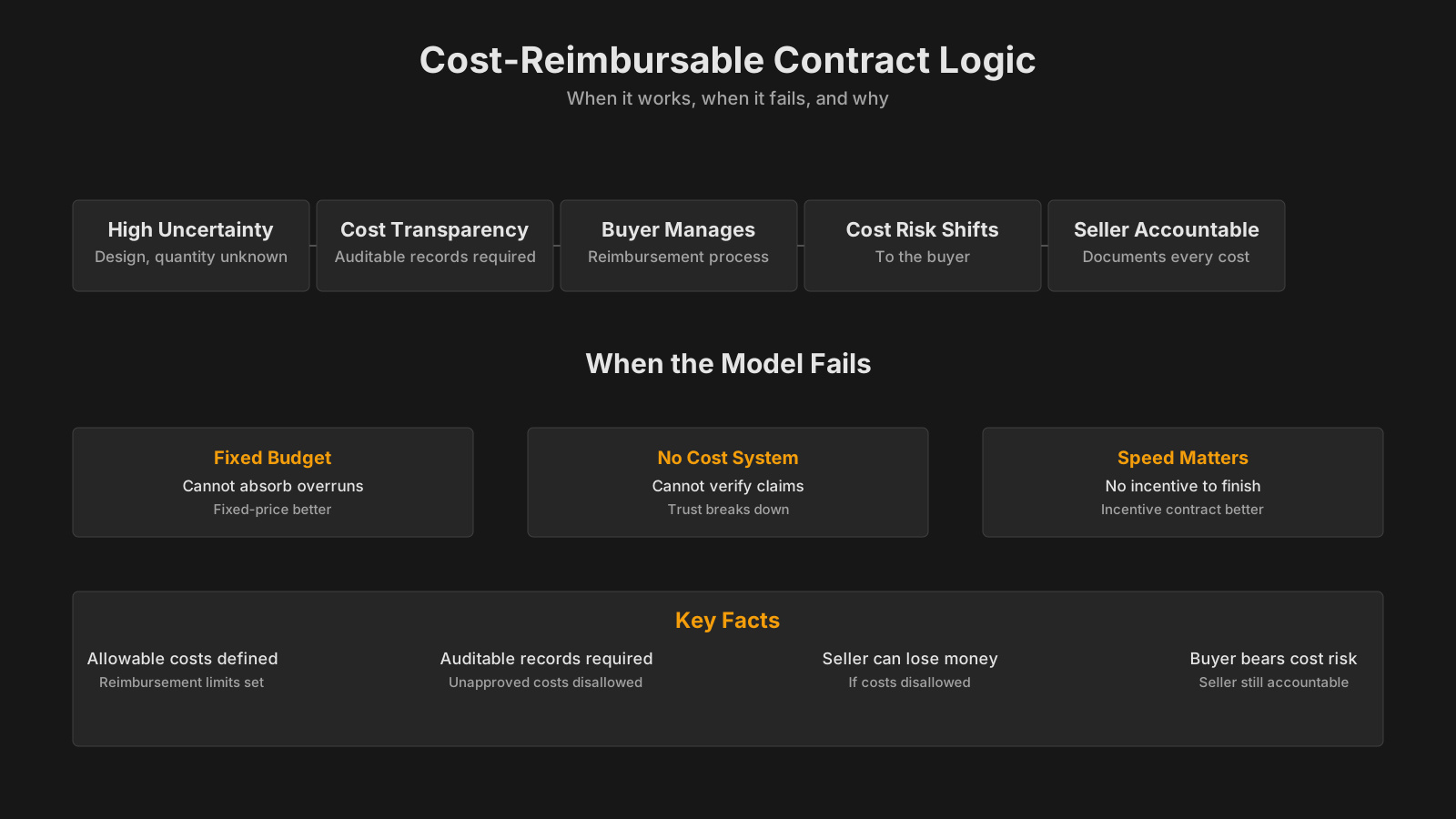
Cost-Reimbursable Contracts: Summary of Key Topics
| Contract Aspect | Professional Summary |
|---|---|
| Definition | A cost-reimbursable contract obligates the buyer to reimburse all allowable costs the seller incurs in performing the work, plus a negotiated fee that serves as profit. This structure shifts performance risk toward the buyer while giving the seller flexibility to respond to evolving requirements. |
| Use Case | Procurement professionals select this model when scope, schedule, technical specifications, or regulatory conditions are too fluid or poorly defined to support a reliable fixed-price baseline. It is especially suitable for research, development, and complex integration projects where requirements evolve during execution. |
| Cost Coverage | Reimbursable costs commonly include direct labor, materials, equipment, subcontractor charges, and approved overhead or general and administrative expenses, provided they fall within the contract's defined cost principles and allocation rules. |
| Documentation | The agreement sets allowable cost categories and mandates rigorous recordkeeping, itemized invoices, supporting receipts, and periodic cost reports. The buyer typically retains rights to audit the seller's financial records to validate claimed expenses. |
| Components | Core elements include a clear definition of allowable and unallowable costs, the fee formula or incentive structure, the reimbursement and invoicing cycle, cost accounting standards, and audit rights with escalation procedures. |
| Award Fee | Under an award fee structure, the seller's profit depends on the buyer's subjective assessment of performance against qualitative criteria such as schedule adherence, technical outcomes, responsiveness, and management effectiveness. This creates an incentive for sustained service quality rather than minimum cost compliance. |
| PMBOK View | PMBOK frames contract type selection within Plan Procurement Management, emphasizing alignment with risk appetite and statement of work clarity. During Control Procurements, the project manager reviews seller cost performance, validates invoices against contract terms, and tracks actual spending to ensure budget forecasts remain reliable. |
| Agile Hybrid | Hybrid Agile procurement arrangements often pair a cost-reimbursable base with a target cost and an incentive fee. This enables the product owner to reprioritize the backlog continuously while preserving cost transparency, earned value tracking, and shared savings or overrun adjustments. |
What Is a Cost-Reimbursable Contract?
At its core, what is a cost-reimbursable contract can be understood as a reimbursement model built on verified expenditures rather than a locked price. The buyer agrees to compensate the seller for labor, materials, equipment, subcontracting, and other legitimate project costs, as long as those costs fall within the rules established in the agreement. The seller receives the fee on top of those costs, which gives the seller a profit margin without requiring it to guess at the final price. In practice, this means the buyer accepts the financial uncertainty of the work, while the seller accepts the performance uncertainty.
A cost-reimbursable contract does not give the seller a blank check. The contract specifies which costs are chargeable and often requires the seller to keep detailed records, submit invoices regularly, and allow audits. The buyer may also retain approval rights over certain expenses, especially subcontracts or equipment purchases. The distinction between direct costs and indirect costs matters here. Direct costs, such as project labor and dedicated materials, are charged to the project. Indirect costs, such as general overhead, are allocated using an agreed rate. Disputes over indirect rates are one of the most common friction points in these contracts.
In project management literature, the term is often used interchangeably with cost plus contract, but cost-reimbursable is the broader category. The fee structure can vary, and that variation creates different incentives. Some cost-reimbursable contracts reward cost containment; others simply compensate costs and provide a fixed fee. The common thread is that the buyer pays actual costs, subject to contract rules, before profit is added.
Core Insights on Cost Reimbursement
- Reimbursement for verified costs
- Under a cost-reimbursement contract, the buyer pays the seller for allowable project costs such as labor, materials, and equipment, then adds a negotiated profit fee instead of committing to a fixed price in advance.
- Rules prevent a blank check
- The agreement precisely defines which costs are reimbursable, requires detailed records and regular invoicing, and commonly grants the buyer approval authority over subcontracts and equipment purchases.
- Broader than cost-plus contracts
- Cost-reimbursement contracts form a broader family than cost-plus contracts alone, covering variants that incentivize cost control as well as those that reimburse actual costs and pay a fixed fee.
Key Components of Cost-Reimbursable Contracts
Key components of cost-reimbursable contracts include the definition of allowable costs, the fee structure, the reimbursement process, and the audit and documentation requirements. Each component shapes how the buyer and seller behave during the project. Without these components clearly written, the contract becomes difficult to administer and prone to disagreements.
Allowable costs are the expenses the buyer will reimburse. The contract usually states that only reasonable, allocable, and allowable costs qualify. Reasonable means the cost is what a prudent person would pay in similar circumstances. Allocable means the cost benefits the project. Allowable means the cost is not specifically prohibited by the contract or applicable regulations. For example, routine travel for project staff may be reimbursable, but entertainment expenses or penalties may not be.
The fee is the seller's profit. In a fixed fee arrangement, the fee does not change with actual costs. In an incentive arrangement, the fee can rise or fall depending on the seller's cost performance. In an award fee arrangement, the fee is based on the buyer's evaluation of qualitative factors like schedule, technical quality, or responsiveness. The fee element is why these contracts are sometimes called cost plus contracts, because the buyer pays cost plus an agreed fee.
The reimbursement process requires the seller to document actual costs and submit periodic invoices. Buyers often review these invoices against the contract terms and may request supporting records. Audit clauses allow the buyer or an independent auditor to verify the seller's cost accounting system. This is especially important when the seller uses indirect cost pools or labor rates that must be reconciled against actual data.
Types of Cost-Reimbursable Contracts
Several types of cost-reimbursable contracts exist, and each alters the financial incentives in a different way. The main forms are cost plus fixed fee, cost plus incentive fee, cost plus award fee, and cost plus percentage of cost. Choosing among them depends on how much cost risk the buyer wants to retain and how much incentive the seller needs to control costs.
Cost Plus Fixed Fee
Cost plus fixed fee, abbreviated CPFF, pays the seller for allowable costs plus a fixed fee that is established at contract award. The fee does not vary with actual costs, so the seller has little financial motivation to reduce spending. However, the fee may be adjusted if the buyer changes the scope of work. CPFF is common in research and development projects where the technical approach is uncertain but the buyer wants predictable profit for the seller.
Cost Plus Incentive Fee
Cost plus incentive fee, or CPIF, includes a target cost and a target fee. Actual costs above or below the target are shared between the buyer and seller according to a share ratio. If the seller completes the work below target cost, it earns part of the savings. If costs exceed target, the seller's fee is reduced. This creates a direct financial incentive for cost control while still protecting the seller from bearing the entire overrun.
Cost Plus Award Fee
Cost plus award fee, or CPAF, pays allowable costs plus a fee based on the buyer's subjective evaluation of the seller's performance. The evaluation criteria are described in the contract, but the final fee amount is not purely formula-based. This allows the buyer to reward schedule adherence, quality, and cooperation. The drawback is that the seller faces uncertainty about the final fee, and disagreements sometimes arise over the fairness of the evaluation.
Cost Plus Percentage of Cost
Cost plus percentage of cost, or CPPC, calculates the fee as a percentage of actual costs. The higher the costs, the higher the fee. This structure creates a clear incentive for the seller to inflate spending. For that reason, CPPC is widely prohibited in public procurement and is considered poor practice in most private contracts. Project managers should recognize that a contract labeled cost-reimbursable is not automatically acceptable in this form.
Key Takeaways on Cost Contract Types
- Contract choice balances risk and incentive
- Choosing a cost-reimbursable contract type requires balancing the buyer's appetite for retaining cost risk against the seller's need for cost-control incentives.
- CPFF pays a fixed fee
- Under a Cost Plus Fixed Fee arrangement, the seller receives reimbursement for allowable costs plus a predetermined fixed fee, which offers limited financial incentive to control or reduce project spending.
- CPFF common in R&D
- Cost Plus Fixed Fee contracts are common in research and development initiatives where the technical scope is uncertain, yet the buyer seeks to provide the seller with stable and predictable profit.
- Incentive contracts share cost outcomes
- In incentive fee contracts, actual costs above or below the target are allocated between buyer and seller through a negotiated share ratio, allowing the seller to retain a portion of any savings achieved below the target cost.
- CPPC generally prohibited
- Cost Plus Percentage of Cost contracts tie the seller's fee directly to incurred costs, which encourages higher spending and is widely prohibited in public procurement as well as considered poor practice in most private contracting.
Cost-Reimbursable Contracts in Project Management Frameworks
In the PMBOK framework, cost-reimbursable contracts PMBOK are addressed primarily within Project Procurement Management. The Project Management Institute recognizes three broad families of contracts: fixed-price, cost-reimbursable, and time and materials. Cost-reimbursable contracts are chosen during Plan Procurement Management when the project team determines that a fixed-price approach would create too much risk for the seller or would result in excessive price contingencies.
PMBOK Perspective
PMBOK places contract type selection inside the Plan Procurement Management process, where the project manager and procurement team analyze the scope, risk, and market conditions. Cost-reimbursable contracts are more appropriate when the statement of work is evolving or when the buyer must retain control over technical direction. During Conduct Procurements, the buyer issues requests for proposals and evaluates bidders based on their cost realism, technical capability, and management approach. During Control Procurements, the project manager monitors the seller's cost reports, approves invoices, manages changes, and verifies that actual costs remain aligned with the contract and the project budget.
The PMBOK framework also connects cost-reimbursable contracts to project risk management. Because the buyer carries most of the cost risk, the risk register should include cost volatility, seller inefficiency, and scope growth as discrete risks. The contingency reserve may need to be larger than it would be for a fixed-price contract. Cost baseline and funding limits must be reviewed more frequently.
PRINCE2 Perspective
PRINCE2 does not prescribe specific contract types, but it does require the project board to understand the commercial approach and its effect on project controls. The contract is treated as part of the project's external dependencies and is reflected in the business case, risk register, and project plan. Cost-reimbursable contracts in PRINCE2 environments tend to require more active supplier assurance, because the seller's internal cost reporting becomes a critical control point. PRINCE2's emphasis on management by stages aligns well with incremental authorization in cost-reimbursable work, since the buyer can review progress before approving further work packages.
Agile and Hybrid Environments
Agile and hybrid delivery models complicate cost-reimbursable contracts because scope is intentionally allowed to change. A cost-reimbursable contract can support that adaptability, since the buyer is not locked into a fixed scope and the seller is not penalized for learning. At the same time, Agile's focus on frequent delivery means the buyer needs visibility into actual costs more often. Some Agile procurement arrangements combine a cost-reimbursable base with a target cost and incentive fee, allowing the product owner to reprioritize backlog items while still maintaining cost transparency. Hybrid projects may use cost-reimbursable contracts for early discovery and fixed-price contracts for later well-defined deliverables.
Purpose and Importance of Cost-Reimbursable Contracts
The purpose of cost-reimbursable contracts is to enable work to proceed when the buyer cannot define the final scope, technical solution, or cost with enough accuracy. This matters in research, advanced engineering, and complex software projects where forcing a fixed price would either scare off capable sellers or load the price with excessive contingency. The buyer essentially buys the seller's capability and effort, while retaining authority to redirect the work as new information emerges.
This contract type also encourages seller participation in difficult projects. If a competent supplier knows it will be reimbursed for justified costs and earn a reasonable fee, it may accept work it would otherwise avoid under a fixed-price model. That can expand the pool of qualified bidders. The importance extends beyond convenience: some project objectives cannot be specified in strict contract language at the outset, and cost-reimbursable contracting provides a legitimate mechanism to begin work under controlled uncertainty.
In public sector and defense contexts, cost-reimbursable contracts have long been used for experimental systems, studies, and prototype development. The buyer often has technical experts who can oversee the seller's work, which is an important condition for success. Without that oversight capability, the buyer may be better served by a fixed-price or time and materials arrangement.
Core Takeaways on Cost-Reimbursable
- Enables work under uncertain scope
- Cost-reimbursable contracts give project sponsors a viable path forward when the final scope, technical approach, or total cost remains genuinely uncertain at the outset.
- Expands pool of qualified sellers
- Reimbursing justified costs plus a reasonable fee attracts capable suppliers that would otherwise decline high risk work under fixed price contracts.
- Controlled uncertainty with oversight
- This contract type creates a legitimate way to launch experimental or prototype work while requiring the buyer to maintain technical staff who can monitor and guide the seller's performance.
Cost-Reimbursable Contracts vs Fixed-Price Contracts
Comparing cost-reimbursable contracts vs fixed-price contracts highlights the fundamental difference in risk allocation. In a fixed-price contract, the seller agrees to deliver a defined scope for a set price, absorbing most of the cost risk if the work costs more than expected. In a cost-reimbursable contract, the buyer pays actual costs and accepts that final cost may exceed initial estimates. The seller's risk is lower, but so is the buyer's certainty.
The incentive picture also shifts. A fixed-price seller has a strong financial incentive to minimize costs because every dollar saved increases profit. A cost-reimbursable seller's incentive depends on the fee structure. CPFF provides little incentive to reduce cost. CPIF and CPAF can partially restore that incentive. Buyers must therefore manage seller performance through oversight, audits, and incentive mechanisms rather than relying on the price itself.
Administrative burden is another difference. Fixed-price contracts require less cost monitoring because the seller bears cost risk, though the buyer still verifies deliverables and progress. Cost-reimbursable contracts require the buyer to review invoices, audit cost records, and confirm allowability. That administrative cost should be considered when selecting a contract type. If the buyer lacks the capacity to perform this oversight, the theoretical flexibility of cost-reimbursable contracting can become a practical liability.
Common Challenges and Misconceptions of Cost-Reimbursable Contracts
One of the most common challenges of cost-reimbursable contracts is the belief that they function as an open checkbook for the seller. That misconception can lead buyers to underfund oversight or sellers to treat all expenses as reimbursable. In reality, these contracts have strict allowability rules, documentation requirements, and audit provisions. A seller that cannot support its claimed costs risks disallowance, fee reduction, or contract termination.
Another challenge is cost growth. Because the buyer carries cost risk, early estimates are often optimistic. As the technical work unfolds, required changes, rework, and market price fluctuations can drive costs higher. Project managers sometimes confuse a cost-reimbursable contract with a blank authorization to spend above the project budget. The contract may allow cost reimbursement, but the project still has a cost baseline and funding limit. Exceeding those limits triggers the same change control and escalation processes as any other project.
A related misconception is that the seller has no incentive to perform well under a cost-reimbursable contract. Performance risk still belongs to the seller, and poor schedule or quality performance can reduce award fees, damage the seller's reputation, or lead to claims. The seller also bears the risk of disallowed costs if it fails to follow contract rules. The buyer's main challenge is to maintain enough visibility into cost and progress without micromanaging the seller.
Disputes over indirect rates, labor classifications, and subcontractor costs are common. The buyer may believe a cost is excessive, while the seller argues it is reasonable and necessary. Resolving these disagreements consumes time and can damage the working relationship. Clear definitions and a structured change process reduce these disputes, but they do not eliminate them.
Cost-reimbursable contracts are not appropriate when the scope is stable and the buyer wants price certainty. In such cases, fixed-price contracts are simpler and place cost risk on the seller. They are also less suitable when the buyer cannot commit resources to invoice review, cost analysis, and auditing. A common mistake is selecting a cost-reimbursable contract merely because the work is complex, without considering the buyer's oversight capability.
Key Takeaways on Contract Misconceptions
- Not an open checkbook
- Cost-reimbursable contracts are frequently misread as unlimited spending authority, yet they carry enforceable allowability standards, documentation mandates, and audit rights that require sellers to justify every charge.
- Buyer bears cost risk
- Because the buyer absorbs most cost risk, initial estimates are often optimistic and actual costs routinely climb as technical changes, rework, and market price fluctuations surface during performance.
- Budget limits still apply
- An overrun beyond the agreed budget does not create unrestricted spending authority and triggers the same change control and escalation reviews used in other contract types.
- Seller retains performance risk
- Schedule delays or quality failures remain the seller's responsibility and can lead to reduced award fees, reputational harm, or formal claims, even when costs are reimbursed.
Risk Allocation in Cost-Reimbursable Contracts
Risk allocation in cost-reimbursable contracts is uneven by design: the buyer absorbs most of the cost risk, while the seller absorbs performance and management risk. The seller is still expected to use efficient methods, follow the contract, and deliver the work described in the statement of work. If the seller performs poorly, the buyer may not have to reimburse costs caused by the seller's negligence or contract breach, depending on the agreement and governing law.
The buyer's cost risk can be managed through several controls. The contract should define allowable costs precisely and set limits on categories such as overtime, travel, and subcontracts. The buyer should receive regular cost reports and earned value data, if applicable. Independent audits and technical reviews provide additional assurance. From a BVOPM perspective, cost-reimbursable procurement variability is better handled through separate product risk management with quantified loss size units and dynamic filtering, rather than lumped together with other project risks. This keeps the financial exposure visible and allows the buyer to adjust controls as the cost trend changes.
Earned value management is particularly useful in cost-reimbursable contracts because it separates schedule performance from cost performance. The buyer can compare the budgeted cost of work performed with the actual cost of work performed to identify inefficiency. That data helps distinguish between higher costs caused by legitimate scope growth and higher costs caused by poor seller productivity. Without that distinction, the buyer ends up paying for waste rather than for progress.
Relationships to Other Project Management Concepts
Cost-reimbursable contracts and earned value management are connected through the need to measure performance against a cost baseline. In earned value terms, the actual cost is the seller's reimbursed cost, while the budgeted cost for work performed comes from the work breakdown structure and project schedule. A cost performance index below 1.0 in a cost-reimbursable environment may indicate seller inefficiency, but it can also reflect a scope change that has not yet been incorporated into the baseline.
The contract type also interacts with the work breakdown structure and the procurement statement of work. A well-developed WBS helps define which work packages will be performed by the seller and which will remain with the buyer. The procurement statement of work becomes the reference for determining whether a claimed cost is related to authorized work. Change requests, scope creep, and risk responses all feed into cost-reimbursable contract administration, because any change can expand the reimbursable scope.
Cost-reimbursable contracts sit alongside time and materials contracts as flexible alternatives to fixed-price arrangements. Time and materials contracts pay for labor hours and materials, with less rigorous cost allowability rules, while cost-reimbursable contracts focus on reimbursing total allowable cost plus a fee. Time and materials is often used when the buyer cannot estimate total effort but can define skill categories and hourly rates. Cost-reimbursable is used when the buyer wants to reimburse broader categories of cost and build in a recognizable profit element.
The project budget, cost baseline, and funding limit reconciliation process must account for the uncertainty of cost-reimbursable work. The buyer may need to set aside a management reserve to absorb legitimate cost growth. If the buyer cannot secure additional funding, the project manager must initiate change control, reduce scope, or adjust the contract rather than allow actual costs to drift beyond authorized limits.
Key Takeaways on Cost Contract Links
- EVM Performance Measurement Link
- Cost-reimbursable contracts link to earned value management through measurement against the cost baseline, and a cost performance index below 1.0 typically indicates either seller inefficiency or a scope change not yet reflected in the baseline.
- WBS and Scope Definitions
- A well-developed WBS and procurement statement of work establish exactly which work packages the seller is accountable for, and the statement of work becomes the authoritative reference for determining whether a claimed cost falls within authorized scope.
- Budget and Funding Reconciliation
- The project budget, cost baseline, and funding limit reconciliation must accommodate cost uncertainty, and if additional funding cannot be secured, the project manager must initiate change control, reduce scope, or adjust the contract terms accordingly.
Evolution of Cost-Reimbursable Contracts
The evolution of cost-reimbursable contracts reflects a shift from simple cost plus percentage arrangements toward more structured incentive and oversight models. Early large government and aerospace programs used cost-reimbursable contracts to attract contractors to risky development work. Over time, regulators and buyers recognized that certain fee structures, particularly cost plus percentage of cost, created perverse incentives. Modern procurement regulations generally prohibit that form and encourage fixed fees, target costs, and objective incentives instead.
Current thinking emphasizes shared risk and collaborative governance. Buyers increasingly use target cost incentives, multi-party agreements, and data-driven cost monitoring rather than relying solely on after-the-fact audits. The growth of agile and hybrid delivery has also pushed contract design toward incremental funding and outcome-based fees, even when the underlying arrangement remains cost-reimbursable. Sellers are expected to show cost transparency in real time through dashboards and integrated reporting, which reduces the need for periodic forensic reviews.
There is ongoing debate about how much oversight is appropriate. Too little oversight invites cost growth and disputes. Too much oversight erodes trust and increases administrative cost. Some practitioners argue that relational contracting principles can improve cost-reimbursable projects by aligning interests early. Others maintain that clear contractual controls remain essential because the buyer cannot rely on goodwill alone when actual costs are being reimbursed. Both views have merit, and the best approach depends on the project's complexity, the maturity of the buyer-seller relationship, and the regulatory environment.