A Cost Plus Award Fee (CPAF) contract is a cost-reimbursement contract type in project management where the buyer reimburses the seller for allowable project costs and adds an award fee determined by a subjective evaluation of the seller's performance against predefined qualitative and quantitative criteria. The award fee is not based on a preset formula tied to cost underruns or overruns, so the final fee can vary. This contract type is used when project scope is uncertain, but the buyer still wants to motivate excellence in areas like technical quality, schedule adherence, and management effectiveness.
Cost Plus Award Fee: Summary of Key Topics
| Contract Characteristic | Key Details |
|---|---|
| Contract Mechanism | A cost-plus-award-fee contract reimburses allowable costs and adds a fee determined by the government's evaluation of performance against both qualitative and quantitative criteria. |
| Optimal Use | This structure is best suited to projects with evolving scope where the buyer still wants to incentivize technical quality, schedule discipline, and strong management performance. |
| Regulatory Authority | FAR 16.405-2 provides the governing framework, permitting cost-plus-award-fee contracts when complexity or uncertainty makes objective cost or schedule incentives difficult to define in advance. |
| Historical Adoption | Defense and space agencies initially used CPAF agreements for research, system integration, and large engineering programs, after which the approach expanded into energy, infrastructure, and private sector initiatives. |
| Award Fee Dynamics | A contractor can meet budget and schedule targets yet receive a low award fee if evaluators determine the technical solution is weak or the management approach lacks responsiveness. |
| Risk Rationale | Public procurement adopted CPAF structures because high uncertainty made fixed-price or formula-based incentives impractical, giving this contract type a clearly defined role in acquisition strategy. |
| Allowable Cost Boundary | Contractors may bill for specialized engineering labor and test equipment, but costs outside the contract terms or those lacking adequate supporting documentation may be disallowed. |
| Procurement Evaluation | In PMBOK-aligned procurement, project managers evaluate scope clarity, market conditions, risk tolerance, and the ability to measure performance objectively before selecting this contract type. |
What Is Cost Plus Award Fee?
In project procurement, the Cost Plus Award Fee definition centers on a cost-reimbursement arrangement in which the seller receives all allowable costs plus a fee composed of a fixed base amount and a variable award amount. The award amount depends on how well the seller meets performance standards described in an award fee plan. Unlike a cost plus incentive fee contract, the fee is not calculated by a mathematical formula. Instead, a fee-determining official reviews performance against subjective criteria and decides the amount of award fee earned for a given evaluation period. This subjective component is the defining characteristic of the contract type.
The contract form has deep roots in United States federal procurement practice. The Federal Acquisition Regulation, specifically FAR 16.405-2, describes the cost-plus-award-fee contract as appropriate when the work is so complex or uncertain that objective cost or schedule incentives cannot be defined in advance. Government agencies such as defense and space organizations have used this structure for research and development, system integration, and large engineering efforts. Over time, the concept spread into other sectors, including energy, infrastructure technology programs, and private organizations dealing with long-duration uncertain scope.
Under a CPAF arrangement, the buyer retains significant oversight. The contractor must track allowable costs precisely, and the buyer evaluates more than cost performance. Areas often include technical quality, timeliness, responsiveness, subcontract management, and the quality of documentation. What this means in practical terms is that a project team could deliver within budget but still receive a low award fee if the evaluation panel considers the technical solution weak or the management approach unresponsive. The contract is designed to reward overall excellence, not merely financial efficiency.
Regulatory Context and Origin
The formal use of CPAF contracts emerged in government acquisition because some projects involve such high uncertainty that neither a fixed price nor a formula-based incentive is workable. In those situations, the buyer still needs a mechanism to encourage the contractor to perform beyond minimum contract requirements. FAR 16.405-2 identifies that a CPAF contract may include a base fee fixed at inception and an award fee that the contractor may earn in whole or in part during performance. The regulatory framework also emphasizes that the award fee must be sufficient to motivate excellence in quality, timeliness, technical ingenuity, and cost-effective management. This regulatory grounding gives the contract type a specific meaning in public sector procurement, though private organizations sometimes adapt the principles informally.
Key Takeaways on CPAF Contracts
- Cost reimbursement with dual fee
- Under a CPAF contract, the seller is reimbursed for all allowable costs and earns a fee that combines a fixed base amount with a variable award component tied to performance.
- Award fee set subjectively
- A fee-determining official evaluates the seller's performance against the award fee plan and exercises judgment in setting the award amount, rather than relying on a predetermined mathematical formula.
- Rooted in federal procurement
- Originally established under FAR 16.405-2 for highly complex or uncertain government work, the CPAF structure has since been adopted across energy, infrastructure, and private sector projects.
Key Components of Cost Plus Award Fee
The key components of Cost Plus Award Fee contracts include allowable cost reimbursement, an award fee pool, a base fee, evaluation criteria, and an award fee plan. Each component shapes how the buyer and seller interact across the project lifecycle. Allowable costs are those expenses defined in the contract terms, often guided by government cost principles or organizational procurement policy. The seller must account for these costs with supporting records, because reimbursement depends on the costs being reasonable, allocable, and consistent with the contract.
Allowable Costs and Reimbursement
Allowable costs in a CPAF contract typically include direct labor, materials, subcontractor costs, travel, and certain indirect costs. The buyer does not simply accept every invoice. Cost reimbursement is subject to subject to audit, contract terms, and applicable regulations. A contractor working on a complex engineering project may bill for specialized engineers and test equipment, but costs that fall outside the contract terms or are not properly documented can be disallowed. This makes cost accounting discipline a central part of project execution.
Award Fee Pool and Base Fee
The award fee pool is the total amount of award fee available over the life of the contract. It is often divided across evaluation periods so the contractor has recurring opportunities to earn portions of the fee. The base fee, when used, is a fixed amount that does not depend on subjective evaluation. It may be zero in some contracts or a small percentage of estimated cost. The base fee protects the contractor from receiving no fee at all when overall cost risk is already high, while the award fee pool retains the incentive effect.
Evaluation Criteria and Award Fee Plan
The award fee plan is the document that defines the rules of the game. It identifies evaluation periods, the criteria used to assess performance, the weight or priority of each criterion, and the officials responsible for making fee determinations. Criteria often include technical performance, schedule progress, management responsiveness, quality of deliverables, and risk communication. The plan must be clear enough to guide the contractor without becoming so rigid that it undermines the judgement-based nature of the award fee. A well-designed plan balances structure with the flexibility to evaluate performance that could not have been precisely specified at contract award.
Cost Plus Award Fee in PMBOK and Government Contracting
The Cost Plus Award Fee PMBOK connection appears in the Project Procurement Management knowledge area, particularly during Plan Procurement Management. The PMBOK Guide classifies contract types into fixed-price, cost-reimbursable, and time and materials. Cost plus award fee belongs to the cost-reimbursable family, which also includes cost plus fixed fee and cost plus incentive fee. According to PMI guidance, cost-reimbursable contracts are selected when the scope of work cannot be defined precisely enough to support a fixed-price agreement, and when the buyer is willing to accept most of the cost risk.
Contract Type Selection
In a PMBOK-aligned procurement process, the project manager and procurement team analyze scope clarity, market conditions, risk tolerance, and the ability to measure performance objectively. If the work is innovative or highly uncertain, a CPAF contract may emerge as the preferred choice. The procurement management plan then documents the contract type and the rationale for selecting it. Source selection criteria may also include the contractor's past performance under similar award fee arrangements, because the evaluation burden is higher than under simpler cost-reimbursable contracts.
Role in Procurement Documents
The CPAF structure appears in the request for proposal or invitation for tender as the proposed contract type. Offerors must understand that the fee arrangement does not guarantee a fixed profit. The buyer may also include draft award fee criteria in the solicitation so bidders can assess whether they can perform well under those qualitative expectations. During contract administration, the project manager tracks cost performance and technical progress, while the fee-determining official handles award fee decisions. This separation of responsibilities supports independence in the subjective evaluation.
Core Insights on CPAF Procurement
- Cost-reimbursable contract family
- Cost plus award fee belongs to the cost-reimbursable contract family in the PMBOK framework, alongside cost plus fixed fee and cost plus incentive fee, and it reimburses allowable costs while paying an additional fee based on performance.
- When CPAF is selected
- Project teams select CPAF when the scope cannot be defined precisely enough to support a fixed-price agreement, the buyer is willing to absorb most of the cost risk, and the work involves innovation or significant technical uncertainty.
- Solicitation and source selection
- The request for proposal includes the CPAF structure and preliminary award fee criteria, while past performance on similar award fee contracts can be used as a source selection factor.
- Contract administration duties
- During contract administration, the project manager monitors cost and technical performance, and the fee-determining official independently evaluates achievement against award fee criteria to make the final fee determination.
Cost Plus Award Fee vs Cost Plus Incentive Fee
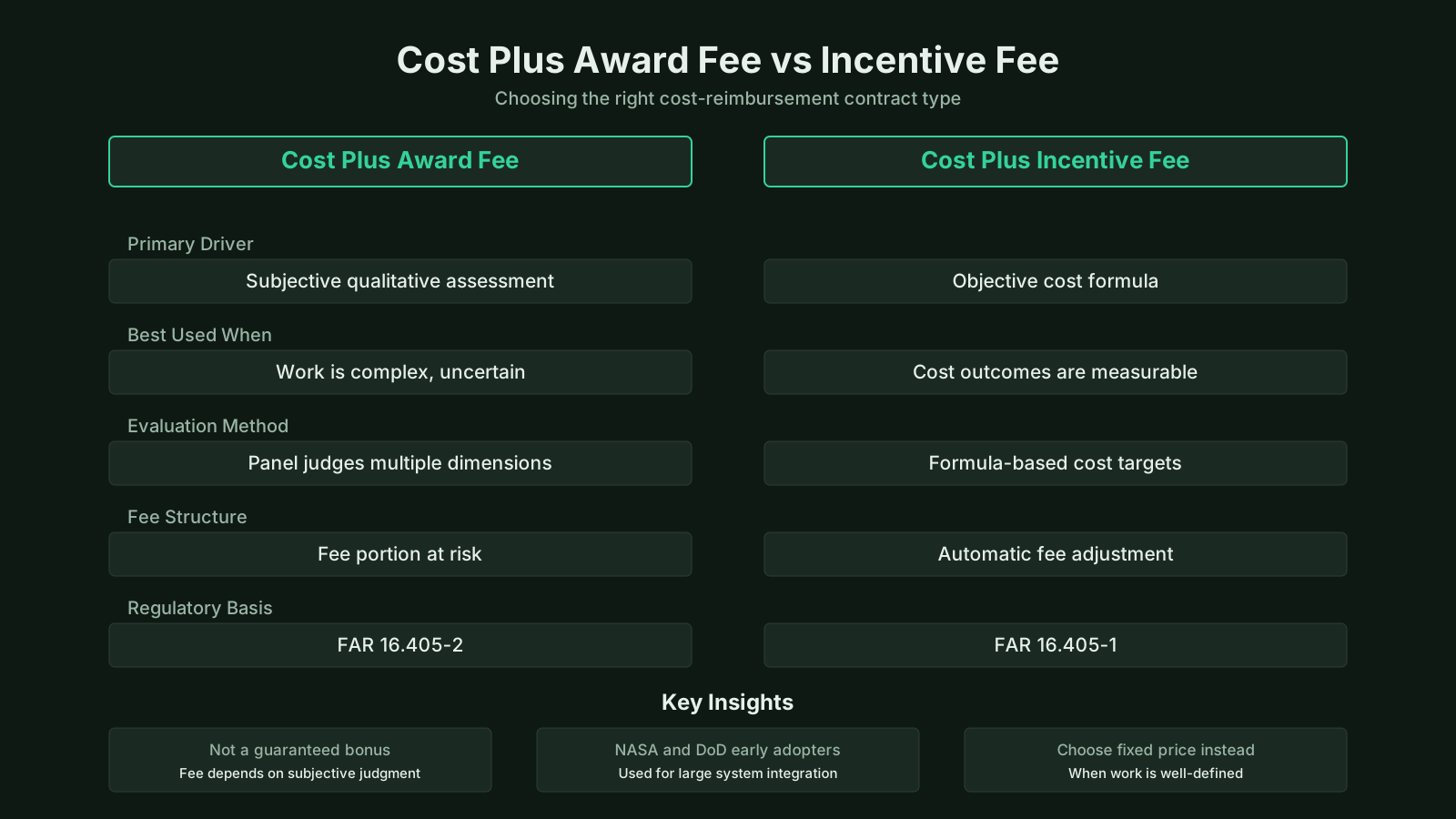
The distinction between Cost Plus Award Fee vs Cost Plus Incentive Fee is one of the most commonly misunderstood comparisons in procurement management. In a cost plus incentive fee contract, the fee adjusts according to a formula that compares actual cost to target cost, and sometimes actual schedule or technical performance to target values. The formula establishes a share ratio, such as 80/20 or 70/30, that defines how cost savings or overruns are shared. In a cost plus award fee contract, there is no formula sharing cost outcomes. The buyer determines the award fee through judgment after reviewing performance.
Different Fee Mechanisms
A cost plus incentive fee contract works well when both parties can agree on objective targets and a fair share ratio. The contractor can calculate the likely fee impact of a cost overrun before it happens. A CPAF contract does not offer that level of predictability. The contractor knows the maximum award fee pool, but not the amount that will actually be earned. This creates a different kind of pressure. Instead of focusing narrowly on cost targets, the contractor must attend to the full set of evaluation criteria, some of which may be subjective and influenced by the buyer's perception of responsiveness.
When Each Contract Type Is Used
Procurement professionals often state that CPIF is preferred when cost, schedule, or performance can be measured objectively enough to support a formula. CPAF is reserved for situations where measurement is partly subjective, such as the quality of a research result or the effectiveness of a management process. Some contracts combine features, but that increases complexity. A common mistake is to select CPAF simply because the buyer wants more control over the contractor. That control comes at a price, including high administrative burden and potential disagreements over fee determinations.
Purpose and Importance of Cost Plus Award Fee
The primary purpose of Cost Plus Award Fee is to motivate contractor performance in areas that cannot be reduced to a numerical target. Many complex projects involve trade-offs among cost, schedule, technical capability, and user satisfaction. A fixed-price contract transfers risk but provides no incentive for behavior beyond minimal compliance. A cost plus fixed fee contract removes cost risk but gives the contractor the same fee regardless of management quality. The award fee creates a structured incentive that is flexible enough to reflect nuanced buyer priorities.
Risk Allocation
In a CPAF contract, the buyer retains most of the cost risk because allowable costs are reimbursed. The contractor bears a different kind of risk: the risk of losing award fee if performance is judged inadequate. This division is useful in technically demanding work where cost estimates are unreliable but the buyer still wants to hold the contractor accountable for non-cost outcomes. The contractor does not face the financial ruin that could accompany a badly priced fixed-price contract, but it does face a meaningful revenue consequence tied to performance quality.
Motivational Effect
The motivational effect of CPAF depends heavily on how clearly the award fee plan communicates expectations. Contractors that understand what excellent performance looks like can direct resources accordingly. However, the effect weakens when criteria are vague, applied inconsistently, or changed mid-performance. The buyer must invest time in setting up a fair evaluation framework. If the contractor views the award fee as arbitrary, the arrangement can become a source of frustration rather than motivation.
Key Insights on CPAF Purpose
- Motivating non-numerical performance
- The primary purpose of a Cost Plus Award Fee contract is to provide a flexible incentive that encourages contractors to excel across cost, schedule, technical capability, and user satisfaction, all areas where performance cannot be reduced to simple numerical targets.
- Balanced risk allocation model
- Under a CPAF contract, the buyer retains most cost risk through reimbursement of allowable costs, while the contractor bears the risk of losing award fees for inadequate performance; this division protects contractors from financial ruin yet still creates meaningful revenue consequences linked to performance quality.
- Clear award fee plan essential
- The motivational impact of a CPAF contract hinges on how clearly the award fee plan communicates performance expectations, because only a well-defined plan enables meaningful accountability for non-cost outcomes in technically demanding work where cost estimates are inherently unreliable.
Fee Determination and Performance Evaluation
Understanding Cost Plus Award Fee fee determination requires separating cost reimbursement from fee evaluation. The buyer reimburses allowable costs throughout performance according to billing terms. In parallel, the buyer evaluates performance during specified award fee periods. An award fee board or fee-determining official reviews contractor performance against the award fee plan, hears the contractor's self-assessment, and assigns an award fee amount for that period. The fee is not subject to negotiation after the determination, although the contractor may receive a debriefing.
Subjectivity and Evaluation Boards
The evaluation process can involve a board made up of technical, contracting, and program representatives. The board examines evidence such as deliverable quality, schedule variance, defect trends, and the contractor's responsiveness to issues. Because the assessment is subjective, the board must document its reasoning. A contractor that misses a major milestone may still earn a portion of the award fee if the board determines that the miss was caused by factors outside the contractor's control and the contractor communicated the risk early. This flexibility is both a strength and a vulnerability of the contract type.
Fee Pool Allocation
The total award fee pool is typically divided among evaluation periods. For example, a two-year contract might have four six-month evaluation periods, with a portion of the pool available in each period. A contractor that underperforms in one period may recover in the next, as long as the pool structure permits it. Some contracts allow unearned award fee from one period to be shifted to future periods under limited circumstances, but this varies by contract. The allocation approach influences how the contractor balances short-term performance against long-term goals.
From a BVOPM perspective, award fee decisions tied to sustained business value delivery rather than short-term output can reduce the risk of rewarding activity that does not benefit the program, although many organizations still rely on traditional technical and schedule criteria.
Cost Plus Award Fee in PRINCE2 and Agile Environments
The use of Cost Plus Award Fee in Agile environments is less common but not impossible. Agile contracts often default to time and materials or target-price arrangements because requirements evolve. However, large agile programs in government or regulated industries may use a CPAF contract with award fee periods aligned to program increments or releases. In such a case, the award fee criteria might include customer satisfaction, working software quality, defect trends, and responsiveness to feedback instead of predefined fixed deliverables.
PRINCE2 Perspective
PRINCE2 does not prescribe contract types, but it emphasizes tailoring the commercial approach to project risk. In PRINCE2, an organization using CPAF would likely capture supplier performance expectations in the business case, risk register, and quality management approach. The project board would need assurance that the award fee judgments align with stage boundaries and continued business justification. Since PRINCE2 controls work through management stages, award fee evaluation periods can be mapped to those stages where the contract duration supports it.
Hybrid and Predictive Environments
Predictive projects with well-defined phases but uncertain technical outcomes are the classic fit for CPAF. Award fee periods may align with stage gates or major deliverables. In hybrid settings, a CPAF contract may cover the overall program while individual work packages use simpler mechanisms. The program manager must ensure that the award fee criteria remain meaningful when some work is being delivered through iterative cycles. If the contract emphasizes traditional documentation while the delivery team uses agile practices, the criteria should reflect value outcomes rather than process compliance alone.
Key Takeaways on CPAF Adaptability
- Agile CPAF award criteria
- In agile environments, CPAF award fee criteria are most effective when they emphasize customer satisfaction, working software quality, defect trends, and responsiveness to feedback instead of predefined deliverables.
- PRINCE2 contract tailoring
- Because PRINCE2 does not prescribe contract types, CPAF arrangements must embed supplier performance expectations in the business case, risk register, and quality management approach, and align award fee periods with management stages.
- Hybrid value-based metrics
- Predictive and hybrid projects with uncertain technical outcomes represent the classic CPAF fit, and award criteria should prioritize value outcomes over process compliance alone.
Practical Application and Use Cases
Real-world Cost Plus Award Fee examples tend to cluster in defense, aerospace, energy, and large-scale IT modernization. A government agency may use a CPAF contract for the development of a new radar system where the physics are understood but integration risks are high. The contractor receives reimbursement for labor, materials, and subcontractor costs, while the award fee depends on how well the system meets performance thresholds and how effectively the contractor manages risk and communicates issues.
Defense and Aerospace
Defense programs frequently involve long development cycles and exacting technical requirements. A CPAF contract allows the government to reimburse the contractor for necessary engineering effort without forcing an unrealistic fixed price. The award fee motivates the contractor to maintain schedule discipline and technical rigor. The evaluation board may consider test results, readiness for production, and the quality of configuration management. These programs often require earned value management reporting because the government needs insight into cost and schedule performance under a reimbursable arrangement.
Complex Engineering and IT Modernization
Large IT modernization efforts can also use CPAF contracts when the legacy environment is poorly documented and the end state cannot be specified in detail. The buyer pays for the actual work performed, while the award fee encourages the contractor to minimize business disruption and deliver incremental business value. Award fee criteria may include system availability, user satisfaction, data migration accuracy, and the timeliness of issue resolution. In such settings, the contract supports a collaborative relationship rather than an adversarial one, provided the evaluation process remains credible.
Who Uses Cost Plus Award Fee
Contract managers, procurement officers, project managers, and legal advisors are the primary users of this contract type. It appears during the planning phase when the procurement strategy is established, and it remains active through execution and closing. The project manager focuses on technical and schedule performance, while the contract manager oversees cost allowability and fee evaluation documentation. Senior leadership may be involved when award fee decisions are contested or when the contract structure must be justified to oversight bodies.
Common Challenges, Pitfalls, and Misconceptions
Several Cost Plus Award Fee challenges emerge in practice. The most common is the belief that award fee is essentially guaranteed profit. That is not accurate. A contractor can be reimbursed for all allowable costs and still receive a zero award fee for a given period if the evaluation panel judges performance unsatisfactory. Another challenge is the administrative burden. The buyer must establish an award fee plan, support an evaluation board, track performance, and defend subjective decisions. The contractor must prepare self-assessments and respond to findings while maintaining detailed cost records.
Subjectivity and Disputes
Subjectivity is the central risk in CPAF contracts. A fee determination can appear arbitrary if the evaluators do not document their reasoning. Contractors may feel that a negative evaluation was influenced by personality conflicts or shifting standards. To reduce this risk, the award fee plan should define rating levels and the evidence required for each level. Even with clear criteria, disagreements can arise because two evaluators may view the same performance differently. This is a structural feature of CPAF, not a defect to be eliminated entirely.
When Not to Use
CPAF is not appropriate when performance can be measured objectively. If cost and schedule targets can be set reliably, a cost plus incentive fee or fixed-price contract may be better. CPAF is also a poor fit for small projects with low administrative capacity. The overhead of evaluation boards and fee determinations can outweigh the motivational benefit. In addition, CPAF should not be used to avoid clear scope definition. It does not remove the need for requirements management, work breakdown structures, and progress measurement. Misusing CPAF to paper over weak scope definition usually leads to cost growth and strained relationships.
Key Insights on CPAF Contract Pitfalls
- Award fee is not guaranteed profit
- Contractors often regard the award fee as assured income, but a contractor may be reimbursed for all allowable costs and still receive a zero award fee when the evaluation panel judges performance unsatisfactory.
- Administrative burden falls on both parties
- The buyer is responsible for establishing an award fee plan, convening an evaluation board, monitoring performance, and defending inherently subjective determinations, while the contractor must prepare self-assessments and maintain detailed cost records.
- Undocumented evaluations seem arbitrary
- Fee determinations appear arbitrary when evaluators fail to document the rationale behind their judgments, which significantly increases the likelihood of disputes over the outcome.
- Perceived bias undermines evaluation trust
- Contractors may suspect that a negative evaluation was driven by personality conflicts or shifting standards, so the award fee plan should define rating levels and the evidence required for each level to reduce that risk.
- CPAF cannot fix weak scope definition
- Attempting to use CPAF to compensate for weak scope definition typically results in cost growth and strained relationships between the buyer and contractor.
Relationships to Other Contract Types and Concepts
The relationship between Cost Plus Award Fee vs cost plus fixed fee highlights the role of performance incentives. In cost plus fixed fee, the fee is established at contract award and does not change based on the contractor's performance quality, assuming the contractor performs the work. Cost plus fixed fee is simpler to administer and appropriate when the buyer does not need to motivate subjective excellence. Cost plus award fee adds a variable fee component that can rise or fall depending on evaluated performance, making it more complex but more responsive to buyer priorities.
Fixed-Price and Time and Materials
A fixed-price contract places maximum cost risk on the seller. A time and materials contract reimburses labor and materials at agreed rates but often provides no separate performance incentive. CPAF sits between these models in some respects. It reimburses costs like time and materials contracts do, but it adds a performance-based fee mechanism that fixed-price contracts partly embed through profit. This makes CPAF useful when the buyer cannot define a fixed scope but still wants formal performance incentives.
Earned Value Management and Performance Measurement
CPAF contracts often require earned value management because cost reimbursement and progress monitoring must be transparent. Earned value data helps the evaluation board assess whether cost and schedule variances are within acceptable ranges. However, the award fee determination is not directly computed from earned value indices. A favorable cost performance index does not automatically yield a high award fee, and an unfavorable schedule variance does not automatically eliminate it. Earned value informs the evaluation, but the final fee decision remains judgment-based.
Evolution and Current Thinking
Cost Plus Award Fee current thinking reflects a push toward more objective award fee criteria. Early CPAF contracts were criticized for awarding high fees regardless of demonstrable outcomes, and for creating evaluation environments that were too cosy between buyer and contractor. Modern practice encourages clearly defined criteria, calibrated rating scales, and robust documentation of the fee determination. Some agencies have moved toward rolling award fee pools that are earned across multiple periods, with unearned amounts deferred to later periods rather than lost entirely, to maintain motivation.
Shift Toward Objective Metrics
The evolution of CPAF has involved blending subjective judgment with more measurable indicators. A modern award fee plan may combine qualitative assessments with quantitative evidence such as defect density, milestone achievement, and response times. This does not convert the contract into a formula-based incentive arrangement, but it gives evaluators more concrete anchors. The challenge is to avoid making the criteria so mechanical that they lose the flexibility that justified CPAF in the first place.
Hybrid Incentive Structures
Some organizations have experimented with hybrid structures that combine a small objectively measured incentive with a larger subjective award fee. These structures attempt to capture the benefits of both approaches. A contractor may receive a formula-based adjustment for cost performance and a judgment-based award fee for technical and management quality. This increases contract complexity but can address stakeholder concerns about subjectivity. In current practice, program managers and procurement officers often debate whether the added complexity is justified by the improved incentive alignment. From a BVOPM perspective, connecting award fee decisions to business value points rather than task completion can align contractor incentives with program benefits, although widespread adoption remains limited.
Key Takeaways on CPAF Evolution
- Push toward objective criteria
- Contemporary CPAF implementations emphasize objective evaluation criteria, calibrated rating scales, and rigorous documentation to address longstanding concerns about award fees being granted without clear evidence of performance.
- Rolling award fee pools
- Several agencies have adopted rolling award fee pools that carry unearned fees into subsequent evaluation periods, sustaining contractor motivation over multi-cycle engagements instead of forfeiting those funds at period close.
- Blending judgment with metrics
- Effective award fee plans integrate structured evaluator judgment with quantitative indicators such as defect density, milestone completion, and response times, while deliberately avoiding rigid formulas that would erode the adaptability central to CPAF arrangements.