The Activity List is a foundational document in project schedule management that provides a detailed, tabulated inventory of all the schedule activities required to produce the project deliverables and accomplish the project work. It is developed during the planning phase, typically after the work breakdown structure (WBS) has been decomposed to a manageable level, and it serves as the definitive reference for building the project schedule, estimating durations, and assigning resources.
Activity List Summary: Key Topics
| Key Concept | Summary |
|---|---|
| Activity List | A structured, comprehensive inventory of all tasks needed to produce project deliverables, serving as the baseline for scheduling, resource allocation, cost estimation, and progress tracking. |
| Scope-Schedule Bridge | Translates the WBS scope into time-phased activities, enabling dependency mapping, critical path analysis, and earned value management by directly linking scope definition to schedule development. |
| Definitional Precision | Each activity is described with such clarity that multiple team leads independently arrive at identical interpretations of scope, outputs, and handoff points, eliminating ambiguity and rework. |
| Unique Identifier | A distinct activity identifier creates traceability back to the control account and WBS element, supporting accurate cost aggregation, earned value tracking, and change impact assessment. |
| Action-Oriented Descriptions | Descriptions center on executable verbs (e.g., “Pour foundation concrete”) rather than static deliverable states, ensuring clarity about the work effort, sequence, and accountability. |
| Embedded Attributes | Activities capture assumptions, constraints, resource requirements, duration estimates, costs, and dependencies either inline or as linked references, fully informing schedule logic and execution planning. |
| Procurement Integration | Vendor-executed activities are explicitly flagged and aligned with contract work breakdown structures, with testing, inspection, and handover tasks itemized to ensure seamless incorporation of external deliverables. |
| PMBOK Framework | Within PMBOK, the activity list is the primary output of the Define Activities process and forms the foundation for sequencing, duration estimation, and schedule development. |
| PRINCE2 Methodology | PRINCE2 derives activities from its product breakdown structure, groups them into work packages, and enforces a strict separation between product scope definitions and activity scheduling to support controlled delegation. |
| Agile Practice | In Agile, activity lists emerge as sprint-backlog task breakdowns, defined just-in-time for each iteration’s scope, fostering flexible execution and incremental delivery. |
What Is an Activity List in Project Management?
Within the discipline of project management, the activity list is defined as a documented compilation of the specific actions, tasks, or steps that the project team must carry out to create the project’s outputs. Each entry in the list identifies a discrete piece of work, usually at the work package level or one level below, and is framed in a way that allows accurate estimation, scheduling, execution, and control. The activity list definition in project management often confuses newcomers because the term “activity” itself can vary across methodologies, but fundamentally it remains the lowest-level work component that is scheduled and tracked.
The real utility of the list becomes apparent when you move beyond seeing it as just a to-do sheet. It acts as the bridge between the scope baseline, expressed through the WBS, and the time-related planning artifacts like the project schedule network diagram and the schedule itself. Without a properly constructed activity list, a project manager lacks the granularity needed to model dependencies, calculate the critical path, or even understand where resources are being consumed. In practice, teams that skip a thorough activity definition step often find themselves missing crucial interfacing work, underestimating integration tasks, or discovering hidden predecessor relationships only after delays have already occurred.
When a project manager sits down to create the list, they are essentially answering the question: “What exactly are we going to do, down to the smallest schedulable unit?” The answer must be precise enough that two different team leads, given the same activity description, would understand the scope, the expected outputs, and the handoff points without additional clarification. This precision is what separates a high-quality activity list from a vague collection of assignment titles.
Core Insights on Activity Lists
- Lowest-level tracked work component
- The activity list captures each discrete action the team must perform, broken down to a level where every item can be estimated, scheduled, and assigned with precision.
- Bridges scope baseline and schedule
- By translating the work breakdown structure into sequenceable activities, this list enables dependency modelling, critical path analysis, and accurate resource-loading across the project schedule.
- Requires precise activity descriptions
- Well-crafted activity statements are unambiguous enough that any experienced team lead can immediately grasp the required deliverables, handoff points, and acceptance criteria without seeking clarification.
Key Components of an Activity List
An effective activity list is never merely a collection of activity names. Key components of an activity list include a unique activity identifier, a concise but complete description of the work to be performed, and a set of associated attributes that feed into other planning processes. The identifier is more than just a numbering scheme; it creates a traceable link back to the control account and the WBS element from which the activity was derived, enabling cost aggregation and earned value management later in the project lifecycle.
The activity description itself must be verb-oriented, describing an action such as “Pour foundation concrete for section A” rather than a state like “Foundation concrete completed.” This verb-focused phrasing reinforces that activities are about the work, not just the deliverable. Alongside the description, the list should capture any assumptions about the conditions under which the work can begin, known constraints that might limit how or when it is performed, and reference to the specific work package or WBS dictionary entry that provides the full scope detail.
Beyond the core identifier and description, the activity list often carries embedded or linked data points for resource requirements, estimated durations, cost estimates, and predecessor or successor dependencies. Some organizations maintain this information directly within the activity list document; others keep it in a complementary activity attributes register and cross-reference it. In either case, the components collectively allow a scheduler to construct a logical network, perform what-if scenario analysis, and baseline the project timeline. When the list includes the responsible person or role, it also begins to function as a preliminary responsibility assignment tool, though that aspect is usually formalized through a RAM or RACI matrix later.
One often-overlooked component is the activity’s relationship to procurement and contract milestones. If certain activities will be performed by external vendors, the activity list must clearly mark those items and align their identifiers with contract work breakdown structures. Similarly, testing, inspection, and handover activities that may look trivial on paper can become major sources of delay if they are not explicitly listed with clear completion criteria.
The Activity List's Place in Project Management Frameworks
Activity List in the PMBOK Framework
In the PMBOK Guide, the activity list emerges from the Define Activities process within the Project Schedule Management knowledge area. This process takes the scope baseline, particularly the WBS, WBS dictionary, and the scope statement, and decomposes work packages into activities that can be scheduled. The PMBOK approach treats the activity list as a primary output that, together with activity attributes and a milestone list, forms the foundation for all subsequent time planning. The sequence is deliberate: define activities, then sequence them, estimate durations, and develop the schedule. The activity list PMBOK process emphasizes progressive elaboration; as more information becomes available, activities are refined and sometimes further decomposed during rolling wave planning.
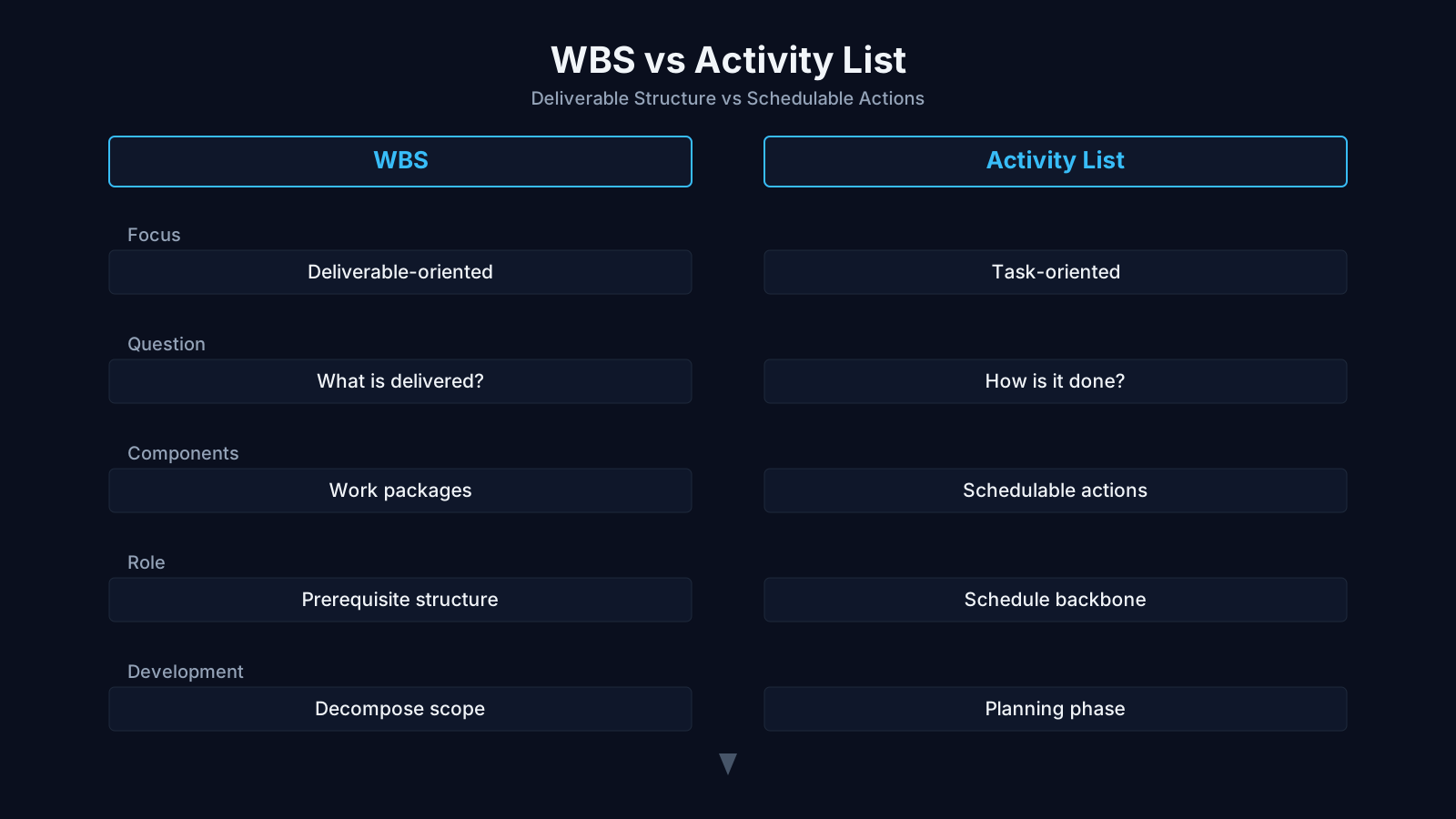
The guide also highlights that the activity list is not a standalone document but is intimately connected to the WBS and the WBS dictionary. While the WBS focuses on deliverables and what will be delivered, the activity list is entirely about how and when the work will be done. This distinction prevents the common mistake of confusing a deliverable with the activities needed to create it. A deliverable like “approved design specification” might require activities such as drafting, internal review, stakeholder review, revision, and final approval signature, and each of those must appear on the activity list.
Activity List in PRINCE2
PRINCE2 does not use the term activity list in the same prescriptive way as the PMBOK, but the concept is deeply embedded in its product-based planning technique. After creating a product breakdown structure and identifying the products, the project manager and team derive the necessary activities to build each product. These activities are then grouped into work packages, and the associated resource and time information flows into the stage plans. In this sense, the PRINCE2 approach yields an implicit activity list that is driven by products rather than by a WBS decomposition of work. Practitioners often remark that this product-first logic forces a cleaner separation between scope and schedule, reducing the temptation to inflate activities that do not directly contribute to a defined product.
Activity List in Agile Contexts
In many Agile environments, the idea of a single, up-front activity list that spans the entire project is intentionally avoided. Instead, activities are defined iteratively and just-in-time, often in the form of tasks within a sprint backlog. A user story represents a thin vertical slice of functionality, but the team still needs to identify the concrete implementation tasks such as coding a specific module, writing unit tests, and updating documentation. When a team plans a sprint, it is effectively generating a short-term activity list limited to the iteration’s scope. This granular, time-boxed list shares the same fundamental characteristics as a traditional activity list: unique identifiers (task IDs), descriptions, estimated effort, and dependencies among tasks, but it remains deliberately incomplete for future sprints. The concept of an activity list in Agile is thus more fluid, yet the core discipline of enumerating schedulable units of work persists.
From the perspective of the Business Value-Oriented Project Management methodology, the activity list sits at the intersection of planning precision and adaptable scope. BVOPM acknowledges that inaccuracies in the work breakdown structure can cascade into an incomplete or flawed activity list, so it encourages treating scope changes not as failures but as feedback, with a five-level scale from Definite to Unlikely scope items. The methodology also favors relational effort points to keep estimates realistic rather than relying on absolute precision early on, a mindset that directly influences how activities are sized and updated throughout the project.
Key Takeaways Across Project Frameworks
- PMBOK defines activities from the WBS
- In PMBOK, the Define Activities process decomposes work packages from the WBS into an activity list, which serves as the foundation for sequencing, estimating, and developing the project schedule.
- Deliverables versus activities distinction
- The WBS specifies what the project will deliver, while the activity list details the tasks and timeline required, preventing the common error of mistaking deliverables for the effort needed to create them.
- PRINCE2 uses product-based planning
- PRINCE2 derives activities from a product breakdown structure, groups them into work packages, and integrates resource and time data directly into stage plans, bypassing traditional WBS decomposition.
- Agile keeps activity lists iterative
- Agile replaces a single upfront activity list with short, time-boxed task lists within sprint backlogs, each complete with identifiers, descriptions, effort estimates, and dependencies to support iterative planning.
- BVOPM links scope and estimation
- In the Business Value-Oriented methodology, scope changes are treated as valuable feedback, and relational effort points are used to keep activity sizing realistic even as precision is still taking shape.
Purpose and Importance of the Activity List
The primary purpose of the activity list is to provide a comprehensive, unambiguous basis for all scheduling work. The purpose and importance of the activity list extend far beyond simple task enumeration; it anchors the entire time management plan. Without it, a project manager cannot logically sequence activities, cannot accurately apply duration estimating techniques, and cannot build a realistic schedule model that reflects resource constraints and dependencies. It is the raw material that feeds the project schedule network diagram and, eventually, the critical path analysis.
The list also plays a critical governance role. It becomes the checklist that functional managers, team leads, and project controllers use to verify that nothing has been omitted from the plan. During execution, it serves as the reference point for tracking progress, collecting actuals, and comparing performance against the baseline. Auditors and portfolio managers often review the activity list to confirm that the planned work aligns with the authorized scope and that no out-of-scope activities have crept in. In highly regulated industries, the activity list may even form part of the quality assurance evidence, demonstrating that all required steps were identified and completed in the correct sequence.
From a team perspective, the activity list decomposes often abstract work packages into tangible, day-to-day actions. This translation reduces ambiguity and helps individual contributors internalize what is expected of them. When the list is co-created with the people who will do the work, it surfaces hidden assumptions early: an engineer might point out that a testing activity requires a simulation environment that was not originally planned, or a procurement specialist might note that a long-lead item must be ordered well before the fabrication activity can start. These insights, captured during list development, are far cheaper to address than during execution.
Activity List vs. Other Project Documents
One of the most frequent areas of confusion is the difference between the activity list, the work breakdown structure, and the WBS dictionary. The WBS is a deliverable-oriented hierarchical decomposition of the total scope of work. It does not contain activities; it contains work packages that define the scope of a deliverable at the control point. The activity list, by contrast, decomposes those work packages further into the actions required to produce the deliverables. The WBS dictionary provides the detailed scope description, acceptance criteria, and sometimes cost and schedule constraints for each WBS element, but it stops short of listing the individual activities. Comparing an activity list with a WBS is like comparing a recipe’s ingredients with the step-by-step cooking instructions — both are necessary, but they serve distinct purposes.
Another common mix-up occurs between the activity list and the milestone list. A milestone is a significant point or event in the project, usually with zero duration, while an activity consumes time and resources. The activity list may include entries that produce or lead to milestones, but the milestones themselves are tracked separately. Similarly, the project schedule appears to contain activities, but it is actually the representation of activities against a timeline, often with assigned dates and resource loading. The activity list is more primitive: it describes what needs to be done, not when.
In organizations that use rolling wave planning, the activity list for later phases may be intentionally left at a higher level of abstraction until more detail is warranted. This creates a distinction between a fully decomposed activity list for the near-term work and a summary-level list for the far-term, blurring the line between an activity and a planning package. Nevertheless, the principle remains: every schedulable element eventually finds its way onto the list.
Essential Activity List Distinctions
- WBS Focuses on Deliverables
- The WBS organizes the project scope into a hierarchy of deliverable-oriented work packages; the activity list then decomposes those packages into the specific actions required to produce each deliverable.
- WBS Dictionary Adds Detail
- While the WBS dictionary provides scope descriptions, acceptance criteria, and cost or schedule constraints for each element, it does not break the work down into individual activities.
- Milestones Have Zero Duration
- A milestone marks a significant event or decision point with no duration, in contrast to activities that consume time and resources; therefore milestones appear as zero-duration entries on the schedule and are tracked separately from the work that leads to them.
- Schedule Adds Timeline to Activities
- The project schedule places activities on a calendar with assigned dates and resource loading, while the activity list only defines the tasks that must be performed without specifying when they occur.
- Rolling Wave Planning Effects
- Rolling wave planning defers detailed decomposition of distant work, keeping far-term items at a summary level until more information is available; this temporarily blurs the line between activities and planning packages, but every schedulable element ultimately becomes a discrete activity on the list.
Common Challenges and Misconceptions
A persistent misconception is that the activity list is simply a download of the project schedule’s task names. In reality, the list must be generated before the schedule is built and must include activities that might not even appear on the timeline in the same granular form if the scheduling tool aggregates or groups them. Another widespread challenge is the over-decomposition trap. Some teams, in an effort to be thorough, decompose work into steps so miniscule that managing the list becomes an administrative burden, with hundreds of sub-hour activities that provide no additional scheduling insight. Common misconceptions about the activity list often stem from failing to recognize the appropriate level of granularity: small enough to enable accurate estimation and assignment, but large enough to be manageable.
There is also the risk of assuming that the activity list, once created, is static. Changes in project scope, risk responses, or resource availability frequently demand that activities be added, modified, or removed. A project manager who treats the list as a one-time planning output rather than a living document will find that the schedule drifts further and further from reality. Furthermore, the activity list can inadvertently become a vehicle for gold-plating when team members insert activities that produce unrequested features or excessive documentation, bloating the schedule without adding stakeholder value.
Another challenge arises in matrixed organizations where different functional groups control their own work. The project manager may be responsible for creating the overall activity list, but functional managers may resist having their people’s time scheduled in detail. This tension can lead to activity lists that look complete on paper but lack buy-in, resulting in activities being quietly deprioritized or re-interpreted during execution. Addressing this requires early involvement of functional representatives during the Define Activities process and a clear understanding that the list is a collaborative product, not an edict.
Evolution and Current Thinking on Activity Lists
The concept of enumerating work activities is as old as large-scale construction and manufacturing, where foremen would write out the sequence of operations on a chalkboard or in a logbook. With the advent of the Gantt chart and later the critical path method in the mid-20th century, the activity list became formalized as the input to network logic diagrams. Early project management standards took a highly prescriptive approach, assuming that all activities could be defined up front in a deterministic plan. Over time, the recognition of uncertainty and complexity has softened that stance, and modern thinking accommodates progressive elaboration, rolling wave planning, and adaptive life cycles where activity lists emerge incrementally.
Current best practice encourages project managers to treat the activity list not just as a scheduling artifact but as a vehicle for team dialogue. Current thinking on activity lists emphasizes collaborative definition sessions, sometimes using techniques like planning poker adapted for tasks, to surface different perspectives on effort and risk. Software tools have also transformed the activity list from a static spreadsheet into a dynamic, linked dataset where changes in activity attributes automatically recalculate the schedule model. Still, the fundamental discipline of writing down what must be done remains irreplaceable, even when the list lives in a digital backlog management system.
Another dimension of evolution relates to integrated project controls. In advanced project environments, activity lists are now often tied directly to cost accounts, risk registers, and even environmental compliance checklists, creating a multi-dimensional view of each work item. This integration allows earned value management to be applied at the activity level, giving earlier and more precise signals of cost and schedule variance. The push toward digital twins and 4D planning in construction, for example, relies on activity lists that are geospatially and temporally linked to building information models, a far cry from the paper-based lists of the past.
Core Insights on Activity Lists
- From prescriptive to adaptive planning
- Activity lists have evolved from fully deterministic blueprints toward progressive elaboration and rolling wave planning, culminating in adaptive life cycles that effectively manage uncertainty and complexity.
- Activity lists foster team collaboration
- Leading teams now treat activity lists as a collaborative dialogue platform, using definition workshops and estimation techniques like planning poker to surface diverse perspectives on effort and risk.
- Digital tools enable dynamic activity lists
- Modern scheduling software transforms activity lists from static spreadsheets into interconnected data sets, so any update to activity attributes automatically regenerates the entire project schedule.
- Integration with broader project controls
- Mature project environments now link activity lists directly to cost accounts, risk registers, and compliance checklists, enabling activity-level earned value management and 4D planning integrated with geospatial models.
Activity List in Agile, Hybrid, and Predictive Environments
In predictive, or waterfall, environments, the activity list is a heavyweight artifact produced early and baselined. It tends to be exhaustive, covering the entire project scope, and it is maintained under formal change control. Any additional activity typically requires a change request and re-baselining of the schedule. This level of control is well-suited to projects with stable requirements and high regulatory oversight, such as pharmaceutical facility construction or aerospace system development.
Agile environments, as noted, rarely produce a single comprehensive activity list for the entire project. Instead, each iteration planning event generates a list of tasks needed to complete the selected user stories. How the activity list functions in hybrid projects is more nuanced. A hybrid team might maintain a traditional activity list for the upfront planning and high-level phase-gate milestones, while deferring detailed task identification for subsequent iterations. The initial list might include summary-level activities like “Sprint 3 development” with a placeholder duration, while the detailed task list for Sprint 3 is created during the sprint planning meeting. This dual approach preserves the governance and long-range visibility of a predictive list while preserving the adaptability of Agile practices at the execution level.
What remains constant across environments is the need to link each activity to an accountable performer, a clear completion criterion, and a logical predecessor. Whether the activity is “Install server OS on node A” in a data center project or “Write authentication API endpoint” in a software sprint, the same fundamentals apply. The toolset may differ: predictive projects might use Primavera P6 or Microsoft Project, while Agile teams use Jira or Trello, but the cognitive act of listing work is universal.
Relationships with Other Key Concepts
The activity list does not exist in isolation. Relationships between the activity list and other project management concepts create a web of dependencies that a project manager must understand to keep the plan coherent. The most direct relationship is with the work breakdown structure. Every activity in the list must trace back to a work package, and through that work package, to a control account and ultimately to the project scope statement. This vertical alignment ensures that nothing extraneous is worked on and that all scope is covered.
The activity list also feeds the activity attributes, which are the descriptive characteristics of each activity, including codes, constraints, and resource requirements. These attributes are often documented in a separate register that complements the list. From the activity list and attributes, the project team can develop the project schedule network diagram by defining logical relationships such as finish-to-start or start-to-start between activities. The list further provides the basis for estimating activity durations, either through expert judgment, analogous estimation, parametric models, or three-point estimates. Each of these processes depends directly on having a clear, well-scoped activity as the unit of analysis.
Resource management processes rely on the activity list to perform resource estimating and to load the schedule with specific named individuals or roles. Cost estimating, too, often bottoms up from activity-level estimates, with the activity list providing the granularity needed to aggregate costs accurately. In earned value management, the planned value is distributed across activities, and actual costs are collected at the activity level, making the list the operational backbone of performance measurement. When these connections break — for instance, when an activity on the list cannot be traced to a WBS element — the project’s ability to measure performance, control change, and report status degrades rapidly.
Essential Summary of Activity Connections
- WBS traceability alignment
- Each activity is linked through its work package and control account directly to the project scope statement, guaranteeing that all defined scope is addressed and no unapproved work slips into the plan.
- Activity attribute enrichment
- Alongside the activity list, a detailed activity attributes register records codes, assumptions, constraints, and resource needs, enriching each activity with the context required for precise planning and control.
- Schedule network diagram basis
- From the activity list, dependencies such as finish-to-start and start-to-start relationships are established to build a schedule network diagram that visualizes the sequence and interdependencies of project work.
- Duration estimating foundation
- Whether derived through expert judgment, analogous benchmarks, parametric formulas, or three-point estimates, credible duration estimates depend on a precisely defined activity list as the fundamental unit of analysis.
- Performance measurement backbone
- Resource estimation, cost accumulation, and earned value analysis are all performed at the activity level, so the activity list serves as the operational backbone for measuring, tracking, and controlling project performance.
Practical Application and Use
On a real project, the activity list is typically constructed during a series of planning workshops that follow the finalization of the WBS. The project manager, often with a scheduler and key subject matter experts, starts with the lowest-level work packages and asks, “What do we actually have to do to create this deliverable?” The answers are captured on a whiteboard or in a planning tool, assigned preliminary identifiers, and then refined iteratively. It is an investigative process more than a mechanical one. A work package like “site preparation completed” might explode into a dozen activities: clearing and grubbing, grading, laying erosion control, setting up temporary fencing, and so on. Each of those must find its place on the list.
During this process, practitioners often find themselves adding activities that represent project management work itself, such as conducting stage-gate reviews, distributing progress reports, or performing quality audits. While some purists argue that management activities should be covered by the project management plan and level-of-effort estimation, many organizations find it useful to list them explicitly to avoid underestimating the time senior staff must dedicate to non-technical work.
The activity list is also used as a communication tool. When presented during stakeholder reviews, it conveys the sheer magnitude of work in a way that a summary schedule often cannot. A sponsor scanning a 300-line activity list immediately grasps the complexity of what the team has signed up for, and questions about missing integration steps or overly aggressive sequencing frequently arise right then, when corrections are cheap. In program environments, the program manager uses the combined activity lists from component projects to identify cross-project dependencies, shared resources, and potential delivery conflicts.
The Activity List Through a Governance Lens
From a governance perspective, the activity list is a control document. Configuration management may apply version control to it, and audit trails track when activities were added, modified, or removed. In projects that follow stringent quality standards such as ISO 9001 or regulatory frameworks like the FDA’s design controls, the activity list serves as objective evidence that planned activities were identified, reviewed, and approved before execution began. The role of the activity list in project governance cannot be overstated; it is often one of the first documents an auditor requests when investigating a schedule overrun or a scope dispute.
Portfolio governance bodies also evaluate activity lists to determine whether a project is over-resourced relative to its expected benefits. A project with an excessively detailed list and a high number of non-value-adding activities might be flagged for re-scoping. Conversely, a project whose activity list glosses over critical integration or testing activities might be asked to detail those before receiving further funding. This use of the list as a governance instrument is a relatively recent development, fueled by the increasing availability of enterprise project management tools that aggregate activity data across the portfolio.
When projects are subject to external regulatory oversight, the activity list often must be mapped to mandated procedures or regulatory milestones. In the nuclear industry, for example, the list will explicitly reference the relevant work procedure document for each activity, creating a traceable chain from regulation to procedure to scheduled work. Failure to maintain that linkage can lead to compliance findings even if the work itself was performed correctly, simply because the planned activities were not demonstrably aligned with the required procedural framework.
Key Governance Insights on Activity Lists
- Control document for governance
- The activity list functions as a configuration-controlled document, with version histories and audit trails that objectively demonstrate all planned activities were identified, reviewed, and approved before work commenced.
- First stop for auditors
- When investigating schedule overruns or scope disputes, auditors routinely begin by requesting the activity list, as it provides the foundational record of planned work and is therefore central to project governance.
- Portfolio resourcing evaluation tool
- Portfolio governance bodies review activity lists to identify over-resourced projects burdened by non-value-adding tasks, or to demand greater detail on critical integration and testing activities before approving additional funding.
- Regulatory procedure traceability
- In highly regulated industries such as nuclear power, each activity must appear in the list with explicit traceability to mandated procedures, and the absence of such linkage can result in compliance findings despite the work being performed correctly.