In project management, customer centricity is defined as a strategic orientation that places the customer's needs, experiences, and desired outcomes at the center of every project decision, from initial scoping through final delivery and benefits realization. It is not a specific process or tool but a mindset and set of practices that align project work with genuine customer value. Unlike a narrow focus on satisfying contractual requirements, customer centricity demands continuous discovery of what actually creates value for the people who will use or benefit from the project's outputs. The concept has become increasingly important as organizations move away from purely output-based delivery toward outcome-driven value creation, a shift that resonates strongly with agile thinking and modern project management frameworks.
Understanding customer centricity requires separating it from adjacent ideas like customer service, user experience, and stakeholder management. Customer service deals with how an organization responds to customer inquiries and problems after a product or service exists. User experience focuses on the quality of interactions with a specific interface or service. Customer centricity is broader and more foundational. It shapes how a project team decides what to build, which features to prioritize, which trade-offs to accept, and how to define success. In practice, a customer-centric project team will revisit the customer's perspective at every stage gate, sprint review, and change control meeting.
Customer Centricity Key Topics at a Glance
| Key Concept | Summary |
|---|---|
| Core Definition | Customer centricity in project management is the deliberate alignment of project objectives, scope, quality standards, and benefit metrics with both the stated and unstated needs of customers and end users. |
| Value Creation Focus | Rather than only satisfying contractual requirements, customer centricity requires continuous discovery of what truly creates value for the people who use the project's outputs. |
| Outcome Orientation | The concept has gained prominence as organizations shift from output-based delivery to outcome-driven value creation, reflecting agile principles and modern delivery frameworks. |
| Operational Practices | It is operationalized through early and frequent customer involvement, empathy-based requirements elicitation, and customer outcome metrics rather than purely technical delivery metrics. |
| Needs Discovery | Teams use interviews, observation, journey mapping, and iterative delivery to reveal underlying needs that may differ from what customers initially request. |
| Enabling Tools | Journey maps, personas, and requirements traceability matrices help ensure every scope element is tied directly to a customer need. |
| Critical Insight | Large volumes of survey data do not guarantee genuine insight when the wrong questions are asked or when responses are filtered through internal biases. |
| Delivery Model Variations | In agile projects, product owners represent the customer voice and users provide feedback during sprint reviews; in predictive projects, co-creation occurs through design sessions, prototyping, and usability-focused user acceptance testing. |
What Is Customer Centricity?
Customer centricity refers to an organizational and project-level orientation where the customer is the primary reference point for decision-making, planning, and performance evaluation. In project management, this orientation manifests through practices such as early and frequent customer involvement, empathy-driven requirement elicitation, and the use of customer outcome metrics rather than purely technical delivery metrics. A practical customer centricity definition in project management goes beyond treating the customer as a passive recipient of deliverables and instead positions the customer as an active participant in value creation.
What this really means in day-to-day project work is simple to state but difficult to sustain. A project team might believe it is being customer-centric because it conducts surveys and tracks satisfaction scores. True customer centricity asks a harder question: does every requirement trace back to a specific customer need or desired outcome? If a requirement exists only because an internal stakeholder wants it, or because a technical architecture makes it convenient, that requirement is not automatically customer-centric. Many projects fail not because the team built the wrong thing technically, but because the team built exactly what was specified in a document that nobody had validated against real customer behavior for months.
Another important nuance is that customer centricity does not mean giving the customer everything they ask for. Customers often cannot articulate what they need until they see a prototype or experience a broken process. A customer-centric project team uses structured discovery techniques, including interviews, observation, journey mapping, and iterative delivery, to surface underlying needs that may differ from stated wants. This makes customer centricity a disciplined practice, not a populist approach to requirements gathering. It requires analytical rigor, facilitation skill, and a willingness to challenge both the customer and the sponsoring organization when assumptions are unverified.
Customer Centricity Definition in Project Management
Within the context of project, program, and portfolio management, customer centricity is defined as the systematic alignment of project objectives, scope decisions, quality criteria, and benefit measures with the explicit and latent needs of the customer or end user. The PMBOK Guide, particularly the Seventh Edition, frames this through the principle of focusing on value. Value, in that framework, is determined not by the project team but by the stakeholders who will use or benefit from the project's outcomes. Customer centricity operationalizes that principle by making customer value the primary filter for prioritization and trade-off decisions.
In predictive environments, customer centricity often appears during requirements definition and scope validation. Business analysts and project managers use tools like customer journey maps, personas, and requirements traceability matrices to ensure that every scope element connects to a customer need. The critical difference between traditional requirements management and customer centricity is that the latter treats requirements as hypotheses to be validated rather than fixed statements to be executed. This hypothesis-driven framing is a hallmark of more mature customer-centric practices, regardless of delivery methodology.
Customer Centricity vs Customer Service
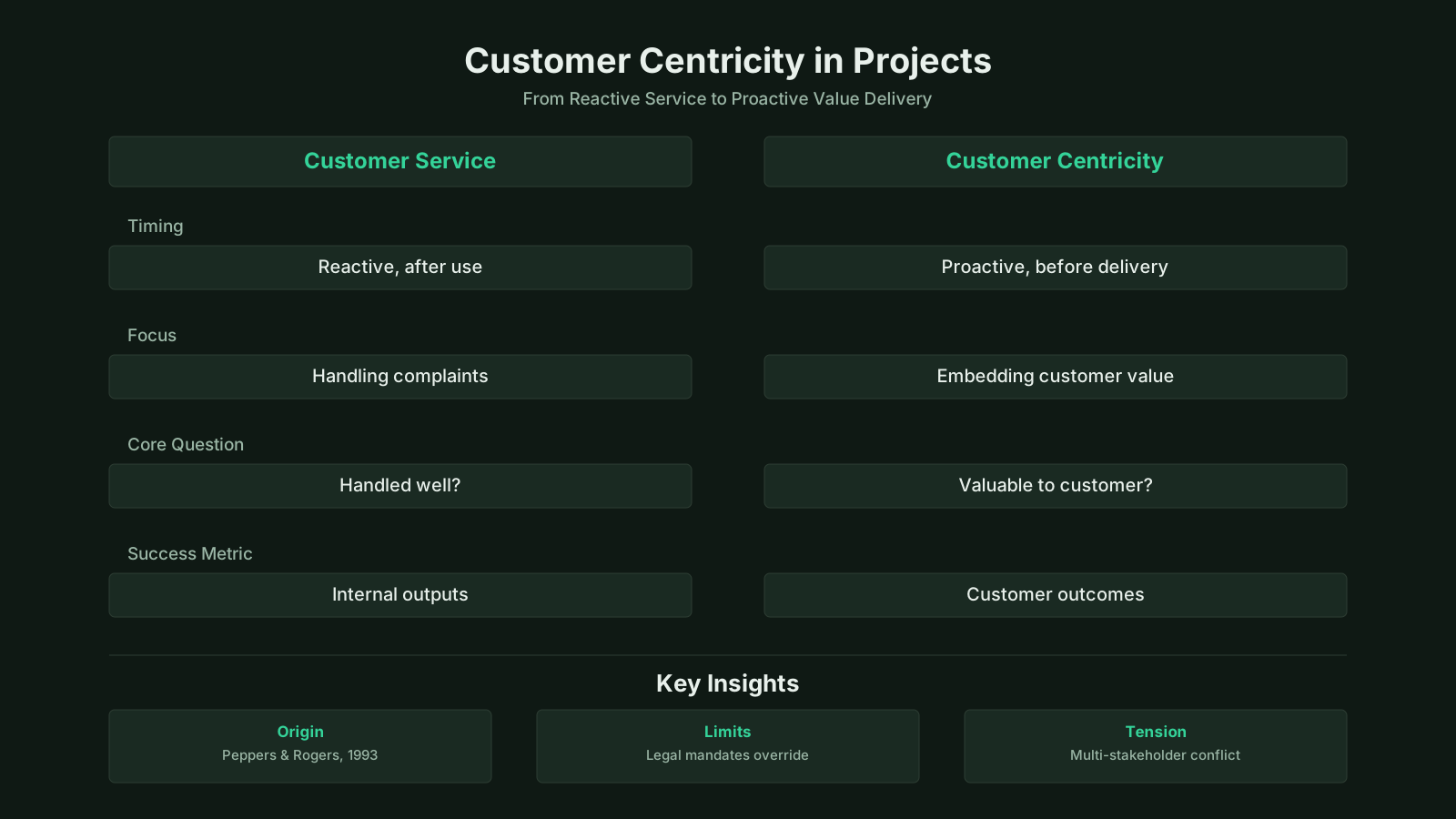
A common confusion in project teams is treating customer centricity as a synonym for customer service or client satisfaction management. Customer service is reactive and transactional. It occurs when a customer contacts the organization with an issue and expects resolution. Customer centricity is proactive and strategic. It influences what the project creates before any service interaction exists. A project can deliver stellar customer service after launch and still fail as customer-centric if the product does not solve a meaningful problem or fit into the customer's actual workflow.
Similarly, customer centricity differs from stakeholder management, though the two overlap significantly. Stakeholder management involves identifying, analyzing, and engaging all parties who can affect or be affected by the project. Customer centricity focuses specifically on the stakeholder group whose needs define the ultimate value of the project's outputs. In many projects, the customer and the sponsor are different people. The sponsor may prioritize budget and schedule, while the customer prioritizes usability and functionality. Customer centricity does not ignore the sponsor, but it insists that sponsor constraints be resolved in ways that do not silently degrade customer value.
Key Takeaways on Customer Centricity
- Customer as primary reference point
- Customer centricity at the organizational and project level establishes the customer as the central reference for decision-making, planning, and performance evaluation, treating them as active participants in value creation rather than passive recipients of deliverables.
- Requirements must trace to customer needs
- True customer centricity requires every requirement to trace back to a specific customer need or desired outcome; projects frequently fail when teams deliver exactly what was specified without validating those specifications against real customer behavior.
- Systematic alignment in project management
- In project management, customer centricity means systematically aligning project objectives, scope decisions, quality criteria, and benefit measures with both explicit and latent customer needs, using tools such as journey maps, personas, and requirements traceability matrices.
Key Components of Customer Centricity
The key components of customer centricity in project management include customer insight, value co-creation, feedback loops, outcome-based measurement, and cross-functional collaboration. Each component reinforces the others. Customer insight provides the raw material for understanding needs. Value co-creation shifts the customer from a passive recipient to an active partner. Feedback loops close the gap between assumption and reality. Outcome-based measurement replaces vanity metrics with evidence of real behavioral or economic change. Cross-functional collaboration ensures that customer perspective is not siloed in a marketing or UX team but permeates every technical and business decision.
Customer insight is not merely data collection. Many project teams gather large volumes of survey data and still lack genuine insight because they ask the wrong questions or interpret responses through internal biases. Effective customer insight requires direct observation of customer behavior, not just self-reported preferences. When a project manager observes a customer struggling to complete a task with an existing system, that observation often reveals more than a dozen survey questions. In project management, this insight feeds into the product backlog, work breakdown structure, and acceptance criteria.
Value co-creation is a concept borrowed from service-dominant logic and increasingly applied in project settings. It recognizes that customers do not simply consume value after a project finishes; they participate in defining and refining that value throughout the project lifecycle. In agile projects, this manifests as product owners who represent the customer voice and sprint reviews where actual users provide feedback on working increments. In predictive projects, co-creation may occur through joint application design sessions, prototyping workshops, or formal user acceptance testing that goes beyond checking requirements to assess real-world usability.
Customer Insight and Segmentation
Customer insight depends on effective segmentation, which is the practice of grouping customers based on shared needs, behaviors, or contexts rather than simple demographic categories. A project team working on an internal system may discover that managers and frontline staff have fundamentally different needs, even though both are called end users. Segmenting these groups prevents the project from optimizing for the loudest or most politically powerful segment while ignoring the segment that will use the system daily. In portfolio management, segmentation helps align projects with the customer groups that create the most strategic value for the organization.
Segmentation also enables more precise requirement prioritization. A feature that is critical for one customer segment may be irrelevant or even harmful for another. Without segmentation, teams often fall back on averaging customer preferences, which produces a product that satisfies no one fully. Practitioners often observe that the most difficult part of customer centricity is admitting that some customer segments must be deliberately underserved or excluded to deliver excellence to the target segment. This is a strategic choice that many organizations avoid making, and project scope suffers as a result.
Value Co-creation and Feedback Loops
Feedback loops are the operational engine of customer centricity. They convert static customer insight into continuous learning. A well-designed feedback loop includes a mechanism for capturing customer reactions, a cadence for reviewing that input, and a decision rule for incorporating it into scope or design adjustments. In Scrum, the sprint review is a formal feedback loop, but customer centricity requires more than showing a demo and asking if people like it. Effective feedback probes specific behavioral questions: Would you use this to complete your work? What prevents you from adopting this now? What would you stop doing if we built this?
Value co-creation through feedback loops can be uncomfortable for project managers because it introduces uncertainty. A customer may provide feedback that invalidates a requirement that was approved months earlier. In traditional change control processes, this often triggers a formal change request and schedule impact analysis. Customer-centric organizations treat such feedback as information that improves the project's value proposition, not as an interruption to be managed. The challenge is balancing responsiveness with governance. A project that changes direction with every piece of feedback becomes chaotic, while a project that resists all feedback becomes irrelevant.
Customer Centricity in PMBOK and PRINCE2
Customer centricity is not named as a distinct knowledge area in the PMBOK Guide, but its principles are embedded across multiple processes and performance domains. The Seventh Edition's project management principles, especially focus on value, stakeholder engagement, and systems thinking, collectively describe what customer centricity looks like in practice. Focus on value requires the project team to continuously assess whether deliverables will produce the intended outcomes and benefits for the customer. Stakeholder engagement demands active collaboration with customers rather than one-way communication. Systems thinking recognizes that customer value is created not in isolation but through interactions among people, processes, technology, and context.
The integration of customer centricity in PMBOK and PRINCE2 can be seen in how each framework handles requirements, business justification, and quality. In the PMBOK's Collect Requirements process, tools like interviews, focus groups, and facilitated workshops are inherently customer-centric when they prioritize discovery over confirmation. The Validate Scope process is a formal checkpoint for customer acceptance, but a customer-centric project manager does not wait until the end of a phase to validate scope. Validation becomes continuous through prototypes, minimum viable increments, and routine demonstrations.
PRINCE2 Focus on Products and Business Case
PRINCE2 offers a distinctive contribution to customer centricity through its principle of continued business justification and its focus on products. Continued business justification means that at every stage boundary, the project board must confirm that the project remains viable and aligned with customer value. This is a governance-level expression of customer centricity because it forces periodic re-examination of whether the project's expected benefits still matter to the customer. A project that drifts from customer needs should, in principle, be stopped or re-scoped, even if it is on time and on budget.
The focus on products in PRINCE2 also supports customer centricity. PRINCE2 distinguishes between specialist products, which are the deliverables the customer will use, and management products, which are documents the project team produces to manage the work. Product descriptions include quality criteria that should be traceable to customer requirements and acceptance criteria. A customer-centric PRINCE2 project invests significant effort in creating clear, testable product descriptions because ambiguity in product quality is a major source of customer dissatisfaction.
Agile Manifesto and User Stories
Agile methodologies place customer centricity at their core. The Agile Manifesto's first value is individuals and interactions over processes and tools, and its principles explicitly state that the highest priority is to satisfy the customer through early and continuous delivery of valuable software. The use of user stories, which follow the format of "as a role, I want a capability, so that I gain a benefit," forces the team to articulate the customer value of every backlog item. This format makes customer value a visible, discussable attribute of each requirement rather than an implicit assumption.
In Scrum, the product owner is the designated voice of the customer, but customer centricity in mature agile teams goes beyond a single role. The entire team engages with customers through sprint reviews, usability testing, and direct observation of work in progress. Extreme Programming practices such as on-site customer and pair programming further embed customer perspective into daily work. Kanban teams often use service level expectations and workflow visualization to understand how delays affect customer value delivery. Across agile frameworks, the unifying theme is that customer feedback is not a phase at the end of the project but a continuous input to every iteration.
Core Insights on Customer Centricity
- PMBOK embeds customer focus
- The PMBOK Guide treats customer centricity as an implicit principle rather than a standalone knowledge area, weaving customer-focused considerations into processes, performance domains, and tailoring decisions.
- Value focus drives outcomes
- The Seventh Edition's principle of focus on value requires project teams to continuously evaluate whether deliverables will generate the intended outcomes and benefits for the customer, not simply meet scope and schedule targets.
- Systems thinking shapes value
- Systems thinking reveals that customer value emerges from the interactions among people, processes, technology, and context, so optimizing any single element in isolation rarely improves the whole experience.
- PRINCE2 governance rechecks value
- Continued business justification in PRINCE2 compels the project board to reassess viability and customer value alignment at each stage boundary, preventing projects from drifting away from their original benefit rationale.
- Clear product descriptions matter
- A customer-centric PRINCE2 project invests in clear, testable product descriptions because vague quality criteria routinely produce rework, disputes, and customer dissatisfaction.
Customer Centricity in Agile, Hybrid, and Predictive Environments
The expression of customer centricity in agile and predictive environments differs in mechanism but not in underlying intent. Agile environments use short feedback cycles, iterative delivery, and empirical process control to adapt to customer needs quickly. Predictive environments rely on upfront analysis, formal change control, and stage gate reviews to manage customer requirements. Hybrid environments blend the two, often using predictive planning for high-level scope and agile iterations for detailed feature definition. In all three, customer centricity requires the same fundamental commitment: customer value must be measured, discussed, and protected.
Agile environments are naturally more adaptable to customer feedback because change is expected and planned for. The product backlog is a living artifact that continuously re-prioritizes work based on customer input. However, agile does not automatically guarantee customer centricity. A team can execute perfect sprints and deliver exactly what the product owner requested, only to discover that the product owner was disconnected from actual end users. The role of the product owner is only as good as the customer insight behind it. Customer centricity in agile requires direct access to real customers, not just a proxy.
Predictive Environments and Formal Validation
Predictive or waterfall environments often struggle with customer centricity because the sequential nature of the lifecycle separates requirements definition from delivery by months or years. During that gap, customer needs can change, assumptions can become stale, and the project team can lose sight of the original customer outcome. The formal Validate Scope process, typically performed at the end of a phase or project, is supposed to confirm customer acceptance, but by then the cost of change is high. Customer-centric predictive projects mitigate this risk by incorporating early prototypes, mockups, and design reviews well before final validation.
One misconception is that customer centricity requires abandoning predictive planning altogether. That is false. Predictive governance can be highly customer-centric when the customer's needs are stable, well-understood, and regulated. Construction projects, for example, have extensive customer involvement during design but limited tolerance for change during physical construction. Customer centricity in such projects means investing heavily in design validation and stakeholder alignment early, because the cost of misunderstanding the customer is enormous later. The discipline is not about being agile or predictive; it is about aligning the approach with the nature of customer value uncertainty.
Hybrid Environments and Tailoring
Hybrid environments offer perhaps the most practical path to customer centricity for many organizations. They allow the project team to use predictive planning for fixed constraints like regulatory compliance, infrastructure dependencies, and contractual milestones, while using agile iterations for customer-facing features and user experience design. This tailoring respects the reality that not all project work benefits equally from rapid feedback. Some work, such as data migration or security hardening, may have little direct customer visibility but is essential for customer value to be realized safely.
The difficulty in hybrid environments is maintaining a consistent customer-centric narrative across different delivery modes. When one part of the project follows a fixed plan and another part iterates based on feedback, communication and integration challenges arise. Customer centricity provides a common reference point for resolving these tensions. When a conflict occurs between a fixed milestone and a newly identified customer need, the project team can evaluate the trade-off explicitly rather than defaulting to schedule pressure. This explicit evaluation is the essence of customer-centric decision-making.
Purpose and Importance of Customer Centricity
The importance of customer centricity in projects lies in its direct connection to benefits realization and long-term organizational value. Projects are temporary endeavors, but their outputs are intended to produce lasting outcomes. A project can meet every constraint of time, cost, and scope and still be judged a failure if customers do not adopt the deliverable or if the expected business value does not materialize. Customer centricity reduces this risk by keeping the project anchored to the reason it was funded in the first place: to solve a customer problem or exploit a customer opportunity.
Beyond risk reduction, customer centricity accelerates decision-making. When a project team has a clear understanding of customer value, prioritization becomes faster and more defensible. A request for a new feature can be evaluated against its expected impact on customer outcomes rather than debated based on internal politics or technical convenience. This reduces the frequency of scope creep driven by the loudest stakeholder and increases the likelihood that the project will deliver something people actually use. Organizations that practice customer centricity consistently report fewer rework cycles and higher stakeholder satisfaction, though these benefits are not automatic and require deliberate cultivation.
Why Customer Centricity Matters for Project Success
Project success is increasingly measured not by the traditional iron triangle alone but by the realization of intended benefits. Customer centricity matters because it provides the connective tissue between project deliverables and those benefits. A deliverable is only valuable if someone uses it to achieve an outcome. If a project delivers a new claims processing system that is technically elegant but forces claims adjusters to change their workflow in ways that increase their workload, the project will fail to deliver value, even if all specifications were met. Customer centricity would have surfaced that workflow conflict during design, not after rollout.
Practitioners often observe that the most expensive phrase in project management is "the customer will adapt." When teams assume that customers will change their behavior to accommodate a new product, they are gambling with the project's value proposition. Sometimes customers do adapt, especially when the new solution offers overwhelming advantages. But more often, resistance, workarounds, and low adoption rates follow. Customer centricity treats the customer's current behavior as important evidence about how value is actually delivered, not as an obstacle to be ignored.
Impact on Benefits Realization
Benefits realization management is the discipline of ensuring that projects deliver the intended business value. Customer centricity is a prerequisite for effective benefits realization because benefits are defined from the customer's or user's perspective. A benefit like "reduced processing time" is not an internal efficiency metric if it does not translate into a better customer experience or lower customer cost. Customer-centric projects define benefits in terms of observable customer outcomes and then track those outcomes after delivery. This post-delivery tracking closes the loop that began with customer insight during project initiation.
Without customer centricity, benefits realization often becomes a paperwork exercise. The project team hands over the deliverable and the business case gets filed away. The benefits owner may or may not track whether the promised value was achieved. Customer centricity insists on accountability for customer outcomes long after the project is formally closed. This does not mean the project team is responsible for operational results forever, but it does mean that the project's design assumptions about customer behavior should be validated during early operational use. When those assumptions prove wrong, corrective action can be taken before value is permanently lost.
Core Insights on Customer Value
- Centricity drives benefits realization
- Customer centricity links project outputs to enduring business value by ensuring that every deliverable is designed to drive long-term outcomes rather than merely satisfy short-term handover criteria.
- Constraints met, value still missed
- A project can meet all time, cost, and scope constraints and still be judged a failure if target users do not adopt the deliverable or if the expected business value never materializes.
- Customer value guides prioritization
- When project teams clearly understand customer value, they prioritize feature requests based on expected impact to customer outcomes rather than internal politics or technical convenience, which helps contain scope creep.
- Success requires adopted outcomes
- Project success now depends on realized benefits and user adoption, so even a technically elegant system that burdens its users will fall short of delivering value.
Practical Application of Customer Centricity
The practical application of customer centricity occurs throughout the project lifecycle, from business case development through operational handover. During initiation, customer centricity influences the problem statement and the definition of success. A problem statement that describes an internal process inefficiency without linking it to a customer consequence is not fully customer-centric. A customer-centric problem statement might say that customers wait an average of five days for a response because the internal routing system cannot identify the correct department. That framing changes the entire solution space.
During planning, customer centricity affects how requirements are elicited, prioritized, and validated. Instead of asking stakeholders what they want, the project team asks what outcomes they need and what problems they experience. Requirements are written as testable hypotheses that can be demonstrated to customers. During execution, customer centricity drives quality assurance and progress reporting. Progress is not measured only by tasks completed or budget consumed, but also by incremental customer feedback. During monitoring and controlling, customer centricity informs change decisions and risk responses. A change that reduces customer value should be treated as a risk even if it saves money.
When and Who Applies It
Customer centricity is applied by project managers, product owners, business analysts, sponsors, and anyone responsible for defining or delivering project value. Its most natural home is in projects where the customer is identifiable, engaged, and willing to participate. Internal process improvement projects, customer-facing digital transformations, new product development, and service design initiatives all benefit from strong customer centricity. Projects that are primarily infrastructure-driven, such as data center upgrades or network refreshes, still have customers, but the customer may be internal IT operations or downstream application teams rather than end consumers.
Customer centricity is not limited to a specific phase, although its intensity varies. Early phases demand heavy customer discovery and problem validation. Middle phases require iterative testing and feedback integration. Late phases focus on acceptance validation and transition support. Even closing activities can be customer-centric if they include structured handover that preserves customer knowledge and sets up operational teams to maintain customer value. The key is that customer perspective is not a one-time event but a thread that runs through the entire project narrative.
Common Scenarios in Projects
Consider a software development project intended to replace a legacy order entry system. A non-customer-centric approach would gather requirements from the sales operations manager, build the system to those requirements, and declare success when the system goes live. A customer-centric approach would spend time observing sales representatives using the legacy system, mapping their workarounds and pain points, and prototyping new interfaces that they test in their actual work environment. The resulting system may look different from what the sales operations manager initially requested, but it will fit the real work pattern of the end users.
Another scenario involves a business process change project in a shared services organization. The project sponsor wants to standardize processes across regions to reduce cost. A customer-centric approach would engage regional teams not merely to inform them of the change but to understand what local variations exist for legitimate customer reasons. Some variations may protect customer relationships or regulatory compliance. Customer centricity would distinguish between variations that create customer value and variations that simply reflect historical habit. The project can then standardize the latter while preserving or redesigning the former.
Common Challenges and Misconceptions
Several customer centricity challenges and misconceptions undermine its effective application in projects. The most prevalent misconception is that customer centricity means obeying every customer request. This leads to requirement bloat, scope creep, and a product that tries to be everything to everyone. True customer centricity requires prioritization and the willingness to say no to customer requests that do not align with the highest-value outcomes. Another misconception is that customer centricity is only relevant for external customers. Internal projects have customers too, often employees or other departments, and ignoring their experience produces the same failure patterns as ignoring external customers.
A significant challenge is the tension between customer centricity and organizational politics. In many organizations, certain internal stakeholders wield more power than the actual customer. A senior executive may demand a specific feature that customers have never asked for. A customer-centric project manager must navigate this tension carefully, using evidence and customer data to challenge executive assumptions without appearing insubordinate. This is not a technical problem but a leadership challenge. It requires diplomatic skill, data literacy, and sometimes the courage to escalate the risk of ignoring customer evidence.
What Typically Goes Wrong
One failure pattern is treating customer feedback as a validation exercise rather than a discovery tool. Teams conduct focus groups or surveys after the design is already locked, expecting customers to confirm what has already been built. When customers express concerns, the team dismisses them as resistance to change or lack of understanding. This confirmation bias destroys the value of customer engagement. Another failure pattern is relying on a single customer proxy, such as a product owner or business analyst, who may be disconnected from the real user base. The proxy reports what they think customers want, not what customers actually experience.
Another common problem is the absence of customer-centric metrics. Teams measure velocity, schedule variance, and budget performance, but not customer adoption, task success rate, or net promoter score. Without customer-centric metrics, the organization has no early warning when the project is delivering the wrong value. By the time customer dissatisfaction becomes visible in support tickets or churn rates, the project has already consumed significant resources and the cost of correction is high.
Misunderstandings and Limitations
Customer centricity has real limitations that practitioners should acknowledge. It is most effective when customers can articulate or demonstrate their needs and when the project directly touches their experience. In highly innovative projects where customers have no frame of reference for the proposed solution, traditional customer discovery may fail. Henry Ford's famous, though likely apocryphal, remark about faster horses illustrates this: customers asked for a better horse, not an automobile. In such cases, customer centricity must be balanced with visionary insight and technical possibility. Blindly following customer requests can suppress breakthrough innovation.
Another limitation is that customer segments may have conflicting needs that cannot all be satisfied within project constraints. Customer centricity does not eliminate trade-offs; it makes them explicit. A project team may have to choose between serving existing customers and attracting new ones, or between customer experience and operational efficiency. These are strategic decisions that customer centricity can inform but not resolve. The concept is not a formula for eliminating conflict but a discipline for surfacing and resolving it in favor of the most valuable customer outcomes.
Core Takeaways on Customer Centricity Traps
- Prioritization means saying no
- Customer centricity demands the discipline to decline requests that do not advance the highest-value outcomes, while recognizing that internal stakeholders often hold disproportionate influence and can inadvertently overshadow the actual end customer.
- Feedback misused as validation
- Teams often treat customer feedback as post-hoc confirmation of decisions already locked in, rather than as an exploratory tool for discovery, and relying on a single proxy such as a product owner can leave the project disconnected from the real user base.
- Wrong metrics hide real failure
- Prioritizing output metrics like velocity, schedule variance, and budget performance while ignoring adoption, task success rate, and net promoter score allows customer dissatisfaction to surface only through support tickets or churn, after resources have already been spent and remediation becomes expensive.
Relationship to Other Project Management Concepts
Customer centricity intersects with several related but distinct concepts, including user centered design, stakeholder engagement, benefits management, and value engineering. The relationship between customer centricity vs user centered design is worth clarifying. User centered design is a specific methodology for designing products and services based on iterative testing with real users. It emphasizes usability, accessibility, and interaction quality. Customer centricity is broader. It includes user centered design practices but also encompasses business model alignment, pricing, service delivery, and post-sale support. A project can be user centered without being customer centric if it focuses on interface quality while ignoring whether the product solves a meaningful customer problem.
Stakeholder engagement is another closely related concept. Customer centricity is a form of stakeholder engagement that prioritizes the customer subset. The PMBOK's Stakeholder Engagement performance domain includes the need to work with stakeholders to understand their expectations and manage their influence on the project. Customer centricity applies this principle with particular intensity to the customer group. It does not ignore other stakeholders, such as regulators, suppliers, or internal sponsors, but it insists that these stakeholders' demands be interpreted in light of their impact on customer value.
Link to Benefits Management and Value Engineering
Benefits management is the natural partner of customer centricity. While customer centricity defines what value looks like from the customer's perspective, benefits management provides the governance structure for tracking that value from business case through post-project operation. A benefits map that traces project outputs to customer outcomes is a powerful customer-centric artifact. It forces the project team to articulate the causal chain from deliverable to customer behavior change to organizational benefit. Gaps in that chain expose assumptions that require validation.
Value engineering, a technique used to optimize the relationship between cost and function, also aligns with customer centricity when performed correctly. Traditional value engineering sometimes reduces cost by stripping features that customers value but that do not appear in the initial specification. A customer-centric approach to value engineering evaluates cost reduction options against their impact on customer outcomes rather than solely against technical requirements. This prevents the classic failure mode of cutting corners on customer-facing quality while preserving internal complexity that adds no customer value.
Evolution and Current Thinking
The evolution of customer centricity in project management reflects broader shifts in how organizations define and deliver value. Early project management frameworks treated the customer as an external entity that received deliverables at the end of the project. The customer's role was largely confined to requirements approval and final acceptance. Over time, influenced by total quality management, user centered design, and the agile movement, the customer became a more active participant. The emergence of product management as a distinct discipline also pushed project teams to think beyond project completion to the ongoing relationship with customers.
Current thinking emphasizes customer centricity as an organizational capability rather than a project-specific technique. This means that the systems, incentives, and culture that surround projects must support customer focus. A single project team can be deeply customer-centric and still fail to deliver value if the organization's governance processes reward schedule compliance over customer outcomes. Portfolio management plays a critical role here. When portfolio decisions prioritize customer value as a selection and continuation criterion, individual projects are more likely to maintain customer centricity throughout their lifecycles.
Historical Context and Cross-Industry Origins
Customer centricity as a term gained prominence in business strategy literature, particularly in marketing and service management, before being adopted in project management. The concept draws on insights from relationship marketing, which argues that long-term customer relationships create more value than transaction-based exchanges. It also draws from service-dominant logic, which frames customers as co-creators of value rather than passive recipients. In manufacturing, the lean movement contributed the idea of eliminating waste that does not add value from the customer's perspective. In software development, the agile movement operationalized customer centricity through user stories, iterative delivery, and continuous feedback.
These cross-industry origins explain why customer centricity in project management can feel fragmented. Different traditions emphasize different tools: marketing emphasizes segmentation and journey mapping, lean emphasizes value stream analysis, agile emphasizes product backlog and sprint reviews. A mature customer-centric project draws on all of these sources, selecting the tools that fit the project context. The fragmentation is not a weakness but a reflection of the concept's breadth. However, it also means that organizations must invest in developing a shared language and mental model for customer centricity across functions.
Debates and Emergent Practices
One active debate concerns the relationship between customer centricity and financial performance. Some argue that customer centricity is always good for business because loyal customers are more profitable. Others point out that excessive customer centricity can lead to over-customization, feature bloat, and unsustainable cost structures. The truth is context-dependent. In high-margin, relationship-driven businesses, customer centricity is often a strong competitive differentiator. In low-margin, commodity businesses, operational efficiency may matter more than customer intimacy. Project managers should understand where their project sits on this spectrum and calibrate the intensity of customer centricity accordingly.
Emergent practices include the use of customer health scores, journey analytics, and outcome-based contracting in project delivery. Customer health scores track indicators of customer satisfaction and adoption during project execution and early operation. Journey analytics use data from customer interactions to identify friction points that projects should address. Outcome-based contracting shifts the project's definition of done from technical acceptance to measurable customer outcomes, often with payment or incentives tied to those outcomes. These practices push customer centricity from a soft skill into a measurable, manageable discipline. The BVOP methodology, for example, treats non-financial program benefits such as employee engagement and future risk reduction as legitimate value, reflecting a broader view of customer centricity that includes internal customers and long-term value creation. It also mandates brief planning documents that everyone, including new joiners, can read, which supports sustained customer focus beyond the original project team.
Customer centricity is not a passing management fad. It is a fundamental reorientation of how project work is conceptualized, planned, and evaluated. The shift from delivering outputs to enabling outcomes is irreversible in most industries, driven by competitive pressure, digital transformation, and rising customer expectations. Project managers who treat customer centricity as a checklist item will add little value. Those who internalize it as a discipline will find that it clarifies decisions, reduces rework, and creates the kind of project results that endure long after the final status report is filed.
Evolution of Customer-Centric Project Management
- Customer role transformation
- Early project management positioned customers as passive recipients of final deliverables, yet total quality management, user-centered design, and agile movements progressively turned them into active collaborators influencing decisions at every stage of the project lifecycle.
- Product management influence
- The growing influence of product management encouraged project teams to extend their focus beyond project completion and treat the ongoing customer relationship as a continuous source of insight, loyalty, and strategic value.
- Organizational alignment necessity
- A customer-centric project team is unlikely to succeed if surrounding systems, incentives, and governance processes continue to reward schedule compliance over customer outcomes, making it essential for the broader organization to embed customer focus into its operating model.
- Portfolio-level customer prioritization
- Embedding customer value into portfolio selection and stage-gate decisions creates a powerful reinforcing loop, making it far more likely that individual projects will maintain customer centricity from initiation through closure and beyond.
- Cross-industry conceptual roots
- Customer centricity has deep roots in marketing and service management, where relationship marketing demonstrated that enduring relationships outperform transactional exchanges; each tradition contributes distinctive tools such as journey mapping, value stream analysis, and sprint reviews that together shape modern project practice.