Business justification analysis methods are systematic techniques used to evaluate and determine whether a proposed project, program, or initiative is worth the investment of organizational resources. These methods assess expected benefits, costs, risks, and strategic alignment to produce a compelling rationale for initiating or continuing a project. They form the analytical backbone of the business case and are fundamental to project selection, portfolio prioritization, and ongoing investment decision-making. Without a structured approach to justification, organizations risk committing capital and talent to endeavors that fail to deliver meaningful value or align with long-term objectives.
Summary of Business Justification Analysis Methods
| Key Concept | Summary |
|---|---|
| Structured Justification | Without a disciplined justification framework, organizations risk allocating scarce capital and specialized talent to initiatives that fail to meet strategic thresholds or produce defensible returns. |
| Definition | Business justification analysis encompasses a set of formal evaluation methodologies designed to pressure-test a proposed initiative's feasibility, strategic coherence, and projected value before committing resources. |
| Method Range | These methods range from purely quantitative financial measures such as net present value and internal rate of return to multidimensional scoring frameworks that integrate strategic contribution, risk exposure, and intangible benefit valuation. |
| Financial Analysis | Financial methods project cash inflows and outflows across the investment horizon to generate comparative metrics benchmarked against a minimum acceptable return or competing alternatives; standard techniques include NPV, IRR, ROI, payback period, and discounted cash flow analysis. |
| Practical Example | Evaluating a new software platform requires mapping initial license and integration expenditures, recurring operational costs, and the quantifiable productivity gains realized by automating manual workflows across affected teams. |
| Strategic Justification | Strategic justification assesses how a proposed project strengthens long-term organizational positioning through enhanced market reach, regulatory compliance, brand equity, or foundational capability development that transcends immediate financial returns. |
| Agile Techniques | Agile business justification relies on empirical outcome validation, with incremental funding decisions revisited at cadenced intervals tied to program increment planning or release milestones, so resource allocation adapts to emerging evidence rather than upfront assumptions. |
| Early Phase Assessment | During initial chartering or envisioning, teams employ a lean business case or canvas to articulate the core problem, solution hypothesis, and measurable success indicators, deliberately avoiding fragile multi-year financial projections that carry low forecasting accuracy. |
What Are Business Justification Analysis Methods?
The term encompasses a broad family of evaluative procedures that business justification analysis methods refer to a set of formal evaluation techniques applied to test the viability and anticipated worth of a proposed initiative. In project, program, and portfolio management, these methods provide a rational foundation for the critical question: why should we do this project? They move the conversation away from intuition or political influence and toward quantifiable and qualifiable evidence. The methods range from purely financial calculations, such as net present value and internal rate of return, to multidimensional scoring models that weigh strategic contribution, risk exposure, and intangible benefits. A single analysis often combines several of these techniques, layering them to address different stakeholder concerns and the inherent uncertainty of future projections.
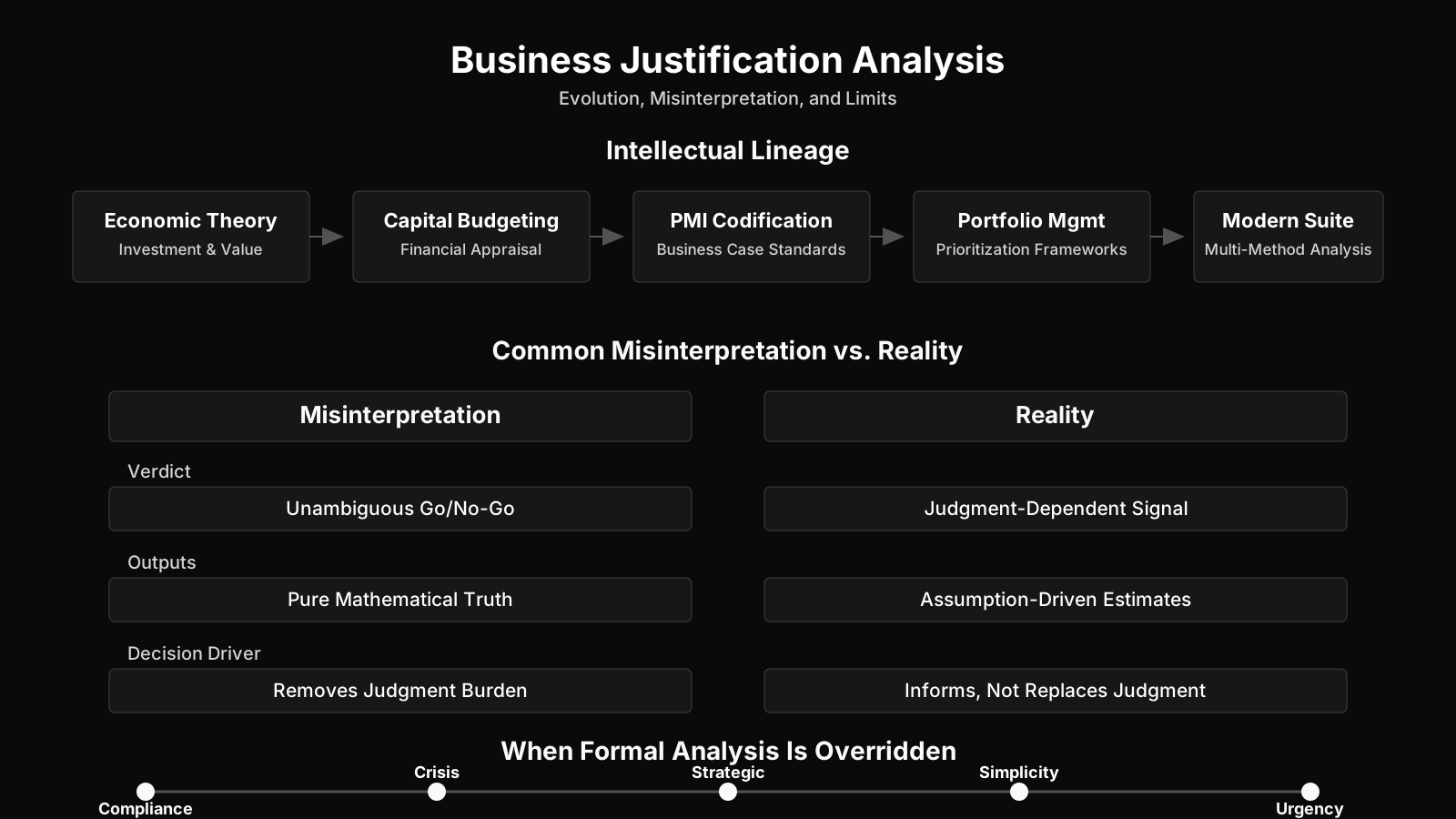
At their core, these methods serve as decision-support tools. They do not make the decision themselves but structure the information that decision-makers need to exercise judgment. A sponsor might rely on a cost-benefit analysis to understand the magnitude of the proposed investment, then consult a weighted scoring model to see how well the project supports the organization's strategic themes. The output of a business justification analysis is not a simple yes or no, but a transparent picture of trade-offs. Practitioners often note that the greatest value of these methods lies not in the final go/no-go answer but in the disciplined conversation they force about assumptions, constraints, and expected outcomes. It forces stakeholders to articulate what success looks like and whether that success is genuinely attainable given the organizational context.
Key Insights on Justification Methods
- Formal evaluation techniques
- Business justification analysis methods provide a structured framework for assessing the viability, strategic alignment, and expected value of proposed initiatives within project, program, and portfolio management.
- Evidence over intuition
- These methods shift decision-making from intuition and political influence to rigorous evidence, combining quantitative measures like net present value with qualitative, multidimensional scoring models.
- Decision-support tools
- Rather than delivering a binary verdict, these analyses illuminate trade-offs and compel disciplined, fact-based examination of assumptions, constraints, risks, and expected outcomes.
Key Categories of Business Justification Analysis Methods
Financial Analysis Methods
Financial methods quantify expected cash inflows and outflows over time to produce a comparative metric that can be benchmarked against a hurdle rate or alternative investments. Financial justification methods in project management most commonly include net present value (NPV), internal rate of return (IRR), return on investment (ROI), payback period, and discounted cash flow analysis. NPV discounts future net cash flows to their present value using a chosen discount rate. A positive NPV suggests the project will add value; a negative one signals a potential wealth destructor. The discount rate itself carries heavy analytical weight because it reflects the cost of capital and the risk appetite of the organization. IRR identifies the discount rate at which the NPV equals zero, effectively showing the project’s expected efficiency of investment.
Practically speaking, if a company is evaluating a new software platform implementation, the analysis would estimate the initial licensing and integration costs, ongoing maintenance, and the productivity savings expected from automating manual tasks. Those numbers get arrayed across a five-year period, discounted back to today’s money, and then compared against a minimally acceptable threshold set by the portfolio governance board. A common subtlety that gets overlooked is that these models are only as reliable as the benefit and cost estimates fed into them. Overly optimistic revenue projections or underestimated change management costs can make a weak project look deceptively attractive.
Strategic Alignment and Qualitative Models
Not all value can be reduced to a currency figure. Strategic justification analysis involves evaluating a project’s contribution to long-term goals such as market positioning, regulatory compliance, brand reputation, or capability building. Qualitative models capture these dimensions through scoring frameworks. The project receives ratings against predetermined criteria, each weighted by its organizational importance. A typical criteria set might include strategic fit, risk level, stakeholder commitment, technical feasibility, and competitive advantage. The scores then aggregate into a composite number that enables a relative comparison across multiple candidate projects.
This approach is particularly valuable in public-sector or nonprofit environments where financial return is not the primary driver. A government agency considering a digital citizen-services portal might struggle to place a dollar value on improved public trust or social inclusion. Yet through a structured scoring model, decision-makers can transparently evaluate whether the initiative advances the agency’s mission, ranks high enough to displace other petitions, and carries acceptable implementation risk. A layered explanation: essentially, strategic scoring works like a college admissions rubric that considers test scores alongside extracurriculars, essays, and recommendation letters. It acknowledges that a project, like a student, has multiple dimensions that cannot be boiled down to a single metric without losing fidelity to the real decision environment.
Multi-Criteria Decision Analysis and Constrained Optimization
Multi-criteria decision analysis formalizes the evaluation of alternatives when multiple conflicting objectives exist. In project portfolio management, MCDA techniques such as the Analytic Hierarchy Process help structure pairwise comparisons of criteria to derive priority weights, then rate each project against those weights. Unlike simple scoring models, MCDA explicitly handles trade-offs and inconsistencies in stakeholder preferences. Constrained optimization methods, by contrast, use mathematical programming to select an optimal portfolio of projects under resource, budget, and dependency constraints. These are less common in day-to-day project initiation but appear frequently in annual portfolio planning cycles when the organization must choose the best mix of initiatives from a large candidate pool.
The analytical strength of constrained optimization is its ability to maximize total portfolio value given finite resources, but its weakness is its sensitivity to input data quality. A slight error in resource estimates can produce a portfolio that looks optimal on paper but founders in execution. Experienced portfolio managers therefore use it as a screening tool rather than a dictator of decisions. They review the recommended set, challenge underlying assumptions, and adjust for political or logical realities that the model cannot capture.
Business Justification Analysis in PMBOK and PRINCE2
Within the PMBOK framework, business justification methods appear primarily as part of the business case, which serves as a key input to the Develop Project Charter process in the Project Integration Management knowledge area. The PMBOK Guide identifies project selection methods broadly as benefit measurement methods and constrained optimization methods. Benefit measurement methods include scoring models, cost-benefit analysis, and economic models. Although the PMBOK does not prescribe a specific technique, business justification in project management frameworks is treated as a foundational gate before formal project authorization. The project manager may not always originate the business case, but is expected to understand its assumptions and monitor the project’s continued alignment with the stated justification throughout the lifecycle.
PRINCE2 takes a more explicit and continuous stance through its Business Case theme. The methodology mandates that a viable business case exists at the start of the project and must be maintained and verified at each stage boundary. The principle of continued business justification means that if the justification evaporates, the project should be stopped or redirected. PRINCE2 separates the business case into components such as expected benefits, dis-benefits, costs, timescale, and risks, and assigns ownership to the senior user and executive. In this environment, analysis methods do not sit in isolation at the start; they feed into regular reviews where actual performance is compared against forecasted benefits. This dynamic approach helps prevent zombie projects that continue consuming resources long after their rationale has died.
Business Justification Across Methodologies
- PMBOK business case role
- The PMBOK framework positions the business case as a foundational input for the Develop Project Charter process, anchoring project authorization in strategic value within the Integration Management knowledge area.
- PRINCE2 continuous verification
- PRINCE2 requires a viable business case not only at project initiation but mandates ongoing validation at each stage gate to ensure continuous alignment with organizational objectives.
- Selection and review methods
- PMBOK emphasizes quantitative selection techniques such as benefit measurement and constrained optimization, whereas PRINCE2 integrates these analyses into periodic reviews that directly compare realized outcomes against projected benefits.
Agile and Hybrid Approaches to Business Justification
Agile environments treat business justification as a living construct, not a one-time approval checkpoint. In Scrum, the Product Owner continuously prioritizes the Product Backlog based on business value, which is the realization mechanism of justification. The initial chartering or envisioning phase often involves creating a lean business case or a canvas that captures the problem, solution hypothesis, and key metrics of success without getting bogged down in multi-year financial projections that will almost certainly be wrong. Agile business justification techniques focus on outcome validation through empirical evidence, where the project proceeds incrementally and funding decisions are revisited at cadenced intervals, often tied to program increment planning or release milestones.
This shift reflects a recognition that in complex, rapidly changing environments, the upfront predictive analysis found in traditional methods can create false confidence. Instead of asking “can we justify this project for the next two years?” the agile practitioner asks “what is the smallest investment we can make to test our value hypothesis?” The business justification evolves as real user feedback and market data accumulate. In hybrid settings, organizations sometimes blend the rigorous initial financial case demanded by governance boards with periodic lightweight value reassessments. A project might secure funding based on a traditional NPV analysis but then adopt rolling-wave re-justification where the Product Owner demonstrates achieved value at each review gate, adjusting the backlog to maximise return on the remaining investment.
The BVOP Perspective on Business Justification
Business Value-Oriented Project Management (BVOPM) incorporates business justification through a structured emphasis on stakeholder validation and transparent governance before authorization. BVOP business justification validation processes ensure that formal stakeholder input is considered and that a Transparent Board of Project Issues serves as a forum where all roles can raise concerns regarding the project’s rationale before it is launched. This creates an environment in which the business case is not the sole responsibility of a sponsor or analyst but undergoes a collective scrutiny that includes perspectives from operations, end-users, and support functions. The approach reduces the risk of a justification that looks good in a spreadsheet but ignores critical ground-level realities.
BVOPM also treats scope assumptions with a different lens. By defining a five-level scope scale from Definite to Unlikely, the methodology acknowledges that benefits estimates tied to less certain scope elements are inherently fragile. This encourages analysts to categorize benefits according to scope confidence, effectively layering a risk assessment onto the traditional justification models. When a project’s estimated value relies heavily on Unlikely deliverables, BVOPM signals that the business justification is correspondingly speculative, prompting governance to either increase oversight or scale back the commitment until more certainty is available.
Key Takeaways on BVOP Justification
- Collective stakeholder scrutiny
- BVOPM mandates that business justification be validated by a Transparent Board of Project Issues, inviting operations, end-users, and support functions to surface concerns before the project receives authorization.
- Ground-level reality check
- Engaging multiple roles in the review prevents the organization from greenlighting projects that look sound on spreadsheets yet fail to account for hard operational constraints.
- Five-level scope confidence scale
- The methodology classifies scope elements on a continuum from Definite to Unlikely, explicitly recognizing that benefit projections tied to lower-confidence items carry inherent fragility.
- Risk-layered benefit categorization
- When analysts map benefits to the appropriate scope confidence tier, governance receives a clear signal to tighten oversight or reduce reliance on results that depend on Unlikely deliverables.
Practical Application of Business Justification Analysis
Business justification analysis methods are applied primarily during the initiation and portfolio selection phases of the project lifecycle, though their relevance persists through stage-gate reviews and benefits realization tracking. Practical use of business justification analysis often begins with a sponsor or business analyst constructing a preliminary business case that combines both financial and strategic reasoning. The project manager then uses this case to shape the project charter and to align the team around measurable objectives. In large organizations, the Project Management Office or portfolio governance board standardises the analysis templates, defines discount rates, and sets the criteria weights to ensure consistency across competing proposals.
The real work of applying these methods is not the arithmetic. It is the rigorous challenge of assumptions that goes on behind the numbers. A seasoned practitioner will spend as much time questioning the source of the estimated benefit figures as they will calculating the IRR. They will ask what operational changes must happen for the projected savings to materialise and whether the organization has the change capacity to absorb them. When a project is huge and complex, the analysis often includes sensitivity testing, varying key assumptions like the adoption rate of a new system or the timing of regulatory changes to see how robust the justification remains. If the business case crumbles under a slight shift in a single variable, that is a red flag no NPV can obscure.
The audience for the output also shapes the method selection. An executive steering committee typically prefers clear financial indicators, while a technical review board might gravitate toward feasibility scores and architectural alignment. The project manager’s skill lies in presenting the analysis in terms that resonate with each group, translating the scoring model into a narrative about risk and opportunity. Over the years, many organizations have moved toward visual representations like bubble charts that plot projects by risk versus expected value, so that the justification analysis becomes a conversation piece rather than a buried appendix.
Common Challenges and Misconceptions
One of the most widespread pitfalls is thinking that a positive NPV or acceptable payback period by itself constitutes a sufficient justification. Common pitfalls in business justification analysis include over-reliance on financial metrics to the exclusion of strategic necessity, organizational readiness, and intangible benefits that are difficult to monetize. This leads to a portfolio skewed toward projects with easily quantifiable cost savings, such as automation or procurement consolidation, while neglecting initiatives that build long-term capability or competitive differentiation. The finance lens is necessary but not sufficient.
Another major challenge is the behavioral bias known as strategic misrepresentation or optimism bias, where project advocates unconsciously or deliberately underestimate costs and overestimate benefits. The very act of championing a project can colour the analysis. Independent review by a portfolio function can mitigate this, but political pressures often overcome governance controls. A related misconception is that the business justification is a static document to be approved and filed away. In reality, conditions shift, assumptions prove wrong, and benefits forecasts that were ambitious in year one become fantasies by year two. Teams that fail to refresh the justification end up executing a project whose original rationale no longer holds.
A subtler issue lies in mistaking precision for accuracy. An analysis that uses detailed cash flow projections and sensitivity analyses can create an illusion of rigour, even when the underlying data is merely guesswork dressed in spreadsheets. Practitioners learn to size the analytical effort to the magnitude and risk of the investment. A small process improvement likely deserves a few hours of back-of-the-envelope calculation, while a multi-year enterprise transformation warrants weeks of modeling and external validation. Applying the same heavy methodology to all proposals wastes effort and signals a process obsession over critical thinking.
Core Insights on Justification Pitfalls
- Financial metrics alone can mislead
- Relying solely on a positive NPV or acceptable payback period ignores critical factors such as strategic alignment, organizational readiness, and intangible benefits, any of which can make a project unjustifiable despite favorable financial metrics.
- Optimism bias distorts projections
- Cost underestimation and benefit overstatement are common when project sponsors’ enthusiasm overrides objective analysis, and independent portfolio reviews often prove ineffective if political pressures weaken governance processes.
- Justification demands continuous renewal
- As market conditions evolve and initial assumptions erode, a business justification quickly loses relevance, making regular reassessment essential to avoid pursuing projects that no longer align with strategic objectives.
Relationships to Other Project Management Concepts
Business justification analysis methods are inextricably linked to the business case, the project charter, and the benefits management plan. The relationship between business justification and the business case is that the case is the narrative document that communicates the findings of the analysis, while the methods are the analytical engine that produces those findings. In turn, the project charter authorizes the undertaking and references the business case as its primary justification, making the charter legally and organizationally dependent on the soundness of the analysis. If the justification is flawed, everything that follows from charter through execution stands on shaky ground.
Within portfolio management, justification analysis connects directly to program and project selection, portfolio balancing, and benefits realization. A portfolio decision relies on comparing the justification outputs of competing projects, often visualised through investment maps and efficient frontiers. The benefits management plan operationalizes the expected benefits that the analysis identified, specifying how and when they will be measured and who owns them. This circle closes only when post-implementation reviews compare actual benefits against the forecasted ones that the original analysis projected. A mature organization feeds that variance data back into future business justification cycles, improving the estimation accuracy over time.
Evolution and Current Thinking in Business Justification
The practice has evolved significantly from early days when a simple payback calculation or the instinct of a senior executive was considered sufficient. The introduction of discounted cash flow techniques in the mid-twentieth century brought financial rigor to project selection, and the rise of strategic planning in the 1980s grafted on alignment objectives. Balanced scorecard thinking in the 1990s encouraged organizations to justify projects against multiple perspectives, not just financial. Modern business justification approaches now blend financial, strategic, and adaptive elements into a continuous justification cycle rather than a one-time hurdle.
Current thinking acknowledges that the inherent uncertainty in innovative projects makes precise upfront forecasting almost impossible. This has driven interest in real options reasoning, where a project is viewed as a series of incremental investments with the right but not the obligation to continue. The initial justification may be to fund a discovery phase rather than the full project, treating knowledge acquisition as a genuine benefit. Lightweight canvases like the Lean Canvas or Opportunity Canvas have gained traction, especially in product-oriented and digital transformations, because they frame justification around problem-solution fit and measurable outcomes rather than long-term revenue assumptions.
A healthy debate persists between the need for centralized consistency in justification analysis and the desire for agile autonomy. Some argue that standardized templates and mandated discount rates ensure comparability and fiscal discipline, while others contend they stifle innovation by forcing every idea into the same financial mold. The compromise often takes the form of tiered governance, where small bets require only a lean one-page justification, while major strategic investments demand full-scale analysis. This reflects a maturing understanding that business justification is not a single method, but a capability that an organization must adapt to the uncertainty and nature of each initiative it undertakes.
Core Insights on Justification Evolution
- From instinct to structured analysis
- Business justification has progressed from simple payback calculations and executive instinct to a rigorous, multidimensional framework that integrates discounted cash flow analysis, strategic alignment, and balanced scorecard perspectives.
- Continuous cycle over one-time hurdle
- Modern justification functions as a continuous cycle that blends financial rigor, strategic relevance, and adaptive learning, rather than serving as a single, upfront approval gate.
- Uncertainty drives flexible frameworks
- Because precise upfront forecasting is nearly impossible for innovative initiatives, organizations increasingly rely on real options reasoning and lightweight canvases that anchor justification in problem-solution fit, validated learning, and measurable outcomes.
- Tiered governance balances competing needs
- Organizations balance fiscal discipline against the need for innovation by employing tiered governance, where small bets warrant only a concise one-page justification and major strategic investments undergo comprehensive financial and strategic scrutiny.