An Agile Charter is a concise, jointly developed document that captures the shared understanding of a project’s purpose, boundaries, and collaborative principles among an Agile team and its stakeholders. Unlike the formal, sponsor-authored project charter common in traditional project management, the Agile charter is co-created by the team at the outset and is designed to be revisited and refined as the project unfolds. It serves as a lightweight compass rather than a contractual mandate, guiding decisions while respecting the Agile values of individuals and interactions over processes and tools and responding to change over following a plan.
Agile Charter: Quick Summary of Key Concepts
| Key Concept | Summary |
|---|---|
| Agile Charter | A collaboratively crafted, living artifact that aligns the team around a joint vision, explicit boundaries, and core working relationships to guide daily decisions. |
| Traditional Contrast | Unlike a sponsor issued, one time mandate, the Agile charter is team authored and serves as an evolving compass that adapts as new insights emerge, not a static contract. |
| Vision and Mission | The vision paints a compelling long term outcome that inspires the team, while the mission translates that aspiration into a concrete, near term purpose and target audience. |
| Scope Boundaries | Explicit inclusion and exclusion parameters give the team a principled way to negotiate scope, deflect distractions, and safeguard iteration focus. |
| Success Criteria | Observable, quantitative signals such as user adoption rates, cycle time reductions, or error rate declines that provide objective proof of delivered value. |
| Working Agreements | Codified norms that clarify meeting etiquette, decision making models, and conflict resolution paths, building the psychological safety needed for honest collaboration. |
| Communication Protocols | Defined channels, cadences, and stakeholder touchpoints that ensure critical information flows predictably, reducing noise particularly in distributed and hybrid setups. |
| Risks and Assumptions | A transparent backlog of provisional constraints, dependencies, and uncertainties that the team revisits in retrospectives and probes early with targeted spikes. |
| Origins and Evolution | Emerged from grassroots Agile communities after the Manifesto, later formalized in scaling frameworks like SAFe and LeSS as a lightweight alignment practice. |
| Framework Role | Where governance gateways demand a traditional charter, the Agile version adds a complementary, tactical layer that enriches authorization with team level detail. |
What Is an Agile Charter?
The Agile charter definition can be understood as an alignment instrument that answers the questions: why this project exists, what value it intends to deliver, who is involved, and how the team will work together. It is not a formal authorization document in the sense of a traditional project charter, which typically grants the project manager authority and commits organizational resources. Instead, the Agile charter focuses on creating a collective identity and a set of guiding principles that the team owns and maintains.
In practice, an Agile charter often emerges from a facilitated workshop where the product owner, scrum master, developers, and sometimes key business stakeholders sit down to hash out their shared vision. The output is not a thick binder but a living artifact, usually captured on a physical board or a shared digital workspace, that can be referenced in daily stand-ups, sprint planning, and retrospectives. Because the charter is co-created, it draws on the perspectives of those doing the work, not just executive mandates, which tends to increase buy-in and psychological ownership.
A common point of confusion is that the Agile charter somehow replaces the project charter. In contexts where organizational governance still requires a formal project charter for funding and authorization, the Agile charter functions as a complementary layer that adds team-level detail. Some organizations even embed the Agile charter within the traditional charter as an appendix or a link to a living wiki page. The key distinction remains that the traditional charter authorizes the project to exist, while the Agile charter defines how the team intends to operate once it exists.
Key Takeaways on Agile Charters
- Alignment tool for teams
- An Agile charter captures the project's purpose, expected value, participant roles, and collaborative working agreements to align the team around a common vision.
- Not an authorization document
- Unlike a traditional project charter, an Agile charter does not confer formal authority to a project manager or commit organizational resources, focusing instead on team alignment and shared understanding.
- Co-created in workshops
- The charter is co-created during facilitated workshops in which the product owner, scrum master, developers, and key stakeholders collaboratively define the team's shared vision, working norms, and success criteria.
- Living team artifact
- Maintained on a physical board or in a shared digital workspace, the charter serves as a living reference that teams revisit during daily stand-ups, sprint planning, and retrospectives to stay aligned with their evolving goals.
- Complements the project charter
- While a formal project charter authorizes the project's existence, the Agile charter complements it by detailing the team's specific working agreements, norms, and operational cadence.
Key Components of an Agile Charter
The key components of an agile charter typically include a vision statement, a mission, scope boundaries, success criteria, team norms, communication protocols, and a preliminary view of risks and assumptions. Each component serves a specific function, blending strategic direction with operational clarity.
Vision and Mission
The vision statement describes the future state the project aims to create, often in a single inspiring sentence that can be easily remembered and repeated. It keeps the team oriented toward a long-term outcome, even as short-term tactics shift. The mission, on the other hand, grounds the vision in immediate purpose: what the team is doing right now, who it serves, and why that matters. Together, vision and mission prevent the project from drifting into a shapeless collection of backlog items by maintaining a clear line of sight to the intended value.
Scope Boundaries
Agile charters do not enumerate a detailed scope of work, but they do set boundaries that define what is in and what is out of the project’s concern. These boundaries might be expressed as a set of user persona groups that are in scope, platforms that are out of scope, or types of work the team will not undertake. By stating what the project is not trying to solve, the charter helps the team say no to well-intentioned requests that would pull them away from their primary objective. This echoes the lean practice of making explicit trade-off curves.
Success Criteria
Success criteria in an Agile charter describe how the team and stakeholders will know the project has delivered value. They go beyond traditional on-time, on-budget metrics to include measurable improvements in user behavior, business outcomes, or system performance. For example, a success criterion might be a specific reduction in customer support tickets or a measurable improvement in checkout completion rate. These criteria provide a shared definition of done at the project level and help prioritize features during backlog refinement.
Team Norms and Working Agreements
Perhaps the most distinctive component of an Agile charter is the set of working agreements that govern how the team interacts. These might cover meeting etiquette, core working hours, decision-making processes (such as consent-based or fist-of-five voting), conflict resolution approaches, and expectations around availability and responsiveness. By making these norms explicit, the charter reduces the friction that arises from unspoken assumptions and creates a psychologically safe environment where people feel comfortable challenging ideas and each other constructively.
Communication Protocols
Agile charters often define communication channels and rhythms so that information flows predictably. This includes specifying which tools the team will use for synchronous and asynchronous communication, the purpose of each regular meeting, and how external stakeholders will be kept informed without disrupting the team’s delivery cadence. In distributed teams, this section gains extra weight because the absence of casual hallway conversations makes structured clarity essential.
Risks, Assumptions, and Constraints
While not a full risk register, the Agile charter typically records the high-level risks, assumptions, and constraints that could derail the project if left unexamined. Surfacing these early allows the team to monitor them in subsequent retrospectives and to test assumptions through spikes or early experiments. This practice aligns with the idea that an Agile team treats its plan as a set of hypotheses rather than a fixed prediction.
Origins and Evolution of the Agile Charter
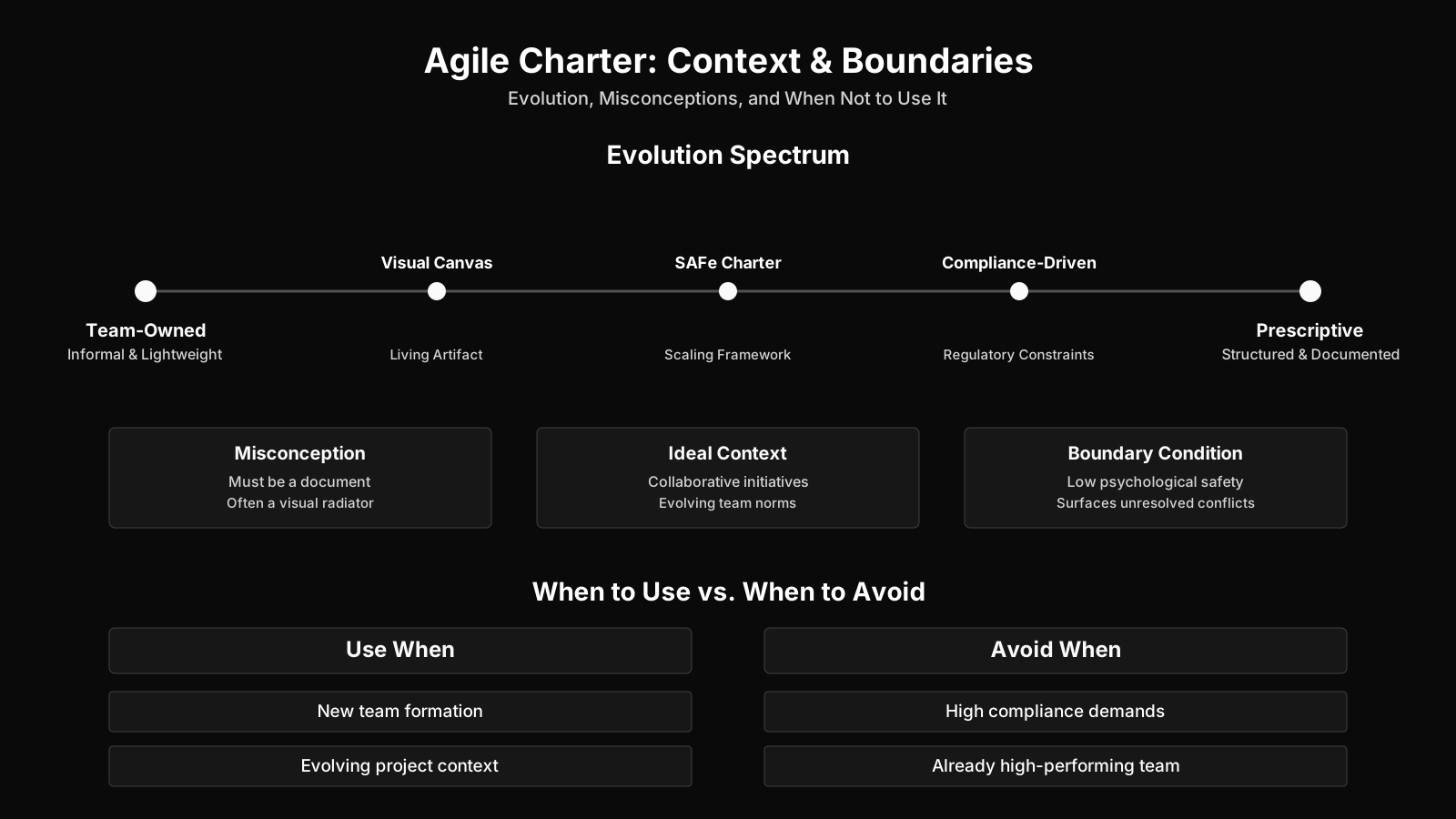
The evolution of the agile charter can be traced to the early 2000s when Agile teams, influenced by the Agile Manifesto’s preference for individuals and interactions over processes and tools, began searching for lightweight mechanisms to align cross-functional groups. The traditional project charter, rooted in large-scale construction and defense projects, felt too cumbersome and one-sided for iterative, small-team environments. Coaches and practitioners started borrowing the concept of a team charter from organizational development and meshing it with the product vision and lean canvas ideas that were circulating in the startup community.
It was a gradual, grassroots shift. There was no single author or framework that introduced the Agile charter. Instead, teams found that a shared, one-page artifact prevented the misunderstandings that otherwise emerged a few sprints in. Over time, the practice became codified in Agile coaching literature and was incorporated into scaling frameworks like the Scaled Agile Framework (SAFe), which includes team chartering as a recommended activity during Program Increment planning. Today, the Agile charter is a recognized, if not universally standardized, artifact in the Agile toolkit.
Agile Charter Origins: Key Insights
- Roots in Agile Manifesto
- The agile charter crystallized in the early 2000s as Agile teams sought a lightweight alignment tool that embodied the Manifesto's emphasis on individuals and interactions over rigid processes.
- Rejection of traditional charters
- Traditional project charters, inherited from construction and defense, proved too cumbersome and top-down for iterative small-team environments, driving practitioners to forge a new approach.
- Grassroots practitioner-driven evolution
- No single author or framework invented the agile charter; it emerged organically as coaches combined team chartering techniques from organizational development with product vision statements and lean canvas thinking.
- One-page artifact prevents misunderstandings
- Teams found that a shared, collectively refined one-page charter eliminated the misalignments that frequently surfaced after just a few sprints.
- Codification in Agile frameworks
- The practice has since been codified in Agile coaching literature and scaling frameworks like SAFe, where team chartering is standard during Program Increment planning, cementing its status as a recognized Agile artifact today.
Agile Charter in Project Management Frameworks
In traditional project management, the charter is a formal authorization document, but the Agile charter in project management frameworks serves a different purpose, focusing on alignment rather than control. PMBOK Guide’s Sixth Edition situates the Develop Project Charter process in the Initiating Process Group, driven by the sponsor. The Seventh Edition shifts to principles of value delivery and tailoring, creating space for an Agile charter as a tailored approach. A team operating in a PMBOK-aligned environment can satisfy the initiating process by pointing to an Agile charter that demonstrates stakeholder alignment and a clear value proposition, even if it lacks a sponsor’s signature block.
PRINCE2 Agile encourages collaborative workshops to develop the Project Brief and Project Product Description, which can parallel the creation of an Agile charter. The emphasis is on shared understanding over documentation for its own sake. In pure Scrum, the framework does not mandate a charter; however, many experienced Scrum teams create a “team charter” or “social contract” that covers working agreements, definitions of ready and done, and core values. Kanban practitioners often design a system charter that defines work item types, service level expectations, and policies, fulfilling the same clarifying role that an Agile charter plays. The common thread across all these frameworks is the recognition that teams perform better when they collectively define their purpose and rules of engagement.
The BVOP Perspective on Agile Chartering
Business Value-Oriented Project Management (BVOPM) reinforces the value of the Agile charter through its principle of a Transparent Board of Project Issues, where all roles can raise concerns before formal authorization. The BVOP Agile charter approach would integrate this transparency directly into the chartering process, ensuring that potential risks and stakeholder reservations are surfaced and addressed collaboratively. In BVOPM, initiation is not a solitary sponsor activity but a multi-voice dialogue, and the Agile charter becomes the artifact where that dialogue is recorded. This elevates the charter from a simple alignment tool to a vehicle for organizational learning and pre-emptive risk management.
Key Takeaways on BVOP Chartering
- Transparent Board of Project Issues
- The Transparent Board of Project Issues principle in BVOPM enables anyone, regardless of role, to flag concerns before formal approval, embedding diverse perspectives into the charter and strengthening collective ownership of project decisions.
- Transparency in the Chartering Process
- By weaving transparency into the chartering workflow, BVOP’s Agile charter approach surfaces hidden risks and stakeholder reservations early, turning them into collaborative problem-solving opportunities rather than post-approval surprises.
- Multi-Voice Initiation Dialogue
- BVOPM redefines project initiation as a multi-voice dialogue where sponsors, teams, and stakeholders jointly shape the charter, making it a living record of negotiated intent rather than a unilateral declaration.
- Charter as a Learning Vehicle
- By using the charter to capture assumptions, debates, and early risk signals, BVOPM turns it into an organizational learning asset, enabling preemptive course corrections long before formal execution begins.
Practical Application and Use of Agile Charters
The process of using an agile charter typically begins with a facilitated kickoff workshop where the entire team, along with key stakeholders, collectively defines the project’s direction and constraints. A facilitator, often the scrum master or an Agile coach, guides the group through exercises like vision crafting, scope boundary definition, and the establishment of working agreements. The session might use silent brainstorming, affinity mapping, and dot-voting to ensure that quieter voices are heard and that the final charter reflects genuine consensus rather than the loudest opinion.
After the workshop, the charter is placed in a highly visible location. In co-located teams, this might be a large sheet of paper on the wall. In remote settings, it lives in a shared document or a team homepage. The charter is then referenced during sprint planning to keep the team’s tactical choices aligned with the vision, and during retrospectives to inspect whether the working agreements are still serving the team well. When a significant external change occurs, such as a shift in market conditions or a new regulatory requirement, the team may convene to update the charter. The living nature of the document means that no one treats a change as a failure of the original plan; rather, it is seen as the team’s response to learning.
Common Challenges, Pitfalls, and Misconceptions
One of the most common misconceptions about agile charters is that they are simply a stripped-down version of the traditional project charter and therefore less important. In reality, the Agile charter demands more discipline because it requires the team to continuously revisit and uphold their commitments. When a team treats the charter as a one-time exercise, it quickly becomes outdated and loses its power to guide behavior.
Another frequent pitfall is over-specifying the charter. Some teams, especially those accustomed to predictive environments, pack the charter with detailed scope statements, milestone dates, and resource plans, effectively turning it into a miniature project management plan. This undermines the agility the charter is supposed to support. A related problem is the confusion between the Agile charter and other artifacts, such as the product backlog or the definition of done. While these artifacts address different aspects, a team that views the charter as redundant will miss the critical social contract it represents. Finally, without genuine stakeholder participation, the charter can become an echo chamber of team preferences, failing to account for external constraints and expectations that will surface painfully later.
Key Insights on Charter Missteps
- Charter demands ongoing discipline
- An agile charter loses its guiding influence when treated as a one-time formality rather than a living agreement that demands regular reinforcement and realignment.
- Over-specification undermines agility
- When teams accustomed to predictive approaches pack the charter with fixed scope, milestones, and resource allocations, they inadvertently create a rigid project plan that stifles the very adaptability the charter should enable.
- Charter is a social contract
- Mistaking the charter for operational artifacts like the product backlog or definition of done leads teams to overlook its unique role as a social contract that defines shared behaviors, mutual expectations, and accountability.
- Missing stakeholder participation
- Without active stakeholder participation, the charter becomes an inward-focused echo chamber that ignores external constraints and expectations, allowing misalignments to surface only when they cause serious project tension.
Relationships to Other Project Management Concepts
Understanding the difference between an Agile charter and a traditional project charter is essential for teams transitioning to Agile ways of working. The traditional charter authorizes the project, assigns the project manager, and defines high-level requirements and constraints. It is typically written by the sponsor and may be treated as a static reference. The Agile charter, in contrast, is an alignment tool co-created by the team, and it assumes that authority is distributed rather than centralized. It is not the document that asks for permission to start; it is the document that says how we will work together now that we have permission.
The Agile charter also relates closely to the team charter, but the two are not synonymous. A team charter focuses almost exclusively on norms, roles, and interpersonal agreements. The Agile charter includes those elements but also layers on vision, mission, scope, and success criteria, making it a more strategic artifact. Similarly, the product vision is a component of the Agile charter, not its entirety. The charter extends the vision by adding the operational and relational glue that turns a desire into a functioning team. The definition of done describes product quality, while the charter describes team quality. An initial risk register can be seen as a detail expansion of the risks and assumptions recorded in the charter. Recognizing these relationships helps teams decide when a separate artifact is needed and when the charter already covers the ground sufficiently.
Current Thinking and Future Directions
Current thinking on agile charters suggests that they should be as dynamic as the backlog, with lightweight version control and regular review cycles built into the sprint cadence. The shift toward remote and hybrid work has accelerated the adoption of digital charters that use collaborative platforms like Miro, Mural, or Confluence, allowing asynchronous inputs and easy updates. Teams are experimenting with linking charter elements to organizational OKRs so that the charter becomes a bridge between company strategy and individual delivery.
There is also a growing recognition that the charter can play a role in onboarding new team members. A well-maintained charter gives a newcomer an immediate sense of the project’s purpose and the team’s cultural norms, reducing the time it takes to become productive. As the Agile community continues to blend practices from DevOps, design thinking, and lean, the Agile charter is likely to evolve further, perhaps incorporating explicit definitions of value streams, experimentation boundaries, or even psychological safety metrics. The central idea, however, will remain constant: a team that starts with a shared understanding and maintains it has a far greater chance of delivering meaningful outcomes than one that never articulates its own operating system.
Key Insights on Charter Evolution
- Dynamic charters with digital tools
- Agile charters now function as living documents, updated through lightweight version control and frequent reviews on collaborative platforms such as Miro, Mural, or Confluence, which enable seamless participation for remote and hybrid teams.
- Charters accelerate new member onboarding
- A well-maintained charter enables newcomers to rapidly understand the project's objectives and the team's cultural expectations, which substantially shortens the ramp-up time to full productivity.
- Evolving with broader agile practices
- As charters evolve, they are expected to integrate principles from DevOps, design thinking, and lean practices, encompassing value stream mapping, experimentation frameworks, and psychological safety indicators, all while preserving the foundational need for shared understanding.