A duration estimate is defined as a quantitative assessment of the likely number of work periods required to complete an activity, work package, or project phase under stated assumptions and resource availability. The estimate is typically expressed in working days, weeks, or months, and it reflects elapsed calendar time rather than pure human effort. Within project management, duration estimates form a central input to schedule development and appear in nearly every planning framework, from the PMBOK to PRINCE2 to Agile delivery methods. That distinction between elapsed time and effort matters far more than many practitioners initially expect.
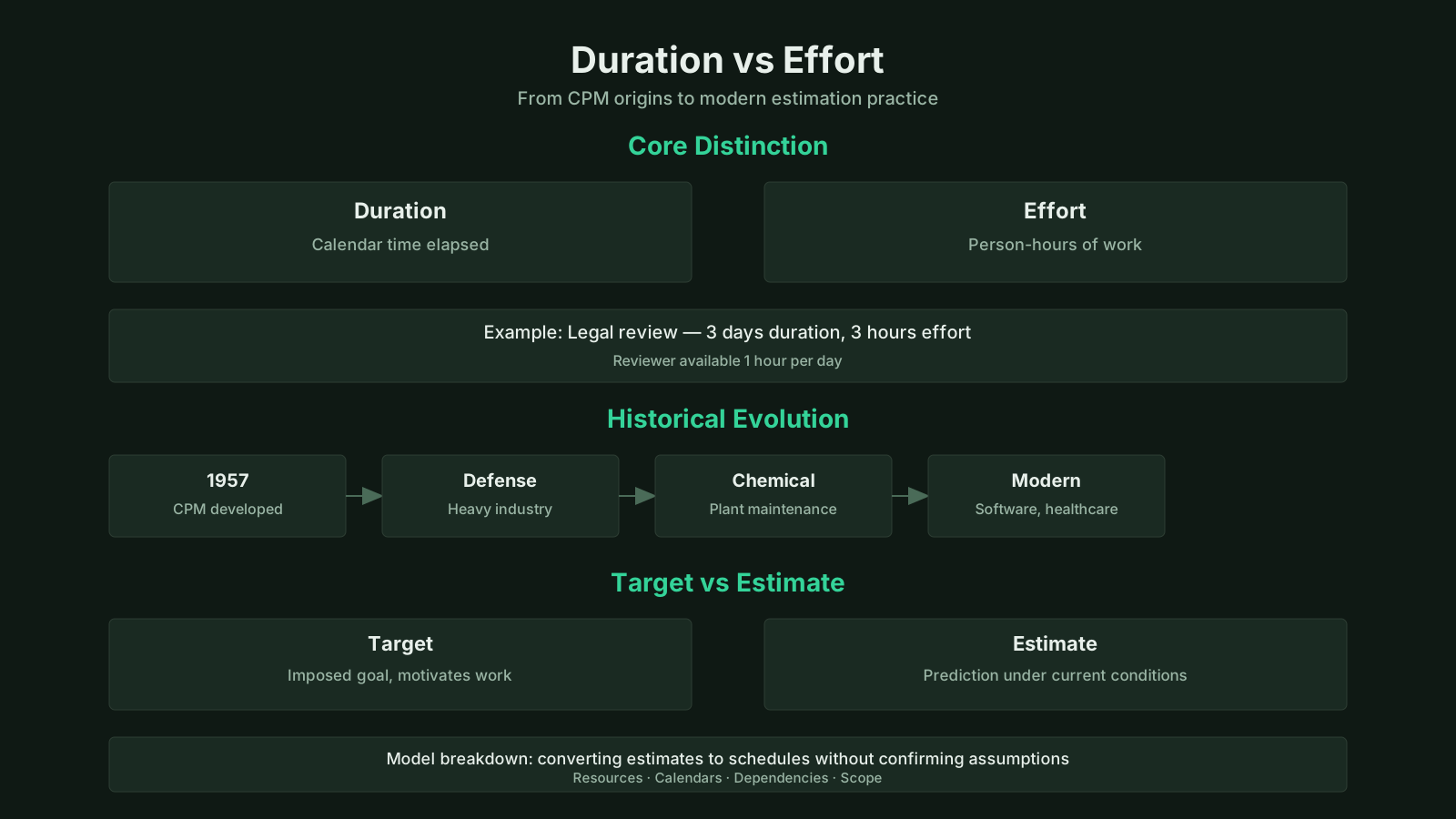
Duration Estimates: Summary of Key Topics
| Concept | Summary |
|---|---|
| Definition | A duration estimate is a quantitative forecast of the calendar time required to complete an activity, work package, or project phase, derived from explicit assumptions about scope, sequencing, and resource availability. |
| Units of Measure | Working days, weeks, or months are used to express duration estimates; these values represent elapsed calendar time and account for non-working periods, distinguishing them from raw effort hours. |
| Role in Planning | Duration estimates serve as the foundation for schedule development across PMBOK, PRINCE2, and Agile delivery frameworks, converting activity logic and resource assignments into a workable timeline. |
| Origins | Modern duration estimating methods originate from the Critical Path Method and the Program Evaluation and Review Technique, both formalized during the 1950s. |
| Early Applications | CPM emerged from a DuPont and Remington Rand collaboration to optimize plant maintenance schedules, while PERT was created by the U.S. Navy Special Projects Office to manage the Polaris missile program's complex research and development timeline. |
| Field Contributions | Construction estimators advanced the field by applying crew-based productivity rates to activities such as concrete pours and steel erection, introducing practical techniques for handling variability, physical constraints, and non-working periods. |
| Key Components | Reliable duration estimates integrate activity scope and attributes, resource requirements, resource calendars, measurable productivity rates, planning assumptions, and the influence of identified risks. |
| Estimate Prerequisites | A defensible estimate depends on clarity about assigned roles, resource capacity, required tools or equipment, and the degree to which activities can overlap or run concurrently. |
What Is a Duration Estimate?
Duration estimates definition centers on elapsed time rather than labor intensity. A task that requires 80 hours of effort can have a duration of five working days if two full-time people work on it, or ten working days if only one person is available at half capacity. The work content stays the same, but the calendar span changes. That simple example exposes a common confusion in project planning: duration is not the same as effort. Duration includes waiting time, dependencies, part-time resource allocation, and non-working periods.
Duration is measured along the calendar, while effort is measured in person hours or person days. A senior planner may say an activity takes three people four weeks to complete; the duration is four weeks, and the effort is twelve person weeks. This distinction becomes operationally critical when resources are overloaded, when calendars include holidays, or when work is handed between teams. A duration estimate therefore answers the question of how long something will take on the timeline, not how much labor is embedded in the work.
Duration estimates can be single-point values or ranges. A single-point estimate says an activity will take ten days. A range estimate says it will most likely take ten days, but could take as few as seven or as many as fifteen. Leading practice has shifted toward ranges because a single number hides the uncertainty that exists in nearly all project work. The range is often accompanied by a confidence level, which tells stakeholders how much certainty the estimator attaches to the spread.
Duration Versus Effort in Everyday Planning
Imagine a design task that needs 120 hours of focused work. If one designer is assigned full-time, the duration is roughly fifteen working days, assuming no holidays and no interruptions. If two designers split the work, the duration may shrink to eight or nine working days. If the same task depends on an external review that takes three days after the design is complete, the duration extends by three full days but the effort does not change. This plain-language example shows why schedule models must treat duration as a distinct variable from effort.
Duration Estimates: Core Takeaways
- Duration is not effort
- Duration reflects the elapsed calendar time between start and finish, whereas effort quantifies the total labor hours consumed; consequently, an 80-hour task may span anywhere from five to ten working days depending on resource availability.
- Duration includes non-working factors
- Waiting periods, external review cycles, part-time resource allocation, public holidays, and team handoffs all extend the calendar span without altering the underlying effort.
- Ranges with confidence levels
- Leading practice recommends expressing duration estimates as a range paired with a confidence level, since a single point estimate conceals the uncertainty that is inherent in most project work.
Origins and Cross-Industry Context
The formal history of duration estimates in project work is usually traced to the development of the Critical Path Method and the Program Evaluation and Review Technique in the 1950s. CPM emerged from work at DuPont and Remington Rand, while PERT was developed for the U.S. Navy Special Projects Office during the Polaris missile program. PERT introduced the practice of using optimistic, pessimistic, and most likely estimates to compute an expected duration. That three-point approach remains a standard technique in modern project scheduling.
Outside project management, duration estimation has deep roots in construction, manufacturing, logistics, and healthcare. Construction estimators have long used productivity rates and resource crews to forecast how many shifts a concrete pour or steel erection will take. In manufacturing, takt time and cycle time relate to duration by expressing the rate at which work moves through a system. Emergency medicine uses time-to-treatment estimates under uncertainty. These fields contributed practical methods for handling variability, resource constraints, and non-working periods that later influenced project scheduling.
Key Components of Duration Estimates
The key components of duration estimates include activity attributes, resource requirements, resource calendars, productivity rates, assumptions, and identified risks. An estimator cannot produce a credible duration without knowing who will do the work, how many people are available, what tools they will use, and whether the work can proceed in parallel with other activities. The same activity can have very different durations depending on skill levels, overtime policies, and the physical environment where the work happens.
Resource calendars play a surprisingly important role. A duration estimate of five working days assumes that the assigned person is available five full days per week. If that person is allocated only 40 percent to the project, the duration may stretch to twelve or thirteen working days. Public holidays, planned leave, and maintenance windows further extend the elapsed time. Experienced schedulers therefore review resource calendars before finalizing any duration figure.
Productivity rates and assumptions also shape the estimate. An estimator may assume that a team can review twenty documents per day, but that rate changes if the documents are highly technical or if the review requires stakeholder sign-off. Assumptions about work conditions, tool reliability, and learning curves should be documented in the basis of estimates. Risk can be addressed through reserve analysis, where contingency time is added to account for known uncertainty.
Resource Availability and Calendar Constraints
Duration is not an intrinsic property of an activity. The same coding task may take three days with a senior developer and ten days with a new hire. Resource availability therefore becomes a direct component of the estimate. Calendars introduce further constraints because work does not occur on weekends or holidays in many organizations. When team members work across time zones, handoff delays can add hours or days to a task that appears simple on paper.
Core Insights on Duration Estimate Inputs
- Six key estimating inputs
- Credible duration estimates draw on six interdependent inputs: activity attributes, resource requirements, resource calendars, productivity rates, documented assumptions, and identified risks.
- Resource calendars extend elapsed time
- A resource assigned at only 40 percent availability can turn a five-day effort into twelve or thirteen working days; public holidays, approved leave, and maintenance windows compound the schedule impact.
- Context alters productivity rates
- Productivity assumptions, such as reviewing twenty documents per day, rarely hold when documents are highly technical, densely worded, or subject to sequential stakeholder approvals.
- Assumptions must be documented
- Recording work conditions, tool reliability, and learning curve assumptions in the basis of estimates creates an audit trail that keeps the estimate credible and defensible.
- Risk and time zone effects
- Reserve analysis builds contingency time for known uncertainty, and distributed teams across time zones introduce handoff delays that can extend even straightforward tasks by hours or days.
Duration Estimates in PMBOK and Predictive Frameworks
Duration estimates PMBOK refers to the outputs and practices defined in the Estimate Activity Durations process within the Schedule Management knowledge area. This process belongs to the Planning process group. It takes inputs such as the activity list, activity attributes, resource calendars, resource requirements, project team assignments, and the risk register, and it produces duration estimates along with the basis of estimates. The process also updates project documents such as activity attributes and the assumption log.
The PMBOK recognizes several tools and techniques for estimating durations. Analogous estimating uses historical data from similar activities as a starting point. Parametric estimating applies statistical relationships between variables, such as hours per square meter or days per test case. Three-point estimating combines optimistic, most likely, and pessimistic values, often through a triangular average or a PERT weighted average. Bottom-up estimating aggregates duration estimates from lower-level work components. Reserve analysis adds contingency time to account for uncertainty.
The basis of estimates is a critical but often neglected output. It records the methods, assumptions, constraints, and confidence levels behind the duration numbers. Without this documentation, later schedule changes become difficult to justify. A duration estimate of fifteen days may be supported by vendor quotes, historical data, or expert judgment, but that support must be visible to those who approve the schedule baseline.
PRINCE2 and Controlled Stage Planning
Within PRINCE2, duration estimates appear in project plans and stage plans. Product-based planning identifies the products to be delivered, and the resulting activity list feeds the estimation exercise. PRINCE2 distinguishes between time-driven activities and resource-driven activities. Time-driven activities have a fixed duration regardless of the number of resources assigned, while resource-driven activities change duration as resource levels change. This distinction mirrors the broader effort-versus-duration tension found in predictive scheduling.
Duration Estimates in Agile, Hybrid, and Adaptive Environments
Duration estimates in Agile work differently from traditional predictive scheduling because Agile teams often estimate relative size rather than absolute time. Story points measure the relative effort, complexity, and uncertainty of a product backlog item. A team can convert a backlog sized in story points into a duration forecast by using velocity, which is the average number of points completed per sprint. If the remaining backlog contains 200 points and the team’s recent velocity is 40 points per sprint, the remaining work will likely take about five sprints, assuming no major scope changes.
Kanban teams rely more on cycle time and throughput than on point-based velocity. Cycle time measures how long a work item takes from start to finish. Throughput measures how many items are completed per week or per day. These flow metrics allow a team to forecast completion dates for a queue of work using historical delivery rates. Unlike fixed-duration activity estimates, flow-based forecasts update continuously as actual data arrives.
Hybrid environments combine predictive milestones with iterative delivery. A project may have a fixed-duration regulatory review phase and an Agile development phase where feature delivery is forecast by velocity. Rolling wave planning allows durations for near-term work packages to be estimated in detail while longer-term work remains at a high level. This adaptive approach keeps the estimate fresher and more responsive to evolving requirements.
Core Insights on Agile Duration Forecasting
- Velocity converts story points to sprints
- Because story points reflect relative size rather than time, dividing the total remaining backlog points by a team's average velocity per sprint converts abstract scope into a defensible forecast of how many sprints the work will require.
- Kanban relies on flow metrics
- Kanban teams use cycle time and throughput instead of point-based velocity, enabling forecasts to stay continuously aligned with actual delivery performance as new completion data emerges.
- Hybrid blends fixed and adaptive approaches
- Projects can combine fixed-duration phases, such as regulatory review, with Agile development phases, using rolling wave planning to define near-term work in detail while keeping longer-term items at a higher level of abstraction.
Duration Estimates and Business Value-Oriented Project Management
BVOPM duration estimates emerge from a planning philosophy that treats rigid work breakdown structures and overly granular baselines with caution. BVOPM uses relational effort points, which express work size relative to known delivered outputs rather than absolute time. This approach supports duration forecasting through empirical delivery rates rather than through isolated task-level predictions. The five-level scope scale in BVOPM, ranging from Definite to Unlikely, also affects duration confidence because scope changes are treated as user feedback rather than failure.
In a BVOPM environment, a duration forecast may rely less on a single baseline schedule and more on the observed rate at which the team converts effort points into completed business value. That perspective aligns with Agile flow thinking while still allowing management to communicate time expectations. It does not eliminate duration estimates; it changes how they are derived and how frequently they are revisited.
Purpose and Importance of Duration Estimates
The importance of duration estimates becomes most visible in the creation of a schedule network. Activity durations are needed to compute the critical path, which determines the shortest possible project completion date under given dependencies. Without credible duration data, the critical path is meaningless and total float cannot be calculated. A schedule that shows dates but lacks defensible durations is simply a calendar filled with guesses.
Duration estimates also drive resource planning and stakeholder expectations. A project sponsor may approve a business case based on a projected finish date. Procurement contracts may include liquidated damages tied to schedule milestones. Team staffing plans depend on when certain activities are expected to start and finish. When duration estimates are too aggressive or too padded, those downstream decisions become distorted.
Schedule Baseline and Critical Path Consequences
Once durations are assigned to activities and dependencies are defined, the schedule model can calculate early start, early finish, late start, late finish, and float. Activities with zero float form the critical path. A one-day overrun on a critical activity usually delays the project by one day unless corrective action is taken. This mechanical relationship makes the quality of the underlying duration estimates a direct driver of schedule realism.
Key Takeaways on Duration Estimates
- Critical path requires solid durations
- Accurate activity durations are the foundation for calculating the critical path, which determines the earliest achievable project completion date under the defined dependency relationships.
- Weak data undermines schedule credibility
- When duration data cannot be defended, the critical path loses its value, total float cannot be calculated, and the schedule becomes little more than a calendar populated with unsupported assumptions.
- Durations shape broader project decisions
- Duration estimates directly shape resource allocation, stakeholder expectations, business case approvals, procurement contracts with milestone penalties, and team staffing plans, making estimate quality the key driver of overall schedule credibility.
Common Challenges, Pitfalls, and Misconceptions
One recurring duration estimate pitfall is optimism bias, where estimators assume everything will go well. The planning fallacy, documented in behavioral research, shows that people consistently underestimate how long tasks will take even when they know that similar tasks ran late in the past. This bias is compounded by organizational pressure to meet aggressive deadlines. The result is a duration estimate that reflects ambition more than evidence.
Another common problem is the confusion between duration and effort, which leads planners to assume that adding people always shortens the timeline. In reality, many activities have a minimum duration that cannot be compressed regardless of resources. Testing a concrete cure, waiting for regulatory approval, or conducting a physical inspection are time-driven activities. Adding more inspectors does not make concrete cure faster.
Padding and sandbagging also distort duration estimates. A team member may add hidden buffer to protect against uncertainty, while the project manager then adds another layer of contingency on top. The result is an inflated schedule that wastes time and reduces urgency. On the opposite side, some executives treat duration estimates as commitments. That misconception creates fear and leads estimators to hide risk rather than document it honestly.
Duration estimates should be treated as probabilistic statements, not fixed promises. A common mistake is to use a single-point estimate for contract negotiations or executive reporting without explaining the confidence interval. When the actual duration exceeds the point estimate, stakeholders perceive failure even though the work fell within a reasonable range. Documenting the basis and the range reduces this credibility problem.
Duration Estimates vs Related Concepts
Duration estimates vs effort estimates is one of the most important distinctions in schedule management. Effort measures the amount of work, usually in person hours or person days. Duration measures the elapsed calendar time from start to finish. A single person working full-time on a forty-hour task has an effort of forty hours and a duration of five working days. If that person works half-time, the effort stays forty hours but the duration becomes ten working days.
Duration estimates are also distinct from schedule development. Estimating durations produces inputs. Schedule development arranges activities, applies dependencies, applies leads and lags, and calculates start and finish dates. A duration estimate can be perfectly accurate while the schedule remains unrealistic if dependencies or resource leveling are ignored. Schedule compression techniques such as crashing and fast-tracking later alter the schedule, but they do not change the original duration estimate.
Analogous, parametric, and three-point estimating are techniques used to develop duration estimates, not separate types of duration. Reserve analysis adds contingency to address risk. Lead and lag are dependency adjustments that shift successor activities in time. These related concepts interact with duration estimates but serve different functions in the schedule model.
Estimating Techniques and Their Outputs
Analogous estimating produces a top-down duration based on similar past work. Parametric estimating yields a duration based on a rate, such as eight hours per test case. Three-point estimating combines three values into an expected duration and a measure of spread. Each technique has different strengths. Analogous estimating is fast but less precise. Parametric estimating works well when the underlying rate is stable. Three-point estimating helps quantify uncertainty when data is limited.
Key Insights on Duration vs Effort
- Effort versus duration distinction
- Effort measures the total person-hours or person-days required to complete a task, whereas duration tracks the elapsed calendar time from start to finish; consequently, a task estimated at forty hours of effort takes ten working days when performed by a half-time resource.
- Duration accuracy does not guarantee realistic schedules
- Precise duration estimates alone do not guarantee a realistic schedule; task dependencies, resource leveling, and resource availability can introduce delays that the original duration estimate never captures.
- Compression and estimation techniques
- Crashing and fast tracking compress the schedule without revising the original duration estimate, while analogous, parametric, and three-point estimating are the techniques used to build that duration estimate in the first place.
Evolution and Current Thinking
Modern duration estimates best practices have moved away from single-point certainty and toward range-based forecasting. Monte Carlo simulation runs thousands of schedule scenarios using probability distributions for each activity duration. The output is a distribution of possible project finish dates, which allows leaders to choose a date with a stated confidence level. This approach is more honest than asking a planner to pick one number and then defending it for months.
Agile communities have introduced further evolution through probabilistic forecasting and the broader no estimates debate. Some practitioners argue that detailed duration estimates add little value when teams can deliver incrementally and measure actual cycle time. Others maintain that sponsors and regulators still need time forecasts for governance decisions. Both perspectives have merit depending on the environment. The current consensus leans toward lighter estimation in early discovery and more empirical forecasting once delivery data exists.
Artificial intelligence and estimation tools can analyze historical project data to suggest duration ranges, but they cannot replace human understanding of context. A tool may know that similar software changes took five days on average, but it does not know that this particular change touches a fragile legacy module. The strongest planners combine data-driven patterns with documented expert judgment. The final duration estimate is then a reasoned range, supported by evidence, and ready to be refined as the project moves forward.