Customer satisfaction in project management is defined as the degree to which a project’s deliverables, processes, and stakeholder interactions meet or exceed the expectations of the customer who commissions, funds, uses, or benefits from the project outcome. The concept extends beyond purely technical conformance to include perceived quality, communication, and the overall experience of working with the project team. In project settings, customer satisfaction is both an outcome measure and a running condition of successful delivery, influencing acceptance, payment, and long-term relationships.
Customer Satisfaction: Key Topics at a Glance
| Definition | Summary |
|---|---|
| Customer Satisfaction | Customer satisfaction measures how closely project deliverables, processes, and interpersonal interactions align with or surpass the expectations of the party that commissions, funds, uses, or benefits from the project. |
| Scope of Satisfaction | Satisfaction extends beyond technical conformance and acceptance criteria to include perceived quality, communication clarity, responsiveness, and the overall experience of collaborating with the project team. |
| Role in Delivery | Satisfaction operates as both an outcome metric and an ongoing condition of effective delivery, directly influencing acceptance decisions, payment cycles, and the durability of long-term relationships. |
| Customer Identity | The customer may be an external client, an internal business unit, or a regulatory body, and this role often overlaps with but is distinct from the sponsor and the end user. |
| Expectation Gap | A project can meet every written requirement yet still generate low satisfaction when the customer expected a different outcome, felt unheard, or received a deliverable that did not solve the underlying business problem. |
| Non-Contractual Drivers | Satisfaction also depends on non-contractual factors such as responsiveness, respect, honesty, and ease of collaboration, which sit outside the formal deliverables and acceptance criteria. |
| Expectation Setting | Setting realistic timelines and surfacing tradeoffs early resets the customer's reference point and creates a fair basis for evaluating project progress and outcomes. |
| Communication Quality | Frequent, honest status reporting enables customers to adapt their plans and reduces the emotional impact of schedule changes, thereby protecting trust and engagement. |
| Gold Plating Risk | Adding unrequested features introduces scope variation outside the agreed baseline, consuming resources, increasing risk, and often reducing satisfaction when customers do not value or cannot absorb the changes. |
What Is Customer Satisfaction in Project Management?
Understanding what is customer satisfaction in project management requires separating the customer from other stakeholder roles. The customer is typically the party who defines requirements and provides funding or resources, but that role can be filled by an external client, an internal business unit, or a regulatory body depending on the project. A sponsor may approve the business case while an end user actually consumes the deliverable; the customer in satisfaction terms often overlaps with both but is not automatically the same. In a construction project, the building owner is the customer even though tenants and facility managers will use the result. In an internal process improvement project, the department head may be the customer while frontline staff experience the new workflow.
Satisfaction itself is perceptual and comparative. It arises from the gap between what the customer expected and what the customer perceives was delivered. That gap can be influenced by expectations set during initiation, the quality of interim communications, the handling of change, and the final performance of the deliverable. A project can meet every written requirement and still produce low customer satisfaction if the customer expected something different, felt ignored during execution, or discovered that the delivered product does not solve the underlying business problem. Conversely, a project that misses some technical targets can still leave a customer satisfied if problems were handled transparently and the outcome proves useful.
This distinction matters because project teams often confuse contract compliance with customer satisfaction. A contract may specify deliverables, milestones, and acceptance criteria, but satisfaction includes non-contractual elements such as responsiveness, respect, honesty, and ease of collaboration. A supplier that delivered exactly what was written but was difficult to reach during risks may still receive low satisfaction ratings. Practitioners observe that customers often remember how a problem was handled more vividly than how a routine deliverable was produced.
Core Insights on Customer Satisfaction
- Customer role defined by funding
- The customer is the party that defines requirements and supplies funding or resources; depending on the project, this role may be filled by an external client, an internal business unit, or a regulatory body.
- Distinct from sponsor and end user
- Although the customer may also serve as the sponsor who approves the business case or the end user who consumes the deliverable, these roles are distinct and should not be treated as interchangeable.
- Meeting requirements does not guarantee satisfaction
- A project can meet every documented requirement yet still leave the customer dissatisfied when expectations were misaligned, the customer felt excluded during delivery, or the final product fails to resolve the underlying business issue.
- Non-contractual factors shape satisfaction
- Satisfaction is also shaped by non-contractual factors such as responsiveness, respect, honesty, and ease of collaboration; customers tend to remember how problems were resolved more clearly than how routine deliverables were delivered.
Key Components of Customer Satisfaction
The key components of customer satisfaction in a project environment include expectation management, perceived quality, timeliness, communication quality, and value realization. Expectation management begins before the project starts and continues through every status update. When a project manager sets realistic timelines and explains tradeoffs early, the customer’s reference point shifts in a way that supports fair evaluation later. Perceived quality goes beyond technical conformance; it captures usability, reliability, and the degree to which the deliverable solves the customer’s original problem. A software system may pass all test cases but still feel clunky or slow to the people who must use it daily.
Expectation Management and Perceived Quality
Timeliness interacts with satisfaction in complex ways. A late deliverable can damage satisfaction even if the result is excellent, but a rushed project that meets a date yet produces defects can do even more harm. The customer’s tolerance for delay often depends on how early and clearly the delay was communicated. Frequent, honest status reporting allows the customer to adjust their own plans, which reduces the emotional impact of a schedule slip.
Communication, Timeliness, and Value Realization
Communication quality encompasses clarity, frequency, and tone. Customers report higher satisfaction when they understand what is happening, why decisions are made, and what is expected of them. This does not mean overwhelming the customer with detail. It means translating technical information into business impact and seeking confirmation that messages have been understood. A project manager who sends dense technical logs without interpretation may meet a reporting obligation but fail the communication test.
Value realization ties satisfaction to the original business case. If the deliverable works but does not produce the expected reduction in cost, increase in revenue, or improvement in service, satisfaction will eventually erode even if initial acceptance was positive. This is why effective project managers keep the benefits conversation alive rather than treating handover as the end of their responsibility.
Origins and Cross-Industry Context
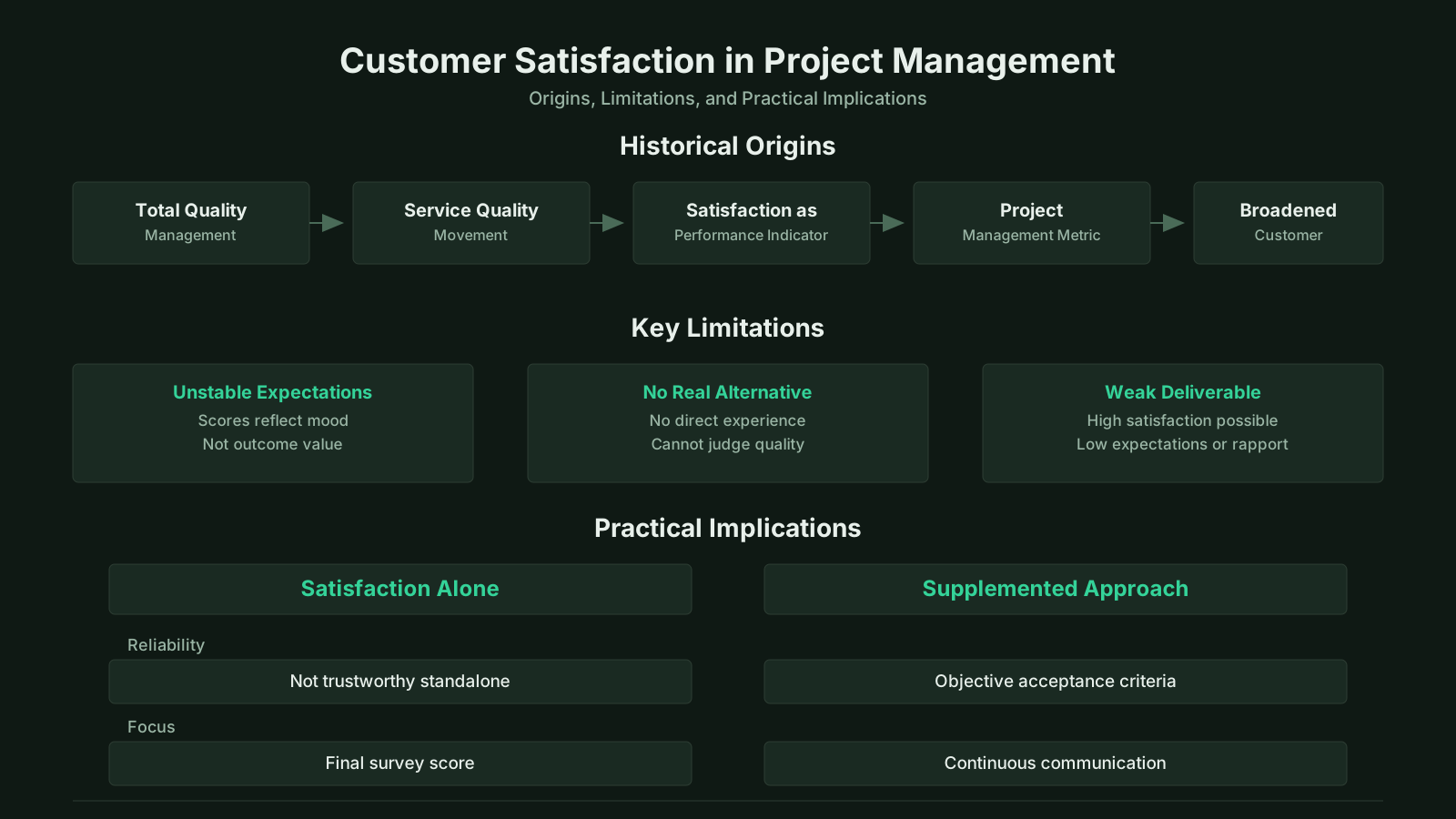
The origins of customer satisfaction as a formal management concept lie in marketing, service quality, and total quality management. The term gained prominence through service quality models that treat satisfaction as a function of expected service versus perceived service. Models such as SERVQUAL and the Kano model are often referenced in product and service design, and their logic carries into project delivery. The Kano model, for example, distinguishes basic needs, performance needs, and delighters. A customer may not mention a basic need because they assume it will be met, but its absence produces intense dissatisfaction. That insight explains why some project failures seem disproportionate to the stated requirements.
In manufacturing, the quality movement shifted focus from inspecting defects out of products to designing processes that consistently produce what the customer wants. Project management borrowed this perspective. Rather than waiting until handover to discover whether the customer is satisfied, modern project practice treats satisfaction as something to be engineered through requirements analysis, quality planning, and continuous stakeholder engagement. In service industries such as hospitality and healthcare, satisfaction measurement became a standard operational practice long before it was formalized in project frameworks. That cross-industry experience demonstrated that satisfaction is not a single score but a dynamic condition influenced by many small interactions.
In software engineering, customer satisfaction has been an explicit value since the rise of iterative methods. The Agile Manifesto places customer satisfaction as the highest priority. That framing has influenced predictive project management as well, where customer satisfaction is now more commonly discussed alongside traditional measures like schedule and budget variance.
Core Takeaways on Satisfaction's Roots
- Service quality model foundations
- Customer satisfaction originated in marketing, service quality, and total quality management, where it is operationalized as the gap between what customers expect and what they perceive they receive.
- Kano model need categories
- The Kano model separates basic needs, performance needs, and delighters, clarifying why unmet basic requirements can produce disproportionately intense dissatisfaction.
- Manufacturing quality evolution
- The manufacturing quality movement shifted from post-production defect inspection to process design that reliably produces what customers actually value.
- Cross-industry satisfaction practice
- Hospitality and healthcare organizations embedded satisfaction measurement into routine operations well before project management frameworks adopted it alongside schedule and budget variance.
Customer Satisfaction in PMBOK and PRINCE2
Within the PMBOK framework, customer satisfaction in PMBOK guidance appears most directly in project quality management. The sixth edition describes customer satisfaction as a key principle for quality, stating that projects should aim to meet customer requirements and avoid gold plating. Gold plating refers to adding features or improvements that were not requested, which can introduce risk, consume resources, and reduce customer satisfaction by creating surprises outside the agreed scope. This principle means that doing more than the customer asked is not automatically a good thing. It can create maintenance burdens, usability confusion, or expectation patterns that harm the relationship.
PMBOK Interpretation
PMBOK also places customer satisfaction within stakeholder management and communication. Identifying the customer as a key stakeholder and understanding their expectations, influence, and interest is part of stakeholder analysis.
Measuring Customer Satisfaction in Project Management
Measuring customer satisfaction in project management requires a mix of formal metrics and informal listening. Formal measurement often includes structured surveys, Net Promoter Score style questions, or Customer Satisfaction Score items administered at milestone reviews and project closeout. These instruments capture the customer’s overall perception, likelihood to recommend the provider, and specific satisfaction with communication, quality, and responsiveness. However, survey results are lagging indicators. They tell the project manager about problems after they have already affected the relationship.
Formal Instruments
Informal measurement is continuous. It includes observing tone in meetings, tracking the speed of customer responses, noting the frequency of escalations, and paying attention to whether the customer proactively shares information. A customer who goes quiet is sometimes satisfied and disengaged, but often the silence signals frustration or disconnection. Experienced project managers watch for shifts in engagement patterns more than they rely on periodic scorecards.
Informal Signals and Acceptance Metrics
Acceptance criteria and quality metrics also contribute to satisfaction measurement. If a deliverable passes its acceptance tests but the customer later reports difficulty using it, the technical metrics were necessary but not sufficient. Effective measurement combines objective performance data with subjective perception data. The two may diverge, and that divergence is often the most useful signal. For example, a system may meet all agreed functional requirements while customers report that it takes too many clicks to complete a common task. The requirements were satisfied, but the customer’s experience was not.
One practical limitation is that satisfaction surveys can be gamed. Customers may inflate scores because they like the project manager personally, or they may deflate scores to gain leverage in commercial negotiations. Project managers should read survey results alongside behavioral evidence. A customer who gives a high score but refuses to sign acceptance or delays payment is not fully satisfied. A customer who gives a moderate score but immediately commissions a follow-up project is more satisfied than the number suggests.
Core Takeaways on Satisfaction Measurement
- Formal surveys lag behind reality
- Structured surveys and formal scorecards offer retrospective snapshots that surface dissatisfaction only after the customer relationship has already begun to erode.
- Informal signals reveal true sentiment
- Experienced project managers interpret informal engagement cues such as meeting tone, response speed, escalation frequency, and silence, because a quiet customer often signals frustration rather than satisfaction.
- Technical metrics are not sufficient
- Deliverables can pass acceptance tests and still disappoint customers, as when a system meets every functional requirement but users find that routine tasks require far too many clicks.
Common Challenges and Misconceptions
Several customer satisfaction challenges and misconceptions distort how project teams pursue it. One common misconception is that customer satisfaction means always saying yes. In reality, saying yes to every request can produce scope creep, quality erosion, and delayed delivery, which ultimately lowers satisfaction. Skilled project managers learn to say no in a way that preserves trust by explaining the tradeoff and offering options. A customer may be temporarily unhappy with a refusal but more satisfied later when the project stays on track.
Another misconception is that gold plating increases satisfaction. Adding unrequested features often creates surprise, but surprise in a project context is usually not a positive event. The customer may worry that the extra work was needed to cover a defect, or they may dislike the additional maintenance burden. Gold plating also consumes resources that could have been used to reduce risk or improve quality on agreed requirements.
A practical challenge is the presence of multiple customers with conflicting expectations. A project may have an executive sponsor who wants lower cost, a departmental manager who wants extensive features, and end users who want simplicity. Satisfying all of them equally is rarely possible. The project manager must negotiate priorities and make tradeoffs explicit. If the team silently tries to please everyone, it often satisfies no one.
Late feedback is another persistent challenge. Customers who do not engage during discovery and development often surface concerns only at final acceptance. By that time, changes are expensive and damaging to the schedule. Project managers can reduce this risk by building review points into the plan and making it easy for customers to provide feedback early. But the customer’s availability is not fully under the project manager’s control, so some residual risk remains.
Customer Satisfaction vs Other Success Criteria
Comparing customer satisfaction vs project success helps clarify what the concept can and cannot tell us. Project success is often measured against the triple constraint of scope, schedule, and budget. A project can meet all three and still produce low customer satisfaction if the deliverable does not solve the underlying problem or if the working relationship was poor. Conversely, a project can exceed schedule and budget yet still be judged successful by the customer because the outcome was valuable and the process was transparent. Satisfaction is therefore related to success but not identical to it.
Product quality and customer satisfaction also differ. Quality is the degree to which a deliverable conforms to requirements and is fit for use. Satisfaction includes that perception but layers on emotional and relational factors. A high-quality product delivered through an unpleasant process may produce mixed satisfaction. A lower-quality product that is easy to use and accompanied by responsive support may produce surprisingly high satisfaction in the short term. Over the longer term, however, poor quality tends to erode satisfaction regardless of how friendly the team was.
Benefits realization is another adjacent concept. Customer satisfaction is a perception at a point in time, while benefits realization is the measurable improvement that occurs after the deliverable is in use. They are linked because a dissatisfied customer is unlikely to adopt the deliverable fully enough to realize benefits. But satisfaction can be high at handover and fade later if the benefits do not materialize. Some organizations separate acceptance satisfaction from post-implementation satisfaction to capture this dynamic.
Key Insights on Satisfaction vs Success
- Success constraints differ from satisfaction
- A project can meet every scope, schedule, and budget target and still produce low customer satisfaction when the deliverable fails to resolve the underlying problem or the working relationship felt strained.
- Quality alone does not guarantee satisfaction
- Because satisfaction layers emotional and relational factors onto perceptions of quality, a technically excellent deliverable can still feel disappointing after a difficult process, while persistent quality problems will eventually erode satisfaction no matter how positive the relationship was.
- Satisfaction versus benefits realization
- Customer satisfaction reflects a perception captured at a specific point in time, whereas benefits realization measures the actual improvements that emerge once the deliverable is actively used.
Evolution and Current Thinking
Current thinking on customer satisfaction has shifted from a gate at project close to a continuous concern throughout the project life cycle. The most widely accepted practice is to identify customer expectations early, align them with project constraints, and revisit them at each stage. This reflects the influence of Agile delivery, service design, and the growing emphasis on value over output. Many organizations now include current thinking on customer satisfaction metrics in their project management dashboards alongside schedule and cost variance.
There is ongoing debate about whether customer satisfaction should be a primary project success measure or a supporting indicator. Some practitioners argue that satisfaction is too subjective and easily manipulated to serve as a reliable governance metric. Others maintain that satisfaction is the only measure that captures whether the customer will use the result and return for future work. The practical resolution is often to use satisfaction as one of several balanced measures, not as the sole determinant of success.
Another shift is the recognition that customer satisfaction depends heavily on expectation management before and during delivery. Teams that invest in a clear project charter, transparent reporting, and honest risk discussions tend to produce higher satisfaction even when projects encounter difficulty. The trend is toward earlier and more frequent customer involvement, not only in Agile settings but also in predictive projects through stakeholder workshops and iterative prototyping. As project management continues to evolve, customer satisfaction remains a central reminder that projects exist to serve people, not just to complete tasks.