Communication planning is defined as the structured process of determining what information project stakeholders need, when and how they should receive it, and who is responsible for delivering it. In project management, it produces a communications management plan that guides formal and informal project communication from initiation through closure. The term encompasses more than schedules for status meetings. It includes audience analysis, channel selection, message format, frequency, feedback loops, and the rules for escalating issues that cannot be resolved at the working level.
Communication Planning: Key Topics at a Glance
| Key Concept | Summary |
|---|---|
| Communication Planning | Communication planning systematically identifies stakeholder information needs, defines message content and timing, and establishes delivery mechanisms that keep every audience aligned across the project life cycle. |
| Core Components | A robust communication plan specifies audience segments, preferred channels, message formats, cadence, feedback mechanisms, and clear escalation thresholds for issues that exceed working level authority. |
| Audience Needs | Stakeholder information needs vary sharply by role: sponsors typically require concise weekly status summaries to govern effectively, while engineering teams often need granular technical data within hours to maintain momentum. |
| Channel Selection | Matching channel and cadence to each audience prevents value leakage, for example by ensuring sponsors receive current decision grade summaries rather than stale reports and engineers receive only the technical detail that supports active work. |
| Feedback Loops | Structured feedback loops confirm that messages are understood as intended and provide early signals for refining channel, cadence, and content before misalignment escalates. |
| Escalation Rules | Escalation rules create a controlled path for issues that exceed working level authority, specifying trigger conditions, decision makers, and response timeframes so that critical problems receive timely executive attention. |
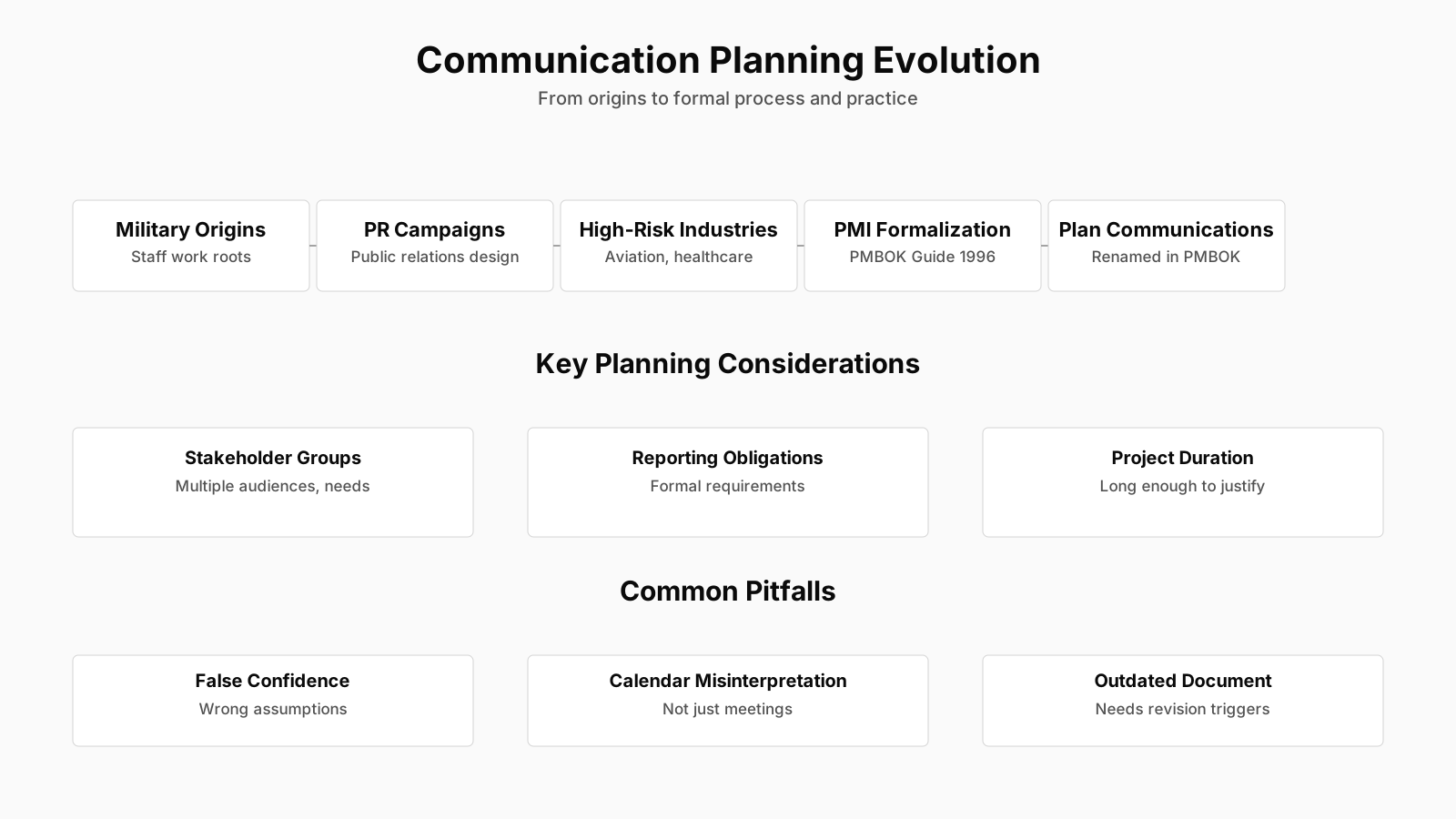
| Historical Origins | Communication planning has deep roots in command and control environments. Aviation formalized crew resource management, while healthcare adopted structured handoff protocols to reduce harmful information gaps. |
| Modern Practices | Modern software delivery added iterative feedback loops, visible information radiators, and a preference for direct conversation over lengthy documentation, shifting communication from static reporting to continuous alignment. |
What Is Communication Planning?
A practical way to understand what is communication planning is to separate it from the simple act of sending messages. Many project managers communicate constantly without ever planning communication. That means information flows by habit, personal preference, or urgency rather than by design. Communication planning makes information flow intentional. It asks who needs to know something, why they need it, what detail is useful, how quickly the information loses value, and who should deliver it.
Communication Planning Definition
Communication planning refers to the process of analyzing stakeholder information requirements and designing a coherent approach for satisfying them throughout the project life cycle. It is both an analytical activity and a design activity. The analysis focuses on audience needs, message content, and the consequences of information arriving late or never arriving at all. The design activity translates those requirements into structured channels, formats, ownership, and timing.
Imagine a large infrastructure project where the sponsor cannot act on a risk without a concise weekly summary, while the engineering team needs raw technical data within hours. If both groups receive the same monthly newsletter, the sponsor gets useful information too late and the engineers drown in irrelevant detail. Communication planning prevents that mismatch by making information needs explicit before execution begins.
Core Takeaways on Communication Planning
- Planning versus sending messages
- Communication planning is distinct from message delivery because frequent communication alone does not ensure that information reaches the right people at the right time for the right reason.
- Intentional information flow
- A communication plan shifts information from reactive distribution to deliberate routing by clarifying who needs each piece of information, why it matters, what level of detail is useful, how time-sensitive it is, and which person or role should deliver it.
- Formal definition and scope
- Communication planning systematically analyzes what stakeholders need to know and designs an integrated approach that keeps the right information flowing across every phase of the project.
- Audience-tailored delivery design
- Effective design converts stakeholder requirements into clear choices about channels, formats, ownership, and cadence, ensuring sponsors receive concise weekly updates while engineers get raw technical data within hours instead of relying on a generic monthly newsletter for both audiences.
Origins and Cross-Industry Context
The origins of communication planning are rarely discussed in project management texts, but the practice has deep roots in command and control environments. Military staffs have long used concise situation reports and clearly assigned communication responsibilities. Aviation applied similar principles through crew resource management, where unexpected information is shared without regard to rank. Healthcare adopted structured handoff protocols because incomplete shift transitions became a measurable source of patient harm. These fields treat communication failure as a system failure rather than a personal weakness.
Cross-Industry Influence on Project Management
Project management absorbed these lessons mostly through standards bodies and large engineering programs. The idea that a project manager can plan communication the way one plans procurement or schedule is relatively modern. Early project management focused heavily on work breakdown structures and critical path logic. Communication was considered a soft skill. That changed as project failure reviews repeatedly identified unclear expectations and silent stakeholders as root causes. Software development then contributed iterative feedback, visible information radiators, and the principle that direct conversation often replaces lengthy documentation.
Key Components of Communication Planning
The key components of communication planning are not formats and templates. They are the underlying decisions about audience, information need, channel, frequency, ownership, and feedback. A template can help standardize those decisions, but it cannot make them. Projects that simply fill in a communication matrix without thinking through these components often end up with a plan that looks complete but does not reflect how people actually work.
Audience and Information Requirements
A communication plan starts with a realistic map of stakeholders. It separates decision makers, influencers, users, and regulatory observers. Each group has different information needs. The sponsor may need earned value data and strategic risk indicators. A regulator may need proof of compliance status. A workstream lead may need issue resolution status. Effective planning records those differences instead of assuming one report fits everyone. The audience analysis also distinguishes between people who must act on information and people who only need awareness.
Channels, Frequency, and Ownership
Channels define how information moves. Push channels such as email or broadcast announcements reach many recipients quickly but can create noise. Pull channels such as shared dashboards or document repositories let stakeholders retrieve information when they need it. Interactive channels such as meetings, workshops, and direct conversations allow immediate feedback. A communication plan assigns each channel to a purpose. It also states frequency and owner. Without named owners, a planned report can disappear the first time the project gets busy.
Feedback Mechanisms and Escalation Paths
Planning also includes how recipients can respond. A status report that provides no path for questions or corrections is not communication; it is distribution. Feedback loops may be formal, such as review cycles, or informal, such as open office hours. Escalation paths define what happens when a risk, conflict, or decision cannot be resolved at the team level. These paths are often neglected until a crisis occurs. A well designed communication plan makes the path visible before it is needed.
Key Takeaways on Communication Planning
- Decisions over templates
- Effective communication planning depends on clear decisions about audience, information need, channel, frequency, ownership, and feedback rather than on completing formats and templates.
- Map stakeholders realistically
- A credible communication plan starts with a realistic stakeholder map that distinguishes decision makers, influencers, users, and regulatory observers.
- Tailor information to each audience
- Because a sponsor may need earned value metrics and strategic risk indicators while other groups require different data, the plan must document these audience-specific requirements rather than assuming a single report serves everyone.
- Match channels to purpose
- Planning must balance push, pull, and interactive channels such as email, shared dashboards, and meetings to match how stakeholders retrieve information and provide feedback.
Communication Planning in PMBOK
The communication planning PMBOK process sits within the Project Communications Management knowledge area and the Planning process group. It is formalized as Plan Communications Management. This process develops an appropriate approach and plan for project communication activities based on stakeholder information needs, requirements, and available organizational assets. It is not a one time administrative step. The process considers the project environment, the sensitivity of information, and the communication requirements set out in the project charter and stakeholder register.
The Plan Communications Management Process
Within the PMBOK Guide, communication planning produces the communications management plan. This plan becomes a subsidiary component of the project management plan. It defines what information will be communicated, the purpose of the communication, the audience, the method, the frequency, and the responsible person. It may also include escalation procedures, glossaries of common terms, and any restrictions such as confidentiality or regulatory disclosure rules. Project document updates are common because communication needs change when new stakeholders appear or a risk matures.
Tools and Analytical Inputs
The main inputs include the project charter, the project management plan, the stakeholder register, and enterprise environmental factors such as organizational culture, geographic distribution, and existing communication infrastructure. Tools include communication requirements analysis, communication technology analysis, communication models, and communication methods. Communication requirements analysis typically examines stakeholder roles, organizational relationships, internal and external dependencies, and the number of communication channels. A large number of channels can illustrate complexity, but experienced planners do not stop at counting possible connections. They focus on the few connections that actually drive decisions.
Communication Planning in PRINCE2
The practice of communication planning PRINCE2 is embedded in the Communication Management Strategy produced during the Initiating a Project process. PRINCE2 treats this strategy as a formal management product. It is not an optional spreadsheet. The strategy describes the means and frequency of communication between the project and its stakeholders. It identifies the information to be communicated, who will receive it, who will send it, the format, and the timing.
The Communication Management Strategy
Unlike a generic communication plan, PRINCE2 sees the Communication Management Strategy as one of several management products that together define how the project will be governed. It is reviewed at stage boundaries to ensure it still matches the current stage plan and stakeholder environment. That review is important because PRINCE2 stages create natural moments where stakeholder needs may have shifted. A strategy that was correct during initiation may be out of date by the second delivery stage.
How PRINCE2 Differs from PMBOK
The difference between PMBOK and PRINCE2 is mostly structural, not philosophical. PMBOK presents communication planning as one process among many in a knowledge area. PRINCE2 embeds it in a product oriented governance baseline. PMBOK may place the communications management plan as a subsidiary plan within the project management plan. PRINCE2 keeps the Communication Management Strategy as a standalone management product that can be updated without revising the entire project plan. Both expect the plan to be live rather than fixed.
Key Insights on PRINCE2 Communication
- Formal management product
- The Communication Management Strategy is a formal PRINCE2 management product that must be created during the Initiating a Project process, rather than being treated as an optional document.
- Specifies communication parameters
- The strategy establishes a deliberate and consistent communication cadence by specifying the information to be shared, the sender and recipient for each message, the format, and the timing.
- Reviewed at stage boundaries
- At each stage boundary, the strategy is reviewed to ensure it remains aligned with the current stage plan and continues to reflect evolving stakeholder requirements.
- Standalone, independently updated
- As a standalone management product, the Communication Management Strategy can be updated independently, without requiring a revision of the entire project plan.
Communication Planning in Agile and Hybrid Environments
Agile teams often resist the term communication planning because it can sound like bureaucracy. In practice, communication planning in Agile still occurs, but it is lightweight and embedded in cadence rather than stored in a separate plan. Daily standups, sprint reviews, retrospectives, and visible product backlogs are communication mechanisms that the team plans when it defines its working agreements. Physical or virtual information radiators show build status, blockers, and progress without requiring a status report.
Agile Practices and Lightweight Planning
Planning in an Agile environment means deciding what information must be radiators, what must be conversations, and what must be recorded for external compliance. Osmotic communication, where team members overhear relevant conversations and gain context, works when people are co located or in shared digital spaces. The team may agree on a simple set of rules. A product owner might need an immediate alert when a sprint goal is at risk. A release manager might need a change log when the definition of done changes. These small agreements are still communication planning, even if no formal plan document exists.
Hybrid Variations
Hybrid projects frequently combine predictive governance with Agile delivery. A project may need formal monthly steering committee reports while a development team uses a Kanban board and daily standup. In that case, communication planning has to do two jobs at once. It must satisfy enterprise reporting expectations and preserve the speed of local team communication. The plan may define a thin bridge between both worlds, such as translating team metrics into portfolio level progress data. This is often harder than choosing purely predictive or purely Agile because the audiences do not share the same assumptions about what constitutes useful information.
Communication Planning and BVOPM
In BVOPM, BVOPM communication planning is treated as a lean practice tied to stakeholder involvement and team dependency analysis. The methodology mandates that planning documents be brief enough to be read by everyone, including new joiners, so communication requirements do not become hidden bureaucracy. It also uses hiring and training dependencies to identify where skill gaps may change who needs to receive certain technical information and when. The communication plan remains a supporting artifact rather than a heavy document.
Core Insights on BVOPM Planning
- Lean communication practice
- BVOPM positions communication planning as a lean discipline that directly connects stakeholder engagement with an analysis of how teams depend on one another.
- Brief, readable planning documents
- Planning documents stay concise enough for any team member, including new joiners, to read in full, preventing communication requirements from becoming an invisible layer of bureaucracy.
- Skill gaps shape information flow
- By examining hiring and training dependencies, teams can pinpoint where skill gaps change the recipients and timing of technical information flows.
- Supporting artifact, not heavy burden
- Within the methodology, the communication plan functions as a lightweight supporting artifact rather than an administrative burden.
Purpose and Importance of Communication Planning
The purpose of communication planning is not to generate more messages; it is to make the right information available to the right people at the right time. A well designed plan reduces ambiguity, protects the team from information overload, and creates a shared expectation about how decisions are supported. It also gives stakeholders a predictable way to raise concerns before those concerns become formal issues.
Why Communication Planning Matters
Projects stall when decision makers lack the information they need, when technical teams hide bad news, or when external stakeholders hear about changes from outside the project team. A communication plan reduces that risk by assigning explicit channels and expectations. It also protects the team from redundant requests. When everyone knows which reports matter and which updates are optional, the project spends less time responding to ad hoc demands for information that already exists somewhere else.
Cost of Poor Communication Planning
Poor planning often shows up as meeting fatigue, duplicate reports, conflicting versions of the truth, and delayed decisions. In regulated industries, it can become a compliance problem if required notifications are not defined early. The financial cost is usually indirect. It appears as rework from misunderstood requirements or as schedule slips caused by a risk that was known at the working level but never surfaced to a sponsor. Communication planning cannot prevent every human misunderstanding, but it removes structural reasons for silence.
Common Challenges, Pitfalls, and Misconceptions
The common challenges in communication planning tend to be behavioral rather than technical. Teams know how to use email, dashboards, and meetings. What they struggle with is discipline, consistency, and honest assessment of what stakeholders actually need. The most frequent failure is treating the plan as a documentation exercise instead of a living agreement.
Overcommunication and Information Overload
A common misconception is that more communication is always better. This is false. Every additional channel or recurring meeting has a cognitive cost. People start ignoring messages when the volume exceeds their capacity. A communication plan that copies everyone on everything creates noise, not transparency. Experienced planners differentiate between mandatory and discretionary information, and they protect low frequency high importance messages from being lost among routine updates.
Treating the Plan as Static
Another pitfall is treating the communication plan as a one time artifact produced during project initiation. Stakeholder needs change when the project moves phases, when new vendors are onboarded, or when a crisis changes the risk landscape. A static plan becomes obsolete quietly. Project managers sometimes discover this when a frustrated stakeholder asks why they are still receiving a report that no longer reflects their responsibility. Communication planning should be reviewed at phase gates and whenever the stakeholder register changes.
Confusing Communication with Reporting
Some teams mistake communication planning for a reporting schedule. Reporting is one part of communication. It is mostly one way and formal. Communication also includes negotiation, expectation setting, active listening, informal updates, and conflict resolution. A plan that only lists reports may satisfy a PMO audit but will not support real decision making. It may also miss the difference between push communication, which sends information to a recipient, and pull communication, which makes information available for someone to retrieve.
Summary of Communication Planning Pitfalls
- Behavioral challenges trump technical ones
- Most teams have the technical tools well in hand, yet they falter on the sustained discipline, consistent execution, and candid stakeholder analysis that effective communication planning actually requires.
- Plan as a living agreement
- The most common pitfall is reducing the communication plan to a static documentation task instead of treating it as a working agreement that adjusts as project conditions evolve.
- More communication is not better
- Once message volume exceeds what people can reasonably absorb, they start tuning out, which means excessive communication directly erodes the engagement it was meant to build.
- Protect high importance messages
- Skilled planners separate mandatory information from optional updates and take deliberate steps to ensure that infrequent, high importance messages do not get buried under routine communications.
- Static plans become obsolete
- A plan treated as a one time deliverable quickly becomes outdated because stakeholder needs shift with project phases, vendor changes, and evolving risk profiles, which leaves affected stakeholders without the information they require.
Communication Planning vs Related Concepts
One of the most useful distinctions is communication planning vs stakeholder engagement plan. These two artifacts overlap heavily but serve different purposes. A stakeholder engagement plan defines how the project will involve stakeholders in decisions, manage their expectations, and increase their support. A communications management plan defines how information will flow. A regulator may require high engagement but low communication volume. A skeptical executive may need highly tailored messages but little involvement in daily decisions.
Communication Plan vs RACI and Risk Register
The communication plan may reference roles from a RACI matrix, but it does not replace it. RACI clarifies accountability for tasks and decisions. Communication planning clarifies who needs to know about those tasks and decisions. Similarly, risk communication is often a section in the risk management plan, but the communication plan defines the channels and cadence for escalating risks. The two plans should be consistent. A risk owner listed in the risk register should also appear as a recipient in the communication plan for the relevant risk category.
Communication Plan vs Project Schedule
Project schedules contain milestones, gates, and dependencies. Communication plans contain cadence and information flow. They are linked because many communication events, such as steering committee reviews, become schedule activities. However, a communication plan should not simply duplicate the meeting calendar. It should explain why the meeting exists and what decision it supports. If a meeting cannot be tied to a decision or an information need, that is a strong signal it may be unnecessary.
Evolution and Current Thinking
The evolution of communication planning reflects a broader shift from compliance oriented documentation to outcome oriented collaboration. The PMBOK Guide Seventh Edition reflects this by moving away from strict process language toward principles and performance domains, but communication planning logic remains vital under the stakeholder and team performance domains. Projects still need clarity about who communicates what, especially when delivery is distributed and decision pressure is high.
From Push Only to Multi Directional Systems
Early project communication plans often read like distribution lists. They grew from the assumption that project managers generate status and push it upward. Current thinking recognizes that valuable information originates at the working level and must flow upward, laterally, and outward as well. The plan is now more likely to include feedback loops, psychological safety considerations, and methods for capturing weak signals before they become formal risks. This shift has made communication planning more behavioral and less mechanical.
Remote Work, Tools, and Human Factors
Remote and distributed teams have forced another shift. The plan can no longer assume hallway conversations or visible whiteboards. It must account for time zones, asynchronous tools, messaging overload, and video meeting fatigue. Some organizations now plan for communication quiet periods, where deep work is protected from constant notifications. This is a sign that communication planning has moved from maximizing reach to managing attention. The value is not in sending more; it is in sending less but better.
Debates and Open Questions
There is healthy debate about how formal a communication plan should be in Agile or startup environments. Some practitioners argue that too much structure slows feedback. Others counter that even lightweight teams benefit from explicit expectations about who owns release notes, incident communication, or customer notifications. The consensus position is context dependent. A communication plan should be scaled to the project's uncertainty, regulatory exposure, stakeholder distribution, and complexity. It is not a universal template. The most effective communication plans are short enough to be read, specific enough to resolve ambiguity, and flexible enough to change when the project changes.
Key Insights on Planning Evolution
- From compliance to collaboration
- Communication planning now prioritizes collaborative outcomes over compliance documentation, with success measured by decision quality and alignment rather than by the completion of procedural checklists.
- PMBOK principles retain planning logic
- Even though the PMBOK Guide Seventh Edition replaced process groups with principles and performance domains, the underlying logic of communication planning remains indispensable for managing stakeholder expectations and team engagement.
- Multi-directional information flow
- Effective communication plans now treat valuable information as originating at the working level and require deliberate upward, lateral, and outward channels that capture feedback loops and weak signals before they escalate.
- Remote work reshapes assumptions
- With distributed teams, informal mechanisms such as hallway conversations and physical whiteboards are no longer reliable, so communication plans must explicitly address digital collaboration tools, asynchronous norms, and the human factors that sustain trust.
- Ongoing formality debate
- Agile and startup contexts continue to debate the appropriate level of formality in communication planning, with practices ranging from lightweight working agreements to structured documentation and no consensus emerging across industries.