Cost-benefit analysis (CBA) in project management is defined as a structured evaluation method that compares the total expected costs of an initiative with its total anticipated benefits, both expressed in monetary terms where possible, to determine whether the investment is justified and which option delivers the strongest net value. It is used at multiple decision gates, from initial idea screening to post-implementation review, and it answers a fundamental management question: is this project worth doing at all, and is it worth doing compared with the alternatives.
Cost-Benefit Analysis: Key Topics at a Glance
| Key Concept | Summary |
|---|---|
| Definition | Cost-benefit analysis is a systematic appraisal framework that quantifies and compares all expected costs and benefits in monetary terms to determine whether an investment is economically justified and which option delivers the highest net value. |
| Decision-Making Role | CBA serves as a decision gate instrument at multiple stages, from initial concept screening through post-implementation evaluation, enabling stakeholders to determine whether a project should proceed, continue, or be displaced by a stronger alternative. |
| Core Methodology | The formal process involves systematically identifying, quantifying, and comparing all material positive and negative impacts of a proposed project across a clearly defined evaluation period, ensuring that no significant effect is overlooked. |
| Comparative Valuation | Unlike a straightforward budget comparison, CBA expresses both benefits and costs in identical monetary units, allowing decision makers to see the margin by which benefits exceed costs, the magnitude of the difference, and the assumptions driving that result. |
| Analytical Components | An effective analysis establishes the baseline scenario, catalogs all relevant costs and benefits, assigns monetary values to each item, discounts future amounts to present value, and reports summary metrics such as net present value, internal rate of return, and benefit-cost ratio. |
| Cost Classification | Cost categories include direct and indirect expenses, capital and operating outlays, fixed and variable cost behavior, and opportunity costs that reflect the value of the next best alternative. |
| Valuation Techniques | When outcomes lack direct market prices, analysts use established valuation methods including contingent valuation, hedonic pricing, and shadow pricing to derive monetary estimates. These techniques, originally developed for public sector appraisals, now influence investment decisions in construction, healthcare, and information technology. |
| Agile Integration | Agile teams apply lightweight economic instruments such as prioritized backlogs, cost of delay, weighted shortest job first, and minimum viable product validation to confirm that each incremental work package justifies its cost and contributes to overall value delivery. |
What Is Cost-Benefit Analysis in Project Management?
The cost-benefit analysis in project management definition encompasses a formal process of identifying, quantifying, and comparing all relevant positive and negative impacts of a proposed project over a defined analysis horizon. Unlike a simple budget check, CBA attempts to express both sides of the value equation in comparable terms, typically currency, so that decision makers can see whether benefits exceed costs, by how much, and under what assumptions.
The analysis usually includes several logical elements: establishing a baseline scenario, cataloguing costs and benefits, assigning monetary values where feasible, converting future values into present terms, and presenting a summary measure such as net present value or benefit-cost ratio. These elements are often iterative. Early estimates are refined as the project scope, schedule, and risk profile become clearer.
Think of it as a balance sheet for a decision. A procurement team wants new software. Licensing, implementation, training, and maintenance costs sit on one side. Faster processing, fewer errors, reduced manual effort, and possibly new revenue sit on the other. CBA gives those disparate effects a common unit. A sponsor can then weigh the investment against other options instead of relying on intuition or advocacy.
In professional practice, the term is often used interchangeably with benefit-cost analysis. Both refer to the same underlying discipline. The separate wording is mostly a matter of convention across industries and regions. What matters is that the approach is systematic, documented, and capable of supporting a defensible decision.
Key Takeaways on Cost-Benefit Analysis
- Formal comparison process
- Cost-benefit analysis is a structured approach that identifies, quantifies, and compares the full range of expected positive and negative impacts over a clearly defined evaluation period.
- Expresses value in currency
- Rather than merely tracking cash outlays, CBA converts all measurable effects into comparable monetary values, allowing decision makers to assess whether total benefits justify total costs.
- Core analytical elements
- A sound CBA establishes the baseline scenario, identifies and values all relevant costs and benefits, discounts future cash flows to present value, and reports decision-ready metrics such as net present value and the benefit-cost ratio.
- Iterative refinement process
- Initial cost-benefit estimates should be updated regularly as project scope, schedule, and risk exposure become more certain, turning early approximations into increasingly reliable decision inputs.
- Balance sheet for decisions
- CBA equips sponsors with a consistent economic logic for comparing alternatives, such as weighing software licensing and training costs against gains from faster processing, reduced error rates, and additional revenue opportunities.
Origins and Cross-Industry Context
The origins of cost-benefit analysis lie in welfare economics and public policy evaluation. Governments have used systematic benefit-cost comparison for infrastructure, health, environmental, and defense investments for decades. Public agencies often require a standardized appraisal to justify the use of taxpayer funds, and that tradition shaped many of the evaluation practices later adopted in private-sector project management.
Engineering economics, transport planning, environmental regulation, and public health have all refined cost-benefit methods. In these fields, benefits often include non-market goods such as reduced travel time, cleaner air, or saved lives. Analysts developed valuation techniques like contingent valuation, hedonic pricing, and shadow pricing to assign monetary estimates to outcomes that have no direct market price.
That cross-industry experience matters because many projects in construction, transportation, healthcare, and information technology borrow from those traditions. Project managers may not perform sophisticated welfare analysis, but they inherit the expectation that a proposed initiative should show a reasonable relationship between what it consumes and what it produces. Public-sector project management in particular continues to rely on cost-benefit logic for funding approvals and stakeholder accountability.
Key Components of Cost-Benefit Analysis
The key components of cost-benefit analysis include the baseline, cost identification, benefit identification, valuation, discounting, and sensitivity testing. Each element shapes whether the analysis produces a reliable decision input or simply a persuasive narrative. A weakness in any single component can distort the outcome or hide a poor investment.
Cost Identification and Classification
Project costs include direct and indirect expenses, capital and operating expenditures, fixed and variable costs, and opportunity costs. Direct costs are usually visible, such as equipment, staffing, materials, software licenses, and consulting fees. Indirect costs include overhead allocation, training time, transition disruption, and ongoing administrative burden. Opportunity cost captures what the organization gives up by committing resources to this project instead of another.
A frequent omission is the full life span of costs. A system may have low initial licensing fees but high integration, customization, and long-term maintenance obligations. CBA should include costs from initiation through decommissioning, including residual disposal, data migration, or contract exit expenses. Sunk costs should be recorded for accounting completeness, but they should not influence future decisions about whether to continue.
Costs can also be categorized as tangible or intangible. Tangible costs have clear market prices. Intangible costs, such as loss of staff morale during a disruptive reorganization, are harder to value but may be significant. A complete analysis acknowledges them even when precise monetary valuation is difficult.
Benefit Identification and Valuation
Benefits are the positive consequences of undertaking the project. They may be financial, such as increased revenue, cost savings, tax reductions, or avoidance of future expenses. They may also be non-financial, such as improved customer satisfaction, employee retention, regulatory compliance, or brand reputation. Valuation seeks to translate these outcomes into monetary terms using observable prices, internal chargebacks, or structured estimation techniques.
Some benefits are straightforward to quantify. Reduced processing time can be multiplied by loaded labor rates, and avoided penalties can be estimated from regulatory schedules. Others require assumptions, such as the revenue impact of a faster product launch or the value of better decision-making from an analytics platform. The analysis should state those assumptions explicitly so they can be challenged and updated.
Not every benefit must be monetized to be legitimate. Many organizations present a core financial analysis alongside a separate articulation of strategic and qualitative benefits. The danger arises when intangible benefits are silently used to justify a weak financial case without any ownership or measurement plan. Good practice links each benefit to an owner, a metric, and a timeline.
Discounting and the Time Value of Money
Money received or spent in the future is worth less than the same amount today. Discounting converts future cash flows into present value equivalents using a selected discount rate. The discount rate usually reflects the organization's cost of capital, a hurdle rate, or the government's social discount rate. The choice can materially change project attractiveness.
A high discount rate penalizes projects whose benefits arrive far in the future, while a low rate makes long-horizon investments more attractive. The selection is not purely technical. It is also an expression of risk preference, funding constraints, and organizational time horizon. Transparent documentation of the discount rate and its rationale is part of a defensible cost-benefit analysis.
In many project appraisals, analysts calculate net present value by subtracting discounted costs from discounted benefits. A positive net present value suggests that benefits exceed costs in present terms. The benefit-cost ratio expresses discounted benefits divided by discounted costs. A ratio greater than one indicates that benefits outweigh costs. Both measures are derived from the same underlying data but serve slightly different communication purposes.
Sensitivity Analysis and Uncertainty
Every CBA rests on assumptions about future volumes, prices, adoption rates, and execution risk. Sensitivity analysis tests how the result changes when key variables move within a plausible range. Scenario analysis, Monte Carlo simulation, and break-even analysis are related methods. A robust analysis identifies which variables have the greatest influence on net value.
Treating the initial point estimate as a precise prediction is a common error. Decision makers need to know not just the expected result but the range around that result and the conditions under which the project would cease to be worthwhile. That is what sensitivity and uncertainty analysis provide. A project may look acceptable under a base case but become unattractive with a modest decrease in expected benefits or increase in integration cost.
Key CBA Component Insights
- Six core CBA components
- The analysis rests on six core components: establishing a baseline, identifying costs, identifying benefits, assigning monetary values, applying discounting, and performing sensitivity testing. Each element determines whether the result functions as a reliable decision input or merely as a persuasive narrative.
- Cost identification and classification
- A complete cost profile includes direct and indirect expenses, capital and operating expenditures, fixed and variable costs, and opportunity costs. Direct items such as equipment and staffing are highly visible, while indirect items like overhead allocation, training time, transition disruption, and ongoing administrative burden are frequently underestimated.
- Full lifecycle cost capture
- A credible CBA captures the full cost lifecycle from project initiation through decommissioning, including residual disposal, data migration, and contract exit expenses. Focusing only on upfront licensing or implementation fees can be misleading because low initial costs often conceal substantial integration, maintenance, and end-of-life obligations.
- Monetary valuation techniques
- Valuation converts project outcomes into monetary terms using observable prices, internal chargebacks, or structured estimation techniques. For example, reduced processing time can be valued at loaded labor rates, avoided regulatory penalties can be derived from published schedules, and revenue or decision-quality improvements can be estimated through clearly stated assumptions.
Cost-Benefit Analysis in PMBOK and PRINCE2
In PMI's framework, the cost-benefit analysis in PMBOK appears primarily in business case development and project selection rather than as a stand-alone knowledge area. The PMBOK Guide describes business documents as inputs to project initiation and emphasizes benefits management as a mechanism for aligning project outputs with organizational strategy. Cost-benefit analysis is one of several benefit measurement methods used for project selection, alongside scoring models, payback period, net present value, internal rate of return, and economic value added.
Within PMI's broader standards, CBA connects to the business case, benefits management plan, and project charter. The business case documents the rationale and expected value. The benefits management plan identifies benefits, owners, metrics, and risks. The charter authorizes the project and may reference the business case as justification. In program management, CBA supports program business cases, component selection, and benefit realization comparisons across multiple projects.
The PMBOK Guide also places project selection in the context of portfolio management. Prioritization does not rest on CBA alone. Strategic alignment, risk, resource capacity, regulatory obligations, and interdependencies all influence which projects receive funding. A project with strong financial returns may still be delayed if it consumes scarce roles or creates excessive risk elsewhere in the portfolio.
PRINCE2 places cost-benefit analysis within its Business Case theme. The business case is a living document that justifies the project throughout its life. PRINCE2 requires the business case to include options, expected benefits, costs, risks, and value for money. The method distinguishes between outputs, outcomes, and benefits. A new system is an output, its use is an outcome, and the measurable improvement is the benefit. Continued viability checks occur at stage boundaries. If projected costs no longer justify expected benefits, the project may be redirected or closed.
Agile, Hybrid, and Value-Oriented Practices
Cost-benefit analysis in Agile and hybrid environments often takes a continuous and incremental form rather than a single upfront approval exercise. Agile teams may use lightweight economic tools such as prioritized backlogs, cost of delay, weighted shortest job first, and minimum viable product thinking to evaluate whether small increments of work are worth delivering. A formal CBA may be reserved for product or release level decisions, while individual iterations are assessed through value contribution and feedback.
In product-centric delivery, the business case is not frozen. Evidence from actual use changes the perceived value and cost of remaining work. A feature that seemed valuable in initial analysis may be deprioritized after low user engagement. Hybrid approaches combine an initial CBA for overall funding with periodic reviews that update the underlying assumptions. This treats cost-benefit analysis as an ongoing decision discipline rather than a one-time ceremony.
Cost of delay deserves particular attention in Agile settings. It quantifies the value lost per unit of time when a product or feature is not available. When combined with effort estimates, it helps teams sequence work to maximize economic return. That mindset shifts CBA from a document produced for a gate review toward a continuous prioritization habit embedded in backlog management.
Business Value-Oriented Project Management, or BVOPM, applies a similar emphasis on value delivery and waste reduction. In its initiation and benefits-focused practices, it stresses formal stakeholder input validation and includes non-financial program benefits such as employee engagement and future risk reduction. This broadens the benefit side of the equation beyond direct monetary returns, which can be a useful corrective in environments where intangible outcomes matter.
Key Insights on Agile CBA
- Continuous incremental cost-benefit analysis
- Agile delivery embeds cost-benefit analysis into each prioritization decision, using lightweight tools such as prioritized backlogs, cost of delay, weighted shortest job first, and minimum viable product logic rather than a single upfront approval gate.
- Living business case from user evidence
- A product-centric approach treats the business case as a living artifact, updating value and cost assumptions with real usage data so that features showing low engagement can be reprioritized or removed.
- Hybrid funding with periodic reviews
- Hybrid funding models combine an initial cost-benefit review for overall approval with recurring assumption checks, turning the analysis into a prioritization discipline within backlog management and extending its scope to non-financial outcomes such as employee engagement and future risk reduction.
Purpose and Importance of Cost-Benefit Analysis
The purpose of cost-benefit analysis in project management is to provide a rational, transparent, and comparable basis for choosing between competing investments. Organizations rarely have unlimited money, people, or attention. CBA helps sponsors and portfolio managers allocate scarce resources toward initiatives that produce the greatest net benefit relative to their cost.
It also creates accountability. By articulating expected benefits and linking them to a financial value, sponsors commit to a measurable promise. That promise can be revisited during project delivery and evaluated after implementation. Without this discipline, projects can drift into activity for its own sake, consuming resources while producing little demonstrable value.
Cost-benefit analysis is not only about go or no-go decisions. It also supports option comparison, sequencing, scope trade-offs, risk tolerance, and stakeholder communication. A well-structured CBA gives executives a common language with finance, operations, and delivery teams. It answers not simply whether a project is possible, but whether it is worth the organization's limited resources.
The importance of CBA grows as organizational complexity increases. In a small team, a manager may make a decision based on intuition and direct observation. In a large enterprise with many competing proposals, that approach becomes unreliable. Formal analysis creates a repeatable way to compare dissimilar initiatives, whether they involve technology, process change, facilities, or product development.
Practical Application Across the Project Lifecycle
Practitioners encounter the question of when to use cost-benefit analysis at several points: portfolio selection, business case development, phase gate reviews, change control, and benefits realization assessment. The earliest application occurs during idea evaluation, when a rough order of magnitude analysis filters out weak proposals. As an initiative survives screening, the CBA becomes more detailed and more rigorously validated.
During initiation, CBA supports the project charter and funding request. The sponsor and key stakeholders use it to confirm strategic alignment and financial viability. In planning, it informs scope decisions, risk response strategies, and resource allocation. If a change request arises, a revised CBA may show whether the additional scope or cost still makes the project worthwhile.
During execution and monitoring, the analysis may be refreshed as actual cost and benefit data emerge. For large or long projects, periodic revalidation prevents organizations from continuing failed efforts. At closure and beyond, a post-implementation review compares realized benefits against the original CBA. That comparison improves future estimates and reveals whether the project actually delivered its promised value.
Portfolio managers often use CBA as one input among several. A project with strong financial returns may be delayed or rejected if it consumes scarce specialist skills needed elsewhere. The analysis is therefore necessary but not sufficient. It provides decision support, not a mechanical approval rule. Context, strategic fit, and capacity constraints still require human judgment.
In program management, cost-benefit analysis can evaluate a group of related projects as a whole. Some components may be financially weak on their own but enable larger benefits across the program. A platform investment, for example, may enable multiple downstream initiatives that would not otherwise be possible. Program-level CBA captures those interdependencies more accurately than isolated project appraisals.
Key Insights: CBA Across the Lifecycle
- Iterative application at key gates
- Cost-benefit analysis is revisited at portfolio selection, business case development, phase gate reviews, change control, and benefits realization; at each gate it is reframed to answer a specific question about funding, continuation, change, or delivered value.
- Analysis deepens as project matures
- A rough order-of-magnitude filter used at the idea stage evolves into a rigorously validated analysis that supports the project charter, funding request, and planning decisions regarding scope, risk, and resource allocation.
- Revalidation prevents sunk cost traps
- Updating the CBA with actual cost and benefit data during execution, then comparing realized benefits against the original analysis at closure, helps organizations terminate underperforming projects before losses accumulate and capture lessons that improve future investment decisions.
Common Challenges, Pitfalls, and Misconceptions
Common misconceptions about cost-benefit analysis include the belief that it is purely a financial exercise, that all benefits must be monetized, and that a positive result automatically means a project should proceed. In practice, non-monetary and strategic factors often sit alongside the CBA, and a high net present value does not guarantee strategic fit, feasibility, or stakeholder readiness.
One persistent challenge is optimism bias. Project teams often underestimate costs, overstate benefits, and assume smooth implementation. Independent reviews, reference class forecasting, and conservative scenario planning can mitigate this tendency. Another challenge is double counting, where the same benefit appears in multiple categories or periods, inflating the apparent value.
Ignoring the baseline is another pitfall. Benefits must be measured against what would happen without the project, not against the current state if the current state is already changing. For example, a project credited with improving customer retention may be claiming a benefit that would have occurred anyway due to market trends. The no-project baseline, sometimes called the do-nothing scenario, must be explicit.
Misconceptions also arise around sunk costs and escalation. Managers sometimes continue a struggling project because past spending appears too large to waste. From a decision standpoint, those sunk costs should not influence future choices. The relevant question is whether future costs are justified by remaining benefits. Similarly, a CBA should not be treated as a one-time approval document. It requires periodic updating as uncertainty resolves.
Data quality is a further limitation. Early-stage estimates are often based on limited information, and small changes in key assumptions can swing the result from positive to negative. When data is unreliable, the best response is not to avoid analysis but to be explicit about uncertainty. Presenting ranges and testing assumptions is often more useful than delivering a single misleadingly precise number.
There are also situations where formal cost-benefit analysis may be less appropriate. For a small, low-risk internal improvement with obvious productivity gains, a heavyweight CBA can consume more effort than the decision justifies. Regulatory or legal obligations may also require action regardless of financial return. In those cases, the analysis may support the choice of approach rather than the decision to comply.
Relationship to Other Project Management Concepts
A useful distinction is cost-benefit analysis vs ROI and related financial metrics. Return on investment expresses the ratio of net benefits to costs, or sometimes the average annual net profit divided by total investment. Cost-benefit analysis is broader, covering both monetary and non-monetary considerations and producing measures such as net present value, benefit-cost ratio, and internal rate of return. ROI is an output, while CBA is the larger analytical process.
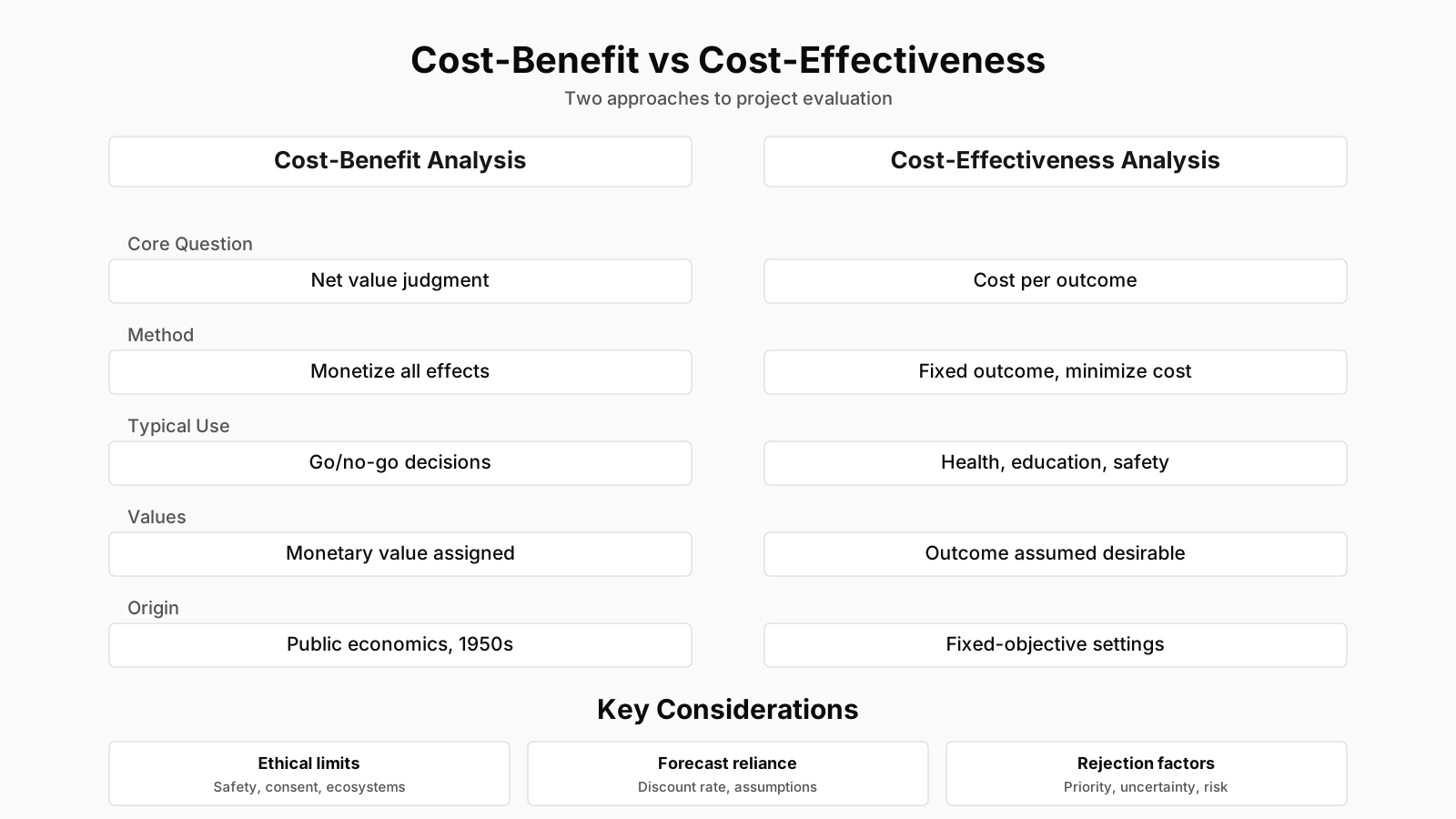
Cost-effectiveness analysis is similar but compares interventions with the same outcome. It identifies the least cost way to achieve a defined result, without assigning a monetary value to the outcome itself. If a regulator requires a certain emission reduction, cost-effectiveness analysis can compare alternative technologies, while cost-benefit analysis might ask whether the emission reduction is worth the cost at all.
Payback period indicates how quickly the initial investment is recovered, but it ignores benefits after that point and does not account for the time value of money unless a discounted payback is used. Net present value and internal rate of return are derived from the same discounted cash flow logic that underpins many cost-benefit analyses. Earned value management tracks project cost and schedule performance but does not evaluate whether the expected benefits still justify continuation.
The business case is the document that commonly contains the CBA. Benefits realization management connects the initial analysis to later measurement, ensuring that promised benefits have owners, metrics, and review mechanisms. Value engineering and value analysis look at improving the ratio of function to cost during design and delivery. Portfolio scoring models frequently combine CBA results with strategic alignment and risk to rank competing investments.
Key Insights on CBA Relationships
- CBA broader than ROI
- Cost-benefit analysis integrates monetary and non-monetary factors to produce net present value, benefit-cost ratio, and internal rate of return, whereas ROI simply reports the ratio of net benefits to costs.
- Cost-effectiveness finds least-cost path
- Cost-effectiveness analysis determines the most economical route to a predetermined outcome without assigning a value to that outcome, while cost-benefit analysis evaluates whether the outcome justifies the investment in the first place.
- CBA connects project management tools
- Payback period, discounted cash flow metrics, earned value management, benefits realization management, and portfolio scoring models support cost-benefit analysis by monitoring performance, connecting analytical estimates to actual results, and prioritizing competing investment options.
Evolution and Current Thinking
The evolution of cost-benefit analysis in project management has moved from a purely financial appraisal tool toward a broader value management discipline. Early applications emphasized direct monetary returns, often for capital-intensive and infrastructure projects. Current practice increasingly recognizes intangible benefits, risk-adjusted value, sustainability, and stakeholder preferences as part of the decision.
Debates continue about how to value non-market outcomes such as user experience, knowledge creation, brand equity, or environmental impact. Some methodologies translate these into monetary terms using survey-based or statistical methods. Others avoid monetization and use multi-criteria decision analysis alongside CBA. Neither approach is universally superior. The choice depends on organizational maturity, data availability, and decision context.
Real options thinking has also influenced current practice. Some investments create future opportunities that are difficult to capture in a static CBA. A platform project may look unattractive on its own but enable multiple future initiatives. Practitioners may adjust the analysis by modeling staged decisions, optionality, or strategic flexibility. Portfolio-level CBA can show how projects interact rather than evaluating each in isolation.
Agile and lean traditions have pushed cost-benefit thinking closer to the delivery cycle. The idea is not to abandon formal analysis but to make it more frequent, evidence-based, and collaborative. That shift reflects a broader recognition that cost-benefit analysis is a decision-support tool, not a substitute for judgment, and that the quality of assumptions matters as much as the arithmetic.
Current best practice emphasizes transparency over false precision. Sensitivity analysis, explicit assumptions, independent review, and periodic revalidation are valued more than a single polished spreadsheet. The most useful cost-benefit analyses invite challenge and can be updated as real project data becomes available. In that sense, CBA has become less of a static approval hurdle and more of a continuous reasoning process embedded in project, program, and portfolio governance.